


Global Lithium Ion Battery Cells Market Size, Share, And Industry Analysis Report By Product Type (Cylindrical, Prismatic, Pouch), By Capacity (0 to 3000 mAh, 3000 to 10000 mAh, 10000 to 60000 mAh, Above 60000 mAh), By Application (Consumer Electronics, Automotive, Energy Storage Systems, Others), By Region and Companies - Industry Segment Outlook, Market Assessment, Competition Scenario, Trends, and Forecast 2025-2034
- Published date: December 2025
- Report ID: 168655
- Number of Pages: 358
- Format:
-
keyboard_arrow_up
Quick Navigation
Report Overview
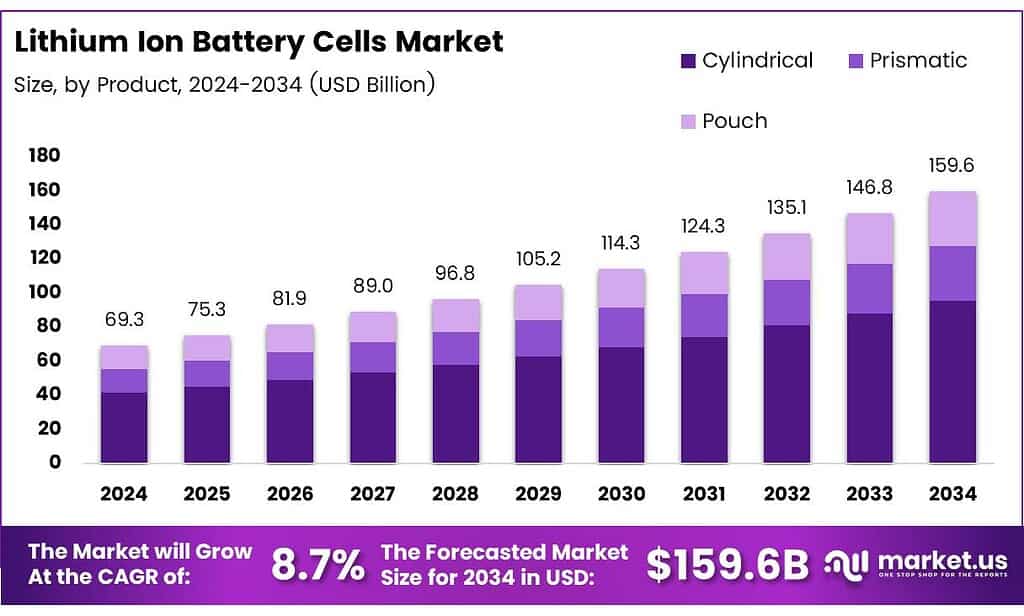
The Global Lithium Ion Battery Cells Market size is expected to be worth around USD 159.6 billion by 2034, from USD 69.3 billion in 2024, growing at a CAGR of 8.7% during the forecast period from 2025 to 2034.
The lithium-ion battery cells market covers the production, trade, and use of rechargeable cells powering electronics, electric vehicles, and energy storage systems. In simple business terms, it connects raw materials, cell manufacturing, and end-use industries. As electrification expands worldwide, this market sits at the centre of mobility and clean-energy transitions.
Lithium-ion battery cells, cells stand out due to performance and reliability advantages. Compared with older technologies, they deliver higher power in compact sizes. This makes them essential for smartphones, laptops, electric vehicles, and stationary storage, while supporting long lifecycle use with limited maintenance requirements.
- Lithium-ion cells achieve energy densities as high as 330 watt-hours per kilogram, compared with roughly 75 watt-hours per kilogram for lead-acid batteries. The U.S. Department of Energy supports this efficiency advantage supports compact, lightweight designs critical for electric vehicles and portable devices. Further strengthening market demand, lithium-ion cells deliver up to 3.6 volts, around 1.5–3 times higher than alternatives, enabling high-power transport applications.
Rechargeable batteries accounted for 45% of lithium demand in 2017, highlighting structural reliance on this technology within energy systems. Supply and investment trends signal strong momentum. Global lithium-ion demand is expected to grow six to seven times by 2026, requiring a battery pipeline roughly twice current levels. To respond, producers plan investments exceeding 150 billion dollars, lifting annual capacity beyond 2 terawatt-hours.
Key Takeaways
- The Global Lithium-ion Battery Cells Market is projected to grow from USD 69.3 billion in 2024 to USD 159.6 billion by 2034, registering an 8.7% CAGR.
- Cylindrical battery cells dominate the product type segment with a market share of 56.2%, supported by standardised design and large-scale manufacturing.
- In terms of capacity, 0 to 3000 mAh cells lead the market, accounting for 38.8% of total demand due to strong use in compact electronic devices.
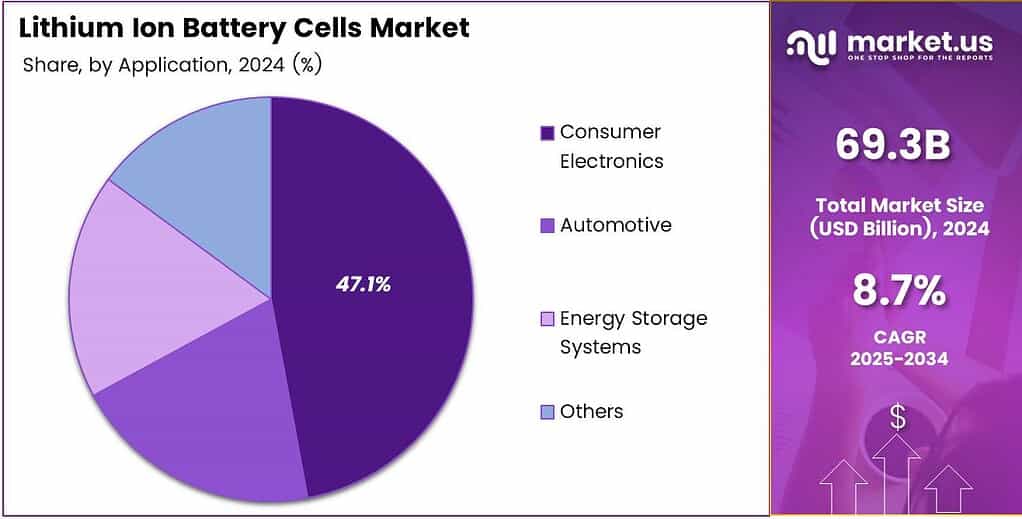
- Consumer electronics is the largest application segment, holding a market share of 47.1%, driven by high replacement cycles and device volume growth.
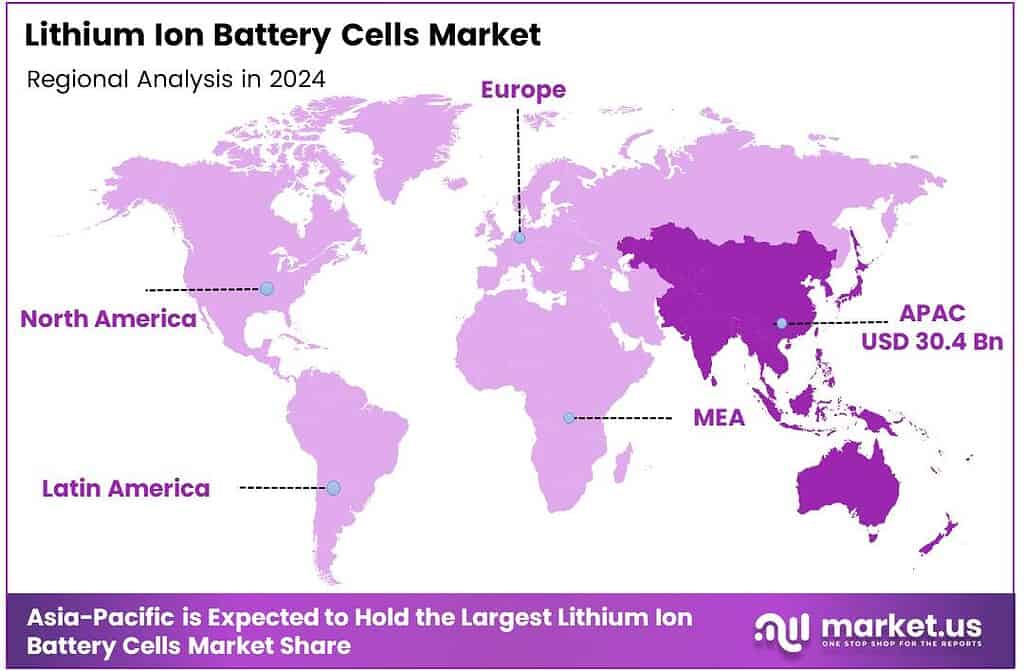
- Asia Pacific is the leading regional market with a share of 43.9%, valued at USD 30.4 billion, supported by large-scale battery manufacturing and EV adoption.
By Product Type Analysis
Cylindrical dominates with 56.2% due to mature manufacturing scale and balanced performance.
In 2024, Cylindrical held a dominant market position in the By Product Type Analysis segment of the Lithium Ion Battery Cells Market, with a 56.2% share. This dominance is driven by standardised formats, reliable thermal stability, and cost-efficient mass production. Manufacturers prefer cylindrical cells for consistency and long production runs.
Prismatic cells continue to gain attention due to their compact rectangular shape and efficient space utilisation. Therefore, they are widely used where design flexibility and higher energy per unit footprint matter. Although production costs remain higher, steady improvements in safety design support broader adoption across premium electronic and automotive platforms.
Pouch cells offer lightweight construction and flexible form factors, which improve overall device ergonomics. Consequently, they are favoured in slim consumer electronics and next-generation mobility solutions. However, sensitivity to mechanical stress and packaging complexity still limits expansion compared to cylindrical and prismatic alternatives.
By Capacity Analysis
0 to 3000 mAh dominates with 38.8% owing to strong demand from compact devices.
In 2024, 0 to 3000 mAh held a dominant market position in the By Capacity Analysis segment of the Lithium Ion Battery Cells Market, with a 38.8% share. This range benefits from widespread use in smartphones, wearables, and portable electronics. Moreover, high shipment volumes reinforce scale advantages for manufacturers.
3000 to 10000 mAh capacity cells are increasingly used in tablets, power banks, and light mobility devices. Consequently, demand grows steadily as consumers expect longer usage times. Manufacturers focus on energy density improvements to balance runtime, safety, and compact packaging across mid-capacity applications.
10000 to 60000 mAh batteries support power tools, backup systems, and select mobility platforms. Therefore, these cells emphasise durability and discharge stability. Growth remains application-driven, with designs optimised for repeated cycling and consistent performance under variable load conditions.
By Application Analysis
Consumer Electronics dominates with 47.1% due to continuous device replacement cycles.
In 2024, Consumer Electronics held a dominant market position in the By Application Analysis segment of the Lithium Ion Battery Cells Market, with a 47.1% share. Strong demand stems from smartphones, laptops, and wearables. Frequent upgrades and short product lifecycles consistently sustain high battery replacement volumes.
Automotive applications continue expanding as electric mobility adoption accelerates. Therefore, the battery cells used here prioritise safety, long cycle life, and fast charging. Automakers increasingly collaborate with cell suppliers to secure stable supply chains and tailored battery designs.
Energy Storage Systems rely on lithium-ion cells for grid balancing and renewable integration. Consequently, these applications demand long-term reliability and high efficiency. While volumes are lower than automotive, system-scale deployments create stable, contract-driven demand patterns.
Key Market Segments
By Product Type
- Cylindrical
- Prismatic
- Pouch
By Capacity
- 0 to 3000 mAh
- 3000 to 10000 mAh
- 10000 to 60000 mAh
- Above 60000 mAh
By Application
- Consumer Electronics
- Automotive
- Energy Storage Systems
- Others
Emerging Trends
Advanced Battery Chemistry Shapes Lithium-Ion Battery Cells Market Trends
One key trend in the lithium-ion battery cells market is the shift toward advanced battery chemistries. Manufacturers are focusing on formulas that improve safety, reduce reliance on rare materials, and extend battery life. This trend supports both electric vehicles and energy storage use.
- Fast-charging technology is another major trend. Consumers expect shorter charging times, pushing companies to develop cells that can charge quickly without reducing lifespan. This directly improves user experience and market acceptance. The International Energy Agency (IEA), LFP batteries accounted for over 40% of global EV battery demand, compared with less than 10%.
Finally, digital battery management systems are gaining importance. Smart monitoring improves performance, safety, and predictive maintenance. From an analyst perspective, these trends show the market is moving toward safer, smarter, and more sustainable lithium-ion battery solutions.
Drivers
Rising Electric Vehicle Adoption Drives Lithium-Ion Battery Cells Market Growth
The lithium-ion battery cells market is mainly driven by the fast growth of electric vehicles across the world. Governments are promoting electric mobility to reduce fuel imports and lower emissions. Automakers are increasing investments in battery production, which directly raises demand for reliable lithium-ion cells.
- Solar and wind power need efficient energy storage to manage supply variations. Lithium-ion battery cells are widely used in energy storage systems because they offer high energy density and long cycle life, making them suitable for grid and residential storage. The United States Department of Energy (DOE) allocated USD 3.5 billion under its Battery Materials Processing and Manufacturing program to strengthen domestic battery supply chains.
Consumer electronics also support market growth. Smartphones, laptops, tablets, and wearable devices continue to rely on lithium-ion battery cells due to their lightweight design and stable performance. Rising digital lifestyles keep this demand steady.
Restraints
High Raw Material Risk Limits Lithium-Ion Battery Cells Market Expansion
One major restraint in the lithium-ion battery cells market is uncertainty in raw material supply. Key inputs such as lithium, cobalt, and nickel face price volatility and supply concentration. Any disruption in mining or trade can affect battery production costs and timelines.
Safety concerns also act as a restraint. Lithium-ion battery cells can overheat or catch fire if damaged or improperly designed. This creates strict safety and regulatory requirements, which increase development and compliance costs for manufacturers.
Environmental and recycling challenges further slow market growth. Battery disposal and recycling systems are still developing in many regions. Without proper recycling infrastructure, waste management becomes difficult, raising environmental concerns.
Growth Factors
Grid Storage And Local Manufacturing Create Strong Growth Opportunities
The lithium-ion battery cells market offers strong growth opportunities through grid-scale energy storage projects. As renewable energy capacity increases, utilities need reliable storage solutions to stabilise the power supply. Lithium-ion cells are well-suited for this role, creating long-term demand.
- Many countries are encouraging domestic battery production to reduce import dependence. Supportive policies, incentives, and partnerships open new doors for regional manufacturers and technology providers. The International Renewable Energy Agency (IRENA) reports that global stationary battery storage capacity exceeded 70 GW in 2023, with lithium-ion technology dominating new installations.
Battery recycling and second-life applications also present opportunities. Used electric vehicle batteries can be reused for stationary energy storage, extending product life and improving sustainability. This reduces waste and lowers overall system costs. Improvements in energy density, charging speed, and lifespan make lithium-ion cells more attractive across industries.
Regional Analysis
Asia Pacific Dominates the Lithium-Ion Battery Cells Market with a Market Share of 43.9%, Valued at USD 30.4 billion
Asia Pacific leads the lithium-ion battery cells market due to its strong manufacturing ecosystem and rapid scale-up of battery production capacities. Asia Pacific accounted for 43.9% of the global market, representing a valuation of USD 30.4 billion, driven by high demand from electric mobility and energy storage applications. Supportive industrial policies and expanding export capabilities further reinforce regional dominance.
North America shows steady growth supported by rising investments in domestic battery manufacturing and energy storage projects. The region focuses strongly on supply chain security and localised production to support electric vehicles and grid-scale storage. Increasing emphasis on clean energy transitions and advanced battery research contributes to consistent market expansion. Demand is also strengthened by strong consumer preference for electric mobility solutions.
Europe’s lithium-ion battery cells market is shaped by strict emission regulations and sustainability goals. The region prioritises low-carbon battery production and recycling-driven value chains. Strong policy alignment with renewable energy integration supports stable demand growth. Europe continues to invest in innovation-led manufacturing models to reduce reliance on imports.
Latin America shows moderate but consistent adoption of lithium-ion battery cells, driven by growing renewable energy projects and urban electrification. Energy storage systems are increasingly used to stabilise the power supply in remote and industrial areas. The region’s expanding electric mobility initiatives support future demand.
Key Regions and Countries
North America
- US
- Canada
Europe
- Germany
- France
- The UK
- Spain
- Italy
- Rest of Europe
Asia Pacific
- China
- Japan
- South Korea
- India
- Australia
- Rest of APAC
Latin America
- Brazil
- Mexico
- Rest of Latin America
Middle East & Africa
- GCC
- South Africa
- Rest of MEA
Key Players Analysis
Tesla, Inc. plays a dual role as both a leading EV manufacturer and an influential cell technology integrator. Through close collaboration with cell partners and its own in-house initiatives, Tesla focuses on high-energy-density chemistries and cost reduction. The company’s vertical integration strategy strengthens its negotiating power in the lithium-ion cell supply chain and shapes performance benchmarks for automotive cells.
Panasonic Corporation remains a key strategic supplier of high-performance cylindrical cells, particularly for premium electric vehicles. Its long partnership with Tesla has helped it refine cell reliability, safety, and manufacturing efficiency at scale. Panasonic’s emphasis on incremental chemistry improvements and yield optimisation positions it as a stable, technology-driven player in a market facing intense cost pressure.
LG Chem Ltd. (through LG Energy Solution) has built a diversified portfolio across automotive, consumer electronics, and stationary storage. The company’s strength lies in balancing advanced NMC chemistries with growing LFP capabilities, allowing it to serve both high-performance and cost-sensitive segments. Its global manufacturing footprint and long-term supply contracts with major OEMs underpin a strong growth pipeline in 2024.
Samsung SDI Co., Ltd. focuses on premium, high-value applications where energy density, cycle life, and safety are critical. The company invests heavily in next-generation cells for performance EVs and grid storage projects, often targeting higher margins rather than pure volume. Its strategy of technology leadership, robust quality control, and selective partnerships positions Samsung SDI as a preferred supplier for OEMs seeking differentiated battery performance and long-term innovation support.
Top Key Players in the Market
- Tesla, Inc.
- Panasonic Corporation
- LG Chem Ltd.
- Samsung SDI Co., Ltd.
- BYD Company Limited
- Contemporary Amperex Technology Co. Limited (CATL)
- A123 Systems LLC
- SK Innovation Co., Ltd.
- GS Yuasa Corporation
- Saft Groupe S.A.
- Hitachi Chemical Co., Ltd.
Recent Developments
- In 2025, Tesla is on track to begin U.S.-based production of its first Lithium Iron Phosphate (LFP) cells for energy storage products like Powerwall and Megapack later. This initiative aims to onshore critical battery materials, reducing reliance on imports and supporting grid-scale storage growth.
- In 2025, Panasonic began operations at its new De Soto, Kansas, facility, the largest economic development project in state history. In a move to enhance safety and production scale, Panasonic extended its agreement with H&T Recharge for lithium-ion battery cans, supplying capacity for both Nevada.
Report Scope
Report Features Description Market Value (2024) USD 69.3 billion Forecast Revenue (2034) USD 159.6 billion CAGR (2025-2034) 8.7% Base Year for Estimation 2024 Historic Period 2020-2023 Forecast Period 2025-2034 Report Coverage Revenue Forecast, Market Dynamics, Competitive Landscape, Recent Developments Segments Covered By Product Type (Cylindrical, Prismatic, Pouch), By Capacity (0 to 3000 mAh, 3000 to 10000 mAh, 10000 to 60000 mAh, Above 60000 mAh), By Application (Consumer Electronics, Automotive, Energy Storage Systems, Others) Regional Analysis North America (US and Canada), Europe (Germany, France, The UK, Spain, Italy, and Rest of Europe), Asia Pacific (China, Japan, South Korea, India, Australia, and Rest of APAC), Latin America (Brazil, Mexico, and Rest of Latin America), Middle East & Africa (GCC, South Africa, and Rest of MEA) Competitive Landscape Tesla, Inc., Panasonic Corporation, LG Chem Ltd., Samsung SDI Co., Ltd., BYD Company Limited, Contemporary Amperex Technology Co. Limited (CATL), A123 Systems LLC, SK Innovation Co., Ltd., GS Yuasa Corporation, Saft Groupe S.A., Hitachi Chemical Co., Ltd. Customization Scope Customisation for segments, region/country-level will be provided. Moreover, additional customisation can be done based on the requirements. Purchase Options We have three licenses to opt for: Single User License, Multi-User License (Up to 5 Users), Corporate Use License (Unlimited Users and Printable PDF)  Lithium Ion Battery Cells MarketPublished date: December 2025add_shopping_cartBuy Now get_appDownload Sample
 -
-
- Tesla, Inc.
- Panasonic Corporation
- LG Chem Ltd.
- Samsung SDI Co., Ltd.
- BYD Company Limited
- Contemporary Amperex Technology Co. Limited (CATL)
- A123 Systems LLC
- SK Innovation Co., Ltd.
- GS Yuasa Corporation
- Saft Groupe S.A.
- Hitachi Chemical Co., Ltd.
Our Clients

- 168655
- December 2025






