


Report Overview
In 2025, the Global Laptop Screen Extender Market was valued at USD 207.6 million. The market is projected to grow at a CAGR of 10.2% during 2026–2035, reaching approximately USD 548.6 million by 2035. North America dominated the global market in 2025, accounting for more than 39.6% of the total market share and generating approximately USD 82.19 million in revenue.
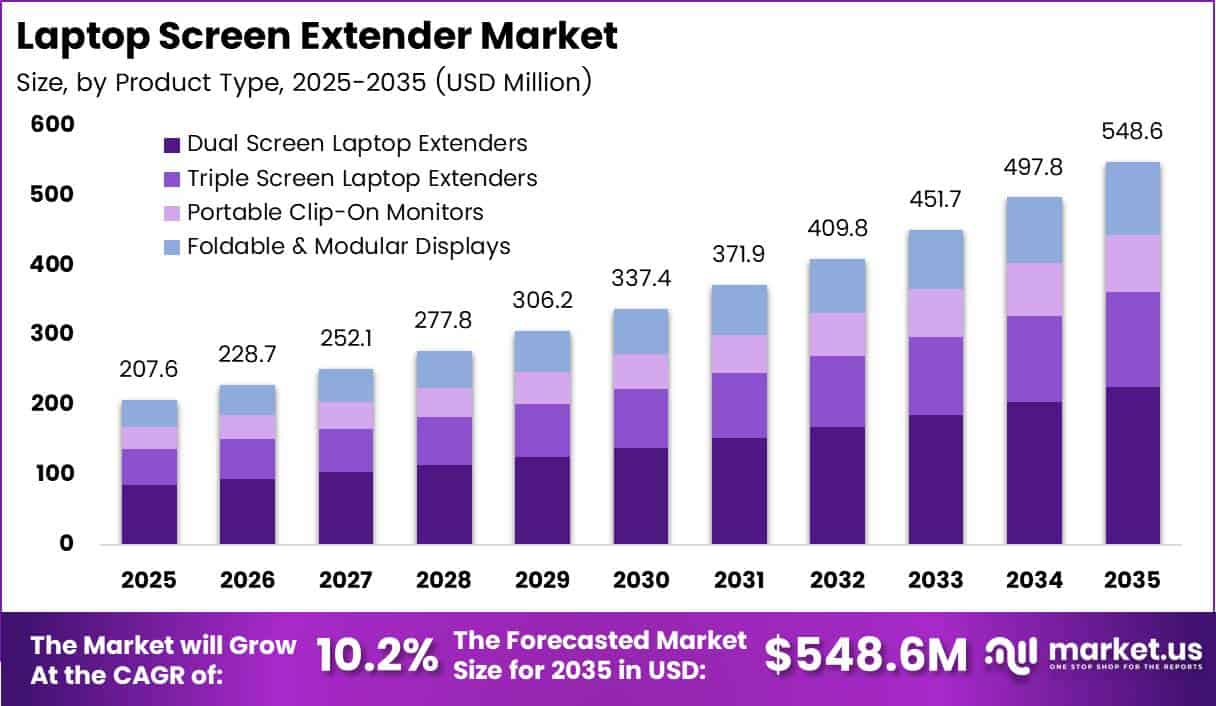
This expansion is supported by the continued rise of remote and hybrid working, increasing laptop deployment, and stronger demand for productivity tools across knowledge-based industries. According to the U.S. Bureau of Labor Statistics, the share of employed adults working remotely increased from 21.5% in early 2023 to 24.9% in early 2024.
This represented around 34.0 million remote workers aged 25 and above. In the fourth quarter of 2024, approximately 23.4% of employed people worked remotely, equal to 36.7 million individuals. Professionals working from home for 2 or more days per week increasingly require additional screens to manage office applications, communication platforms, and data dashboards efficiently.
North America region benefits from a large installed base of laptops, frequent device replacement, and strong adoption of digital and AI-enabled technologies. International Data Corporation estimated that global PC shipments reached 284.7 million units in 2025, increasing by 8.1% from 2024.
Shipments were also expected to record 4.3% year-over-year growth as organizations replaced devices before Windows 10 support ended and adopted AI-ready systems. These upgrades create additional demand for USB-C portable monitors and triple-screen extenders, supporting sustained market growth through 2035.
Key Takeaway
- The Laptop Screen Extender Market reached USD 207.6 million in 2025 and is projected to grow at a 10.2% CAGR to USD 548.6 million by 2035.
- Dual-screen laptop extenders dominated with a 41.2% share due to their balanced productivity, portability, weight, and price.
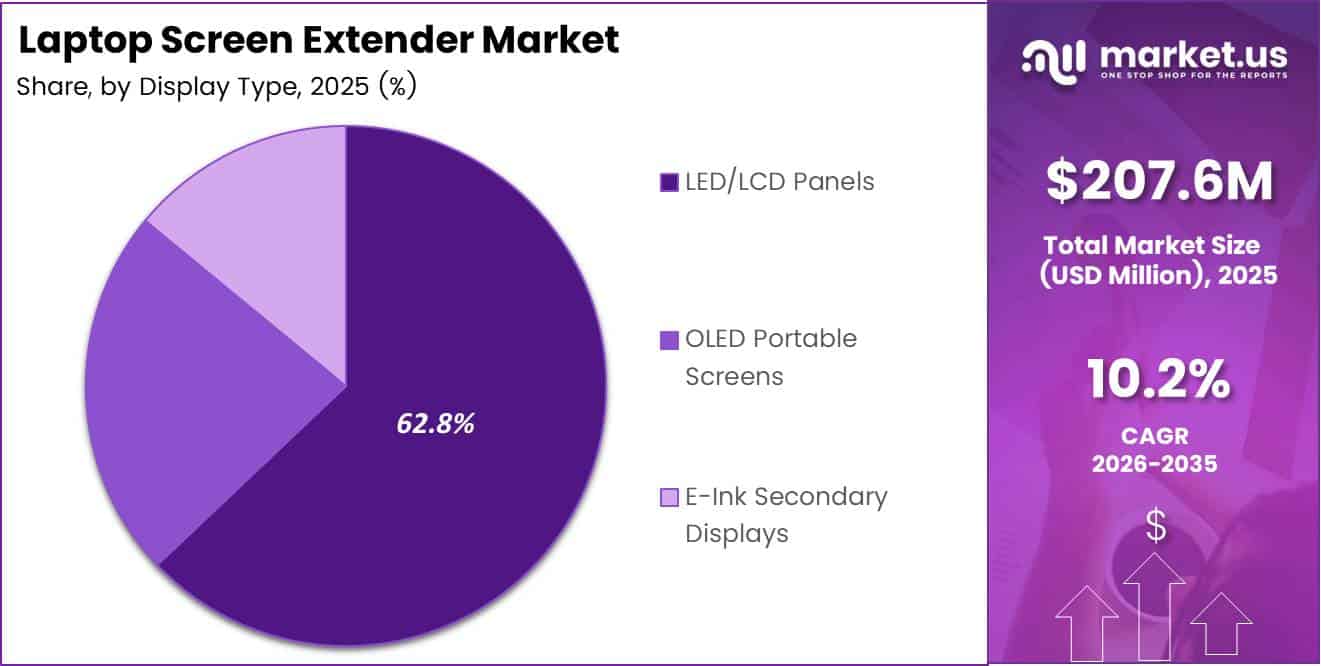
- LED/LCD panels accounted for 62.8% of the market, supported by affordable pricing, durability, and established production capacity.
- The 13–15 inch segment held a 48.1% share because it matches standard laptop sizes and remains convenient for travel.
- USB-C connectivity led with a 54.60% share by enabling power, video, and data transfer through a single cable.
- Remote work and productivity applications captured 46.7% of the market as professionals increasingly adopted multi-screen digital workspaces.
- Individual professionals represented 52.3% of demand due to strong independent purchasing of portable productivity accessories.
- Online retail dominated distribution with a 71.4% share because it enables easy product comparison, wider selection, and convenient delivery.
- Mid-range extenders priced between USD 150 and USD 400 held a 49.80% share by offering a practical balance of cost, quality, and performance.
- North America led the market with a 39.6% share, generating approximately USD 82.19 million in 2025.
By Product Type
Dual-screen laptop extenders held a leading 41.2% share, supported by their practical balance of productivity, weight, portability, and price. These devices are widely preferred by professionals and students because one additional display is usually enough to manage email, collaboration tools, spreadsheets, presentations, and analytical dashboards alongside the main laptop screen.
According to ILOSTAT, global employment reached approximately 3.5 billion people in 2023, with a growing proportion working in service and knowledge-based industries that rely heavily on digital tools. This large user base supports higher sales volumes for dual-screen models, as they remain more affordable and easier to carry than advanced alternatives.
By Display Type
LED/LCD panels held a dominant 62.8% share of the laptop screen extender market, supported by their low cost, mature manufacturing base, durability, and wide availability. These panels allow manufacturers to produce lightweight and reliable screen extenders at prices suitable for students, professionals, and corporate buyers.
Large-area LCDs measuring 9 inches and above were projected to generate approximately USD 74.2 billion in revenue in 2024. Unit shipments increased by 7.4% year over year, while the total display area shipped grew by 11.1%. This large production scale reduces manufacturing costs and keeps LED/LCD panels affordable, making them the preferred option for buyers who value price and reliability over premium display performance.
OLED panels are the fastest-growing display type because they offer higher contrast, deeper blacks, thinner designs, and improved visual quality. OLED panel shipments increased by 32% year over year in Q3 2024, supported by strong demand across smartphones, televisions, monitors, notebook computers, and tablets. Wider OLED adoption is also increasing user expectations for portable extender screens.
By Screen Size
The 13–15 inch laptop screen extender segment held a leading 48.1% share because it closely matches the standard notebook sizes used by professionals, students, and frequent travelers. This screen range provides enough workspace for multitasking while remaining easy to carry in regular laptop bags. Most airlines allow carry-on bags measuring around 22 × 14 × 9 inches, and portable monitors between 13 and 15 inches generally fit within these limits.
This makes them suitable for daily commuting, business travel, hybrid work, and client meetings without requiring separate cases or checked baggage. Their compatibility with widely used laptop sizes also encourages corporate IT teams and individual buyers to select these models.
The 15–17 inch segment is expected to record the fastest growth because larger displays support more complex visual tasks. Professionals working in engineering, financial trading, media production, architecture, and design require additional screen space to view charts, timelines, editing tools, and CAD models clearly. Portable monitors measuring up to 17 inches can also remain within common cabin baggage limits when packed properly, supporting stronger adoption without significantly reducing mobility.
By Connectivity Type
USB-C connectivity held a leading 54.60% share of the laptop screen extender market because it allows power, data, and video transmission through a single cable. Its growing use across laptops, tablets, and smartphones has made USB-C the preferred option for users seeking simple installation and fewer adapters.
The European Union’s common-charger rules require most new portable electronic devices sold in the region to adopt USB-C from late 2024, while laptops are included from 2026. The regulation covers mobile phones, tablets, digital cameras, handheld gaming consoles, and other portable devices. As hundreds of millions of compatible products are shipped each year, demand for USB-C screen extenders continues to increase.
Wireless connectivity, including Wi-Fi and DisplayLink, is the fastest-growing segment because it supports flexible and cable-free multi-screen setups. The Wi-Fi Alliance forecasts that 4.1 billion Wi-Fi devices would be shipped in 2024, while 21.1 billion devices would be in use worldwide. It also expected shipments of 807.5 million devices supporting 6 GHz Wi-Fi and 576.2 million Wi-Fi 6E devices in 2024. These technologies improve bandwidth, reduce latency, and support stable video transmission.
By Application
Remote work and productivity applications held a leading 46.7% share of the laptop screen extender market. This dominance is supported by the expansion of knowledge-based employment and the growing use of digital tools across daily work activities. The International Labour Organization estimates that service industries account for over half of global employment and around two-thirds of global GDP.
Professional services, finance, information and communication technology, and public-sector roles depend heavily on laptops, communication platforms, spreadsheets, and analytical dashboards. Global PC shipments also exceeded 270 million units in 2025, rising by 9.1% from 2024, as organizations upgraded operating systems and adopted AI-enabled devices.
Gaming and entertainment is the fastest-growing application segment. Global gaming revenue was estimated at more than USD 184 billion in 2024, supported by increasing participation in online gaming, video streaming, and digital content consumption. Gamers and streamers use portable monitors to separate gameplay from chat, expand viewing space, display streaming controls, or share content. Thin designs, portability, and low-latency performance make laptop screen extenders suitable for these activities, supporting faster adoption despite productivity applications remaining the largest segment.
By End User
Individual professionals held a leading 52.3% share of the laptop screen extender market because they form the largest group of users purchasing productivity accessories independently. According to the International Labour Organization, global employment reached approximately 3.4 billion people in 2023, with a growing proportion working in service and high-skill occupations where laptops are widely used.
Freelancers, consultants, remote employees, designers, finance professionals, media workers, and IT specialists often require additional screen space for coding, communication, dashboards, and content creation. Since many of these users do not have access to fixed multi-monitor office setups, portable screen extenders offer a practical and affordable way to improve their workspace.
Corporate enterprises are the fastest-growing end-user segment, supported by large-scale laptop replacement programs linked to Windows 10 end-of-support and Windows 11 adoption. Gartner reported that global PC shipments exceeded 270 million units in 2025, increasing by 9.1% compared with 2024. As companies upgrade their device fleets and adopt AI-ready hardware, screen extenders can be added as standardized accessories at a relatively small cost within overall IT budgets.
By Distribution Channel
Online retail, or e-commerce, held a dominant 71.4% share of laptop screen extender sales because these products are easy to search, compare, and purchase through digital platforms. Buyers can review models based on screen size, connectivity, price, brand, and customer ratings before making a decision. According to UNCTAD, global e-commerce sales, including business-to-consumer and business-to-business transactions, exceeded USD 26.7 trillion in recent years.
The growing use of online channels for electronics and ICT products allows individual professionals and small businesses to access a wider product range, competitive pricing, and convenient home or office delivery. These advantages have made multi-brand online marketplaces the main sales channel for laptop screen extenders.
Direct brand sales are the fastest-growing distribution channel as laptop and monitor manufacturers expand their own online stores and authorized partner networks. Global PC shipments reached approximately 278.7 million units in 2025, increasing by 9.1% from 2024. Major brands such as Lenovo, HP, Dell, Apple, and Asus are promoting portable monitors and screen extenders through integrated workspace and creator-focused bundles. Direct sales also help vendors improve margins, strengthen customer loyalty, and connect accessories with laptop replacement programs and corporate purchasing agreements.
By Price Range
Mid-range laptop screen extenders priced between USD 150 and USD 400 held a leading 49.80% share because they offer a practical balance between cost, performance, and build quality. This price range is affordable for many professionals and small businesses that want to improve productivity without investing in premium equipment.
In advanced economies, average annual labour costs per employee often exceed USD 50,000, while costs in upper-middle-income countries generally range from USD 15,000 to USD 30,000. Therefore, the price of a mid-range extender can be recovered through small improvements in working time, fewer delays, and reduced switching between applications. Buyers in this category usually look for reliable panels, USB-C connectivity, portability, and durable construction.
Premium laptop screen extenders priced above USD 400 are the fastest-growing segment. These products are mainly adopted by professionals working in design, engineering, trading, gaming, and content creation. Features such as 4K resolution, OLED panels, wider colour coverage, and faster response times can improve visual accuracy and workflow speed. Global PC shipments exceeded 270 million units in 2025, while AI-enabled laptops gained wider adoption. This trend is encouraging high-income users and enterprises to pair advanced laptops with premium screen extenders.
Key Market Segments
By Product Type
- Dual Screen Laptop Extenders
- Triple Screen Laptop Extenders
- Portable Clip-On Monitors
- Foldable & Modular Displays
By Display Type
- LED/LCD Panels
- OLED Portable Screens
- E-Ink Secondary Displays
By Screen Size
- 13–15 Inch Extenders
- 15–17 Inch Extenders
- Below 13 Inch Ultra-Portable Screens
By Connectivity Type
- USB-C Connectivity
- HDMI Connectivity
- Wireless (Wi-Fi/DisplayLink)
By Application
- Remote Work & Productivity
- Gaming & Entertainment
- Financial Trading & Analytics
- Creative Design & Editing
By End User
- Individual Professionals
- Corporate Enterprises
- Students & Educational Institutions
- Digital Nomads & Freelancers
By Distribution Channel
- Online Retail (E-commerce)
- Offline Electronics Stores
- Direct Brand Sales
By Price Range
- Mid-Range Devices ($150–$400)
- Premium Devices ($400+)
- Budget Devices (<$150)
Geopolitical Impact Analysis
Geopolitical tensions are increasing the cost and supply risk of important components used in laptop screen extenders, including LCD and OLED panels, driver ICs, memory, power-management chips, printed circuit boards, and aluminium housings. The US–China trade conflict has raised average bilateral tariffs to around 16–17%, while selected electronics and semiconductor equipment face additional duties of up to 25%. These tariffs increase production and import costs for extenders assembled in East Asia and sold in North America or Europe, especially when components cross international borders several times during manufacturing.
Shipping disruption in the Red Sea and Bab el-Mandeb is creating further pressure. Carriers rerouting around the Cape of Good Hope can add up to 17 days to Asia–Europe delivery schedules. For portable displays produced in China, South Korea, or Taiwan, delays of 2–3 weeks increase distributor lead times, inventory expenses, and working-capital requirements. These additional costs can result in higher wholesale and retail prices.
Energy and freight volatility also affect market profitability. Brent crude prices have exceeded USD 100 per barrel during major supply disruptions, while container freight rates have recorded double-digit percentage increases during peak periods. A 10–20% rise in freight costs can significantly reduce margins on mid-range extenders, encouraging manufacturers to increase prices or move production closer to major markets.
At the same time, friend-shoring and semiconductor export controls are pushing companies to adopt multi-country sourcing. However, establishing new suppliers, production tools, and quality approvals requires additional investment and can temporarily increase operating costs and component lead times.
Regional Analysis
North America held a dominant 39.6% share of the global laptop screen extender market, generating approximately USD 82.1 million in 2025. The region benefits from high laptop ownership, strong IT spending, and the early adoption of remote and hybrid working models. In 2024, North America accounted for more than 37.4% of global laptop screen extender revenue and generated around USD 1.0 billion within the narrower portable monitor segment.
This performance highlights the strong regional preference for flexible multi-screen workstations. The United States, with GDP per capita of approximately USD 81,000, supports demand through its large population of knowledge workers, freelancers, technology professionals, and enterprises. High corporate technology budgets, developed e-commerce channels, frequent laptop replacement cycles, and the presence of major device manufacturers also strengthen regional sales.
Asia-Pacific is expected to be the fastest-growing regional market due to the expansion of laptop and monitor ownership, improving incomes, and the increasing adoption of mobile working practices. The regional computer monitor market is projected to grow at approximately 5.5% CAGR. In addition, the Asia-Pacific refurbished laptop market is expected to reach USD 4.2 billion by 2035, expanding at around 6.2% CAGR.
This growing installed base creates more opportunities for laptop screen extender sales. Small businesses, students, remote employees, and independent professionals are increasingly selecting affordable portable displays instead of fixed desktop monitor setups. As a result, unit demand in Asia-Pacific is expected to rise faster than in mature regions, although North America is likely to remain the largest revenue-generating market over the medium term.
Key Regions and Countries
North America
- US
- Canada
Europe
- Germany
- France
- The UK
- Spain
- Italy
- Rest of Europe
Asia Pacific
- China
- Japan
- South Korea
- India
- Australia
- Rest of APAC
Latin America
- Brazil
- Mexico
- Rest of Latin America
Middle East & Africa
- GCC
- South Africa
- Rest of MEA
Market Dynamics
Drivers
| Driver | (~) % CAGR | Geographic Relevance | Impact Timeline |
|---|---|---|---|
| Hybrid & remote work normalization | +3.0% | North America, Europe, Asia-Pacific | Short term (≤ 2 years) |
| USB-C native laptop ecosystems | +2.0% | EU, India, North America, East Asia | Medium term (2–4 years) |
| Productivity-focused knowledge workers | +1.5% | Global urban centers | Short term (≤ 2 years) |
| Gaming & creator multi-screen setups | +1.2% | North America, Europe, East Asia | Medium term (2–4 years) |
| Advances in thin, lightweight displays | +0.9% | Global manufacturing hubs | Long term (≥ 4 years) |
| Corporate mobility & BYOD policies | +0.6% | Multinational enterprises | Medium term (2–4 years) |
Hybrid & remote work normalization
The rapid normalization of hybrid and remote work since 2020 has structurally increased the number of professionals who rely on laptops as their primary compute device, making multi-screen productivity accessories like laptop screen extenders a mainstream requirement rather than a niche add-on.
In leading digital economies, between roughly 25% and 40% of full-time employees now operate in hybrid or fully remote models, translating into tens of millions of knowledge workers who can realize productivity gains of 15%–30% when moving from one to two or three displays, according to enterprise IT productivity studies.
At the business model level, this has shifted demand from occasional home use to always-on, work-critical equipment, pushing OEMs and peripheral brands to prioritize slim, sub-1.5 kg, bus-powered extenders that can be bundled with laptops in corporate refresh cycles of roughly 3–4 years, and driving attach-rate targets in some enterprise accounts toward the high single digits as a share of new laptop deployments.
This dynamic supports a meaningful incremental uplift of around +3.0 percentage points to the baseline market CAGR, as both B2C and B2B channels deepen penetration in segments like software development, financial services, and distributed customer support teams that collectively account for a sizable portion of global remote-capable roles.
Restraints
| Restraint | (~) % CAGR | Geographic Relevance | Impact Timeline |
|---|---|---|---|
| Price sensitivity vs. laptop ASPs | -2.2% | Emerging markets, cost-conscious segments | Short term (≤ 2 years) |
| Limited retail visibility & education | -1.4% | Global, especially offline-heavy markets | Short term (≤ 2 years) |
| Port, power, and device compatibility gaps | -1.3% | Global multi-brand laptop base | Medium term (2–4 years) |
| Corporate IT procurement conservatism | -1.1% | Large enterprises, regulated sectors | Medium term (2–4 years) |
| Ergonomics and safety concerns | -0.8% | North America, EU, developed Asia | Medium term (2–4 years) |
| Customs duties on finished electronics | -0.7% | South Asia, Latin America, Africa | Long term (≥ 4 years) |
Price sensitivity vs. laptop ASPs
In many price-sensitive markets, laptop screen extenders compete directly with core device upgrades for limited household and small-business budgets, creating a structural ceiling on near-term adoption when the accessory can represent roughly 20%–40% of an entry-level laptop’s average selling price.
Household ICT spend data in emerging economies shows that a large share of buyers still prioritizes stretching notebook replacement cycles from about 4 to as much as 6 years, and in that context, a non-essential peripheral that adds no compute power but only screen real estate becomes difficult to justify at ticket sizes equal to several months of broadband bills.
This pricing imbalance compresses retail margins as brands resort to promotional discounts of 10%–25% during peak shopping seasons, while channel partners demand rebates of several percentage points to carry slow-moving SKUs, together reducing the headroom to invest in design differentiation and after-sales support.
The result is an estimated drag of around -2.2 percentage points on the baseline CAGR, as large pockets of demand in emerging regions remain latent until costs fall through scale manufacturing and component cost declines.
Challenges
| Challenge | (~) % CAGR | Geographic Relevance | Mitigation Horizon |
|---|---|---|---|
| Complex multi-OS compatibility | -1.8% | Global | Medium term (2–4 years) |
| Supply chain exposure to panels | -1.6% | East Asia-centric manufacturing | Long term (≥ 4 years) |
| Quality variance in low-cost imports | -1.3% | North America, Europe, Asia-Pacific | Short term (≤ 2 years) |
| Thermal and power management limits | -1.1% | Global performance laptops | Medium term (2–4 years) |
| Channel clutter and product confusion | -0.9% | Online-first markets | Short term (≤ 2 years) |
| E-waste and sustainability pressures | -0.7% | EU, UK, select US states | Long term (≥ 4 years) |
Complex multi-OS compatibility
The heterogeneous mix of laptop operating systems, processor architectures, and port standards creates a structural compatibility challenge that drags on the maximum achievable growth rate even as the market expands. Users routinely run combinations of Windows, macOS, ChromeOS, and various Linux distributions across both x86 and ARM platforms, while hardware interfaces span legacy HDMI and USB-A alongside newer USB-C and Thunderbolt variants, with differing capabilities for DisplayPort Alt Mode and power delivery.
For manufacturers, ensuring reliable plug-and-play performance across this fragmented installed base can require maintaining and testing dozens of firmware branches and driver stacks, pushing engineering and QA costs per active SKU up by an estimated high single-digit percentage and lengthening development cycles by several months.
This friction shows up commercially as elevated return rates in some online channels, where double-digit percentages of dissatisfied buyers cite incompatibility or setup complexity, prompting brands to fund replacement and support costs that can erode unit margins by 3–5 percentage points for affected models. Over the medium term, this recurring complexity is estimated to suppress the market’s potential CAGR by around -1.8 percentage points relative to a fully standardized interface environment, until wider convergence around USB-C and clearer device labeling reduces uncertainty.
Opportunities
| Opportunity | (~) % CAGR | Geographic Relevance | Execution Window |
|---|---|---|---|
| USB-C regulatory harmonization plays | +2.4% | EU, India, other harmonizing markets | Medium term (2–4 years) |
| Enterprise bundles and DaaS add-ons | +2.0% | Global large and mid-size enterprises | Medium term (2–4 years) |
| Creator- and gamer-optimized SKUs | +1.7% | North America, Europe, East Asia | Short term (≤ 2 years) |
| Integrated productivity software and analytics | +1.3% | Knowledge-work hubs | Medium term (2–4 years) |
| Sustainability-certified modular designs | +1.1% | EU, UK, North America | Long term (≥ 4 years) |
| Emerging-market localization and financing | +0.9% | South Asia, Africa, Latin America | Long term (≥ 4 years) |
USB-C regulatory harmonization plays
Upcoming regulatory mandates that standardize USB-C ports across phones, tablets, and laptops in major markets such as the EU and India create a future, not-yet-fully-monetized opportunity for laptop screen extender vendors to design around a single, high-volume interface and lower unit costs through scale.
As EU rules extend USB-C requirements to laptops by around 2026 and India phases in similar obligations for phones and tablets starting mid-2025, with laptops following by the end of 2026, the addressable base of USB-C-native devices will expand by many tens of millions of units annually, reducing the need for multiple cable types and active adapters.
When layered onto subscription-style hardware-as-a-service or warranty-extension upsells, these cost efficiencies can translate into margin expansion of roughly 2–4 percentage points on qualifying SKUs and support an incremental upside of about +2.4 percentage points to the market CAGR versus a counterfactual with continued interface fragmentation, provided vendors move quickly to align roadmaps with the regulatory deadlines.
Key Players Analysis
Tier-1 companies in the laptop screen extender market include Samsung Electronics, LG Electronics, Lenovo, Dell Technologies, HP Inc., ASUS, and AOC. These companies use their global PC, display, retail, and enterprise networks to increase accessory sales. Lenovo’s Intelligent Devices Group generated USD 50.5 billion in FY2024/25, rising 13% year over year. Dell Technologies reported USD 95.6 billion in FY2024 revenue, including USD 52.0 billion from its Client Solutions Group.
HP Inc. recorded USD 62.0 billion in FY2024 revenue, with Personal Systems contributing approximately USD 36.0 billion. Together, Lenovo, Dell, and HP are estimated to represent 25–30% of the global PC-linked extender attachment opportunity. ASUS also reported around TWD 532.4 billion, equivalent to nearly USD 16.7 billion, in consolidated revenue during 2024.
Tier-2 participants, including Mobile Pixels, SideTrak, UPERFECT, Arzopa, InnoView, Lepow, ViewSonic, and GeChic, focus more closely on portable monitors and screen extenders. Their annual revenue generally ranges from tens of millions to low hundreds of millions of dollars. Selected triple-screen models reportedly sell more than 1,000 units per month in the United States.
These companies often introduce several new SKUs each year and rely on contract manufacturing in China and Taiwan. As the market approaches USD 7.1 billion by 2034, Tier-1 companies are expected to lead enterprise and premium sales, while Tier-2 brands compete through lower prices, faster product updates, and specialized designs.
Top Key Players in the Market
- Mobile Pixels
- Lepow
- ASUS
- Lenovo
- Dell Technologies
- ViewSonic
- HP Inc.
- AOC
- LG Electronics
- Samsung Electronics
- Arzopa
- InnoView
- SideTrak
- UPERFECT
- GeChic
Recent Developments
- In January 2026, ViewSonic introduced the VG1457, its first dual-screen portable monitor, at an estimated price of USD 349.9. The system combines 2 × 14-inch WUXGA displays with 1,920 × 1,200 resolution, a 60 Hz refresh rate, 5 viewing modes, and USB-C connectivity. Weighing under 3 pounds, the product marked ViewSonic’s direct expansion into foldable laptop screen extenders.
- In March 2026, LG Display began mass production of the world’s first laptop LCD panel supporting a variable refresh rate from 1 Hz to 120 Hz. The panel provides up to 48% longer battery usage than existing alternatives and was selected for Dell’s premium XPS laptops. LG Display also confirmed plans to begin producing a 1 Hz OLED version in 2027 and target up to a 10% reduction in usage-phase carbon emissions.
- In June 2026, ASUS expanded its ZenScreen portfolio with the Duo MB14FCD and OLED MQ14FCKV. The Duo model combines 2 × 14-inch, 16:10 IPS panels with 1,920 × 1,200 resolution, 100% sRGB coverage and an approximately 20-inch unfolded workspace. The OLED model weighs below 500 grams, offers 90% DCI-P3 coverage, and supports 65-watt USB-C power passthrough.
Report Scope
| Report Features | Description |
|---|---|
| Market Value (2025) | USD 207.6 Million |
| Forecast Revenue (2035) | USD 548.6 Million |
| CAGR (2026-2035) | 10.2% |
| Base Year for Estimation | 2025 |
| Historic Period | 2020-2024 |
| Forecast Period | 2026-2035 |
| Report Coverage | Revenue Forecast, Market Dynamics, Competitive Landscape, Recent Developments |
| Segments Covered | By Product Type (Dual Screen Laptop Extenders, Triple Screen Laptop Extenders, Portable Clip-On Monitors, Foldable & Modular Displays); By Display Type (LED/LCD Panels, OLED Portable Screens, E-Ink Secondary Displays); By Screen Size (13–15 Inch, 15–17 Inch, Below 13 Inch Ultra-Portable Screens); By Connectivity Type (USB-C, HDMI, Wireless (Wi-Fi/DisplayLink)); By Application (Remote Work & Productivity, Gaming & Entertainment, Financial Trading & Analytics, Creative Design & Editing); By End User (Individual Professionals, Corporate Enterprises, Students & Educational Institutions, Digital Nomads & Freelancers); By Distribution Channel (Online Retail, Offline Electronics Stores, Direct Brand Sales); By Price Range (Mid-Range $150–$400, Premium $400+, Budget <$150) |
| Regional Analysis | North America – US, Canada; Europe – Germany, France, The UK, Spain, Italy, Rest of Europe; Asia Pacific – China, Japan, South Korea, India, Australia, Singapore, Rest of APAC; Latin America – Brazil, Mexico, Rest of Latin America; Middle East & Africa – GCC, South Africa, Rest of MEA |
| Competitive Landscape | Mobile Pixels, Lepow, ASUS, Lenovo, Dell Technologies, ViewSonic, HP Inc., AOC, LG Electronics, Samsung Electronics, Arzopa, InnoView, SideTrak, UPERFECT, GeChic |
| Customization Scope | Customization for segments, region/country-level will be provided. Moreover, additional customization can be done based on the requirements. |
| Purchase Options | We have three licenses to opt for: Single User License, Multi-User License (Up to 5 Users), Corporate Use License (Unlimited Users and Printable PDF) |





































