


Report Overview
Global Laminated Busbar Market size is expected to be worth around USD 1.7 Billion by 2035 from USD 0.93 Billion in 2025, growing at a CAGR of 6.0% during the forecast period 2026 to 2035.
The laminated busbar market covers compact, multi-layer electrical interconnect assemblies used to distribute high-current power across industrial, automotive, telecom, aerospace, and renewable energy platforms. These assemblies replace conventional wiring by stacking conductive layers separated by dielectric insulation, reducing parasitic inductance and improving thermal management in dense power electronics environments.
Key Takeaways
- Market size in 2025: USD 0.93 Billion
- Forecast market size by 2035: USD 1.7 Billion
- CAGR (2026 to 2035): 6.0%
- Dominant material segment: Copper with 65.6% share
- Dominant layer type segment: Multi-Layer Laminated Busbars with 60.5% share
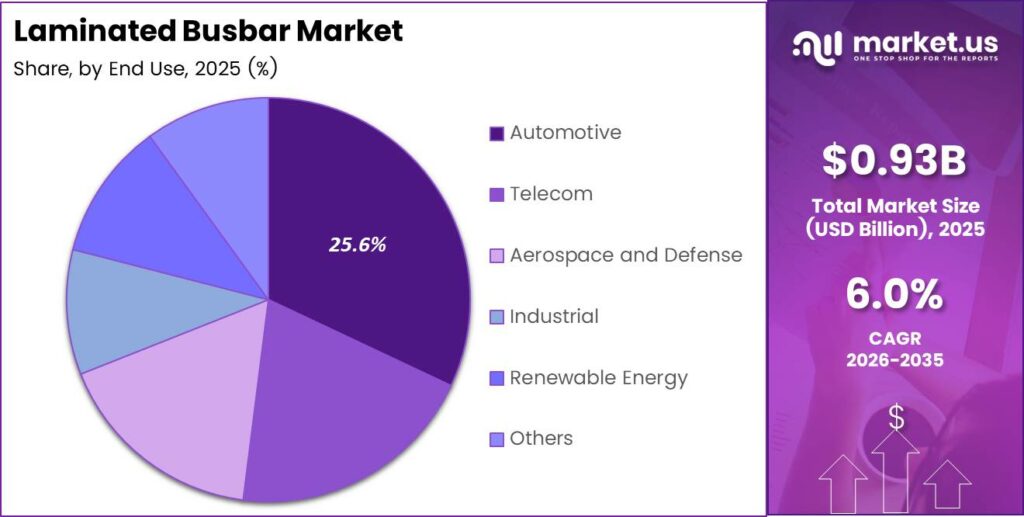
- Dominant end-use industry segment: Automotive with 25.6% share
- Dominant region: Asia Pacific with 40.5% market share
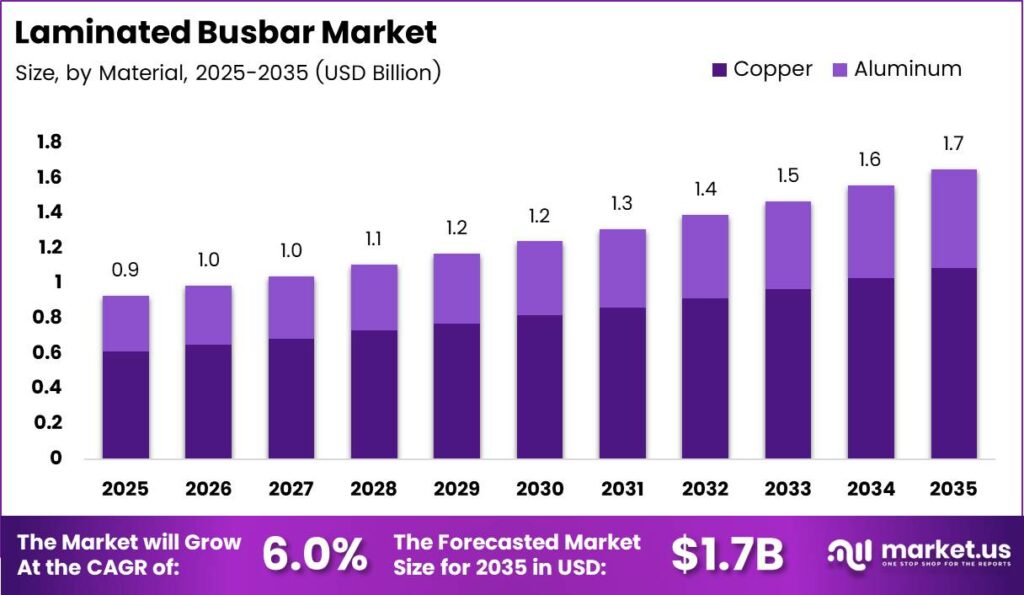
As per our research, the laminated busbar market was estimated at USD 987.47 Million in 2026, supported by EV adoption, renewable energy inverter deployment, and high-density data center power distribution needs. This early-period valuation confirms the market is tracking above its base-year position. Investors can treat 2026 as a reference anchor for modeling near-term revenue benchmarks.
According to IEA data, the total volume of batteries used in the energy sector exceeded 2,400 GWh in 2023, a fourfold increase compared with 2020. This sharp rise in battery deployment scales the required busbar content per installation. Suppliers who build capacity ahead of downstream battery program ramps will capture disproportionate early share. IEA data further shows global battery demand in the energy sector reached 1 TWh in 2024, underscoring the sustained pace of power infrastructure buildout that directly expands laminated busbar addressable volume.
Government policy is reshaping where busbars are made, not just how many are needed. The EU Net-Zero Industry Act targets domestic manufacturing capacity at 40% of annual deployment needs by 2030. US clean-energy guidance continues to reinforce domestic content requirements for inverters and storage systems. Regional suppliers with dual-sourcing footprints in the US, EU, and India gain preferred supplier status in subsidized clean-tech programs.
Material Analysis
Copper dominates with 65.6% due to superior conductivity and thermal management.
In 2025, Copper held a dominant market position in the By Material segment of the Laminated Busbar Market, with a 65.6% share. Copper delivers the lowest resistivity among commercially viable conductor metals, making it the default choice for high-frequency inverter and EV traction applications where thermal losses directly affect system performance. This conductivity advantage creates switching costs that protect copper-focused suppliers from aluminum substitution in premium segments.
Aluminum held the remaining 34.4% share in the material segment. As reported by Mordor Intelligence, transitioning from copper to aluminum in laminated busbar designs provides manufacturers with estimated base-material cost savings of roughly 40%. This cost differential makes aluminum attractive for price-sensitive industrial and renewable energy applications. Vendors offering aluminum-based designs at competitive lead times will capture share in volume-driven procurement programs where conductivity tolerances allow substitution.
Layer Type Analysis
Multi-Layer Laminated Busbars dominate with 60.5% due to superior inductance control in dense power modules.
In 2025, Multi-Layer Laminated Busbars held a dominant market position in the By Layer Type segment of the Laminated Busbar Market, with a 60.5% share. Multi-layer architectures reduce parasitic inductance more effectively than two-layer designs, making them the preferred choice for SiC and GaN power electronics where switching frequencies demand tight electromagnetic control. Mordor Intelligence data shows low-voltage assemblies below 1 kV account for 47.85% of all deployed laminated busbar technology, confirming that volume demand concentrates in the accessible voltage tier where multi-layer designs are most cost-competitive.
Two-Layer Laminated Busbars held the remaining 39.5% share in the layer type segment. These simpler assemblies serve applications where cost control outweighs inductance performance, including legacy industrial switchgear and entry-level energy storage configurations. Two-layer products face margin compression as multi-layer pricing declines, but they retain relevance in markets with less demanding electrical specifications.
End Use Industry Analysis
Automotive dominates with 25.6% due to EV traction inverter and battery pack content requirements.
In 2025, Automotive held a dominant market position in the By End Use Industry segment of the Laminated Busbar Market, with a 25.6% share. IEA data shows electric cars accounted for more than 85% of global EV battery demand in 2024, directly scaling the addressable volume for laminated busbars embedded in traction inverters and battery packs. IndexBox data further shows EV traction inverters and onboard charging systems account for 8% to 12% of global laminated copper busbar consumption, confirming automotive as the most concentrated demand channel.
Renewable Energy held 19.0% share in the end-use segment, making it the second-largest application. IEA reports that utility-scale projects represented 65% of global battery storage additions in 2023, a year when over 40 GW of battery storage was added globally. This concentration in utility-scale deployments translates into high-volume, repeat procurement cycles for laminated busbars used in power conversion and storage systems. Suppliers already qualified with utility developers hold structural advantage in this segment.
Industrial applications held 17.2% share, driven by power distribution upgrades in manufacturing and grid modernization programs. Telecom accounted for 12.2% share, supported by data center and network infrastructure buildout. Aerospace and Defense held 11.0% share, with demand tied to electrified aircraft and defense power systems. The remaining 15.0% fell under Other applications, collectively serving niche power electronics platforms across diverse end markets.
Key Market Segments
By Material
- Copper
- Aluminum
By Layer Type
- Multi-Layer Laminated Busbars
- Two-Layer Laminated Busbars
By End Use Industry
- Automotive
- Telecom
- Aerospace and Defense
- Industrial
- Renewable Energy
- Others
Market Dynamics
Market Opportunity Analysis - Underpenetrated end-use segments and nascent regions offer structured entry points for focused suppliers
The renewable energy segment holds 19.0% of end-use share but remains underpenetrated relative to the pace of global solar-storage and grid BESS deployment. Utility-scale storage projects concentrated in China, the US, India, and Australia represent repeatable, high-volume procurement cycles. Suppliers who achieve early qualification with utility-scale battery integrators in these markets secure long-duration revenue visibility that commodity-driven competitors cannot easily replicate.
The Industrial segment holds 17.2% end-use share and serves grid modernization and electrification retrofit programs. This segment receives comparatively less supplier focus than automotive, leaving pricing discipline intact for specialists who invest in application-specific busbar designs for motor drives, switchgear, and industrial UPS platforms. Consequently, industrial-segment suppliers face fewer direct competitors at the application engineering level than in automotive or telecom channels.
Latin America and the Middle East and Africa remain import-dependent markets with no established domestic busbar manufacturing base. Renewable energy project pipelines in Brazil and GCC states create traceable early-stage demand anchor points. Suppliers who enter these regions as qualified partners to project developers bypass the traditional local distributor model and establish direct procurement relationships that become defensible as regional installation volumes compound.
The Aerospace and Defense segment holds 11.0% end-use share and serves electrified aircraft and defense power programs. This segment carries the longest qualification cycles but also the highest contract lifetimes and lowest price sensitivity once a supplier achieves platform approval. By contrast, shorter-cycle industrial and telecom programs offer faster revenue realization, making aerospace a parallel investment rather than a primary growth lever for most mid-sized busbar producers.
Technology and Innovation Landscape - Performance engineering and digital design methods widen competitive distance between integrated suppliers and commodity fabricators
ResearchGate data shows high-power SiC-based traction inverters using laminated busbar solutions see voltage overshoot drop to 15%, compared with 112% measured without busbars. This performance gap quantifies why laminated busbars are non-negotiable in SiC inverter designs. Suppliers who can demonstrate and document this inductance suppression benefit gain a specification-level advantage that locks in repeat business across EV and industrial inverter platform generations.
Technavio data shows integrating laminated busbars instead of standard wiring configurations yields a measured 15% improvement in overall electrical system reliability by eliminating individual point-to-point connections. This reliability uplift translates directly into reduced warranty cost and field service exposure for OEMs. Suppliers who quantify this system-level benefit in their commercial proposals move the conversation from component price to total cost of ownership, which reshapes procurement criteria in their favor.
AECE research shows physical optimization applied to laminated busbar routing paths reduces stray parasitic inductance by 2.73% while keeping variation across stray resistance negligible. This precision-engineering capability requires simulation tools and iterative prototyping investment that smaller fabricators cannot easily match. As a result, suppliers with established routing optimization workflows build structural barriers to entry in high-frequency, high-power applications where parasitic performance tolerances are contractually specified.
Digital twin-based thermal simulation for busbar design optimization is an active trend reshaping how engineering value is created and monetized. Suppliers who deploy simulation-led design environments reduce OEM development cycles by 2 to 4 months, compressing time-to-revenue on new platform programs. Laser-welded flexible busbar configurations for compact power modules and halogen-free high-temperature insulation materials are additional technology directions that expand the application envelope for laminated busbars beyond conventional power electronics boundaries.
Challenge
Supplier Lead-Time Variability
Even where absolute shortages have eased from the worst post-pandemic period, lead-time variability across films, resins, stamped metal components, fasteners, and power-system-adjacent parts remains a meaningful operating challenge because global manufacturing in early 2026 was still reporting supply delays amid rising energy costs, and geopolitical disruption has kept commodity and logistics conditions unstable rather than normalized.
For laminated busbar plants, the issue is less a universal inability to source and more the mismatch between nominal 4 to 6 week procurement plans and actual 7 to 12 week arrivals on selected inputs, which raises the probability of line rescheduling, partial kit builds, and expedited freight that can add 1.5% to 3.0% to conversion cost on short-notice orders, particularly for export-oriented producers serving cross-regional EV, inverter, or industrial accounts.
The modeled CAGR drag is about -0.6 percentage point because firms must compensate with larger safety stocks, supplier localization, and more conservative customer commitments, and while this is more manageable than a hard restraint, it still absorbs working capital and management attention that would otherwise support faster capacity utilization gains
| Challenge | (~) % CAGR Friction Drag | Geographic Relevance | Mitigation Horizon |
|---|---|---|---|
| Copper-Aluminum Cost Swings | -1.1% | North America core, EU industrial belt, APAC export hubs | Medium term (2-4 years) |
| Dielectric Qualification Bottlenecks | -0.8% | EU regulatory hubs, Japan-Korea precision manufacturing, North America OEM programs | Medium term (2-4 years) |
| Power Electronics Talent Gap | -0.9% | Germany, U.S., India, China EV and inverter clusters | Long term (≥ 4 years) |
| OEM Redesign Cycle Compression | -0.7% | Global EV platforms, utility inverter suppliers, data center power OEMs | Short term (≤ 2 years) |
| Grid Equipment Backlog Spillover | -1.0% | U.S. utility corridors, EU grid buildouts, APAC renewable interconnect zones | Long term (≥ 4 years) |
| Supplier Lead-Time Variability | -0.6% | APAC logistics corridors, transatlantic import lanes, Middle East exposed manufacturers | Short term (≤ 2 years) |
Opportunity
SiC/GaN co-engineered modules
This is not a baseline driver because wide-bandgap adoption is already improving power-electronics efficiency, but the incremental opportunity lies in repositioning busbars from passive conductors into co-engineered semiconductor-enablement components for SiC and GaN systems. In high-frequency inverter environments, design constraints such as low inductance, thermal stability, and EMI suppression make laminated and optimized interconnect structures a critical part of system performance rather than a secondary mechanical part. Laminated busbar architectures are increasingly designed alongside power modules to reduce commutation losses and improve switching behavior through tighter electrical and thermal integration, shifting value creation upstream into system design collaboration rather than commodity fabrication.
This enables suppliers to capture premium pricing through simulation-led design, prototyping, and integrated interconnect solutions that can command 20%–35% price premiums, while also improving system-level switching efficiency by 50–150 basis points in targeted applications and reducing OEM development cycles by 2–4 months. If adopted across EV inverters, industrial drives, and renewable power conversion systems, this co-engineered model can support approximately 1.2 percentage points of long-term CAGR uplift, particularly in Germany, Japan, the US, South Korea, and China.
| Opportunity | (~) % Potential CAGR Upside | Geographic Relevance | Execution Window |
|---|---|---|---|
| AI data-center power trains | +1.4% | North America core, EU, Japan, GCC | Short term (≤ 2 years) |
| Grid BESS DC busbar platforms | +1.8% | China, US, India, Australia, EU | Short term (≤ 2 years) |
| SiC/GaN co-engineered modules | +1.2% | Germany, Japan, US, South Korea, China | Medium term (2-4 years) |
| Battery-pack integration services | +1.0% | China, EU, US, Southeast Asia | Medium term (2-4 years) |
| Rail, defense, aerospace adjacencies | +0.9% | EU, US, India, Middle East | Medium term (2-4 years) |
| Roll-up of regional custom fabricators | +1.6% | North America, EU, India | Long term (≥ 4 years) |
Driver
Localization incentives for clean-tech components
Policy now matters not just for end-market demand but for where laminated busbars are manufactured and qualified: the EU Net-Zero Industry Act is targeting domestic manufacturing capacity equivalent to at least 40% of annual deployment needs by 2030, while US clean-energy guidance continues to reinforce domestic content and production incentives tied to inverters, storage technologies, and related manufactured products. That creates a second-order demand effect for busbars because inverter, storage, and power electronics assembly plants need localized interconnect supply to meet cost, lead-time, and compliance thresholds, especially when qualification cycles penalize transcontinental sourcing risk.
Strategically, this favors regional busbar players and multinational converters with dual-sourcing footprints in the US, EU, and India, and it supports margin resilience because localized supply can capture value not only from volume growth but from faster engineering support, lower logistics exposure, and preferred supplier status in subsidized clean-tech projects
| Driver | (~) % Impact on CAGR Forecast | Geographic Relevance | Impact Timeline |
|---|---|---|---|
| EV traction inverter and battery pack busbar content expansion | +1.8% | China core, EU, US, Korea, Japan | Short term |
| Solar-storage and PCS inverter build-out | +1.5% | China core, India, EU, US, Middle East | Short term |
| AI data-center UPS and high-density power distribution | +1.2% | US core, EU, China, India spill-over | Medium term |
| Grid modernization and industrial electrification retrofits | +0.9% | North America, EU, China, ASEAN | Medium term |
| Localization incentives for clean-tech components | +0.7% | US, EU, India | Medium term |
| Copper-price volatility driving laminated design optimization and aluminum substitution | +0.5% | Global, strongest in APAC and EU export corridors | Short term |
Restrain
Trade tariffs on metal-intensive parts
The April 2026 US Section 232 changes materially raise landed-cost risk for busbar assemblies and subassemblies by extending stronger tariff treatment to copper alongside steel and aluminum, with 50% tariffs generally applying to core metal articles and 25% to certain derivative products, while also shifting duty calculation to the full customs value rather than only embedded metal value.
For laminated busbar suppliers shipping into US EV, switchgear, UPS, and industrial-power accounts, that can turn a nominal 8% to 12% imported cost advantage into a deficit almost overnight, particularly where parts are sourced from Asia and converted in Mexico or Canada before US final assembly, leading OEMs to rebid platforms, delay vendor nominations by one to two quarters, or localize stamping, lamination, and plating at higher fixed cost.
The result is a direct demand-timing penalty rather than a permanent technology rejection: program launches still occur, but volume ramps stretch, qualification costs rise by 3% to 6%, and smaller suppliers without US content strategies or tariff engineering lose competitiveness fastest, supporting a -1.1 percentage-point near-term CAGR deduction.
| Restraint | (~) % Impact on CAGR Forecast | Geographic Relevance | Impact Timeline |
|---|---|---|---|
| Copper cost volatility | -1.4% | Global; EU, North America, China core | Short term (≤ 2 years) |
| Trade tariffs on metal-intensive parts | -1.1% | US import chain, Mexico, Canada, Asia exporters | Short term (≤ 2 years) |
| Insulation/fire compliance burden | -0.9% | EU, UK, North America | Medium term (2-4 years) |
| SiC/power-module program delays | -0.8% | EV and inverter hubs in China, EU, US, Japan | Medium term (2-4 years) |
| Freight-route and lead-time instability | -0.7% | Europe-Asia corridors, Middle East, global OEM supply chains | Short term (≤ 2 years) |
| Carbon and traceability cost pass-through | -0.6% | EU aluminum-linked imports, global suppliers to EU | Long term (≥ 4 years) |
Regional Analysis
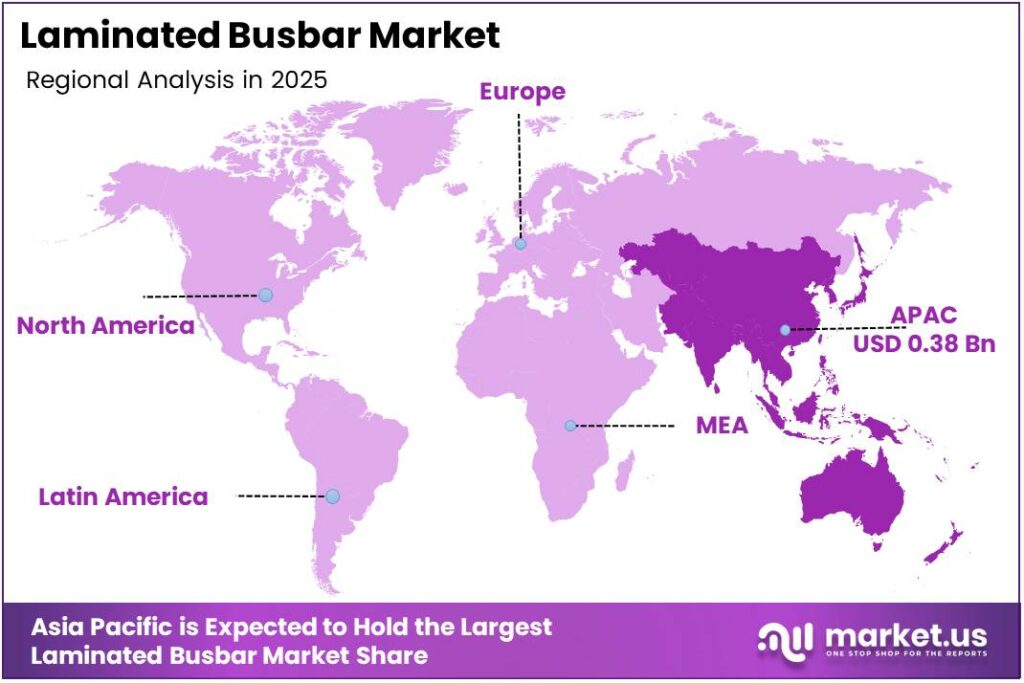
Asia Pacific Dominates the Laminated Busbar Market with a Market Share of 40.5%, Valued at USD 0.38 Billion
Asia Pacific holds the largest regional share at 40.5%, valued at USD 0.38 Billion in 2025. IEA data shows approximately 85% of global battery manufacturing capacity was located in China during 2024. This concentration of battery production directly anchors laminated busbar demand in the region. China-based suppliers and OEMs operating within this ecosystem benefit from proximity to the world’s largest EV and energy storage manufacturing base.
North America represents a structurally important secondary region. EIA data shows U.S. operators added 5 GW of utility-scale battery storage capacity during the first seven months of 2024 alone. This pace of storage deployment expands laminated busbar procurement across inverter, UPS, and grid-tied battery platforms. However, April 2026 US Section 232 tariff changes impose significant landed-cost risk on imported busbar assemblies, shifting advantage toward domestic and nearshore suppliers.
Europe holds a firm third-tier regional position. The EU Net-Zero Industry Act targets domestic clean-tech manufacturing capacity at 40% of annual deployment needs by 2030, which creates localized demand for laminated busbars in inverter and storage assembly lines. Insulation and fire compliance burdens unique to the EU add qualification costs for non-European suppliers. This regulatory environment favors regional manufacturers with established EU certifications.
Latin America and the Middle East and Africa remain nascent laminated busbar markets at this stage. Renewable energy project pipelines in Brazil and GCC states create early-stage demand. However, both regions lack domestic busbar manufacturing ecosystems, making them import-dependent and more sensitive to freight and tariff disruptions that constrain growth velocity compared to established regions.
Key Regions and Countries
North America
- US
- Canada
Europe
- Germany
- France
- The UK
- Spain
- Italy
- Rest of Europe
Asia Pacific
- China
- Japan
- South Korea
- India
- Australia
- Rest of APAC
Latin America
- Brazil
- Mexico
- Rest of Latin America
Middle East and Africa
- GCC
- South Africa
- Rest of MEA
Key Company Insights
Eaton Corporation PLC positions itself as a vertically integrated power management supplier with a dedicated busbar product line serving EV, industrial, and data center applications. This broad end-market coverage reduces Eaton’s exposure to single-sector cyclicality. However, its scale and product breadth create slower customization cycles compared to specialist fabricators, leaving gaps for agile regional challengers on highly engineered, application-specific programs. In November 2025, Rittal launched the RiLineX modular 60 mm busbar system for plug-and-play deployment across industrial automation, EV charging, and IT infrastructure.
Ryoden Kasei Co. Ltd focuses on precision laminated busbar assemblies with a manufacturing base oriented toward Japanese OEM and power electronics supply chains. This deep integration with Japanese automotive and industrial platforms creates reliable revenue visibility. By contrast, limited geographic diversification outside Japan and East Asia constrains Ryoden Kasei’s ability to capture share in the faster-growing US and European clean-energy program pipelines.
Key Players
- Eaton Corporation PLC
- Ryoden Kasei Co. Ltd
- Methode Electronics Inc
- Rogers Corporation
- Mersen SA
- Sun.King Power Electronics Group Ltd
- Zhuzhou CRRC Times Electric Co. Ltd
- Amphenol Corporation
- Shanghai Eagtop Electronic Technology Co. Ltd
- Molex LLC
- Raychem RPG Private Limited
- Astrolkwx
- SVM Private Limited
- PSIL India Pvt Ltd
- Storm Power Components
- Other Key Players
Recent Developments
- January 2026 – IMMSA acquired Dexco’s manufacturing operations and launched IMX Power Holdings to integrate busbar and enclosure production for data center, utility, and industrial power distribution applications.
- October 2025 – Dielectric Manufacturing acquired EMS Industrial and Service Company to expand production capacity for electric busbars serving electric vehicle, data center, and power transmission markets.
Report Scope
| Report Features | Description |
|---|---|
| Market Value (2025) | USD 0.93 Billion |
| Forecast Revenue (2035) | USD 1.7 Billion |
| CAGR (2026-2035) | 6.0% |
| Base Year for Estimation | 2025 |
| Historic Period | 2020-2024 |
| Forecast Period | 2026-2035 |
| Report Coverage | Revenue Forecast, Market Dynamics, Market Opportunity Analysis, Technology and Innovation Landscape, Competitive Landscape, Recent Developments |
| Segments Covered | By Material (Copper, Aluminum), By Layer Type (Multi-Layer Laminated Busbars, Two-Layer Laminated Busbars), By End Use Industry (Automotive, Telecom, Aerospace and Defense, Industrial, Renewable Energy, Others) |
| Regional Analysis | North America (US and Canada), Europe (Germany, France, The UK, Spain, Italy, and Rest of Europe), Asia Pacific (China, Japan, South Korea, India, Australia, and Rest of APAC), Latin America (Brazil, Mexico, and Rest of Latin America), Middle East and Africa (GCC, South Africa, and Rest of MEA) |
| Competitive Landscape | Eaton Corporation PLC, Ryoden Kasei Co. Ltd, Methode Electronics Inc, Rogers Corporation, Mersen SA, Sun.King Power Electronics Group Ltd, Zhuzhou CRRC Times Electric Co. Ltd, Amphenol Corporation, Shanghai Eagtop Electronic Technology Co. Ltd, Molex LLC, Raychem RPG Private Limited, Astrolkwx, SVM Private Limited, PSIL India Pvt Ltd, Storm Power Components, Other Key Players |
| Customization Scope | Customization for segments, region/country-level will be provided. Additional customization can be done based on requirements. |
| Purchase Options | We have three licenses to opt for: Single User License, Multi-User License (Up to 5 Users), Corporate Use License (Unlimited User and Printable PDF) |





































