


Report Overview
Global Plasma Cutting Machine Market size is expected to be worth around USD 1,138.0 Million by 2035 from USD 755.5 Million in 2025, growing at a CAGR of 4.2% during the forecast period 2026 to 2035.
The plasma cutting machine market covers equipment that uses ionized gas to cut electrically conductive metals with high speed and precision. These machines serve fabricators, manufacturers, and heavy industry operators who need reliable, repeatable cuts across a range of material thicknesses. The market spans portable units for field use through to large automated gantry systems for industrial production floors.
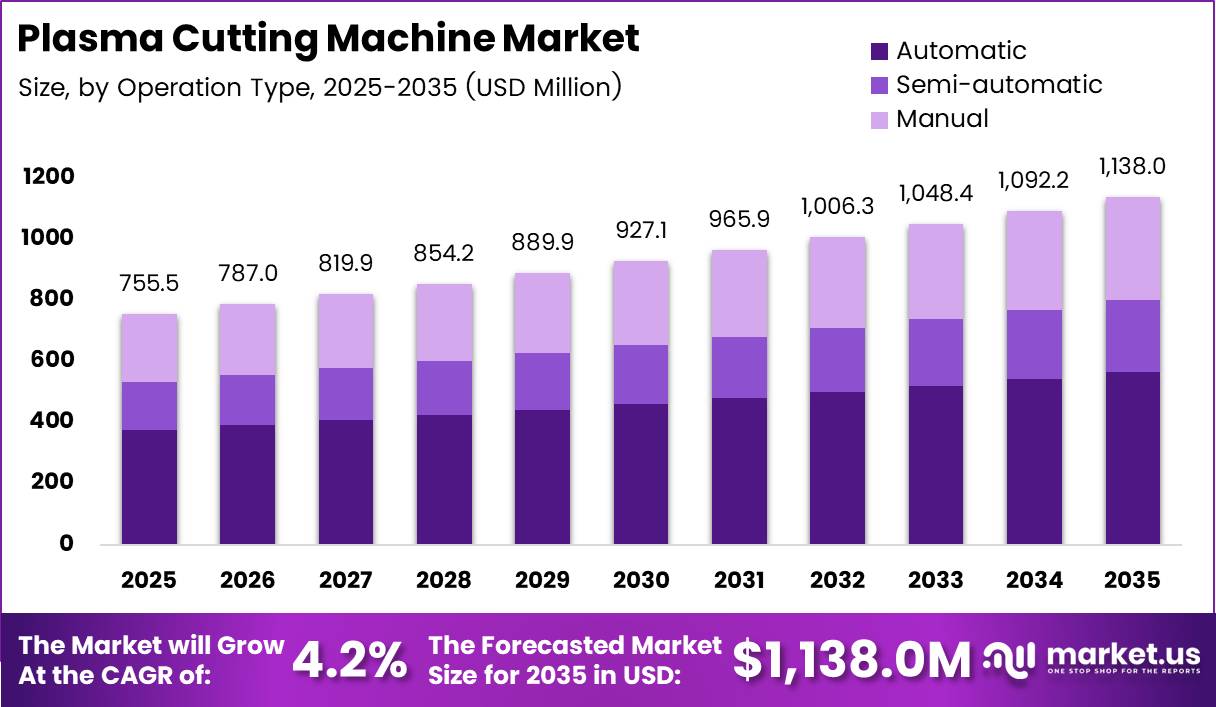
The market organizes into five primary segments: cutting technology, operation mode, power capacity, thickness capacity, and end use. Each segment reflects a distinct buyer need and production environment. Buyers select machines based on the metal type, required cut quality, throughput volume, and level of automation their operations demand. This segmentation creates clear differentiation opportunities for vendors.
Government investment in infrastructure, defense, and shipbuilding directly sustains demand for plasma cutting equipment. Structural steel fabrication for bridges, terminals, and energy facilities requires consistent high-volume cutting capability. National programs supporting domestic manufacturing capacity in key economies reinforce procurement of automated cutting systems across both public and private sectors.
Regulatory pressure to improve workplace safety and reduce material waste is reshaping equipment specifications. Buyers in regulated industries increasingly specify machines with enclosed cutting environments, fume extraction, and digital monitoring outputs. This creates a purchasing shift away from basic manual systems toward semi-automatic and automatic configurations with compliance-ready features.
According to data from the source, standard gantry-type CNC plasma systems handle plate up to 50 mm, while portable bench units typically process up to 20 mm mild steel. This performance split defines two distinct commercial channels: field maintenance buyers who prioritize portability and light-industrial shops that require mid-range thickness capability.
Data from the source shows that 100 to 200 A industrial plasma torches cut carbon steel up to 60 mm thick, while 300 to 400 A high-power systems process plates exceeding 150 mm. This power-to-thickness relationship signals that vendors targeting shipbuilding and heavy engineering must invest in high-amperage platforms to compete for the most demanding contracts in those segments.
Key Takeaways
- The Global Plasma Cutting Machine Market was valued at USD 755.5 Million in 2025 and is forecast to reach USD 1,138.0 Million by 2035.
- The market grows at a CAGR of 4.2% during the forecast period 2026 to 2035.
- By Cutting Technology, Air Plasma Cutting Machines dominate with a 48.3% share in 2025.
- By Operation, Automatic machines hold the leading share at 49.6% in 2025.
- By Power Capacity, the 121 to 300 Amp range leads with a 49.7% share in 2025.
- By Thickness Capacity, the 5mm to 15mm segment commands a 41.9% share in 2025.
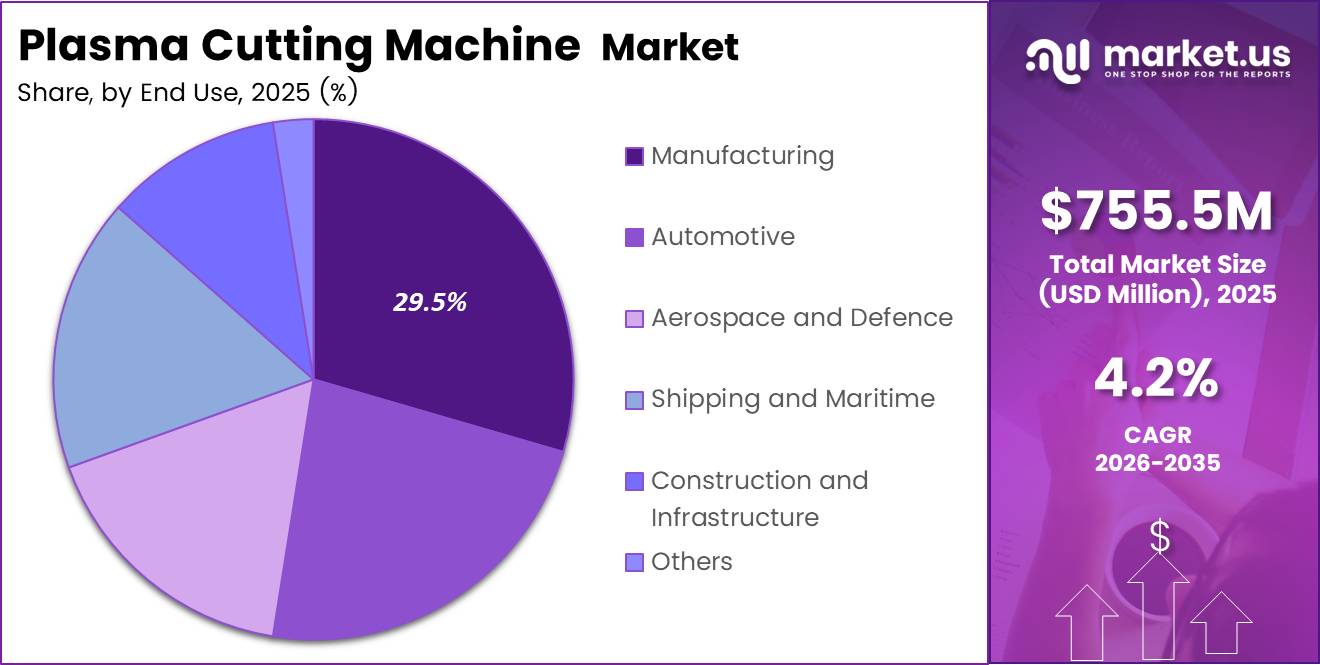
- By End Use, Manufacturing is the dominant vertical with a 29.5% share in 2025.
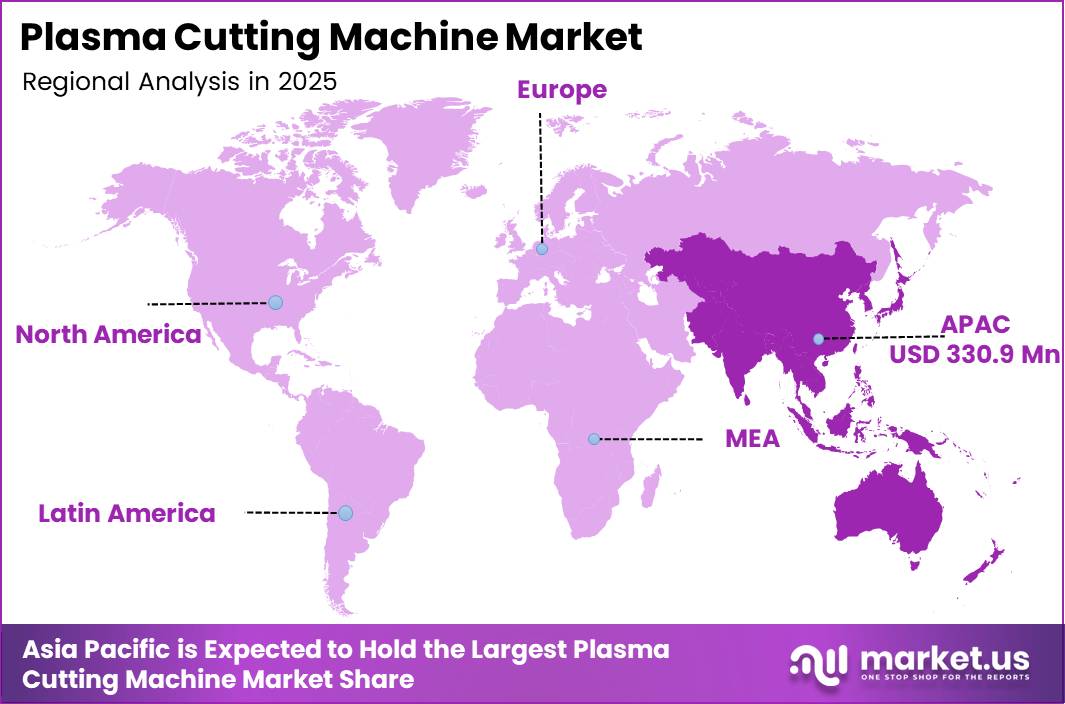
- Asia Pacific is the dominant region with a 43.80% share, valued at USD 330.9 Million in 2025.
Cutting Technology Analysis
Air Plasma Cutting Machines dominate with 48.3% due to lower operating cost and wide industrial accessibility.
In 2025, Air Plasma Cutting Machines held a dominant market position in the By Cutting Technology segment of the Plasma Cutting Machine Market, with a 48.3% share. Air plasma systems use compressed shop air as the cutting gas, removing the need for separate gas supply infrastructure. This cost advantage makes them the first-choice platform for metal fabricators, job shops, and construction contractors who prioritize uptime over cut-edge refinement.
Oxygen Plasma Cutting Machines deliver cleaner, lower-dross cuts on mild steel compared to air plasma alternatives. Buyers in precision structural fabrication and high-volume plate processing specify oxygen-based systems to reduce secondary grinding and rework. This performance premium positions oxygen plasma as the preferred upgrade path when surface quality directly affects downstream assembly costs.
Nitrogen Plasma Cutting Machines offer an inert cutting environment suited to stainless steel and aluminum applications. Fabricators serving food processing, pharmaceutical, and aerospace customers use nitrogen systems to prevent surface oxidation that would compromise material certification. This application-specific demand creates a stable niche with less price sensitivity than the general fabrication segment.
Hydrogen Plasma Cutting Machines serve a specialized tier of the market focused on reactive and exotic metals. These systems require additional gas handling and safety infrastructure, which limits adoption to operators with existing hydrogen supply chains. Demand is concentrated in advanced aerospace and defense fabrication where material traceability standards justify the higher operating cost.
Operation Analysis
Automatic machines dominate with 49.6% due to high throughput demand in industrial production environments.
In 2025, Automatic Plasma Cutting Machines held a dominant market position in the By Operation segment of the Plasma Cutting Machine Market, with a 49.6% share. Automatic systems integrate with CNC controllers, nest optimization software, and factory management platforms to deliver consistent output with minimal operator intervention. This integration capability directly reduces per-part labor cost, making automatic machines the investment-grade choice for high-volume fabrication facilities.
Semi-automatic Plasma Cutting Machines bridge the gap between manual skill and automated repeatability. Operators guide the cutting head along a preset track or template while the machine controls arc parameters. Buyers who process low-to-medium volumes of varied part geometries favor semi-automatic systems for their flexibility without the capital cost of full CNC integration.
Manual Plasma Cutting Machines remain active in maintenance, repair, and field construction applications where portability outweighs precision requirements. Operators use handheld torches to cut irregular shapes, remove damaged components, or perform on-site modifications. This segment is price-sensitive and volume-driven, sustained by a broad base of small contractors and maintenance workshops worldwide.
Power Capacity Analysis
The 121 to 300 Amp range dominates with 49.7% due to its versatility across mid-thickness industrial applications.
In 2025, the 121 to 300 Amp Power Capacity segment held a dominant market position in the By Power Capacity segment of the Plasma Cutting Machine Market, with a 49.7% share. This power band delivers sufficient amperage to cut structural steel, pipe, and plate thicknesses common in manufacturing, construction, and general fabrication. Vendors targeting this range access the broadest installed base across industrial buyers globally.
Below or equal to 120 Amp machines address light fabrication, sheet metal work, and portable cutting applications. These lower-power systems carry lower price points and operating costs, making them accessible to smaller shops and field maintenance crews. Growth in this sub-segment tracks closely with expansion in small-scale manufacturing and infrastructure repair spending.
Above 300 Amp machines serve the most demanding heavy industry applications, including shipbuilding, offshore structure fabrication, and large-diameter pipe processing. These high-power systems require dedicated power infrastructure and trained operators, concentrating buyers among large industrial facilities and specialist contractors with both the capital and technical capacity to operate them.
Thickness Capacity Analysis
The 5mm to 15mm range dominates with 41.9% due to alignment with standard structural steel fabrication requirements.
In 2025, the 5mm to 15mm Thickness Capacity segment held a dominant market position in the By Thickness Capacity segment of the Plasma Cutting Machine Market, with a 41.9% share. Structural steel plate, hollow sections, and fabricated components in this thickness range are the standard inputs for construction, machinery, and transportation equipment manufacturing. Vendors targeting this segment capture the highest unit volume opportunity across industrial end markets.
Below 5mm capacity machines serve thin sheet metal fabrication for HVAC, automotive body panels, and light enclosures. Buyers in this sub-segment often evaluate plasma against laser cutting, making price competitiveness and edge quality the primary selection factors. Market development here depends on vendors demonstrating plasma’s speed advantage over laser at comparable cost per cut.
The 5mm to 50mm segment captures mid-to-heavy structural fabrication applications including pressure vessels, heavy equipment frames, and shipbuilding components. This range represents the operational sweet spot for standard industrial CNC plasma tables, where throughput and cut quality both meet commercial production standards. Buyers in this band make up a significant share of the addressable CNC plasma machine market.
Above 50mm capacity machines address the most material-intensive applications in heavy manufacturing and offshore construction. These systems require high-amperage plasma sources and robust machine frames, driving higher capital investment and longer procurement cycles. Demand in this sub-segment is closely tied to shipbuilding activity, energy infrastructure projects, and national defense fabrication programs.
End Use Analysis
Manufacturing dominates with 29.5% due to high-volume metal processing needs across production facilities.
In 2025, Manufacturing held a dominant market position in the By End Use segment of the Plasma Cutting Machine Market, with a 29.5% share. General manufacturing facilities consume plasma cutting capacity across product lines spanning industrial machinery, agricultural equipment, and consumer goods infrastructure. The breadth of this end use makes it the most diversified and volume-stable demand channel in the entire market.
Automotive plasma cutting demand centers on chassis fabrication, structural component processing, and tooling manufacture. Automakers and their Tier 1 suppliers require high-speed, high-precision cutting to meet production cycle targets. Investment in plasma cutting in this vertical tracks closely with vehicle production volumes and platform changeover schedules at major assembly facilities.
Aerospace and Defence buyers specify plasma cutting for airframe structural components, ground support equipment, and defense platform fabrication. Material traceability, cut-edge quality standards, and process certification requirements make this a premium segment where equipment suppliers compete on technical compliance rather than price. Procurement decisions in this vertical are long-cycle and contract-driven.
Shipping and Maritime applications demand plasma cutting across hull plate fabrication, bulkhead processing, and outfitting operations. Shipyards operate large gantry and robotic plasma systems to process high volumes of thick steel plate under time-critical production schedules. This end use drives demand for the highest-power, widest-format plasma cutting equipment available commercially.
Construction and Infrastructure buyers use plasma cutting for structural steel preparation, rebar processing, and on-site metal modification. Project-based procurement patterns create cyclical demand tied to public infrastructure spending and private construction investment cycles. Portable and semi-automatic plasma systems see the strongest uptake in this vertical due to field deployment requirements.
Others in the end use segment include energy, rail, and maintenance service providers. These buyers collectively represent a tail of diverse applications not captured by the primary categories above. Demand here is fragmented across many small operators, making distribution reach and after-sales service coverage the primary competitive levers for vendors targeting this group.
Key Market Segments
By Cutting Technology
- Air Plasma Cutting Machines
- Oxygen Plasma Cutting Machines
- Nitrogen Plasma Cutting Machines
- Hydrogen Plasma Cutting Machine
By Operation
- Automatic
- Semi-automatic
- Manual
By Power Capacity
- ≤120 Amp
- 121–300 Amp
- Above 300 Amp
By Thickness Capacity
- Below 5mm
- 5mm–15mm
- 5mm–50mm
- Above 50mm
By End Use
- Manufacturing
- Automotive
- Aerospace and Defence
- Shipping and Maritime
- Construction and Infrastructure
- Others
Market Dynamics
Drivers – CNC Automation and Infrastructure Development Accelerate Plasma Cutting Equipment Demand
CNC-integrated plasma cutting systems deliver consistent geometry, faster cycle times, and reduced operator skill dependency compared to manual alternatives. Fabricators running multi-shift production floors specify CNC plasma to maintain throughput without proportional headcount increases. This pairing of software-driven nesting and automated torch motion is the primary investment driver across general manufacturing and structural steel sectors.
As reported by source data, 100 to 200 A industrial plasma torches cut carbon steel up to 60 mm thick, covering the structural plate range that dominates construction and shipbuilding procurement. This performance capability makes mid-range CNC plasma systems a technically sufficient and cost-effective alternative to laser or waterjet in high-volume thick-plate environments. Vendors who communicate this cost-per-cut advantage capture specification decisions early.
Expanding infrastructure and industrial construction programs are placing sustained order pressure on structural steel cutting equipment suppliers. Public investment in roads, terminals, and energy facilities generates demand for fabricated steel components that plasma cutting systems produce at scale. This demand is not project-specific; it compounds across multiple concurrent programs in high-growth economies, creating multi-year equipment procurement pipelines for machine vendors and their distributors.
Restraints – High Operating Costs and Material Compatibility Limit Market Expansion
Plasma cutting is an energy-intensive process, and operating costs increase materially as power levels rise. Facilities running multiple plasma machines on extended shifts face electricity and consumable costs that compress margin on per-part pricing. Buyers under cost pressure defer capital equipment upgrades or opt for lower-power systems, which limits the addressable market for high-amperage machine vendors.
According to source data, 50 to 80 A portable plasma devices achieve cutting depth only up to 38 mm, while industrial-grade applications require significantly higher amperage to reach commercial thickness targets. This performance gap means buyers cannot substitute portable units for industrial machines without accepting lower throughput and material limits. The cost barrier to industrial-grade systems therefore acts as a brake on broader market adoption among smaller operators.
Plasma cutting is fundamentally limited to electrically conductive materials, which excludes composites, ceramics, and engineered polymers from the addressable cutting scope. Manufacturers processing mixed-material assemblies must maintain separate cutting infrastructure for non-conductive components, increasing capital expenditure and floor space requirements. This application boundary prevents plasma from fully displacing alternative cutting technologies in multi-material fabrication environments.
Growth Factors – Robotic Plasma Systems and Renewable Energy Projects Create New Growth Avenues
Robotic plasma cutting cells replace fixed-gantry systems in complex three-dimensional fabrication tasks. Manufacturing facilities deploying robotic arms with plasma torches gain the ability to cut curved surfaces, tube ends, and structural profiles in a single automated pass. This capability shift opens new revenue streams for machine integrators and consumable suppliers who support robotic plasma installations in smart factory environments.
Based on source data, high-definition CNC plasma tables are commercially available with working envelopes up to 4 m by 12 m, integrating directly with Hypertherm XPR power sources. High-definition plasma systems also cut plate up to 80 mm, while heavy-duty automatic systems extend this range beyond 150 mm. This envelope and quality combination creates a direct revenue opportunity for vendors offering full-system integration packages to shipbuilders and large structural fabricators.
Renewable energy infrastructure development is generating sustained demand for fabricated metal components in wind tower bases, solar mounting structures, and substation frames. These components require plasma cutting across a range of plate thicknesses and profile geometries. Vendors who align product positioning and distribution support with renewable energy supply chains access a procurement channel that operates on government-backed project timelines rather than private market cycles.
Emerging Trends – High-Definition Plasma Technology and IIoT Integration Transform Cutting Performance
High-definition plasma cutting systems are delivering edge quality that narrows the performance gap with fiber laser on mild steel and structural plate. Fabricators who previously specified laser for tight-tolerance parts are now evaluating high-definition plasma for cost and speed advantages on thicker materials. This substitution dynamic reshapes the competitive boundary between cutting technologies and expands the premium plasma segment’s addressable market.
As reported by source data, 300 to 400 A high-power plasma systems process steel plates exceeding 150 mm thick, a capability that positions plasma as the dominant technology for the heaviest structural applications in shipbuilding and offshore construction. Vendors who develop IIoT connectivity for these high-power systems enable remote diagnostics, cut parameter logging, and predictive maintenance alerts. This data layer transforms a hardware sale into an ongoing service relationship with recurring revenue potential.
In March 2026, Hypertherm Associates launched the Powermax33 XP, a compact professional-grade air plasma cutter offering greater cutting capacity, enhanced portability, and a six-year power supply warranty. This product launch reflects an industry direction toward portable systems that perform closer to industrial-grade specifications. Early movers who distribute compact high-performance plasma systems gain access to field maintenance, repair, and on-site fabrication buyers who were previously served only by lower-capability portable units.
Regional Analysis
Asia Pacific Dominates the Plasma Cutting Machine Market with a Market Share of 43.80%, Valued at USD 330.9 Million
Asia Pacific commands the largest regional share of the global plasma cutting machine market. China, Japan, South Korea, and India collectively sustain demand through active shipbuilding programs, manufacturing export industries, and infrastructure investment pipelines. The concentration of heavy fabrication capacity in this region gives Asia Pacific a structural volume advantage that other regions cannot match on unit procurement alone.
North America represents a high-value market driven by defense manufacturing, energy infrastructure, and reshoring of industrial production. Fabricators in this region operate automated CNC plasma systems at scale and invest in high-definition and IIoT-capable platforms. Regulatory requirements for worker safety and environmental compliance push buyers toward enclosed, monitored plasma systems with digital output capability.
Europe sustains plasma cutting demand through its precision engineering, automotive supply chain, and shipbuilding sectors. German, Italian, and Scandinavian fabricators specify high-quality plasma systems for structural steel, transportation equipment, and offshore components. European procurement emphasizes energy efficiency and emissions performance, creating a vendor opportunity in eco-efficient plasma platforms that reduce fume generation and power consumption per cut.
Latin America’s plasma cutting market is tied to construction activity, mining equipment fabrication, and agricultural machinery manufacturing in Brazil and Mexico. Demand is project-dependent, with government infrastructure programs acting as the primary procurement trigger. The region’s price sensitivity favors mid-range air plasma systems with strong local distributor support over premium high-definition platforms.
The Middle East and Africa market is driven by oil and gas infrastructure, desalination plant construction, and defense platform assembly. GCC nations invest in fabrication capability as part of industrial diversification programs that reduce import dependency. Plasma cutting equipment procurement in this region follows project award cycles tied to energy and infrastructure spending commitments from national governments and sovereign funds.
Key Regions and Countries
North America
- US
- Canada
Europe
- Germany
- France
- The UK
- Spain
- Italy
- Rest of Europe
Asia Pacific
- China
- Japan
- South Korea
- India
- Australia
- Rest of APAC
Latin America
- Brazil
- Mexico
- Rest of Latin America
Middle East and Africa
- GCC
- South Africa
- Rest of MEA
Key Company Insights
Hypertherm Associates holds a product depth advantage through its Powermax platform, which spans recommended cut capacities from 8 mm to 38 mm and severance depths up to 57 mm across mechanized system configurations. The Powermax125 reaches a max cut speed of 7,160 mm/min on 6 mm mild steel. In September 2025, Hypertherm enhanced the XPR platform with IIoT connectivity, Ethernet LAN capability, MTConnect support, and automated gouging functionality. This digital integration strategy positions Hypertherm to convert hardware customers into connected service subscribers, building recurring revenue on top of equipment sales.
ESAB Corporation competes across welding, cutting, and automation equipment with a global distribution infrastructure that supports both consumable supply and equipment deployment. ESAB’s broad industrial workflow coverage gives it cross-selling leverage with fabrication facilities that operate multiple cutting and joining processes under one procurement contract. However, the company’s wide portfolio creates execution risk when allocating R&D and commercial resources across competing product priorities in a market where plasma-specific innovation is accelerating.
Lincoln Electric brings integrated welding and cutting system expertise to the plasma machine market, with a strong position in the North American industrial and automotive fabrication segments. Its direct sales model and established service network support long-cycle capital equipment decisions where post-sale support weighs heavily in the buyer’s selection process. Lincoln Electric’s automation division represents a strategic path to robotic plasma cell integration, aligning with the industry’s shift toward smart factory configurations.
Komatsu NTC operates in the heavy industrial plasma segment with a focus on large-format machine tools and CNC cutting systems. The company’s background in construction machinery and precision machine tools gives it credibility with shipbuilding and heavy fabrication buyers who require high-rigidity cutting platforms. Komatsu NTC’s geographic strength in Japan and Asia Pacific aligns directly with the region that commands the largest share of global plasma cutting machine demand.
Key Players
- Hypertherm Associates
- ESAB Corporation
- Lincoln Electric
- Komatsu NTC
- Messer Cutting Systems
- TRUMPF
- Koike Aronson
- Hornet Cutting Systems
- Jinan Style CNC
- Huayuan Electric
Recent Developments
- April 2026 – ESAB Corporation announced the acquisition of Eddyfi Technologies for approximately USD 1.45 Billion, expanding its industrial workflow, inspection, and fabrication technology portfolio.
- May 2026 – Hypertherm Associates introduced MAXPRO200 FlushCut consumables, a new plasma cutting technology for heavy industrial applications that enables faster removal of welded attachments while reducing grinding requirements.
Report Scope
| Report Features | Description |
|---|---|
| Market Value (2025) | USD 755.5 Million |
| Forecast Revenue (2035) | USD 1,138.0 Million |
| CAGR (2026-2035) | 4.2% |
| Base Year for Estimation | 2025 |
| Historic Period | 2020-2024 |
| Forecast Period | 2026-2035 |
| Report Coverage | Revenue Forecast, Market Dynamics, Competitive Landscape, Recent Developments |
| Segments Covered | By Cutting Technology (Air Plasma Cutting Machines, Oxygen Plasma Cutting Machines, Nitrogen Plasma Cutting Machines, Hydrogen Plasma Cutting Machine), By Operation (Automatic, Semi-automatic, Manual), By Power Capacity (≤120 Amp, 121-300 Amp, Above 300 Amp), By Thickness Capacity (Below 5mm, 5mm-15mm, 5mm-50mm, Above 50mm), By End Use (Manufacturing, Automotive, Aerospace and Defence, Shipping and Maritime, Construction and Infrastructure, Others) |
| Regional Analysis | North America (US and Canada), Europe (Germany, France, The UK, Spain, Italy, and Rest of Europe), Asia Pacific (China, Japan, South Korea, India, Australia, and Rest of APAC), Latin America (Brazil, Mexico, and Rest of Latin America), Middle East and Africa (GCC, South Africa, and Rest of MEA) |
| Competitive Landscape | Hypertherm Associates, ESAB Corporation, Lincoln Electric, Komatsu NTC, Messer Cutting Systems, TRUMPF, Koike Aronson, Hornet Cutting Systems, Jinan Style CNC, Huayuan Electric |
| Customization Scope | Customization for segments, region/country-level will be provided. Additional customization can be done based on requirements. |
| Purchase Options | We have three licenses to opt for: Single User License, Multi-User License (Up to 5 Users), Corporate Use License (Unlimited User and Printable PDF) |





































