Report Overview
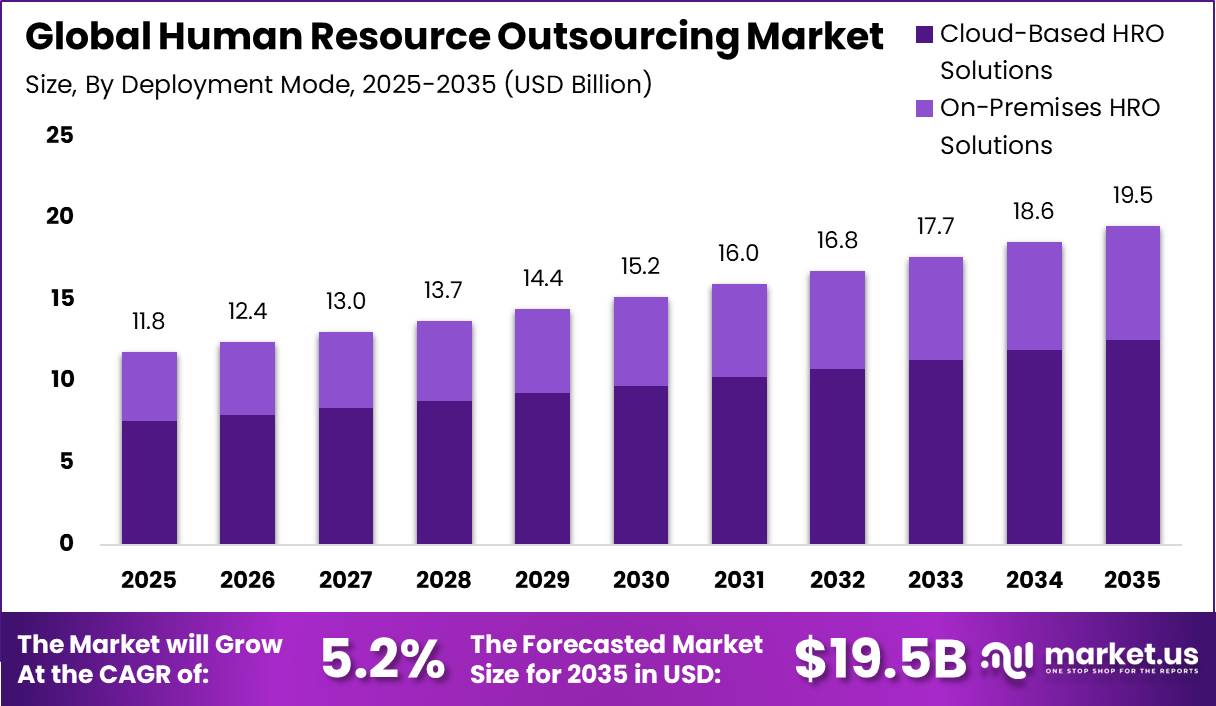
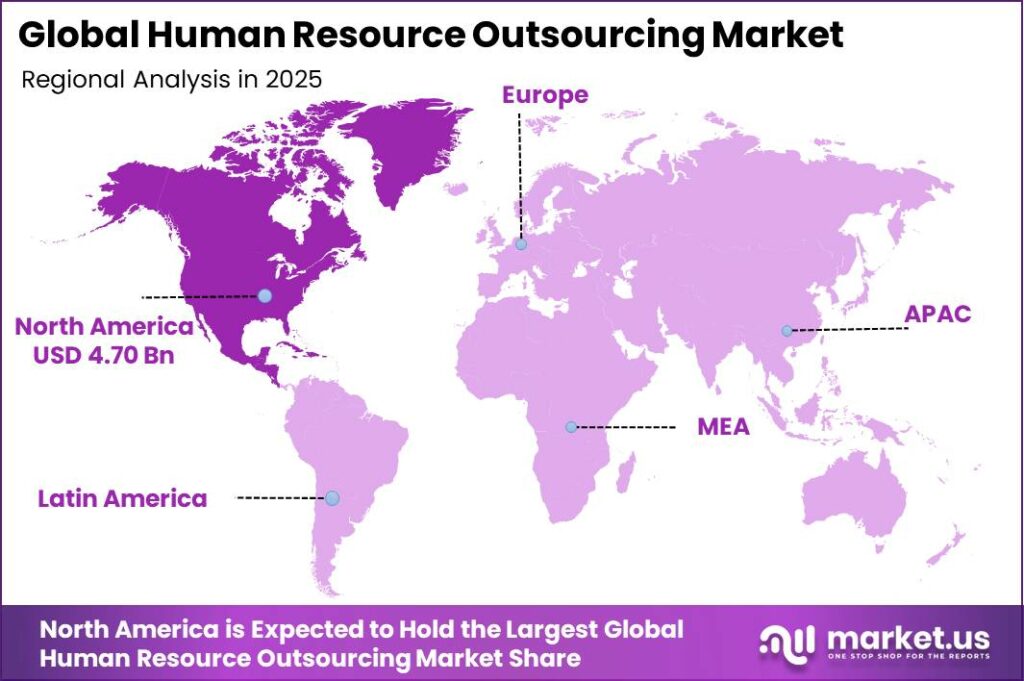
In 2025, the Global Human Resource Outsourcing Market was valued at USD 11.8 billion. The market is projected to grow at a CAGR of 5.2% during 2026–2035, reaching approximately USD 19.5 billion by 2035. North America dominated the global market in 2025, accounting for more than 39.8% of the total market share and generating approximately USD 4.7 billion in revenue.
This growth is primarily driven by the rising number of small and medium-sized enterprises (SMEs), which are the largest users of outsourced payroll, benefits administration, tax filing, and HR compliance services. According to the U.S. Census Bureau, 531,423 new business applications were filed in June 2026, contributing to the continued expansion of new businesses across the country.
The U.S. Small Business Administration (SBA) reports that the U.S. has 36.2 million small businesses, including 6.4 million employer firms that account for nearly half of all private-sector employment. Most of these businesses lack dedicated HR teams and increasingly rely on Professional Employer Organizations (PEOs) and HR outsourcing providers to manage workforce administration efficiently.
North America’s leadership is supported by its large concentration of SMEs and increasing demand for outsourced HR services to manage payroll, employee benefits, and regulatory compliance. According to Eurostat, the European Union has 33.1 million active enterprises employing 162.2 million people, with SMEs representing 99.8% of all businesses.
Although SME employment growth in Europe is expected to slow to 0.6% in 2025, the large number of existing businesses continues to create strong demand for outsourced HR solutions. In addition, increasingly complex labor regulations and the growth of cross-border hiring are encouraging organizations across North America and Europe to outsource HR functions, supporting long-term market expansion.
Key Takeaways
- In 2025, the Global Human Resource Outsourcing (HRO) Market was valued at USD 11.8 billion and is projected to reach USD 19.5 billion by 2035, expanding at a CAGR of 5.2% during the forecast period from 2026 to 2035.
- By service type, Payroll Outsourcing held the leading position with a 32.8% market share in 2025.
- By outsourcing type, Business Process Outsourcing (BPO) dominated the market, capturing 58.4% of the global revenue share in 2025.
- By deployment mode, Cloud-Based HRO Solutions led the market with a 64.2% share in 2025.
- By organization size, Large Enterprises accounted for the largest share of 61.7% in 2025.
- By industry vertical, IT & Telecommunications emerged as the leading segment, contributing 24.9% of the market revenue in 2025.
- By function, Administrative HR Services dominated the market with a 37.5% share in 2025.
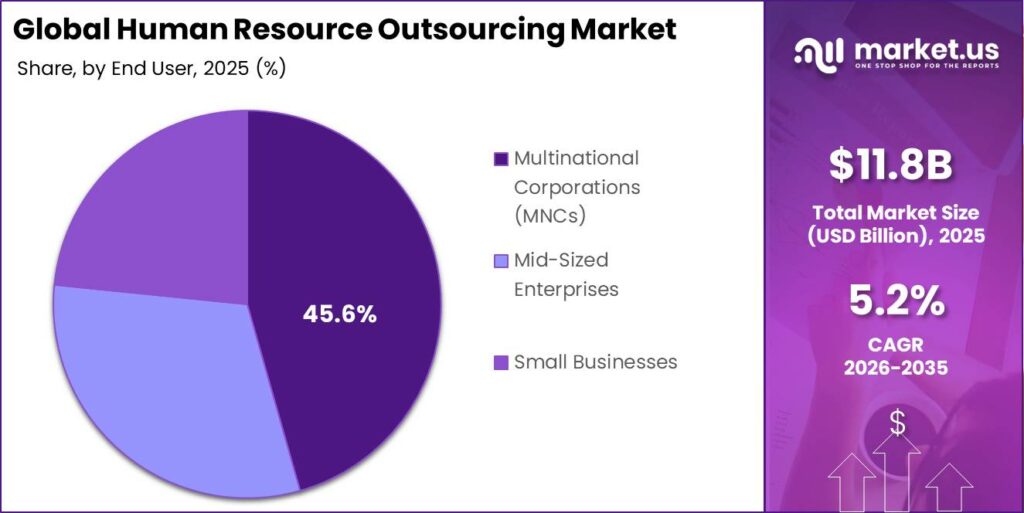
- By end user, Multinational Corporations (MNCs) held the largest market share of 45.6% in 2025.
- North America dominated the global market in 2025, accounting for more than 39.8% of the total market share and generating approximately USD 4.7 billion in revenue.
By Service Type
Payroll Outsourcing dominated the Human Resource Outsourcing market in 2025, accounting for 32.8% of the total market share. The segment leads because payroll is one of the most critical and compliance-intensive HR functions for every organization, regardless of its size or industry.
Businesses must accurately manage employee salaries, tax deductions, and regulatory filings while meeting strict government deadlines. According to the U.S. Internal Revenue Service (IRS), it processed more than US$5.3 trillion in gross tax collections and issued 120.6 million refunds in FY2025, highlighting the large volume of payroll-related tax activities handled each year.
The Recruitment Process Outsourcing (RPO) segment is expected to register the fastest CAGR during the forecast period. According to the U.S. Bureau of Labor Statistics (BLS), there were 7.6 million job openings in May 2026, remaining largely unchanged from the previous month, indicating continued demand for skilled workers.
By Outsourcing Type
Business Process Outsourcing (BPO) dominated the HR outsourcing market in 2025, accounting for 58.4% of the total revenue. Its strong market position is driven by the growing demand for outsourcing multiple HR functions, including payroll, recruitment, employee administration, and compliance, to reduce operational costs and improve efficiency.
According to the IT and Business Process Association of the Philippines (IBPAP), the country’s IT-BPM industry employed approximately 1.9 million workers in 2025 and generated US$40 billion in export revenue, growing faster than the global industry average of 3%. The sector also contributes more than 8% of the Philippines’ GDP, highlighting the increasing global reliance on large-scale business process outsourcing.
According to the National Association of Professional Employer Organizations (NAPEO), PEOs serve approximately 208,000 client businesses and manage 4.5 million worksite employees, paying nearly US$305 billion in annual wages. These client companies represent around 17% of all U.S. employers with 10–99 employees, demonstrating the growing importance of PEO services in supporting small business operations.
By Deployment Mode
Cloud-Based HRO Solutions dominated the Human Resource Outsourcing (HRO) market in 2025, accounting for 64.2% of the total market share. The segment leads because organizations are increasingly moving their business operations to cloud-based platforms to improve flexibility, reduce IT costs, and enable real-time access to HR services.
According to Eurostat, 52.7% of European Union enterprises used paid cloud computing services in 2025, an increase of 7.4 percentage points compared to 2023. Among these businesses, 85.2% used cloud services for e-mail, while 58.2% relied on cloud-based finance and accounting software, where payroll and HR functions are commonly integrated.
Cloud adoption reached 77.6% among large enterprises and 41.7% among small enterprises, highlighting widespread digital transformation across organizations of all sizes. Cloud-based HRO solutions allow service providers to deliver secure, scalable, and regularly updated HR services while enabling businesses to manage payroll, employee benefits, recruitment, and workforce data from any location.
By Organization Size
Large enterprises dominated the Human Resource Outsourcing (HRO) market in 2025, accounting for 61.7% of the total market share. Their leadership is driven by the need to manage large workforces across multiple locations while complying with complex labor laws, tax regulations, payroll requirements, and employee benefit programs.
According to Eurostat, although large enterprises represent only a small share of the 33.5 million businesses operating in the European Union, they generated the majority of the region’s €38.7 trillion net turnover in 2024, reflecting the scale of their HR and payroll operations.
Similarly, data from the U.S. Census Bureau shows that businesses with 500 or more employees account for a significant share of private-sector employment despite representing only a small percentage of the country’s 5.58 million employer firms.
By Industry Vertical
The IT & Telecommunications segment dominated the Human Resource Outsourcing market in 2025, accounting for 24.9% of the total market share. The segment’s leadership is driven by the rapid expansion of the global digital economy, which continues to increase the demand for skilled technology professionals. According to the International Telecommunication Union (ITU), around 6 billion people, representing 74% of the global population, used the internet in 2025, up from 5.8 billion in 2024.
The addition of more than 240 million new internet users within a year has accelerated hiring across IT and telecom companies. As a result, organizations are increasingly outsourcing recruitment, payroll, workforce management, and other HR functions to improve hiring speed, reduce administrative workload, and support large, geographically distributed teams.
The Healthcare & Life Sciences segment is projected to register the fastest CAGR during the forecast period. According to the World Health Organization (WHO), the global healthcare sector is expected to face a shortage of 11 million health workers by 2030, despite the current workforce exceeding 70 million professionals.
By Function
Administrative HR Services dominated the Human Resource Outsourcing (HRO) market in 2025, accounting for 37.5% of the total market share. The segment’s leadership is driven by the continuous need for payroll processing, employee benefits administration, tax compliance, and regulatory reporting across organizations.
According to the U.S. Bureau of Labor Statistics (BLS), employer costs for employee benefits averaged US$15.03 per hour worked for civilian workers in June 2025, while insurance, retirement, and legally required benefits alone cost private employers US$8.29 per hour worked.
Talent Acquisition Services is projected to register the fastest CAGR during the forecast period. According to LinkedIn Economic Graph, hiring in the United States increased by 5.2% month-over-month in May 2025, with the strongest hiring growth recorded in the technology, financial services, and construction sectors.
By End User
Multinational Corporations (MNCs) dominated the Human Resource Outsourcing market in 2025, accounting for 45.6% of the total market share. Their leadership is driven by the complexity of managing employees across multiple countries with different labor laws, payroll systems, tax regulations, and employee benefits.
According to UNCTAD’s World Investment Report 2025, global foreign direct investment (FDI) reached US$1.5 trillion in 2024, while FDI inflows into the United States totaled US$279 billion, highlighting the continued expansion of multinational companies.
Small Businesses are projected to register the fastest CAGR during the forecast period. Growth is supported by the rising number of small enterprises that need affordable HR solutions without maintaining dedicated in-house HR teams. According to the World Bank, small and medium-sized enterprises (SMEs) represent around 90% of businesses worldwide and account for more than 50% of global employment.
Key Market Segments
By Service Type
- Payroll Outsourcing
- Recruitment Process Outsourcing (RPO)
- Benefits Administration Outsourcing
- Learning & Development Outsourcing
- Workforce Management Services
- Multi-Process HRO
By Outsourcing Type
- Business Process Outsourcing (BPO)
- Professional Employer Organization (PEO)
- Application Service Provider (ASP)
By Deployment Mode
- Cloud-Based HRO Solutions
- On-Premises HRO Solutions
By Organization Size
- Large Enterprises
- Small & Medium Enterprises (SMEs)
By Industry Vertical
- IT & Telecommunications
- BFSI
- Healthcare & Life Sciences
- Retail & E-commerce
- Manufacturing
- Government & Public Sector
By Function
- Administrative HR Services
- Talent Acquisition Services
- Compensation & Benefits Management
- Compliance & Risk Management
- Employee Engagement Services
By End User
- Multinational Corporations (MNCs)
- Mid-Sized Enterprises
- Small Businesses
Market Dynamics
Drivers
| Driver | (~) % CAGR | Geographic Relevance | Impact Timeline |
|---|---|---|---|
| Shift to strategic HR outsourcing | +1.3% | North America, Western Europe, Asia-Pacific | Short term (≤ 2 years) |
| Multi-country payroll standardization | +0.9% | Multinational enterprises globally | Short to medium term (1–4 years) |
| Post-pandemic remote work models | +0.7% | Global, especially services economies | Short term (≤ 2 years) |
| Compliance complexity in HR data | +0.6% | EU, UK, GCC, India, selected U.S. states | Short to medium term (1–4 years) |
| SMB cost-optimization initiatives | +0.4% | North America, Europe, India, Southeast Asia | Short term (≤ 2 years) |
Shift to strategic HR outsourcing
In the two years before 2026, HR outsourcing has shifted from transactional processing to strategic enablement as enterprises restructured HR operating models to focus internal teams on workforce strategy while external partners assumed end-to-end execution of payroll, benefits, and core HRIS administration, with many large providers reporting that more than 60% of new deals now bundle advisory-led transformation rather than standalone staffing or payroll-only contracts.
This shift supports an incremental impact of around +1.3% on the baseline CAGR of 5.20% as buyers move from small-ticket, function-specific contracts to multi-year SaaS-plus-managed-services agreements that can expand average contract value by an estimated 25–35% and increase revenue visibility through 3–5-year terms.
Commercially, the strategic orientation enables providers to migrate clients from license-based or on-premise HR systems into recurring cloud subscription bundles, which can lift gross margins by roughly 300–500 basis points via higher utilization of standardized platforms and lower per-employee servicing cost, while simultaneously compressing client-side HR administration costs by around 20–30% per full-time equivalent and reducing cycle time for key HR processes such as onboarding and payroll closure by 20–40%.
Restraints
| Restraint | (~) % Impact on CAGR | Geographic Relevance | Impact Timeline |
|---|---|---|---|
| Stringent HR data protection penalties | -1.0% | EU, UK, GCC, India, selected U.S. states | Short term (≤ 2 years) |
| Vendor lock-in and switching risk | -0.6% | Global large enterprises | Medium term (2–4 years) |
| Macroeconomic cost-cutting cycles | -0.5% | OECD economies | Short term (≤ 2 years) |
| Regulatory uncertainty in emerging markets | -0.4% | India, Middle East, parts of Africa | Medium term (2–4 years) |
| Security concerns around third-party access | -0.3% | Global, highly regulated sectors | Short term (≤ 2 years) |
Stringent HR data protection penalties
Data protection regimes such as the EU’s GDPR, Gulf data protection laws with fines up to roughly AED 5 million, and India’s evolving personal data framework have materially raised the downside risk associated with outsourcing employee data processing, with regulators empowered to levy penalties that can equate to several percentage points of annual revenue for serious breaches.
This legal exposure translates into an estimated drag of about -1.0% on the baseline CAGR as some enterprises delay or scale back cross-border HR outsourcing projects, while providers must incur security, legal, and audit costs that can add 10–20% to platform compliance spending and reduce operating margins by roughly 100–200 basis points, particularly in multi-country payroll and benefits administration.
Challenges
| Challenge | (~) % CAGR | Geographic Relevance | Mitigation Horizon |
|---|---|---|---|
| Shortage of specialized HR talent | -0.9% | OECD, India, Southeast Asia | Medium term (2–4 years) |
| Complex multi-jurisdiction labor rules | -0.7% | Global multinationals | Long term (≥ 4 years) |
| Integration with legacy HR systems | -0.6% | Global mid to large enterprises | Medium term (2–4 years) |
| Evolving expectations for employee experience | -0.5% | Knowledge-economy markets | Medium term (2–4 years) |
| Pricing pressure from commoditized services | -0.4% | Global, especially SMB-focused vendors | Short to medium term (1–4 years) |
Shortage of specialized HR talent
Persistent labour and skills shortages across advanced economies, particularly in HR, payroll, and compliance roles, create structural friction for HRO providers because they must compete for the same scarce talent pool needed to deliver complex services at scale, with OECD surveys indicating that roughly one in 4 firms reports difficulty recruiting qualified staff in the post-pandemic period.
This constraint translates into an estimated friction drag of about -0.9% on potential CAGR, as vendors are forced to carry higher bench costs, increase salaries by roughly 10–15% annually for niche roles such as multi-country payroll specialists, and accept lower utilization during ramp-up periods, thereby eroding EBITDA margins by an estimated 150–250 basis points relative to a fully staffed model.
Over the medium term, providers respond by offshoring more functions to large talent hubs such as India, redesigning delivery models to shift up to 30–40% of tickets to self-service and automation, and tightening client selection to prioritize higher-yield, standardized contracts, but these adjustments require 2–4 years of sustained investment in recruitment, training, and process reengineering before they meaningfully reduce the talent bottleneck.
Opportunities
| Opportunity | (~) % CAGR | Geographic Relevance | Execution Window |
|---|---|---|---|
| AI-augmented HR service delivery | +1.1% | Global, tech-adopting enterprises | Short to medium term (1–4 years) |
| Expansion into emerging-market SMBs | +0.8% | India, Southeast Asia, Latin America, Africa | Medium term (2–4 years) |
| Outcome-based HR outsourcing models | +0.7% | North America, Europe | Medium term (2–4 years) |
| Global contractor and gig workforce solutions | +0.6% | Global, digital-first companies | Short to medium term (1–4 years) |
| Verticalized HR platforms for regulated sectors | +0.5% | Healthcare, financial services, public sector | Long term (≥ 4 years) |
AI-augmented HR service delivery
AI-augmented delivery represents untapped upside rather than a current driver because, as of 2026, most providers are still in pilot or early rollout phases for generative and predictive tools in HR workflows, with a relatively small fraction of tickets fully automated and substantial room to scale automation across case management, knowledge management, and employee self-service.
Capturing this opportunity could add around +1.1% to CAGR above the baseline by enabling vendors to automate an estimated 30–50% of routine interactions (such as leave queries or benefits FAQs), reduce average handling time by 40–60%, and cut per-employee service delivery cost by roughly 15–25%, which in turn supports either 200–300 basis points of margin expansion or price reductions that expand addressable demand among cost-sensitive clients.
At the unit-economics level, integrating AI co-pilots into HR case management can lower the cost per ticket by an estimated 1–3 currency units and reduce onboarding time for new HR agents by up to 30%, while predictive analytics for attrition and workforce planning create premium opportunities, analytics-rich service tiers that can lift revenue per employee served by approximately 10–20% without proportionate increases in labour costs.
Geopolitical Impact Analysis
Global trade conditions are becoming more challenging, creating pressure on the Human Resource Outsourcing (HRO) market. According to the World Trade Organization (WTO), global services trade, which includes HR outsourcing, grew by 5.3% in 2025 but is expected to slow to 4.8% in 2026 and could decline further to 4.1% if geopolitical tensions in the Middle East continue.
In addition, UNCTAD reported that global tariffs increased significantly in 2025, mainly due to U.S. trade measures, while nearly two-thirds of global trade now moves through supply chains affected by geopolitical uncertainty. This is encouraging outsourcing companies to diversify their delivery locations and review pricing strategies.
Currency fluctuations are adding further pressure. The Indian rupee, one of Asia’s weakest-performing currencies in 2025, depreciated by approximately 4.9% and reached a record low of ₹96.84 per U.S. dollar in May 2026, affecting the profitability of India-based payroll and recruitment outsourcing providers.
According to the International Monetary Fund (IMF), global trade growth is projected to slow from 5.0% in 2025 to 3.5% in 2026, while global inflation is expected to remain relatively high at 4.7%. Higher inflation is increasing labor and operating costs across major outsourcing hubs, particularly in Asia, where many HR service providers operate.
Regional Analysis
North America dominated the Human Resource Outsourcing market in 2025, accounting for 39.8% of the global market and generating approximately USD 4.7 billion in revenue. The region’s leadership is supported by a large and well-established business base across the United States and Canada, creating consistent demand for outsourced HR services.
According to Statistics Canada, there were approximately 1.37 million employer businesses in December 2025, with 91.2% employing between 1 and 19 employees. These small businesses often rely on third-party providers for payroll, employee benefits, recruitment, and regulatory compliance due to limited in-house HR resources. In addition, small and medium-sized businesses contribute nearly 48% of Canada’s GDP, highlighting their important role in driving long-term demand for HR outsourcing services across the region.
Asia-Pacific is expected to register the fastest CAGR during the forecast period. Rapid economic growth, increasing business registrations, and expanding formal employment are driving demand for HR outsourcing services across the region. According to the Asian Development Bank (ADB), developing Asia’s economy is projected to grow by 4.9% in 2026, while South Asia is expected to expand by 6.0%, making it one of the fastest-growing regions globally.
Key Regions and Countries Covered in this Report
- North America
- The US
- Canada
- Europe
- Germany
- France
- The UK
- Spain
- Italy
- Russia & CIS
- Rest of Europe
- APAC
- China
- Japan
- South Korea
- India
- ASEAN
- Rest of APAC
- Latin America
- Brazil
- Mexico
- Rest of Latin America
- Middle East & Africa
- GCC
- South Africa
- Rest of MEA
Key Players Analysis
The global HR outsourcing market is led by a few large companies with strong payroll networks, global operations, and broad HR service portfolios. ADP remains the market leader, reporting US$20.6 billion in revenue in FY2025, up 7% from the previous year, while net earnings increased 9% to US$4.1 billion. The company serves more than 1.1 million clients and processes payroll for over 42 million workers across 140+ countries, giving it a significant competitive advantage.
Paychex also holds a strong position, generating US$5.6 billion in FY2025 revenue, a 6% year-over-year increase, with US$2.2 billion in operating income, supported by its strong presence among small and medium-sized businesses in the United States.
Meanwhile, Randstad, one of the largest staffing and HR service providers, reported €23.1 billion in 2025 revenue and €720 million in underlying EBITA. Although its revenue declined by 2% due to slower hiring activity in Europe, the company continues to maintain a strong global market presence.
The market also includes several established Tier-2 companies that are expanding their HR outsourcing capabilities through technology and business process services. Accenture generated US$34.57 billion from its outsourcing business in fiscal 2025, nearly equal to its US$35.11 billion consulting revenue, highlighting the importance of outsourcing services in its business strategy.
Infosys reported FY2025 revenue of ₹1,62,990 crore (approximately US$19.6 billion), growing 4.2%, while its Business Process Management (BPM) division recorded ₹8,501 crore in revenue, an increase of 7.7%. Companies such as TriNet and Insperity focus primarily on Professional Employer Organization (PEO) services, serving businesses through workforce and payroll management.
The Major Players in the Industry
- ADP
- Paychex
- Alight Solutions
- Aon
- Insperity
- TriNet
- Randstad
- ManpowerGroup
- Korn Ferry
- Accenture
- IBM
- Infosys
- Tata Consultancy Services
- Wipro
- Capgemini
- Other Key Players
Recent Development
- In April 2025, Paychex completed the acquisition of Paycor HCM in an all-cash transaction on April 14, 2025. The deal was valued at approximately US$4.1 billion in enterprise value, with Paycor shareholders receiving US$22.50 per share. The acquisition strengthened Paychex’s human capital management (HCM) capabilities and expanded its presence in the payroll and HR technology market.
- In June 2025, ADP reported fiscal year 2025 revenue of US$20.6 billion, representing a 7% year-over-year increase, while net earnings reached US$4.1 billion, up 9%. The company served more than 1.1 million clients and processed payroll for over 42 million workers globally, reinforcing its leadership in payroll and workforce management services.
- In December 2025, Randstad reported full-year 2025 revenue of €23.1 billion and underlying EBITA of €720 million. During the year, the company placed more than 1.7 million people into jobs through its global network, serving nearly 150,000 clients, highlighting its strong position in the global HR outsourcing and staffing market.
- In March 2026, KKR announced an agreement to acquire Alight’s core benefits administration business for US$2.2 billion. The transaction is expected to close in the fourth quarter of 2026, subject to shareholder and regulatory approvals, and reflects continued investment in the benefits administration and HR outsourcing sector.
Report Scope
| Report Features | Description |
|---|---|
| Market Value (2025) | USD 11.8 Billion |
| Forecast Revenue (2035) | USD 19.5 Billion |
| CAGR (2026-2035) | 5.2% |
| Base Year for Estimation | 2025 |
| Historic Period | 2020-2024 |
| Forecast Period | 2026-2035 |
| Report Coverage | Revenue Forecast, Market Dynamics, Competitive Landscape, Recent Developments |
| Segments Covered | By Service Type [Payroll Outsourcing, Recruitment Process Outsourcing (RPO), Benefits Administration Outsourcing, Learning & Development Outsourcing, Workforce Management Services and Multi-Process HRO) By Outsourcing Type [Business Process Outsourcing (BPO), Professional Employer Organization (PEO) and Application Service Provider (ASP)] By Deployment Mode (Cloud-Based HRO Solutions and On-Premises HRO Solutions) By Organization Size [Large Enterprises and Small & Medium Enterprises (SMEs)] By Industry Vertical (IT & Telecommunications, BFSI, Healthcare & Life Sciences, Retail & E-commerce, Manufacturing and Government & Public Sector) By Function (Administrative HR Services, Talent Acquisition Services, Compensation & Benefits Management, Compliance & Risk Management and Employee Engagement Services) By End User [Multinational Corporations (MNCs), Mid-Sized Enterprises and Small Businesses] |
| Regional Analysis | North America – The US & Canada; Europe – Germany, France, The UK, Spain, Italy, Russia & CIS, Rest of Europe; APAC- China, Japan, South Korea, India, ASEAN & Rest of APAC; Latin America- Brazil, Mexico & Rest of Latin America; Middle East & Africa- GCC, South Africa, & Rest of MEA |
| Competitive Landscape | ADP, Paychex, Alight Solutions, Aon, Insperity, TriNet, Randstad, ManpowerGroup, Korn Ferry, Accenture, IBM, Infosys, Tata Consultancy Services, Wipro, Capgemini and Others |
| Customization Scope | Customization for segments and region/country-level will be provided. Moreover, additional customization can be done based on the requirements. |
| Purchase Options | We have three licenses to opt for: Single User License, Multi-User License (Up to 5 Users), Corporate Use License (Unlimited Users and Printable PDF) |