


Report Overview
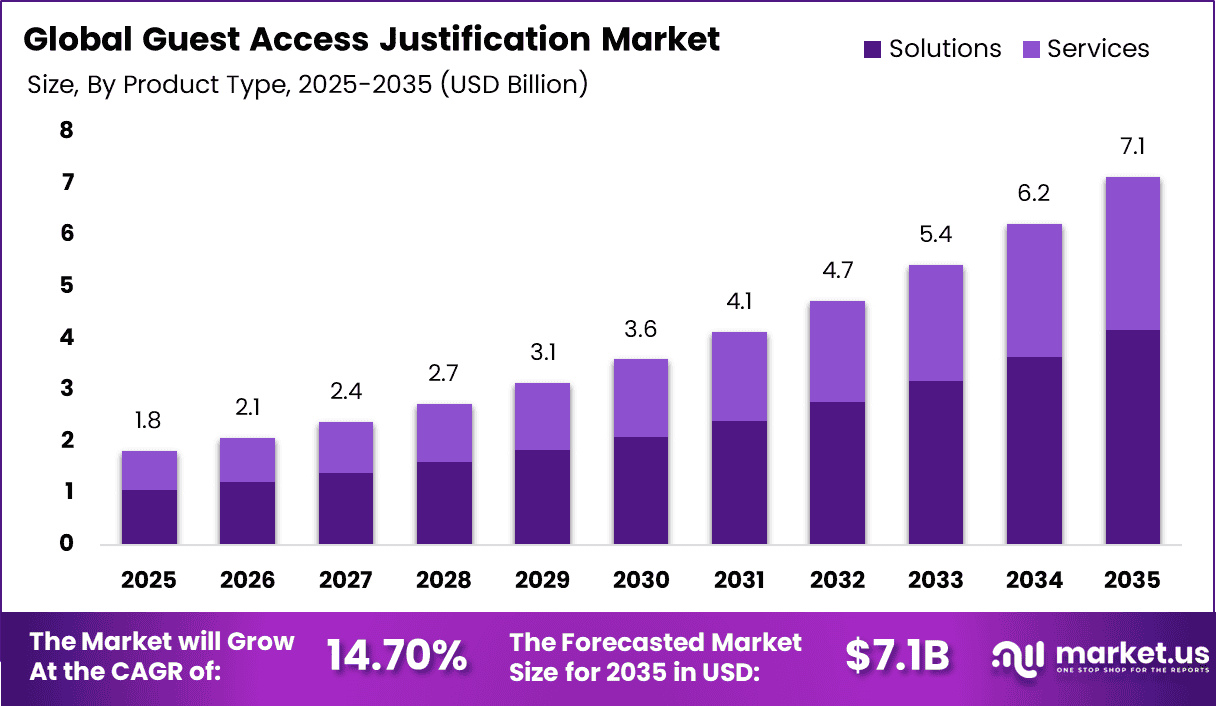
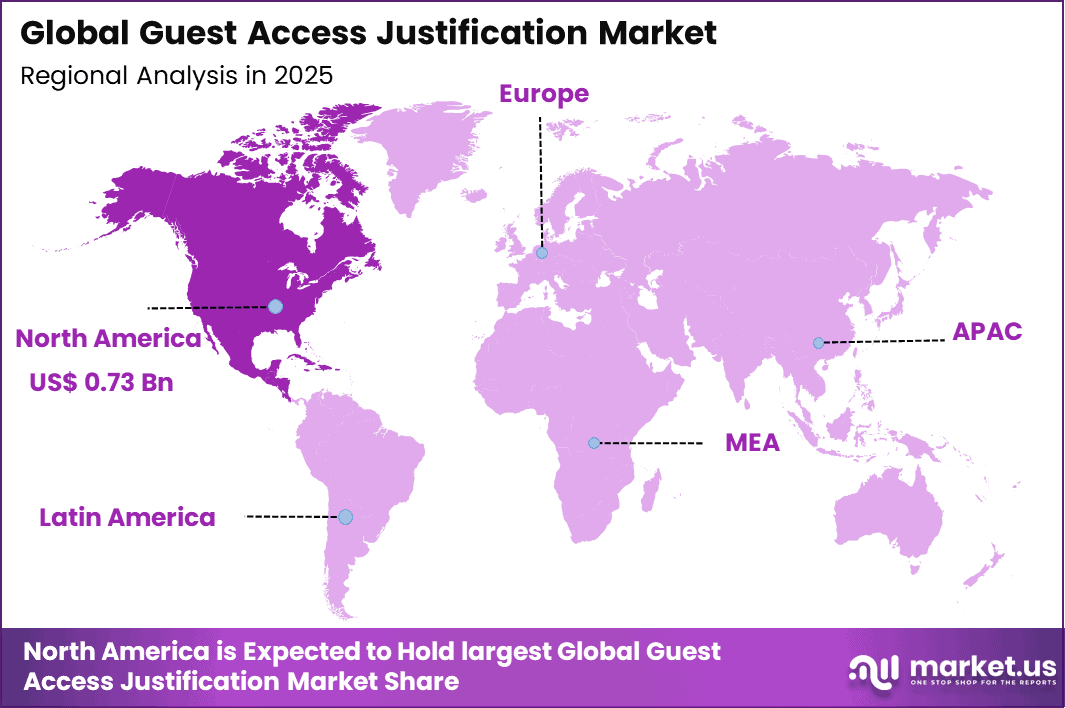
The Global Guest Access Justification Market generated USD 1.8 billion in 2025 and is projected to grow from USD 2.1 billion in 2026 to about USD 7.1 billion by 2035, recording a CAGR of 14.7% over the forecast period. In 2025, North America held a dominant market position, capturing more than a 40.7% share, with USD 0.73 billion in revenue.
Guest Access Justification market refers to tools and software that require a clear business reason before outside users are allowed to access internal systems, files, or applications. These solutions are used when companies work with vendors, consultants, contractors, partners, or temporary users who need limited access.
Demand for guest access justification solutions is increasing across large enterprises and regulated sectors that work with many third parties. These organizations need practical systems that can approve, monitor, and remove guest access without creating delays for business teams. Demand is also rising because companies now view external access as an ongoing governance issue rather than a one-time setup process.
Top Market Takeaways
- By Component, solutions dominate with a 58.4% share, automating risk-based approvals, temporary credential issuance, and audit trails for third-party ecosystem access.
- By Application, IT & telecom captures 23.6%, securing vendor portals, field technician connectivity, and partner extranets with just-in-time provisioning.
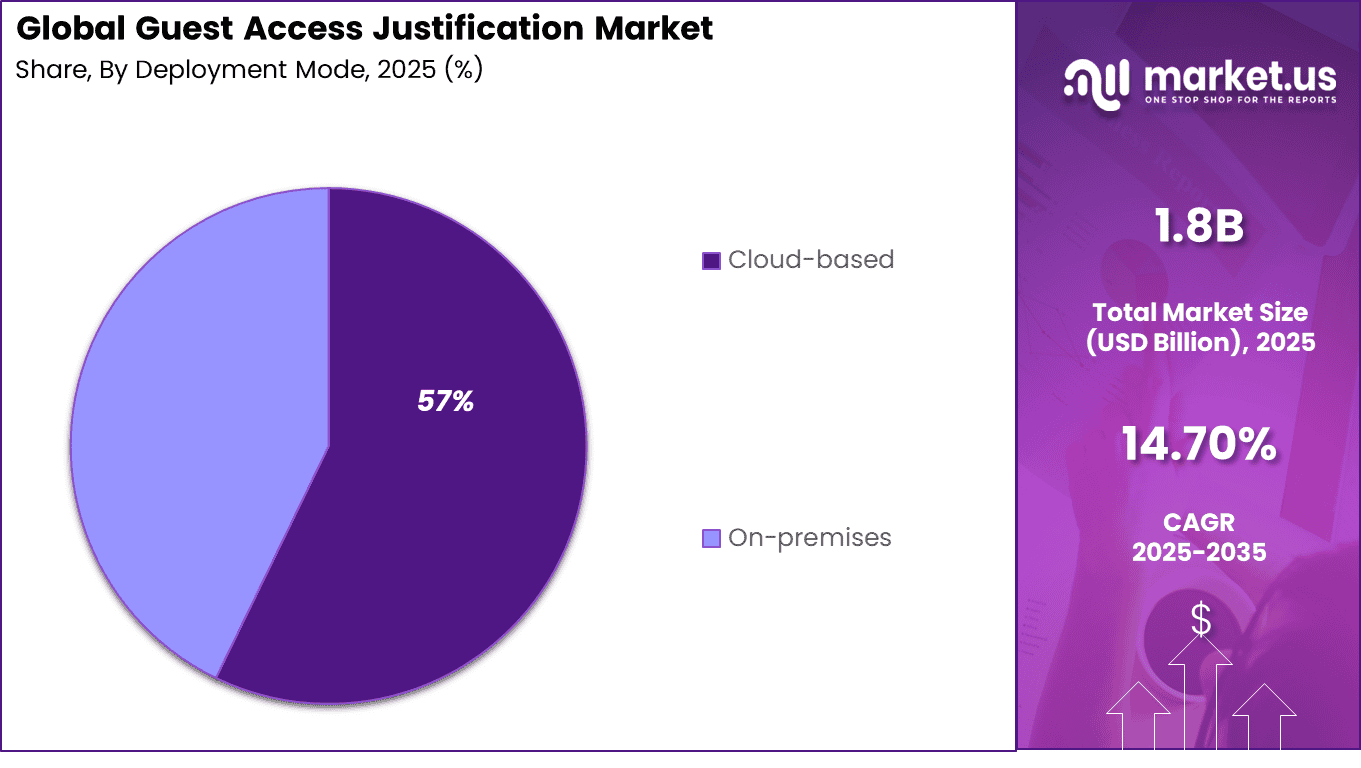
- By Deployment Mode, cloud captures 57.2%, enabling elastic policy enforcement, real-time behavioral analytics, and seamless integration with IdPs.
- By Organization Size, large enterprises hold 60.6%, orchestrating guest journeys across global campuses with centralized visibility and automated escalation.
- By End-User, enterprises lead at 42.9%, streamlining contractor onboarding, visitor WiFi authorization, and compliance reporting.
- Regionally, North America accounts for 40.7% global share, with the U.S. market valued at USD 0.65 billion and a CAGR of 12.5%, driven by NIST 800-207 and hybrid work security requirements.
By Component Analysis
Solutions held 58.4% of the Guest Access Justification Market. This segment leads because organizations need dedicated tools that can verify guest requests, validate access needs, and maintain clear approval records. These solutions help security and IT teams reduce unauthorized access while keeping the process structured and traceable.
The segment also benefits from the growing need for policy-based access control across modern workplaces and digital systems. Companies increasingly prefer solution-driven platforms that combine request validation, approval workflows, and audit visibility in one system, which supports steady demand in this market.
By Application Analysis
IT & Telecom accounted for 23.6% of the market. This segment remains strong because companies in this sector manage large user networks, sensitive systems, and frequent third-party interactions. Guest access justification tools help them control temporary access requests and reduce risk across infrastructure, applications, and support environments.
The fast pace of system changes in IT and telecom also increases the need for controlled access management. As teams work with vendors, contractors, and remote users more often, the demand for systems that justify and document guest access continues to rise across this segment.
By Deployment Mode Analysis
Cloud captured 57% of the Guest Access Justification Market. Organizations prefer cloud deployment because it supports easier implementation, centralized management, and smoother access across multiple locations. This model is especially useful for businesses that need flexible access governance without building heavy internal infrastructure.
Cloud platforms also allow faster updates and easier integration with identity management, compliance, and security monitoring tools. These advantages make cloud deployment more attractive for organizations that want scalable guest access control with better operational efficiency.
By Organization Size Analysis
Large enterprises represented 60.6% of the market. These organizations often manage complex access environments involving employees, contractors, partners, and visitors across many departments and sites. As a result, they need stronger systems to justify temporary access and maintain proper oversight over approval decisions.
Large enterprises also face greater compliance pressure and higher security expectations. With more users and broader digital infrastructure, even a small gap in guest access control can create serious operational risk. This keeps adoption strong among large organizations.
By End User Analysis
Enterprises held 42.9% of the market. This segment leads because businesses across industries are placing greater focus on access governance, internal security, and accountability. Guest access justification systems help enterprises verify why access is needed, who approved it, and how long it should remain active.
The segment is also supported by rising digital collaboration and the growing use of external service providers. As enterprises work with more temporary users and outside partners, the need for structured guest access justification continues to expand across business environments.
Key Market Segments
By Component
- Solutions
- Services
By Deployment Mode
- On-Premises
- Cloud
By Application
- IT & Telecom
- Healthcare
- BFSI
- Government
- Education
- Retail
- Others
By Organization Size
- Small and Medium Enterprises (SMEs)
- Large Enterprises
By End-User
- Enterprises
- Institutions
- Government Agencies
- Others
Regional Analysis
North America accounted for 40.7% of the Guest Access Justification Market, reflecting strong adoption of identity governance and access management practices across enterprises. Organizations in sectors such as banking, healthcare, government, and technology increasingly focus on controlling temporary or external user access to sensitive systems.
Businesses across the region deploy guest access justification platforms to verify, document, and monitor why third-party users require system entry. As companies strengthen cybersecurity governance and internal compliance practices, structured access approval and tracking systems continue to gain importance across North American enterprises.
The United States generated about USD 0.65 Bn within the regional market and is projected to expand at a CAGR of 12.5%. Companies across the country continue to strengthen security controls as external collaborations with vendors, consultants, and contractors increase.
Guest access justification tools help security teams review requests, validate access reasons, and maintain clear audit records for compliance reviews. As digital infrastructure expands and organizations manage complex multi-user environments, demand for solutions that ensure controlled and transparent external access management continues to rise across the US market.
Key Regions and Countries
- North America
- US
- Canada
- Europe
- Germany
- France
- The UK
- Spain
- Italy
- Russia
- Netherlands
- Rest of Europe
- Asia Pacific
- China
- Japan
- South Korea
- India
- Australia
- Singapore
- Thailand
- Vietnam
- Rest of APAC
- Latin America
- Brazil
- Mexico
- Rest of Latin America
- Middle East & Africa
- South Africa
- Saudi Arabia
- UAE
- Rest of MEA
Drivers Impact Analysis
| Key Driver | Impact on CAGR Forecast (~%) | Geographic Relevance | Impact Timeline | Strategic Effect |
|---|---|---|---|---|
| Rising adoption of identity and access management solutions | +2.6% | North America, Europe, Asia Pacific | Short to Mid Term (2025–2031) | Improves governance of third-party access |
| Increasing cybersecurity threats targeting enterprise networks | +2.3% | US, Europe, Japan | Short to Mid Term (2025–2030) | Drives need for stricter access validation |
| Expansion of remote work and external collaboration | +2.0% | Global | Mid Term (2026–2032) | Encourages stronger guest access control |
| Regulatory compliance requirements for identity management | +1.9% | North America, Europe | Mid to Long Term (2026–2035) | Supports secure access auditing |
| Growth of cloud-based enterprise security platforms | +1.7% | North America, Asia Pacific | Mid to Long Term (2026–2035) | Expands scalable identity governance |
Restraints Impact Analysis
| Key Restraint | Impact on CAGR Forecast (~%) | Geographic Relevance | Impact Timeline | Strategic Effect |
|---|---|---|---|---|
| Complexity in managing multiple identity systems | -1.9% | North America, Europe | Mid Term (2026–2032) | Slows unified implementation |
| Limited awareness among smaller organizations | -1.6% | Asia Pacific, Latin America | Short Term (2025–2029) | Reduces adoption outside large enterprises |
| Integration challenges with legacy IT infrastructure | -1.8% | Global | Mid Term (2026–2032) | Increases deployment time |
| Concerns around user experience and workflow disruption | -1.5% | Global | Short to Mid Term (2025–2030) | Creates resistance to strict access policies |
| Budget constraints in mid-sized organizations | -1.4% | Emerging economies | Short to Mid Term (2025–2031) | Limits security investment capacity |
Key Challenges
- Many organizations find it difficult to create clear and consistent rules for guest access justification, especially when different teams follow different approval practices.
- Managing temporary access is a major challenge because guest users often need quick entry, but companies also need strong checks to prevent misuse.
- The market faces integration issues because guest access justification tools must work smoothly with identity systems, security platforms, and internal approval workflows.
- User experience remains a concern because long approval steps and complex forms can slow down access requests and reduce adoption.
- Tracking, auditing, and reviewing guest access on time is also difficult, as many organizations struggle to monitor who received access, why it was approved, and when it should be removed.
Emerging Trends
A notable trend in the Guest Access Justification market is the growing adoption of structured access approval processes within enterprise security systems. Organizations increasingly require clear justification before granting temporary access to external users such as contractors, vendors, or partners.
Modern access management platforms now record the purpose, duration, and approval path for each request, creating better visibility and accountability. This approach helps security teams monitor how guest users interact with internal systems and ensures that access permissions remain aligned with organizational security policies.
Growth Factors
The expansion of collaborative work environments is a major factor supporting the growth of guest access justification solutions. Businesses regularly work with external consultants, service providers, and temporary project teams who require controlled access to internal applications and data. Without clear verification processes, such access can create security risks.
Guest access justification tools help organizations maintain strong access governance by ensuring that every external user request is reviewed and approved with proper reasoning. Growing attention to data protection and internal security practices also encourages enterprises to adopt systems that manage external access in a transparent and controlled manner.
Competitive Analysis
The competitive landscape of the Guest Access Justification market includes major identity and access management companies that provide secure authentication, user verification, and access control tools. Microsoft Corporation, IBM Corporation, Cisco Systems, Inc., and Broadcom Inc. support enterprises with platforms that help manage guest users, control temporary access, and maintain security across digital systems.
Other players such as One Identity LLC, CyberArk Software Ltd., SailPoint Technologies Holdings, Inc., RSA Security LLC, BeyondTrust Corporation, SecureAuth Corporation, Centrify Corporation, Avatier Corporation, and Micro Focus International plc strengthen competition through identity governance, privileged access management, and compliance-focused solutions.
These companies help organizations improve access approval processes, reduce security risks, and maintain proper control over third-party and guest access. Together, these firms create a market focused on security, compliance, and efficient access management.
Top Key Players in the Market
- Microsoft Corporation
- IBM Corporation
- Cisco Systems, Inc.
- Okta, Inc.
- Ping Identity Corporation
- One Identity LLC
- CyberArk Software Ltd.
- SailPoint Technologies Holdings, Inc.
- Oracle Corporation
- Broadcom Inc. (Symantec Enterprise Division)
- RSA Security LLC
- BeyondTrust Corporation
- SecureAuth Corporation
- Centrify Corporation
- Avatier Corporation
- Micro Focus International plc
- Others
Future Outlook
The future outlook for the Guest Access Justification Market appears positive as organizations place greater focus on access control, security compliance, and user accountability. Companies are expected to adopt solutions that verify and document the reason for temporary or limited access, especially in cloud environments, enterprise networks, and sensitive systems. As cyber risks increase and audit requirements become stricter, demand for guest access justification tools is likely to grow steadily across businesses and public sector organizations.
Recent Developments
- In January 2026, Cisco Duo Guest Access Management introduced zero-trust network access (ZTNA) with justification-based segmentation controlling lateral movement for 10M+ external contractors across global enterprises.
- In February 2026, IBM Security Verify Access integrated generative AI justification templates generating context-aware approval rationales from project metadata and risk profiles.
Report Scope
| Report Features | Description |
|---|---|
| Market Value (2025) | USD 1.8 Billion |
| Forecast Revenue (2035) | USD 7.1 Billion |
| CAGR(2025-2035) | 14.7% |
| Base Year for Estimation | 2024 |
| Historic Period | 2020-2024 |
| Forecast Period | 2025-2035 |
| Report Coverage | Revenue forecast, AI impact on Market trends, Share Insights, Company ranking, competitive landscape, Recent Developments, Market Dynamics and Emerging Trends |
| Segments Covered | By Component (Solutions, Services), By Deployment Mode (On-Premises, Cloud), By Application (IT & Telecom, Healthcare, BFSI, Government, Education, Retail, Others), By Organization Size (Small and Medium Enterprises (SMEs), Large Enterprises), By End-User (Enterprises, Institutions, Government Agencies, Others) |
| Regional Analysis | North America – US, Canada; Europe – Germany, France, The UK, Spain, Italy, Russia, Netherlands, Rest of Europe; Asia Pacific – China, Japan, South Korea, India, New Zealand, Singapore, Thailand, Vietnam, Rest of Latin America; Latin America – Brazil, Mexico, Rest of Latin America; Middle East & Africa – South Africa, Saudi Arabia, UAE, Rest of MEA |
| Competitive Landscape | Microsoft Corporation, IBM Corporation, Cisco Systems, Inc., Okta, Inc., Ping Identity Corporation, One Identity LLC, CyberArk Software Ltd., SailPoint Technologies Holdings, Inc., Oracle Corporation, Broadcom Inc. (Symantec Enterprise Division), RSA Security LLC, BeyondTrust Corporation, SecureAuth Corporation, Centrify Corporation, Avatier Corporation, Micro Focus International plc, Others |
| Customization Scope | Customization for segments, region/country-level will be provided. Moreover, additional customization can be done based on the requirements. |
| Purchase Options | We have three licenses to opt for: Single User License, Multi-User License (Up to 5 Users), Corporate Use License (Unlimited Users and Printable PDF) |





























