


Report Overview
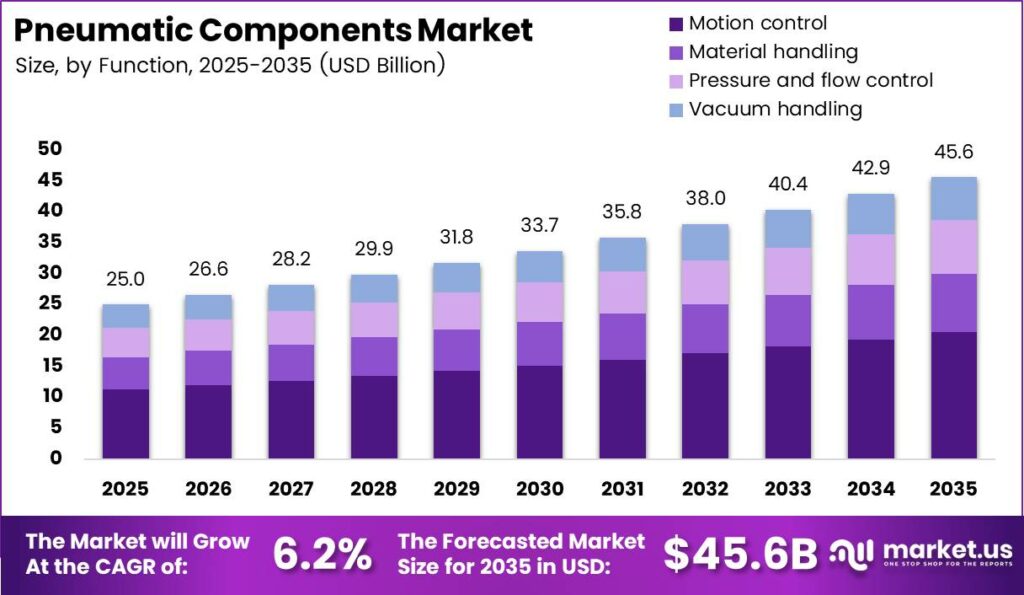
Global Pneumatic Components Market size is expected to be worth around USD 45.6 Billion by 2035 from USD 25.0 Billion in 2025, growing at a CAGR of 6.2% during the forecast period 2026 to 2035.
The pneumatic components market encompasses cylinders, valves, air-treatment units, fittings, tubing, and vacuum devices used to generate, control, and transmit compressed-air power across industrial applications. These components serve as core motion and control elements in automated manufacturing environments spanning automotive, food processing, packaging, electronics, and healthcare sectors. This reflects sustained industrial capital investment across global manufacturing corridors.
Key Takeaways
- The global Pneumatic Components Market is valued at USD 25.0 Billion in 2025 and is forecast to reach USD 45.6 Billion by 2035.
- The market expands at a CAGR of 6.2% during the forecast period 2026 to 2035.
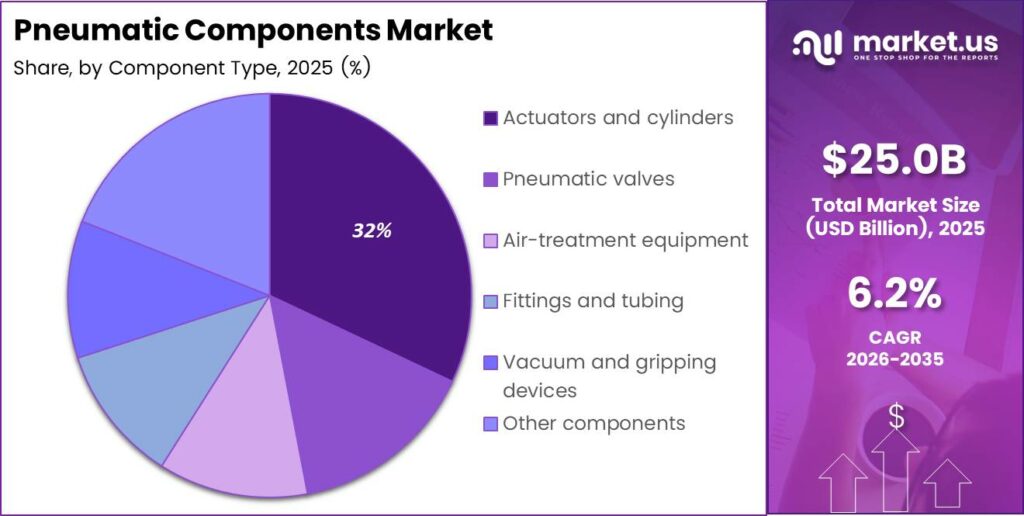
- By Component Type, Actuators and Cylinders dominate with a 32.00% share in 2025.
- By Function, Motion Control holds the leading position with a 40.00% share in 2025.
- By Operation Type, Automatic operations lead with a 58.00% share in 2025.
- By Pressure Range, Medium Pressure (5 to 10 bar) dominates with a 59.00% share in 2025.
- By End-Use Industry, Automotive holds the largest share at 28.00% in 2025.
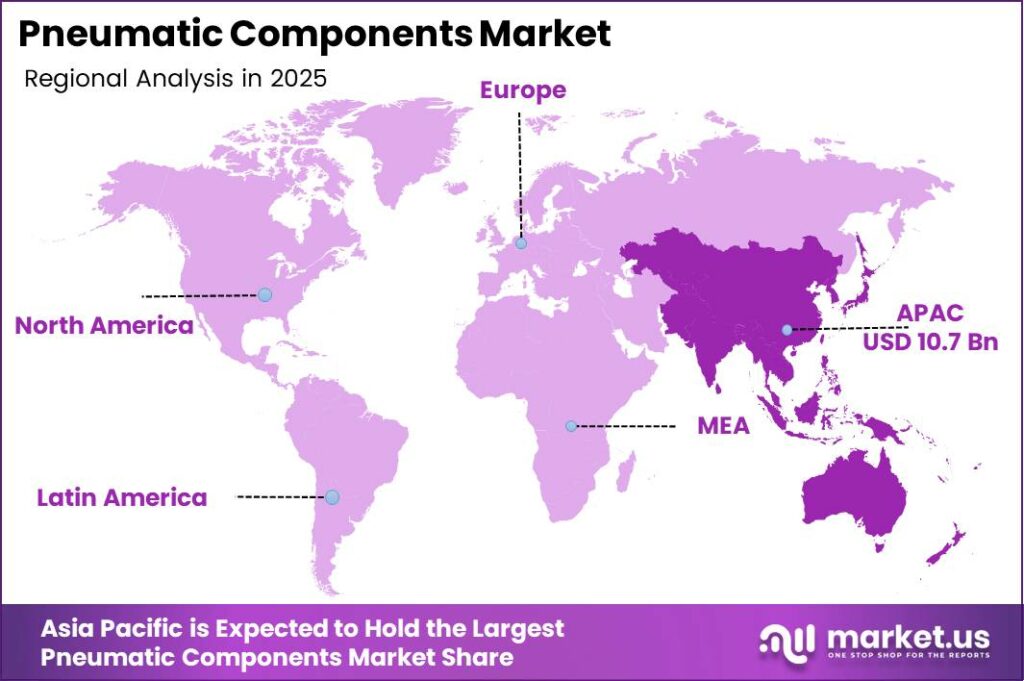
- Asia Pacific is the dominant region with a 43.00% market share, valued at USD 10.7 Billion in 2025.
Global trade grew by approximately $2.5 trillion, or 7.5%, to $35 trillion in 2025, signaling strong cross-border industrial activity that drives equipment procurement cycles. Global economic growth is projected at 3.0% in 2026 and 3.4% in 2027, creating a stable demand foundation for capital equipment. Manufacturers expanding output across emerging and established markets will drive sustained pneumatic component orders through the forecast period.
Worldwide industrial-robot installations totaled 542,076 units in 2024, and each automated cell typically incorporates multiple pneumatic actuators, valves, and grippers. This means robot density growth directly translates into pneumatic component volume. Global manufacturing value added grew by 2.8% in 2023, confirming that factory output expansion underpins replacement and new-installation demand across the sector.
Compressed-air leaks can waste 20% to 30% of compressor output, creating a measurable cost burden that pushes plant operators toward component upgrades and leak-reduction programs. In March 2026, Siemens announced an investment exceeding €200 million for a new intelligent Smart Infrastructure factory, signaling that major industrial players are committing capital to precision-manufacturing environments where high-performance pneumatic components are standard. These investments accelerate both new-installation and replacement demand across the forecast window.
Component Type Analysis
Actuators and Cylinders dominate with 32.00% due to high-cycle mechanical output demand.
In 2025, Actuators and Cylinders held a dominant market position in the By Component Type segment of the Pneumatic Components Market, with a 32.00% share. These components deliver the primary mechanical output in pneumatic circuits, executing clamping, pressing, lifting, and transfer tasks across high-cycle production environments. Collaborative robots accounted for 10.5% of industrial robots installed worldwide in 2023, expanding the addressable market for compact pneumatic end-effectors in shared workspaces.
Pneumatic valves control airflow direction, timing, and pressure sequencing across automated cells and process lines. Their specification increases as machine complexity grows and simultaneous motion axes multiply per station. Festo proportional pneumatic valves support high-pressure operation from 10 bar to 40 bar, enabling this sub-segment to serve both standard industrial and demanding high-force process applications across the full pressure envelope.
Air-treatment equipment, including filters, regulators, and lubricators, maintains compressed-air quality throughout distribution networks and protects downstream components from contamination and pressure instability. This sub-segment benefits from growing awareness that poor air quality shortens actuator and valve service life, increasing total ownership cost. Fittings, tubing, vacuum and gripping devices, and other components fill system-integration roles that grow in unit volume as facility footprints expand and production lines multiply.
Function Analysis
Motion Control dominates with 40.00% due to broad use across automated assembly lines.
In 2025, Motion Control held a dominant market position in the By Function segment of the Pneumatic Components Market, with a 40.00% share. Motion control encompasses linear and rotary actuation tasks that position, clamp, insert, and transfer workpieces across assembly and machining stations. Global machinery and equipment turnover was expected to grow by about 2% in real terms in 2026, sustaining capital spending on motion-intensive pneumatic systems globally.
Material handling covers pick-and-place, conveying, palletizing, and sorting operations where pneumatic grippers and cylinders execute high-repetition tasks with consistent force output. This function segment captures demand from food, beverage, e-commerce, and parcel-sorting sectors where throughput targets drive investment in automated handling solutions. Pressure and flow control functions govern system-level air management, while vacuum handling serves precision part pickup in electronics, glass, and thin-material processing environments.
Operation Type Analysis
Automatic dominates with 58.00% due to widespread factory automation deployment.
In 2025, Automatic operations held a dominant market position in the By Operation Type segment of the Pneumatic Components Market, with a 58.00% share. Fully automated pneumatic circuits eliminate operator intervention in repetitive cycle steps, reducing labor cost per unit and improving throughput consistency across shift changes. World merchandise-trade volume growth was projected to slow from 4.6% in 2025 to 1.9% in 2026, pushing manufacturers toward productivity gains from automation rather than volume-led expansion.
Semi-automatic operation retains a human decision step within a pneumatic-assisted process, serving applications where part variability or quality judgment requires operator input before cycle execution. In September 2025, Parker Hannifin completed the Curtis Instruments acquisition for approximately $1.0 billion, expanding its controls and sensing capability that supports intelligent semi-automatic and fully automatic pneumatic system integration. Manual pneumatic operation, the smallest sub-segment, serves low-volume, low-cycle specialty applications where capital investment in automation cannot be justified.
Pressure Range Analysis
Medium Pressure (5 to 10 bar) dominates with 59.00% due to compatibility with standard industrial equipment.
In 2025, Medium Pressure (5 to 10 bar) held a dominant market position in the By Pressure Range segment of the Pneumatic Components Market, with a 59.00% share. This range aligns with standard ISO and NFPA cylinder specifications and is compatible with the compressed-air infrastructure already installed across most industrial facilities globally. Its dominance reflects design standardization rather than performance preference, creating a structurally stable demand base for valve, actuator, and fitting suppliers.
Low-pressure operation, defined as up to 5 bar, serves lightweight assembly, electronics handling, and precision gripping applications where excess force risks damaging delicate components or workpieces. High-pressure operation, above 10 bar, addresses heavy-duty clamping, stamping, and press applications in metalworking and structural manufacturing where standard actuator bore sizes cannot generate required output forces without elevated supply pressure.
End-Use Industry Analysis
Automotive dominates with 28.00% due to high pneumatic content per vehicle assembly line.
In 2025, Automotive held a dominant market position in the By End-Use Industry segment of the Pneumatic Components Market, with a 28.00% share. Vehicle assembly lines are among the most pneumatic-intensive manufacturing environments, with cylinders, grippers, and valve manifolds executing thousands of cycles per shift in body welding, painting, trim fitting, and engine assembly operations. Global motor-vehicle production reached 96.4 million units in 2025, sustaining high replacement and expansion demand for automotive pneumatic components.
Food and beverages require pneumatic systems certified for hygienic operation, including stainless-steel actuators, non-toxic lubricants, and IP-rated enclosures that withstand wash-down environments. U.S. food-and-beverage industrial-robot installations rose 21% to 2,200 units in 2024, signaling automation investment that directly expands pneumatic component content per production line in this sector.
Packaging lines depend on pneumatic actuators and vacuum systems for sealing, labeling, cartoning, and palletizing at high throughput rates. Europe produced approximately 49 billion square metres of corrugated board in 2024, reflecting the scale of packaging output that drives sustained pneumatic equipment demand across European converting and logistics operations. Electronics and semiconductors, healthcare and pharmaceuticals, chemicals, oil and gas, and other industries collectively absorb the remaining market share across diverse application environments with differing pressure, purity, and certification requirements.
Key Market Segments
By Component Type
- Actuators and Cylinders
- Pneumatic Valves
- Air-Treatment Equipment
- Fittings and Tubing
- Vacuum and Gripping Devices
- Other Components
By Function
- Motion Control
- Material Handling
- Pressure and Flow Control
- Vacuum Handling
By Operation Type
- Automatic
- Semi-Automatic
- Manual
By Pressure Range
- Low Pressure: Up to 5 bar
- Medium Pressure: 5 to 10 bar
- High Pressure: Above 10 bar
By End-Use Industry
- Automotive
- Food and Beverages
- Packaging
- Electronics and Semiconductors
- Healthcare and Pharmaceuticals
- Chemicals, Oil, and Gas
- Other Industries
Regional Analysis
Asia Pacific Dominates the Pneumatic Components Market with a Market Share of 43.00%, Valued at USD 10.7 Billion
Asia Pacific leads the global Pneumatic Components Market, driven by concentrated manufacturing activity across China, Japan, South Korea, India, and Southeast Asia. Asia accounted for 74% of worldwide industrial-robot deployments in 2024, establishing the region as the single largest destination for automated production systems that generate pneumatic component demand. This concentration of automation investment reinforces Asia Pacific’s structural advantage as the dominant consuming region through the forecast period.
North America represents the fastest-growing developed-market region, anchored by U.S. manufacturing investment and reshoring activity across automotive, electronics, and defense sectors. U.S. manufacturing generated approximately $7.0 trillion in total revenue during 2024, reflecting an industrial base of sufficient scale to absorb premium pneumatic system upgrades at volume. In June 2025, Eaton agreed to acquire Ultra PCS Limited for $1.55 billion, signaling continued strategic investment in advanced industrial control and actuation capabilities serving North American manufacturers.
Europe maintains a significant installed base of pneumatic systems across German, Italian, and French engineering and automotive sectors. EU sold industrial production was valued at €5.992 trillion in 2023, confirming the scale of industrial output that sustains regional pneumatic component replacement and upgrade cycles. Latin America and the Caribbean was projected to grow by 2.1% in 2026, while MENAP economic growth was projected to slow to 1.4% in 2026. Approximately 20% of global oil consumption and LNG trade flows through the Strait of Hormuz, making energy-sector stability a direct variable in Middle East and Africa pneumatic procurement capacity.
Key Regions and Countries
North America
- US
- Canada
Europe
- Germany
- France
- The UK
- Spain
- Italy
- Rest of Europe
Asia Pacific
- China
- Japan
- South Korea
- India
- Australia
- Rest of APAC
Latin America
- Brazil
- Mexico
- Rest of Latin America
Middle East and Africa
- GCC
- South Africa
- Rest of MEA
Market Dynamics
Market Opportunity Analysis - Underserved regions and niche segments offer structural entry points for new pneumatic component suppliers
India’s manufacturing localization program creates a concentrated entry window for pneumatic component suppliers not yet established in South Asian supply chains. New automotive, electronics, and pharmaceutical plants in India specify pneumatic content from greenfield build, meaning early-entrant suppliers with local stocking and service capability capture long-term installed-base positions before incumbent distributors consolidate coverage. This asymmetry favors smaller specialist suppliers willing to invest ahead of peak demand.
Typical compressed-air systems can save approximately 30% of energy use through efficiency improvements, yet most brownfield facilities still operate without connected monitoring or systematic leak-management programs. This gap defines a measurable retrofit opportunity across the global installed manufacturing base. Suppliers that package air-audit services, monitoring hardware, and performance contracts together can access spending that would otherwise flow to utility cost reduction rather than component procurement.
The healthcare and pharmaceuticals end-use segment, identified in the market’s segment structure, operates under regulatory requirements that create high switching costs once a pneumatic supplier is qualified into a production environment. By contrast, this same barrier reduces the competitive intensity that established suppliers face after initial qualification. New entrants willing to invest in hygienic product design and regulatory documentation can secure defensible long-term positions in this segment ahead of broader market consolidation.
Vacuum and gripping devices represent a structurally underexploited sub-segment within the broader component type landscape as electronics and semiconductor manufacturers expand production capacity. These applications require contamination-controlled, precision-performance gripping systems that command premium pricing and carry higher gross margins than standard cylinders or fittings. Suppliers that develop dedicated cleanroom-compatible vacuum product lines can capture disproportionate value from semiconductor capital investment cycles.
Technology and Innovation Landscape - Component miniaturization, energy efficiency, and digital integration redefine competitive differentiation in pneumatic systems
The ctrlX AUTOMATION architecture can reduce automation-component and engineering costs by 30% to 50%, demonstrating that integrated software-hardware platforms deliver measurable economic outcomes beyond hardware-only pneumatic installations. This cost compression shifts competitive differentiation from component unit price to system-level total cost of ownership. Suppliers that embed digital configuration, diagnostics, and remote-monitoring capability into their product architecture gain a structural pricing advantage over commodity-component vendors.
A 10°F reduction in compressed-air inlet temperature can produce approximately 2% energy savings, illustrating how system-level thermal management creates compounding efficiency gains when combined with leak reduction and pressure optimization programs. Festo compact proportional pneumatic equipment supports pressure ranges from -1 bar to 6 bar, enabling a single product platform to address both standard positive-pressure actuation and vacuum-generation applications across diverse manufacturing environments.
SMC pneumatic-cylinder sizing optimization can reduce air consumption by up to 29%, confirming that right-sizing actuator bore and stroke to actual load requirements delivers material energy reductions without system redesign. This capability allows suppliers to offer engineering-led service engagements that reduce customer operating costs while increasing specification loyalty and repeat procurement. In January 2026, Bosch Rexroth advanced its ctrlX DRIVE cabinet-free platform with energy losses reduced by up to 60%, setting a benchmark for drive-system efficiency that raises customer expectations for all automation components including pneumatic systems.
Drivers
Factory automation expansion is the largest active contributor to pneumatic component demand as manufacturers convert manual assembly, sorting, clamping, and material-transfer tasks into repeatable machine cycles. Pneumatic cylinders and valve manifolds remain cost-competitive versus servo-motion architectures for simple point-to-point tasks, supporting an estimated +1.4% incremental contribution to the baseline CAGR. Suppliers that shorten commissioning time defend margins despite commodity pricing on standard cylinders and fittings.
Energy-saving air retrofits contribute an estimated +1.1% to the baseline CAGR as plant operators face rising electricity costs and corporate decarbonization targets. Packaging-line modernization across food, beverage, and pharmaceutical hubs adds an estimated +0.9%, driven by throughput targets and hygiene certification requirements. Automotive assembly localization in India, Mexico, and Southeast Asia contributes an estimated +0.8% as new plants specify pneumatic content from groundup installation programs.
| Driver | (~) % Impact on CAGR Forecast | Geographic Relevance | Impact Timeline |
|---|---|---|---|
| Factory automation expansion | +1.4% | Global; strongest in East Asia, North America, Western Europe | Short term (≤ 2 years) |
| Energy-saving air retrofits | +1.1% | Europe, North America, Japan, China | Short term (≤ 2 years) |
| Packaging-line modernization | +0.9% | Global; food, beverage, pharmaceutical hubs | Medium term (2–4 years) |
| Automotive assembly localization | +0.8% | India, Mexico, United States, Southeast Asia | Medium term (2–4 years) |
| Compact robotic end-effectors | +0.7% | East Asia, Europe, North America | Medium term (2–4 years) |
| Hygienic processing investments | +0.6% | Europe, North America, India, China | Short term (≤ 2 years) |
Restraints
Compressed-air operating cost is the most immediate structural restraint because pneumatic component purchases commit end users to long-lived utility burdens involving compressor electricity, air treatment, leak detection, and pressure management. Reducing system pressure by only 1 bar can materially lower compressor energy demand in appropriately engineered networks. This dynamic shifts commercial value from standard replacement sales toward engineered air-audit, monitoring, and retrofit packages.
Electric-actuator substitution imposes an estimated -1.0% deduction from the baseline CAGR as servo and stepper drives displace pneumatics in variable-position and force-controlled applications across Europe, North America, Japan, and China. Industrial CapEx deferrals in Europe and export-oriented Asian manufacturing add an estimated -0.8% drag as customers delay new-cell investment during periods of demand uncertainty. Certification compliance costs, commodity-component price pressure, and weak discrete-manufacturing demand in Germany, Italy, South Korea, and China compound this structural headwind.
| Restraint | (~) % Impact on CAGR Forecast | Geographic Relevance | Impact Timeline |
|---|---|---|---|
| Compressed-air operating cost | -1.3% | Global; most acute in high-power-cost markets | Short term (≤ 2 years) |
| Electric-actuator substitution | -1.0% | Europe, North America, Japan, China | Medium term (2–4 years) |
| Industrial CapEx deferrals | -0.8% | Europe, export-oriented Asian manufacturing | Short term (≤ 2 years) |
| Certification compliance cost | -0.6% | European Economic Area, United Kingdom, North America | Medium term (2–4 years) |
| Commodity-component price pressure | -0.5% | Global; particularly price-sensitive emerging markets | Short term (≤ 2 years) |
| Weak discrete-manufacturing demand | -0.5% | Germany, Italy, South Korea, China | Short term (≤ 2 years) |
Challenges
Semiconductor-grade component qualification imposes the largest ceiling on addressable growth because pneumatic equipment used in wafer handling, cleanroom automation, and high-purity environments must meet strict requirements for particle generation, outgassing, material compatibility, and contamination control. A routine design change in general manufacturing can require customer revalidation lasting several months to more than 1 year in this segment. This friction drag imposes an estimated -0.9% on maximum market growth potential.
Skilled maintenance technician gaps impose an estimated -0.8% friction drag as aging industrial workforces reduce the capacity to diagnose, tune, and repair complex pneumatic circuits at the plant level. Fragmented distributor inventories across emerging industrial markets create fulfillment delays that slow adoption of new pneumatic system architectures. Contamination-control reliability challenges in food, pharmaceutical, and electronics environments, cross-border supply volatility in concentrated Asian supply corridors, and interoperability data gaps across North America, Europe, and East Asia compound the overall challenge load on market growth.
| Challenge | (~) % CAGR Friction Drag | Geographic Relevance | Mitigation Horizon |
|---|---|---|---|
| Semiconductor-grade component qualification | -0.9% | East Asia, United States, Europe | Long term (≥ 4 years) |
| Skilled maintenance technician gaps | -0.8% | Global; acute in aging industrial workforces | Medium term (2–4 years) |
| Fragmented distributor inventories | -0.7% | Global; especially emerging industrial markets | Medium term (2–4 years) |
| Contamination-control reliability | -0.6% | Food, pharmaceutical, electronics manufacturing regions | Medium term (2–4 years) |
| Cross-border supply volatility | -0.6% | Global; concentrated Asian supply corridors | Short term (≤ 2 years) |
| Interoperability data gaps | -0.5% | North America, Europe, East Asia | Long term (≥ 4 years) |
Opportunities
Connected air-management platforms represent the largest untapped opportunity because most installed pneumatic networks still treat compressed air as an unmetered utility. A platform integrating valve-terminal diagnostics, point-of-use pressure sensing, leak analytics, and outcome-linked service contracts can reduce compressed-air consumption by approximately 10 to 20% in suitable applications. This transition lifts gross-margin potential by roughly 5 to 10 percentage points versus hardware-only transactions, adding an estimated +1.3% above the baseline CAGR.
Aftermarket leak-performance contracts offer an estimated +1.0% CAGR upside across the global installed manufacturing base by converting one-time hardware sales into recurring service revenue. India manufacturing localization adds an estimated +0.9% potential upside as new automotive, electronics, and pharmaceutical plants specify pneumatic content from greenfield builds. Medical automation applications, circular remanufacturing programs, and regional distributor roll-ups across India, Southeast Asia, Latin America, and Africa provide further upside layers for suppliers that enter early and build local service capability.
| Opportunity | (~) % Potential CAGR Upside | Geographic Relevance | Execution Window |
|---|---|---|---|
| Connected air-management platforms | +1.3% | Europe, North America, Japan, China | Medium term (2–4 years) |
| Aftermarket leak-performance contracts | +1.0% | Global installed manufacturing base | Short term (≤ 2 years) |
| India manufacturing localization | +0.9% | India and South Asia | Medium term (2–4 years) |
| Medical automation applications | +0.8% | North America, Europe, East Asia, India | Long term (≥ 4 years) |
| Circular remanufacturing programs | +0.7% | Europe, North America, Japan | Medium term (2–4 years) |
| Regional distributor roll-ups | +0.6% | India, Southeast Asia, Latin America, Africa | Medium term (2–4 years) |
Key Company Insights
SMC Corporation reported consolidated net sales of ¥842.5 billion, reflecting its position as the world’s largest pneumatic component manufacturer by revenue. SMC compact guide cylinders offer up to 28% lower volume and 41% lower weight, making their actuator portfolio directly competitive in space-constrained robotic and automated assembly cells where envelope reduction is a primary design constraint.
Festo SE & Co. KG generated €3.33 billion in sales revenue and employed approximately 20,600 people in 2025, confirming its standing as a major global pneumatic and automation technology supplier. Festo’s VTEP proportional valve terminal delivers pressure-control precision of ±2 millibars, a performance level that addresses high-accuracy dispensing, clamping, and process-control applications where standard on-off valves cannot meet cycle-to-cycle consistency requirements.
In May 2026, Parker Hannifin agreed to acquire CIRCOR’s commercial and defense aerospace business for $2.55 billion, extending its motion and control portfolio into high-specification aerospace pneumatic and fluid-handling applications. Parker Hannifin fiscal-year 2026 net sales increased 8.3% to $21.50 billion, and in March 2025, Siemens committed $285 million to two U.S. electrical-products manufacturing facilities expected to create more than 900 jobs, reinforcing both companies’ strategic investment in North American industrial manufacturing infrastructure.
Key Players
- SMC Corporation
- Festo SE & Co. KG
- Parker Hannifin Corporation
- Emerson Electric Co.
- Bosch Rexroth AG
- IMI plc (Norgren)
- CKD Corporation
- AirTAC International Group
- Camozzi Automation S.p.A.
- Siemens AG
- Eaton Corporation plc
- ROSS Controls
- Janatics India Private Limited
- Metal Work S.p.A.
- PNEUMAX S.p.A.
Recent Developments
- September 2026 – Eaton signed an agreement to acquire COL Group for an enterprise value of €810 million, expanding its industrial components portfolio into new European market segments.
- August 2026 – Parker Hannifin completed the $9.25 billion acquisition of Filtration Group, significantly expanding its filtration and fluid-management capabilities across industrial and process markets.
- May 2026 – Siemens reached $1 billion in cumulative U.S. manufacturing investments, supporting more than 2,200 projected jobs across American industrial and infrastructure production sites.
- January 2026 – Bosch Rexroth advanced its ctrlX DRIVE cabinet-free platform, with energy losses reduced by up to 60%, setting a new benchmark for drive-system efficiency in automated manufacturing environments.
- March 2025 – Emerson completed the acquisition of the remaining AspenTech shares for approximately $7.2 billion, consolidating its industrial software and process-automation portfolio under a unified ownership structure.
- March 2025 – Eaton completed the Fibrebond acquisition for $1.4 billion, strengthening its modular infrastructure and enclosure capabilities serving power-intensive industrial and data-center markets.
Report Scope
| Report Features | Description |
|---|---|
| Market Value (2025) | USD 25.0 Billion |
| Forecast Revenue (2035) | USD 45.6 Billion |
| CAGR (2026-2035) | 6.2% |
| Base Year for Estimation | 2025 |
| Historic Period | 2020-2024 |
| Forecast Period | 2026-2035 |
| Report Coverage | Revenue Forecast, Market Dynamics, Market Opportunity Analysis, Technology and Innovation Landscape, Competitive Landscape, Recent Developments |
| Segments Covered | By Component Type (Actuators and Cylinders, Pneumatic Valves, Air-Treatment Equipment, Fittings and Tubing, Vacuum and Gripping Devices, Other Components), By Function (Motion Control, Material Handling, Pressure and Flow Control, Vacuum Handling), By Operation Type (Automatic, Semi-Automatic, Manual), By Pressure Range (Low Pressure: Up to 5 bar, Medium Pressure: 5 to 10 bar, High Pressure: Above 10 bar), By End-Use Industry (Automotive, Food and Beverages, Packaging, Electronics and Semiconductors, Healthcare and Pharmaceuticals, Chemicals, Oil, and Gas, Other Industries) |
| Regional Analysis | North America (US and Canada), Europe (Germany, France, The UK, Spain, Italy, and Rest of Europe), Asia Pacific (China, Japan, South Korea, India, Australia, and Rest of APAC), Latin America (Brazil, Mexico, and Rest of Latin America), Middle East and Africa (GCC, South Africa, and Rest of MEA) |
| Competitive Landscape | SMC Corporation, Festo SE & Co. KG, Parker Hannifin Corporation, Emerson Electric Co., Bosch Rexroth AG, IMI plc (Norgren), CKD Corporation, AirTAC International Group, Camozzi Automation S.p.A., Siemens AG, Eaton Corporation plc, ROSS Controls, Janatics India Private Limited, Metal Work S.p.A., PNEUMAX S.p.A. |
| Customization Scope | Customization for segments, region/country-level will be provided. Additional customization can be done based on requirements. |
| Purchase Options | We have three licenses to opt for: Single User License, Multi-User License (Up to 5 Users), Corporate Use License (Unlimited User and Printable PDF) |





































