


Report Overview
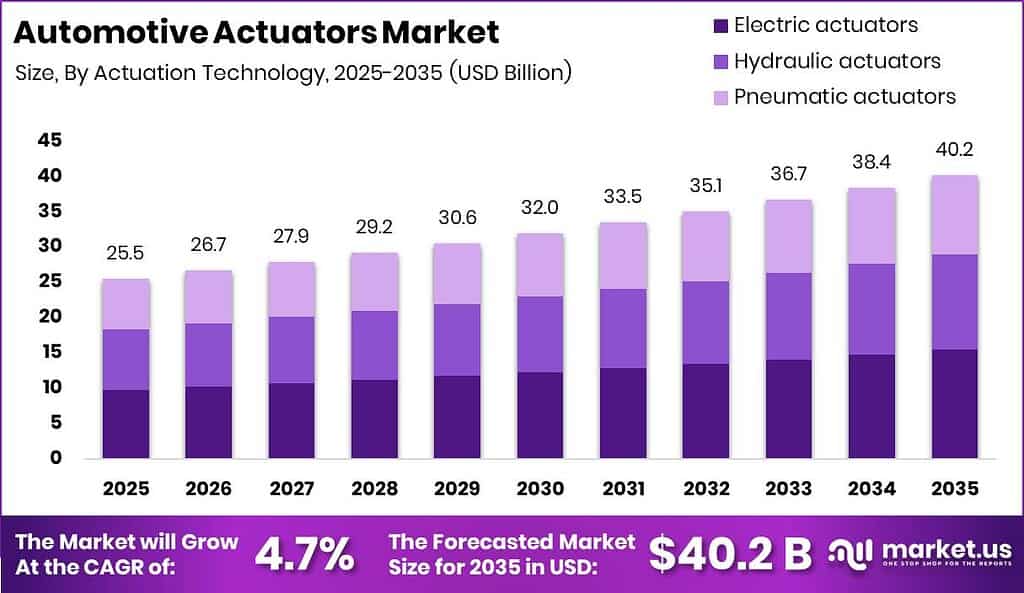
Global Automotive Actuators Market size is expected to be worth around USD 40.2 Billion by 2035 from USD 25.5 Billion in 2025, growing at a CAGR of 4.7% during the forecast period 2026 to 2035.
Automotive actuators convert electrical, hydraulic, or pneumatic energy into mechanical motion that controls braking, steering, throttle, and comfort functions inside a vehicle. This market spans passenger cars, light commercial vehicles, and heavy commercial vehicles. Therefore, actuator demand tracks closely with vehicle production volumes and the pace of electrification across global fleets.
Key Takeaways
- Global Automotive Actuators Market size is projected to reach USD 40.2 Billion by 2035, up from USD 25.5 Billion in 2025.
- The market is expanding at a CAGR of 4.7% between 2026 and 2035.
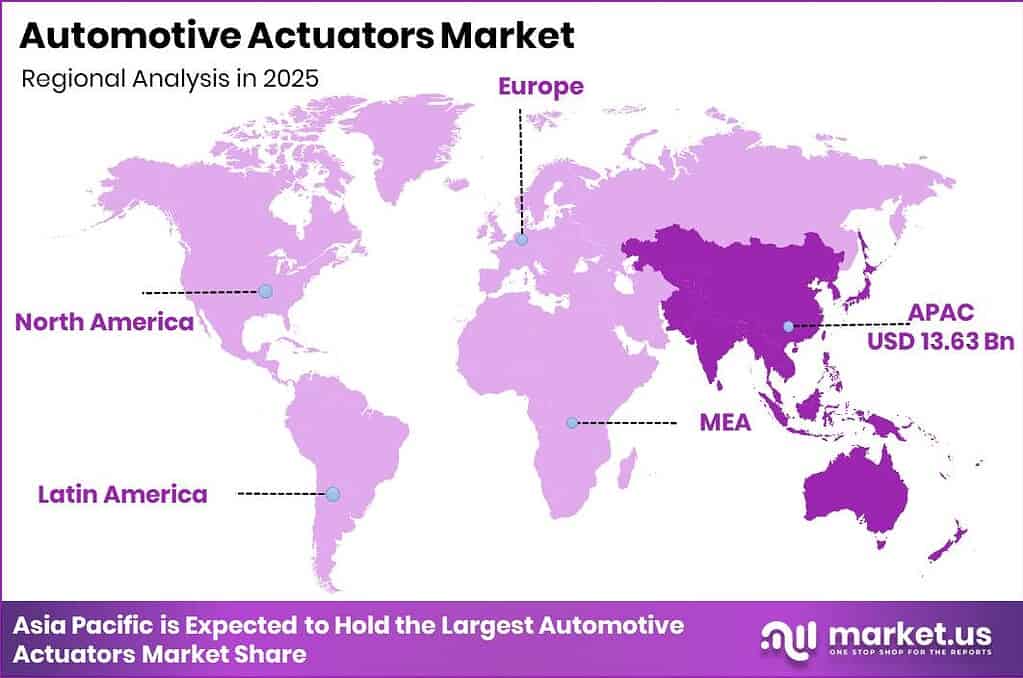
- Asia Pacific dominates the market with a 53.4% share, valued at USD 13.63 Billion.
- Brake actuators lead the By Product Type segment with a 25.6% share and are the fastest growing category.
- Electric actuators dominate By Actuation Technology with a 38.4% share and remain the fastest growing technology.
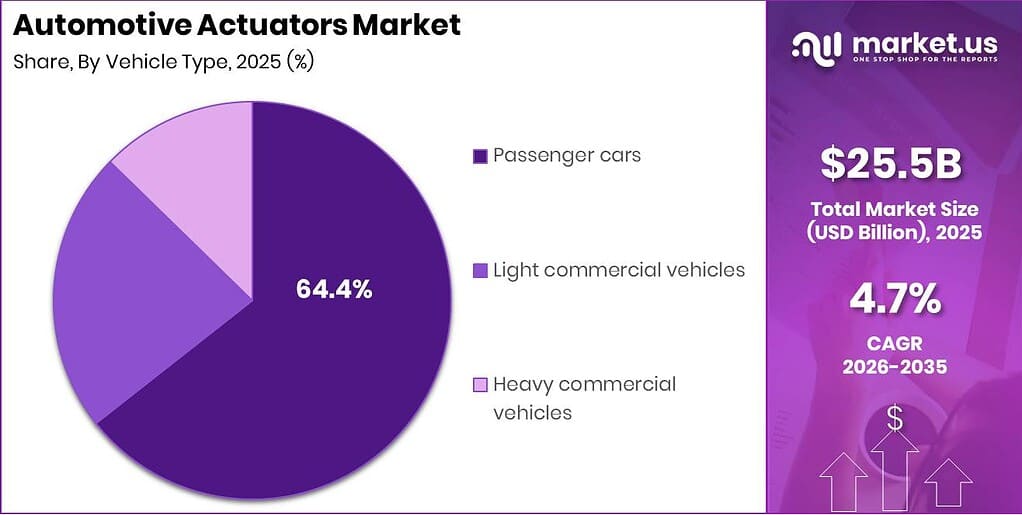
- Passenger cars hold the largest By Vehicle Type share at 64.4% and are growing fastest.
- Powertrain control leads By Propulsion with a 35.6% share, while chassis and brake control is the fastest growing category.
Governments across major auto producing regions continue tightening emissions and safety mandates that push automakers toward electromechanical actuation. This means suppliers face growing pressure to replace mechanical linkages with motor driven units for braking, steering, and thermal management. As a result, actuator content per vehicle rises even when overall unit production stays flat.
Vehicle recalls tied to electrical systems accounted for 822,000 units in Q1 2025, representing 23.74% of total recall volume that quarter. Faulty actuator wiring and control modules drive a meaningful share of this figure. Consequently, OEMs are investing in tighter actuator quality validation before vehicles reach production lines.
In October 2025, Bosch introduced its next generation brake-by-wire technology at the Japan Mobility Show, removing the mechanical link between the brake pedal and braking system. Series production is scheduled to begin in early 2026. This signals a broader industry shift toward fully electromechanical braking architectures ahead of regulatory deadlines in key markets.
Product Type Analysis
Brake actuators dominates with 25.6% due to rising brake-by-wire safety mandates.
In 2025, Brake actuators held a dominant market position in the By Product Type segment of Automotive Actuators Market, with a 25.6% share. Continental’s MK C2 brake-by-wire system generates brake pressure within 150 milliseconds when an automated-driving function requests braking, according to a March 2025 manufacturer disclosure. This speed advantage supports faster regulatory approval for autonomous braking features. Suppliers investing early in brake-by-wire hardware gain a structural head start over competitors still reliant on hydraulic linkages.
Throttle actuators regulate engine air intake and remain essential even as electrification expands across the fleet. Bosch’s electronic throttle valve achieves an actuation time under 100 milliseconds at t90, based on published Bosch mobility specifications. Bosch also manufactures throttle valves ranging from 32 to 64 millimeters in diameter across its passenger car lineup. Faster response times let automakers meet tightening fuel economy calibration targets without redesigning engine control systems.
EGR actuators and wastegate actuators support emissions control on internal combustion and hybrid powertrains. These components manage exhaust gas recirculation and turbocharger boost pressure, functions that remain necessary through the hybrid transition period. Automakers extending combustion engine production lines depend on these actuators to hold emissions compliance without costly engine redesigns, sustaining demand even as electric vehicle volumes climb.
HVAC actuators, power seat actuators, power window actuators, and other actuators including headlamp units collectively hold the remaining share of this segment. These components drive comfort and convenience features that automakers use to differentiate trim levels. Rising premium feature penetration across mid-range vehicles supports steady replacement and upgrade demand for this combined actuator group.
Actuation Technology Analysis
Electric actuators dominates with 38.4% due to precise software controlled motion delivery.
In 2025, Electric actuators held a dominant market position in the By Actuation Technology segment of Automotive Actuators Market, with a 38.4% share. ZF’s steer-by-wire system limits maximum steering wheel rotation to between 180 and 210 degrees, cutting travel compared with conventional multi-turn steering. This shorter rotation range improves driver ergonomics in software defined vehicles. Suppliers building steer-by-wire capability now position themselves ahead of upcoming active safety mandates in North America and Europe.
Hydraulic actuators deliver high force output and remain standard in heavy braking and steering applications. These actuators depend on fluid pressure systems that require regular maintenance across commercial fleets. Fleet operators favor hydraulic systems for their proven durability under heavy loads, sustaining demand in commercial vehicle segments even as electric alternatives expand in passenger cars.
Pneumatic actuators use compressed air to operate braking and suspension systems primarily in heavy commercial vehicles. Their simple design and low cost make them attractive for cost sensitive fleet operators in developing markets. Manufacturers serving heavy duty truck segments continue supplying pneumatic systems where electrification remains commercially impractical due to duty cycle demands.
Vehicle Type Analysis
Passenger cars dominates with 64.4% due to high per vehicle comfort actuator counts.
In 2025, Passenger cars held a dominant market position in the By Vehicle Type segment of Automotive Actuators Market, with a 64.4% share. Passenger vehicles carry a growing number of actuators per unit as automakers add power seats, power windows, and climate features across trim levels. Structural growth in global light vehicle output tracked by national statistical offices supports this actuator volume base. Suppliers targeting passenger platforms capture the widest addressable unit count in the market.
Light commercial vehicles rely on actuators for braking, throttle, and cargo area comfort systems used across delivery and service fleets. Fleet electrification programs in urban logistics are pushing operators toward electric actuator retrofits for lower maintenance costs. Suppliers offering retrofit compatible actuator kits stand to capture recurring aftermarket revenue from this expanding delivery fleet base.
Heavy commercial vehicles depend on rugged pneumatic and hydraulic actuators built for continuous duty braking and suspension control. These vehicles favor proven mechanical systems over newer electric alternatives due to payload and reliability requirements. Component durability standards published by national regulatory bodies keep replacement cycles long, creating steady but slower unit turnover than passenger platforms.
Propulsion Analysis
Powertrain control dominates with 35.6% due to core engine and motor actuation needs.
In 2025, Powertrain control held a dominant market position in the By Propulsion segment of Automotive Actuators Market, with a 35.6% share. Powertrain actuators manage throttle, gear shifting, and motor cooling functions across both combustion and electric platforms. Global vehicle production volumes tracked by OICA confirm the broad installed base these components serve. Suppliers with actuators compatible across both propulsion types reduce platform specific engineering costs.
Chassis and brake control actuators are the fastest growing category as automakers adopt brake-by-wire and steer-by-wire architectures. These systems remove mechanical linkages, reducing weight while enabling faster software controlled response. Regulatory bodies pushing active safety requirements accelerate adoption timelines, giving early suppliers a durable technology lead over competitors still reliant on hydraulic circuits.
Body and comfort systems and lighting and exterior systems actuators together hold the remaining propulsion category share. These actuators control seats, windows, mirrors, and adaptive headlamp positioning. Rising premium feature demand across mid-market vehicles keeps replacement and new fitment volumes steady for this combined actuator group.
Key Market Segments
By Product Type
- Brake actuators
- Throttle actuators
- EGR actuators
- Wastegate actuators
- HVAC actuators
- Power seat actuators
- Power window actuators
- Others (Headlamp, etc.)
By Actuation Technology
- Electric actuators
- Hydraulic actuators
- Pneumatic actuators
By Vehicle Type
- Passenger cars
- Light commercial vehicles
- Heavy commercial vehicles
By Propulsion
- Powertrain control
- Chassis and brake control
- Body and comfort systems
- Lighting and exterior systems
Regional Analysis
Asia Pacific Dominates the Automotive Actuators Market with a Market Share of 53.4%, Valued at USD 13.63 Billion
Asia Pacific leads the global market on the strength of its vehicle production base, which anchors regional actuator demand across passenger and commercial segments. China, Japan, South Korea, and India host dense automotive supply chains that keep component sourcing costs low. Automakers expanding local production capacity in this region secure faster access to actuator suppliers than competitors relying on imported components.
North America and Europe show the fastest actuator technology adoption as automakers roll out brake-by-wire and steer-by-wire platforms ahead of active safety mandates. Suppliers such as Bosch and ZF are validating these systems through extensive road testing before regional launches. Automakers in these regions gain earlier regulatory approval pathways by partnering with suppliers already running production validated electromechanical actuator programs.
Key Regions and Countries
North America
- US
- Canada
Europe
- Germany
- France
- The UK
- Spain
- Italy
- Rest of Europe
Asia Pacific
- China
- Japan
- South Korea
- India
- Australia
- Rest of APAC
Latin America
- Brazil
- Mexico
- Rest of Latin America
Middle East and Africa
- GCC
- South Africa
- Rest of MEA
Market Dynamics
Market Opportunity Analysis - Underserved fleets and secondary regions offer clear entry points for new suppliers.
Heavy commercial vehicles remain underexploited relative to passenger cars, holding a smaller share of actuator demand despite carrying rugged pneumatic and hydraulic systems with long replacement cycles. Fleet operators in this category still rely on manual maintenance scheduling. Suppliers offering durable retrofit actuator kits for this vehicle class could capture share before larger rivals shift focus away from passenger platforms.
Body and comfort systems actuators, though a smaller share of the Propulsion segment, benefit from rising premium feature penetration across mid-market vehicles. This means suppliers targeting power seats and windows in non-premium trims can grow volume without competing directly against Tier-1 leaders focused on brake-by-wire technology. Instead, this space rewards cost efficient, high-volume manufacturing strategies.
Latin America and Middle East and Africa remain smaller regional contributors compared with Asia Pacific’s dominant share. Vehicle fleets in these regions are aging, creating replacement part demand outside the tightly contested Asia Pacific and European supplier networks. Therefore, regional distributors entering early can secure exclusive supply relationships before global Tier-1 suppliers expand local footprints.
Technology and Innovation Landscape - Software calibrated actuators and connected diagnostics reshape supplier value
Brake-by-wire systems, such as Continental’s MK C2 platform, eliminate mechanical linkages entirely, generating brake pressure within 150 milliseconds of a software request. This shift moves actuator value from mechanical precision toward software calibration quality. Suppliers investing in control algorithm development, not just hardware manufacturing, capture a larger share of per-unit margin under this new architecture.
Steer-by-wire technology from ZF limits maximum steering wheel rotation to between 180 and 210 degrees, a substantial reduction from conventional multi-turn systems. This design change simplifies cabin layouts for future autonomous driving features. Automakers adopting steer-by-wire early gain flexibility in interior design that competitors using legacy steering columns cannot match.
Over-the-air software updates are changing how automakers manage actuator faults after vehicles reach the road. Of vehicles affected by recalls, 27.7%, representing 961,000 units, could be repaired through over-the-air updates instead of physical actuator replacement. This reduces warranty costs substantially. Automakers building actuator control units with update capability from the outset avoid costly dealer service visits down the line.
Drivers
Rising electric vehicle penetration, reaching roughly 18% of new light vehicle registrations in 2024 per IEA tracking, is reshaping actuator content as automakers replace single mechanical throttle linkages with multiple motor driven units for cooling valves and thermal management. Global vehicle output near 93 million units across 2024 and 2025 confirms the volume base for this shift, with actuator shipments per electrified platform climbing an estimated 15% to 20% based on supplier investor disclosures.
This content escalation lifts Tier-1 gross margins by roughly 250 to 350 basis points as suppliers move from commoditized mechanical parts to electromechanical assemblies. However, rare-earth-free motor winding lead times extending to 30 to 40 weeks are pulling OEM capital decisions forward by 12 to 18 months, accelerating the retirement of legacy hydraulic actuator lines industry wide.
| Driver | (~) % Impact on CAGR Forecast | Geographic Relevance | Impact Timeline |
|---|---|---|---|
| EV Powertrain Electrification and Motor-Driven Actuation | +1.5% | Asia-Pacific core; North America and EU follow | Long term (4 years or more) |
| ADAS and Active-Safety Mandates (Steer-by-Wire, Brake-by-Wire) | +1.0% | EU, North America | Medium term (2 to 4 years) |
| Tightening Emissions and Fuel-Economy Standards | +0.8% | Global | Short term (2 years or less) |
| Asia-Pacific Vehicle Production Expansion | +0.6% | Asia-Pacific | Medium term (2 to 4 years) |
| Software-Defined Vehicle Architecture Adoption | +0.5% | North America, EU | Medium term (2 to 4 years) |
| Rising Premium Comfort Feature Penetration | +0.3% | Global, premium segment first | Short term (2 years or less) |
Restraints
China’s tightened rare-earth export licensing regime, with control measures effective across 2024 and 2025, is constraining global neodymium-praseodymium supply used in electric actuator motor windings. Per USGS pricing series, NdPr prices climbed roughly 20% to 35% amid quota tightening, pushing electric actuator bill-of-materials costs up an estimated 8% to 12%.
This bottleneck compresses Tier-2 supplier gross margins by roughly 150 to 250 basis points and extends component qualification cycles by 6 to 9 months. Consequently, OEMs and Tier-1 suppliers are freezing new electric actuator sourcing commitments and diverting capital toward rare-earth-free switched-reluctance alternatives until input cost volatility stabilizes.
| Restraint | (~) % Impact on CAGR Forecast | Geographic Relevance | Impact Timeline |
|---|---|---|---|
| Elevated Rare-Earth and Specialty Raw-Material Costs | -0.7% | Global | Short term (2 years or less) |
| Semiconductor and MCU Supply Constraints | -0.5% | Global, Asia-Pacific fab-dependent | Short term (2 years or less) |
| High Capex Burden of Retooling Legacy Lines | -0.5% | Europe, North America | Short term (2 years or less) |
| Elevated Interest-Rate Environment Delaying Capex | -0.4% | North America, Europe | Short term (2 years or less) |
| Cross-Border Tariff and Trade Barriers | -0.3% | North America, EU | Short term (2 years or less) |
Challenges
The rapid shift toward sensor-embedded, software-calibrated actuators requires combined mechatronics and embedded-software expertise under functional-safety frameworks such as ISO 26262. SAE International workforce tracking points to tens of thousands of unfilled automotive software and mechatronics roles across North America and Europe heading into 2026, slowing new platform development.
This talent gap extends actuator electronic control unit calibration and safety validation cycles by 4 to 6 months, while outsourced engineering costs rise 15% to 20%. As a result, Tier-1 suppliers are expanding offshore engineering centers in India and Eastern Europe, raising engineering amortization costs but creating new opportunity for regional engineering service providers.
| Challenge | (~) % CAGR Friction Drag | Geographic Relevance | Mitigation Horizon |
|---|---|---|---|
| Mechatronics Talent Shortage | -0.5% | Global, acute Europe and North America | Medium term (2 to 4 years) |
| Software Validation Complexity | -0.4% | Global | Medium term (2 to 4 years) |
| Legacy Platform Retrofit Complexity | -0.3% | Europe, North America | Medium term (2 to 4 years) |
| Networked Actuator Cybersecurity Exposure | -0.3% | Global | Long term (4 years or more) |
| Fragmented Global By-Wire Standards | -0.2% | Global | Long term (4 years or more) |
Opportunities
Today’s actuator revenue comes almost entirely from one-time hardware sales bundled into original vehicle production, leaving the existing in-service parc of over 1.4 billion registered vehicles tracked by OICA without a monetized maintenance layer. Fitting connected sensing modules to actuators approaching their 8 to 10-year replacement window converts a low-margin hardware sale into a recurring service relationship.
This unit-economic shift is substantial. Incremental telematics-module costs of roughly 15 to 25 dollars per unit enable subscription-based predictive-maintenance margins near 60% to 70%, versus 25% to 30% typical of hardware-only supply. Capturing this white space requires investment in retrofit-compatible sensor kits and subscription billing infrastructure that current OEM-centric models do not yet support.
| Opportunity | (~) % Potential CAGR Upside | Geographic Relevance | Execution Window |
|---|---|---|---|
| Aftermarket Retrofit and Predictive-Maintenance Servitization | +0.8% | Global, mature fleets in North America and EU | Medium term (2 to 4 years) |
| Two/Three-Wheeler and Off-Highway Electrification Adjacency | +0.7% | Asia-Pacific, India | Medium term (2 to 4 years) |
| Humanoid Robotics Precision-Actuator Cross-Over | +0.6% | Global | Long term (4 years or more) |
| Roll-Up Consolidation of Fragmented Tier-2 Suppliers | +0.5% | Europe, North America | Medium term (2 to 4 years) |
| Localized Manufacturing Under EV Incentive Schemes | +0.5% | North America, India | Short term (2 years or less) |
| Miniaturized Shape-Memory-Alloy and Piezo Interior Actuators | +0.4% | Global, premium segment first | Long term (4 years or more) |
Key Company Insights
Continental AG holds a technology edge in brake-by-wire systems, with its MK C2 platform generating brake pressure within 150 milliseconds during automated braking requests. This response speed strengthens its position with automakers deploying advanced driver assistance features. However, competitors racing to match this speed threshold could erode Continental’s early mover advantage within the forecast period.
DENSO Corporation supports its actuator lineup with deep integration across throttle and thermal management systems for both combustion and hybrid platforms. In February 2025, Bosch completed over 3,300 kilometers of public-road brake-by-wire testing across multiple climate zones, raising the validation bar rivals like DENSO must clear. DENSO’s broad platform compatibility still gives it resilience against single-technology disruption.
Key Players
- Robert Bosch GmbH
- DENSO Corporation
- Continental AG
- Valeo SE
- Mitsubishi Electric Corporation
- ZF Friedrichshafen AG
- Aisin Corporation
- Hitachi Astemo Ltd.
- BorgWarner Inc.
- Johnson Electric Holdings Limited
- Nidec Corporation
- HELLA GmbH & Co. KGaA
- Magneti Marelli
- Mahle GmbH
- Sensata Technologies
Recent Developments
- January 2025: ADVIK acquired Germany-based Powersports MTG, a manufacturer of mechanical and hydraulic braking and clutch systems, strengthening its hydraulic brake actuator portfolio for premium motorcycles and future mobility applications.
Geopolitical Impact Analysis
Trade tensions between major economies are reshaping actuator supply chains as manufacturers diversify sourcing away from concentrated production hubs. According to the WTO, global merchandise trade growth forecasts have been repeatedly revised amid tariff uncertainty, directly affecting cross-border shipment of actuator components such as motor windings and control modules. As reported by the World Bank, elevated shipping costs compound these pressures for automotive parts manufacturers.
Energy price volatility further strains actuator production costs, since electric actuator manufacturing depends on stable power supply for precision motor winding processes. Data from the IEA shows continued volatility in industrial electricity pricing across major manufacturing regions. This reflects a broader pattern where automakers reliant on single-region actuator sourcing face higher input cost exposure than those with diversified supplier networks across Asia Pacific and Europe.
Report Scope
| Report Features | Description |
|---|---|
| Market Value (2025) | USD 25.5 Billion |
| Forecast Revenue (2035) | USD 40.2 Billion |
| CAGR (2026-2035) | 4.7% |
| Base Year for Estimation | 2025 |
| Historic Period | 2020-2024 |
| Forecast Period | 2026-2035 |
| Report Coverage | Revenue Forecast, Market Dynamics, Market Opportunity Analysis, Technology and Innovation Landscape, Competitive Landscape, Recent Developments |
| Segments Covered | By Product Type (Brake actuators, Throttle, EGR actuators, Wastegate, HVAC actuators, Power seat actuators, Power window, Others), By Actuation Technology (Electric, Hydraulic, Pneumatic), By Vehicle Type (Passenger cars, Light commercial vehicles, Heavy commercial vehicles), By Propulsion (Powertrain control, Chassis and brake control, Body and comfort systems, Lighting and exterior systems) |
| Regional Analysis | North America (US and Canada), Europe (Germany, France, The UK, Spain, Italy, and Rest of Europe), Asia Pacific (China, Japan, South Korea, India, Australia, and Rest of APAC), Latin America (Brazil, Mexico, and Rest of Latin America), Middle East and Africa (GCC, South Africa, and Rest of MEA) |
| Competitive Landscape | Robert Bosch GmbH, DENSO Corporation, Continental AG, Valeo SE, Mitsubishi Electric Corporation, ZF Friedrichshafen AG, Aisin Corporation, Hitachi Astemo Ltd., BorgWarner Inc., Johnson Electric Holdings Limited, Nidec Corporation, HELLA GmbH & Co. KGaA, Magneti Marelli, Mahle GmbH, Sensata Technologies |
| Customization Scope | Customization for segments, region / country-level will be provided. Additional customization can be done based on requirements. |
| Purchase Options | We have three licenses to opt for: Single User License | Multi-User License (Up to 5 Users) | Corporate Use License (Unlimited User and Printable PDF) |





































