


Report Overview
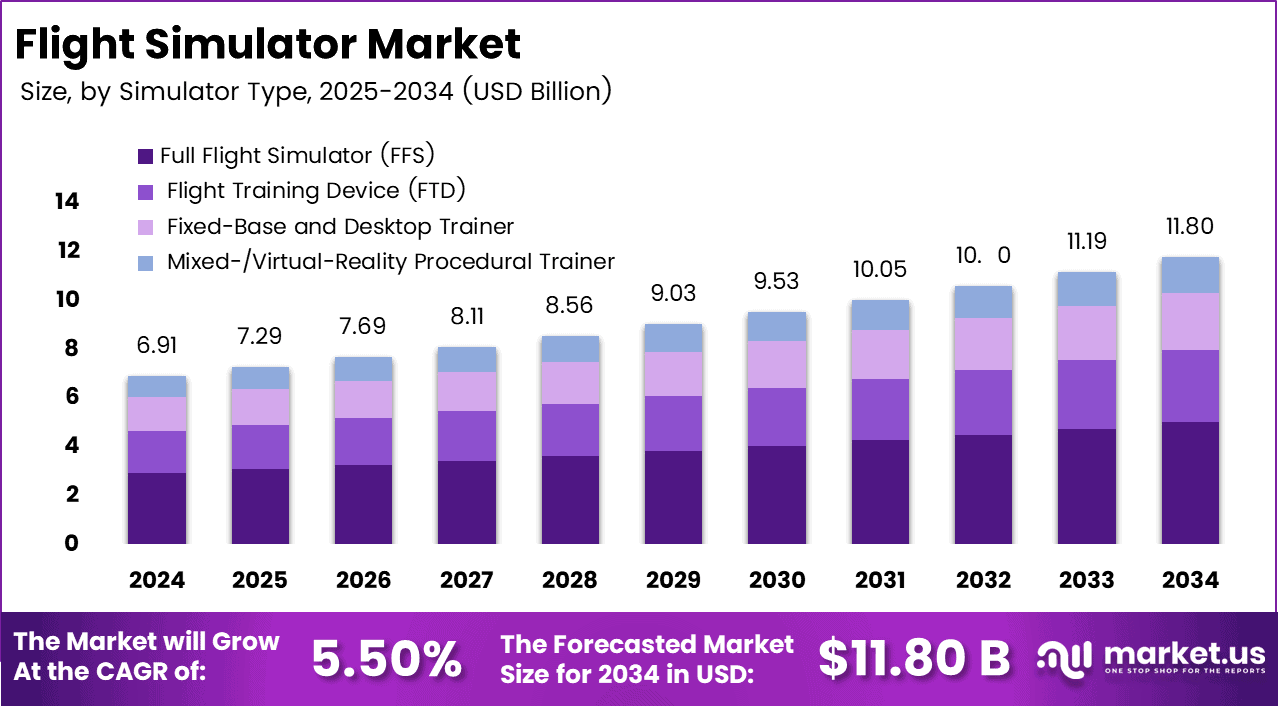
In 2024, the Global Flight Simulator Market was valued at USD 6.9 billion. The market is projected to grow at a CAGR of 5.5% during 2025–2034, reaching approximately USD 11.1 billion by 2034. North America dominated the global market in 2024, accounting for more than 41.3% of the total market share and generating approximately USD 2.85 billion in revenue.
Global air passenger traffic increased by 10.4% in 2024 and stood 3.8% above 2019 levels, while passenger volumes crossed 9.5 billion travelers. Rising air travel is increasing the need for safe and cost-efficient pilot training.
A major growth driver is the expected shortage of trained pilots. Boeing estimates that the aviation industry will require around 674,000 new pilots through 2043, including about 123,000 in North America. Nearly two-thirds of new hiring is expected to replace retiring pilots, creating sustained demand for simulator-based training.
In the U.S., active pilot certificates reached 848,770 by the end of 2024, while commercial pilot certificates increased by 2.8% during the year. North America accounts for more than 41.3% of global flight simulator revenue, representing about USD 2.85 billion, supported by strong pilot recruitment, airline expansion, and continued investment in aviation training infrastructure.
Key Takeaways
- The Flight Simulator Market size by simulator type is projected to grow from USD 6.9 billion in 2024 to USD 11.8 billion by 2034, with a CAGR of 5.5%.
- Hardware leads the US flight simulator market with a 58% share in 2024 and is projected to retain about 56.2% by 2034, supported by demand for advanced simulator hardware.
- Full Flight Simulators (FFS) dominate the simulator type segment with a 42.5% share in 2024, driven by pilot certification and regulatory training requirements.
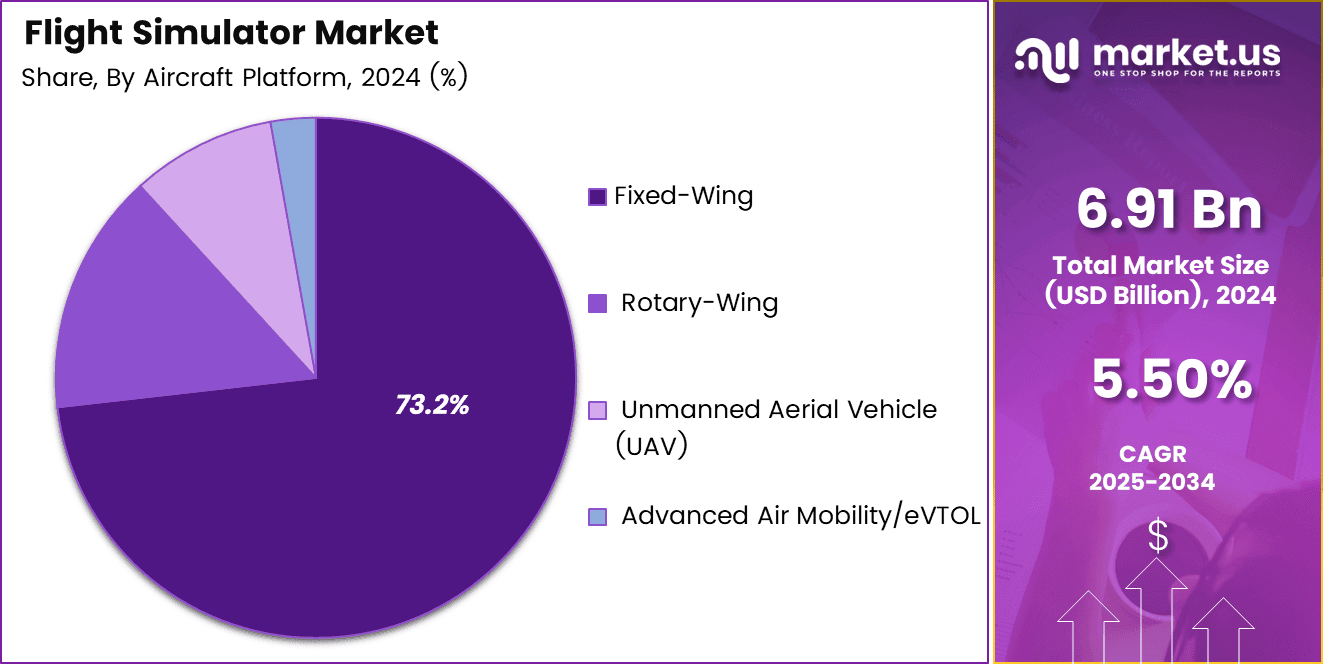
- Fixed-wing aircraft platforms hold the largest share at 73.2% in 2024, supported by strong demand from commercial airlines, business aviation, and military fleets.
- Synthetic training methods dominate with an 80.7% share in 2024, reflecting their wide use for safe, high-fidelity commercial and military pilot training.
- North America is anticipated to hold the largest share of the global Flight Simulator Market in 2024, valued at USD 2.85 billion.
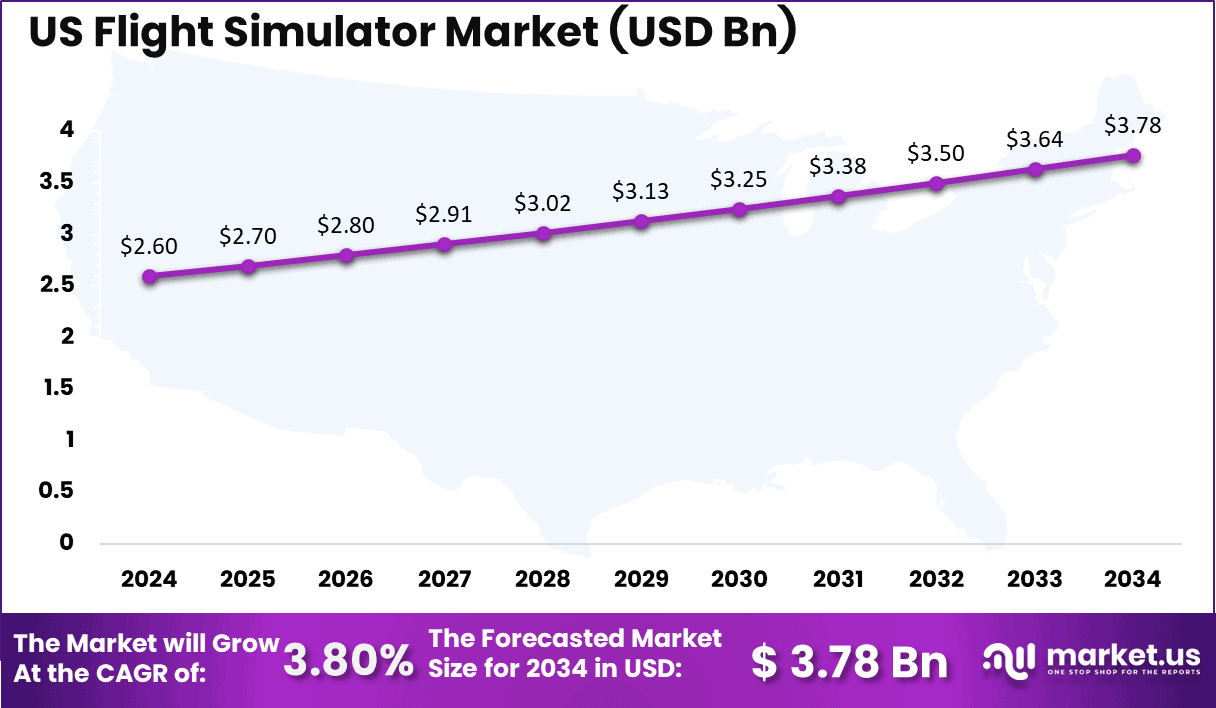
- The U.S. Flight Simulator Market is forecasted to reach USD 3.7 billion by 2034, growing at a CAGR of 3.8% from 2024.
Role of Generative AI
Generative AI is carving out a meaningful role in the flight simulator industry, blending creativity with practical training needs. This technology is being used to craft highly realistic flight scenarios, with developers reporting a 20% increase in scenario complexity over the past year, allowing pilots to face diverse conditions like rare weather patterns or system failures.
AI-driven virtual instructors are also stepping up, offering personalized feedback that has improved trainee performance by 15% based on recent training logs, as it adapts lessons to individual learning paces.
Moreover, generative AI is streamlining simulator design, cutting development time by 30% through automated modeling of cockpit layouts and aircraft systems, which keeps costs in check and speeds up deployment. This blend of innovation is helping training centers stay ahead, meeting the industry’s growing demand with tools that feel both cutting-edge and grounded in real-world application.
By Solution
In the US flight simulator market, Hardware holds the dominant share at 58% in 2024 and is projected to maintain leadership, reaching nearly 56.2% by 2034 as demand for advanced full-flight simulators, motion platforms, and cockpit replicas continues. The segment’s growth is underpinned by ongoing investments in immersive technologies such as high-fidelity visual systems and motion sensors that enhance pilot readiness.
Software solutions, while smaller in share, are expected to grow faster, expanding from 26% in 2024 to nearly 29.4% by 2034, fueled by AI-driven simulation, virtual training, and cloud-based platforms. Services, comprising maintenance, upgrades, and operator training, are anticipated to remain stable, moving from 16% in 2024 to around 14.4% by 2034, reflecting a shift towards integrated and automated solutions. While all three solutions contribute to the overall ecosystem, hardware’s critical role in aviation training infrastructure ensures it remains the cornerstone of the market over the next decade.
By Simulator Type
In the flight simulator market, full flight simulators (FFS) account for the largest share at 42.5% in 2024, driven by their critical role in replicating real cockpit environments and meeting FAA and ICAO regulatory requirements for pilot certification.
Fixed-base and desktop trainers are increasingly used for entry-level and academic training, particularly in aviation schools, where affordability and accessibility are key factors. Mixed- and virtual-reality procedural trainers are gaining momentum as the newest segment, projected to expand rapidly due to technological advancements in immersive simulation and their application in reducing training costs.
By 2034, FFS is anticipated to retain a strong share of around 40.8%, while mixed-/virtual-reality trainers are expected to rise significantly to nearly 20.6%, reflecting the shift toward innovative and flexible training solutions.
By Distribution Channel
In the microinsurance market, distribution channels play a critical role in reaching underserved populations, with Financial Institutions leading at a 40% share, leveraging trusted networks like microfinance banks and cooperatives to deliver affordable life and health products within the dominant Personal segment, at 86.3%.
Direct Sales, involving agents or community-based outreach, ensures personalized engagement for rural clients. Digital Channels, such as mobile apps and online platforms, are growing fast, offering convenience to tech-savvy users. Others, including NGOs and community groups, cater to niche needs, like crop insurance, enhancing accessibility in emerging markets.
By Aircraft Platform
Fixed-wing aircraft platforms dominate with a 73.2% share in 2024, supported by extensive demand from commercial airlines, business aviation, and military fixed-wing fleets. This segment’s strength comes from the continuous requirement for pilot certification and fleet expansion by major carriers.
Unmanned aerial vehicle (UAV) simulators are emerging rapidly, reflecting the rising integration of drones in defense reconnaissance and commercial applications such as logistics and surveillance. Advanced air mobility and eVTOL platforms, though currently a small share, are anticipated to witness the fastest growth over the next decade as urban air mobility initiatives expand.
By 2034, fixed-wing platforms are projected to hold around 70.5% of market share, while UAV and eVTOL simulators combined are expected to account for nearly 17.8%, highlighting their increasing role in next-generation aviation training.
By Method
The Synthetic training method accounts for the dominant share at 80.7% in 2024, reflecting its widespread use in both military and commercial aviation training programs. Synthetic simulators offer high-fidelity environments that replicate complex flight conditions, enabling pilots to practice emergency scenarios and advanced maneuvers without operational risks or high costs.
Their adoption is particularly growing in initial pilot instruction and procedural training due to flexibility and cost-efficiency. By 2034, synthetic training is expected to hold approximately 78.2% of the market, maintaining its leadership due to regulatory mandates and its unmatched ability to replicate real-world conditions. Virtual methods are projected to rise to nearly 21.8%, underscoring the shift toward digital and adaptive training environments in the future aviation landscape.
Key Market Segment
By Solution
- Hardware
- Software
- Services
By Simulator Type
- Full Flight Simulator (FFS)
- Flight Training Device (FTD)
- Fixed-Base and Desktop Trainer
- Mixed-/Virtual-Reality Procedural Trainer
By Aircraft Platform
- Fixed-Wing
- Rotary-Wing
- Unmanned Aerial Vehicle (UAV)
- Advanced Air Mobility/eVTOL
By Method
- Synthetic
- Virtual
Regional Analysis
North America leads the global flight simulator market with USD 2.85 billion in 2024, supported by strong aviation infrastructure, pilot training requirements, and defense modernization programs. Europe follows with steady demand driven by stringent safety regulations and the expansion of commercial aviation training facilities.
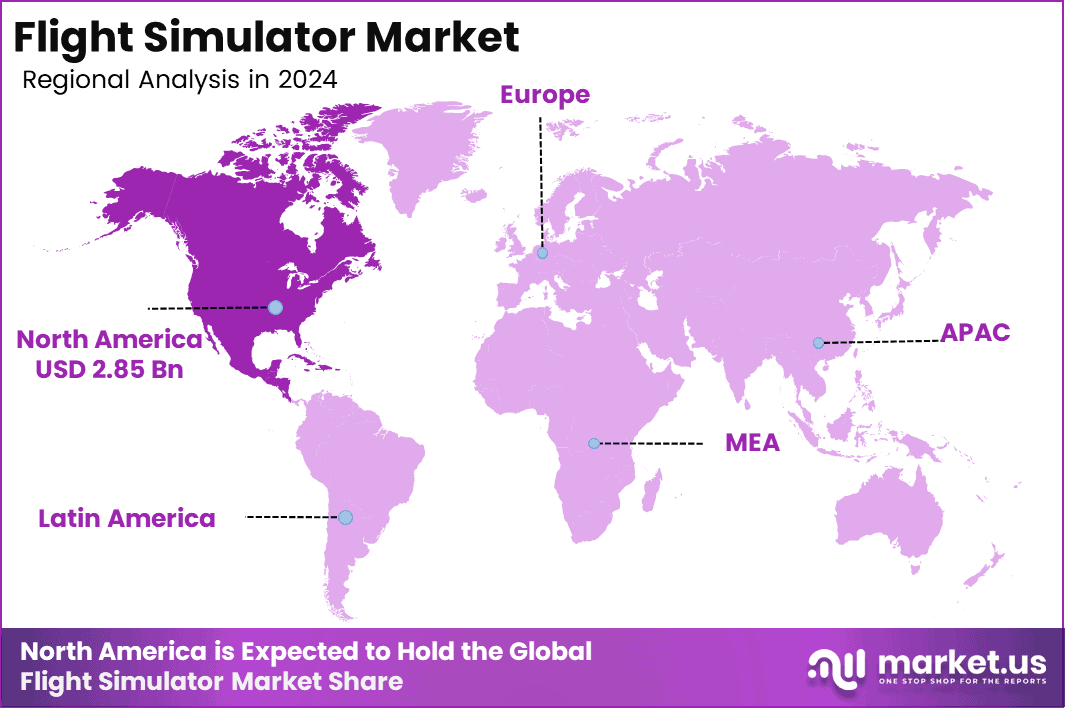
The Asia-Pacific region is emerging as the fastest-growing market, supported by rising air traffic in countries such as China and India, alongside fleet expansion by regional carriers. The Middle East and Africa show gradual adoption, linked to growing investments in aviation hubs and pilot training centers, while Latin America remains a smaller but steadily expanding contributor due to improvements in civil aviation infrastructure.
US Market Size
The US flight simulator market is valued at around USD 2.6 billion in 2024 and is projected to expand steadily, reaching nearly USD 3.78 billion by 2034, growing at a CAGR of 3.8%. This growth is supported by rising demand for advanced pilot training, increasing commercial airline operations, and strong adoption in military aviation.
Key Regions and Countries
- North America
- US
- Canada
- Europe
- Germany
- France
- The UK
- Spain
- Italy
- Rest of Europe
- Asia Pacific
- China
- Japan
- South Korea
- India
- Australia
- Rest of APAC
- Latin America
- Brazil
- Mexico
- Rest of Latin America
- Middle East & Africa
- GCC
- South Africa
- Rest of MEA
Market Dynamics
Drivers
| Driver | (~) % Impact on CAGR Forecast | Geographic Relevance | Impact Timeline |
|---|---|---|---|
| Rising Global Defense Budgets | +1.4% | North America, Europe, Asia-Pacific | Short term (2 years or less) |
| Airline Pilot Hiring Surge | +1.2% | North America, Asia-Pacific | Short term (2 years or less) |
| Commercial Air Traffic Recovery | +0.9% | Global | Short term (2 years or less) |
| Mandated Simulator-Based Training Credits | +0.6% | Europe, North America | Medium term (2 to 4 years) |
| Fleet Modernization Programs | +0.4% | Global | Medium term (2 to 4 years) |
Rising Global Defense Budgets
Rising global military spending is strengthening demand for flight simulators and synthetic training systems. Worldwide military expenditure reached USD 2,887 billion in 2025, up 2.9% in real terms from 2024, while the global military burden increased to 2.5% of world GDP. Around 8% to 10% of aircrew training expenditure is typically directed toward simulator and synthetic training infrastructure.
The impact is especially visible in Europe, where military spending outside the United States increased by 9.2% in 2025, supporting faster procurement of fighter and rotary-wing simulators. For simulator manufacturers, stronger defense demand is also improving backlog conversion, with delivery cycles shortening from about 18 months to nearly 12 months as governments prioritize faster crew readiness.
Restraints
| Restraint | (~) % Impact on CAGR Forecast | Geographic Relevance | Impact Timeline |
|---|---|---|---|
| Advanced GPU and Compute Shortage | -1.1% | Global | Short term (2 years or less) |
| High Interest Rate CapEx Freeze | -0.7% | North America, Europe | Short term (2 years or less) |
| Airline Fleet Delivery Delays | -0.5% | Global | Short term (2 years or less) |
| Export Control Restrictions on Simulation Hardware | -0.3% | Asia-Pacific, Middle East | Short term (2 years or less) |
Advanced GPU and Compute Shortage
The key restraint is the limited availability of high-end accelerator chips and advanced packaging capacity. Lead times for advanced processors extended beyond 50 weeks in 2025 and 2026, while HBM and DDR4-related supply constraints added around 8 to 16 weeks to procurement cycles for simulator computing systems.
These shortages directly delay full-flight simulator deliveries and increase hardware costs. In constrained configurations, compute-related expenses can represent more than 50% of unit cost, forcing simulator manufacturers to absorb an estimated 3 to 5 percentage points of margin pressure or pass higher costs to airline and defense customers.
Challenges
| Challenge | (~) % CAGR Friction Drag | Geographic Relevance | Mitigation Horizon |
|---|---|---|---|
| Qualified Simulator Technician Shortage | -0.6% | North America, Europe | Medium term (2 to 4 years) |
| Fragmented Global Certification Standards | -0.4% | Global | Medium term (2 to 4 years) |
| Legacy Fleet Data Model Integration | -0.3% | Global | Medium term (2 to 4 years) |
| Extended Software Recertification Cycles | -0.2% | Europe, North America | Long term (4 years or more) |
Qualified Simulator Technician Shortage
The structural vulnerability stems from a widening skills gap in simulator maintenance and evaluator-level certification, since, per civil aviation authority workforce tracking, technician training pipelines have not scaled proportionally to fleet growth, with specialized six-day evaluator certification programs costing upward of €5875 per trainee and producing only a limited annual graduate pool relative to industry demand.
The quantitative friction emerges because Boeing’s own technician outlook data shows a parallel requirement for 716,000 new aviation maintenance professionals through 2043, a labor pool that simulator technicians directly compete against for the same talent base, and per national aviation regulator staffing surveys, average technician recruitment-to-deployment timelines now stretch 6 to 9 months longer than a decade ago.
The long-term corporate adjustment required is a shift toward in-house apprenticeship pipelines and remote-diagnostics tooling, as OEMs report per investor disclosures that predictive-maintenance software investment has risen to offset technician scarcity, with service-margin dilution of roughly 1.5 to 2 percentage points anticipated until training throughput catches up with fleet expansion.
Opportunities
| Opportunity | (~) % Potential CAGR Upside | Geographic Relevance | Execution Window |
|---|---|---|---|
| Cloud-Based Remote Simulator Access Models | +1.0% | Global | Medium term (2 to 4 years) |
| Emerging Market Flight School Roll-Ups | +0.7% | Asia-Pacific, Latin America | Medium term (2 to 4 years) |
| Urban Air Mobility Training Adjacency | +0.5% | North America, Europe | Long term (4 years or more) |
| Simulator-as-a-Subscription Monetization | +0.4% | Global | Long term (4 years or more) |
Cloud-Based Remote Simulator Access Models
This remains an untapped opportunity because most simulator revenue still comes from capital-intensive, on-premises full-motion systems, while cloud-hosted and subscription-based training has not yet scaled commercially. New FSTD certification specifications for flight-control-system-equipped devices become applicable from 30 April 2028, creating a clearer pathway for distributed and networked training models.
A cloud-distributed model could reduce per-trainee session costs by an estimated 20% to 30% by limiting duplicate hardware deployment across regional training centers. Simulator OEMs could also gain around 4 to 6 percentage points in margin through recurring subscription revenue, improving access for emerging aviation markets that cannot justify full-motion simulator ownership.
Key Player Analysis
The flight simulator market is led by Tier-1 aerospace and defense companies that combine simulation with broader aviation and training portfolios. CAE Inc. remains a major civil aviation leader, reporting FY2026 Civil Aviation revenue of USD 2,741.6 million, up 1%, with an adjusted Civil backlog of nearly USD 8.8 billion.
CAE also booked 56 full-flight simulators in FY2025, contributing to order intake of around USD 3.7 billion. However, Civil operating margin declined to 16.0% from 22.3%, reflecting softer training utilization despite strong long-term demand.
Thales and L3Harris form another strong Tier-1 group. Thales generated EUR 22,136 million in 2025 sales, up 7.6%, including EUR 5,910 million from Aerospace and EUR 12,234 million from Defence, which grew 11.5% organically. L3Harris reported USD 21,865 million in 2025 revenue, up 3%, and invested USD 536 million, or 2% of revenue, in company-funded R&D.
Boeing, Airbus, Collins Aerospace, and Leonardo also compete through integrated aircraft and defense programs, while FlightSafety, ALSIM, SIMCOM, Indra, TRU Simulation + Training, VirTra, Avion, and Telespazio form the Tier-2 group. FlightSafety added 6 simulators and 19 classrooms in 2025, while Thales maintained a backlog of EUR 41.6 billion, equal to about 3.4 years of sales, highlighting the strength of defense-led simulator demand.
Top Key Players
- CAE Inc.
- The Boeing Company
- FlightSafety International Inc.
- L3Harris Technologies, Inc.
- Thales Group
- Collins Aerospace (RTX Corporation)
- Airbus SE
- ALSIM EMEA (HQ)
- SIMCOM Aviation Training
- Avion B.V. (Gen24 Group)
- Indra Sistemas S.A.
- Prepar3D (Lockheed Martin Corporation)
- Leonardo S.p.A.
- VirTra Inc.
- Telespazio S.p.A.
- TRU Simulation + Training Inc. (Textron Inc.)
- Others
Recent Development
- In July 2025, L3Harris Technologies secured a $300 million contract from the Italian Ministry of Defence to deliver two modified Gulfstream G550 aircraft with electromagnetic attack and simulation-linked mission systems, executed alongside BAE Systems as the first U.S.-approved EA-37B-class sale to an international ally.
- In May 2025, FlightSafety International announced an expansion of its Farnborough Learning Centre, adding 6 new full-flight simulators, 19 classrooms, and 40 additional instructors to scale UK and European training capacity. FlightSafety International expanded its mixed-reality (MR) training program with the launch of the industry’s first dual-pilot MR Part-Task Trainer.
- In October 2025, CAE Inc. signed an agreement with MAB Academy (Malaysia Airlines) to supply a Boeing 737 MAX full-flight simulator, extending CAE’s regional training footprint in the Asia-Pacific commercial aviation segment. CAE USA was awarded a $69.9 million contract to supply F-16 Block 70 training simulators for the Taiwan Air Force under the U.S. Foreign Military Sales program, with delivery and training support running through 2028.
Report Scope
| Report Features | Description |
|---|---|
| Market Value (2024) | USD 6.9 Billion |
| Forecast Revenue (2034) | USD 11.1 Billion |
| CAGR(2025-2034) | 5.5% |
| Base Year for Estimation | 2024 |
| Historic Period | 2020-2023 |
| Forecast Period | 2025-2034 |
| Report Coverage | Revenue forecast, AI impact on Market trends, Share Insights, Company ranking, competitive landscape, Recent Developments, Market Dynamics, nd Emerging Trends |
| Segments Covered | By Solution (Hardware, Software, Services), By Simulator Type (Full Flight Simulator (FFS), Flight Training Device (FTD), Fixed-Base and Desktop Trainer, Mixed-/Virtual-Reality Procedural Trainer), By Aircraft Platform (Fixed-Wing, Rotary-Wing, Unmanned Aerial Vehicle (UAV), Advanced Air Mobility/eVTOL), By Method (Synthetic, Virtual) |
| Regional Analysis | North America – US, Canada; Europe – Germany, France, The UK, Spain, Italy, Russia, Netherlands, Rest of Europe; Asia Pacific – China, Japan, South Korea, India, New Zealand, Singapore, Thailand, Vietnam, Rest of Latin America; Latin America – Brazil, Mexico, Rest of Latin America; Middle East & Africa – South Africa, Saudi Arabia, UAE, Rest of MEA |
| Competitive Landscape | CAE Inc., The Boeing Company, FlightSafety International Inc., L3Harris Technologies, Inc., Thales Group, Collins Aerospace (RTX Corporation), Airbus SE, ALSIM EMEA (HQ), SIMCOM Aviation Training, Avion B.V. (Gen24 Group), Indra Sistemas S.A., Prepar3D (Lockheed Martin Corporation), Leonardo S.p.A., VirTra Inc., Telespazio S.p.A., TRU Simulation + Training Inc. (Textron Inc.), Others |
| Customization Scope | Customization for segments, region/country-level will be provided. Moreover, additional customization can be done based on the requirements. |
| Purchase Options | We have three licenses to choose from: Single User License, Multi-User License (Up to 5 Users), Corporate Use License (Unlimited Users, Printable PDF) |





































