


Report Overview
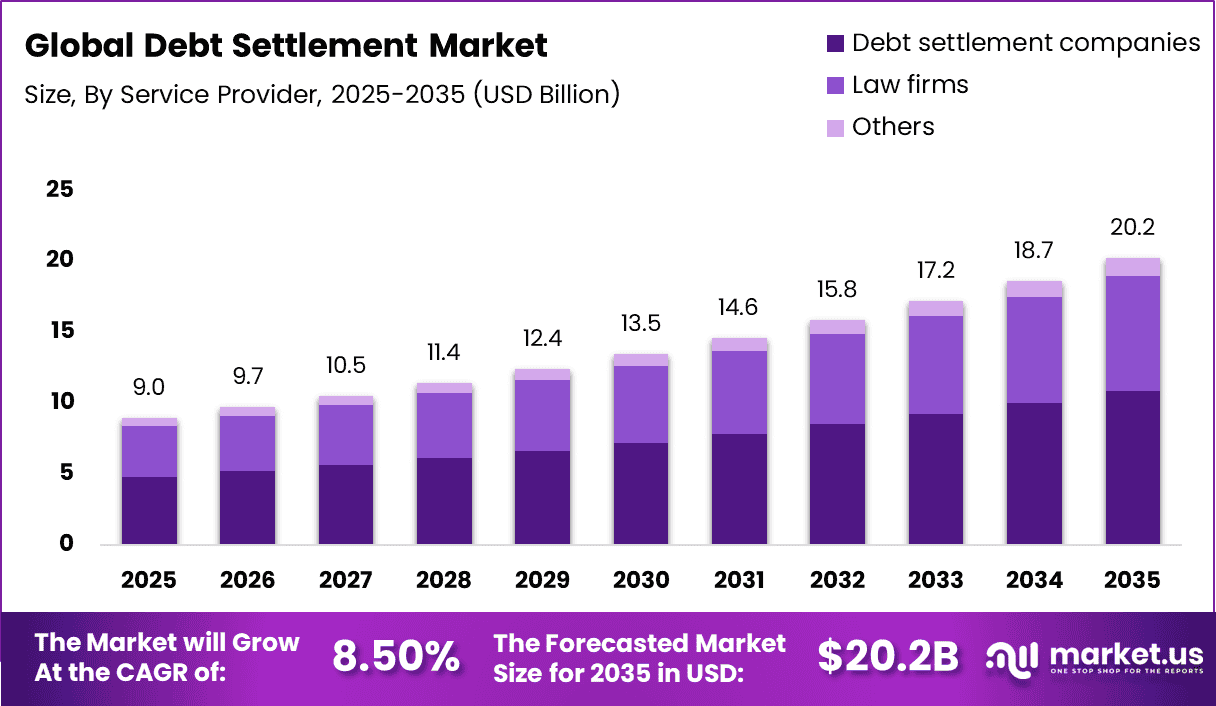
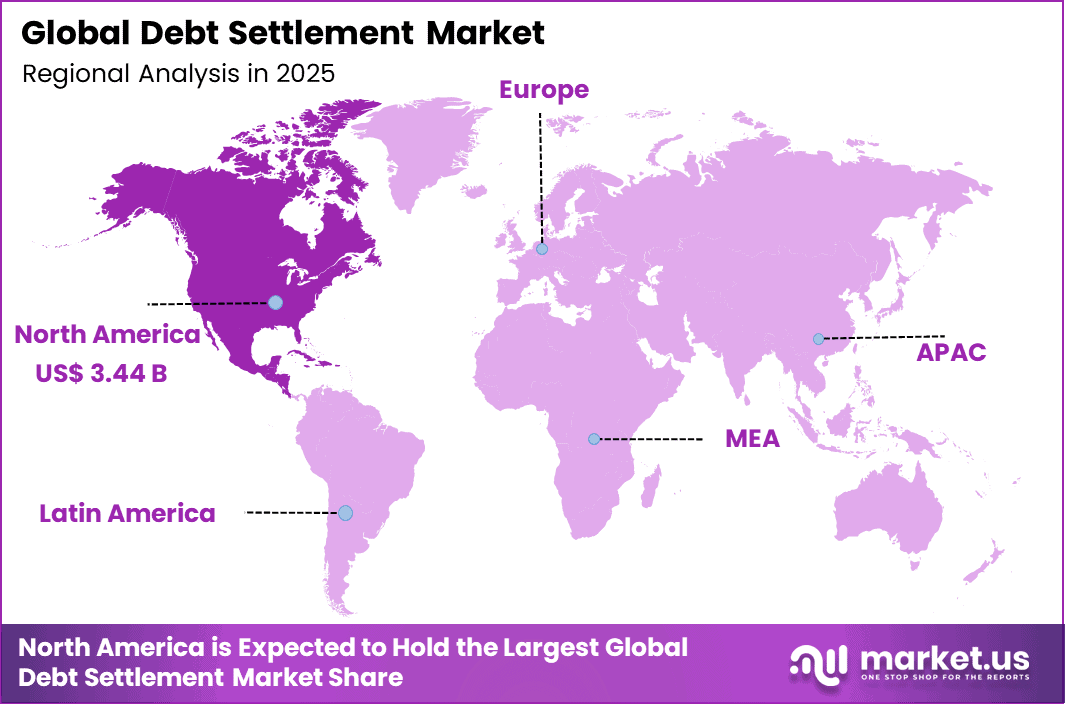
The Global Debt Settlement Market generated USD 9.0 billion in 2025 and is predicted to register growth from USD 9.7 billion in 2026 to about USD 20.2 billion by 2035, recording a CAGR of 8.5% throughout the forecast span. In 2025, North America held a dominant market position, capturing more than a 38.5% share, with USD 3.44 billion in revenue.
The debt settlement market refers to services and platforms that help individuals or businesses negotiate with creditors to reduce the total amount of debt owed. These services are commonly used by people facing financial stress from credit card balances, personal loans, medical bills, or other unsecured debts. The market includes debt settlement firms, legal support providers, financial advisory services, and digital platforms that manage repayment discussions and settlement plans.
One of the main factors driving this market is the growing financial pressure on consumers, driven by rising living costs, higher borrowing costs, and irregular income patterns. Many borrowers struggle to keep up with monthly payments, which increases interest charges and pushes them to seek alternative debt relief options.
Another key factor is the rising awareness of debt resolution services, especially through digital financial platforms that make consultation and settlement support easier to access. As more consumers look for ways to reduce outstanding balances and regain financial stability, demand for debt settlement support continues to grow.
Top Market Takeaways
- By Debt, credit card debt dominates with a 37.5% share, targeting high-interest unsecured obligations through negotiated lump-sum reductions and extended payment plans.
- By Service Provider, debt settlement companies capture 53.6%, offering end-to-end negotiation, creditor liaison, and tax implication guidance for optimized settlements.
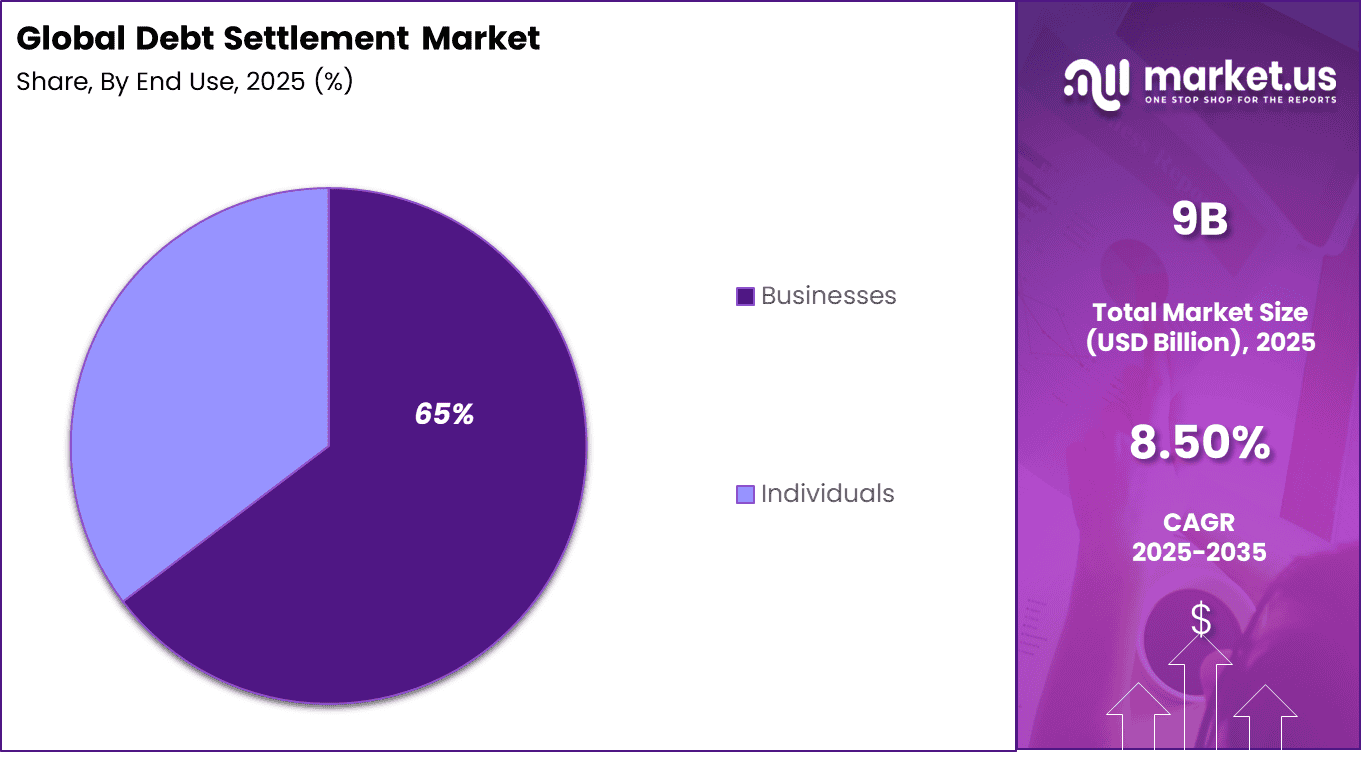
- By End Use, businesses hold 64.7%, utilizing B2B debt resolution for vendor disputes, commercial card balances, and working capital preservation.
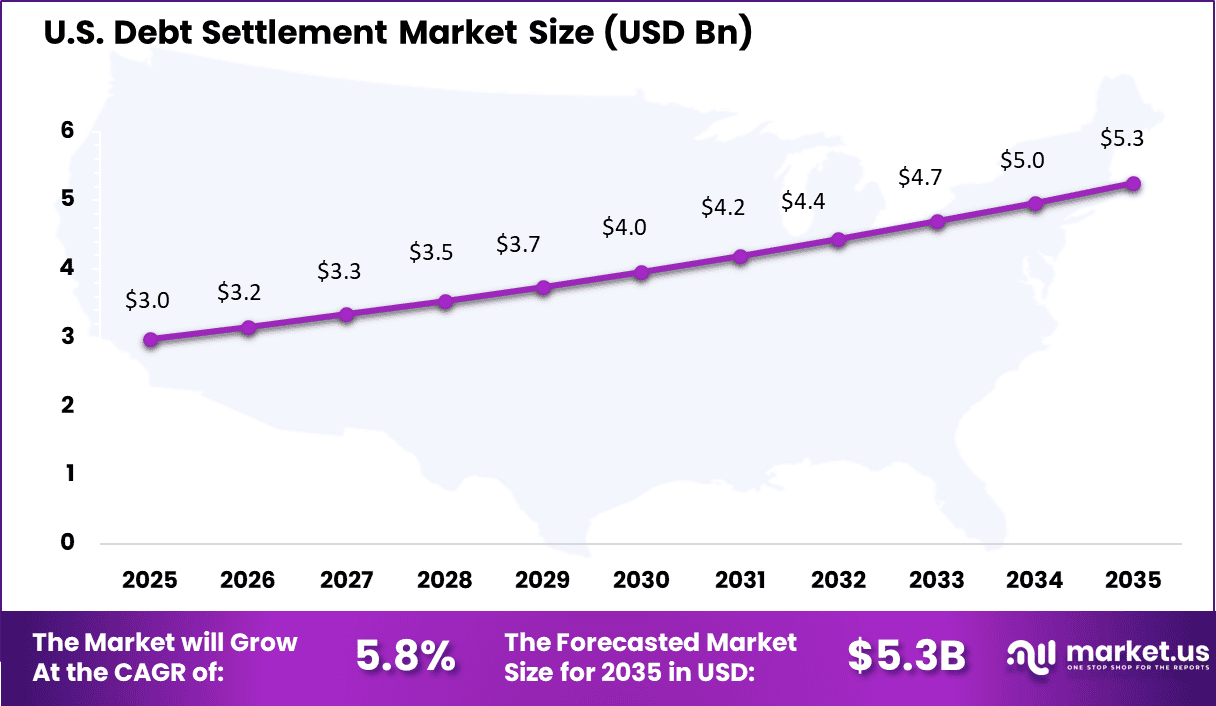
- Regionally, North America accounts for 38.5% global share, with the U.S. market valued at USD 2.99 billion and a CAGR of 5.8%, driven by elevated corporate debt levels and favorable bankruptcy alternatives.
By Debt Analysis
Credit card debt accounted for 37.5% of the Debt Settlement Market. This segment led because unsecured credit card balances are one of the most common forms of financial stress for both individuals and small firms. High interest charges, rolling balances, and missed payments often push borrowers to seek settlement support to reduce outstanding obligations.
The segment also remained strong because credit card debt is easier to negotiate than many secured forms of borrowing. Settlement providers often focus on these accounts since they involve frequent delinquency cases and large customer volumes. This keeps credit card debt as the most important debt category in the market.
By Service Provider Analysis
Debt settlement companies held 53.6% of the market. These firms lead the segment because they offer structured negotiation services, payment planning support, and direct communication with creditors. Many borrowers choose specialized settlement companies to manage complex debt situations and improve the chances of reaching reduced payoff agreements.
Their position is also supported by growing demand for professional financial assistance during periods of repayment pressure. Debt settlement companies provide process knowledge, case handling experience, and customer support, which makes them the preferred service providers for many users entering settlement programs.
By End Use Analysis
Businesses captured 64.7% of the Debt Settlement Market. This segment dominated because many businesses face cash flow pressure, delayed receivables, rising operating costs, and multiple outstanding liabilities. In such situations, debt settlement becomes an important option to restructure obligations and reduce financial strain without fully shutting down operations.
The business segment also benefits from the need to protect working capital and maintain continuity during unstable economic conditions. Companies often use settlement services to manage vendor dues, credit obligations, and other unsecured liabilities in a more controlled way. This keeps businesses at the center of market demand.
Key Market Segments
By Debt
- Credit card debt
- Personal loans debt
- Medical debt
- Student loans
- Business debt
By Service Provider
- Debt settlement companies
- Law firms
- Others
By End Use
- Individuals
- Businesses
Regional Analysis
North America accounted for 38.5% of the Debt Settlement Market, reflecting the strong presence of structured financial counseling services and debt negotiation programs across the region. Consumers and small businesses increasingly seek professional assistance to manage high levels of unsecured debt, including credit card balances and personal loans.
Financial service providers across the region offer settlement programs that help borrowers negotiate reduced repayment amounts with creditors. Growing awareness about alternative debt management options continues to support the adoption of debt settlement services across North America.
The U.S. generated about USD 2.99 Bn within the regional market and is projected to expand at a CAGR of 5.8%. Many households across the country continue to face financial pressure due to rising living expenses and accumulated consumer debt.
Debt settlement providers assist borrowers in restructuring repayment obligations and negotiating lower balances with lenders. As individuals look for practical solutions to manage financial stress and avoid bankruptcy, the demand for structured debt settlement services continues to develop steadily across the US market.
Key Regions and Countries
- North America
- US
- Canada
- Europe
- Germany
- France
- The UK
- Spain
- Italy
- Russia
- Netherlands
- Rest of Europe
- Asia Pacific
- China
- Japan
- South Korea
- India
- Australia
- Singapore
- Thailand
- Vietnam
- Rest of APAC
- Latin America
- Brazil
- Mexico
- Rest of Latin America
- Middle East & Africa
- South Africa
- Saudi Arabia
- UAE
- Rest of MEA
Investor Type Impact Matrix
| Investor Type | Growth Sensitivity | Risk Exposure | Geographic Focus | Investment Outlook |
|---|---|---|---|---|
| Venture Capital Firms | Medium | Medium | US, Europe | Growth in fintech debt platforms |
| Private Equity Firms | High | Medium | North America | Consolidation of financial services firms |
| Strategic Financial Investors | Medium | Low to Medium | US, Europe | Expansion of financial advisory services |
| Corporate Venture Arms | Medium | Medium | Global | Fintech partnership opportunities |
| Government and Social Finance Funds | Low to Medium | Low | North America, Europe | Support for consumer financial stability |
Technology Enablement Analysis
| Technology Enabler | Impact on CAGR Forecast (~%) | Geographic Relevance | Impact Timeline | Implementation Significance |
|---|---|---|---|---|
| AI-driven financial assessment tools | +1.6% | North America, Europe | Mid Term (2026–2032) | Improves debt analysis accuracy |
| Digital debt negotiation platforms | +1.5% | US, UK, Canada | Short to Mid Term (2025–2031) | Enables faster settlement processes |
| Cloud-based financial advisory systems | +1.3% | Global | Short to Mid Term (2025–2030) | Expands service scalability |
| Data analytics for consumer credit evaluation | +1.2% | North America, Europe | Mid Term (2026–2032) | Enhances risk assessment |
| Mobile-based financial counseling platforms | +1.1% | Asia Pacific, North America | Mid to Long Term (2026–2035) | Improves consumer engagement |
Key Challenges
- Many consumers hesitate to use debt settlement services because they are unsure about the process, the final savings, and the effect on their credit profile.
- The market faces trust issues because some service providers have created concerns around hidden fees, misleading claims, and poor customer communication.
- Regulatory compliance is a major challenge, as debt settlement firms must follow changing consumer protection rules and financial service regulations across different regions.
- Not all creditors agree to settle debts, which makes the outcome uncertain and can delay the resolution process for customers.
- Economic pressure on households also creates difficulty, because people already facing financial stress may struggle to continue payments during the settlement period.
Emerging Trends
A clear trend in the Debt Settlement market is the growing shift toward digital platforms that help individuals and businesses manage and negotiate outstanding debts through structured processes. Many service providers now offer online tools that allow borrowers to review their financial obligations, communicate with creditors, and track settlement progress in a transparent manner.
This digital approach makes the process more organized and accessible for people who want to resolve debt issues without complex paperwork or lengthy procedures. As financial services continue to move toward online interaction, digital debt management platforms are becoming an important part of the settlement ecosystem.
Growth Factors
Rising financial pressure on households and small businesses is encouraging greater use of debt settlement services. Many borrowers face challenges in managing multiple financial obligations, which creates demand for structured solutions that help reduce repayment burdens and create manageable agreements with creditors.
Debt settlement services assist borrowers in negotiating revised payment arrangements and resolving outstanding liabilities in a controlled manner. Growing awareness about financial recovery options also supports market expansion, as individuals and organizations increasingly seek professional guidance to stabilize their financial position and regain control over long-term financial commitments.
Drivers Impact Analysis
| Key Driver | Impact on CAGR Forecast (~%) | Geographic Relevance | Impact Timeline | Strategic Effect |
|---|---|---|---|---|
| Rising household debt and credit card liabilities | +1.9% | North America, Europe | Short to Mid Term (2025–2031) | Increases demand for debt relief services |
| Growing awareness of debt settlement programs | +1.6% | US, Canada, UK, Australia | Short to Mid Term (2025–2030) | Encourages consumers to seek structured repayment solutions |
| Expansion of digital financial advisory platforms | +1.4% | North America, Asia Pacific | Mid Term (2026–2032) | Improves accessibility to debt negotiation services |
| Increasing financial stress among consumers | +1.5% | Global | Mid Term (2026–2032) | Drives demand for alternative debt restructuring |
| Regulatory frameworks supporting consumer debt relief | +1.2% | North America, Europe | Mid to Long Term (2026–2035) | Strengthens market legitimacy |
Restraints Impact Analysis
| Key Restraint | Impact on CAGR Forecast (~%) | Geographic Relevance | Impact Timeline | Strategic Effect |
|---|---|---|---|---|
| Regulatory scrutiny and compliance requirements | -1.5% | US, Europe | Mid Term (2026–2032) | Limits aggressive settlement practices |
| Consumer trust issues with settlement firms | -1.3% | Global | Short to Mid Term (2025–2031) | Slows adoption in some regions |
| Availability of alternative debt management options | -1.4% | North America, Europe | Mid Term (2026–2032) | Reduces reliance on settlement services |
| Credit score impact concerns among consumers | -1.2% | Global | Short to Mid Term (2025–2030) | Discourages participation in programs |
| Economic recovery reducing debt distress | -1.0% | Developed economies | Mid to Long Term (2026–2035) | May moderate long-term demand |
Competitive Analysis
The competitive landscape of the Debt Settlement market is shaped mainly by specialized debt relief service providers that focus on negotiating with creditors and helping consumers reduce their overall repayment burden. Companies include Accredited Debt Relief, Century Support Services, ClearOne Advantage, Credit Associates, financial counseling, and customer support services.
Competition in this market remains strong because customers compare firms based on fees, program structure, customer experience, and the speed of debt resolution. Many providers are also improving their digital platforms to simplify enrollment, account tracking, and communication with clients. As a result, the market is becoming more service-driven, with companies focusing on credibility, compliance, and personalized support to attract and retain customers.
Top Key Players in the Market
- Accredited Debt Relief
- Century Support Services
- ClearOne Advantage
- Credit Associates
- FREED
- Freedom Debt Relief
- National Debt Relief
- Pacific Debt Inc.
- Others
Future Outlook
The future outlook for the Debt Settlement Market remains steady as more consumers and businesses seek practical ways to manage unpaid debt and reduce financial pressure. Demand is expected to rise as borrowers look for structured settlement support, professional negotiation services, and digital platforms that simplify the repayment process. Growing financial stress, wider awareness of debt relief options, and the expansion of online financial services are likely to support continued market growth in the coming years.
Recent Developments
- In March 2025, Perfios acquired CreditNirvana, an AI-powered debt-management and collections platform, to strengthen its end-to-end collections capabilities; the transaction value was not disclosed.
- In March 2025, ClearGrid emerged from stealth after raising USD 10 million through USD 3.5 million in pre-seed funding and USD 6.5 million in seed funding to expand its AI-powered debt-resolution platform across the Middle East and North Africa.
- In April 2025, Kikoff launched AI Debt Negotiation, a voice-AI agent designed to negotiate consumer debt directly with creditors, with rollout to Kikoff users scheduled during 2025.
Report Scope
| Report Features | Description |
|---|---|
| Market Value (2025) | USD 9.0 Billion |
| Forecast Revenue (2035) | USD 20.2 Billion |
| CAGR(2025-2035) | 8.5% |
| Base Year for Estimation | 2024 |
| Historic Period | 2020-2024 |
| Forecast Period | 2025-2035 |
| Report Coverage | Revenue forecast, AI impact on Market trends, Share Insights, Company ranking, competitive landscape, Recent Developments, Market Dynamics and Emerging Trends |
| Segments Covered | By Debt (Credit card debt, Personal loans debt, Medical debt, Student loans, Business debt), By Service Provider (Debt settlement companies, Law firms, Others), By End Use (Individuals, Businesses) |
| Regional Analysis | North America – US, Canada; Europe – Germany, France, The UK, Spain, Italy, Russia, Netherlands, Rest of Europe; Asia Pacific – China, Japan, South Korea, India, New Zealand, Singapore, Thailand, Vietnam, Rest of Latin America; Latin America – Brazil, Mexico, Rest of Latin America; Middle East & Africa – South Africa, Saudi Arabia, UAE, Rest of MEA |
| Competitive Landscape | Accredited Debt Relief, Century Support Services, ClearOne Advantage, Credit Associates, FREED, Freedom Debt Relief, National Debt Relief, Pacific Debt Inc., Others |
| Customization Scope | Customization for segments, region/country-level will be provided. Moreover, additional customization can be done based on the requirements. |
| Purchase Options | We have three licenses to opt for: Single User License, Multi-User License (Up to 5 Users), Corporate Use License (Unlimited Users and Printable PDF) |





































