Report Overview
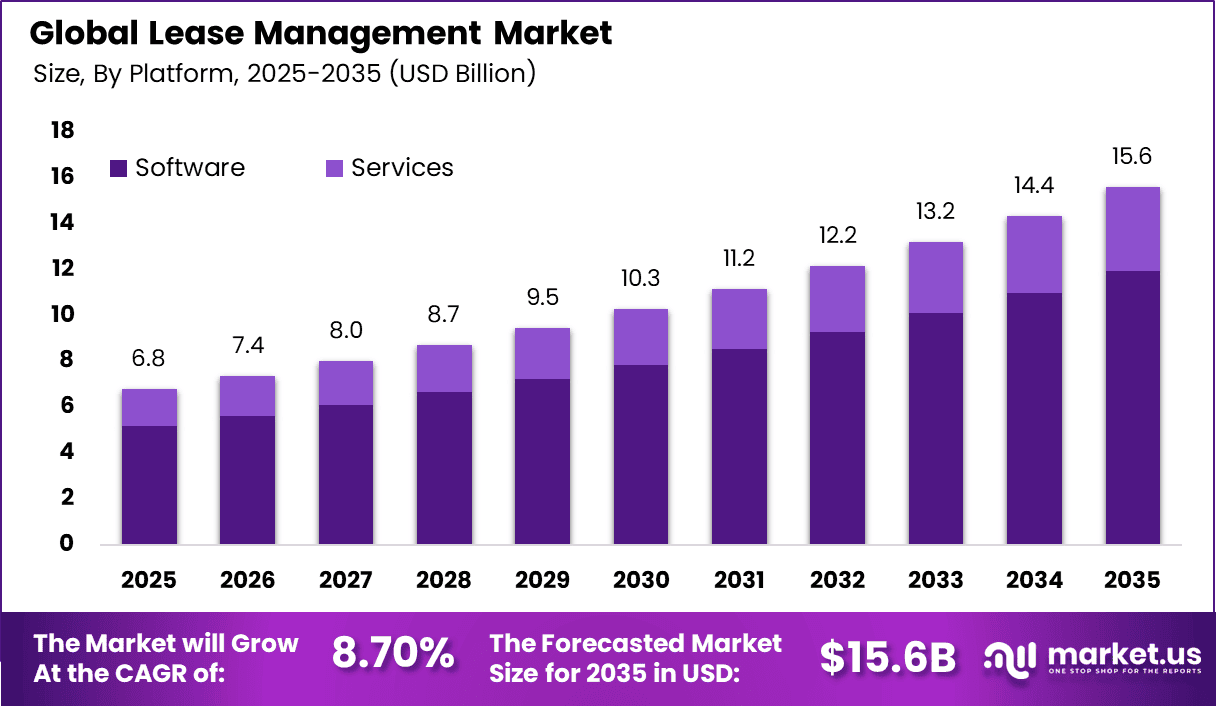
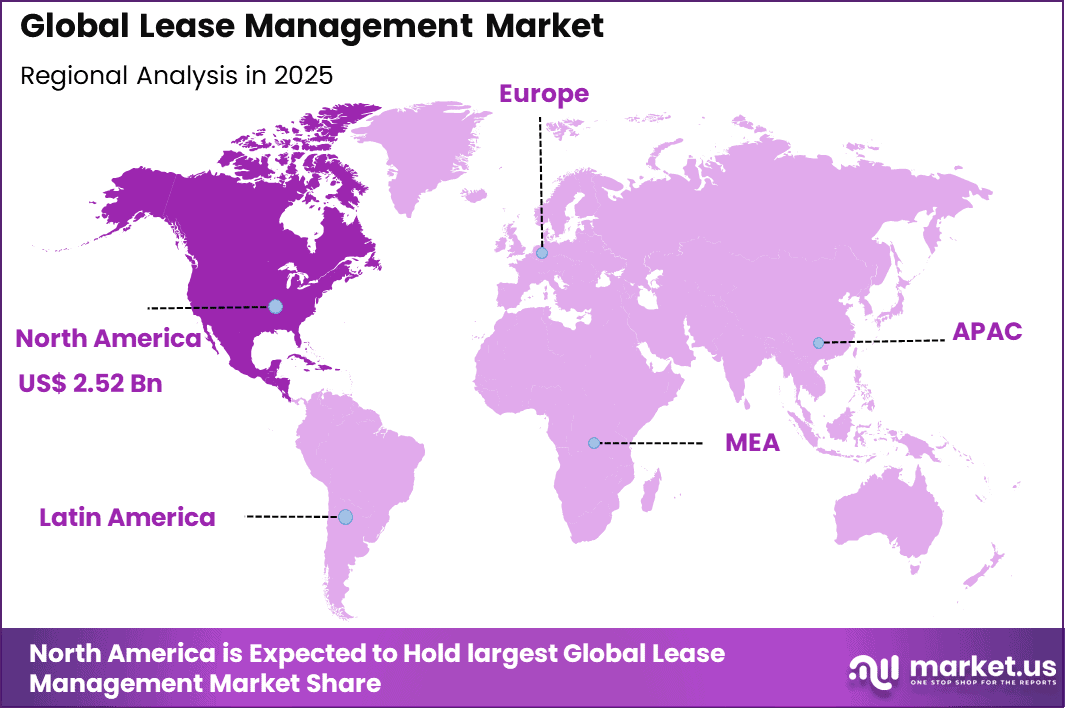
The Global Lease Management Market generated USD 6.8 billion in 2025 and is predicted to register growth from USD 7.4 billion in 2026 to about USD 15.6 billion by 2035, recording a CAGR of 8.7% throughout the forecast span. In 2025, North America held a dominant market position, capturing more than a 37.3% share, with USD 2.52 billion in revenue.
The lease management market refers to software and services that help organisations manage contracts, payments, assets, and compliance related to leased property and equipment. Lease management systems support tracking of lease terms, rent schedules, renewals, and financial reporting. These solutions are used by property owners, real estate firms, corporate tenants, and businesses that lease vehicles, machinery, or technology.
The main driving factors for the lease management market are the need for better visibility into lease portfolios and the growing complexity of accounting standards. Many organisations hold multiple leases across different asset types and regions, making it difficult to track terms, obligations, and costs manually. New accounting rules require transparent reporting of lease liabilities and assets, which increases demand for systems that can handle calculations and reporting consistently.
Top Market Takeaways
- By platform, software led the lease management market with a 76.4% share, automating lease tracking, compliance, and financial reporting.
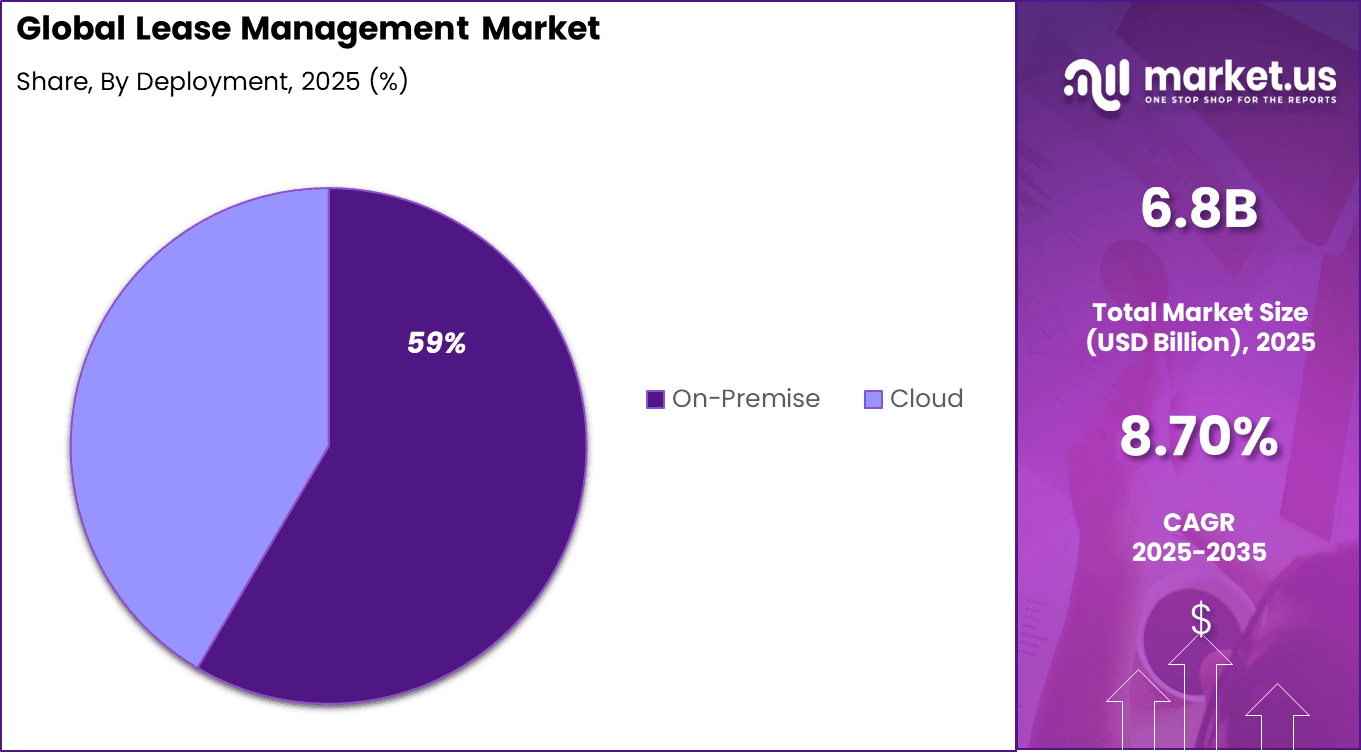
- By deployment, on-premise solutions captured 58.5%, preferred for data control and integration with existing enterprise systems.
- By application, commercial leases dominated at 45.7%, focusing on office, retail, and industrial property administration.
- By organization size, large organizations accounted for 76.4%, managing extensive portfolios under standards like ASC 842 and IFRS 16.
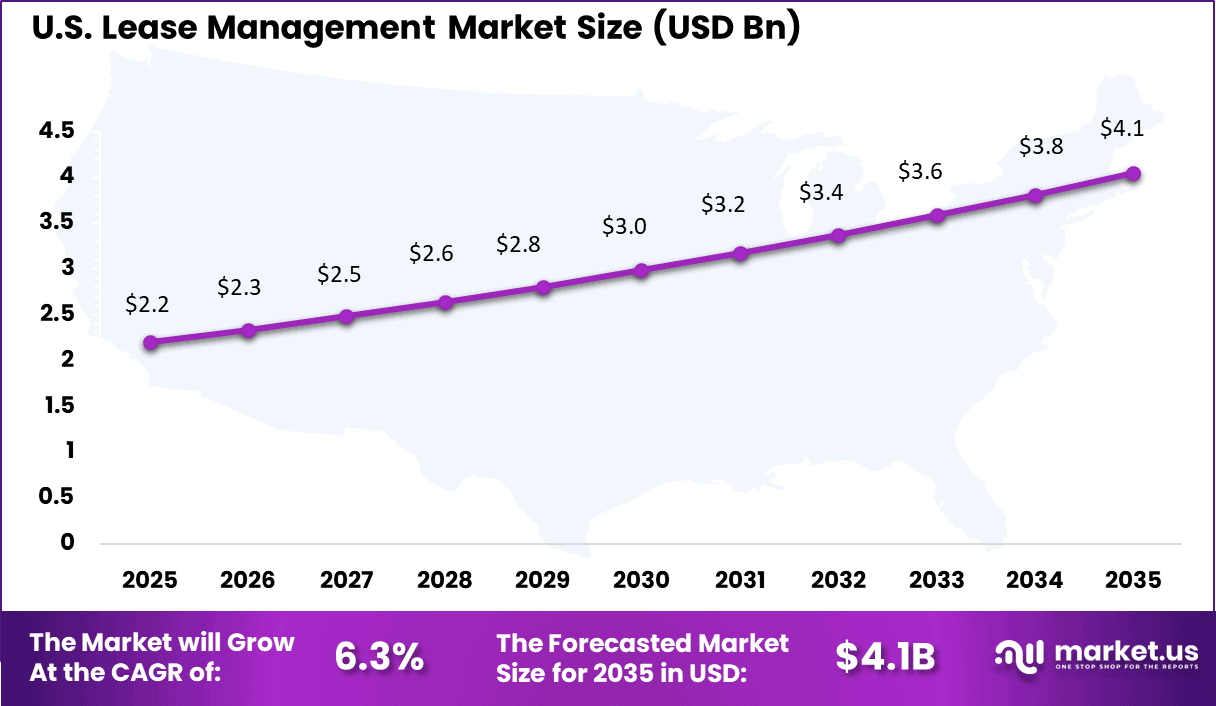
- North America held 37.3% of the global market, with the U.S. valued at USD 2.2 billion and growing at a CAGR of 6.3%
Platform Analysis
Software platforms account for 76.4% of the Lease Management market, showing that digital systems have become the primary way organizations manage lease portfolios. Lease management software supports functions such as lease accounting, contract tracking, payment scheduling, and compliance reporting.
Organizations adopt software platforms to centralize lease data and reduce manual errors associated with spreadsheet-based tracking. These platforms also help improve visibility across multiple lease contracts and locations.
From an operational perspective, software platforms improve efficiency and accuracy in lease administration. Automated alerts, reporting tools, and audit trails support better financial control. The strong share of this segment reflects growing demand for structured and scalable lease management systems that support regulatory compliance and long-term planning.
Deployment Analysis
On-premise deployment holds 59% of the Lease Management market, indicating that many organizations prefer to keep lease data within their internal IT environments. On-premise systems provide greater control over sensitive financial and contractual information. This deployment model is often favored by organizations with strict data governance and security requirements.
On-premise solutions also allow customization based on internal workflows and reporting needs. They integrate closely with existing enterprise systems such as ERP and accounting platforms. The strong presence of this segment reflects continued preference for controlled and customized deployment environments, especially among large organizations.
Application Analysis
Commercial applications account for 45.7% of market demand, making this the largest application segment. Commercial lease management covers office spaces, retail properties, warehouses, and industrial facilities. Organizations managing commercial properties require structured systems to handle complex lease terms, renewals, and compliance obligations.
Lease management software helps commercial users track multiple leases across locations and manage financial exposure. It improves accuracy in rent calculations and contract performance monitoring. The strong share of this segment reflects widespread adoption of digital tools to manage growing commercial real estate portfolios efficiently.
Organization Size Analysis
Large organizations represent 76.4% of market adoption, driven by their extensive lease portfolios and operational complexity. These organizations manage numerous leases across regions, which increases the need for centralized control and reporting. Lease management platforms help large organizations standardize processes and reduce financial risk.
Large organizations also face higher regulatory scrutiny and accounting requirements. Automated lease management systems support compliance and audit readiness. The strong presence of this segment reflects the critical role of lease management software in supporting large-scale operations.
Key Market Segments
By Platform
- Software
- Services
By Deployment
- On-Premise
- Cloud
By Application
- Commercial
- Residential
- Industrial
By Organization Size
- Large Organizations
- Small & Medium Organizations
Regional Analysis
North America accounted for a 37.3% share, supported by widespread adoption of digital lease administration across real estate, retail, and corporate asset management sectors. Organizations in the region have increasingly adopted lease management solutions to manage complex lease portfolios, ensure compliance with accounting standards, and improve visibility into lease obligations.
Demand has been driven by regulatory requirements, rising lease complexity, and the need for accurate financial reporting. The region’s mature real estate market and strong corporate governance practices have reinforced steady adoption.
The U.S. market reached USD 2.2 Bn and is projected to grow at a 6.3% CAGR, reflecting consistent demand from enterprises with large and diverse lease portfolios. Adoption has been driven by the need to comply with lease accounting standards and improve transparency in financial disclosures. Lease management software has helped U.S. organizations track lease terms, manage renewals, and optimize space utilization.
Key Regions and Countries
- North America
- US
- Canada
- Europe
- Germany
- France
- The UK
- Spain
- Italy
- Russia
- Netherlands
- Rest of Europe
- Asia Pacific
- China
- Japan
- South Korea
- India
- Australia
- Singapore
- Thailand
- Vietnam
- Rest of APAC
- Latin America
- Brazil
- Mexico
- Rest of Latin America
- Middle East & Africa
- South Africa
- Saudi Arabia
- UAE
- Rest of MEA
Key Reasons for Adoption
- Lease portfolios are becoming more complex across commercial and residential assets
- Regulatory and accounting standards require accurate lease tracking and reporting
- Manual lease administration increases the risk of errors and compliance issues
- Organizations need better visibility into lease costs and contract terms
- Real estate and asset teams seek centralized control over lease information
Benefits
- Lease data accuracy is improved through centralized management systems
- Compliance with accounting and reporting requirements is strengthened
- Operational efficiency is increased by automating lease administration tasks
- Cost management is improved with clear visibility into lease obligations
- Decision-making quality is enhanced with reliable and up-to-date lease insights
Usage
- Used by enterprises to manage commercial property lease agreements
- Applied in retail chains to track store leases and renewals
- Deployed in corporate real estate departments for portfolio management
- Utilized in equipment leasing to monitor contract terms and payments
- Integrated into finance systems for reporting and compliance purposes
Emerging Trends
| Key Trend | Description |
|---|---|
| AI-powered lease abstraction | Automation extracts key terms, dates, and clauses from complex contracts. |
| Cloud-native SaaS platforms | Web-based solutions replace on-premise tools for scalability and remote access. |
| Integrated accounting compliance | Built-in support for IFRS 16 and ASC 842 ensures accurate lease accounting. |
| Advanced analytics and dashboards | Real-time KPIs support portfolio optimization and strategic decisions. |
| Mobile-first and self-service portals | Stakeholders manage approvals, documents, and renewals from any device. |
Growth Factors
| Key Factors | Description |
|---|---|
| Increasing lease complexity | Multi-site, multi-asset portfolios drive demand for centralized control. |
| Regulatory pressure on disclosures | New accounting standards require precise lease data and reporting. |
| Digital transformation in real estate | Owners and tenants modernize from spreadsheets to automated systems. |
| Cost-optimization initiatives | Organizations seek to reduce occupancy and operational expenses. |
| Growth of multi-location businesses | Retail, logistics, and franchise networks need scalable lease oversight. |
Market Dynamics
Driver Analysis - Increasing Need for Compliance and Lease Transparency
A strong driver for the lease management market is the growing need for organisations to handle increasingly complex lease portfolios with reliable compliance and transparency. New accounting standards require companies to record lease obligations accurately and maintain detailed lease records. This has encouraged adoption of lease management solutions that automate tracking, reporting, and compliance tasks, improving financial visibility and reducing manual errors.
The expansion of commercial operations, growth of leased assets, and rising volume of lease contracts across sectors such as retail, manufacturing, and real estate also support demand. Companies are seeking tools that centralise lease data, streamline workflows, and ensure timely actions on renewals or payments. This trend is contributing to wider use of lease management platforms that provide structured oversight of obligations and rights under lease agreements.
Restraint Analysis - High Implementation Costs and Resource Barriers
One restraint on the lease management market is the high cost and resource requirement associated with implementing comprehensive solutions. Many lease management systems need investment in software licences, integration, and staff training to manage adoption effectively. Small and medium-sized enterprises, in particular, may find these upfront and ongoing costs challenging relative to their budgets, which can slow adoption.
In addition, existing business practices in some organisations rely on manual processes or basic spreadsheets for lease tracking. Transitioning from these legacy methods to structured platforms can require process reengineering and internal change management. This can create hesitation or delay in upgrading lease systems until the perceived benefits outweigh the transition effort and cost.
Opportunity Analysis - Cloud-Based and Integrated Solutions
An important opportunity for the lease management market is the shift toward cloud-based platforms and integrated enterprise solutions. Cloud deployment allows organisations to access lease data remotely, streamline updates, and reduce the need for costly on-site infrastructure. This makes lease solutions more accessible and scalable for companies of all sizes that are increasingly embracing digital transformation.
Integration of lease management with enterprise resource planning (ERP), financial systems, and automation tools also offers value by aligning lease activities with broader business processes. This connected approach can improve decision quality and operational efficiency, creating scope for vendors to offer richer, interoperable offerings that address end-to-end lease lifecycle needs.
Challenge Analysis - Adapting to Diverse Lease Types and Business Needs
A key challenge in the lease management market is adapting solutions to handle diverse lease types and evolving business needs. Organisations manage varied lease contracts, including real estate, equipment, and vehicle leases, each with different terms and conditions. Capturing this complexity in a single system requires flexible functionality and customisation, which can be difficult to design and deliver effectively.
Another challenge arises from the need to align lease solutions with industry-specific requirements and internal policies. Lease obligations can vary widely by sector, and businesses may require tailored features or workflows that standard platforms do not offer. Developing and maintaining these custom capabilities adds complexity for solution providers and may extend deployment timelines for adopters.
Competitive Analysis
The competitive landscape of the lease management market is shaped by enterprise software providers and specialized real estate and asset management solution vendors. Accruent, CoStar Group, IBM, Oracle, SAP, MRI Software, RealPage, and Yardi Systems hold strong positions due to their comprehensive platforms that support lease administration, accounting compliance, and portfolio analytics.
These vendors are widely adopted by large enterprises and property managers because they integrate lease management with finance, real estate, and enterprise resource planning systems. At the same time, specialist providers such as LeaseAccelerator, Nakisa, and Odessa increase competition by focusing on compliance-driven lease accounting, automation, and detailed reporting.
Competitive differentiation increasingly depends on ease of regulatory compliance, scalability across large lease portfolios, integration with financial systems, and usability for both finance and real estate teams.
Top Key Players in the Market
- Accruent
- CoStar Group
- IBM Corporation
- LeaseAccelerator
- MRI Software, LLC
- Nakisa Inc.
- Odessa
- Oracle
- RealPage, Inc.
- SAP
- Yardi Systems Inc.
- Others
Future Outlook
Growth in the Lease Management market is expected to remain steady as organizations handle more complex lease portfolios and compliance requirements. Businesses are using lease management software to track contracts, payments, renewals, and accounting standards more accurately.
Rising adoption of new lease accounting rules and the need for transparency are supporting demand. Over time, better automation, reporting, and integration with finance systems are likely to improve control and reduce administrative effort.
Recent Developments
- In December 2025, CoStar Group’s Visual Lease (VL) platform, its integrated lease‑management and lease‑accounting solution, released the “2026 Outlooks: The Trends, Risks and Opportunities Shaping Lease Portfolio Management” report through the Visual Lease Data Institute, highlighting rising confidence in lease‑portfolio visibility and strategic use of lease data.
- In November 2025, Nakisa updated its lease‑management‑software product page, emphasizing its platform’s support for IFRS 16, ASC 842, and local GAAP with true contract‑ and asset‑level accounting, parallel‑standard compliance, and highly configurable reporting for large global enterprises.
Report Scope
| Report Features | Description |
|---|---|
| Market Value (2025) | USD 6.8 Billion |
| Forecast Revenue (2035) | USD 15.6 Billion |
| CAGR(2025-2035) | 8.7% |
| Base Year for Estimation | 2024 |
| Historic Period | 2020-2024 |
| Forecast Period | 2025-2035 |
| Report Coverage | Revenue forecast, AI impact on Market trends, Share Insights, Company ranking, competitive landscape, Recent Developments, Market Dynamics and Emerging Trends |
| Segments Covered | By Platform (Software, Services), By Deployment (On‑Premise, Cloud), By Application (Commercial, Residential, Industrial), By Organization Size (Large Organizations, Small & Medium Organizations) |
| Regional Analysis | North America – US, Canada; Europe – Germany, France, The UK, Spain, Italy, Russia, Netherlands, Rest of Europe; Asia Pacific – China, Japan, South Korea, India, New Zealand, Singapore, Thailand, Vietnam, Rest of Latin America; Latin America – Brazil, Mexico, Rest of Latin America; Middle East & Africa – South Africa, Saudi Arabia, UAE, Rest of MEA |
| Competitive Landscape | Accruent, CoStar Group, IBM Corporation, LeaseAccelerator, MRI Software, LLC, Nakisa Inc., Odessa, Oracle, RealPage, Inc., SAP, Yardi Systems Inc., Others |
| Customization Scope | Customization for segments, region/country-level will be provided. Moreover, additional customization can be done based on the requirements. |
| Purchase Options | We have three licenses to opt for: Single User License, Multi-User License (Up to 5 Users), Corporate Use License (Unlimited Users and Printable PDF) |