Report Overview
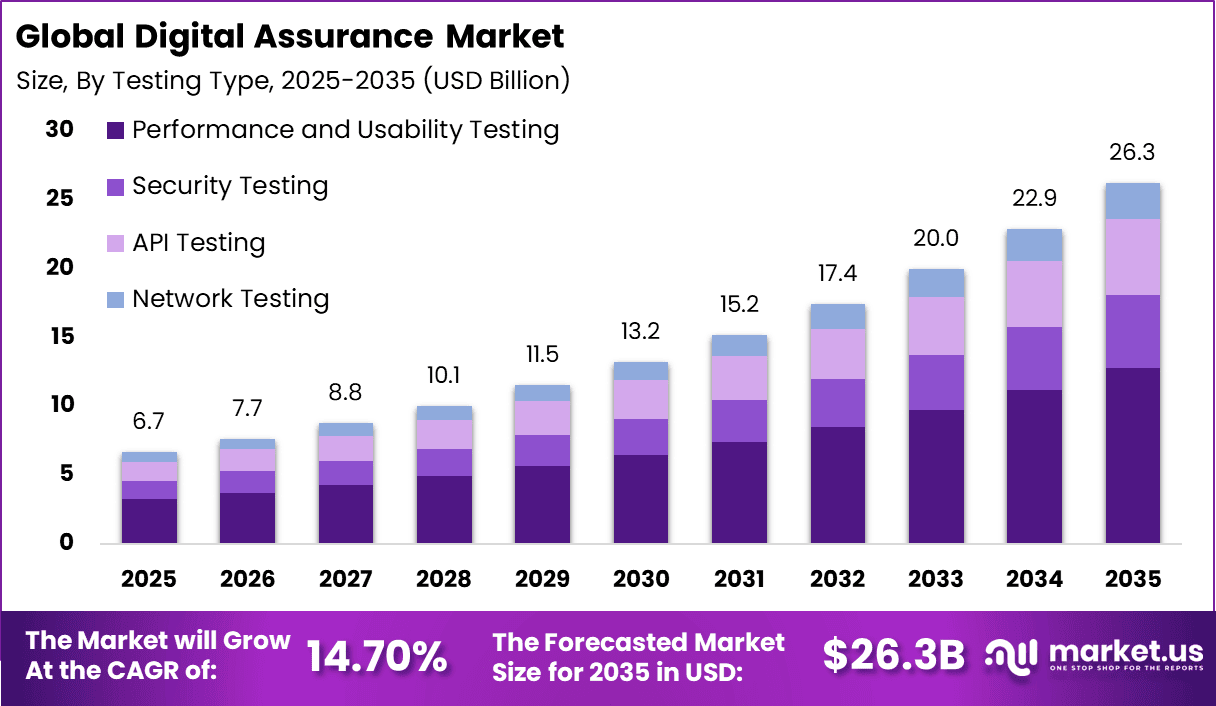
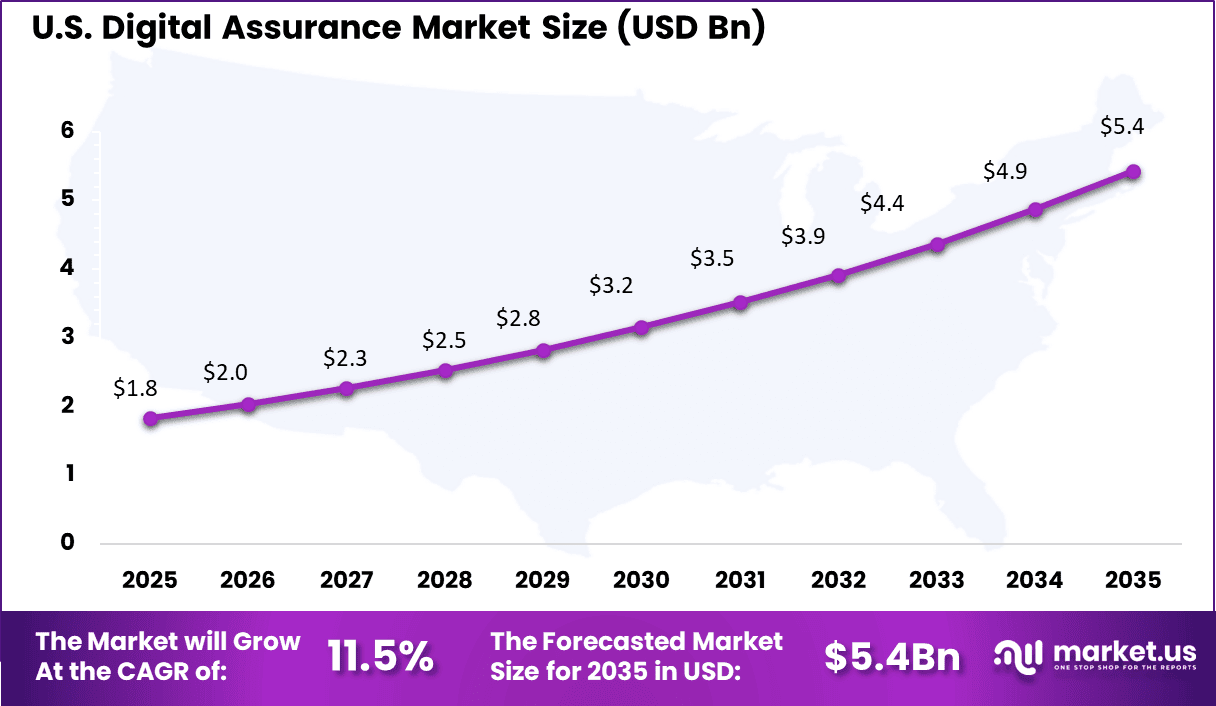
The Global Digital Assurance Market generated USD 6.7 billion in 2025 and is predicted to register growth from USD 7.7 billion in 2026 to about USD 26.3 billion by 2035, recording a CAGR of 14.7% throughout the forecast span. In 2025, North America held a dominant market position, capturing more than a 32.7% share, with USD 2.18 billion in revenue.
The digital assurance market refers to services and technologies that help organisations ensure quality, performance, and reliability of digital products and systems. Digital assurance covers testing, monitoring, validation, and risk assessment for software, applications, platforms, and digital processes. These services check functionality, security, user experience, and compliance before and after deployment.
The main driving factors for the digital assurance market are the increasing reliance on digital systems and the higher expectations for seamless user experiences. Organisations deliver software and digital services to customers and employees, and any failure, delay, or security issue can lead to financial loss and reputational harm.
Top Market Takeaways
- By testing type, performance and usability testing led the digital assurance market with a 48.8% share, ensuring apps deliver fast, intuitive experiences across devices.
- By testing mode, manual testing deployment captured 65.5%, complementing automation for complex user scenarios and exploratory checks.
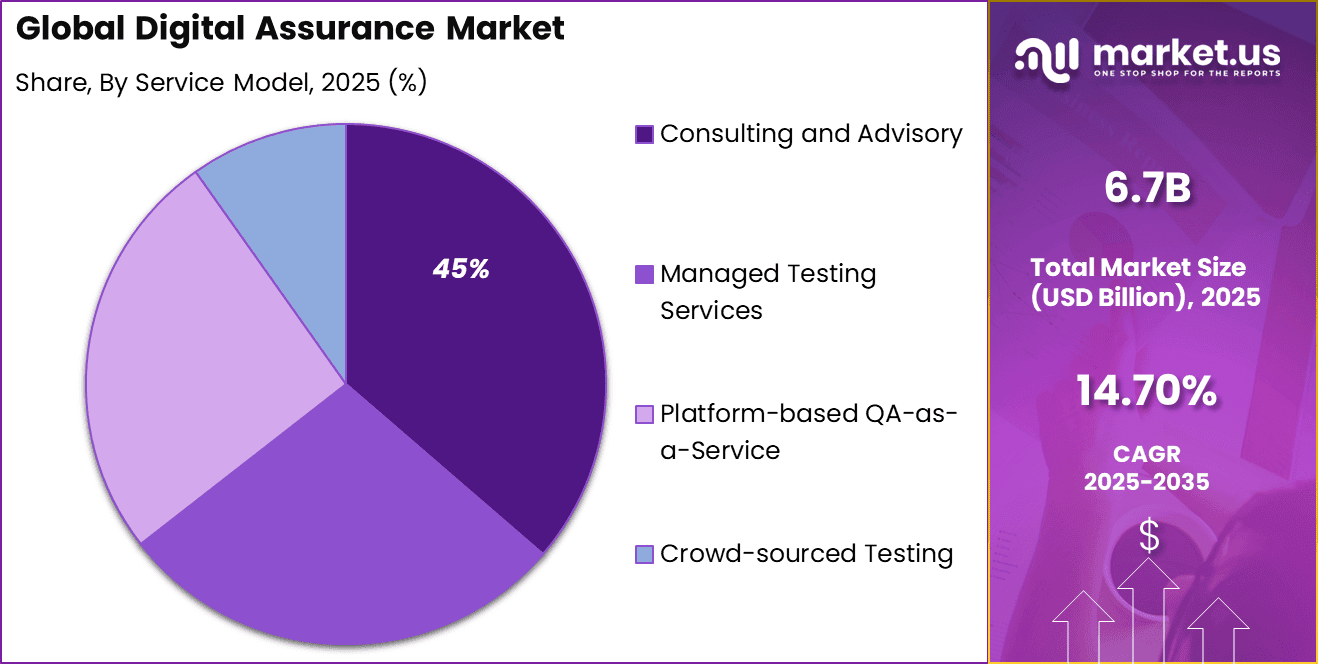
- By service model, consulting and advisory services held 45.2%, guiding enterprises on QA strategies and tool selection.
- By organization size, large enterprises dominated at 70.2%, investing in assurance for mission-critical digital transformations.
- North America accounted for 32.7% of the global market, with the U.S. valued at USD 1.83 billion and growing at a CAGR of 11.5%.
Testing Type Analysis
Performance and usability testing accounts for 48.8% of the Digital Assurance market, showing strong focus on application quality and user experience. Organizations use these testing services to ensure digital applications perform reliably under different workloads while remaining easy to use. Performance testing helps identify system bottlenecks, response time issues, and scalability limits.
From a business perspective, performance and usability testing reduces the risk of application failures and poor user adoption. Digital services that perform well and offer intuitive experiences support customer satisfaction and retention. The strong share of this segment reflects growing emphasis on delivering stable and user-friendly digital products.
Testing Mode Analysis
Manual testing deployment holds 65.5% of the market, indicating that human-led testing remains widely used in digital assurance. Manual testing is effective for exploratory testing, usability validation, and complex scenarios that require human judgment. Organizations rely on manual testers to identify issues that automated tools may not detect.
Manual testing also supports flexibility in test execution and rapid adaptation to changing requirements. It is commonly used in early development stages and for user experience validation. The strong dominance of this segment reflects continued reliance on skilled testing professionals to ensure software quality.
Service Model Analysis
Consulting and advisory services account for 45.2% of the Digital Assurance market, highlighting demand for strategic guidance in quality assurance. These services help organizations design testing strategies, assess digital maturity, and implement best practices. Consulting support is often required when organizations adopt new technologies or modernize legacy systems.
From an implementation standpoint, advisory services help align testing with business objectives and compliance requirements. They support risk management and quality planning. The strong presence of this segment reflects the need for expert insight to manage complex digital transformation initiatives.
Organization Size Analysis
Large enterprises represent 70.2% of market adoption, driven by their complex application environments and large user bases. These organizations operate multiple digital platforms and require structured assurance frameworks to maintain quality. Digital assurance services help large enterprises manage risk and ensure consistent performance across systems.
Large enterprises also face higher reputational and compliance risks. Comprehensive testing and assurance support audit readiness and reliability. The strong share of this segment reflects the critical role of digital assurance in large-scale enterprise operations.
Key Market Segments
By Testing Type
- Performance and Usability Testing
- Security Testing
- API Testing
- Network Testing
By Testing Mode
- Manual Testing Deployment
- Test Automation Deployment
By Service Model
- Consulting and Advisory
- Managed Testing Services
- Platform-based QA-as-a-Service
- Crowdsourced Testing
By Organisation Size
- Small and Mid-sized Enterprises
- Large Enterprises
By End-user Vertical
- Government
- Banking, Financial Services and Insurance
- Healthcare and Life Sciences
- Manufacturing
- IT and Telecommunications
- Media and Entertainment
- Other End-user Vertical
Regional Analysis
North America accounted for a 32.7% share, supported by strong demand for quality assurance and risk management across digital transformation initiatives. Enterprises in the region have increasingly adopted digital assurance solutions to ensure reliability, security, and performance of applications, platforms, and digital services.
Demand has been driven by rapid adoption of cloud, mobile, and AI-based systems, where continuous testing and monitoring are required. The region’s mature IT services ecosystem and emphasis on regulatory compliance have reinforced steady adoption.
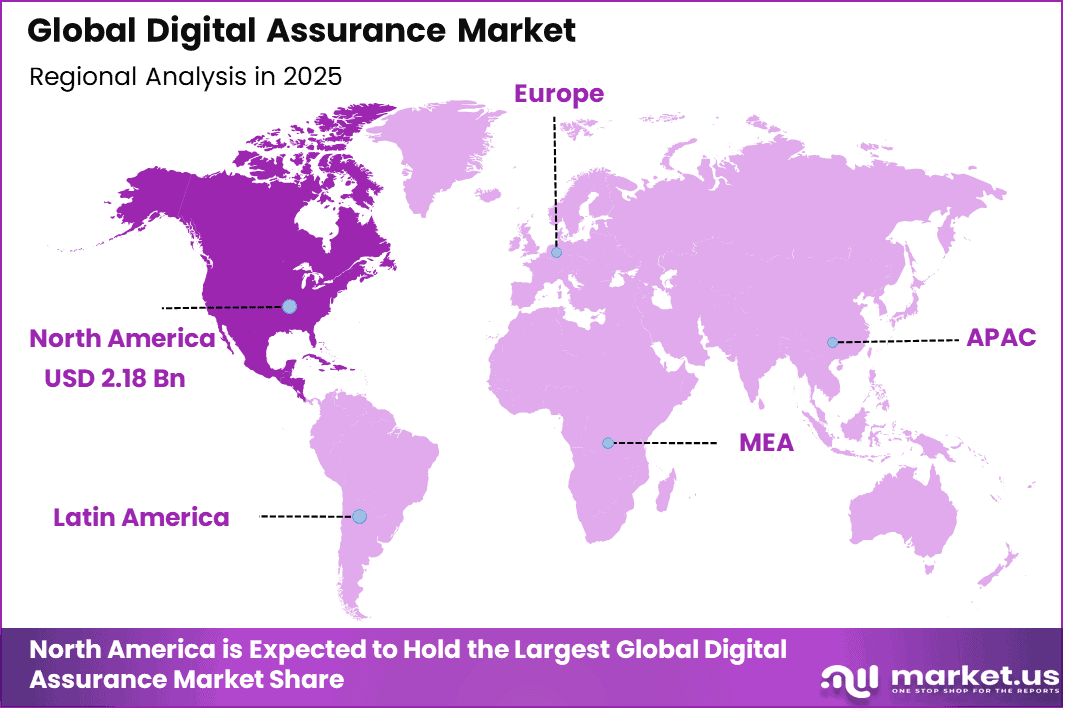
The U.S. market reached USD 1.83 Bn and is projected to grow at an 11.5% CAGR, reflecting consistent investment in enterprise software quality and risk control. Adoption has been driven by the need to reduce downtime, improve customer experience, and meet compliance standards in sectors such as banking, healthcare, and telecommunications. Digital assurance solutions have helped U.S. organizations manage testing, monitoring, and validation across complex digital platforms.
Key Regions and Countries
- North America
- US
- Canada
- Europe
- Germany
- France
- The UK
- Spain
- Italy
- Russia
- Netherlands
- Rest of Europe
- Asia Pacific
- China
- Japan
- South Korea
- India
- Australia
- Singapore
- Thailand
- Vietnam
- Rest of APAC
- Latin America
- Brazil
- Mexico
- Rest of Latin America
- Middle East & Africa
- South Africa
- Saudi Arabia
- UAE
- Rest of MEA
Key Reasons for Adoption
- Digital services are expanding rapidly across industries and platforms
- Service quality expectations are increasing among customers and regulators
- Complex digital systems require continuous testing and monitoring
- Business risks are rising from application failures and downtime
- Enterprises need assurance across cloud, mobile, and digital channels
Benefits
- Service reliability is improved through continuous validation and testing
- Customer experience quality is strengthened across digital touchpoints
- Risk exposure is reduced by identifying issues early
- Compliance confidence is increased through consistent assurance processes
- Operational efficiency is improved by preventing major service disruptions
Usage
- Used in application testing to ensure digital service performance
- Applied in cloud environments for service quality monitoring
- Deployed in digital transformation programs for system validation
- Utilized in telecom and financial services for service assurance
- Integrated into enterprise operations for end-to-end digital quality management
Emerging Trends
| Key Trend | Description |
|---|---|
| AI-augmented testing | Use of AI and machine learning to auto-generate test cases, self-heal scripts, and predict high-risk areas. |
| Continuous testing in DevOps | End-to-end automation embedded into CI/CD pipelines for every release. |
| Shift-left and shift-right assurance | Quality checks move earlier into development and extend into production monitoring. |
| Cloud-native and API assurance | Focus on testing microservices, APIs, containers, and multi-cloud architectures. |
| Security-first and compliance-driven QA | Integrated functional, performance, and security testing to meet stricter regulations. |
Growth Factors
| Key Factors | Description |
|---|---|
| Accelerating digital transformation | Enterprises launch more apps and channels, increasing demand for robust assurance. |
| Rising complexity of IT landscapes | Hybrid cloud, microservices, and IoT require specialized, scalable testing. |
| Adoption of Agile and DevOps | Faster release cycles make automation and continuous assurance essential. |
| Heightened cybersecurity and privacy risks | Breaches and data laws drive investment in security and compliance testing. |
| Customer experience as a differentiator | Businesses rely on high-quality digital experiences to reduce churn and grow revenue. |
Market Dynamics
Driver Analysis - Increasing Digital Transformation and Quality Assurance Focus
A primary driver of the digital assurance market is the rise in digital transformation initiatives by organisations across sectors. As companies expand digital experiences and services, there is a stronger emphasis on ensuring that software and applications operate reliably and securely in live environments. Digital assurance encompasses a broad set of testing and validation services designed to confirm that digital systems work as intended across platforms and conditions, which improves customer trust and reduces operational risks.
This need is reinforced by businesses adopting agile and DevOps methodologies that shorten development cycles and require continuous testing and assurance. Digital assurance helps organisations maintain quality while accelerating delivery timelines by integrating testing into the development lifecycle. The drive to maintain high performance and compliance across complex digital systems is prompting wider investment in assurance solutions.
Restraint Analysis - Integration Complexity and Resource Constraints
A significant restraint on the digital assurance market is the complexity involved in integrating assurance processes with existing development and operational workflows. Organisations often rely on varied tools, platforms, and legacy systems, making it challenging to align digital assurance practices smoothly across the entire ecosystem. This complexity can slow rollout and reduce confidence in achieving consistent quality outcomes.
Resource constraints also limit adoption, particularly for smaller enterprises that may lack specialised testing teams or budget to deploy advanced assurance tools. Digital assurance requires not only software but also skilled personnel to design, execute, and interpret tests and results. Where internal expertise is limited, organisations may delay adoption until they build required capabilities.
Opportunity Analysis - Expansion of Automation and Security Testing
An important opportunity for the digital assurance market is the increasing integration of automated and security-focused testing tools. Automation helps organisations reduce manual effort and improve test coverage, which is valuable in environments where frequent releases and updates occur. Automated assurance workflows enable faster validation cycles and help teams maintain consistency even as complexity grows.
Security assurance is also emerging as a key area of opportunity as concerns over cyber threats intensify. Organisations are seeking assurance solutions that not only test functionality but also assess performance under stress and potential attack scenarios. Providers that offer strong security assurance capabilities are likely to attract demand from sectors where data protection is critical.
Challenge Analysis - Keeping Pace with Rapid Technology Change
A core challenge for the digital assurance market is keeping pace with rapid changes in technology landscapes. Digital environments now include cloud platforms, mobile applications, Internet of Things devices, and distributed systems, each with unique behaviours and assurance requirements. Ensuring comprehensive testing across such diverse environments requires continual updates to tools, frameworks, and best practices.
Another challenge arises from the evolving expectations around user experience and performance. Organisations must ensure that digital systems not only work correctly but also perform well under varying load conditions and deliver consistent user satisfaction. Balancing these demands with limited testing windows and development timelines remains a practical hurdle for assurance teams and solution providers alike.
Competitive Analysis
The competitive landscape of the digital assurance market is shaped by large IT services providers and specialized quality engineering firms that support software reliability, performance, and security across digital platforms.
Accenture, Tata Consultancy Services, Capgemini, Cognizant, Wipro, Infosys, HCL Tech, IBM Consulting, DXC Technology, Atos, and EPAM Systems hold strong positions due to their scale, global delivery models, and ability to embed testing and assurance services into end-to-end digital transformation programs. These companies serve large enterprises across banking, telecom, retail, and manufacturing, where continuous quality validation is critical.
At the same time, testing-focused and tool-driven providers such as Cigniti Technologies, Hexaware, Software Quality Systems, Qualitest Group, and Applause add competitive pressure by offering automation, performance testing, and crowd-based quality assurance. Competitive differentiation increasingly depends on automation depth, support for agile and DevOps workflows, domain expertise, and measurable quality outcomes.
Top Key Players in the Market
- Accenture plc
- Tata Consultancy Services Ltd.
- Capgemini SE
- Cognizant Technology Solutions Corp.
- Wipro Ltd.
- Atos SE
- DXC Technology Co.
- Hexaware Technologies Ltd.
- Cigniti Technologies Ltd.
- Software Quality Systems AG
- OpenText Corp. (Micro Focus UFT)
- EPAM Systems Inc.
- Qualitest Group Ltd.
- Infosys Ltd.
- HCL Tech Ltd.
- IBM Consulting
- Keysight Technologies Inc.
- Tricentis GmbH
- Katalon Inc.
- Applause App Quality Inc.
- Others
Future Outlook
Growth in the Digital Assurance market is expected to remain strong as organizations rely more on digital platforms and services. Digital assurance helps ensure application quality, performance, security, and user experience across complex IT environments.
Rising use of cloud, mobile apps, and continuous software updates is increasing the need for ongoing testing and validation. Over time, greater use of automation, analytics, and AI is likely to improve coverage and reduce time to market.
Recent Developments
- In February 2026, Cognizant reported full‑year 2025 results with revenue growth driven by digital projects, cloud, and AI, which typically include significant quality engineering and assurance work for clients in regulated industries.
- In May 2026, Infosys hosted the “Infosys AI Assurance Conclave” in Basel, focused explicitly on assuring safe, reliable, and responsible AI through advanced quality engineering practices, underscoring a strategic push in AI‑centric digital assurance.
- In March 2026, Accenture announced a new Reinvention Services leadership structure, including a “Digital Core” unit focused on helping clients reinvent their digital foundations with embedded data and AI, which supports large‑scale digital assurance and quality engineering programs
Report Scope
| Report Features | Description |
|---|---|
| Market Value (2025) | USD 6.7 Billion |
| Forecast Revenue (2035) | USD 26.3 Billion |
| CAGR(2025-2035) | 14.7% |
| Base Year for Estimation | 2024 |
| Historic Period | 2020-2024 |
| Forecast Period | 2025-2035 |
| Report Coverage | Revenue forecast, AI impact on Market trends, Share Insights, Company ranking, competitive landscape, Recent Developments, Market Dynamics and Emerging Trends |
| Segments Covered | By Testing Type (Performance and Usability Testing, Security Testing), By Testing Mode (Manual Testing Deployment, Test Automation Deployment), By Service Model (Consulting and Advisory, Managed Testing Services), By Organisation Size (Small and Mid‑sized Enterprises, Large Enterprises), By End‑user Vertical (Government, Banking, Financial Services and Insurance, Other End‑user Vertical) |
| Regional Analysis | North America – US, Canada; Europe – Germany, France, The UK, Spain, Italy, Russia, Netherlands, Rest of Europe; Asia Pacific – China, Japan, South Korea, India, New Zealand, Singapore, Thailand, Vietnam, Rest of Latin America; Latin America – Brazil, Mexico, Rest of Latin America; Middle East & Africa – South Africa, Saudi Arabia, UAE, Rest of MEA |
| Competitive Landscape | Accenture plc, Tata Consultancy Services Ltd., Capgemini SE, Cognizant Technology Solutions Corp., Wipro Ltd., Atos SE, DXC Technology Co., Hexaware Technologies Ltd., Cigniti Technologies Ltd., Software Quality Systems AG, OpenText Corp. (Micro Focus UFT), EPAM Systems Inc., Qualitest Group Ltd., Infosys Ltd., HCL Tech Ltd., IBM Consulting, Keysight Technologies Inc., Tricentis GmbH, Katalon Inc., Applause App Quality Inc., Others |
| Customization Scope | Customization for segments, region/country-level will be provided. Moreover, additional customization can be done based on the requirements. |
| Purchase Options | We have three licenses to opt for: Single User License, Multi-User License (Up to 5 Users), Corporate Use License (Unlimited Users and Printable PDF) |