


Global Anticoccidial Drugs Market By Drug Class (Ionophore Antibiotics, Chemical Derivatives and Combination Products), By Animal Type (Poultry, Cattle, Sheep, Goats, Swine and Others (Equine, Aquaculture, Companion Animals)), By Route of Administration (Oral, Feed Additives, Water Additives and Injectable), By Distribution Channel (Veterinary Hospitals, Retail Pharmacies, Online Pharmacies and Veterinary Clinics), Region and Companies – Industry Segment Outlook, Market Assessment, Competition Scenario, Trends and Forecast 2026-2035
- Published date: March 2026
- Report ID: 182152
- Number of Pages: 263
- Format:
-
keyboard_arrow_up
Quick Navigation
- Report Overview
- Key Takeaways
- Drug Class Analysis
- Animal Type Analysis
- Route of Administration Analysis
- Distribution Channel Analysis
- Key Market Segments
- Drivers
- Restraints
- Opportunities
- Impact of Macroeconomic / Geopolitical Factors
- Latest Trends
- Regional Analysis
- Key Players Analysis
- Recent Developments
- Report Scope
Report Overview
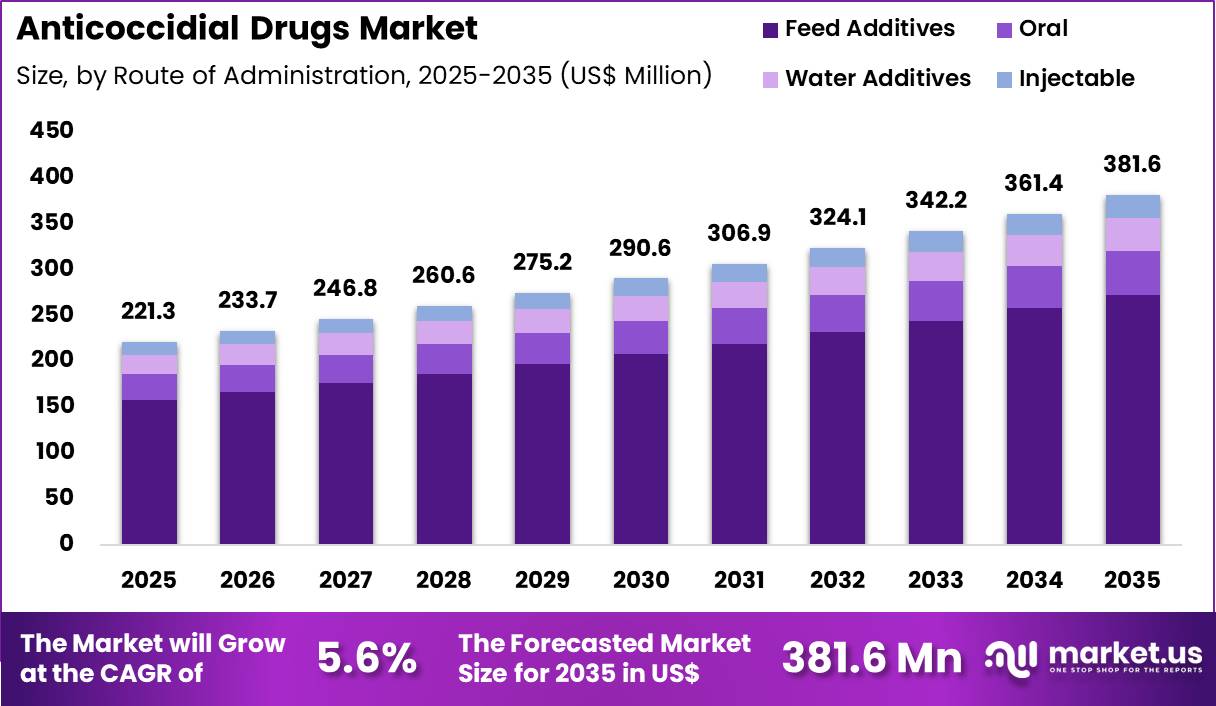
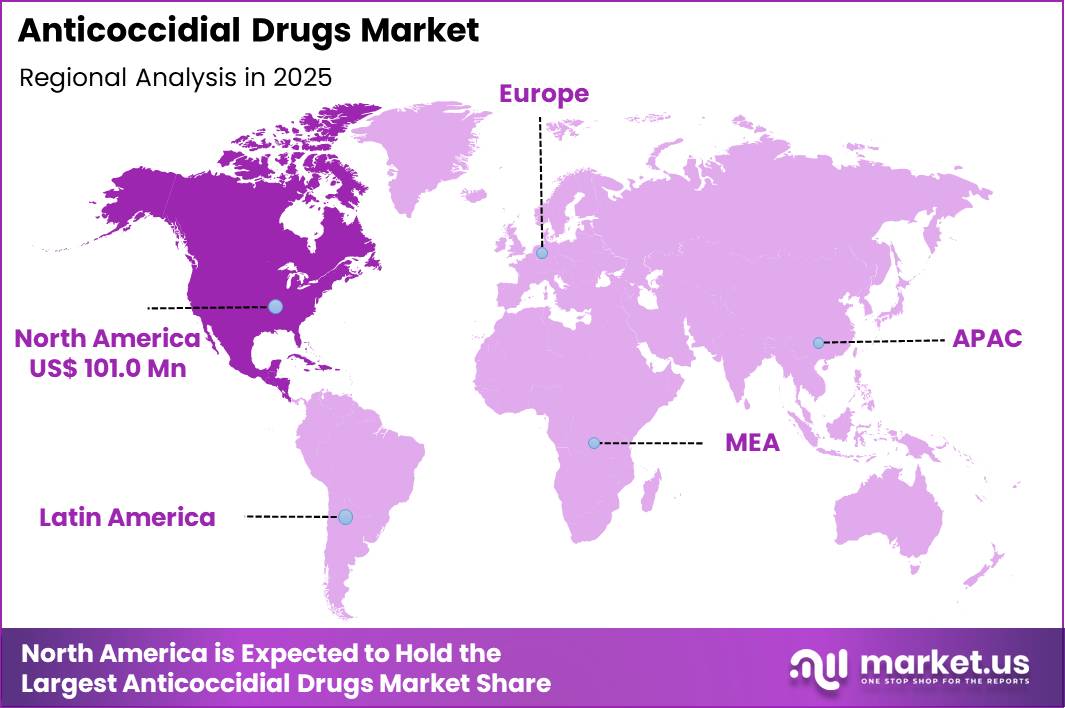
The Global Anticoccidial Drugs Market size is expected to be worth around US$ 381.6 Million by 2035 from US$ 221.3 Million in 2025, growing at a CAGR of 5.6% during the forecast period 2026-2035. In 2025, North America led the market, achieving over 45.6% share with a revenue of US$ 101.0 Million.
Increasing global poultry and livestock production intensifies pressure on producers to control coccidiosis outbreaks that threaten flock health, feed efficiency, and profitability, fueling the Anticoccidial Drugs market as veterinarians and farm managers require effective preventive and therapeutic agents.
Poultry producers increasingly incorporate ionophore anticoccidials such as monensin and salinomycin into starter and grower feeds to suppress Eimeria species replication in the intestinal epithelium, preventing clinical coccidiosis and subclinical damage that reduces weight gain and increases mortality in broilers and turkeys.
These drugs support rotation programs that alternate chemical and ionophore classes to delay resistance development in intensive broiler operations. In ruminant production, farmers administer diclazuril and toltrazuril to young calves and lambs, targeting intracellular stages of Eimeria bovis and Eimeria zuernii to reduce diarrhea, dehydration, and growth retardation during the pre-weaning period.
Swine producers apply toltrazuril in piglet nurseries to manage coccidiosis caused by Isospora suis, minimizing neonatal diarrhea and improving weaning weights in farrow-to-finish systems. These applications also extend to game birds and rabbits, where anticoccidials prevent severe enteritis in high-density production environments.
Manufacturers pursue opportunities to develop novel non-ionophore anticoccidials with novel modes of action that maintain efficacy against resistant Eimeria strains, expanding applications in antibiotic-free and organic production systems. These advancements support combination products that integrate anticoccidials with probiotics or prebiotics, enhancing gut health and reducing reliance on single-agent therapies in broiler and turkey flocks.
By early 2026, Zoetis continued expanding the use of its chemical anticoccidial product Zoamix, positioning it as a suitable option for production programs that avoid antibiotics. The product supports disease control without classification as an antibiotic, making it compatible with evolving regulatory and market preferences.
Following the acquisition of global rights to Vecoxan, Merck Animal Health expanded its presence in emerging markets during 2025 by broadening product availability for livestock applications. The treatment is widely used for managing coccidiosis in calves and lambs due to its safety profile and single-dose administration.
Recent trends emphasize targeted prophylaxis, resistance mitigation through rotation strategies, and integration with gut health promoters, positioning the market for continued growth in sustainable, high-performance animal production systems focused on health, efficiency, and regulatory compliance.
Key Takeaways
- In 2025, the market generated a revenue of US$ 221.3 Million, with a CAGR of 5.6%, and is expected to reach US$ 381.6 Million by the year 2035.
- The drug class segment is divided into ionophore antibiotics, chemical derivatives and combination products, with ionophore antibiotics taking the lead with a market share of 58.6%.
- Considering animal type, the market is divided into poultry, cattle, sheep, goats, swine and others. Among these, poultry held a significant share of 62.7%.
- Furthermore, concerning the route of administration segment, the market is segregated into oral, feed additives, water additives and injectable. The feed additives sector stands out as the dominant player, holding the largest revenue share of 71.5% in the market.
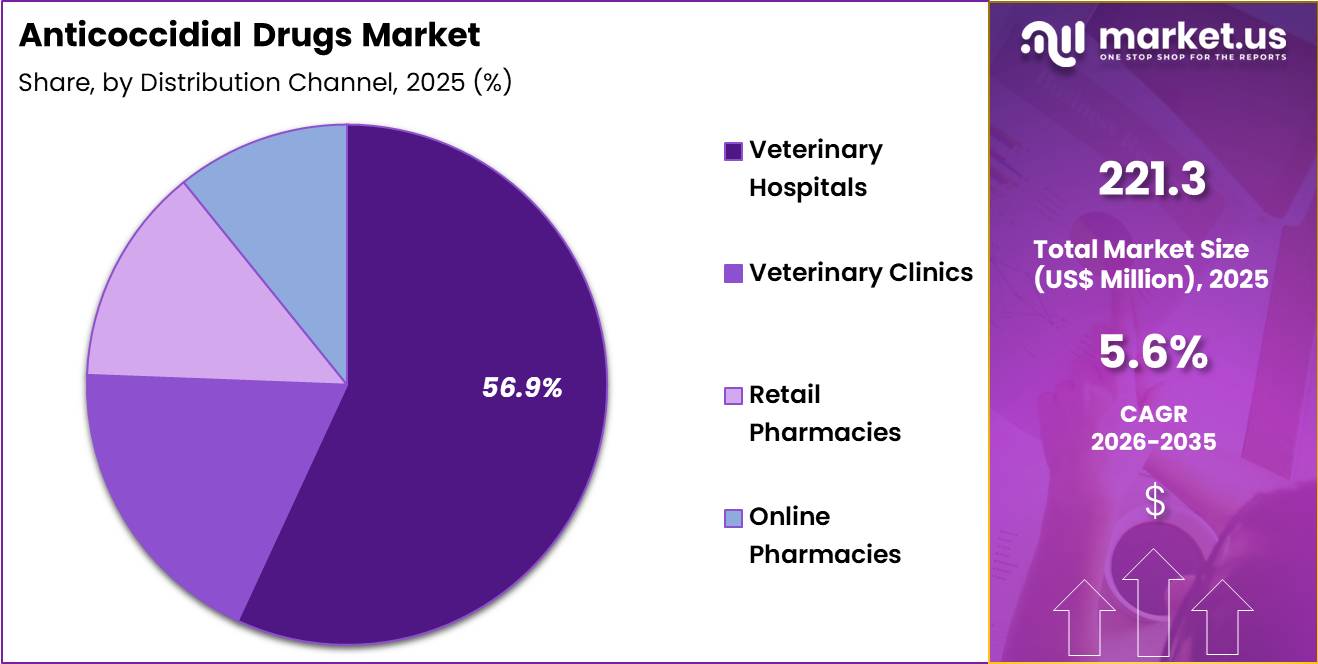
- The distribution channel segment is segregated into veterinary hospitals, retail pharmacies, online pharmacies and veterinary clinics, with the veterinary hospitals segment leading the market, holding a revenue share of 56.9%.
- North America led the market by securing a market share of 45.6%.
Drug Class Analysis
Ionophore antibiotics accounted for 58.6% of growth within drug class and dominate the anticoccidial drugs market due to their proven efficiency in preventing coccidiosis in large-scale livestock production systems. These compounds help control parasitic infections by disrupting ion transport in protozoa, which reduces disease spread and improves animal health outcomes.
Poultry producers widely adopt ionophores because they support better feed conversion ratios and reduce mortality rates in intensive farming environments. Global poultry production continues to expand steadily, with food and agriculture authorities reporting billions of chickens raised annually, which strengthens demand for preventive anticoccidial solutions.
Ionophore antibiotics are expected to maintain strong usage because they integrate easily into feed-based delivery systems and align with routine farm management practices. Farmers prefer these drugs as they offer cost-effective disease control across large flocks with minimal handling effort.
The segment is projected to grow further as commercial farming intensifies and biosecurity measures gain importance in livestock management. Veterinary professionals also recommend ionophores as part of rotational programs to manage resistance and sustain long-term effectiveness.
Increased focus on animal productivity and reduced disease outbreaks is likely to reinforce their adoption. As livestock producers prioritize consistent output and herd health stability, ionophore antibiotics are estimated to retain their leading position in this market.
Animal Type Analysis
Poultry accounted for 62.7% of growth within animal type and dominates the anticoccidial drugs market due to the high susceptibility of chickens to coccidiosis and the massive scale of global poultry farming. Intensive poultry production environments create conditions where parasites spread rapidly, which increases the need for continuous preventive treatment.
Food and agriculture organizations highlight that poultry remains one of the fastest-growing sources of animal protein worldwide, which significantly expands the at-risk population for coccidial infections. Farmers actively use anticoccidial drugs to maintain flock health, improve growth rates, and avoid economic losses caused by disease outbreaks.
Poultry producers are expected to continue prioritizing disease prevention as they aim to meet rising global demand for affordable protein. The segment benefits from structured feeding programs where medicated feed becomes a standard practice in broiler and layer production.
Poultry operations also require consistent disease control due to short production cycles and high stocking densities. The segment is projected to expand as emerging markets increase poultry consumption and modernize farming systems.
Integration of veterinary monitoring and improved farm management practices is likely to further support demand. As poultry farming remains central to global meat supply, this segment is anticipated to maintain its dominant share in the anticoccidial drugs market.
Route of Administration Analysis
Feed additives accounted for 71.5% of growth within route of administration and dominate the anticoccidial drugs market because they provide the most efficient and scalable method for delivering medication to large animal populations. Farmers incorporate anticoccidial drugs directly into feed, which ensures uniform intake across flocks and reduces the need for individual dosing.
This method supports consistent disease prevention in intensive livestock systems where manual administration becomes impractical. Feed-based delivery aligns closely with daily feeding routines, which increases compliance and reduces labor costs for producers. Livestock operations are expected to continue favoring feed additives as they simplify large-scale disease management and improve operational efficiency.
The segment benefits from the expansion of commercial feed mills that produce medicated feed tailored to different animal types and growth stages. Feed additives also allow controlled dosing over time, which supports better disease control and reduces sudden infection spikes.
The segment is projected to grow further as precision nutrition and feed optimization practices gain traction in modern agriculture. Increasing demand for high productivity and reduced mortality is likely to reinforce this delivery method. As livestock farming scales up globally, feed additives are estimated to remain the most preferred route for anticoccidial drug administration.
Distribution Channel Analysis
Veterinary hospitals accounted for 56.9% of growth within distribution channel and dominate the anticoccidial drugs market due to their role in disease diagnosis, prescription management, and professional veterinary oversight. Farmers rely on veterinary hospitals for accurate identification of coccidiosis outbreaks and for guidance on appropriate treatment protocols.
These facilities provide access to trained veterinarians who evaluate infection severity and recommend suitable drug combinations or preventive strategies. Veterinary hospitals are expected to remain central to drug distribution as regulatory frameworks emphasize controlled use of veterinary medicines in livestock production.
They also serve as trusted points for high-quality products, which strengthens farmer confidence in treatment outcomes. The segment benefits from increasing awareness of animal health management and the economic impact of parasitic diseases on farm productivity. Veterinary hospitals are projected to expand their role as livestock producers seek expert consultation to prevent resistance and ensure effective drug rotation.
Access to diagnostic tools and clinical expertise is likely to further support their dominance. Farmers prefer hospital-based procurement for reliable supply and professional advice. As livestock health management becomes more structured and compliance-driven, veterinary hospitals are anticipated to retain their leading position in the anticoccidial drugs market.
Key Market Segments
By Drug Class
- Ionophore Antibiotics
- Chemical Derivatives
- Combination Products
By Animal Type
- Poultry
- Cattle
- Sheep
- Goats
- Swine
- Others (Equine, Aquaculture, Companion Animals)
By Route of Administration
- Oral
- Feed Additives
- Water Additives
- Injectable
By Distribution Channel
- Veterinary Hospitals
- Retail Pharmacies
- Online Pharmacies
- Veterinary Clinics
Drivers
Growing sales of medicated feed additives including anticoccidials is driving the market.
Phibro Animal Health Corporation reported MFAs and other net sales of $439,827,000 for the nine months ended March 31, 2025. This figure increased from $304,261,000 in the corresponding nine-month period of 2024. The growth reflects expanded demand for products that prevent coccidiosis in poultry and livestock production systems.
Producers incorporate these additives into feed to maintain intestinal health and optimize weight gain. The category encompasses established ionophore and synthetic compounds that inhibit parasite replication. Veterinary and nutrition teams recommend consistent inclusion to support flock and herd performance under intensive farming conditions.
The upward sales trajectory supports continued manufacturing investments in premix facilities. Enhanced global distribution networks ensure reliable supply to major poultry-producing regions. This driver reinforces the strategic importance of anticoccidial formulations in commercial animal production. Overall, the documented expansion sustains market momentum through improved disease prevention outcomes.
Restraints
Rising cost of goods sold for animal health products is restraining the market.
Phibro Animal Health Corporation recorded cost of goods sold within the Animal Health segment of $340,903,000 for the six months ended December 31, 2025. This amount rose from $246,318,000 in the comparable six-month period of 2024. The increase stems from higher raw material and manufacturing expenses associated with medicated feed additive production.
Producers face elevated input costs that pressure margins on anticoccidial formulations. The restraint limits pricing flexibility in competitive tender environments. Supply chain participants must absorb inflationary pressures while maintaining product quality standards. The factor contributes to moderated investment in new formulation development.
Facilities adjust production schedules to optimize cost structures. This dynamic influences overall profitability within the anticoccidial category. The limitation persists in constraining rapid capacity expansion during the 2024-2025 interval.
Opportunities
Acquisition of additional medicated feed additive assets is creating growth opportunities.
Phibro Animal Health Corporation completed the acquisition of Zoetis’s medicated feed additive portfolio on October 31, 2024. The transaction added multiple manufacturing sites and established product lines to the existing anticoccidial offering. Opportunities arise for expanded geographic reach through integrated production and distribution networks.
The combined portfolio enables broader coverage of ionophore and synthetic compounds for poultry and livestock. Developers can accelerate lifecycle management and line extensions for existing molecules. The framework supports enhanced technical service capabilities for customers facing coccidiosis challenges.
Such consolidation facilitates synergies in regulatory compliance and quality assurance. The opportunity promotes differentiation through comprehensive anticoccidial solutions. Stakeholders anticipate improved supply chain resilience and customer retention. This development positions participants for scalable advancement in parasite control technologies.
Impact of Macroeconomic / Geopolitical Factors
Macroeconomic trends and geopolitical developments continue to influence cost structures, supply stability, and demand patterns in the anticoccidial drugs market. Rising feed prices and inflation increase livestock production costs, which pushes farmers to optimize disease prevention and maintain steady demand for anticoccidial solutions.
However, currency fluctuations and trade disruptions create pricing pressure on imported raw materials and finished formulations. Governments across major poultry-producing regions strengthen biosecurity regulations and support animal health programs, which encourages consistent product adoption.
At the same time, geopolitical tensions disrupt global supply chains for active pharmaceutical ingredients, affecting timely availability. Current US tariffs on certain veterinary inputs and intermediates raise input costs for manufacturers, leading to margin adjustments and selective price increases.
These tariffs also motivate local sourcing and domestic production investments, improving supply security over time. Overall, despite cost and trade-related challenges, strong protein consumption trends and regulatory focus on animal health are expected to support stable market growth.
Latest Trends
Contribution of acquired medicated feed additive portfolio to 2025 sales is driving the market.
Phibro Animal Health Corporation documented meaningful sales contributions from the acquired Zoetis medicated feed additive portfolio throughout fiscal 2025. The integration added established anticoccidial products to the Animal Health segment. The 2025 performance reflects accelerated uptake of these formulations in key poultry markets.
Producers benefit from continuity of supply and technical support for proven coccidiosis prevention programs. The development aligns with sustained demand for effective intestinal health solutions in commercial operations. Facilities achieve operational efficiencies through combined manufacturing expertise.
The trend supports expanded customer access to diversified anticoccidial options. Early 2025 results demonstrate consistent performance across multiple regions. The integration stimulates further portfolio optimization initiatives. Overall, this 2025 contribution advances the sector through strengthened product availability and market presence.
Regional Analysis
North America is leading the Anticoccidial Drugs Market
North America accounted for 45.6% of the anticoccidial drugs market in 2025 as livestock producers and veterinary professionals strengthened disease prevention programs to protect poultry and cattle health. Coccidiosis remains a major parasitic disease affecting poultry production, prompting widespread use of preventive and therapeutic medications in feed and water systems.
According to the United States Department of Agriculture, U.S. broiler chicken production exceeded 9 billion birds annually in recent years, highlighting the scale of poultry operations that require consistent parasite control measures. Large-scale commercial farming systems across the United States and Canada rely on integrated disease management programs that include routine use of anticoccidial treatments to maintain productivity and reduce mortality rates.
Veterinary professionals are also promoting rotation programs and combination therapies to improve effectiveness and reduce resistance development. Growth in demand for high-quality animal protein has encouraged producers to adopt advanced health management practices.
Feed manufacturers are incorporating medicated additives that support continuous parasite prevention in intensive farming environments. Regulatory oversight and food safety standards are encouraging controlled and responsible use of veterinary pharmaceuticals. These factors collectively supported steady expansion of parasite control treatments across North America in 2025.
The Asia Pacific region is expected to experience the highest CAGR during the forecast period
Asia Pacific is expected to experience strong growth during the forecast period as expanding livestock production and rising demand for poultry and meat products increase the need for effective disease management solutions. Countries such as China, India, Indonesia, and Vietnam maintain large poultry and livestock populations that require consistent health monitoring and parasite control.
The Food and Agriculture Organization reported that Asia produces more than 40% of the world’s poultry meat, underscoring the importance of maintaining flock health and productivity across the region. Farmers are increasingly adopting preventive treatment programs to reduce economic losses associated with parasitic infections.
Governments across the region are strengthening veterinary health infrastructure and implementing disease control programs to improve food security. Rapid intensification of farming practices is encouraging use of targeted parasite management strategies. Veterinary professionals are promoting improved biosecurity measures and treatment protocols to reduce infection risks.
Regional pharmaceutical companies are expanding production of veterinary medicines tailored to local farming conditions. Increasing awareness of animal health and productivity is driving adoption of modern livestock management practices. These developments are expected to accelerate growth of parasite control solutions throughout Asia Pacific in the coming years.
Key Regions and Countries
North America
- The US
- Canada
Europe
- Germany
- France
- The U.K.
- Italy
- Spain
- Russia & CIS
- Rest of Europe
Asia Pacific
- China
- India
- Japan
- South Korea
- ASEAN
- Australia & New Zealand
- Rest of Asia Pacific
Middle East & Africa
- GCC
- South Africa
- Rest of Middle East & Africa
Latin America
- Brazil
- Mexico
- Rest of Latin America
Key Players Analysis
Key participants in the Anticoccidial Drugs market drive expansion by developing broad-spectrum formulations, strengthening partnerships with poultry and livestock producers, and enhancing feed additive solutions that improve disease control efficiency. Companies invest in research programs to address drug resistance and introduce combination therapies that deliver better protection against coccidiosis in intensive farming systems.
They also expand distribution through veterinary channels and agribusiness networks to ensure consistent product availability across large-scale animal operations. Elanco Animal Health represents a prominent participant in the Anticoccidial Drugs market and operates as a U.S.-based animal health company that develops pharmaceuticals, vaccines, and feed additives for livestock and companion animals.
The company focuses on innovative parasitic control solutions and collaborates with producers to improve animal health and productivity. Industry competitors continue to launch advanced formulations, strengthen regulatory compliance, and expand global reach to support effective disease management in modern livestock production.
Top Key Players
- Zoetis Inc.
- Elanco Animal Health Incorporated
- Merck & Co., Inc. (Merck Animal Health)
- Ceva Santé Animale
- Virbac
- Phibro Animal Health Corporation
- Huvepharma
- Bioproperties Pty Ltd.
- HIPRA
Recent Developments
- During 2025 and 2026, Phibro Animal Health expanded its rotational coccidiosis control programs, encouraging producers to alternate different modes of action within a single production cycle. Combinations such as semduramicin with nicarbazin are being used to help manage resistance and maintain treatment effectiveness in poultry operations.
- In February 2026, Huvepharma highlighted advancements in digital disease management through its Aviapp platform during a global poultry health seminar. The system enables producers to monitor infection pressure in real time and adjust anticoccidial feed strategies based on field-level data insights.
- For the 2025–2026 cycle, HIPRA introduced an industry initiative focused on vaccination-based control of coccidiosis in broilers. The program promotes the use of attenuated vaccines and reflects a broader shift toward production systems that limit or eliminate antibiotic usage in poultry farming.
Report Scope
Report Features Description Market Value (2025) US$ 221.3 Million Forecast Revenue (2035) US$ 381.6 Million CAGR (2026-2035) 5.6% Base Year for Estimation 2025 Historic Period 2020-2024 Forecast Period 2026-2035 Report Coverage Revenue Forecast, Market Dynamics, COVID-19 Impact, Competitive Landscape, Recent Developments Segments Covered By Drug Class (Ionophore Antibiotics, Chemical Derivatives and Combination Products), By Animal Type (Poultry, Cattle, Sheep, Goats, Swine and Others (Equine, Aquaculture, Companion Animals)), By Route of Administration (Oral, Feed Additives, Water Additives and Injectable), By Distribution Channel (Veterinary Hospitals, Retail Pharmacies, Online Pharmacies and Veterinary Clinics) Regional Analysis North America – The US, Canada; Europe – Germany, France, The U.K., Italy, Spain, Russia & CIS, Rest of Europe; Asia Pacific – China, India, Japan, South Korea, ASEAN, Australia & New Zealand, Rest of Asia Pacific; Middle East & Africa – GCC, South Africa, Rest of Middle East & Africa; Latin America – Brazil, Mexico, Rest of Latin America Competitive Landscape Zoetis Inc., Elanco Animal Health Incorporated, Merck & Co., Inc., Ceva Santé Animale, Virbac, Phibro Animal Health Corporation, Huvepharma, Bioproperties Pty Ltd., HIPRA. Customization Scope Customization for segments, region/country-level will be provided. Moreover, additional customization can be done based on the requirements. Purchase Options We have three licenses to opt for: Single User License, Multi-User License (Up to 5 Users), Corporate Use License (Unlimited User and Printable PDF)  Anticoccidial Drugs MarketPublished date: March 2026add_shopping_cartBuy Now get_appDownload Sample
 -
-
- Zoetis Inc.
- Elanco Animal Health Incorporated
- Merck & Co., Inc. (Merck Animal Health)
- Ceva Santé Animale
- Virbac
- Phibro Animal Health Corporation
- Huvepharma
- Bioproperties Pty Ltd.
- HIPRA
Our Clients

- 182152
- March 2026






