Report Overview
The Global 3D Sensor Market generated USD 5.6 billion in 2024 and is predicted to register growth from USD 6.6 billion in 2025 to about USD 30.0 billion by 2034, recording a CAGR of 18.3% throughout the forecast span. In 2024, Asia-Pacific held a dominant market position, capturing more than a 45.7% share, with USD 2.55 billion in revenue.
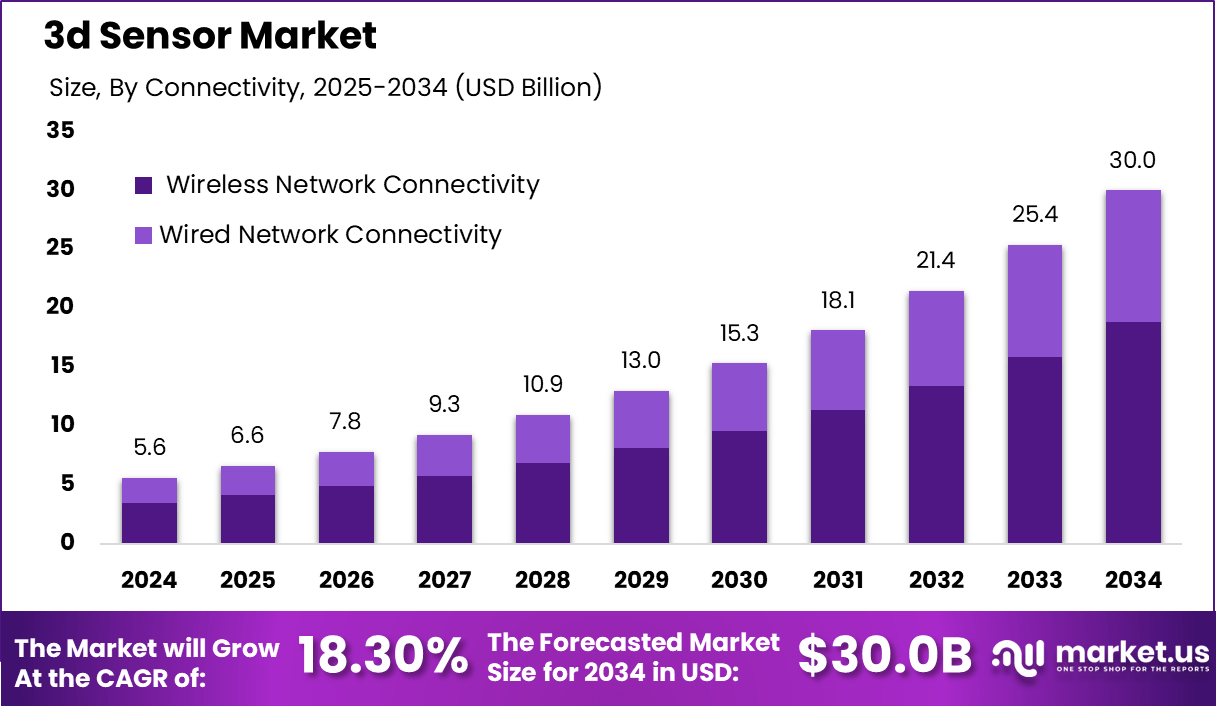
The 3D sensor market is expanding as demand rises across consumer electronics, automotive, healthcare, and industrial automation. Smartphones, wearables, and gaming devices increasingly use 3D sensing for facial recognition, gesture control, augmented reality, and improved user interaction.
Automotive adoption is also increasing as advanced driver assistance systems and autonomous vehicles rely on 3D sensors for depth sensing, object detection, collision avoidance, parking assistance, and navigation. Technologies such as time-of-flight, structured light, and stereoscopic vision are improving sensor accuracy, speed, and power efficiency.
Industrial automation uses 3D sensors in robotics, quality inspection, inventory management, and smart infrastructure. Consumer electronics remains a major demand segment, while automotive applications continue to grow due to a stronger focus on safety, automation, and reliable environmental sensing.
Top Market Takeaways
- By connectivity, wireless network connectivity leads the market with a 62.7% share, favored for its flexibility and ease of integration in IoT, consumer electronics, and industrial automation applications.
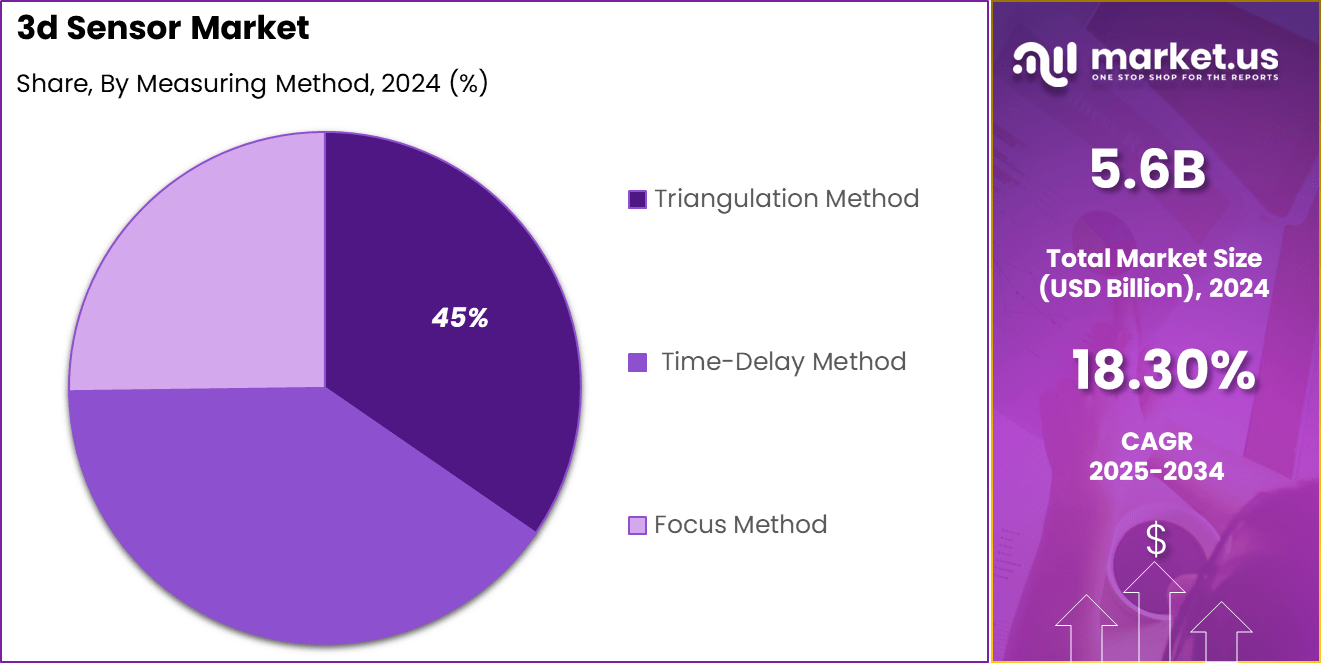
- By measuring method, the triangulation method dominates with 45.3%, used widely for accurate depth and distance measurement applications, such as in cameras and industrial sensors.
- By type, image sensors hold a majority 54.5% share, driven by their essential role in facial recognition, augmented reality, and autonomous systems.
- By technology, Time-of-Flight (ToF) sensors account for about a 35.4% share, valued for precise distance measurement and fast response times, especially in automotive, robotics, and consumer electronics.
- By end-use industry, consumer electronics lead with 40.8%, fueled by growing demand for 3D sensing in smartphones, tablets, gaming devices, and smart home applications.
- Regionally, Asia Pacific commands about a 45.7% share of the 3D sensor market.
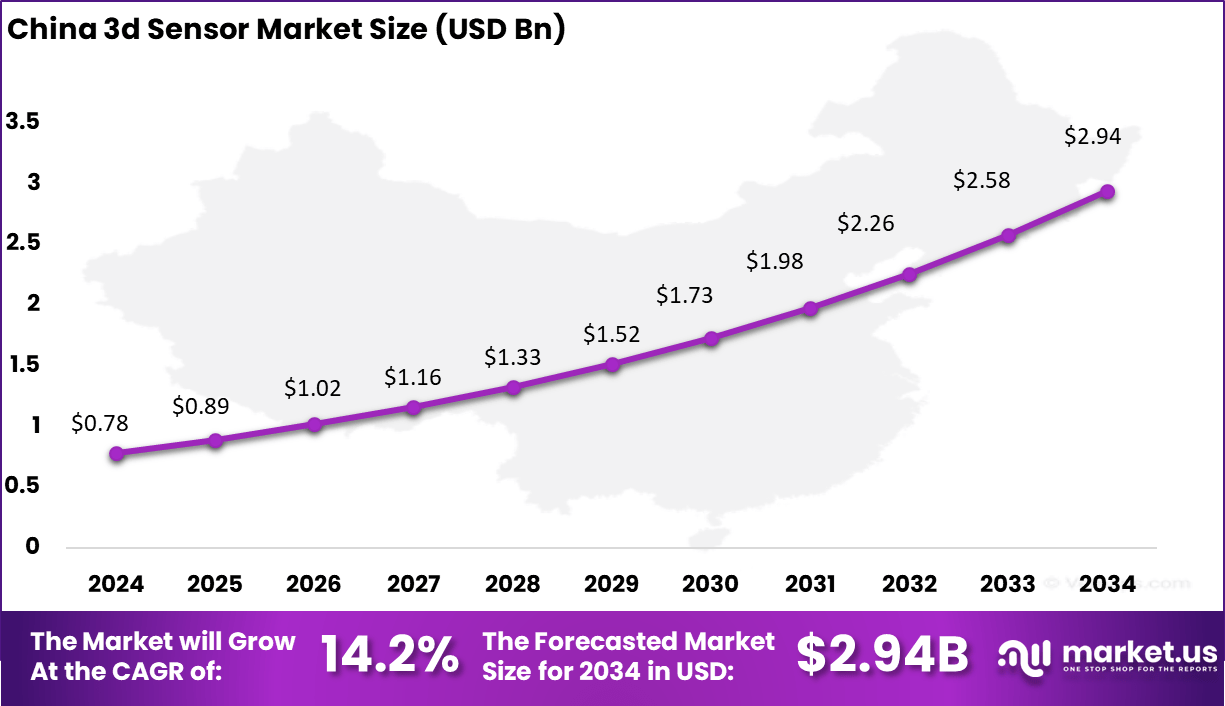
- The China market is valued at approximately USD 0.78 billion in 2025, supported by rapid adoption of advanced consumer electronics, automotive production, and expanding industrial automation.
By Connectivity
Wireless network connectivity leads the 3D sensor market with a robust share of 62.7%. The significant preference for wireless sensors is driven by their flexibility, ease of installation, and the growing demand for IoT-enabled smart devices and systems. Wireless 3D sensors facilitate seamless data transmission in diverse environments, providing freedom from the constraints of wired connections.
They are widely used in consumer electronics, industrial automation, healthcare, and automotive applications where mobility and scalability are key. The evolution of wireless standards such as 5G and the integration of edge computing further boost the adoption of wireless 3D sensors, enabling real-time data processing with reduced latency and power consumption.
By Measuring Method
The triangulation measuring method accounts for 45% of the market share, reflecting its effectiveness in accurate depth and distance measurement. This method uses projected light patterns and stereoscopic vision to calculate spatial dimensions, making it highly suitable for applications demanding high precision like robotics, gesture recognition, and quality inspection.
Triangulation sensors are leveraging advancements in optics and computation to improve speed and accuracy further. Its ability to deliver detailed 3D spatial information rapidly has made triangulation the preferred choice in many commercial and industrial 3D sensing applications.
By Type
Image sensors dominate the 3D sensor market with a 54.5% share. These sensors integrate traditional imaging with depth perception, enabling applications like facial recognition, augmented reality, and autonomous navigation. The widespread adoption of CMOS technology in image sensors has contributed greatly to their predominance by offering high resolution, low power consumption, and faster processing speeds.
Image sensors continue to evolve with capabilities such as backside illumination and single-photon avalanche photodiodes enhancing performance, making them central to consumer electronics and industrial use cases.
By Technology
Time-of-Flight (ToF) technology holds a noteworthy 35.4% market share, prized for its direct depth measurement by calculating light pulse travel time. ToF sensors offer advantages including long-range detection, real-time depth sensing, and robustness in various lighting conditions, which make them ideal for applications ranging from autonomous vehicles to industrial automation.
Innovations in VCSEL emitters and SPAD receivers boost ToF sensor precision and reduce latency.The expanding use of ToF technology is driven by demands for accurate 3D modeling, improved safety in autonomous systems, and enhanced user experience in consumer devices.
By End-Use Industry
Consumer electronics constitute 40.8% of the end-use industry segment in the 3D sensor market. The increasing integration of 3D sensors in smartphones, tablets, gaming consoles, and smart home devices is driven by demand for features like facial recognition, augmented reality, and gesture control.
Consumer preferences for richer, interactive experiences are encouraging manufacturers to embed advanced 3D sensing technologies into devices. This segment benefits from rapid product cycles and technological innovation, making consumer electronics a key growth driver and adoption hub for 3D sensor advancements.
Key Market Segments
By Connectivity
- Wired Network Connectivity
- Wireless Network Connectivity
By Measuring Method
- Time-Delay Method
- Triangulation Method
- Focus Method
By Type
- Image Sensor
- Position Sensor
- Acoustic Sensor
- Magnetometer
- Others
By Technology
- Stereo Vision
- Structured Light
- Time-of-Flight
- Ultrasound
- Others
By End-Use Industry
- Consumer Electronics
- Automotive
- Industrial Robotics
- Aerospace & Defense
- Healthcare
- Entertainment
- Others
Emerging Trends
| Key Trend | Description |
|---|---|
| Miniaturization and Integration | 3D sensors are becoming smaller and easier to integrate into a range of devices such as smartphones, wearables, and IoT gadgets, increasing adoption across consumer and industrial sectors. |
| AI-Enhanced 3D Imaging | Artificial intelligence is improving depth and spatial interpretation, enabling faster and more accurate recognition for applications like AR/VR and facial authentication. |
| Wearables Expansion into Consumer Electronics | LIDAR technology, previously used mainly in automotive and industrial systems, is now entering consumer devices to deliver enhanced depth sensing and augmented reality capabilities. |
| Edge AI Processing | Processing data directly on the sensor reduces latency and energy use, supporting real-time performance for applications such as autonomous vehicles and robotics. |
| Low-Power Sensor Development | Efforts are focused on designing energy-efficient 3D sensors to extend battery life in IoT and portable devices while maintaining high accuracy. |
Growth Factors
| Key Factor | Description |
|---|---|
| Rise in Consumer Electronics | Growing demand for interactive features like facial recognition and gesture control is accelerating the adoption of 3D sensors in consumer devices. |
| Autonomous Vehicle and Robotics Growth | The need for precise environmental sensing in autonomous vehicles, robotics, and drones is boosting demand for advanced 3D sensing technologies. |
| Increasing AR/VR Applications | Growth in augmented and virtual reality platforms is driving demand for high-performance depth sensing to enable realistic user interactions. |
| Technological Advancements | Improvements in accuracy, cost reduction, and miniaturization are making 3D sensors more accessible across industries and applications. |
| Smart City and Industrial Automation | 3D sensors are being adopted in infrastructure monitoring, public safety, and industrial automation where precise spatial data enhancement improves operational efficiency. |
Regional Analysis
Asia-Pacific dominated the 3D sensor market with a substantial 45.7% share, fueled by rapid industrialization, technological progress, and rising consumer electronics production. The region benefits from a large manufacturing base and critical contributions from countries like Japan, South Korea, India, and particularly China.
Growing demand for automotive safety features such as advanced driver assistance systems (ADAS), augmented and virtual reality devices, and industrial automation solutions propels the market forward. Supportive government policies, increasing R&D investments, and the adoption of sophisticated sensing solutions across multiple sectors foster robust growth and innovation.
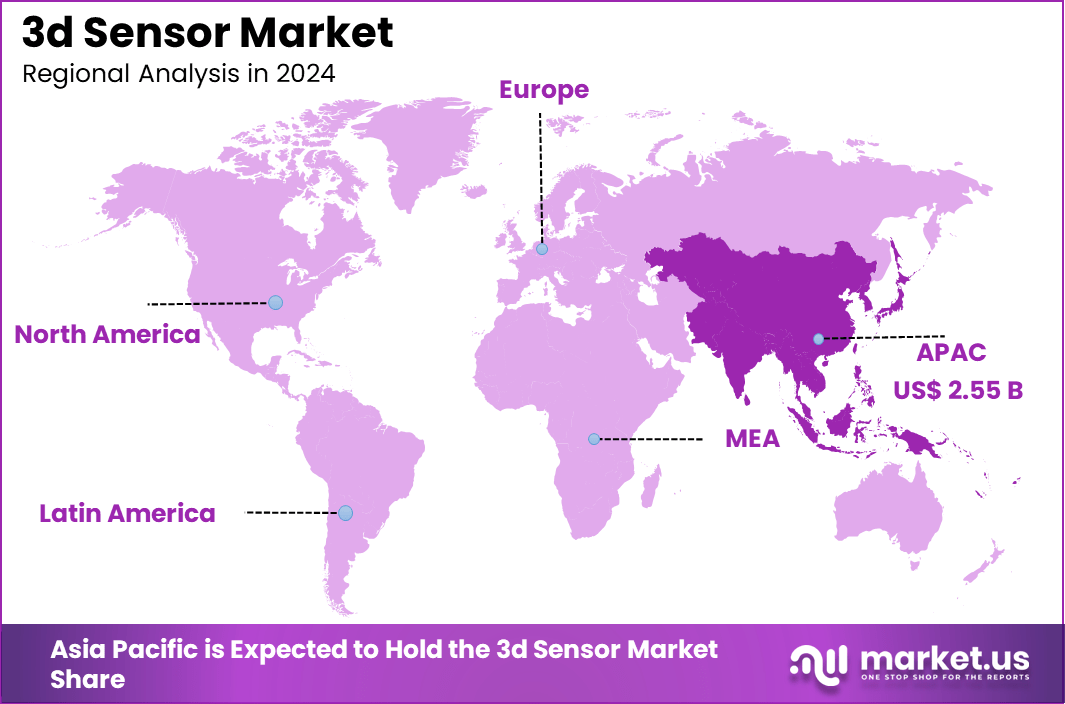
China, as the largest market within Asia-Pacific, was valued at approximately USD 0.78 billion in 2024. The country’s expanding electronics manufacturing sector, booming automotive industry, and growing applications in robotics and logistics create strong demand for 3D sensing technology.
Additionally, efforts to boost semiconductor manufacturing and AI integration support advancements in sensor design and production. China’s rapidly growing consumer base and increasing disposable incomes contribute to its market expansion, consolidating its leadership in the 3D sensor market and driving the larger Asia-Pacific region’s growth trajectory forward.
Key Regions and Countries
- North America
- US
- Canada
- Europe
- Germany
- France
- The UK
- Spain
- Italy
- Russia
- Netherlands
- Rest of Europe
- Asia Pacific
- China
- Japan
- South Korea
- India
- Australia
- Singapore
- Thailand
- Vietnam
- Rest of APAC
- Latin America
- Brazil
- Mexico
- Rest of Latin America
- Middle East & Africa
- South Africa
- Saudi Arabia
- UAE
- Rest of MEA
Market Dynamics
Driver - Growing Demand for Advanced Consumer Electronics
The 3D sensor market is driven by the increasing adoption of advanced consumer electronics like smartphones, tablets, and gaming consoles that require sophisticated spatial sensing capabilities. Features such as facial recognition, gesture control, and augmented reality (AR) demand precise 3D sensing technology to deliver enhanced user experiences.
Additionally, automotive applications, particularly in autonomous driving and advanced driver-assistance systems (ADAS), rely heavily on 3D sensors for object detection and environmental mapping. Government regulations promoting vehicle safety further stimulate demand, making this sector a critical growth driver in the market.
Restraint - High Cost and Integration Complexity
Despite promising growth, the 3D sensor market faces restraints from the high cost of sensor components and the complexity of integrating 3D sensors into compact electronic devices. The manufacturing process involves expensive materials and precise calibration, elevating the overall product cost. This can deter adoption in price-sensitive markets and small-scale applications.
Moreover, embedding 3D sensors alongside other components in limited device spaces requires sophisticated design and engineering skills, complicating product development cycles. Companies must invest heavily in R&D and skilled personnel to overcome these technological challenges.
Opportunity - Expansion in Healthcare and Industrial Automation
There are substantial opportunities for 3D sensors in healthcare and industrial automation sectors. In healthcare, 3D sensors are used in medical imaging, diagnostics, and wearable health devices to improve patient monitoring and treatment accuracy. These applications benefit from the sensors’ ability to capture depth and spatial data critical for detailed analysis.
Industrial automation increasingly incorporates 3D sensors for robotics, quality control, and inventory management, where precise spatial awareness enhances efficiency and safety. The rising adoption of smart factories and Industry 4.0 initiatives worldwide accelerates market growth by integrating 3D sensors into automated systems.
Challenge - Rapid Technological Advances and Market Competition
A key challenge in the 3D sensor market is keeping pace with rapid technological advancements and intense competition. Continuous innovation in sensor accuracy, size reduction, and power efficiency demands significant and sustained investment. Rapidly evolving standards require manufacturers to regularly update products, adding to operational complexity.
Simultaneously, emerging players and low-cost alternatives intensify price competition, pressuring established companies to balance quality and affordability. Managing these dynamics while preserving profitability and market share is a critical hurdle for industry participants.
Key Player Analysis
The 3D sensor market is shaped by strong participation from semiconductor, optics, and imaging companies that continue to advance depth-sensing and LiDAR technologies. Intel, Sony, ams OSRAM, STMicroelectronics, and Infineon play a major role in improving accuracy and speed for ToF, structured-light, and optical modules used in smartphones and AR devices.
Apple and Samsung drive large-scale adoption through continuous integration of 3D sensors in premium consumer electronics. Industrial automation demand is supported by Cognex, Sick, LMI Technologies, and Teledyne e2v, whose 3D vision systems are used in logistics and inspection applications.
Velodyne Lidar, OmniVision, Himax, and Melexis strengthen automotive and mobility use cases, while Qualcomm contributes key processing capabilities. New entrants such as XYZ Interactive and established technologies like Sony DepthSense add momentum to gesture control and compact depth-sensing solutions. Overall, these players collectively enhance performance, efficiency, and reliability across consumer, industrial, and automotive applications.
Top Key Players in the Market
- Intel Corp.
- Sony Group Corp.
- ams OSRAM AG
- STMicroelectronics N.V.
- Infineon Technologies AG
- Lumentum Holdings Inc.
- Apple Inc. (PrimeSense)
- Samsung Electronics Co. Ltd.
- OmniVision Technologies Inc.
- Panasonic Holdings Corp.
- Cognex Corp.
- Sick AG
- LMI Technologies Inc.
- Teledyne e2v
- Qualcomm Inc.
- SoftKinetic (Sony DepthSense)
- Melexis N.V.
- Himax Technologies Inc.
- Velodyne Lidar Inc.
- XYZ Interactive Technologies
- Others
Recent Developments
- In January 2025, Intel announced plans to spin off its RealSense depth camera business into an independent company within its Capital portfolio, aiming to accelerate growth in AI-driven computer vision, robotics, and healthcare solutions.
- In September 2025, Sony showcased next-generation tools at IBC 2025, including its Virtual Production Tool Set Ver3.0 and camera tracking system OCELLUS, enhancing 3D tracking and virtual production workflows for media and entertainment.
Report Scope
| Report Features | Description |
|---|---|
| Market Value (2024) | USD 5.6 Bn |
| Forecast Revenue (2034) | USD 30.0 Bn |
| CAGR(2025-2034) | 18.3% |
| Base Year for Estimation | 2024 |
| Historic Period | 2020-2023 |
| Forecast Period | 2025-2034 |
| Report Coverage | Revenue forecast, AI impact on Market trends, Share Insights, Company ranking, competitive landscape, Recent Developments, Market Dynamics and Emerging Trends |
| Segments Covered | By Connectivity (Wired Network Connectivity, Wireless Network Connectivity), By Measuring Method (Time-Delay Method, Triangulation Method, Focus Method), By Type (Image Sensor, Position Sensor, Acoustic Sensor, Magnetometer, Others), By Technology (Stereo Vision, Structured Light, Time-of-Flight, Ultrasound, Others), By End-Use Industry (Consumer Electronics, Automotive, Industrial Robotics, Aerospace & Defense, Healthcare, Entertainment, Others) |
| Regional Analysis | North America – US, Canada; Europe – Germany, France, The UK, Spain, Italy, Russia, Netherlands, Rest of Europe; Asia Pacific – China, Japan, South Korea, India, New Zealand, Singapore, Thailand, Vietnam, Rest of Latin America; Latin America – Brazil, Mexico, Rest of Latin America; Middle East & Africa – South Africa, Saudi Arabia, UAE, Rest of MEA |
| Competitive Landscape | Intel Corp., Sony Group Corp., ams OSRAM AG, STMicroelectronics N.V., Infineon Technologies AG, Lumentum Holdings Inc., Apple Inc. (PrimeSense), Samsung Electronics Co. Ltd., OmniVision Technologies Inc., Panasonic Holdings Corp., Cognex Corp., Sick AG, LMI Technologies Inc., Teledyne e2v, Qualcomm Inc., SoftKinetic (Sony DepthSense), Melexis N.V., Himax Technologies Inc., Velodyne Lidar Inc., XYZ Interactive Technologies, and others |
| Customization Scope | Customization for segments, region/country-level will be provided. Moreover, additional customization can be done based on the requirements. |
| Purchase Options | We have three licenses to opt for: Single User License, Multi-User License (Up to 5 Users), Corporate Use License (Unlimited Users and Printable PDF) |