


Report Overview
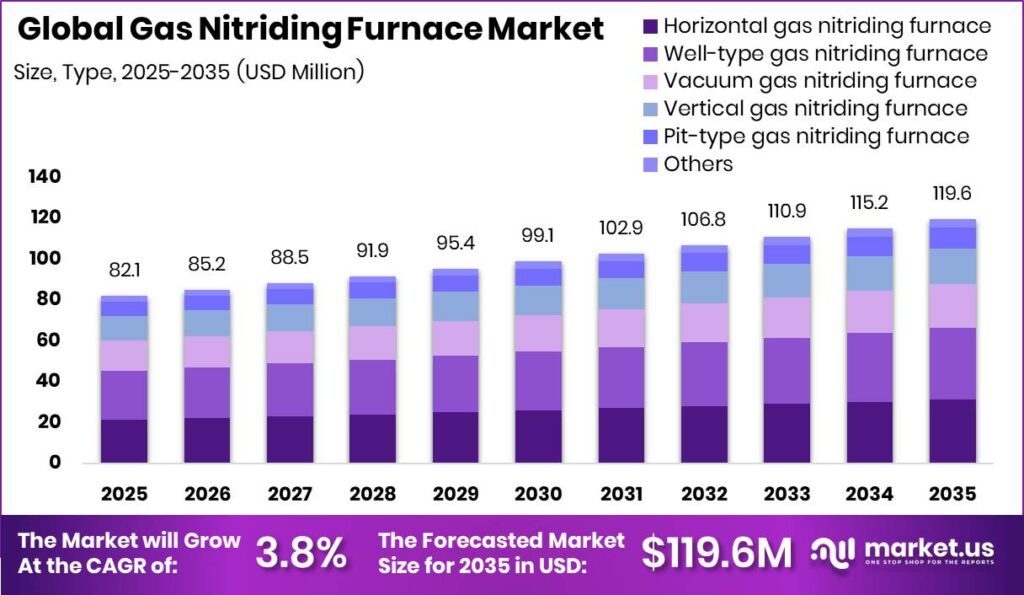
Global Gas Nitriding Furnace Market size is expected to be worth around USD 119.60 Million by 2035 from USD 82.10 Million in 2025, growing at a CAGR of 3.8% during the forecast period 2026 to 2035. This steady climb reflects rising demand for precise surface hardening across metal-intensive industries. Equipment makers who invest in controlled nitriding technology now will secure long term supply contracts with quality-focused manufacturers.
The Heat Treatment Equipment market centers on furnaces that harden metal surfaces using nitrogen diffusion at controlled temperatures. Buyers include automotive, aerospace, and tooling manufacturers who need wear-resistant components. This means the market structure rewards vendors offering tight process control, energy efficiency, and compliance with sector standards. Suppliers who bundle atmosphere control systems with furnace hardware gain a clear competitive position among industrial buyers.
Key Takeaways
- Global Gas Nitriding Furnace Market will reach USD 119.60 Million by 2035 from USD 82.10 Million in 2025 at a CAGR of 3.8%.
- Horizontal gas nitriding furnace leads the By Type segment with a 26.4% share.
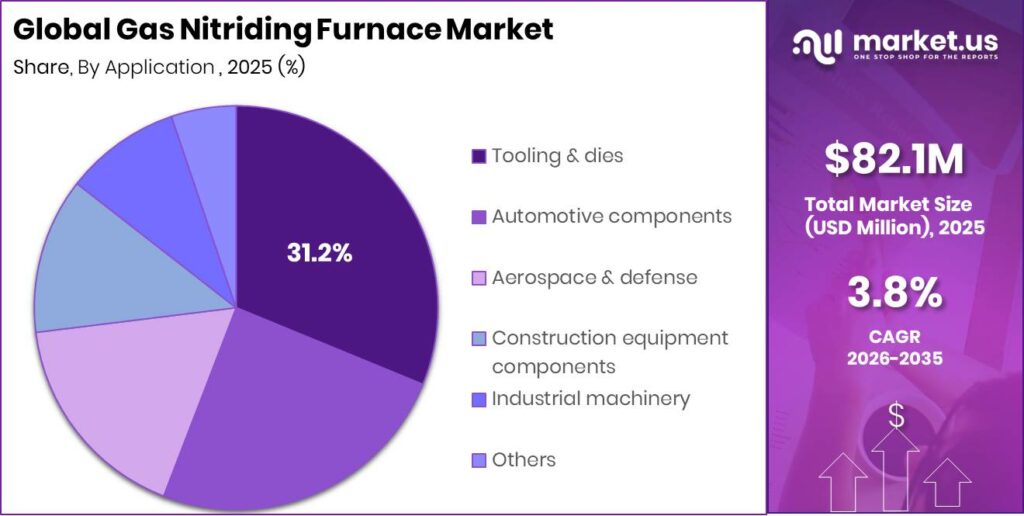
- Tooling and dies dominates the By Application segment with a 31.2% share.
- Automotive OEMs and suppliers lead the By End User segment with a 29.0% share.
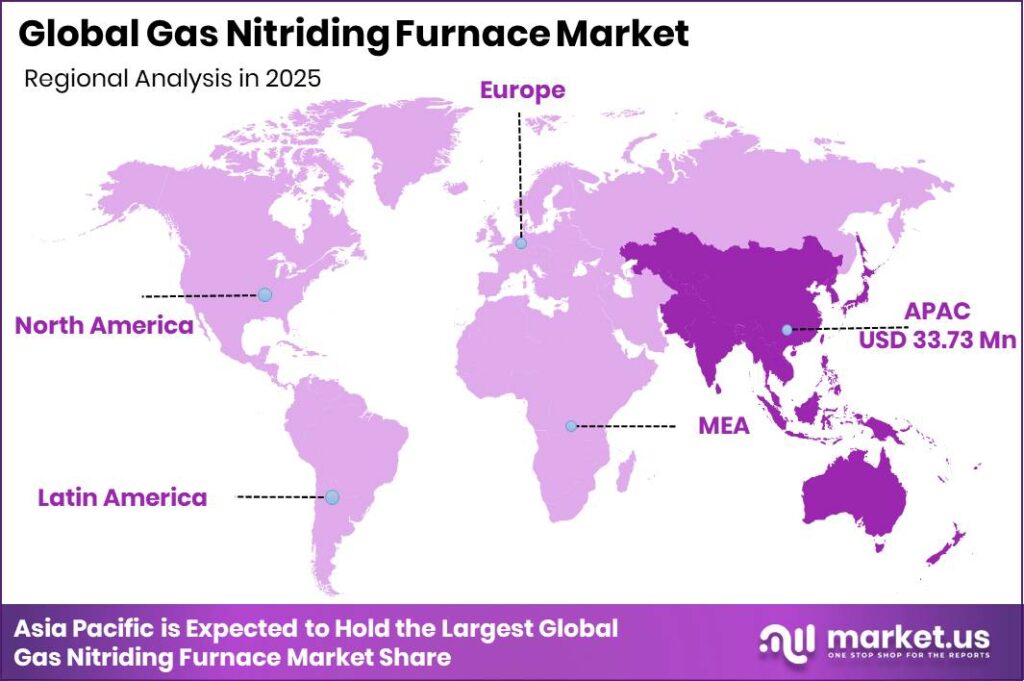
- Asia-Pacific leads globally with a 41.1% share, valued at USD 33.73 Million.
Government programs across major economies now fund cleaner industrial heat treatment, pushing shops toward furnaces that cut process-gas waste. This regulatory pressure favors vendors offering closed-retort systems over legacy continuous-flow units. As a result, buyers face rising compliance costs that reshape purchasing decisions across the entire heat-treatment supply chain.
Growth in high-fatigue automotive and aerospace parts directly lifts demand for controlled nitriding furnaces. As per our research, gas-nitrided tool and alloy steels reach surface hardness of 800 to 1,200 HV and deliver 3 to 5x better wear resistance than untreated surfaces. This performance edge lets component makers extend part life. Therefore, manufacturers adopting nitriding win contracts requiring longer service intervals.
Cost advantage further strengthens the case for gas nitriding investment. As per our research, batch gas nitriding costs $10 to $50 per part versus $50 to $200 for PVD or CVD coatings, yielding 40 to 70% savings in medium-to-high volume production. This gap makes nitriding the default choice for high-volume shops. Consequently, furnace suppliers targeting automotive gear producers capture the strongest recurring demand.
Type Analysis
Horizontal gas nitriding furnace dominates with 26.4% due to uniform loading and batch efficiency.
In 2025, Horizontal gas nitriding furnace held a dominant market position in the By Type segment of Gas Nitriding Furnace Market, with a 26.4% share. Industrial gas nitriding furnaces operate at process temperatures from 495°C to 565°C, using single-stage ammonia dissociation rates of 15 to 30%. This wide operating band lets horizontal units handle diverse steel grades. Therefore, shops standardizing on horizontal furnaces reduce equipment count and simplify operator training.
Vacuum gas nitriding furnaces rank as the fastest growing type through precise atmosphere isolation and low gas use. Double-stage processes use elevated dissociation rates of 65 to 80% to achieve tight layer control on demanding parts. This precision suits aerospace buyers needing repeatable case depth. As a result, vendors offering vacuum-capable systems command premium pricing among quality-driven manufacturers.
Pit-type gas nitriding furnaces serve heavy component makers needing large load capacity and vertical stacking. Nitrex pit-type models support load capacities from 1,000 kg up to 10,000 kg, with rack heights reaching 4,500 mm. This scale handles oversized gears and shafts efficiently. This creates a defensible niche for pit-furnace suppliers serving marine and industrial machinery buyers.
Well-type, vertical, and other furnace formats hold the remaining share collectively. Well-type units suit deep vertical loads, while vertical designs favor floor-space efficiency in compact facilities. Buyers select these formats based on part geometry and available headroom. This means specialized vendors can defend margin by matching furnace shape to specific production layouts rather than competing on price alone.
Application Analysis
Tooling and dies dominates with 31.2% due to high wear resistance demands.
In 2025, Tooling and dies held a dominant market position in the By Application segment of Gas Nitriding Furnace Market, with a 31.2% share. Gas nitriding furnaces produce nitrided case depth up to 0.6 mm, using furnace diameters up to 1,100 mm and processing times of 12 hours or longer per cycle. This case depth extends die life under repeated stress. Therefore, toolmakers investing in nitriding cut die replacement costs sharply.
Automotive components rank as the fastest growing application through rising engine and gear durability needs. During gas nitriding, ammonia flow targets a minimum of four complete atmosphere changes per hour, with cycles running 4 to 10 hours near 525°C. This controlled cycle builds a consistent white layer for high-fatigue parts. As a result, furnace suppliers serving automotive plants gain steady repeat orders.
Aerospace and defense buyers require certified process control for flight-critical parts. These operators demand documented case depth and hardness records for each batch. This creates a barrier that favors furnace makers with proven compliance systems. Consequently, vendors holding aerospace qualifications defend high-margin positions against lower-cost entrants.
Construction equipment components, industrial machinery, and other applications hold the remaining share collectively. These buyers value durability under abrasive and high-load conditions. Furnace suppliers who tailor cycle recipes to each sector capture broader demand. This signals that flexible process programming, not just hardware, drives application-level competitiveness.
End User Analysis
Automotive OEMs and suppliers dominate with 29.0% due to high-volume durable component output.
In 2025, Automotive OEMs and suppliers held a dominant market position in the By End User segment of Gas Nitriding Furnace Market, with a 29.0% share. This group also ranks as the fastest growing end user. Most industrial gas nitriding applications require process cycles between 20 and 80 hours, covering heating, nitriding, and slow cooling. This long cycle rewards high-volume batch planning. Therefore, automotive plants investing in large furnace lines maximize throughput per shift.
Heavy industrial and machinery manufacturers rely on nitriding for large load-bearing parts under constant stress. These buyers value furnaces that hold hardness across thick sections. Gas-nitrided H13 tool steel reaches 68 HRC at the surface against a core of 39 HRC. This hardness gradient improves fatigue life. As a result, machinery makers specify nitriding to reduce field failures and warranty costs.
Aerospace and defense manufacturers plus MROs need certified repeatability for safety-critical parts. Tool and die manufacturers use nitriding to extend service intervals on high-wear tooling. Both groups prioritize process documentation over lowest price. This means furnace vendors offering full traceability win these demanding accounts.
Job shops, heat-treatment service providers, and other end users hold the remaining share collectively. Service providers process mixed part volumes for many clients at once. Furnace flexibility and fast recipe switching drive their equipment choices. This creates steady demand for versatile mid-capacity furnaces across regional service markets.
Key Market Segments
By Type
- Well-type gas nitriding furnace
- Vacuum gas nitriding furnace
- Horizontal gas nitriding furnace
- Vertical gas nitriding furnace
- Pit-type gas nitriding furnace
- Others
By Application
- Tooling and dies
- Automotive components
- Aerospace and defense
- Construction equipment components
- Industrial machinery
- Others
By End User
- Heavy industrial and machinery manufacturers
- Automotive OEMs and suppliers
- Aerospace and defense manufacturers and MROs
- Tool and die manufacturers
- Job shops / heat-treatment service providers
- Others
Regional Analysis
Asia Pacific Dominates the Gas Nitriding Furnace Market with a Market Share of 41.1%, Valued at USD 33.73 Million
Asia Pacific leads the Gas Nitriding Furnace Market with a 41.1% share, valued at USD 33.73 Million in 2025. The region hosts dense automotive and machinery manufacturing that drives furnace demand. This concentration lets regional suppliers scale production and cut delivery times. Therefore, global furnace makers targeting Asia Pacific must build local support to compete with entrenched domestic vendors.
North America ranks among the fastest expanding regions through aerospace and automotive capacity growth. Bodycote announced a new heat-treatment facility in Apodaca, Mexico in 2025, raising regional nitriding and case-hardening capacity for automotive and industrial customers. This expansion signals rising near-shore demand. As a result, furnace suppliers who position early in North American supply chains capture new installation contracts.
Europe holds a strong position through strict process standards and advanced tooling industries. European buyers demand compliance-ready furnaces with tight atmosphere control. This creates premium demand for certified equipment. This means vendors meeting European standards can command higher margins across both regional and export markets.
Key Regions and Countries
North America
- US
- Canada
Europe
- Germany
- France
- The UK
- Spain
- Italy
- Rest of Europe
Asia Pacific
- China
- Japan
- South Korea
- India
- Australia
- Rest of APAC
Latin America
- Brazil
- Mexico
- Rest of Latin America
Middle East and Africa
- GCC
- South Africa
- Rest of MEA
Market Dynamics
Market Opportunity Analysis - Underserved furnace types and high-value end users open clear entry lanes
Vacuum gas nitriding furnaces, the fastest growing type, remain underexploited against the 26.4% horizontal leader. New entrants offering vacuum-capable systems can target aerospace buyers needing tight layer control. This gap exists because most shops still run legacy horizontal lines. Therefore, vendors entering the vacuum niche early face weaker competition and stronger pricing power among quality-driven manufacturers.
Aerospace and defense applications trail the 31.2% tooling and dies leader, leaving room for specialized furnace makers. This segment stays underserved because certification barriers deter generalist suppliers. Instead, focused vendors who invest in compliance systems can lock in high-margin contracts. This means early movers building certified aerospace furnace lines defend durable positions against price-based rivals.
Job shops and heat-treatment service providers sit below the 29.0% automotive OEM leader, yet handle diverse mixed-volume work. This group stays underexploited because most vendors chase large OEM orders. By contrast, suppliers offering flexible mid-capacity furnaces can win recurring service-market demand. As a result, targeting service providers gives new entrants a broad, fragmented base with lower competitive intensity.
North America, an expanding region behind Asia Pacific’s 41.1% lead, offers near-shore installation growth. This region stays open because local capacity still trails rising demand. Consequently, furnace suppliers positioning early in North American supply chains capture new contracts before entrenched competition arrives. This signals a timing advantage for vendors building regional support now rather than later.
Technology and Innovation Landscape - Closed-retort efficiency and precision control reshape furnace competition
SECO/WARWICK’s electric horizontal retort furnace, Type HRNE 60.60.90, reaches maximum power consumption of 90 kW with 75 kW heating power across 9 Kanthal elements, while holding a purging vacuum of 0.1 mbar. This precise power and vacuum design cuts energy waste. Therefore, buyers choosing such systems lower operating costs and improve process repeatability across batches.
ZeroFlow-equipped automated nitrocarburizing lines for gear production achieved 99% process reliability and 98% equipment availability at a full capacity of 1 million gears per year. This near-continuous uptime maximizes output per line. As a result, manufacturers adopting automated ZeroFlow cells gain a throughput edge that justifies premium equipment pricing in high-volume production.
Nitrex’s accelerated cooling system, added to standard furnaces, cuts post-process cooling time by 40% or more, shortening total cycle time and improving furnace utilization. This add-on lifts capacity without new furnace purchases. This creates a clear upgrade path for shops seeking more output from existing assets rather than full Industrial Furnace replacement.
Gas nitriding of AISI H13 steel yielded surface hardness of about HV 1,000, dropping sharply to HV 550 in the core at a case depth near 200 μm, with a compound-layer nanohardness up to 16.38 GPa. This hardness gradient extends part life under stress. Consequently, material innovation in nitriding recipes lets manufacturers meet demanding wear specifications with standard furnace hardware.
Drivers
New gas nitriding furnace designs such as retort-based systems with controlled ammonia dissociation and hydrogen monitoring, including energy-saving VR and PVR-type units introduced in 2026, cut process-gas use and improve nitrogen absorption. Operating guidance for pit-furnace processes recommends ammonia decomposition rates in the 18% to 35% band during strong penetration. This precise control reduces gas waste. Therefore, shops adopting these designs protect operating margins while meeting output targets.
These systems hold furnace pressure between roughly 200 and 600 pascals and keep temperature deviation below about 5 degrees Celsius, producing layers that grow near 0.01 millimetres per hour. This tight control cuts rework rates by high-single-digit percentages. As a result, energy-efficient furnace investment adds an estimated 1.4% uplift to the baseline 3.8% CAGR and justifies incremental capital spending.
| Driver | (~) % Impact on CAGR Forecast | Geographic Relevance | Impact Timeline |
|---|---|---|---|
| Adoption of energy-efficient gas nitriding furnace designs | +1.4% | Europe, Asia Pacific, North America | Medium term (2–4 years) |
| Growth in high-fatigue automotive and aerospace components | +1.1% | Global | Medium term (2–4 years) |
| Compliance-driven shift to controlled nitriding potential processes | +0.8% | Europe, North America | Short term (≤ 2 years) |
| Expansion of specialized heat-treatment service centers | +0.6% | Asia Pacific, Europe | Medium term (2–4 years) |
Restraints
Automated gas nitriding equipment meeting aerospace specifications such as AMS2759/10 must achieve furnace Class 3 or better and cap nitriding temperatures near 649 degrees Celsius, plus include full shutdown and alarm systems. These requirements raise capital costs sharply over legacy manual furnaces. This burden hits mid-sized shops hardest. Therefore, many operators delay upgrades and lose access to high-value certified contracts.
Compliance-ready lines also need gas-analysis tools to measure ammonia decomposition every 15 to 30 minutes and hold temperature deviation under 5 degrees Celsius during long cycles. This added instrumentation increases both purchase and operating costs. As a result, some shops choose partial retrofits over full installations, delaying the refresh cycle and subtracting an estimated 1.5% from the baseline 3.8% CAGR.
| Restraint | (~) % Impact on CAGR Forecast | Geographic Relevance | Impact Timeline |
|---|---|---|---|
| High initial investment for automated, standards-compliant furnaces | -1.5% | Global | Medium term (2–4 years) |
| Stringent AMS2759/10 furnace classification requirements | -0.9% | North America, Europe | Short term (≤ 2 years) |
| Process-gas handling safety and regulatory constraints | -0.6% | Global | Medium term (2–4 years) |
Challenges
Gas nitriding must balance temperature, time, and ammonia decomposition to build layers with the right hardness for each steel grade. Operating temperatures near 500 to 530 degrees Celsius produce maximum hardness, with seepage velocities near 0.01 millimetres per hour governing growth. Guidance recommends decomposition rates of 25% to 40%. This tight window limits process flexibility across varied loads.
Operators must avoid decomposition above roughly 60%, where hydrogen fractions reach around 52% and cause denitrification and layer thinning. Maintaining control requires gas sampling every 15 to 30 minutes and careful part loading. This complexity limits throughput scalability. As a result, tight process control drags the market’s maximum growth by an estimated 1.1% against the 3.8% baseline CAGR.
| Challenge | (~) % CAGR Friction Drag | Geographic Relevance | Mitigation Horizon |
|---|---|---|---|
| Tight process-window control for case-depth and hardness | -1.1% | Global | Medium term (2–4 years) |
| Skilled furnace operator and process engineer shortage | -0.7% | Europe, North America | Long term (≥ 4 years) |
| Integration of new control electronics (e.g., Arduino-based systems) | -0.5% | Asia Pacific, Europe | Medium term (2–4 years) |
Opportunities
Low-pressure nitriding in specialized furnaces builds iron-nitride combination layers that raise surface hardness up to roughly 1,100 Vickers while protecting core properties and treating complex shapes evenly. Adoption remains limited versus conventional installations. This gap leaves clear white space. Therefore, providers upgrading to low-pressure systems capture unmet demand for wear- and fatigue-critical parts in power transmission and high-performance machinery.
These upgrades also improve yield by cutting distortion and enabling precise case-depth control, expanding facility margins by mid-single-digit percentages through premium process pricing. Because this needs multi-year capital investment and process qualification, it stays untapped for now. As a result, strategic execution supports an incremental upside of around 1.3% above the baseline 3.8% CAGR for early movers using Surface Hardening technology.
| Opportunity | (~) % Potential CAGR Upside | Geographic Relevance | Execution Window |
|---|---|---|---|
| Low-pressure nitriding furnace upgrades for high-hardness applications | +1.3% | Europe, North America | Long term (≥ 4 years) |
| Retrofitting legacy furnaces with automated nitriding-potential control | +1.0% | Global | Medium term (2–4 years) |
| Specialized furnace lines for wear- and fatigue-critical components | +0.8% | Global automotive and industrial | Medium term (2–4 years) |
Key Company Insights
Wuhan Hankou Furnace Co., Ltd builds gas nitriding furnaces holding temperature uniformity within 5 degrees Celsius of the set value inside the retort zone, ensuring consistent case depth across the batch. This precision suits high-volume Asian buyers needing repeatable results. However, competition on price in this region pressures margins. This creates a risk unless the firm differentiates on control technology and after-sales support.
Nitrex Metal, Inc. designed and delivered its largest gas nitriding furnace in 2025, featuring a 4.5 meter diameter chamber for large marine propulsion gears. This scale opens a defensible niche in oversized components. Its ZeroFlow method cut one automotive user’s ammonia use from 160 to 20 metric tons yearly, an 87.5% reduction. This efficiency edge strengthens its position among sustainability-focused buyers.
Key Players
- Wuhan Hankou Furnace Co., Ltd
- THERELEK Engineers
- Teknovak Endustriyel Firin Sistemleri A.S.
- Tangshan Yajie Furnace Co., Ltd
- Surface Combustion, Inc.
- Solar Manufacturing, Inc.
- Shenzhen Dory Technology Co., Ltd.
- SECO/VACUUM Technologies LLC
- Nitrex Metal, Inc.
- Nabertherm GmbH
- JR Furnace & Ovens (P) Ltd
- JGEF Furnace
- Ipsen International GmbH
- Gasbarre Products, Inc.
Recent Developments
- August 2025: AICHELIN Group acquired NITREX, including NTS and UPC, expanding its heat-treatment portfolio with gas nitriding, nitrocarburizing, and atmosphere control technologies.
- June 2025: SECO/WARWICK reorganized and consolidated its U.S. operations to strengthen engineering, manufacturing, and aftermarket support for industrial heat-treatment systems, including nitriding furnaces.
- April 2025: Retech, part of the SECO/WARWICK Group, acquired ReMelt Scientific to expand its advanced thermal processing and metallurgy capabilities.
Geopolitical Impact Analysis
According to the WTO, rising industrial tariffs continue to reshape furnace and component sourcing across regions. Recent US tariff actions raised duties on many steel and machinery imports to 25%, while some categories now face rates near 50%. This raises input costs for furnace makers relying on imported steel retorts and heating elements. Therefore, suppliers reshoring component production protect delivery timelines and shield buyers from sudden price shocks.
As reported by UNCTAD, supply chain rerouting around key shipping lanes has extended transit times, with some Asia-to-Europe voyages adding 10 to 14 days after Red Sea diversions. This delay lengthens lead times for imported nitriding furnace parts and ammonia-handling systems. As a result, manufacturers holding larger regional inventories gain a reliability edge, while buyers increasingly favor local suppliers to avoid volatile logistics costs.
Report Scope
| Report Features | Description |
|---|---|
| Market Value (2025) | USD 82.10 Million |
| Forecast Revenue (2035) | USD 119.60 Million |
| CAGR (2026-2035) | 3.8% |
| Base Year for Estimation | 2025 |
| Historic Period | 2020-2024 |
| Forecast Period | 2026-2035 |
| Report Coverage | Revenue Forecast, Market Dynamics, Market Opportunity Analysis, Technology and Innovation Landscape, Competitive Landscape, Recent Developments |
| Segments Covered | By Type (Well-type, Vacuum, Horizontal, Vertical, Pit-type, Others), By Application (Tooling and dies, Automotive components, Aerospace and defense, Construction equipment components, Industrial machinery, Others), By End User (Heavy industrial and machinery manufacturers, Automotive OEMs and suppliers, Aerospace and defense manufacturers and MROs, Tool and die manufacturers, Job shops / heat-treatment service providers, Others) |
| Regional Analysis | North America (US and Canada), Europe (Germany, France, The UK, Spain, Italy, and Rest of Europe), Asia Pacific (China, Japan, South Korea, India, Australia, and Rest of APAC), Latin America (Brazil, Mexico, and Rest of Latin America), Middle East and Africa (GCC, South Africa, and Rest of MEA) |
| Competitive Landscape | Wuhan Hankou Furnace Co., Ltd, THERELEK Engineers, Teknovak Endustriyel Firin Sistemleri A.S., Tangshan Yajie Furnace Co., Ltd, Surface Combustion, Inc., Solar Manufacturing, Inc., Shenzhen Dory Technology Co., Ltd., SECO/VACUUM Technologies LLC, Nitrex Metal, Inc., Nabertherm GmbH, JR Furnace & Ovens (P) Ltd, JGEF Furnace, Ipsen International GmbH, Gasbarre Products, Inc. |
| Customization Scope | Customization for segments, region / country-level will be provided. Additional customization can be done based on requirements. |
| Purchase Options | We have three licenses to opt for: Single User License | Multi-User License (Up to 5 Users) | Corporate Use License (Unlimited User and Printable PDF) |





































