


Report Overview
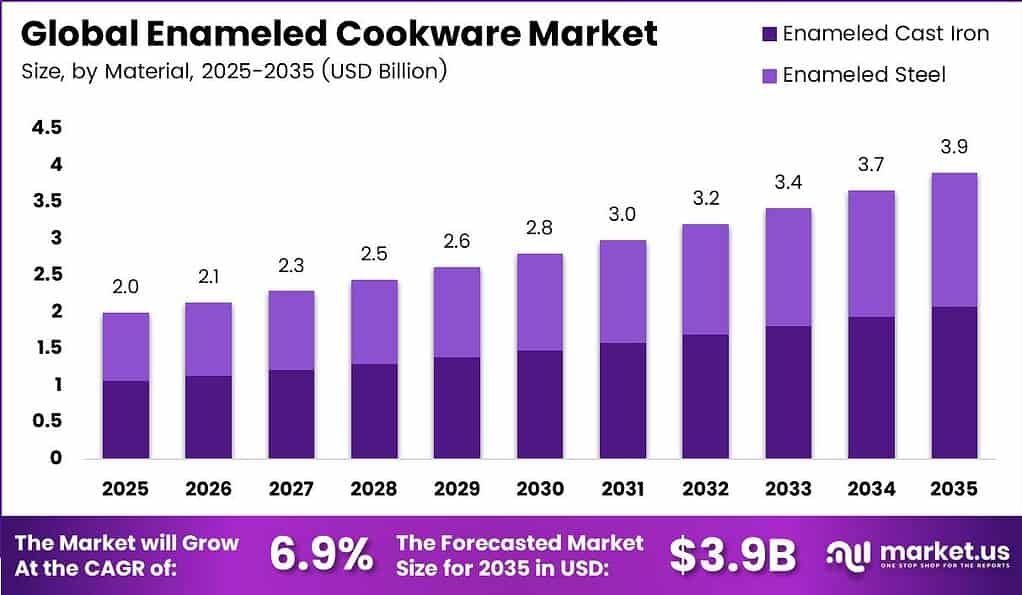
Global Enameled Cookware Market size is expected to be worth around USD 3.91 Billion by 2035 from USD 2.00 Billion in 2025, growing at a CAGR of 6.96% during the forecast period 2026 to 2035. This trajectory reflects a market where functional durability and design aesthetics are converging into a single purchase decision for millions of households globally.
The enameled cookware market covers cookware products with a fused vitreous enamel coating applied over cast iron or steel substrates. The market spans pots, pans, ovens, bakeware, cookware sets, and griddles sold across residential and commercial end users. Distribution runs through both offline retail channels such as specialty kitchen stores and department stores, and online platforms including brand websites and e-commerce marketplaces.
Key Takeaways
- The global enameled cookware market is valued at USD 2.00 Billion in 2025 and is forecast to reach USD 3.91 Billion by 2035 at a CAGR of 6.96%.
- By Product Type, Pans dominate with a 32.40% share, while Pots represent the fastest-growing sub-segment.
- By Material, Enameled Cast Iron holds the largest share at 52.70%, with Enameled Steel identified as the fastest-growing material.
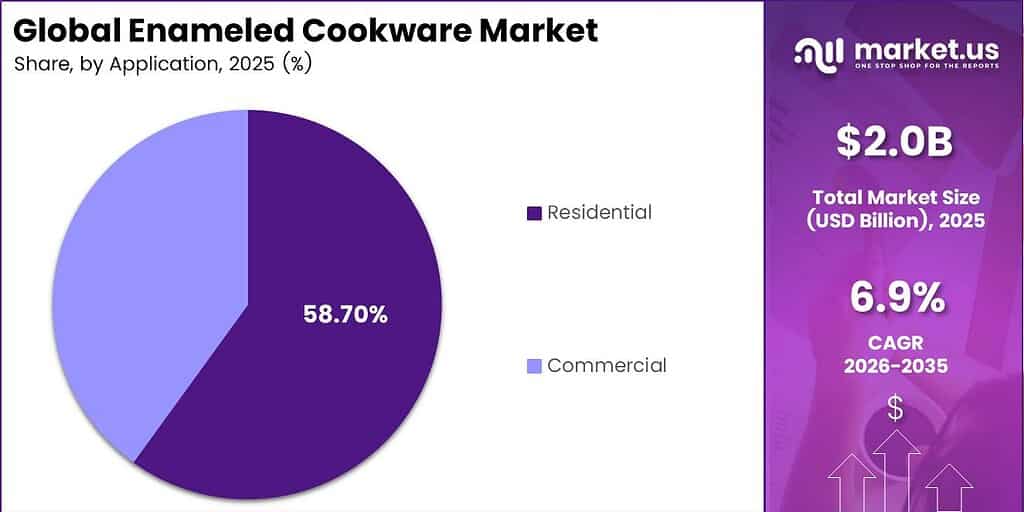
- By Application, Residential use leads with a 58.70% share, while the Commercial segment is growing fastest.
- By Distribution Channel, Offline Retail accounts for 62.30% of sales, while Online / E-Commerce is the fastest-growing channel.
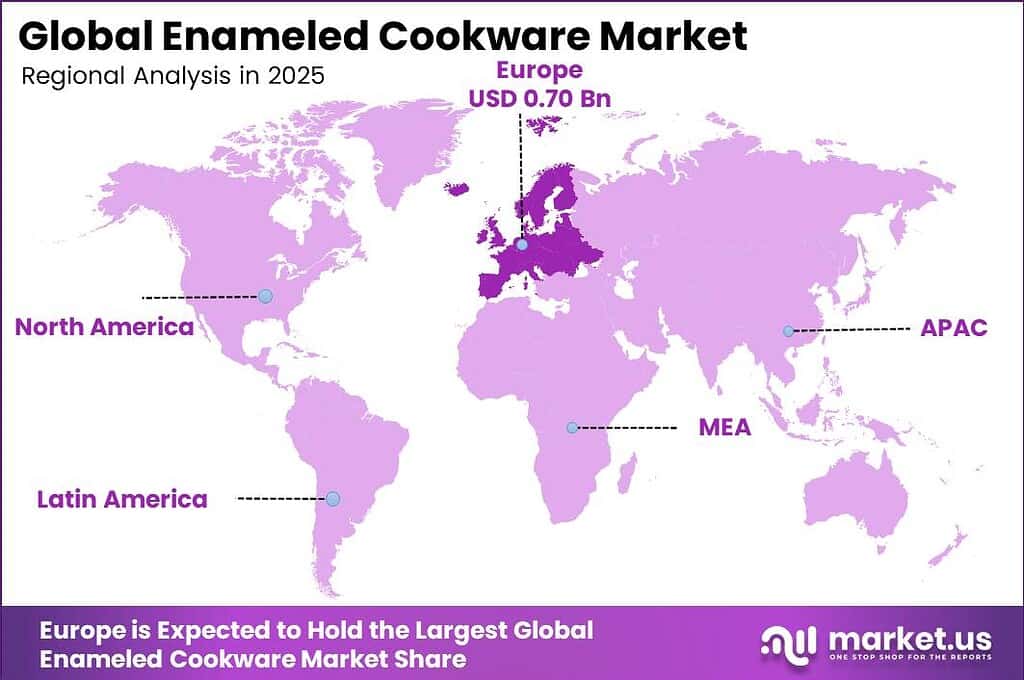
- Europe is the dominant region, holding a 34.80% market share valued at USD 0.70 Billion.
As per our research, enameled cookware surfaces resist staining, corrosion, and flavor transfer. This property allows repeated use with acidic and alkaline foods without altering taste. Buyers choosing enamel over alternative surfaces gain a functional advantage that extends product life and reduces replacement frequency, which reinforces long-term brand loyalty and justifies the premium price positioning manufacturers defend in this category.
According to the U.S. Environmental Protection Agency, cast iron products are highly recyclable because iron can be remelted repeatedly without significant material degradation. This supports circular manufacturing models for enameled cookware. Manufacturers who communicate recyclability credentials can reach environmentally conscious buyers and differentiate against conventional nonstick alternatives, particularly as sustainability purchasing criteria gain weight in North America and Europe.
Data from Energy Star shows that induction cooking reduces wasted heat by transferring energy directly into compatible cookware, including enameled cast iron. This energy efficiency advantage accelerates consumer replacement of conventional cookware. Sellers who position enameled cast iron as the natural partner to induction hobs capture the growing base of kitchen renovators who upgrade their cooktops and require compatible, non-fluorinated cookware simultaneously.
Product Type Analysis
Pans dominate with 32.40% due to high daily-use cooking frequency across households.
In 2025, Pans held a dominant market position in the By Product Type segment of the Enameled Cookware Market, with a 32.40% share. According to the Food and Agriculture Organization, households in developed economies cook an average of 5 meals per week at home, driving consistent demand for versatile pan formats. Frying pans, sauté pans, and grill pans each address distinct cooking methods, giving retailers a multi-SKU opportunity within a single consumer household.
Pots represent the fastest-growing sub-segment within the By Product Type segment. The World Bank reports that urban household formation rates in Asia Pacific exceeded 2.3% annually in recent years, creating new first-purchase cookware demand. Saucepans, stockpots, and stewpots serve foundational cooking functions that new households prioritize before purchasing specialty cookware. This structural demand dynamic makes the pots sub-segment a reliable growth vehicle for brands expanding into emerging urban markets.
Ovens and Bakeware occupy a premium tier within the product type mix. The European Commission’s Joint Research Centre reports that home baking participation in EU households rose by over 20% between 2020 and 2023. Dutch ovens and casserole dishes are high-ticket items that drive basket size and average order value upward. Retailers who merchandise ovens and bakeware alongside recipe content and lifestyle imagery convert interest-led browsers into high-margin buyers.
Cookware Sets and Griddles, along with other miscellaneous formats, collectively hold the remaining share. The U.S. Bureau of Labor Statistics consumer expenditure data shows cookware set purchases increase during household formation and gifting seasons. Cookware sets serve as an efficient entry point for brands, bundling multiple formats into one transaction. Griddles appeal to specific cuisine segments but remain a niche within the broader product mix.
Material Analysis
Enameled Cast Iron dominates with 52.70% due to superior heat retention and lifetime durability.
In 2025, Enameled Cast Iron held a dominant market position in the By Material segment of the Enameled Cookware Market, with a 52.70% share. The U.S. Geological Survey reports that the United States produced approximately 2.5 million metric tons of pig iron in a recent reporting year, supporting domestic cast iron manufacturing supply chains. Enameled cast iron’s thermal mass and heat distribution properties justify its premium pricing and sustain repeat purchase intent among serious home cooks and culinary professionals.
Enameled Steel is the fastest-growing material within the By Material segment. The American Iron and Steel Institute reports that U.S. steel mills shipped over 86 million net tons of steel products in a recent year, reflecting the broad availability of the substrate for cookware manufacturers. Enameled steel offers a lighter-weight alternative to cast iron, addressing urban consumer preferences for easier handling without sacrificing the non-reactive enamel cooking surface. This trade-off positions enameled steel as the growth engine among younger, urban-dwelling buyers prioritizing convenience.
Application Analysis
Residential dominates with 58.70% due to sustained home cooking frequency in mature markets.
In 2025, Residential held a dominant market position in the By Application segment of the Enameled Cookware Market, with a 58.70% share. The U.S. Bureau of Labor Statistics American Time Use Survey shows that Americans spent an average of 37 minutes per day on food preparation and cleanup in a recent reporting year. High cooking frequency sustains consistent residential cookware demand. Brands that align product messaging with daily cooking use cases retain the residential buyer longer than those focused solely on aspirational or occasion-based positioning.
The Commercial segment is the fastest-growing application within the enameled cookware market. NSF International certifies commercial cookware and food-contact equipment against public health standards used by restaurants, institutional kitchens, and foodservice operators. This certification framework gives enameled cookware clear entry into regulated foodservice procurement pipelines. Hotels, restaurants, catering services, and culinary institutes seeking certified, durable, oven-compatible cooking vessels represent a structurally underserved channel that offers above-average margin potential for suppliers pursuing commercial certification pathways.
Distribution Channel Analysis
Offline Retail dominates with 62.30% due to tactile product evaluation needs at point of purchase.
In 2025, Offline Retail held a dominant market position in the By Distribution Channel segment of the Enameled Cookware Market, with a 62.30% share. The U.S. Census Bureau reports that specialty trade stores accounted for over USD 130 Billion in annual retail sales across home goods categories in a recent year. Specialty kitchen stores, department stores, and supermarkets and hypermarkets allow consumers to assess weight, color, and finish in person. This tactile evaluation step is particularly critical for premium enameled cookware where price points demand pre-purchase physical confirmation.
Online and E-Commerce is the fastest-growing distribution channel in the enameled cookware market. The International Trade Administration reports that global B2C e-commerce sales exceeded USD 5.8 Trillion in 2023, with home goods among the top-performing categories. Brand websites and e-commerce marketplaces now support high-resolution product photography, customer review ecosystems, and direct-to-consumer subscription models. Sellers who invest in digital content and platform presence convert social media-driven discovery into measurable online revenue without the shelf-space constraints of physical retail.
Key Market Segments
By Product Type
- Pans
- Frying Pans
- Sauté Pans
- Grill Pans
- Pots
- Saucepans
- Stockpots
- Stewpots
- Ovens and Bakeware
- Dutch Ovens
- Casserole Dishes
- Others
- Cookware Sets
- Griddles
By Material
- Enameled Cast Iron
- Enameled Steel
By Application
- Residential
- Commercial
- Hotels and Restaurants
- Catering Services
By Distribution Channel
- Offline Retail
- Specialty Kitchen Stores
- Department Stores
- Supermarkets and Hypermarkets
- Online / E-Commerce
- Brand Websites
- E-Commerce Marketplaces
Regional Analysis
Europe Dominates the Enameled Cookware Market with a Market Share of 34.80%, Valued at USD 0.70 Billion
Europe holds the leading regional position in the global enameled cookware market, driven by a deep-rooted culinary culture and a long-established presence of premium cookware manufacturers across France, Germany, and the UK. As reported by Eurostat, household expenditure on kitchenware and cookware across EU member states reached USD 12.4 Billion annually in recent reporting years. The region’s consumer base prioritizes craftsmanship, brand heritage, and material quality, creating sustainable demand for premium enameled cast iron products at higher average selling prices than other regions.
Asia Pacific represents the fastest-growing regional market within the global enameled cookware landscape. According to World Bank data, Asia Pacific’s urban population exceeded 2.4 Billion people in recent years, generating a substantial and expanding base of urban households transitioning to modern premium cookware. Rising disposable incomes in China, India, and Southeast Asian economies are pushing first-time buyers toward enameled cookware as cooking culture modernizes. The October 2025 Le Creuset × Wicked collection demonstrated that limited-edition, culturally resonant product launches can generate outsized consumer interest across globally connected, digitally active markets including Asia Pacific.
North America constitutes a structurally important market supported by active PFAS legislation and strong direct-to-consumer channel adoption. Latin America and the Middle East and Africa together represent emerging secondary markets where organized retail penetration and rising middle-class formation are early-stage but directionally positive for premium cookware entry strategies over the medium term.
Key Regions and Countries
North America
- US
- Canada
Europe
- Germany
- France
- The UK
- Spain
- Italy
- Rest of Europe
Asia Pacific
- China
- Japan
- South Korea
- India
- Australia
- Rest of APAC
Latin America
- Brazil
- Mexico
- Rest of Latin America
Middle East and Africa
- GCC
- South Africa
- Rest of MEA
Market Dynamics
Market Opportunity Analysis - Underpenetrated commercial channels and emerging urban markets offer the clearest entry points for growth-oriented players
The Commercial application segment remains structurally underserved relative to its long-term revenue potential. As established in the Application Analysis, the commercial segment is the fastest-growing application despite Residential commanding a 58.70% share. Hotels, premium restaurants, catering services, and culinary institutes represent organized procurement buyers who replace cookware on scheduled cycles rather than through impulse purchases. Brands that achieve NSF certification and build foodservice-specific sales channels access a repeat-purchase buyer base that individual consumer markets cannot replicate.
Online and E-Commerce, the fastest-growing distribution channel, remains underpenetrated relative to Offline Retail’s 62.30% dominance. This gap represents a structural shift in progress rather than a settled channel balance. Brands that invest now in digital storefront infrastructure, direct-to-consumer fulfillment, and platform-exclusive product bundles will capture disproportionate online share before the channel reaches maturity. By contrast, brands tied exclusively to physical retail shelf agreements will experience margin compression as footfall migrates toward digital discovery and purchase.
Enameled Steel is the fastest-growing material but holds a minority position against Enameled Cast Iron’s 52.70% dominance. This gap signals an underpenetrated opportunity for mid-tier brands unable to compete on cast iron heritage. Enameled steel’s lighter weight and lower retail price create a distinct entry corridor targeting urban millennials and first-time buyers. Brands that build a steel-specific product and communication strategy rather than treating it as a secondary cast iron alternative will define this sub-segment’s positioning before a dominant player claims it.
Pots represent the fastest-growing product type yet hold a minority share relative to Pans at 32.40%. This growth-share divergence identifies an underpenetrated category where new household formation in Asia Pacific and Latin America is driving first-purchase demand. Saucepans, stockpots, and stewpots are foundational cookware that new urban households acquire before expanding into specialty formats. Brands that develop affordable entry-level enameled pot ranges for emerging market distribution build category loyalty at the earliest point in the consumer purchase journey.
Technology and Innovation Landscape - Circular material science and surface innovation are redefining manufacturing value and consumer positioning in enameled cookware
The American Iron and Steel Institute confirms that steel is 100% recyclable and can be recycled repeatedly without loss of quality. This material property makes enameled steel cookware directly compatible with circular manufacturing commitments that regulatory bodies and premium retail buyers increasingly require from suppliers. Brands that source recycled steel substrates and communicate this in product labeling gain a documented sustainability credential that supports premium price positioning without requiring a change in product performance specifications.
According to the U.S. Geological Survey, approximately 68 Million metric tons of iron and steel scrap were consumed by U.S. manufacturers in a recent year. This volume confirms that recycled feedstock availability at industrial scale is not a barrier to circular cookware production. Manufacturers who integrate scrap iron and recycled steel into their melt mix reduce virgin material dependency and qualify for green procurement programs operated by large retailers and institutional foodservice buyers prioritizing measurable supply chain sustainability targets.
In May 2025, Le Creuset launched its new Ceramic Essential Non-Stick Cookware Collection, expanding its premium cookware portfolio with advanced ceramic cooking surfaces. This product move signals that established enameled cookware brands are diversifying surface technology beyond traditional vitreous enamel to capture buyers seeking non-fluorinated alternatives beyond cast iron formats. Manufacturers that develop ceramic surface variants within existing enameled cookware production infrastructure reduce capital expenditure on new lines while broadening addressable consumer segments.
Induction compatibility represents a structural technology interface between cookware and evolving kitchen hardware. The enameled cast iron substrate’s ferrous composition makes it natively compatible with induction hobs without requiring surface modification. This compatibility eliminates the retrofit cost and consumer confusion that affects non-induction-ready cookware ranges. Brands that foreground induction compatibility in product specifications convert kitchen renovators who upgrade cooktops into immediate enameled cookware buyers rather than allowing them to default toward competing surface types.
Drivers
The strongest active force reshaping the enameled cookware market is the regulatory retreat from fluoropolymer coatings. Minnesota became the first U.S. state to prohibit intentionally added PFAS in cookware effective January 1, 2025, and seven states introduced new PFAS product restrictions taking effect during 2026. Manufacturers migrating to porcelain enameling lines raise finished unit costs by roughly 8% to 14% but gain a durable margin premium and eliminate compliance liability tied to legacy nonstick products under U.S. EPA oversight.
The Vitreous Enamel Association confirms that vitreous enamel is chemically inert and does not release substances into food during normal cooking conditions, making it suitable for repeated food-contact applications. This safety credential directly supports health-conscious consumer positioning in North America and the EU. Sellers who lead with inert surface claims in product descriptions and retail marketing can accelerate conversion among buyers actively replacing fluoropolymer cookware with chemically stable alternatives.
| Driver | (~) % Impact on CAGR Forecast | Geographic Relevance | Impact Timeline |
|---|---|---|---|
| PFAS nonstick substitution toward inert enamel surfaces | +2.1% | North America, EU | Short term (2 years or less) |
| Premiumization of home cooking and health positioning | +1.6% | Global | Medium term (2 to 4 years) |
| Direct to consumer and social commerce channel expansion | +1.2% | North America, Asia Pacific | Short term (2 years or less) |
| Rising disposable income in emerging kitchen markets | +1.0% | India, Southeast Asia | Medium term (2 to 4 years) |
| Color and design led lifestyle differentiation | +0.7% | North America, EU | Medium term (2 to 4 years) |
Restraints
The most acute constraint on current sales is the European Commission’s escalation of anti-dumping duties on ceramic and enamel-adjacent kitchenware from China. A definitive countrywide duty of 79% entered into force on 7 February 2026, replacing prior individual rates ranging between 13% and 36%. Distributors previously absorbing low double-digit duties now face a near quadrupling of the tariff line, which forces a scramble to qualify alternative supply from Turkey, India, and domestic foundries or suspend affected SKUs entirely.
The American Cleaning Institute recommends avoiding abrasive steel wool and harsh scouring powders on enamel-coated cookware to preserve the glass surface finish. This care requirement reinforces consumer concerns around surface chipping and enamel damage. Buyers who experience enamel degradation before replacement cycle expectations are met generate negative reviews that erode brand equity. Manufacturers investing in thicker enamel application and consumer-facing care education programs reduce return rates and protect long-term repurchase intent.
| Restraint | (~) % Impact on CAGR Forecast | Geographic Relevance | Impact Timeline |
|---|---|---|---|
| EU anti dumping duties on Chinese kitchenware | -1.9% | EU | Short term (2 years or less) |
| US punitive tariffs on Chinese sourced cookware | -1.4% | North America | Short term (2 years or less) |
| High interest rates suppressing discretionary spend | -1.0% | Global | Short term (2 years or less) |
| Premium price ceiling limiting mass adoption | -0.8% | Emerging markets | Medium term (2 to 4 years) |
| Retail shelf displacement by cheaper substitutes | -0.6% | Global | Medium term (2 to 4 years) |
Challenges
The deepest structural friction in this market is the shortage of certified foundry and porcelain enameling technicians. Per Indian foundry cluster assessments aligned with MSME and Skill India bodies, technician churn exceeds 15% annually while only a minority of the workforce holds formal certified foundry training. This deficit constrains the capacity expansion needed to backfill demand shifting away from imports, directly limiting how quickly domestic manufacturers can scale production to meet order volumes.
Manual, defect-sensitive steps including pattern work, fettling, and enamel spraying resist cheap automation. Per International Labour Organization skills mismatch data for manufacturing, each unfilled specialist role slows melt-to-finish throughput and inflates scrap on enamel firing lines. Companies that establish cluster training academies, apprenticeship tie-ups with polytechnics, and targeted micro-automation of robotic fettling will convert craft labor into certified technicians over a multi-year horizon and gain a structural production cost advantage over competitors dependent on opportunistic hiring.
| Challenge | (~) % CAGR Friction Drag | Geographic Relevance | Mitigation Horizon |
|---|---|---|---|
| Skilled foundry and enameling labor deficit | -1.3% | India, Asia Pacific | Long term (4 years or more) |
| Iron ore and energy input volatility | -1.0% | Global | Medium term (2 to 4 years) |
| Enamel firing energy intensity and emissions | -0.8% | EU, China | Long term (4 years or more) |
| Quality consistency and chipping defects | -0.6% | Global | Medium term (2 to 4 years) |
| Freight and heavyweight logistics cost | -0.5% | Global | Medium term (2 to 4 years) |
Opportunities
The largest untapped upside sits in converting first-time premium cookware buyers across fast-urbanizing emerging economies. Per World Bank and IMF household consumption indices, the rising middle-income cohort in India and Southeast Asia has only recently crossed the disposable income threshold at which enamel cookware becomes attainable. Per Reserve Bank of India consumption and credit data, organized retail expansion and installment financing lower the effective purchase barrier, compressing landed cost per unit by an estimated 10% to 18% when domestic enameling capacity substitutes for imports.
This opportunity supports gross margin expansion of roughly 4 to 6 percentage points for manufacturers who build in-region firing capacity ahead of the demand curve. Players who establish domestic production and channel investment before the window closes will convert unmet demand into durable market share. By contrast, brands relying on passive export strategies will cede price positioning and distribution reach to domestically embedded competitors who operate at lower landed cost and faster delivery cycles.
| Opportunity | (~) % Potential CAGR Upside | Geographic Relevance | Execution Window |
|---|---|---|---|
| Emerging market premiumization of first time buyers | +2.0% | India, Southeast Asia | Medium term (2 to 4 years) |
| Domestic and nearshore supply roll up post tariff | +1.5% | North America, EU | Medium term (2 to 4 years) |
| Commercial and hospitality foodservice channel | +1.1% | Global | Long term (4 years or more) |
| Licensed lifestyle and chef collaboration collections | +0.9% | North America, EU | Medium term (2 to 4 years) |
| Circular resale and refurbishment monetization | +0.6% | North America, EU | Long term (4 years or more) |
Key Company Insights
Le Creuset has manufactured enameled cast iron cookware continuously since 1925, representing over 100 years of commercial production. This manufacturing heritage underpins a brand equity position that justifies premium price points few competitors can replicate. In May 2025, Le Creuset introduced the “Flamme Dorée” limited-edition color collection to celebrate its centennial anniversary, demonstrating that the brand converts heritage milestones into commercial product launches that sustain consumer excitement and press coverage without discounting.
Lodge Manufacturing Company has produced cast iron cookware since 1896, giving it more than 125 years of manufacturing experience in cast iron cookware. This depth of production knowledge translates into process efficiency and material sourcing advantages that newer entrants cannot replicate quickly. Lodge’s positioning as an accessible, domestically manufactured American brand creates a differentiated trust signal in a market where tariff pressures on Chinese-sourced cookware are redirecting buyer preference toward origin-verified domestic alternatives.
Key Players
- Le Creuset France Sas
- Staub (Zwilling J.A. Henckels)
- Lodge Manufacturing Company
- Tramontina Usa, Inc.
- Cuisinart (Conair Llc)
- Williams-Sonoma, Inc.
- The Coleman Company, Inc.
- Chasseur (Invicta Foundry)
- Berndes Gmbh
- Circulon (Meyer Corporation)
Recent Developments
- February 2025: Le Creuset launched its “On The Go” collection, expanding beyond traditional cookware with insulated food and beverage containers to strengthen its premium kitchen ecosystem and lifestyle portfolio.
- August 2025: Le Creuset unveiled the “Modern Heritage” Enameled Cast Iron Collection, reintroducing archival design elements with updated stainless-steel handles as part of its centennial product strategy.
- March 2026: Le Creuset introduced the new “Riviera” color across its signature enameled cast iron Dutch ovens, braisers, skillets, and bread ovens, inspired by Mediterranean coastal aesthetics.
Geopolitical Impact Analysis
According to WTO trade policy monitoring data, global goods trade growth slowed to under 1% in 2023 as tariff escalation and trade fragmentation between major economies disrupted established supply chains. The EU’s definitive anti-dumping duty of 79% on Chinese enamelware, confirmed in the Official Journal effective February 2026, directly restructures the landed cost economics for European cookware importers. This forces procurement teams to absorb margin compression or qualify alternative foundry suppliers in Turkey, India, and domestic EU markets at substantially higher base unit costs.
As reported by UNCTAD, global container freight rates experienced peak-to-trough volatility exceeding 400% between 2020 and 2023, a range that disproportionately affects dense, heavyweight manufactured goods such as cast iron cookware. This freight cost instability forces enameled cookware manufacturers to either absorb logistics volatility into margin or reprice frequently, both of which damage retailer and distributor relationships. Consequently, nearshore manufacturing strategies that shorten freight lanes and reduce exposure to transoceanic rate cycles are gaining operational priority among brands sourcing from geopolitically exposed production regions.
Report Scope
| Report Features | Description |
|---|---|
| Market Value (2025) | USD 2.00 Billion |
| Forecast Revenue (2035) | USD 3.91 Billion |
| CAGR (2026-2035) | 6.96% |
| Base Year for Estimation | 2025 |
| Historic Period | 2020-2024 |
| Forecast Period | 2026-2035 |
| Report Coverage | Revenue Forecast, Market Dynamics, Market Opportunity Analysis, Technology and Innovation Landscape, Competitive Landscape, Recent Developments |
| Segments Covered | By Product Type (Pans, Pots, Ovens and Bakeware, Others, Cookware Sets, Griddles), By Material (Enameled Cast Iron, Enameled Steel), By Application (Residential, Commercial), By Distribution Channel (Offline Retail, Online / E-Commerce) |
| Regional Analysis | North America (US and Canada), Europe (Germany, France, The UK, Spain, Italy, and Rest of Europe), Asia Pacific (China, Japan, South Korea, India, Australia, and Rest of APAC), Latin America (Brazil, Mexico, and Rest of Latin America), Middle East and Africa (GCC, South Africa, and Rest of MEA) |
| Competitive Landscape | Le Creuset France Sas, Staub (Zwilling J.A. Henckels), Lodge Manufacturing Company, Tramontina Usa Inc., Cuisinart (Conair Llc), Williams-Sonoma Inc., The Coleman Company Inc., Chasseur (Invicta Foundry), Berndes Gmbh, Circulon (Meyer Corporation) |
| Customization Scope | Customization for segments, region / country-level will be provided. Additional customization can be done based on requirements. |
| Purchase Options | We have three licenses to opt for: Single User License | Multi-User License (Up to 5 Users) | Corporate Use License (Unlimited User and Printable PDF) |





































