


Report Overview
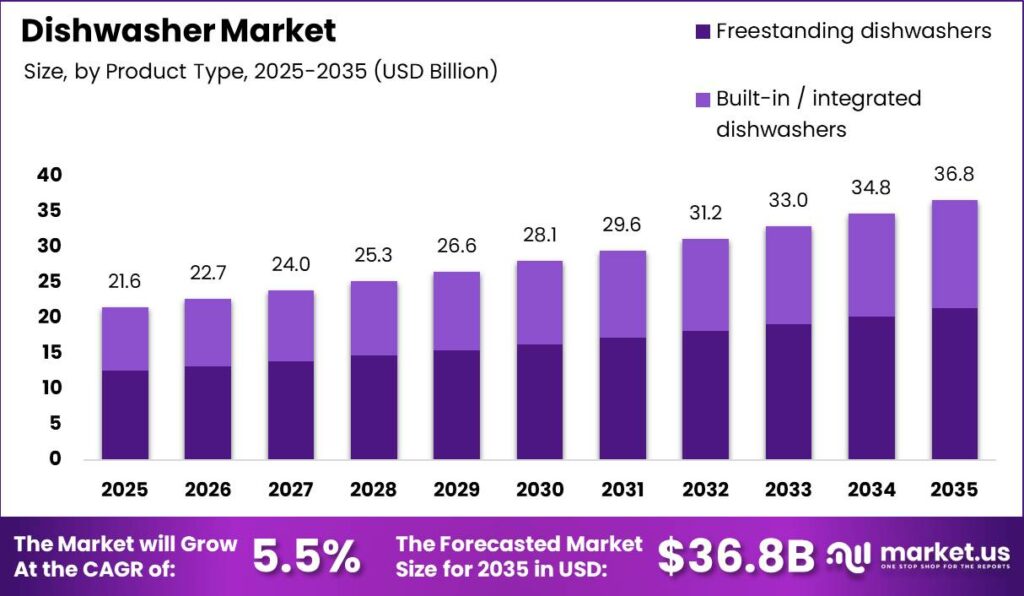
Dishwasher Market size is expected to be worth around USD 36.8 Billion by 2035 from USD 21.6 Billion in 2025, growing at a CAGR of 5.5% during the forecast period 2026 to 2035. This trajectory reflects steady replacement cycles in mature markets and first-time adoption across emerging economies. Vendors who align product tiers to both patterns will capture the widest revenue base.
The Dishwasher Market covers residential and commercial cleaning appliances sold through offline and online channels. Manufacturers structure offerings around freestanding and built-in formats, then layer smart features and efficiency ratings on top. This means product architecture, not brand alone, decides shelf position. Companies that segment clearly across price and format tiers defend margin better than single-line players.
Key Takeaways
- Global Dishwasher Market will reach USD 36.8 Billion by 2035, up from USD 21.6 Billion in 2025.
- Market grows at a CAGR of 5.5% across the 2026 to 2035 forecast window.
- Freestanding dishwashers lead the product type segment with a 58.3% share.
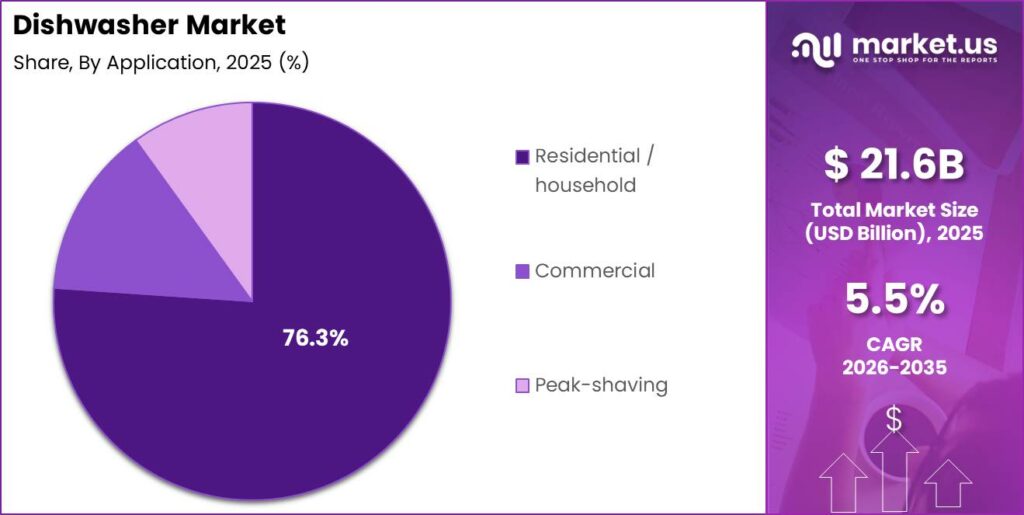
- Residential and household use dominates applications with a 76.3% share.
- Offline distribution controls the channel segment with a 68.3% share.
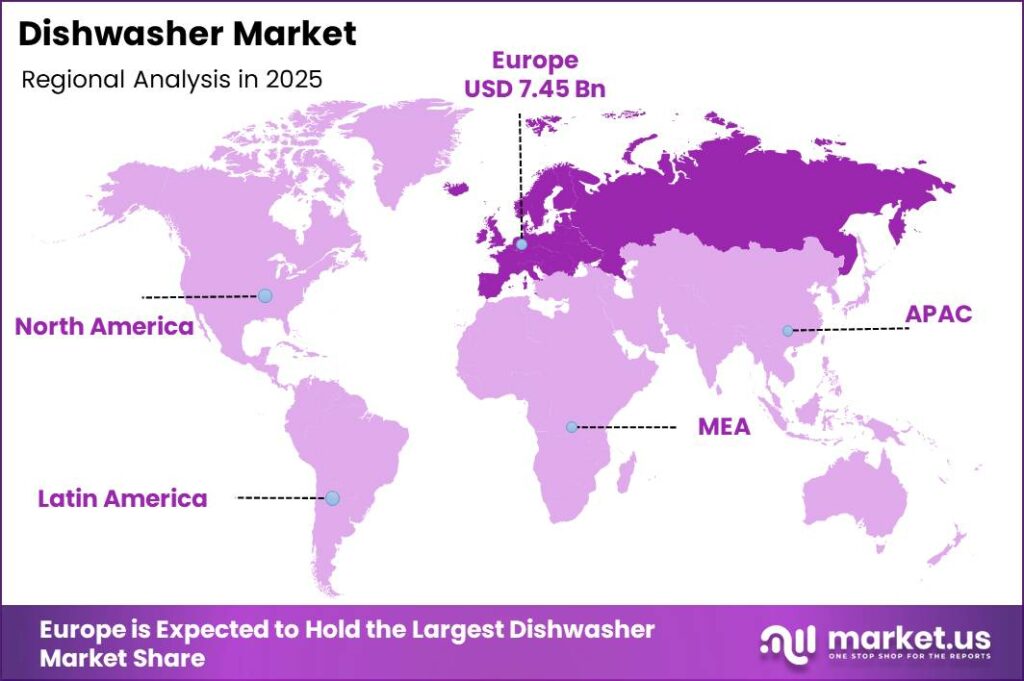
- Europe leads all regions with a 34.5% share, valued at USD 7.45 Billion.
Smart Dishwasher platforms increasingly shape purchase decisions in mature markets. Governments reinforce this shift through efficiency regulation. According to U.S. EPA ENERGY STAR data, certified standard dishwashers use about 12 to 20% less energy and roughly 30% less water than non-certified models. This gap pushes buyers toward compliant units. Manufacturers who lead with certified ranges win regulatory-driven replacement demand.
Regulators also anchor operating-cost claims that sway shoppers. Figures from U.S. EPA ENERGY STAR show certified dishwasher operating cost sits near 30 to 50 US dollars per year by size category. This low running cost strengthens the total-cost message against handwashing. As a result, sellers who quantify yearly savings convert hesitant first-time buyers faster than feature-only pitches.
Whirlpool advanced this smart-appliance direction at the February 2026 Kitchen and Bath Industry Show. The company introduced KitchenAid’s 360 degree Max Jets Third Rack platform with AI-enabled ProDry technology. This signals that premium innovation now sets the competitive benchmark. Brands that delay connected features risk losing the high-margin modular-kitchen buyer to faster rivals.
Product Type Analysis
Freestanding dishwashers dominate with 58.3% due to flexible install and rental suitability.
In 2025, Freestanding dishwashers held a dominant market position in the By Product Type segment of Dishwasher Market, with a 58.3% share. As per our research, freestanding units suit rental and older housing where plumbing retrofits are costly. This flexibility widens the addressable base. Manufacturers who keep strong freestanding lines protect volume in markets where built-in installation stays impractical.
Built-in and integrated dishwashers serve the modular kitchen buyer who values seamless cabinet fit. These units attach at the point of kitchen design rather than standalone retail. As per our research, built-in attachment rates rise sharply when specified during kitchen consultations. This creates a channel advantage. Brands that partner with kitchen studios capture built-in demand before standalone retailers can compete.
Application Analysis
Residential household use dominates with 76.3% due to daily domestic cleaning demand.
In 2025, Residential and household held a dominant market position in the By Application segment of Dishwasher Market, with a 76.3% share. As per our research, modern units use about 3 to 4 gallons per cycle versus up to 27 gallons for a handwashed equivalent load. This efficiency drives household replacement. Vendors leading with water savings convert manual washers into buyers.
Commercial dishwashers serve restaurants, hotels, and institutional kitchens that need speed and hygiene at scale. These buyers prioritize throughput and sanitation compliance over unit price. As per our research, foodservice recovery lifts undercounter and rack conveyor demand. This creates steady B2B volume. Suppliers with certified high-temperature sanitizing models win contracts that residential lines cannot serve.
Distribution Channel Analysis
Offline retail dominates with 68.3% due to hands-on inspection and install support.
In 2025, Offline held a dominant market position in the By Distribution Channel segment of Dishwasher Market, with a 68.3% share. As per our research, buyers prefer physical stores for large appliances needing delivery and installation. This preference reflects service reliance, not habit alone. Retailers bundling install services defend this channel against pure online sellers.
Online channels attract price-comparing buyers who research specifications before purchase. These shoppers value convenience and broader model choice. As per our research, connected and compact formats sell well through digital channels. This shifts entry-tier volume online. Brands that pair online listings with local install networks capture buyers offline retail cannot reach on price.
Key Market Segments
By Product Type
- Freestanding dishwashers
- Built-in / integrated dishwashers
By Application
- Residential / household
- Commercial
By Distribution Channel
- Offline
- Online
Regional Analysis
Europe Dominates the Dishwasher Market with a Market Share of 34.5%, Valued at USD 7.45 Billion
Europe leads the Dishwasher Market with a 34.5% share worth USD 7.45 Billion in 2025. As per our research, high household penetration and strict efficiency labeling sustain steady replacement demand. This regulatory pull keeps volume stable. In February 2025, BSH Home Appliances launched Bosch and Siemens dishwashers with 15 place setting capacity and steam cleaning. This reflects Europe’s premium, large-household focus.
Asia Pacific stands as the fastest-growing region on urbanization and low current penetration. As per our research, new apartment formats increasingly include cabinetry pre-configured for built-in units. This structurally lowers adoption friction. In April 2026, LG Electronics revealed AI SenseClean technology with a one-hour wash-and-dry cycle. This signals rising demand for efficient, space-conscious models across dense Asian cities.
North America, Latin America, and the Middle East and Africa hold the remaining share collectively. As per our research, North America shows high penetration with steady premium replacement demand. Latin America and MEA grow on rising urban incomes. This mix rewards flexible portfolios. Vendors spanning entry to premium tiers capture demand across these varied regional maturity levels.
Key Regions and Countries
North America
- US
- Canada
Europe
- Germany
- France
- The UK
- Spain
- Italy
- Rest of Europe
Asia Pacific
- China
- Japan
- South Korea
- India
- Australia
- Rest of APAC
Latin America
- Brazil
- Mexico
- Rest of Latin America
Middle East and Africa
- GCC
- South Africa
- Rest of MEA
Market Dynamics
Market Opportunity Analysis - Compact formats, entry-tier platforms, and connected services open the widest entry points
The compact and countertop segment stays underexploited despite solving urban space limits. This format holds under 5 to 8% of residential volume while addressing the top barrier in small apartments. This means dense markets like Japan and Korea remain open. New entrants with purpose-built compact platforms capture demand that incumbents have not served at scale.
The sub-USD 200 entry tier in India and Southeast Asia stays wide open. No tier-1 brand serves this price point, leaving the affluent 8 to 12% of urban households as the only reachable base. This means demographic demand sits uncaptured. Investors backing local low-cost platforms unlock the largest volume pool in the market.
The offline-dominant channel structure signals room for connected direct-to-consumer models. Offline holds 68.3% of sales, yet online suits compact and smart formats better. This creates a service-revenue opening. Companies pairing IoT dishwashers with subscription detergent and predictive service build recurring income beyond one-time hardware sales.
Technology and Innovation Landscape - AI sensing, connectivity, and efficiency engineering reshape competitive edges
AI-based soil detection now defines next-generation performance. LG’s AI SenseClean technology automatically adjusts wash cycles to detected soil levels for higher efficiency. This shifts the benchmark from fixed programs to adaptive cleaning. Manufacturers without sensing capability risk falling behind on the efficiency claims that regulators and buyers increasingly demand.
Connected ecosystems move dishwashers into the smart home. Whirlpool’s KitchenAid 360 degree Max Jets Third Rack platform pairs advanced jets with AI-enabled ProDry automation. This links appliance value to app control and integration. Brands building connected platforms capture premium buyers and open recurring service revenue that standalone units cannot generate.
Efficiency engineering advances through drying and water systems. ENERGY STAR standard limits set energy use at 240 kWh per year and water use at 3.2 gallons per cycle, with compact models capped at 155 kWh and 2.0 gallons. This raises the compliance bar. Manufacturers investing in heat pump drying meet tightening standards while cutting operating cost for buyers.
Drivers
Rising middle-class urbanization drives first-time dishwasher adoption across Asia Pacific, Latin America, and the Middle East. Urban household formation runs at 2.5 to 4.0% yearly in tier-1 and tier-2 cities, while per-capita incomes cross the USD 8,000 to 12,000 threshold that triggers white goods adoption. This creates a large first-buyer cohort. Manufacturers targeting these new households capture uncaptured demand early.
India shows the widest gap and the largest opportunity. Urban dishwasher penetration stayed below 3 to 5% through 2024 to 2025, against Western Europe at 55 to 75% and North America at 75 to 80%. This gap marks the biggest uncaptured pool. Brands embedding dishwashers into modular kitchen consultations lift attachment rates to 18 to 30% versus 4 to 8% at standalone retail.
| Driver | (~) % Impact on CAGR Forecast | Geographic Relevance | Impact Timeline |
|---|---|---|---|
| Rising Middle-Class Urbanisation & Nuclear Family Formation Expanding First-Time Dishwasher Adoption | +1.70% | China, India, Southeast Asia, Latin America, Middle East | Short term (≤ 2 years) |
| Water Conservation Awareness & Regulatory Mandates Validating Dishwasher Efficiency Versus Hand Washing | +1.10% | European Union, Australia, United States, GCC, South Africa | Short term (≤ 2 years) |
| Premiumisation & Smart Home Integration Driving ASP Upgrade Cycles in Mature Markets | +0.85% | North America, Europe, Japan, South Korea, GCC | Medium term (2–4 years) |
| Commercial Foodservice & Hospitality Sector Recovery Driving Undercounter & Rack Conveyor Unit Demand | +0.72% | Global — North America, Europe, Asia Pacific, Middle East | Short term (≤ 2 years) |
| Time-Saving Convenience Demand Among Dual-Income Households Accelerating Penetration Rate | +0.55% | India, China, Brazil, Mexico, Turkey, Eastern Europe | Short term (≤ 2 years) |
| Energy Label Reclassification (EU Energy Label Regulation) Stimulating Replacement Purchase Cycle | +0.38% | European Union, United Kingdom, Norway, Switzerland | Short term (≤ 2 years) |
Restraints
High upfront cost blocks mass-market penetration in price-sensitive economies. Entry-level freestanding models cost USD 250 to 350, while target households earn USD 5,000 to 9,000 yearly, making a dishwasher 4 to 6% of annual income. This share far exceeds the 0.4 to 0.8% burden on Western buyers. Manufacturers without a viable low-price platform stay locked out of the largest urban cohort.
The cost barrier reflects a hard engineering limit, not pricing choice. Reducing bill-of-materials cost by the needed 30 to 40% requires new platform architectures and local sourcing taking 3 to 5 years and USD 15,000,000 to 40,000,000 per platform. This delays mass adoption. Brands lacking sub-USD 200 products stay confined to the affluent 8 to 12% of urban households.
| Restraint | (~) % Impact on CAGR Forecast | Geographic Relevance | Impact Timeline |
|---|---|---|---|
| High Upfront Cost & Limited Affordability in Price-Sensitive Emerging Markets Blocking Mass-Market Penetration | -1.20% | India, Southeast Asia, Sub-Saharan Africa, Latin America, Pakistan | Short term (≤ 2 years) |
| Consumer Perception of Dishwashers as Water-Wasteful & Non-Essential in Water-Scarce Markets | -0.75% | India, Middle East, North Africa, Sub-Saharan Africa, Australia | Short term (≤ 2 years) |
| Kitchen Space Constraints & Non-Standard Cabinet Dimensions Limiting Built-In Unit Installation | -0.55% | Japan, South Korea, Hong Kong, Singapore, urban India & China | Short term (≤ 2 years) |
| Cheap Domestic Labour Availability Reducing Perceived Value Proposition in Emerging Markets | -0.38% | India, Southeast Asia, Sub-Saharan Africa, Middle East | Medium term (2–4 years) |
Challenges
Supply chain localization and component cost inflation squeeze manufacturer margins. Between 2022 and 2025, steel, copper, motor magnets, and plastics raised built-in dishwasher bill-of-materials cost by 12 to 19%. Manufacturers passed only 6 to 10% through list prices, cutting European appliance EBIT margins by 150 to 280 basis points. This margin drag forces cost redesign to protect profitability.
Logistics compounds the strain on delivered cost. Shipping cost per unit from China to Europe rose from USD 45 to 65 pre-pandemic to USD 120 to 185 at the 2022 peak, with Red Sea disruption adding 10 to 14 transit days. This raises landed cost unpredictably. Manufacturers nearshoring components over 3 to 5 year timelines gain a durable cost and reliability edge.
| Challenge | (~) % CAGR Friction Drag | Geographic Relevance | Mitigation Horizon |
|---|---|---|---|
| Supply Chain Localisation & Component Cost Inflation | -0.80% | Global — most acute for European & U.S. manufacturers dependent on Asian components | Long term (≥ 4 years) |
| After-Sales Service Network Gaps in Tier-2 & Tier-3 Markets | -0.65% | India, Southeast Asia, Latin America, Sub-Saharan Africa | Long term (≥ 4 years) |
| Detergent & Rinse Aid Ecosystem Underdevelopment Suppressing Satisfaction | -0.48% | India, Southeast Asia, Middle East, Africa | Medium term (2–4 years) |
| Competitive Intensity & Chinese OEM Price Erosion in Mid-Tier Segment | -0.38% | Global — most acute in Asia Pacific, Latin America, Eastern Europe | Long term (≥ 4 years) |
| Hard Water Compatibility & Mineral Scale Damage in Limestone-Rich Markets | -0.28% | India, Middle East, North Africa, parts of Europe & United States | Medium term (2–4 years) |
Opportunities
Compact and countertop dishwashers open white space in dense urban markets. These units wash 4 to 6 place settings using 4 to 6 liters per cycle, yet hold under 5 to 8% of residential volume. This format solves the top adoption barrier in small apartments. Early movers capture demand that full-size units physically cannot serve.
The unit economics reward first entrants strongly. Countertop models retail at USD 180 to 350 against bill-of-materials cost near USD 55 to 90, yielding gross margins of 48 to 62% versus 32 to 42% on built-in units. This margin edge favors early scale. Brands committing USD 8,000,000 to 25,000,000 to a compact platform within 2 to 3 years win a durable lead.
| Opportunity | (~) % Potential CAGR Upside | Geographic Relevance | Execution Window |
|---|---|---|---|
| Compact & Countertop Dishwasher Segment Development for Space-Constrained Urban Apartments | +1.30% | Japan, South Korea, China, India, Hong Kong, Singapore, urban Europe | Short term (≤ 2 years) |
| IoT-Connected & AI-Optimised Dishwasher Subscription Detergent & Predictive Service Revenue Model | +0.90% | North America, Europe, South Korea, Japan, GCC | Long term (≥ 4 years) |
| Commercial Dishwasher-as-a-Service for SME Foodservice & Ghost Kitchen Operators | +0.72% | United States, United Kingdom, Germany, Australia, India, GCC | Medium term (2–4 years) |
| Heat Pump Drying & Ultra-Low Energy Class A+++ Replacement Cycle in EU Eco-Design Compliance | +0.55% | European Union, United Kingdom, Norway, Switzerland, Australia | Medium term (2–4 years) |
| Branded Entry-Tier Platform Development for India & Southeast Asia Sub-USD 200 Price Tier | +0.42% | India, Indonesia, Vietnam, Philippines, Bangladesh | Long term (≥ 4 years) |
Key Company Insights
Bosch anchors the premium built-in segment through deep engineering and strong European brand trust. The company benefits from strict EU efficiency labeling that rewards its certified, low-water models. This regulatory alignment protects share in high-penetration markets. However, its premium positioning leaves the sub-USD 200 entry tier exposed to lower-cost rivals across emerging economies where affordability decides adoption. This creates a strategic gap at the mass-market base.
Whirlpool Corporation competes on Smart Kitchen Appliances innovation and broad channel reach. At the February 2026 Kitchen and Bath Industry Show, it introduced the KitchenAid 360 degree Max Jets Third Rack platform with AI-enabled ProDry technology. This positions Whirlpool at the connected-appliance frontier. However, heavy reliance on premium smart features risks ceding value-tier volume to price-focused competitors in developing regions.
Key Players
- Bosch
- Whirlpool Corporation
- Electrolux AB
- Haier Group
- LG Electronics Inc.
- Samsung Electronics Co., Ltd.
- Miele & Cie. KG
- Arçelik A.Ş.
- Panasonic Corporation
- SMEG S.p.A.
- The Middleby Corporation
- Winterhalter Gastronom GmbH
- ASKO Appliances AB
- Fagor Industrial
- Blakeslee
- Others
Recent Developments
- February 2026: Whirlpool showcased next-generation AI-enabled kitchen appliances including advanced dishwasher systems with ProDry technology and intelligent automation features at the Kitchen and Bath Industry Show.
- April 2026: LG Electronics announced a new dishwasher lineup for EuroCucina 2026, featuring a one-hour wash-and-dry cycle and AI-based soil detection for optimized cleaning performance.
- February 2025: BSH Home Appliances launched a new range of Bosch and Siemens dishwashers featuring 15 place setting capacity and enhanced steam-cleaning technology for large household usage.
Geopolitical Impact Analysis
According to the World Shipping Council, Red Sea disruption forced carriers onto the Cape of Good Hope route, adding 10 to 14 days of transit for Asia to Europe shipments. This directly raised dishwasher landed costs, as per-unit freight climbed from roughly USD 45 to 65 before the pandemic toward USD 75 to 110 in 2024. This means European brands reliant on Asian pumps and control boards face persistent margin pressure and longer inventory cycles.
Based on WTO data, tariff tensions and reshaped trade flows continue to lift component and steel costs across appliance supply chains. Stainless steel tub grade inputs rose roughly 18 to 28% from 2021 baselines at peak, squeezing manufacturers dependent on cross-border sourcing. This means producers face pressure to nearshore to Eastern Europe and Mexico. Companies diversifying supply bases reduce exposure to tariff shocks and single-region logistics risk.
Report Scope
| Report Features | Description |
|---|---|
| Market Value (2025) | USD 21.6 Billion |
| Forecast Revenue (2035) | USD 36.8 Billion |
| CAGR (2026-2035) | 5.5% |
| Base Year for Estimation | 2025 |
| Historic Period | 2020-2024 |
| Forecast Period | 2026-2035 |
| Report Coverage | Revenue Forecast, Market Dynamics, Market Opportunity Analysis, Technology and Innovation Landscape, Competitive Landscape, Recent Developments |
| Segments Covered | By Product Type (Freestanding dishwashers, Built-in / integrated dishwashers), By Application (Residential / household, Commercial), By Distribution Channel (Offline, Online) |
| Regional Analysis | North America (US and Canada), Europe (Germany, France, The UK, Spain, Italy, and Rest of Europe), Asia Pacific (China, Japan, South Korea, India, Australia, and Rest of APAC), Latin America (Brazil, Mexico, and Rest of Latin America), Middle East and Africa (GCC, South Africa, and Rest of MEA) |
| Competitive Landscape | Bosch, Whirlpool Corporation, Electrolux AB, Haier Group, LG Electronics Inc., Samsung Electronics Co. Ltd., Miele & Cie. KG, Arçelik A.Ş., Panasonic Corporation, SMEG S.p.A., The Middleby Corporation, Winterhalter Gastronom GmbH, ASKO Appliances AB, Fagor Industrial, Blakeslee, Others |
| Customization Scope | Customization for segments, region / country-level will be provided. Additional customization can be done based on requirements. |
| Purchase Options | We have three licenses to opt for: Single User License | Multi-User License (Up to 5 Users) | Corporate Use License (Unlimited User and Printable PDF) |





































