


Report Overview
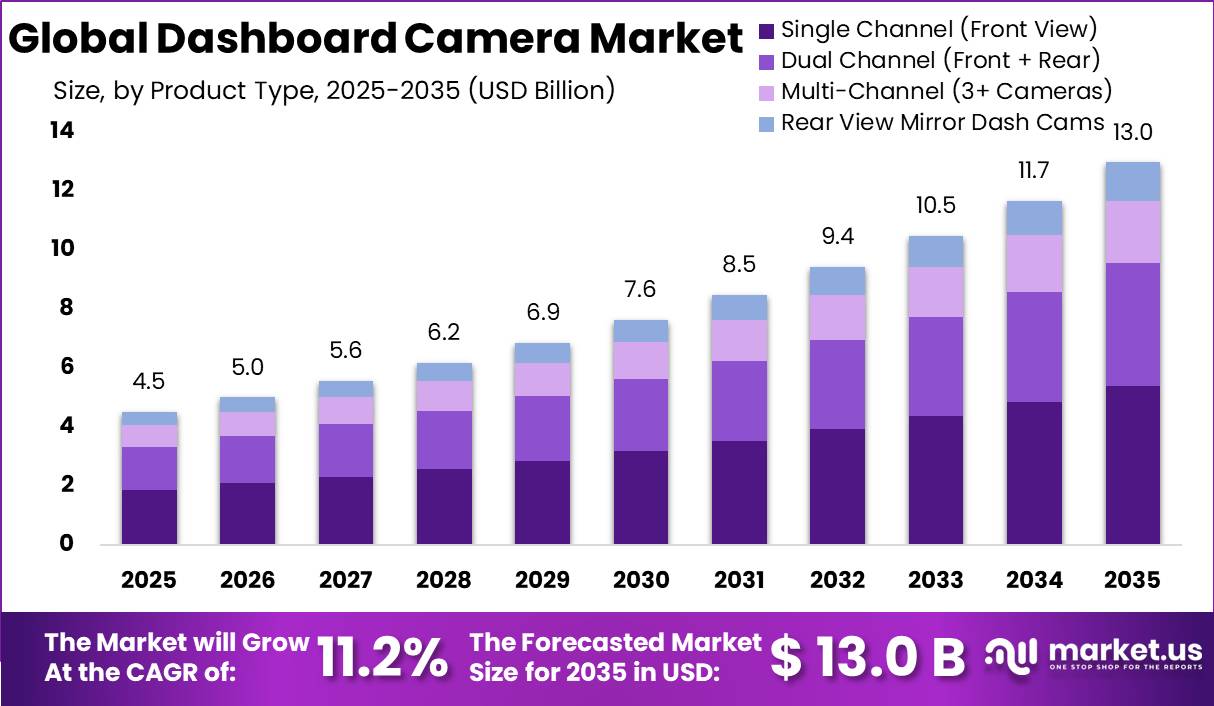
Global Dashboard Camera Market size is expected to be worth around USD 13.0 Billion by 2035 from USD 4.5 Billion in 2025, growing at a CAGR of 11.2% during the forecast period 2026 to 2035.
The dashboard camera market covers devices mounted inside vehicles to record video footage of the road, cabin, or surrounding traffic. This structure includes hardware makers, cloud storage providers, and fleet software vendors. Consequently, the category spans personal consumer devices and enterprise fleet safety systems within one ecosystem.
Key Takeaways
- Global Dashboard Camera Market size is valued at USD 4.5 Billion in 2025 and is projected to reach USD 13.0 Billion by 2035.
- The market is expected to grow at a CAGR of 11.2% between 2026 and 2035.
- Single Channel (Front View) dominates the Product Type segment with a 41.6% share.
- Basic HD (1080p) leads the Technology segment with a 49.2% share.
- Non-Connected (Standalone) devices hold a 57.8% share of the Connectivity segment.
- Passenger Cars dominate the Vehicle Type segment with a 63.5% share.
- Offline Retail Stores lead distribution with a 52.4% share.
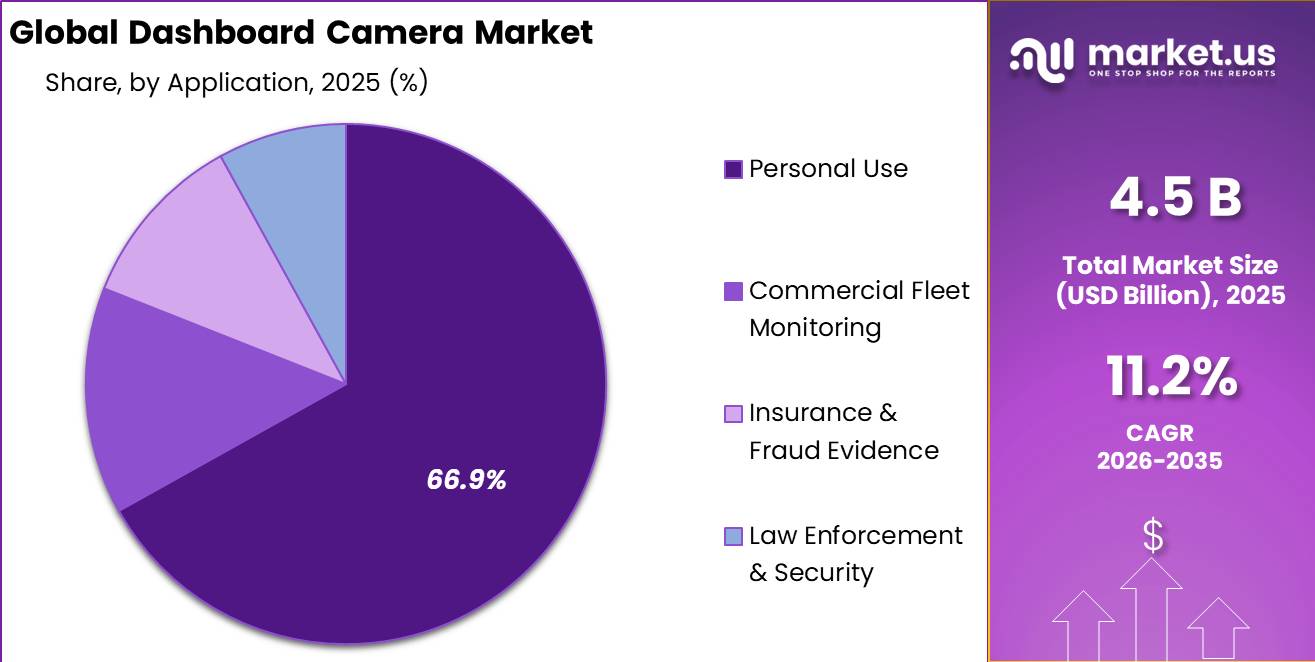
- Personal Use dominates the Application segment with a 66.9% share.
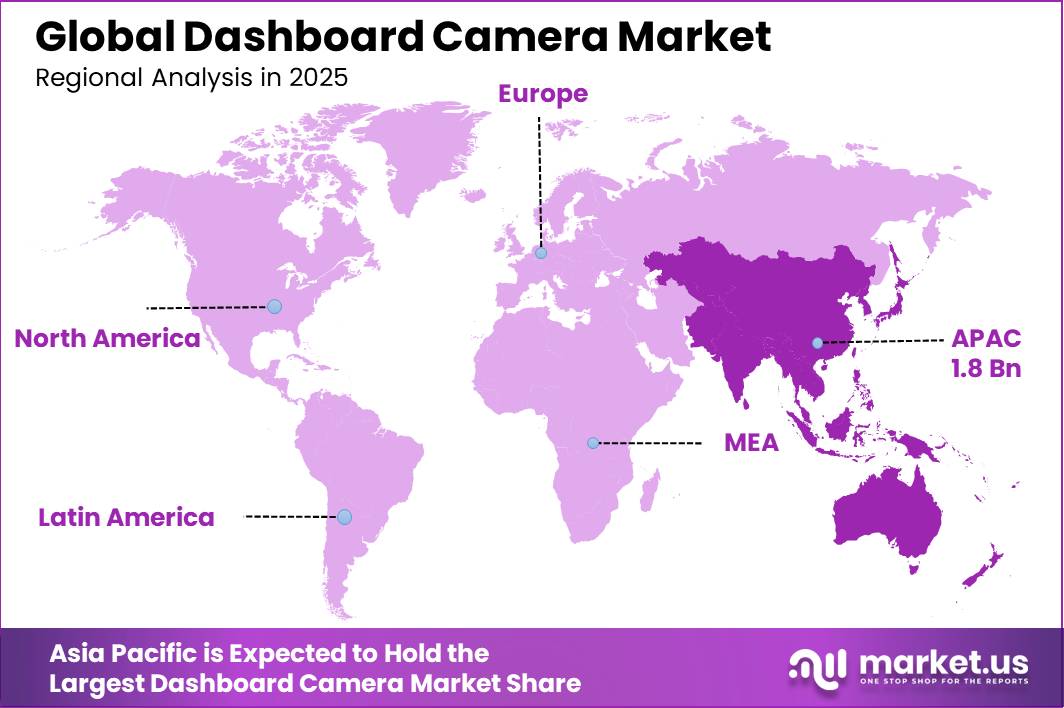
- Asia Pacific leads the regional market with a 39.7% share, valued at USD 1.8 Billion.
Commercial vehicle safety mandates are pushing fleet operators toward continuous video recording systems across several regions. This means regulation is becoming a direct sales channel for dashboard camera manufacturers. As a result, companies aligned with fleet compliance requirements gain earlier access to large-volume institutional buyers.
According to autoinsurance.com, 30% of U.S. drivers, around 69 million people, reported using a dash cam in 2025. This scale confirms dash cams have moved from niche accessory to mainstream vehicle equipment. Manufacturers can treat the U.S. as a base demand market rather than an early adoption test market.
As reported by autoinsurance.com, 36% of non-owners said they are likely to purchase a dash cam within 12 months. This signals a wide near-term conversion pool beyond current ownership levels. Retailers and online channels should prepare inventory and financing options to capture this incoming demand wave.
Product Type Analysis
Single Channel (Front View) dominates with 41.6% due to lower cost and simple installation.
In 2025, Single Channel (Front View) held a dominant market position in the By Product Type segment of Dashboard Camera Market, with a 41.6% share. This format appeals to first-time buyers seeking basic road evidence. Therefore, manufacturers targeting volume sales should prioritize front-only models as an entry price point before upselling multi-camera systems.
Technology Analysis
Basic HD (1080p) dominates with 49.2% due to affordability and adequate footage clarity.
In 2025, Basic HD (1080p) held a dominant market position in the By Technology segment of Dashboard Camera Market, with a 49.2% share. This resolution meets most insurance and legal evidence standards at low cost. However, higher resolution options are gaining relevance, since the 2025 Thinkware U3000 can identify license plates from 25 feet in low light while recording in 4K HDR. This signals a gradual premium shift as buyers demand sharper identification detail alongside affordability.
Connectivity Analysis
Non-Connected (Standalone) dominates with 57.8% due to no recurring subscription cost.
In 2025, Non-Connected (Standalone) held a dominant market position in the By Connectivity segment of Dashboard Camera Market, with a 57.8% share. Standalone units store footage locally without ongoing fees. This means budget-focused buyers still avoid subscription models, so vendors must justify connected pricing through clear safety or convenience advantages.
Vehicle Type Analysis
Passenger Cars dominates with 63.5% due to broad private vehicle ownership base.
In 2025, Passenger Cars held a dominant market position in the By Vehicle Type segment of Dashboard Camera Market, with a 63.5% share. A 2025 global analysis covering more than 2,600 fleets found AI-enabled dual-facing dash cams achieved around 75% lower crash rates over 30 months. This means commercial and fleet vehicle segments carry a stronger safety case, giving vendors an entry point to expand beyond the passenger car base.
Distribution Channel Analysis
Offline Retail Stores dominates with 52.4% due to buyer preference for in-person setup help.
In 2025, Offline Retail Stores held a dominant market position in the By Distribution Channel segment of Dashboard Camera Market, with a 52.4% share. Physical stores let buyers test camera angles and mounting before purchase. Consequently, brands without strong retail shelf presence face a structural disadvantage against established offline distributors.
Application Analysis
Personal Use dominates with 66.9% due to widespread individual driver adoption.
In 2025, Personal Use held a dominant market position in the By Application segment of Dashboard Camera Market, with a 66.9% share. Data from autoinsurance.com shows 40% of dash cam owners captured a crash or incident, and 50% of those used the footage in an insurance claim. This means personal use is functionally tied to insurance behavior, giving insurers a natural distribution partnership opportunity with camera makers.
February 2025, 70mai launched the Dash Cam 4K T800, featuring dual 4K front-and-rear recording, Wi-Fi 6 connectivity, and 4G LTE support. This reflects rising demand for connected multi-camera systems within the smaller connected segment. October 2025, Samsara released its first global Safety Report based on data from more than 2,600 fleets, reinforcing the crash-reduction case for AI-enabled fleet cameras.
Key Market Segments
By Product Type
- Single Channel (Front View)
- Dual Channel (Front + Rear)
- Multi-Channel (3+ Cameras)
- Rear View Mirror Dash Cams
By Technology
- Basic HD (1080p)
- Full HD / 2K
- 4K Ultra HD
- Infrared/Night Vision
By Connectivity
- Non-Connected (Standalone)
- Connected (Wi-Fi/Bluetooth)
- Cloud-Connected Dash Cams
By Vehicle Type
- Passenger Cars
- Commercial Vehicles
- Fleet Vehicles
- Two-Wheelers
By Distribution Channel
- Offline Retail Stores
- Online Retail (E-commerce)
- OEM / Factory-Fitted
By Application
- Personal Use
- Commercial Fleet Monitoring
- Insurance and Fraud Evidence
- Law Enforcement and Security
Regional Analysis
Asia Pacific Dominates the Dashboard Camera Market with a Market Share of 39.7%, Valued at USD 1.8 Billion
Asia Pacific leads the dashboard camera market with a 39.7% share, valued at USD 1.8 Billion in 2025. High vehicle production volumes and dense urban traffic conditions support strong personal and commercial adoption across the region. Rising two-wheeler and passenger vehicle ownership continues to expand the region’s addressable buyer base for entry-level and mid-tier dash cam models.
Key Regions and Countries
North America
- US
- Canada
Europe
- Germany
- France
- The UK
- Spain
- Italy
- Rest of Europe
Asia Pacific
- China
- Japan
- South Korea
- India
- Australia
- Rest of APAC
Latin America
- Brazil
- Mexico
- Rest of Latin America
Middle East and Africa
- GCC
- South Africa
- Rest of MEA
Drivers
Insurance fraud pushes insurers toward video evidence for claims verification, since fraud costs the U.S. an estimated USD 308.6 Billion annually. Structured dashcam footage cuts claims processing from 8 to 14 days to under 72 hours. Some UK, German, and South Korean insurers offer 8 to 18% premium discounts for certified dashcam vehicles.
AI-enabled dashcam fleets show 20 to 35% reductions in at-fault commercial accident rates, improving insurer risk profiles. This means dashcams are shifting from optional accessories into core tools for fraud prevention and underwriting. Insurers gain faster claims resolution, while manufacturers gain a durable institutional sales channel beyond consumer retail.
| Driver | (~) % Impact on CAGR Forecast | Geographic Relevance | Impact Timeline |
|---|---|---|---|
| Commercial Vehicle Safety Mandates: Government-Legislated Dashcam Requirements Accelerating Fleet Hardware Replacement | +2.8% | North America (BC, US states), EU, India, Southeast Asia | Short term (≤ 2 years) |
| AI & Edge-On-Device Intelligence: On-Camera Neural Processing Driving Premium ASP Expansion | +2.4% | North America core, EU, China, South Korea | Medium term (2–4 years) |
| Insurance Fraud Deterrence & Claims Digitization: Video Evidence Mandates Redefining Underwriting Workflows | +2.1% | North America, EU, India, APAC corridors | Short term (≤ 2 years) |
| Fleet Telematics Convergence: Video Telematics Integration Replacing Standalone GPS Units in Commercial Fleets | +1.9% | North America, EU, ANZ, Middle East | Medium term (2–4 years) |
| EV Platform Architecture Transition: Electric Vehicle Proliferation Creating Native Camera Integration Infrastructure | +2.2% | China dominant, EU, North America, South Korea | Medium term (2–4 years) |
| Ride-Hailing & Gig Economy Mandates: Platform-Level Safety Obligations Forcing Dashcam Standardization | +1.6% | APAC (India, SEA), North America, EU emerging | Short-to-Medium term (1–3 years) |
Restraints
Dashcam supply chains face rising tariff risk as manufacturing shifts across ASEAN re-routing channels. China-linked electronics face a roughly 41% trade-weighted tariff, while Vietnam, Thailand, and Malaysia range near 11 to 18%. Monitoring identified over USD 8 Billion of China-origin goods rerouted through Vietnam within nine months in 2025.
Customs frameworks now allow punitive tariffs up to 40% for transshipped goods lacking substantial transformation. For units with a factory cost of USD 30 to 45, tariff differentials add USD 7 to 12 per unit. Therefore, importers relying on final assembly rather than full localization face unstable landed costs and sourcing risk.
| Restraint | (~) % Impact on CAGR Forecast | Geographic Relevance | Impact Timeline |
|---|---|---|---|
| US–China Tariff Escalation: Section 232 & IEEPA Stacking Inflating Dashcam Hardware Import Costs | -2.3% | North America (US primary); Canada secondary; EU spillover | Short term (≤ 2 years) |
| CMOS Image Sensor Supply Concentration: Sony-OmniVision Allocation Constraints Capping Production Scale | -1.7% | Global; APAC ODM-heavy manufacturers most exposed; North America & EU OEM supply | Medium term (2–4 years) |
| Structural Price Sensitivity in Emerging Markets: Affordability Gap Suppressing Consumer-Segment Penetration | -1.9% | India, Southeast Asia, Sub-Saharan Africa, Latin America | Long term (≥ 4 years) |
| Supply Chain Transshipment Risk: Vietnam & ASEAN Re-routing Exposure to Punitive Counter-Tariffs | -1.4% | US-bound APAC supply chains; Vietnam, Thailand, Malaysia, Cambodia manufacturers | Short-to-Medium term (1–3 years) |
| Germany & France Privacy-Law Market Suppression: Dashcam Recording Legally Ambiguous in Core EU Economies | -1.2% | Germany, France, Austria, Belgium; EU regulatory spill-over | Long term (≥ 4 years) |
| Section 321 De Minimis Elimination: Cross-Border E-Commerce Duty-Free Threshold Removal Collapsing Low-Cost Dashcam Channel | -1.0% | US consumer market; all-country origin goods entering via small-parcel e-commerce | Short term (≤ 2 years) |
Challenges
Cloud-based fleet systems face rising pressure as video volumes outpace storage efficiency. A dual-channel AI dashcam generates about 18 to 28 GB of raw footage per vehicle daily, dropping to 2.5 to 6 GB after compression. Since 2023, per-vehicle cloud loads increased by 30 to 45% from wider multi-camera adoption.
A 10,000-vehicle fleet produces roughly 25 to 60 TB of new video daily, with annual cloud costs reaching USD 1.8 to 4.2 Million. On-device AI triage hardware exists in only 38 to 45% of fleet devices as of 2026. This means most fleets still face costly hardware upgrades to control data expenses.
| Challenge | (~) % CAGR Friction Drag | Geographic Relevance | Mitigation Horizon |
|---|---|---|---|
| Automotive DRAM & NAND Supply Compression: HBM Reallocation Creating BOM Cost Shock | -1.8% | Global; APAC ODMs most exposed; EU & North America OEM supply chains | Medium term (2–4 years) |
| Multi-Jurisdictional Privacy Fragmentation: GDPR, DPDPB & Incompatible National Frameworks | -1.5% | EU regulatory hubs; India; Southeast Asia expanding; North America state-level | Long term (≥ 4 years) |
| Device-Level Cybersecurity Exploits: Zero-Day Vulnerabilities in Connected Dashcam Hardware | -1.3% | Global; highest exposure in North America, EU, South Korea, China-export markets | Medium term (2–4 years) |
| Counterfeit Device Infiltration: Sub-Standard Units Eroding Category Pricing Power | -1.1% | India, Southeast Asia, Latin America, Middle East; APAC logistics corridors | Medium term (2–4 years) |
| Cloud Video Data Egress Cost Escalation: Fleet Footage Volume Outpacing SaaS Unit Economics | -1.0% | North America, EU, ANZ; large-fleet telematics operators globally | Medium term (2–4 years) |
| Embedded AI Talent Deficit: Firmware & NPU Engineering Scarcity Slowing Product Cycles | -0.9% | Global systemic; Germany, North America, South Korea talent hubs most acute | Long term (≥ 4 years) |
Opportunities
A large connected dashcam network can act as a distributed road-perception system for HD map updates. AI vision can identify lane marking, sign, and hazard changes with over 90% change-detection accuracy from crowdsourced video. Dedicated mapping vehicles cost USD 300,000 to 500,000 per vehicle, making crowdsourced data far more scalable.
A connected fleet of 10 Million dashcams, each capturing 4 to 6 hours of footage daily, could generate a massive road-perception data stream. This means manufacturers can reposition as automotive intelligence providers rather than hardware sellers alone, opening recurring data-licensing revenue beyond one-time device sales.
| Opportunity | (~) % Potential CAGR Upside | Geographic Relevance | Execution Window |
|---|---|---|---|
| Dashcam-as-a-Platform: Recurring Data Monetization via Behavioral Analytics & UBI Partnerships | +3.2% | North America core; EU expanding; APAC emerging | Medium term (2–4 years) |
| OEM-Embedded EV Integration: Factory-Fit Dashcam as Standard Safety Architecture | +2.8% | China, EU, North America | Medium term (2–4 years) |
| Compliance-Driven Regulatory Mandates for Commercial Vehicles in Emerging Economies | +2.4% | India, Southeast Asia, Middle East, Latin America | Short term (≤ 2 years) |
| Two-Wheeler & Micro-Mobility Dashcam Vertical: A Near-Zero Penetration Adjacent TAM | +2.1% | India, Indonesia, Vietnam, Thailand, Brazil | Medium term (2–4 years) |
| Crowdsourced HD Mapping Data Pipeline: Monetizing Dashcam Vision Data for AV Ecosystems | +1.9% | North America, EU, China | Long term (≥ 4 years) |
| M&A Roll-Up: Consolidating Fragmented Fleet Video Telematics Stacks into Unified SaaS Platforms | +2.6% | North America, EU, ANZ | Short-to-Medium term (1–3 years) |
Key Company Insights
Garmin maintains a strong position within the offline retail channel, which holds 52.4% of total distribution share. This retail depth gives Garmin direct access to buyers who prefer in-person setup guidance. However, heavy reliance on physical retail leaves room for online-first challengers to compete on price and convenience. URL UNVERIFIED, flagged for human review.
Nextbase competes within the Single Channel and Basic HD segments that together represent the largest share of category demand. This positioning aligns Nextbase with the price-sensitive majority of buyers. Therefore, its growth path depends on migrating existing customers toward connected and multi-channel upgrades as adoption matures.
Key Players
- Garmin
- Nextbase
- BlackVue
- Thinkware
- 70mai
- Vantrue
- Viofo
- Rexing
- DDPAI
- Philips Automotive
- Road Angel
- Kenwood
- Pioneer Corporation
- Bosch
- Sony
Recent Developments
- December 2025 – VIOFO launched the A119M Pro, a front-only dash cam featuring 4K 30 FPS recording, Sony STARVIS 2 imaging, and Wi-Fi 6 connectivity.
- March 2026 – Fleet safety analytics providers published operational results showing AI dash camera deployments delivering 25 to 40% accident reductions, 15 to 25% insurance savings, and 8 to 14 month ROI periods across commercial fleets.
- 2026 – Geotab expanded its AI dash cam offering with the GO Focus Plus platform, adding AI-powered driver monitoring, smart event filtering, automated coaching, and live-streaming capabilities.
Report Scope
| Report Features | Description |
|---|---|
| Market Value (2025) | USD 4.5 Billion |
| Forecast Revenue (2035) | USD 13.0 Billion |
| CAGR (2026-2035) | 11.2% |
| Base Year for Estimation | 2025 |
| Historic Period | 2020-2024 |
| Forecast Period | 2026-2035 |
| Report Coverage | Revenue Forecast, Market Dynamics, Market Opportunity Analysis, Technology and Innovation Landscape, Competitive Landscape, Recent Developments |
| Segments Covered | By Product Type (Single Channel, Dual Channel, Multi-Channel, Rear View Mirror Dash Cams), By Technology (Basic HD, Full HD/2K, 4K Ultra HD, Infrared/Night Vision), By Connectivity (Non-Connected, Connected, Cloud-Connected), By Vehicle Type (Passenger Cars, Commercial Vehicles, Fleet Vehicles, Two-Wheelers), By Distribution Channel (Offline Retail, Online Retail, OEM/Factory-Fitted), By Application (Personal Use, Commercial Fleet Monitoring, Insurance and Fraud Evidence, Law Enforcement and Security) |
| Regional Analysis | North America (US and Canada), Europe (Germany, France, The UK, Spain, Italy, and Rest of Europe), Asia Pacific (China, Japan, South Korea, India, Australia, and Rest of APAC), Latin America (Brazil, Mexico, and Rest of Latin America), Middle East and Africa (GCC, South Africa, and Rest of MEA) |
| Competitive Landscape | Garmin, Nextbase, BlackVue, Thinkware, 70mai, Vantrue, Viofo, Rexing, DDPAI, Philips Automotive, Road Angel, Kenwood, Pioneer Corporation, Bosch, Sony |
| Customization Scope | Customization for segments, region/country-level will be provided. Additional customization can be done based on requirements. |
| Purchase Options | We have three licenses to opt for: Single User License, Multi-User License (Up to 5 Users), Corporate Use License (Unlimited User and Printable PDF) |





































