Report Overview
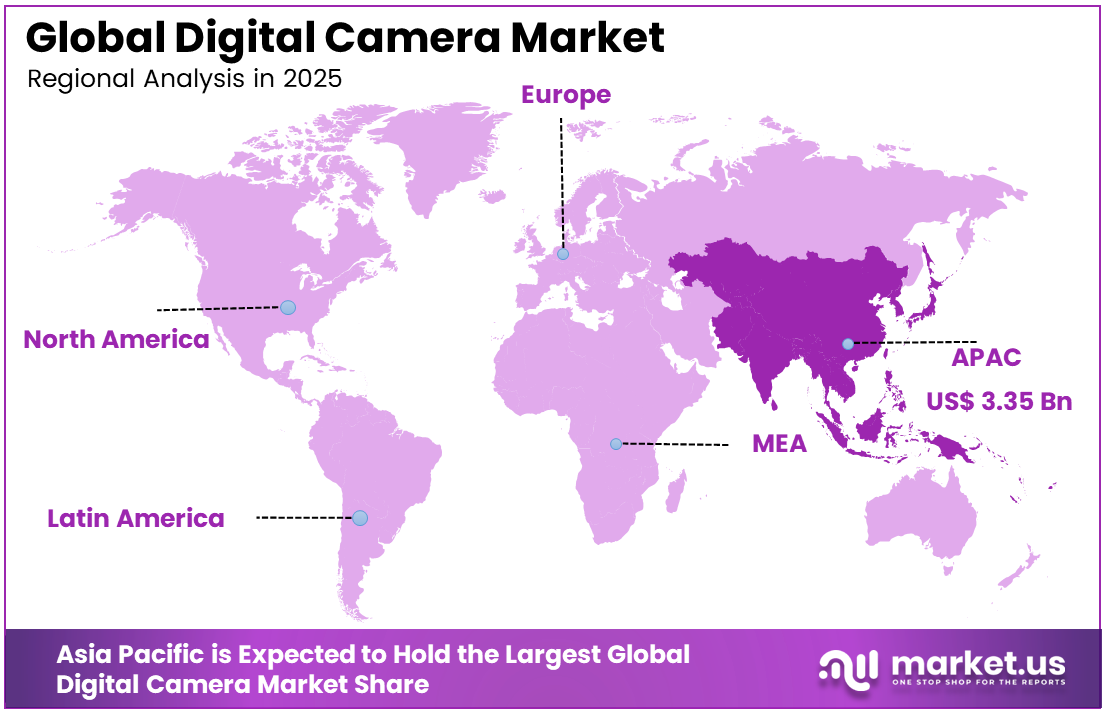
The Global Digital Camera Market size is expected to be worth around USD 13.20 billion by 2035, from USD 8.26 billion in 2025, growing at a CAGR of 4.8% during the forecast period from 2025 to 2035. Asia Pacific held a dominant market position, capturing more than a 40.5% share, holding USD 3.35 billion in revenue.
A digital camera refers to an electronic imaging device that captures photos and videos using a sensor instead of film. It processes light into digital data, allowing instant viewing, editing, and storage. These cameras are used in personal, professional, and commercial settings to produce high-quality visuals with greater control over focus, exposure, and detail.
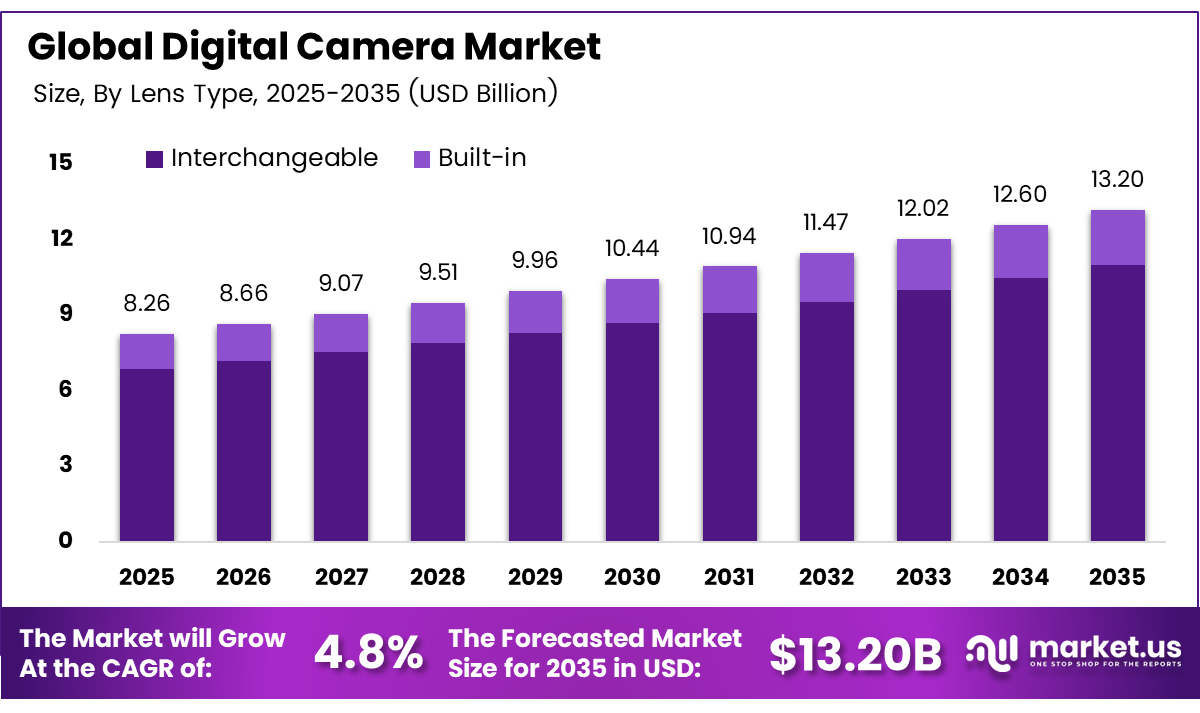
The top growth factors include strong growth in social media content creation and travel photography. A major shift toward video consumption is visible, with around 80% of web traffic now video-related. Users increasingly prefer dedicated cameras as they provide better dynamic range, smoother background blur, and higher usable ISO performance for low-light conditions.
The market for digital cameras is driven by increasing demand for high-quality photography and video across social media, travel, and business use. Users seek better image clarity, low-light performance, and creative control beyond smartphones. Growth in content creation, online marketing, and personal branding is also encouraging consumers and professionals to invest in advanced and reliable camera systems.
Demand is concentrated in mirrorless cameras, vlog kits, and hybrid still plus video systems. These segments are gaining traction as users seek lightweight and versatile equipment. At the same time, compact cameras continue to decline due to smartphone substitution, while mirrorless product searches and purchases have increased by over 30% in recent years.
For instance, in April 2026, Sony continues to lean on its Alpha mirrorless ecosystem and in-house sensor roadmap, using frequent firmware updates and incremental body refreshes to keep hybrid shooters in its camp. Analysts note that Sony’s strategy of embedding AI-driven autofocus and subject recognition across price tiers is a key pillar of its roughly one-third share of the interchangeable-lens mirrorless segment.
Key Takeaway
- In 2025, the Interchangeable segment held a dominant market position, capturing a 83.2% share of the Global Digital Camera Market.
- In 2025, the Mirrorless segment held a dominant market position, capturing a 72.4% share of the Global Digital Camera Market.
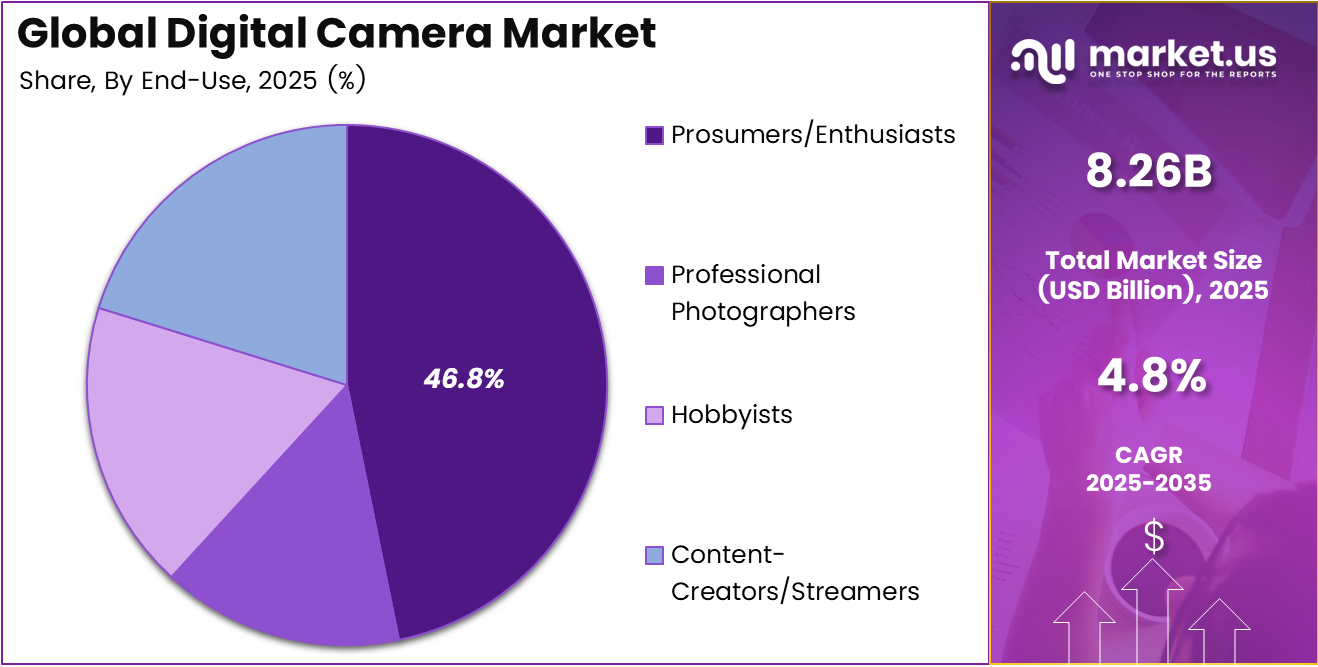
- In 2025, the Prosumers/Enthusiasts segment held a dominant market position, capturing a 46.8% share of the Global Digital Camera Market.
- In 2025, the Full-Frame segment held a dominant market position, capturing a 55.6% share of the Global Digital Camera Market.
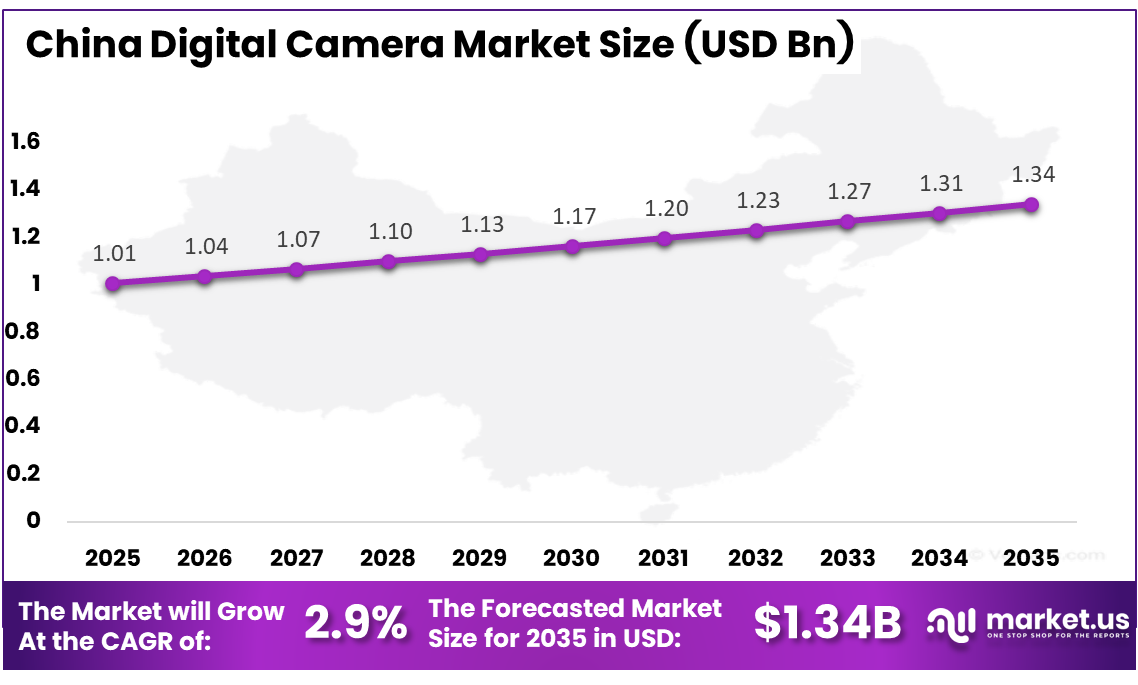
- The China Digital Camera Market was valued at USD 1.01 billion in 2025, with a robust CAGR of 2.9%.
- In 2025, the Asia Pacific held a dominant market position in the Global Digital Camera Market, capturing more than a 40.5% share.
Role of Generative AI
Generative AI is reshaping digital camera usage by improving image processing, scene detection, and automated editing. Modern systems can enhance clarity, remove noise, and adjust lighting conditions in real time. Around 65% of creators now use AI-based tools during editing, which shows how intelligent workflows are becoming central to photography and video production.
AI is also enabling features such as subject tracking, auto framing, and background enhancement directly within cameras. These capabilities reduce manual effort and improve output quality for both professionals and beginners. Nearly 70% of content creators report faster production cycles due to AI-assisted editing, supporting wider adoption across creative and commercial use cases.
Investment and Business Benefits
Investment potential extends beyond camera bodies into lenses, accessories, and digital ecosystems such as editing software and cloud storage. As content creators adopt RAW formats and high-bitrate video, demand for advanced tools is rising. Subscription-based editing and AI-driven solutions are seeing user growth of over 15% annually within active creator communities.
Businesses are benefiting from improved visual quality in product images, training materials, and marketing content. Dedicated cameras enable sharper visuals and smoother motion compared to smartphones. Companies adopting such equipment have reported improvements in engagement metrics, including 10 to 20% higher view times and click-through rates across digital platforms.
Regional Analysis
In 2025, the Asia Pacific held a dominant market position in the Global Digital Camera Market, capturing more than a 40.5% share, holding USD 3.35 billion in revenue. This dominance is due to strong demand from China, Japan, South Korea, and India, where photography, travel, vlogging, and social media content creation are expanding quickly. Asia Pacific also benefits from a strong camera manufacturing base, wide online retail access, and rising adoption of mirrorless systems. Growing interest in professional-quality visuals among creators, tourists, and small businesses continues to support higher camera sales across the region.
For instance, in November 2025, Panasonic, headquartered in Osaka Prefecture, strengthened its Asia-Pacific position in video-first mirrorless cameras through Lumix models widely adopted for streaming and long-form content. Its focus on robust video codecs, stabilization, and live-production features made the brand a backbone for regional creators and small studios moving from smartphones to dedicated cameras.
China Digital Camera Market Size
The market for digital cameras within China is growing tremendously and is currently valued at USD 1.01 billion; the market has a projected CAGR of 2.9%. The market is growing due to strong demand from content creators, travel enthusiasts, and social media users across China. Rising interest in high-quality video and photography has encouraged consumers to upgrade from smartphones to dedicated cameras. Growth in domestic tourism, live streaming culture, and short video platforms is also supporting demand, while improving local retail access and online sales channels are making advanced camera systems more widely available to users.
For instance, in November 2025, Yongnuo, the Shenzhen-based optics and camera maker, deepened its foothold in Asia-Pacific by supplying low-cost lenses and compact bodies to mirrorless shooters in China, India, and Southeast Asia. Its ecosystem of flashes, lenses, and entry-level cameras reinforces China’s dominance in value-driven digital imaging hardware for emerging creator communities.
Key Regions and Countries
North America
- US
- Canada
Europe
- Germany
- France
- The UK
- Spain
- Italy
- Russia
- Netherlands
- Rest of Europe
Asia Pacific
- China
- Japan
- South Korea
- India
- Australia
- Singapore
- Thailand
- Vietnam
- Rest of APAC
Latin America
- Brazil
- Mexico
- Rest of Latin America
Middle East & Africa
- South Africa
- Saudi Arabia
- UAE
- Rest of MEA
Lens Type Analysis
In 2025, the Interchangeable segment held a dominant market position, capturing a 83.2% share of the Global Digital Camera Market. This dominance is due to the flexibility offered by interchangeable lens systems, allowing users to adapt their equipment for different shooting needs such as portraits, landscapes, and video. The ability to upgrade lenses without replacing the camera body also supports long-term value and encourages continued investment among users.
Interchangeable systems are widely preferred by both enthusiasts and professionals who seek creative control and consistent output quality. The expanding ecosystem of lenses and accessories further strengthens this segment, making it suitable for a wide range of applications from casual photography to advanced commercial and content creation use cases.
For instance, in April 2026, Nikon recently expanded its NIKKOR Z lineup with a new fast telephoto zoom, reinforcing its focus on interchangeable lens bodies for wildlife, sports, and event shooters. By refreshing core lenses, Nikon is giving existing users more reasons to stay in the system while making its mirrorless platform more attractive to people moving up from smartphones or older DSLRs.
Camera Type Analysis
In 2025, the Mirrorless segment held a dominant market position, capturing a 72.4% share of the Global Digital Camera Market. This dominance is due to the growing preference for compact and lightweight camera systems that still deliver high performance. Mirrorless cameras provide faster autofocus, silent shooting, and strong video capabilities, making them highly suitable for modern content creation needs across photography and videography applications.
Users are increasingly shifting away from bulkier camera systems in favor of mirrorless options that are easier to carry and operate. Continuous improvements in battery life, sensor performance, and lens availability have strengthened user confidence, supporting wider adoption among professionals as well as emerging content creators.
For instance, in May 2025, Panasonic has been expanding its full-frame Lumix S mirrorless series, positioning recent S1 models as hybrids for both photo and video users. On top of that, new registrations and industry coverage point to fresh Lumix launches in 2026, which indicates Panasonic sees mirrorless as the core of its future imaging business.
End User Analysis
In 2025, the Prosumers/Enthusiasts segment held a dominant market position, capturing a 46.8% share of the Global Digital Camera Market. This dominance is due to rising interest among serious hobbyists who seek better image quality and more control over their photography. These users often transition from smartphones to dedicated cameras to explore advanced features such as manual settings, lens selection, and creative shooting techniques.
Prosumers and enthusiasts are highly engaged in travel, social media, and personal content creation, which drives frequent equipment upgrades. Their willingness to invest in cameras and accessories supports steady demand, while their growing skills encourage the use of more advanced tools for both photography and video projects.
For instance, in March 2026, at CP+ 2026, OM System executives confirmed a change in stance toward enthusiast compacts and outlined plans for a new PEN camera and smaller lenses aimed at hobbyists and creators. This shift shows the company is paying closer attention to prosumers who want capable but portable gear, a group that often chooses Micro Four Thirds for reach and size advantages.
Sensor Size Analysis
In 2025, the Full-Frame segment held a dominant market position, capturing a 55.6% share of the Global Digital Camera Market. This dominance is due to the superior image quality delivered by full-frame sensors, especially in low-light conditions and high-contrast scenes. These cameras provide better depth control and clarity, which is essential for professional photography, cinematic video, and detailed commercial content creation.
Full frame systems are also preferred for their ability to capture more visual information, resulting in richer and more accurate images. Advanced users and professionals rely on these benefits for demanding applications, which continues to support strong adoption despite the availability of smaller and more affordable sensor options.
For instance, in April 2026, Canon’s latest cinema lens and firmware updates announced at NAB 2026 are aimed at professionals using its full-frame Cinema EOS and mirrorless systems. By enhancing video features and long-range optics around full-frame cameras, Canon is reinforcing this sensor size as its main platform for serious stills and motion work.
Key Market Segments
By Lens Type
- Built-in
- Interchangeable
By Camera Type
- Compact Digital Camera
- DSLR (Digital Single-Lens Reflex)
- Mirrorless
- Action/360°
By End User
- Prosumers/Enthusiasts
- Professional Photographers
- Hobbyists
- Content-Creators/Streamers
By Sensor Size
- Medium Format
- Full-Frame
- APS-C
- Micro Four-Thirds and Smaller
Emerging Trends
The shift toward hybrid shooting is a major trend, where users demand both high-quality photography and advanced video in one device. About 75% of new camera users prioritize video features alongside still photography. This has increased demand for models that support seamless switching between formats with minimal setup complexity.
Another visible trend is the growth of creator-focused ecosystems, including accessories, cloud storage, and editing platforms. Nearly 60% of users now rely on connected workflows for sharing and backup. This indicates a move beyond standalone devices toward integrated digital environments that support continuous content creation and distribution.
Growth Factors
Rising social media engagement continues to support digital camera demand, as visual content becomes a key communication tool. Around 80% of online traffic is video-based, encouraging users to invest in better recording equipment. This trend is supported by increasing demand for high-resolution visuals across entertainment, marketing, and personal branding activities.
The expansion of travel and lifestyle content creation also plays a strong role in market growth. More than 55% of young users actively create and share travel-related visuals. This behavior drives demand for compact, high-performance cameras that can deliver professional-quality output in diverse shooting environments without complex setups.
Market Dynamics
Drivers - Growth of Content Creation
The market is driven by the rapid rise of content creation across social media, travel, education, and online business platforms. Users are looking for cameras that can deliver sharper images, better color quality, and smoother video performance than basic devices used for casual shooting.
Creators also prefer digital cameras because they offer stronger control over focus, lighting, lenses, and image depth. This makes them useful for vlogging, product photography, short videos, and professional content work, where visual quality directly affects audience engagement and brand presentation.
For instance, in April 2025, Insta360 introduced the X5 360-degree camera with dual sensors and strong stabilization to let creators reframe scenes and produce immersive clips in post. Travel, action, and social media users gain a flexible capture tool that supports dynamic edits without repeatedly reshooting from different angles.
Restraint - Substitution from Advanced Smartphone Cameras
The market faces pressure from advanced smartphone cameras, which have become strong enough for everyday photography and video needs. Many casual users now prefer smartphones because they are easy to carry, simple to use, and already connected to editing and sharing platforms.
This shift has reduced demand for entry-level and compact digital cameras. Consumers who only need quick images often avoid buying separate devices, especially when smartphones provide automatic image processing, multiple lenses, and strong low-light performance in a convenient format.
For instance, in February 2026, Canon’s celebration of 30 years of PowerShot highlighted a more specialized, enthusiast-oriented compact at a time when basic compacts had largely disappeared because smartphones satisfy casual photography needs. The limited-edition release acknowledges that only higher-value niches remain viable in the small-camera space.
Opportunities - Rising Demand from Content Creation and Video-centric Use
The rising use of video for marketing, education, entertainment, and personal branding creates strong opportunities for digital camera makers. Demand is increasing for cameras that support high-quality recording, clear audio connections, fast autofocus, and flexible lens options for different shooting environments.
This opportunity is especially visible among vloggers, freelancers, small businesses, and online educators. These users need reliable equipment that can improve production quality without complex studio setups. Camera brands can benefit by offering creator-focused kits, video accessories, and easy workflow support.
For instance, in March 2025, Blackmagic’s URSA Cine range, including immersive variants, is presented as built for high-end workflows used by streamers, production companies, and online education providers. Support for advanced codecs and tight integration with DaVinci Resolve give video-first creators a clear path from capture to final delivery.
Challenges - High Development Costs
High development costs remain a key challenge for digital camera manufacturers. Advanced sensors, image processors, autofocus systems, stabilization features, and compact body designs require continuous research and technical investment. These costs can place pressure on margins, especially in a market where buyers compare cameras closely with smartphones.
Manufacturers also need to update products regularly to match changing creator needs and video standards. This adds pressure on design teams, supply chains, and component sourcing. Smaller brands may find it difficult to compete when development cycles become shorter, and technology expectations continue to rise.
For instance, in September 2025, premium brands like Leica are often cited in discussions about rising camera prices, as advanced optics and precision construction drive up costs. Their products show how pursuing image quality and craftsmanship in a smaller market can result in higher price points that limit broader adoption.
Key Players Analysis
One of the leading players in February 2025, Tamron expanded its portfolio of mirrorless-optimized zooms for Sony, Nikon, and Fujifilm mounts, reinforcing its position as a price-performance leader in third-party lenses. Its strategy of quick porting to new mounts helps camera brands fill lens gaps faster, indirectly supporting body sales and giving photographers more affordable upgrade paths.
Top Key Players in the Market
- Canon Inc.
- Sony Group Corporation
- Nikon Corporation
- Fujifilm Holdings Corporation
- Panasonic Holdings Corporation
- OM Digital Solutions Corporation
- Leica Camera AG
- Sigma Corporation
- Victor Hasselblad AB
- Eastman Kodak Company
- Ricoh Imaging Company, Ltd.
- GoPro, Inc.
- Insta360 (Arashi Vision Inc.)
- DJI Technology Co., Ltd.
- Blackmagic Design Pty. Ltd.
- Phase One A/S
- RED Digital Cinema, LLC
- Z CAM (Shenzhen ImagineVision Tech)
- Pentax (Brand of Ricoh Imaging)
- Tamron Co., Ltd.
- Carl Zeiss AG (Consumer Imaging)
- Yongnuo Photographic Equipment Co., Ltd.
- Others
Recent Developments
- In April 2026, DJI confirmed the launch window for its next-generation Pocket 4 gimbal camera, after a teaser campaign that fueled speculation around improved 4K/8K capture and AI tracking. The Pocket line sits at the intersection of camera and stabilizer, and DJI uses it to extend dominance from drones into ground-based video tools for travelers and run-and-gun creators.
- In October 2025, Panasonic’s Lumix brand sharpened its focus on hybrid creators, with new full-frame and Micro Four Thirds bodies designed around open-gate 6K/8K capture, improved low-light performance, and better phase-detect autofocus. This strategy aims to solidify Panasonic as the go-to choice for solo video creators and small studios that want cinema-leaning features at a fraction of traditional broadcast budgets.
Report Scope
| Report Features | Description |
|---|---|
| Market Value (2025) | USD 8.26 Billion |
| Forecast Revenue (2035) | USD 13.20 Billion |
| CAGR (2026-2035) | 4.8% |
| Base Year for Estimation | 2025 |
| Historic Period | 2020-2024 |
| Forecast Period | 2026-2035 |
| Report Coverage | Revenue Forecast, Market Dynamics, Competitive Landscape, Recent Developments |
| Segments Covered | By Lens Type (Built-in, Interchangeable), By Camera Type (Compact Digital Camera, DSLR (Digital Single-Lens Reflex), Mirrorless, Action/360°), By End User (Professional Photographers, Prosumers/Enthusiasts, Hobbyists, Content-Creators/Streamers), By Sensor Size (Medium Format, Full-Frame, APS-C, Micro Four-Thirds and Smaller) |
| Regional Analysis | North America (US and Canada), Europe (Germany, France, The UK, Spain, Italy, and Rest of Europe), Asia Pacific (China, Japan, South Korea, India, Australia, and Rest of APAC), Latin America (Brazil, Mexico, and Rest of Latin America), Middle East & Africa (GCC, South Africa, and Rest of MEA) |
| Competitive Landscape | Canon Inc., Sony Group Corporation, Nikon Corporation, Fujifilm Holdings Corporation, Panasonic Holdings Corporation, OM Digital Solutions Corporation, Leica Camera AG, Sigma Corporation, Victor Hasselblad AB, Eastman Kodak Company, Ricoh Imaging Company, Ltd., GoPro, Inc., Insta360 (Arashi Vision Inc.), DJI Technology Co., Ltd., Blackmagic Design Pty. Ltd., Phase One A/S, RED Digital Cinema, LLC, Z CAM (Shenzhen ImagineVision Tech), Pentax (Brand of Ricoh Imaging), Tamron Co., Ltd., Carl Zeiss AG (Consumer Imaging), Yongnuo Photographic Equipment Co., Ltd., Others |
| Customization Scope | Customization for segments and region/country levels will be provided. Moreover, customization can be tailored to the requirements. |
| Purchase Options | We have three licenses to opt for: Single User License, Multi-User License (Up to 5 Users), Corporate Use License (Unlimited Users and Printable PDF) |