Report Overview
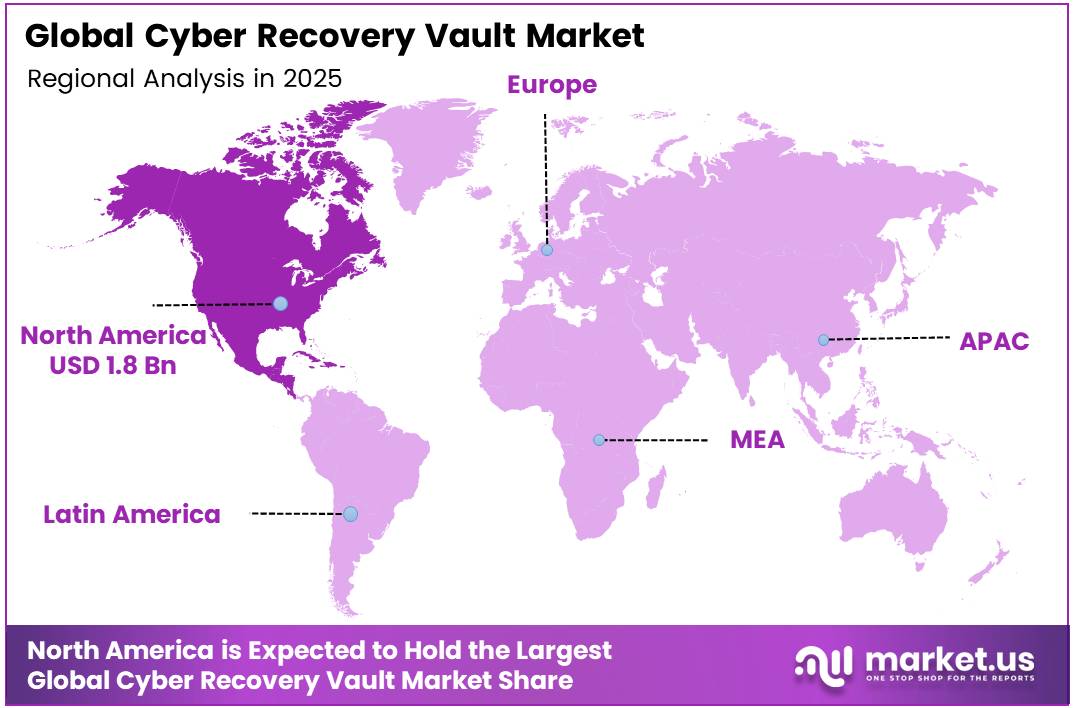
In 2025, the Global Cyber Recovery Vault Market was valued at USD 4.3 billion. The market is projected to grow at a CAGR of 16.8% during 2026–2035, reaching approximately USD 20.2 billion by 2035. North America dominated the global market in 2025, accounting for more than 43.0% of the total market share and generating approximately USD 1.8 billion in revenue.
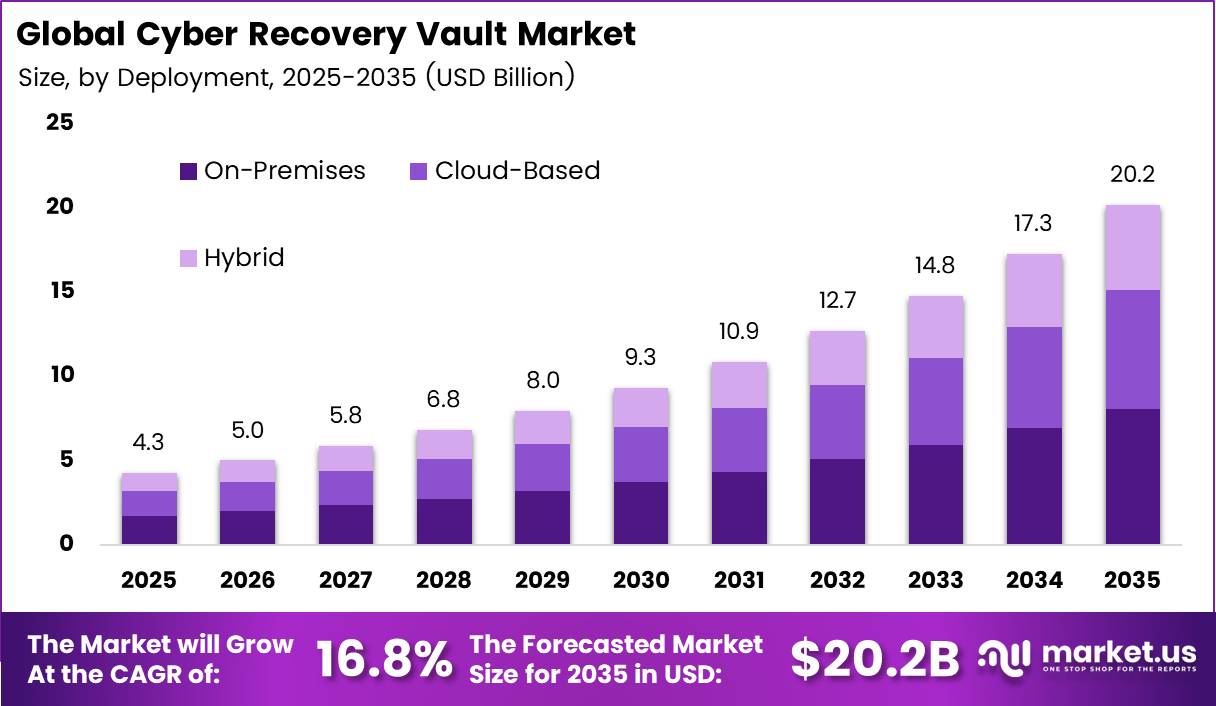
Rising cybercrime drives this growth. The FBI Internet Crime Complaint Center (IC3) logged 859,532 complaints in 2024, with reported losses of USD 16.6 billion. That is a 33% jump from 2023. Ransomware complaints rose 9%, to 3,156 cases. IC3 also found 67 new ransomware variants in 2024.
Banks, hospitals and factories now need isolated, unchangeable backup copies that attackers cannot reach. Critical manufacturing alone reported 258 ransomware attacks, and healthcare reported 238. Each attack pushes boards to fund air-gapped vaults that allow clean recovery.
The North America region faces the heaviest attack load and has the deepest vendor base. The FBI reported that its agents have handed out thousands of decryption keys since 2022. These keys helped victims avoid more than USD 800 million in ransom payments.
Federal agencies push firms to plan for recovery, and US vendors lead product development. Rubrik grew fiscal 2026 revenue to USD 1,316.2 million, up from USD 886.5 million. This shows how fast US buyers are taking up cyber recovery tools.
Key Takeaways
- The Cyber Recovery Vault Market reached USD 4.3 billion in 2025 and should reach USD 20.2 billion by 2035. at a CAGR of 16.8% from 2026 to 2035.
- By Component, Solutions lead with a 70.0% share.
- By Deployment Mode, On-Premises leads with a 40.0% share.
- By Organization Size, Large Enterprises lead with an 80.0% share.
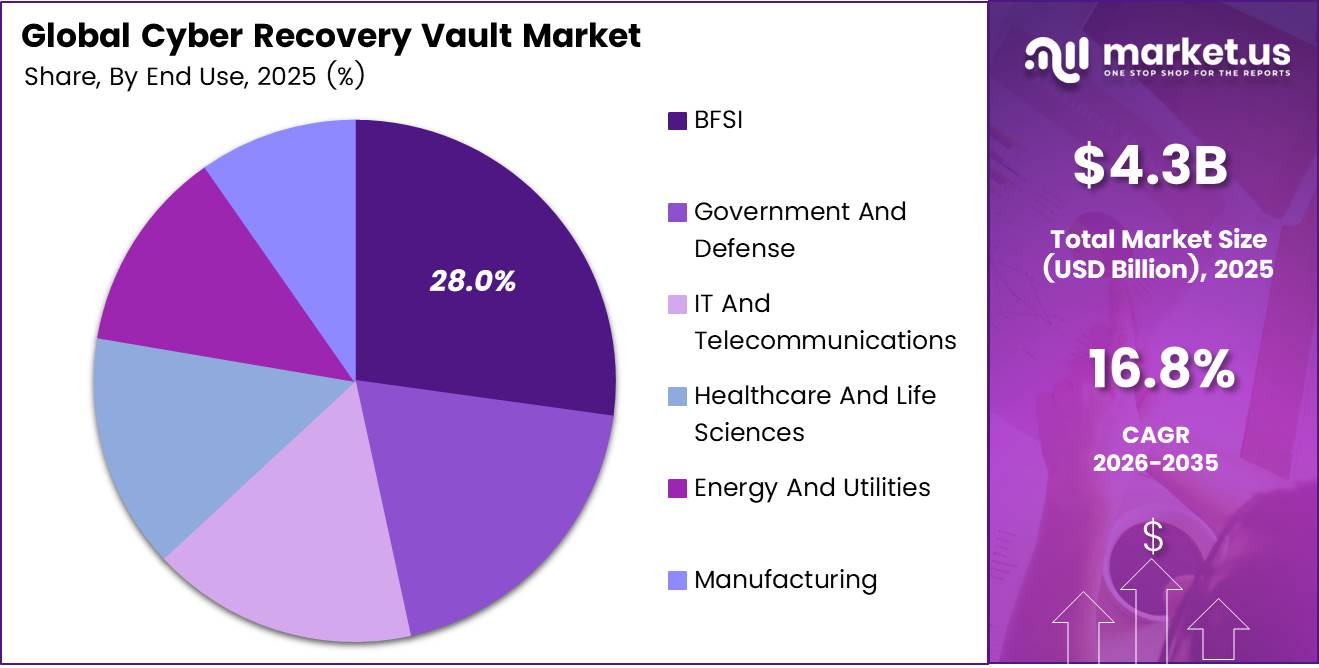
- By End-Use Industry, BFSI leads with a 28.0% share.
- North America leads with a 43.0% share and USD 1.85 billion in revenue.
By Component
Solutions dominate with 70.0% due to demand for isolated, immutable data copies.
Solutions hold the largest share because buyers need a locked, isolated copy of key data that attackers cannot reach. The FBI tracked 67 new ransomware variants in 2024. Each new strain pushes firms to buy vault software, immutable storage, and clean-room recovery tools as one ready package.
Services form the fastest-growing sub-segment. Ransomware complaints from critical infrastructure rose 9% in 2024, and the FBI received 4,878 complaints from these sectors. Many teams lack the skills to design, test, and run a vault, so they hire partners for setup, recovery drills, and managed operations with fixed response times.
By Deployment Mode
On-Premises dominates with 40.0% due to full control over air-gapped data.
On-premises vaults lead because large banks, defense units, and utilities want a physical air gap that they own and control. CISA’s Cyber Essentials guidance tells firms to keep backups offline and to protect them with physical security and encryption. An on-site vault follows that advice directly and keeps sensitive records inside national borders.
Cloud-based deployment shows the fastest growth. Eurostat reports that 52.74% of EU enterprises bought cloud computing services in 2025, up 7.42 percentage points from 2023. Among medium-sized firms, use climbed from 59.09% to 66.78% over the same period. As firms move workloads to the cloud, they want their vault there too, with object lock and separate accounts.
By Organization Size
Large Enterprises dominate with 80.0% due to high breach rates and large budgets.
Large enterprises account for most spending because they face the heaviest attack pressure and hold the most data. The UK Cyber Security Breaches Survey 2025 found that 74% of large businesses suffered at least one breach or attack in the past year. These firms run complex networks across many sites, so a single ransomware hit can halt costly operations.
Small and medium-sized enterprises are the fastest-growing group. The same survey showed that 67% of medium businesses faced a breach or attack, which is close to the rate for large firms. In the latest edition, about 43% of all UK businesses, or roughly 612,000 firms, reported a breach. Attackers now see smaller firms as easy targets with weak backups.
By End-Use Industry
Banking, Financial Services, and Insurance (BFSI) dominates with 28.0% due to strict recovery rules and fraud risk.
BFSI leads because banks, insurers, and payment firms hold high-value data and must restore services quickly under strict rules. ENISA reviewed 11,079 cyber incidents in its 2024 threat landscape and listed finance among the most targeted sectors, with about 9% of observed events. Regulators in many markets now ask lenders to prove they can recover clean data after an attack.
Healthcare and life sciences post the fastest growth. The U.S. HHS Office for Civil Rights recorded 663 large breaches in 2024, affecting about 242.9 million people. The Change Healthcare ransomware attack alone affected around 192.7 million people and disrupted claims across the country.
Key Market Segments
By Component
- Solutions
- Services
By Deployment Mode
- On-Premises
- Cloud-Based
- Hybrid
By Organization Size
- Small And Medium-Sized Enterprises (SMEs)
- Large Enterprises
By End-Use Industry
- Banking, Financial Services, And Insurance (BFSI)
- Government And Defense
- IT And Telecommunications
- Healthcare And Life Sciences
- Energy And Utilities
- Manufacturing
- Retail And E-Commerce
- Other Industries
Geopolitical Impact Analysis
Cyber recovery vaults run on servers, storage arrays, and chips. This means global trade in AI hardware shapes their supply and cost. The WTO reported that goods trade grew 4.6% in 2025. That beat its earlier forecast of about 2.4% to 2.5%. AI goods such as chips and processors made up 42% of that growth.
Demand for this same hardware keeps getting tighter. The WTO said servers and chips made up 47% of global goods trade growth in the first half of 2026. Trade in these products rose 67% year on year. Vault vendors now compete with AI data centers for the same storage and compute parts. That raises the risk of longer lead times and higher appliance prices.
Tariffs create less pressure than many buyers expect. The WTO noted that most data center goods face low or 0% tariffs under the Information Technology Agreement. 84 WTO members take part in that agreement. This protects the pricing of on-premises vault hardware. Even so, previously delayed tariffs and policy uncertainty led the WTO to set a 1.9% base forecast for goods trade growth in 2026.
Conflict in the Middle East adds energy and shipping risk. The WTO warned that high oil prices could cut trade growth by 0.5 percentage points, from 1.9% to 1.4%. Choke points such as the Strait of Hormuz put hardware shipments and data center power costs at risk. Energy costs feed straight into vault hosting prices.
Regional Analysis
North America dominates the Cyber Recovery Vault Market, holding a 43.0% share and generating USD 1.85 billion in revenue. The US faces the world’s most intense cybercrime pressure. The FBI’s IC3 recorded 256,256 complaints with actual losses in 2024.
The average reported loss was USD 19,372. Cyber-enabled fraud caused about 83% of all losses, which totaled USD 13.7 billion. The FBI calls ransomware the most widespread threat to critical infrastructure. Akira, LockBit, RansomHub, FOG and PLAY were the top variants. These threats push hospitals, banks, utilities and agencies to keep immutable, isolated copies of their key data.
Most leading vault vendors have their headquarters in the US, which gives buyers fast access to new tools. Commvault reported subscription revenue of USD 269 million for the quarter ended September 30, 2026, up 21% year on year.
Asia Pacific is the fastest-growing region in the Cyber Recovery Vault Market. China, Japan, South Korea, India and Australia keep expanding their digital banking, telecom and government systems. These systems give attackers more targets and force firms to fund recovery tools. Asia Pacific benefits from the AI hardware trade boom.
Europe holds a strong position, led by Germany, France and the UK. Strict data protection and operational resilience rules push banks and critical service providers to prove they can recover after an attack. Sovereignty concerns also shape what buyers choose.
Key Regions and Countries
North America
- US
- Canada
Europe
- Germany
- France
- The UK
- Spain
- Italy
- Rest of Europe
Asia Pacific
- China
- Japan
- South Korea
- India
- Australia
- Rest of APAC
Latin America
- Brazil
- Mexico
- Rest of Latin America
Middle East and Africa
- GCC
- South Africa
- Rest of MEA
Market Dynamics
Drivers
| Driver | (~) % Impact on CAGR Forecast | Geographic Relevance | Impact Timeline |
|---|---|---|---|
| Escalating Ransomware Targeting Backup Infrastructure | +3.2% | Global | Short term (2 years or less) |
| Operational Resilience Mandates in Financial Services (DORA, APRA CPS 230) | +2.6% | Europe, Asia Pacific | Short term (2 years or less) |
| NIS2 Transposition and Critical Infrastructure Rules | +1.8% | Europe | Medium term (2 to 4 years) |
| Cyber Insurance Underwriting Requirements | +1.4% | North America, Europe | Short term (2 years or less) |
| Immutable Storage and Air-Gap Technology Maturation | +1.1% | Global | Medium term (2 to 4 years) |
| SEC Cyber Incident Disclosure Pressure | +0.9% | North America | Short term (2 years or less) |
Escalating Ransomware Targeting Backup Infrastructure
Ransomware groups now go after backup copies on purpose before they encrypt production data. That has turned recovery vaults from an optional add-on into a core control. Vendor threat telemetry, including Sophos’s annual State of Ransomware survey, has shown attackers trying to compromise backups in roughly 94% of incidents.
Where those backups were compromised, median ransom demands came close to double. The FBI Internet Crime Complaint Center logged more than 3,000 ransomware complaints in 2024, and critical infrastructure was the most-hit category. CISA’s Known Exploited Vulnerabilities catalog also added several backup-software CVEs during 2024 and 2025.
Earnings disclosures from listed data-protection vendors show recurring revenue reaching about 80% or more of total revenue. Sales cycles also get shorter when buyers frame the vault as a ransomware-recovery control rather than a storage upgrade, which lowers customer acquisition cost.
Restraints
| Restraint | (~) % Impact on CAGR Forecast | Geographic Relevance | Impact Timeline |
|---|---|---|---|
| High Upfront Cost of Isolated Vault Infrastructure | -1.9% | Global, especially SME segment | Short term (2 years or less) |
| Constrained IT Budgets Under Elevated Interest Rates | -1.3% | North America, Europe | Short term (2 years or less) |
| Data Localization Barriers to Offshore Vaulting | -0.9% | Asia Pacific, Middle East | Medium term (2 to 4 years) |
| Public Sector Procurement Freezes | -0.7% | North America, Latin America | Short term (2 years or less) |
| Storage Hardware Price Inflation | -0.6% | Global | Short term (2 years or less) |
High Upfront Cost of Isolated Vault Infrastructure
A real cyber recovery vault needs a second, physically or logically isolated copy of critical data. That means separate compute, immutable storage, and analytics, usually adding about 25% to 40% on top of the existing backup budget, based on capital expenditure ratios in data-protection vendors’ investor presentations.
Small and mid-sized businesses feel this most. The U.S. Small Business Administration estimates they spend under 5% of revenue on IT. In practice, many deals stall at the approval stage, and many enterprises only protect 10% to 20% of their workloads in a vault. Vendors respond by discounting to protect the deal, which squeezes appliance-heavy gross margins by about 3 to 5 percentage points.
Challenges
| Challenge | (~) % CAGR Friction Drag | Geographic Relevance | Mitigation Horizon |
|---|---|---|---|
| Cybersecurity Recovery Talent Shortage | -1.2% | Global | Long term (4 years or more) |
| Clean Data Validation Complexity | -0.8% | Global | Medium term (2 to 4 years) |
| Hybrid Multicloud Integration Friction | -0.7% | North America, Europe | Medium term (2 to 4 years) |
| Recovery Time Objective Gaps | -0.5% | Global | Medium term (2 to 4 years) |
| AI-Enabled Attack Evolution | -0.4% | Global | Long term (4 years or more) |
Cybersecurity Recovery Talent Shortage
Running a vault takes rare, overlapping skills in storage engineering, forensics, and incident response, and few people have all three. ISC2’s Cybersecurity Workforce Study puts the global workforce gap at about 4.8 million professionals. Its later editions also show nearly 90% of organizations reporting at least one skills gap.
The U.S. Bureau of Labor Statistics projects information security analyst jobs growing about 33% over the decade, much faster than new graduates enter the field. As a result, many vaults are bought but only partly deployed, and recovery rehearsals happen less often than they should. Customers then see weaker results from their vaults, which slows expansion and renewals.
Opportunities
| Opportunity | (~) % Potential CAGR Upside | Geographic Relevance | Execution Window |
|---|---|---|---|
| Managed Recovery-as-a-Service for SMEs | +2.1% | Global | Medium term (2 to 4 years) |
| Sovereign In-Country Vault Offerings | +1.5% | Asia Pacific, Middle East, Europe | Medium term (2 to 4 years) |
| Healthcare and OT Recovery Verticalization | +1.2% | North America, Europe | Medium term (2 to 4 years) |
| Insurance-Linked Recovery Warranties | +0.9% | North America | Short term (2 years or less) |
| SaaS Application Data Vaulting | +0.8% | Global | Short term (2 years or less) |
Managed Recovery-as-a-Service for SMEs
This is still an opportunity rather than a current driver. Today, vault adoption sits mostly with large enterprises and regulated industries, while small businesses remain largely uncovered. The OECD’s SME and Entrepreneurship Outlook notes that SMEs make up more than 99% of firms and about 60% of employment across member economies.
Using the cost structures large cloud providers report in their annual filings, shared infrastructure could cut per-terabyte vault costs by about 40% to 55% compared with dedicated appliances. That shift could lift vendor gross margins by about 8 to 12 percentage points. It would also turn one-time capital deals into monthly recurring revenue and open up a sizable portion of the market that no one serves today.
Key Players Analysis
Tier 1 leaders include Dell Technologies, Cohesity, Veeam Software, Rubrik and Commvault, along with the hyperscalers AWS, Microsoft and Google Cloud. Cohesity grew in scale by merging with Veritas, which was completed in December 2024. The combined firm posted USD 1.7 billion in revenue for the fiscal year ended July 2024.
Veeam signed a deal in October 2025 to buy Securiti AI for USD 1.725 billion and closed it in December 2025. The purchase adds data security posture management to its recovery platform. Insight Partners bought Veeam for about USD 5 billion in 2020.
Rubrik grew total revenue 48% to USD 1,316.2 million in fiscal 2026. Subscription revenue reached USD 1,263.9 million. Fourth quarter revenue hit USD 377.7 million, up 46%, and net new subscription ARR set a record of USD 115 million. Commvault posted record quarterly revenue of USD 314 million in Q3 FY2026, and its ARR passed USD 1 billion.
Tier 2 challengers include HPE, IBM, NetApp, Druva, Hitachi Vantara, Arcserve and Index Engines. These firms win deals through installed storage bases, SaaS backup, or niche detection tools. Commvault also bought Satori Cyber to add AI data security, its third acquisition in less than two years.
Top Key Players in the Market
- Dell Technologies
- Rubrik
- Cohesity
- Commvault
- Veeam Software
- Hewlett Packard Enterprise (HPE)
- IBM
- NetApp
- Amazon Web Services (AWS)
- Microsoft
- Google Cloud
- Druva
- Hitachi Vantara
- Arcserve
- Index Engines
Recent Developments
- In December 2025, Veeam Software completed its USD 1.725 billion acquisition of Securiti AI, adding data security posture management to its data resilience platform.
- In March 2026, Rubrik reported fiscal 2026 revenue of USD 1,316.2 million, up 48%, with record net new subscription ARR of USD 115 million.
- In October 2026, Commvault reported fiscal Q2 2027 subscription revenue of USD 269 million, up 21%, and linked its Threat Scan tool with Google Threat Intelligence to find clean recovery points faster.
Report Scope
| Report Features | Description |
|---|---|
| Market Value (2025) | USD 4.3 Billion |
| Forecast Revenue (2035) | USD 20.2 Billion |
| CAGR (2026-2035) | 16.8% |
| Base Year for Estimation | 2025 |
| Historic Period | 2020-2024 |
| Forecast Period | 2026-2035 |
| Report Coverage | Revenue Forecast, Market Dynamics, Competitive Landscape, Recent Developments |
| Segments Covered | By Component (Solutions, Services); By Deployment Mode (On-Premises, Cloud-Based, Hybrid); By Organization Size (Small And Medium-Sized Enterprises (SMEs), Large Enterprises); By End-Use Industry (Banking, Financial Services, And Insurance (BFSI), Government And Defense, IT And Telecommunications, Healthcare And Life Sciences, Energy And Utilities, Manufacturing, Retail And E-Commerce, Other Industries) |
| Regional Analysis | North America – US, Canada; Europe – Germany, France, The UK, Spain, Italy, Rest of Europe; Asia Pacific – China, Japan, South Korea, India, Australia, Singapore, Rest of APAC; Latin America – Brazil, Mexico, Rest of Latin America; Middle East & Africa – GCC, South Africa, Rest of MEA |
| Competitive Landscape | Dell Technologies, Rubrik, Cohesity, Commvault, Veeam Software, Hewlett Packard Enterprise (HPE), IBM, NetApp, Amazon Web Services (AWS), Microsoft, Google Cloud, Druva, Hitachi Vantara, Arcserve, Index Engines |
| Customization Scope | Customization for segments, region/country-level will be provided. Moreover, additional customization can be done based on the requirements. |
| Purchase Options | We have three licenses to opt for: Single User License, Multi-User License (Up to 5 Users), Corporate Use License (Unlimited Users and Printable PDF) |