


Report Overview
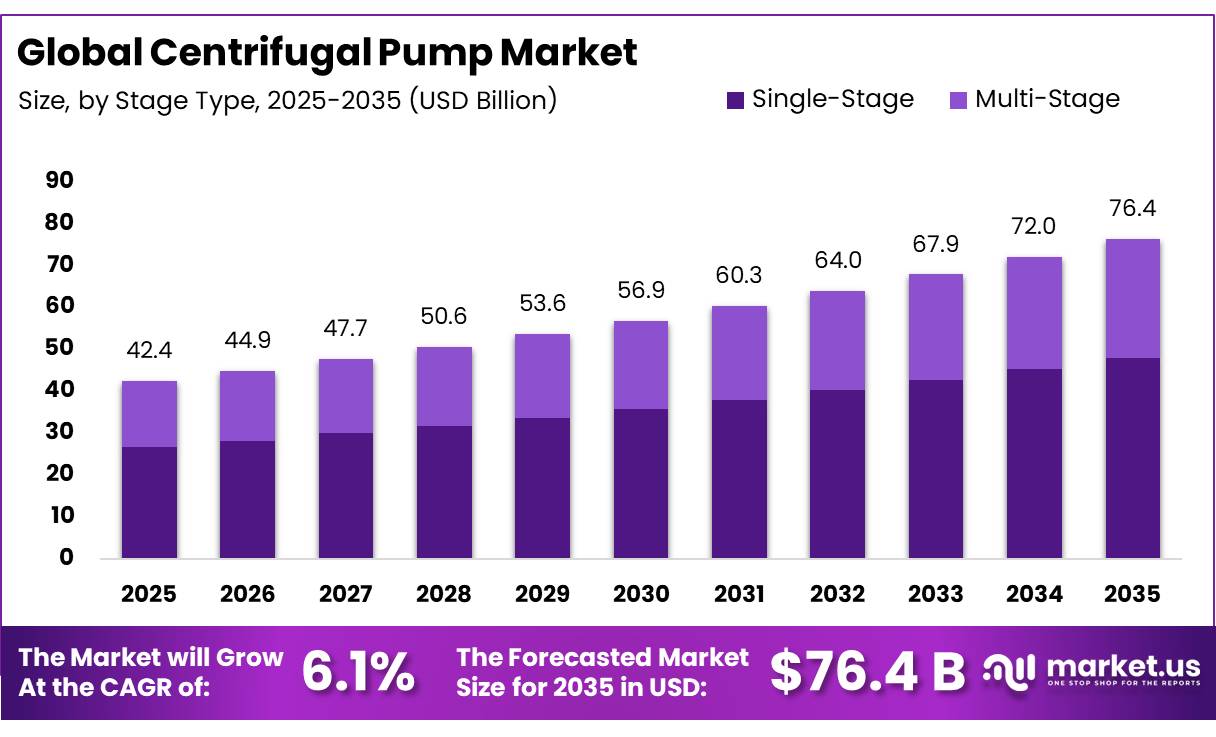
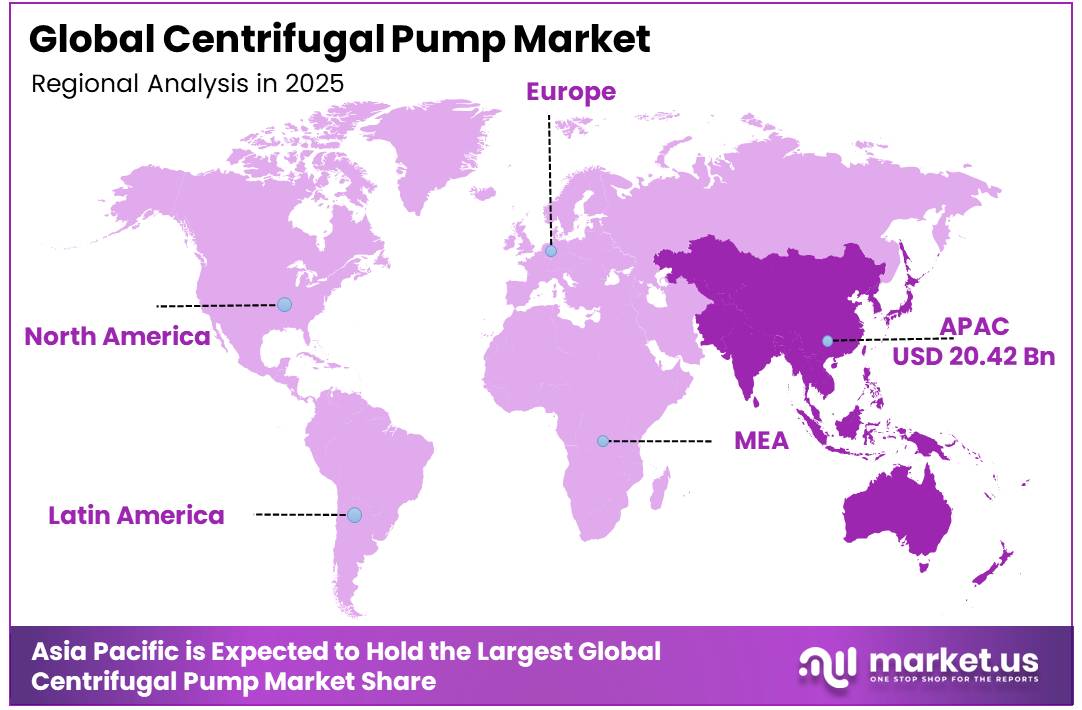
In 2025, the Global Centrifugal Pump Market was valued at USD 42.4 billion, and between 2026 and 2035, this market is estimated to register a CAGR of 6.1%, reaching about USD 76.4 billion by 2035. Asia Pacific held a dominant market position, capturing more than a 48.2% share, holding USD 20.42 billion in revenue.
Centrifugal pumps are industrial fluid handling systems that convert rotational energy into hydraulic energy for moving liquids through pipelines and process systems. They are widely used in water and wastewater treatment, oil and gas, chemical processing, petrochemicals, power generation, and manufacturing operations. The market includes single-stage and multi-stage pumps, radial, mixed, and axial flow designs, along with horizontal and vertical configurations selected according to pressure, flow, and operational requirements.
- The United Nations Industrial Development Organization reported that global manufacturing value added grew by 2.9% in 2024, highlighting continued industrial expansion that supports demand for reliable pumping equipment across processing and production facilities. Manufacturing represented 78.7% of total industrial value added, demonstrating its importance in global industrial activity.
Key Takeaways
- The global centrifugal pump market was valued at USD 42.4 billion in 2025.
- The global market is projected to grow at a CAGR of 6.1% and is estimated to reach USD 76.4 billion by 2035.
- On the basis of stage type, the single-stage centrifugal pump dominated the market, constituting 62.80% of the total market share.
- Based on pump design and flow, radial flow pumps dominated the centrifugal pump market, with a substantial market share of around 64.10%.
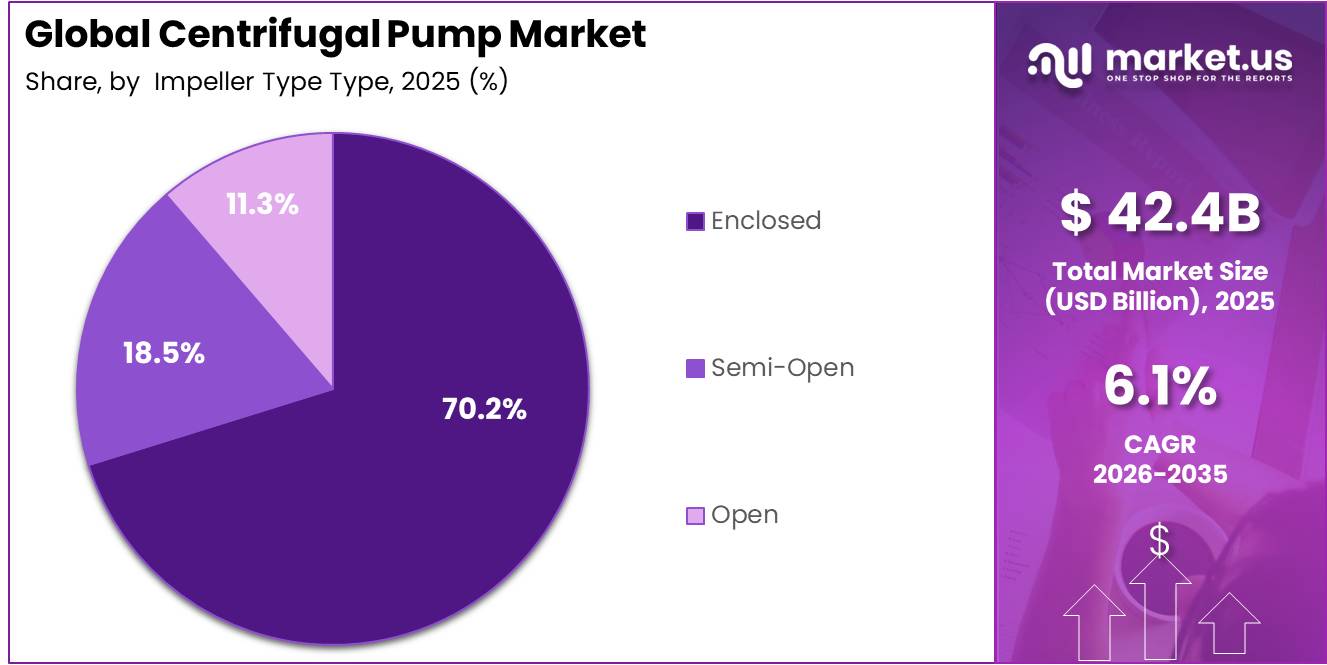
- Based on impeller type, enclosed impellers led the centrifugal pump market, comprising 70.20% of the total market.
- Based on orientation, horizontal centrifugal pumps dominated the market, accounting for 65.00% of the total market share.
- Among the end-use industries, water and wastewater treatment held a major share in the centrifugal pump market, accounting for 27.00% of the total market share.
- In 2025, Asia Pacific was the most dominant region in the centrifugal pump market, accounting for 48.20% of the total global market share.
Growth is driven by water infrastructure upgrades, energy efficiency requirements, chemical processing expansion, and modernization of industrial facilities. The United States Department of Energy promotes energy-efficient pump systems through assessment tools and guidance focused on improving pump performance, reducing operating costs, and optimizing industrial pumping applications. These initiatives encourage adoption of advanced centrifugal pumps with improved efficiency, variable speed control, and optimized impeller designs.
Future opportunities are emerging through smart monitoring, automation, predictive maintenance, and sustainable industrial operations. Governments and industries are increasingly focusing on resource efficiency, creating demand for pumps that reduce energy consumption and improve reliability.
- The United Nations Industrial Development Organization projected that manufacturing value added would continue expanding in 2025, with expected growth of 8%, supporting continued investment in industrial equipment and fluid handling technologies.
Stage Type Analysis
Single-Stage Pumps Lead with 62.80% Due to Broad Industrial Applications
In 2025, Single-Stage held a dominant market position, capturing more than a 62.80% share of the centrifugal pump market. Its leadership was supported by widespread use in water supply, wastewater treatment, irrigation, commercial facilities, and general industrial operations. Single-stage pumps are preferred for applications requiring moderate pressure and high flow rates because they offer simpler designs, easier maintenance, lower installation complexity, and reliable performance. Their cost efficiency and suitability for routine fluid transfer requirements continue to support adoption across multiple industries.
- For instance, in March 2025, according to the U.S. Department of Energy, the agency continued promoting industrial energy efficiency programs focused on improving equipment performance and reducing energy consumption in manufacturing systems, including motor-driven equipment such as pumps.
Multi-Stage is the growing segment as industries require higher pressure pumping solutions for demanding applications such as oil and gas, power generation, water distribution networks, and industrial processing. Multi-stage pumps provide increased pressure through multiple impellers, making them suitable for operations requiring long-distance fluid movement, high-pressure circulation, and improved system efficiency.
Pump Design and Flow Analysis
Radial Flow Pumps Lead with 64.10% Due to Versatile Fluid Handling Capability
In 2025, Radial Flow held a dominant market position, capturing more than a 64.10% share of the centrifugal pump market. Its leadership was supported by widespread adoption across water treatment, chemical processing, oil and gas, power generation, and industrial applications requiring moderate to high pressure. Radial flow pumps efficiently convert rotational energy into pressure energy, making them suitable for applications where reliable fluid movement and consistent pressure performance are required.
- For instance, in April 2025, according to the U.S. Department of Energy, the agency continued supporting industrial energy efficiency improvements through initiatives focused on optimizing motor-driven systems, including pumps used in manufacturing and processing facilities.
Mixed Flow is the growing segment as industries increasingly require pumps that provide a balance between high flow capacity and moderate pressure performance. These pumps are gaining adoption in water management, irrigation, flood control, and large-scale circulation systems. Their ability to handle greater flow volumes while maintaining efficient operation supports their increasing use in infrastructure and industrial applications.
Impeller Type Analysis
Enclosed Impellers Lead with 70.20% Due to Efficient Fluid Transfer Performance
In 2025, Enclosed held a dominant market position, capturing more than a 70.20% share of the centrifugal pump market. Its leadership was supported by extensive use in water and wastewater treatment, chemical processing, power generation, and industrial fluid handling applications. Enclosed impellers provide efficient hydraulic performance, reduced turbulence, and reliable operation when handling clean or moderately contaminated fluids. Their ability to deliver consistent flow, lower maintenance requirements, and long service life supports their preference across industrial pumping systems.
- For instance, in May 2025, according to the U.S. Department of Energy, the agency continued promoting energy-efficient industrial equipment practices to improve the performance of motor-driven systems, including pump applications used in industrial facilities.
Semi-Open is the growing segment as industries increasingly require flexible pumping solutions for fluids containing suspended particles, solids, or higher contamination levels. Semi-open impellers are gaining adoption in wastewater, agriculture, mining, and process industries because they provide better handling of challenging fluids while maintaining operational reliability. Their adaptability supports wider use in applications requiring easier cleaning and maintenance.
Orientation Analysis
Horizontal Pumps Lead with 65.00% Due to Flexible Industrial Installation Benefits
In 2025, Horizontal held a dominant market position, capturing more than a 65.00% share of the centrifugal pump market. Its leadership was supported by extensive adoption in water treatment plants, industrial processing facilities, agriculture, oil and gas operations, and commercial infrastructure. Horizontal pumps are preferred because they offer easier maintenance access, simpler installation, cost-effective operation, and suitability for applications requiring efficient fluid transfer. Their reliable performance and flexible configuration continue to support demand across various industries.
- For instance, in June 2025, according to the U.S. Department of Energy, the agency continued supporting industrial energy efficiency programs focused on improving the performance of motor-driven equipment, including pumping systems used in manufacturing and processing applications.
Vertical is the growing segment as industries increasingly require space-efficient pumping solutions for deep wells, high-rise facilities, water distribution systems, and specialized industrial processes. Vertical pumps provide advantages where installation space is limited and fluid lifting requirements are higher. Growing infrastructure development and demand for efficient water management systems are supporting wider adoption of vertical centrifugal pumps.
End-Use Industry Analysis
Water and Wastewater Treatment Leads with 27.00% Due to Growing Infrastructure Demand
In 2025, Water and Wastewater Treatment held a dominant market position, capturing more than a 27.00% share of the centrifugal pump market. Its leadership was supported by rising demand for municipal water supply, wastewater processing, industrial water recycling, and treatment infrastructure. Centrifugal pumps are widely used in these systems for fluid transfer, circulation, filtration, and pressure management. Their reliability, continuous operation capability, and suitability for handling large water volumes make them essential across public utilities and industrial treatment facilities.
- For instance, in February 2025, according to the United States Environmental Protection Agency, the agency announced funding opportunities under the Water Infrastructure Finance and Innovation Act program to support water infrastructure improvements and strengthen long-term water system reliability.
Oil and Gas is the growing segment as exploration, refining, pipeline operations, and processing facilities require reliable fluid movement solutions. Centrifugal pumps support crude oil transfer, fuel circulation, cooling systems, and process operations due to their high flow capacity and operational efficiency. Increasing investment in energy infrastructure and modernization of existing facilities is supporting wider adoption of advanced pumping systems.
Key Market Segments
By Stage Type
- Single-Stage
- Multi-Stage
By Pump Design and Flow
- Radial Flow
- Mixed Flow
- Axial Flow
By Impeller Type
- Enclosed
- Semi-Open
- Horizontal
- Vertical
By End-Use Industry
- Water and Wastewater Treatment
- Oil and Gas
- Chemical and Petrochemical
- Power Generation
- Others
Driver Analysis
Infrastructure and Water–Wastewater Buildout
Globally, centrifugal water pump revenues are estimated near USD 39.9 billion in 2025 and projected to exceed USD 51.9 billion by 2032 at around 3.8% CAGR, explicitly linked to expansion of infrastructure development and industrial activities that require efficient pumps in water supply, wastewater, and cooling systems. Because each new treatment plant and distribution expansion embeds long-lived installed pump bases with typical lifetimes of 10–15 years and recurring overhaul cycles every 5–7 years, OEMs capture not only first-fit revenues but also downstream parts and service, structurally lifting baseline CAGR by mid-single-digit percentage points as long as capital flows into these networks continue.
With multiyear national programs in APAC and the Middle East targeting billion-dollar investments in water reuse, desalination, and urban drainage resilience through 2030, this infrastructure-led demand is locked in over a medium-term horizon, adding roughly +2.6% upside on top of core replacement demand.
Drivers Impact Analysis
| Driver | (~) % Impact on CAGR | Geographic Relevance | Impact Timeline |
|---|---|---|---|
| Infrastructure and water–wastewater buildout driving centrifugal pump deployments | +2.6% | APAC (India, China), Middle East, Africa, EU urban | Medium term (2–4 years) |
| Oil & gas and petrochemical capacity expansions boosting process pump demand | +2.3% | Middle East, APAC, North America | Medium term (2–4 years) |
| Energy-efficiency regulations pushing replacement of legacy pump fleets | +2.0% | EU core, North America, advanced APAC corridors | Short term (≤2 years) |
| Construction and mining dewatering demand sustaining portable pump sales | +1.8% | APAC, Latin America, Middle East mining corridors | Short term (≤2 years) |
| Industrial cooling and HVAC upgrades under building performance directives | +1.5% | EU, North America, high-urbanization APAC | Medium term (2–4 years) |
| Digitalization and predictive maintenance adoption transforming pump service models | +1.2% | Global, strongest in EU/North America industrial hubs | Long term (≥4 years) |
Restraint Analysis
Copper and Pump-Grade Metal Price Spikes
The root cause of this restraint is the sharp, sustained volatility in copper and pump-grade metals that has emerged as a structural feature of the 2025–2026 macro environment, with copper prices briefly exceeding USD 14,500 per tonne intraday in January 2026 and forecast averages around USD 12,075 per tonne for 2026, with peaks near USD 12,500 per tonne during supply-constrained periods and baseline ranges above USD 10,600–11,000 per tonne driven by supply disruptions and strong electrification demand.
Metals-market commentary indicates that 5–10% annual price volatility is a realistic planning assumption for 2026, with copper experiencing 5%+ swings over short windows, and stainless steel and aluminium also peaking at the end of 2025 before entering a still-elevated plateau.
Over the next 12–24 months, until new mine capacity and recycling infrastructure materially ease supply–demand imbalance, this volatility remains a near-term hard restraint on achievable CAGR, cutting roughly 2.4 percentage points from the theoretical growth trajectory by dampening investment appetite and squeezing profitability on core product lines.
Restraint Impact Analysis
| Restraint | (~) % Impact on CAGR Forecast | Geographic Relevance | Impact Timeline |
|---|---|---|---|
| Copper and pump-grade metal price spikes compressing margins | -2.4% | Global, acute in APAC and EU manufacturing | Short term (≤2 years) |
| Power semiconductor and VFD shortages delaying smart-pump shipments | -2.1% | EU, North America, APAC industrial corridors | Medium term (2–4 years) |
| Mechanical seal failure rates driving unplanned downtime and over-design | -1.7% | Global water/process industries | Medium term (2–4 years) |
| Working-capital strain from volatile metals and electronic inventory | -1.4% | Global OEMs and mid-tier integrators | Short term (≤2 years) |
| Retrofit economics challenged by capex constraints in small/midsize industry | -1.2% | APAC, Latin America, emerging markets | Medium term (2–4 years) |
| Fragmented service networks limiting value capture on advanced pump offerings | -1.0% | APAC, Middle East, Africa corridors | Long term (≥4 years) |
Opportunity Analysis
ESCO-Linked Pump Efficiency Retrofits via EPC
This opportunity is distinct from today’s baseline driver of efficiency regulations because it monetizes centrifugal pump upgrades through energy performance contracts (EPCs) executed by Energy Service Companies (ESCOs), fundamentally shifting capex and risk from end-users to service providers and unlocking retrofit TAM that is currently stuck due to budget constraints.
Under EPC models, ESCOs commit to installing necessary equipment, guarantee performance, and are paid from measured energy savings over contract terms that typically span 2–20 years, meaning pump replacements and hydraulic optimizations can be financed off-balance-sheet for factories, water plants, and building owners who lack upfront capital but face rising audit and savings obligations under frameworks like the EU Energy Efficiency Directive.
If even 10–15% of inefficient pumps flagged in upcoming audits across EU and Indian urban corridors are addressed via EPC schemes by 2030, the market could see low single-digit billions of incremental retrofitting value, translating into roughly +2.7% CAGR uplift on top of baseline growth over the 2–4 year window in which ESCO models are formalized and scaled.
Opportunity Impact Analysis
| Opportunity | (~) % Potential CAGR | Geographic Relevance | Execution Window |
|---|---|---|---|
| ESCO-linked pump efficiency retrofits via energy performance contracts | +2.7% | EU core, North America, India urban/industrial | Medium term (2–4 years) |
| Pumps-as-a-Service subscription bundles for SME and municipal fleets | +2.3% | North America, EU, APAC emerging markets | Short term (≤2 years) |
| Predictive-maintenance IoT platforms monetized as recurring software | +2.0% | Global industrial hubs, oil & gas, water utilities | Medium term (2–4 years) |
| Electric and hybrid pump systems aligned with building decarbonization | +1.7% | EU, North America, high-urbanization APAC | Long term (≥4 years) |
| M&A roll-ups of mid-tier pump OEMs into standardized global platforms | +1.4% | APAC manufacturing base, EU, North America | Medium term (2–4 years) |
| Financing partnerships embedding pumps into EPC/ESCO portfolios | +1.2% | EU, India, Latin America industrial corridors | Medium term (2–4 years) |
Challenges Analysis
Rotating-Equipment Maintenance Technician Skills Gap
Industry commentary shows that maintenance technician roles across rotating equipment need to span traditional tasks carrying out repairs to mechanical equipment, performing preventive maintenance, and reporting shortages or faults while increasingly interpreting AI‑generated alerts and IoT sensor data, with forecasts indicating that roughly 67% of maintenance teams will adopt AI‑powered tools by the end of 2026.
Quantitatively, this skills gap manifests as persistent reliance on rule‑of‑thumb settings, higher rates of reactive maintenance, and underutilization of high‑efficiency pump features, which collectively shave around 1.7 percentage points off maximum achievable CAGR by limiting the realized performance of installed fleets. Closing the gap requires multi‑year investment in cross‑disciplinary training, apprenticeship programs, and wage competitiveness, placing mitigation on a long‑term horizon even though incremental improvements are possible via targeted up‑skilling initiatives.
Challenges Impact Analysis
| Challenge | (~) % CAGR Friction Drag | Geographic Relevance | Mitigation Horizon |
|---|---|---|---|
| Rotating-equipment maintenance technician skills gap | -1.7% | North America, EU, APAC industrial hubs | Long term (≥4 years) |
| Pump system optimization know-how deficit | -1.4% | Global, especially legacy industrial plants | Medium term (2–4 years) |
| Global shipping and heavy-equipment logistics disruptions | -1.3% | APAC logistics corridors, Middle East, EU ports | Medium term (2–4 years) |
| Fragmented rotating-equipment repair ecosystem | -1.1% | Global, acute in APAC/Middle East | Medium term (2–4 years) |
| Next-generation digital tools adoption and interpretation gap | -1.0% | North America, EU, APAC early adopters | Medium term (2–4 years) |
| Training and certification pipeline lag for pump specialists | -0.9% | Global, stronger in emerging markets | Long term (≥4 years) |
Geopolitical Impact Analysis
Metal Tariffs and Shipping Disruption Reshape Centrifugal Pump Supply Chains
Current geopolitical tensions are reshaping the centrifugal pump market through metal tariffs, shipping disruption, energy investment uncertainty, and localization of equipment supply chains. Pump production depends on steel casings, stainless-steel impellers, copper motors, seals, bearings, and electronic controls. Restrictions affecting these inputs can raise manufacturing costs, delay deliveries, and complicate sourcing for water, oil and gas, chemical, and power projects.
- In June 2025, the United States ncreased tariffs on imported steel and aluminium from 25% to 50%. This measure can increase the cost of pump bodies, shafts, frames, and motor components, while encouraging manufacturers to expand domestic machining, casting, and assembly.
Maritime disruption adds further pressure. United Nations Trade and Development reported that maritime trade growth slowed from 2.2% in 2024 to an expected 0.5% in 2025, while vessel rerouting increased ton-miles by 5.9% in 2024. Longer routes can delay pumps, spare parts, and replacement components required for infrastructure and industrial maintenance.
Investment uncertainty also affects demand. The International Energy Agency projected USD 3.3 trillion in global energy investment during 2025, including USD 1.1 trillion for oil, natural gas, and coal. These conditions support pump demand, but trade fragmentation encourages regional sourcing, larger inventories, supplier diversification, and local service capacity.
Regional Analysis
Asia Pacific Leads with 48.20% Share and USD 20.42 Billion Revenue
In 2025, Asia Pacific held the dominant position in the centrifugal pump market, capturing 48.20% of global revenue and generating USD 20.42 billion. Regional leadership was supported by expanding water supply, wastewater treatment, irrigation, manufacturing, and energy infrastructure.
- The Asian Development Bank estimated that Asia and the Pacific requires USD 4 trillion in water, sanitation, and hygiene investment through 2040, creating sustained demand for high-flow and pressure-management equipment across municipal and industrial projects.
Europe is the fastest-growing region, supported by wastewater modernization, energy-efficiency requirements, and replacement of aging pumping systems. The revised European Union Urban Wastewater Treatment Directive entered into force on January 1, 2025 and covers urban areas with more than 1,000 inhabitants. The European Commission also reports 30,354 wastewater treatment plants operating across the European Union.
Key Regions and Countries Covered
- North America
- The US
- Canada
- Europe
- Germany
- France
- The UK
- Spain
- Italy
- Russia & CIS
- Rest of Europe
- APAC
- China
- Japan
- South Korea
- India
- ASEAN
- Rest of APAC
- Latin America
- Brazil
- Mexico
- Rest of Latin America
- Middle East & Africa
- GCC
- South Africa
- Rest of MEA
Key Players Analysis
Centrifugal pump manufacturers focus on hydraulic efficiency, equipment reliability, lifecycle costs, and application-specific engineering to strengthen their competitive positions. Key participants include Xylem Inc., Grundfos Holding A/S, Flowserve Corporation, KSB SE & Co. KGaA, Sulzer Ltd., Ebara Corporation, Wilo SE, ITT Inc., The Weir Group PLC, Pentair plc, Baker Hughes Company, Torishima Pump Mfg. Co., Ltd., and Alfa Laval AB. Companies compete through single-stage and multi-stage designs, digital monitoring, energy-efficient motors, advanced impellers, aftermarket services, and customized systems for water treatment, oil and gas, chemicals, power generation, and industrial processes.
In 2026, competition increasingly centred on localized manufacturing, product efficiency, and long-term service agreements. In June 2026, Grundfos began expanding its Brookshire, Texas campus with an approximately 143,000-square-foot facility designed for annual production capacity of 75,000 pump and water-technology units. In January 2026, KSB launched a new generation of Omega water pumps with improved hydraulic efficiency, serviceability, operating reliability, and lower energy input. In April 2026, Sulzer signed a five-year agreement with Aramco covering centrifugal pumps, spare parts, and aftermarket services, with an option for a three-year extension.
Market Key Players
- Xylem Inc.
- Grundfos Holding A/S
- Flowserve Corporation
- KSB SE & Co. KGaA
- Sulzer Ltd.
- Ebara Corporation
- Wilo SE
- ITT Inc.
- The Weir Group PLC
- Kirloskar Brothers Limited
- Pentair plc
- CIRCOR International, Inc.
- Baker Hughes Company
- Torishima Pump Mfg. Co., Ltd.
- Alfa Laval AB
Key Development
- In March 2026, ITT Inc. completed the acquisition of SPX FLOW, strengthening its Flow Technologies business with additional fluid-handling, separation, mixing, and thermal-transfer solutions for industrial, chemical, energy, and processing applications.
- In June 2026, Xylem Inc. expanded its long-term partnership with Dow to design, build, and operate an integrated industrial water-treatment and reuse system at Dow’s Fort Saskatchewan complex in Alberta, Canada.
- In July 2026, Ebara Corporation and Ebara Elliott Energy secured the world’s first type approval for liquid-hydrogen cargo pumps, validating their design, structural integrity, and operational performance for liquefied-hydrogen carrier applications.
Report Scope
| Report Features | Description |
|---|---|
| Market Value (2025) | USD 42.4 Bn |
| Forecast Revenue (2035) | USD 76.4 Bn |
| CAGR (2026-2035) | 6.1% |
| Base Year for Estimation | 2025 |
| Historic Period | 2020-2024 |
| Forecast Period | 2026-2035 |
| Report Coverage | Revenue Forecast, Market Dynamics, Competitive Landscape, Recent Developments |
| Segments Covered | By Stage Type (Single-Stage and Multi-Stage), By Pump Design and Flow (Radial Flow, Mixed Flow, and Axial Flow), By Impeller Type (Enclosed, Semi-Open, and Open), By Orientation (Horizontal and Vertical), By End-Use Industry (Water and Wastewater Treatment, Oil and Gas, Chemical and Petrochemical, Power Generation, and Others) |
| Regional Analysis | North America – The US & Canada; Europe – Germany, France, The UK, Spain, Italy, Russia & CIS, Rest of Europe; APAC– China, Japan, South Korea, India, ASEAN & Rest of APAC; Latin America– Brazil, Mexico & Rest of Latin America; Middle East & Africa– GCC, South Africa, & Rest of MEA |
| Competitive Landscape | Xylem Inc., Grundfos Holding A/S, Flowserve Corporation, KSB SE & Co. KGaA, Sulzer Ltd., Ebara Corporation, Wilo SE, ITT Inc., The Weir Group PLC, Kirloskar Brothers Limited, Pentair plc, CIRCOR International, Inc., Baker Hughes Company, Torishima Pump Mfg. Co., Ltd., Alfa Laval AB. |
| Customization Scope | Customization for segments, region/country-level will be provided. Moreover, additional customization can be done based on the requirements. |
| Purchase Options | We have three licenses to opt for: Single User License, Multi-User License (Up to 5 Users), Corporate Use License (Unlimited Users and Printable PDF) |





































