


Report Overview
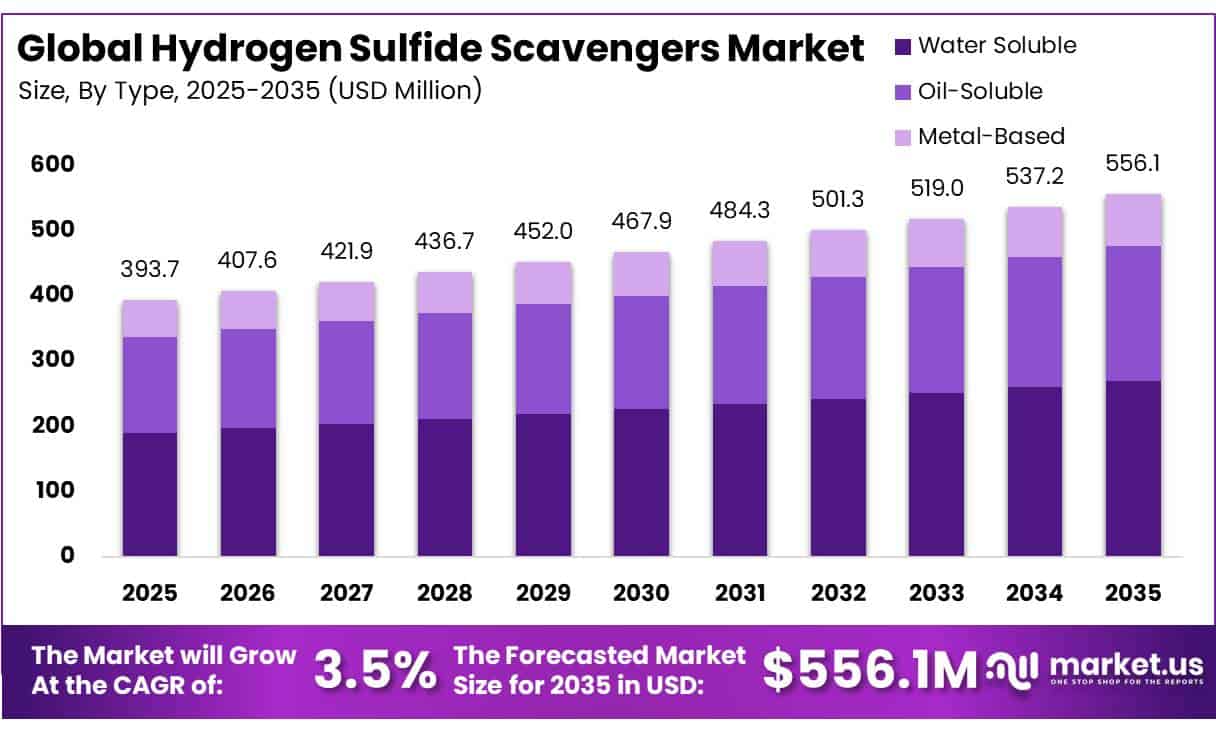
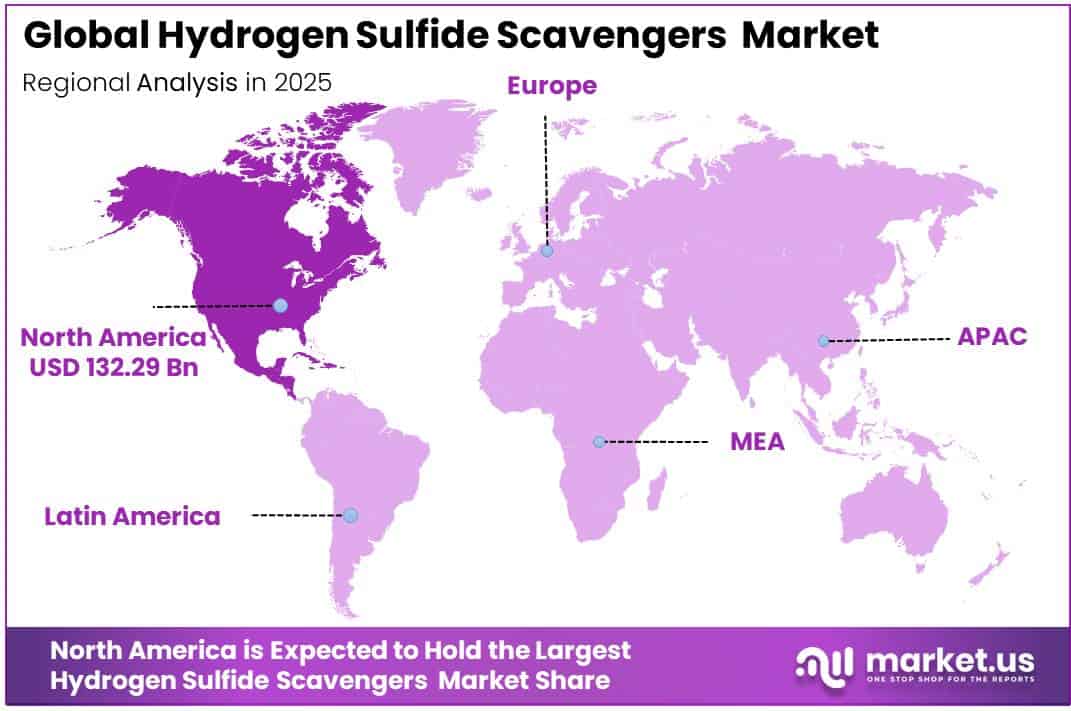
In 2025, the Hydrogen Sulfide Scavengers Market was valued at USD 393.7 million, and between 2026 and 2035, this market is estimated to register a CAGR of 3.5%, reaching about USD 556.1 million by 2035. North America held a dominant market position, capturing more than a 33.6% share, holding USD 132.29 million in revenue.
Hydrogen sulfide scavengers are chemical agents used in the oil and gas, refining, and gas processing industries to remove or neutralize hydrogen sulfide, a toxic and corrosive gas found in sour crude oil and natural gas.
- The United States Environmental Protection Agency classifies natural gas as sour when hydrogen sulfide content exceeds 5.7 milligrams per normal cubic meter, equivalent to 0.25 grains per 100 standard cubic feet, and this gas must be treated, known as sweetening, before it can be used commercially.
Key Takeaways
- The global hydrogen sulfide (H₂S) scavengers market was valued at USD 393.7 million in 2025.
- The global market is projected to grow at a CAGR of 3.5% and is estimated to reach USD 556.1 million by 2035.
- On the basis of product, the non-regenerative segment dominated the market, constituting 54.6% of the total market share.
- Based on the type, water soluble dominated the market, with a substantial market share of around 48.5%.
- Based on the application, onshore dominated the market, accounting for 67.3% of the total market share.
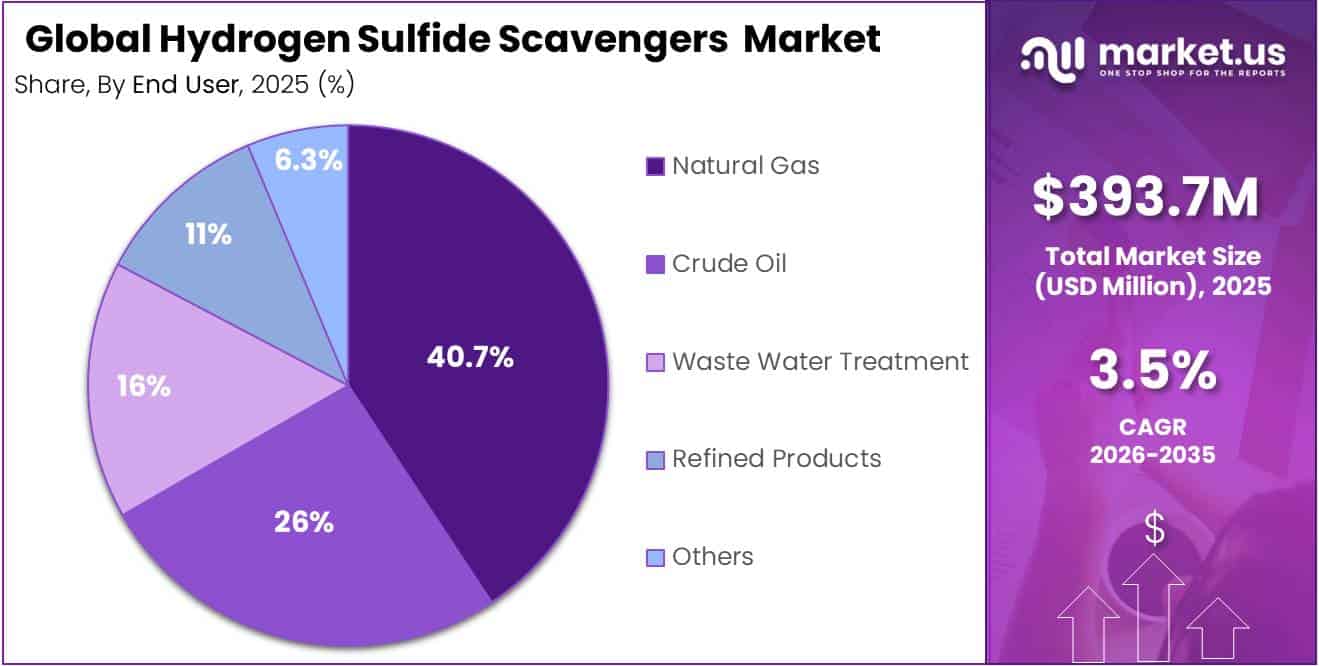
- Based on the end-use, natural gas dominated the market, accounting for 40.7% of the total market share.
- In 2025, North America was the most dominant region in the hydrogen sulfide (H₂S) scavengers market, accounting for 33.6% of the global market.
The industrial scenario is dominated by amine-based treatment. The Environmental Protection Agency reports that amine processes account for over 95% of all gas sweetening conducted in the United States, with the recovered hydrogen sulfide typically flared, incinerated, or converted into elemental sulfur or sulfuric acid as byproducts of the sweetening process.
Driving factors center on strict occupational exposure regulation. The Occupational Safety and Health Administration sets a permissible exposure limit ceiling of 20 parts per million, not to exceed 50 parts per million for more than 10 minutes.
- The National Institute for Occupational Safety and Health recommends a tighter 10 parts per million ceiling and designates 100 parts per million as immediately dangerous to life or health, while the American Conference of Governmental Industrial Hygienists sets a threshold limit value of 1 part per million as an 8-hour time-weighted average. These layered thresholds push operators toward scavenging technologies to maintain safe working environments.
Regulatory requirements continue to support the use of hydrogen sulfide scavengers in refining operations. The U.S. Environmental Protection Agency (EPA) requires diesel fuel subject to the Ultra-Low Sulfur Diesel (ULSD) standard to contain no more than 15 parts per million (ppm) of sulfur. Compliance with these fuel quality regulations requires refineries to maintain effective sulfur removal throughout processing and production. As a result, desulfurization systems and hydrogen sulfide scavenging technologies continue to play an important role in meeting environmental standards, protecting processing equipment from corrosion, and ensuring the production of cleaner transportation fuels.
By Product Type
Non-Regenerative dominates with 54.6% share due to its widespread use in continuous H₂S removal operations.
In 2025, Non-Regenerative held a dominant market position, capturing more than a 54.6% share. The segment maintained its leading position because it is widely used for efficient hydrogen sulfide removal across oil and gas operations where simple handling and dependable performance are important. Throughout 2025, non-regenerative scavengers continued to be preferred in applications requiring direct chemical treatment without the need for regeneration. Their broad adoption was supported by ongoing efforts to meet operational safety and environmental requirements established by energy regulators and industry safety authorities.
Regenerative emerged as the fastest-growing product segment as operators increasingly looked for solutions that improve chemical utilization and support long-term operating efficiency. During 2025 and into 2026, interest in regenerative scavenger technologies continued to increase as companies evaluated approaches that could reduce waste generation and optimize process performance. Research activities and technology development supported by energy organizations and industrial programs contributed to greater attention toward advanced regeneration systems.
By Type
Water Soluble leads with 48.5% share due to its broad compatibility with oil and gas processing systems.
In 2025, Water Soluble held a dominant market position, capturing more than a 48.5% share. The segment remained the leading choice because of its effective performance in treating hydrogen sulfide across a variety of oil and gas production and processing operations. During 2025, water soluble scavengers continued to be widely used in systems where easy injection, efficient mixing, and reliable treatment performance were important.
Oil-Soluble emerged as the fastest-growing type as demand increased for treatment solutions designed for hydrocarbon-rich production environments. During 2025 and into 2026, operators showed growing interest in oil-soluble scavengers because of their ability to perform effectively in applications where direct contact with hydrocarbon streams is required. Continued technical development and field evaluations supported by industry organizations and energy sector programs encouraged broader adoption of these formulations.
By Application
Onshore dominates with 67.3% share driven by extensive oil and gas production activities.
In 2025, Onshore held a dominant market position, capturing more than a 67.3% share. The segment maintained its leading position because onshore oil and gas fields require continuous hydrogen sulfide management to support safe production and processing operations. Throughout 2025, hydrogen sulfide scavengers remained widely used across onshore production facilities, gathering systems, and processing infrastructure where maintaining operational safety and equipment integrity was essential.
Offshore emerged as the growing application segment as investment in offshore exploration and production continued to expand. During 2025 and into 2026, operators increased their focus on reliable hydrogen sulfide treatment solutions that could perform under demanding offshore operating conditions. Continued development of offshore energy projects and the need to maintain safe production environments supported greater adoption of advanced scavenger technologies.
By End-Use
Natural Gas leads with 40.7% share due to the continuous need for hydrogen sulfide removal during gas processing.
In 2025, Natural Gas held a dominant market position, capturing more than a 40.7% share. The segment remained the largest end-use because hydrogen sulfide removal is an essential step in natural gas production, gathering, processing, and transportation. Throughout 2025, hydrogen sulfide scavengers continued to play an important role in helping operators protect processing equipment, maintain gas quality, and support safe operating conditions.
Crude Oil emerged as the fastest-growing end-use segment as producers increased their focus on managing hydrogen sulfide during crude oil extraction, storage, and transportation. During 2025 and into 2026, the demand for effective scavenger solutions continued to grow as operators sought to improve asset protection, reduce corrosion risks, and maintain safe working environments. Ongoing development of oil production projects and continued emphasis on operational reliability encouraged wider adoption of hydrogen sulfide treatment technologies.
Key Market Segments
By Product Type
- Non‑Regenerative
- Regenerative
By Type
- Water Soluble
- Oil-Soluble
- Metal-Based
By Application
- Onshore
- Offshore
By End-Use
- Natural Gas
- Crude Oil
- Waste Water Treatment
- Refined Products
- Others
Driver Analysis
H₂S safety and emission compliance
Regulation and worker-safety exposure convert H₂S treatment from discretionary maintenance expenditure into operational continuity spending, particularly at oil and gas facilities, refineries, chemical plants, pulp-and-paper operations and confined wastewater assets. In the United States, OSHA’s general-industry H₂S ceiling limit is 20 ppm, with a 50 ppm peak permitted for no more than 10 minutes under specified conditions; construction and shipyard exposure limits are 10 ppm as an 8-hour time-weighted average.
Reporting visibility also raises the cost of inaction: CDC analysis of U.S. Toxic Release Inventory data estimates that air releases account for 9,114 tonnes per year, or 65% of reported H₂S releases, while paper, chemical and oil-and-gas sectors represent 54%, 21% and roughly 10%, respectively, of reported air emissions. In Canada, H₂S is reportable under the National Pollutant Release Inventory at a 10-tonne manufactured, processed or otherwise used threshold, and the federal risk-management process specifically identifies upstream oil and gas as a major point-source contributor.
Drivers Impact Analysis
| Driver | (~) % Impact on CAGR | Geographic Relevance | Impact Timeline |
|---|---|---|---|
| Sour-gas and LNG conditioning | +1.3 pp | North America, Middle East, APAC LNG | Short term (≤ 2 years) |
| H₂S safety and emission compliance | +0.9 pp | North America, EU, Canada, GCC | Short term (≤ 2 years) |
| Wastewater odor and corrosion control | +0.8 pp | EU, North America, China, India | Medium term (2-4 years) |
| Biomethane upgrading expansion | +0.7 pp | EU, North America, India, China | Medium term (2-4 years) |
| Higher-performance, lower-waste chemistries | +0.5 pp | North America, EU, offshore APAC | Medium term (2-4 years) |
| Asset-integrity digitalization | +0.3 pp | North America, GCC, North Sea, APAC | Long term (≥ 4 years) |
Restraint Analysis
Feedstock and logistics volatility
Scavenger profitability is vulnerable to volatility in chemical intermediates, energy, freight and working-capital requirements because commonly used formulations depend on petrochemical-derived input chains and are often shipped as liquids to remote fields, offshore platforms, terminals, wastewater stations or digesters. The 2026 market illustrates the exposure: reported June methanol assessments ranged from approximately USD 452 per tonne in China to USD 511 per tonne in the United States, while some April assessments were near USD 593 per tonne in the United States and USD 536 per tonne in India, showing sizeable regional cost divergence that can rapidly alter procurement economics for methanol-linked chemical production.
Supply disruption risk is amplified where an operator depends on a single qualified formulation, has limited tankage, faces long-distance trucking constraints or must import material into regions with constrained port and hazardous-chemical logistics capacity. Suppliers can pass through cost escalation only with indexed contracts; otherwise, fixed-price supply agreements compress gross margins, whereas customer resistance to surcharges lowers shipment volumes or prompts substitution with locally available media and treatment methods.
Restraint Impact Analysis
| Restraint | (~) % Impact on CAGR | Geographic Relevance | Impact Timeline |
|---|---|---|---|
| High chemical-use intensity | -0.9 pp | North America, GCC, APAC upstream | Short term (≤ 2 years) |
| Spent-scavenger disposal burden | -0.8 pp | EU, North America, Australia | Medium term (2-4 years) |
| Variable H₂S loading | -0.7 pp | Global upstream, wastewater, biogas | Short term (≤ 2 years) |
| Alternatives and fixed treatment | -0.6 pp | North America, EU, Middle East | Medium term (2-4 years) |
| Feedstock and logistics volatility | -0.5 pp | Europe, India, APAC import markets | Short term (≤ 2 years) |
| Upstream CapEx uncertainty | -0.4 pp | North America, MEA, Latin America | Medium term (2-4 years) |
Opportunity Analysis
Wastewater service contracts
This is a large, under-monetized installed-base opportunity because the U.S. Environmental Protection Agency’s 2024 assessment placed national wastewater infrastructure needs at USD 630 billion over 20 years, an increase of roughly 45% from the 2016 estimate, while U.S. wastewater and stormwater infrastructure funding gaps have been estimated at USD 271 billion and USD 115 billion, respectively.
A supplier that converts a municipality from ad hoc deliveries to a 36–60-month contract can improve revenue visibility, increase site-level wallet share through pumps, sensors and dose control, and reduce customer acquisition cost by using multi-site utility frameworks; even a 10–20% reduction in over-dosing can fund online monitoring in chemically intensive systems. With Infrastructure Investment and Jobs Act water funding scheduled to expire on September 30, 2026 after approximately USD 43.4 billion flowed into state revolving funds, providers must act quickly to embed H₂S-control specifications in funded rehabilitation projects before municipal capital prioritization tightens.
Opportunity Impact Analysis
| Opportunity | (~) % Potential CAGR | Geographic Relevance | Execution Window |
|---|---|---|---|
| Biomethane fleet solutions | +1.1 pp | EU, North America, India, China | Medium term (2-4 years) |
| Wastewater service contracts | +0.9 pp | North America, EU, India, GCC | Short term (≤ 2 years) |
| Low-waste chemistry premium | +0.8 pp | EU, North America, Australia | Medium term (2-4 years) |
| Digital dosing-as-a-service | +0.7 pp | North America, GCC, APAC offshore | Medium term (2-4 years) |
| Geothermal and industrial adjacencies | +0.6 pp | Indonesia, Türkiye, Kenya, U.S. | Long term (≥ 4 years) |
| Regional distributor roll-ups | +0.5 pp | India, MEA, Latin America, SE Asia | Short term (≤ 2 years) |
Challenges Analysis
Field-Skills and Safety Gaps
Effective scavenger deployment depends on specialist competence across hazardous-chemical handling, confined-space safety, gas detection, dosage calculation, injection-system maintenance, sampling integrity, waste segregation and emergency response, yet distributed oilfield, wastewater and biogas operations often rely on lean field crews with uneven access to process-chemistry training. The health-risk context raises the stakes: OSHA maintains a 20 ppm H₂S general-industry ceiling limit and permits a 50 ppm peak only for up to 10 minutes under specified conditions, while the construction and maritime limit is 10 ppm as an 8-hour time-weighted average.
A technician who misreads a gas monitor, cross-connects an injection line, fails to recognize a blocked quill or handles contaminated spent material incorrectly can turn a dosage issue into a personnel incident, equipment failure, reportable release or shutdown; therefore, operators frequently require contractor certifications, permit-to-work processes, supervised commissioning and periodic requalification.
Challenges Impact Analysis
| Challenge | (~) % CAGR Friction | Geographic Relevance | Mitigation Horizon |
|---|---|---|---|
| Variable sour-stream chemistry | -0.8 pp | Global upstream, biogas, wastewater | Medium term (2-4 years) |
| Extreme-duty performance limits | -0.7 pp | GCC, North America, offshore APAC | Long term (≥ 4 years) |
| Chemical-program compatibility | -0.6 pp | North America, EU, MEA refineries | Medium term (2-4 years) |
| Field-skills and safety gaps | -0.5 pp | India, MEA, Latin America, Africa | Long term (≥ 4 years) |
| Remote logistics reliability | -0.5 pp | APAC corridors, MEA, Latin America | Medium term (2-4 years) |
| Measurement-data fragmentation | -0.4 pp | Global distributed assets | Medium term (2-4 years) |
Geopolitical Impact Analysis
Geopolitical Impact Analysis: Ongoing Regional Conflicts Strengthen the Need for Hydrogen Sulfide Scavengers Across the Energy Sector.
The ongoing Russia-Ukraine conflict and continued instability in the Middle East have increased uncertainty across global oil and gas supply chains, indirectly supporting demand for hydrogen sulfide scavengers. These chemicals are widely used to remove toxic hydrogen sulfide from sour crude oil and natural gas before transportation and refining.
- According to the United Nations Conference on Trade and Development (UNCTAD), maritime transport carries more than 80% of global trade, while Suez Canal transits declined by 42% following disruptions in the Red Sea.
Geopolitical tensions have also reinforced the importance of maintaining secure domestic refining and gas processing capacity. UNCTAD further reports that 22% of global seaborne container trade normally passes through the Suez Canal, making disruptions to this corridor significant for energy and industrial supply chains. As crude oil and natural gas continue to be processed despite logistical challenges, operators remain focused on protecting equipment, ensuring worker safety, and complying with environmental regulations through effective hydrogen sulfide removal.
Regional Analysis
Regional Analysis: North America.
North America emerges as the dominant region in the hydrogen sulfide scavengers market, accounting for 33.6% of the global share, valued at 132.29 million, supported by extensive sour gas and sour crude reserves across the region’s producing basins. The United States, the region’s primary contributor, recorded a new high in marketed natural gas production in 2025, averaging 118.5 billion cubic feet per day, an increase of 5.3 billion cubic feet per day over the prior year, according to the U.S. Energy Information Administration.
- The Appalachia region led output at 31%, or 36.6 billion cubic feet per day, while the Permian region in Texas and New Mexico contributed 23%, or 27.7 billion cubic feet per day, much of it associated gas generated alongside oil extraction, a stream that typically carries higher hydrogen sulfide content requiring scavenger treatment. The Haynesville region, spanning Louisiana and Texas, added 14.9 billion cubic feet per day, 4% above the previous year.
This combination of record production, associated gas growth, and concentrated basin activity across sour-prone formations reinforces North America’s leading position and sustains steady demand for hydrogen sulfide scavenger chemistries across upstream and midstream operations in the region.
Key Regions and Countries Covered
- North America
- The US
- Canada
- Europe
- Germany
- France
- The UK
- Spain
- Italy
- Russia & CIS
- Rest of Europe
- APAC
- China
- Japan
- South Korea
- India
- ASEAN
- Rest of APAC
- Latin America
- Brazil
- Mexico
- Rest of Latin America
- Middle East & Africa
- GCC
- South Africa
- Rest of MEA
Key Players Analysis
Hydrogen sulfide scavenger manufacturers focus on improving product efficiency, expanding production capacity, and strengthening supply chain reliability to remain competitive in the market. A key priority is the development of high-performance scavenger formulations that provide effective hydrogen sulfide removal while supporting operational safety across oil and gas production, refining, and wastewater treatment. Companies continue to invest in research to improve reaction efficiency, extend product effectiveness, and develop formulations suited for different operating conditions.
Another major strategy is expanding regional manufacturing and distribution networks to improve product availability and reduce supply chain risks. Companies are strengthening partnerships with oil and gas operators, engineering contractors, and industrial service providers through long-term supply agreements and technical support services. Investment in application-specific product development allows manufacturers to offer customized scavenger solutions for natural gas processing, crude oil production, offshore platforms, and industrial treatment systems.
Market Key Players
- Halliburton Co.
- Hexion Inc.
- Schlumberger Ltd.
- SNF Group
- Solvay SA
- The Lubrizol Corp.
- Kemira Oyj
- Merichem Co.
- Newpoint Gas LLC
- BASF SE
- Cestoil Chemical Inc.
- Chevron Phillips Chemical Co.
- Clariant International Ltd.
- Dow Chemical Co.
- Arkema Group
Key Development
- January 2026, Halliburton Co. reported its fourth-quarter and full-year 2025 results, with its Completion and Production segment, which includes its specialty chemicals business supplying hydrogen sulfide scavengers, generating fourth-quarter revenue of 3 billion dollars and operating income of 570 million dollars, an increase of 56 million dollars, or 11%, sequentially.
- January 2026, Schlumberger Ltd. (SLB) announced its fourth-quarter and full-year 2025 results, highlighting that its Production Systems division, incorporating the acquired ChampionX production chemicals and artificial lift businesses, contributed 5 billion dollars in revenue with accretive margins since the acquisition closed in July 2025.
- June 2026, Merichem Co., through its Merichem Technologies process division, announced successful results from its ECOTREAT field trial in the Permian Basin, achieving sustained removal of more than 99% of hydrogen sulfide gas from production separator streams without producing solid waste byproducts, with the technology now transitioning to full-scale commercial rollout.
Report Scope
| Report Features | Description |
|---|---|
| Market Value (2025) | USD 393.7 Mn |
| Forecast Revenue (2035) | USD 556.1 Mn |
| CAGR (2026 2035) | 3.5% |
| Base Year for Estimation | 2025 |
| Historic Period | 2020-2024 |
| Forecast Period | 2026-2035 |
| Report Coverage | Revenue Forecast, Market Dynamics, Competitive Landscape, Recent Developments |
| Segments Covered | By Product (Non-Regenerative, Regenerative), By Type (Water Soluble, Oil-Soluble, Metal-Based), By Application (Onshore, Offshore), By End-Use (Natural Gas, Crude Oil, Waste Water Treatment, Refined Products, Others) |
| Regional Analysis | North America The US & Canada; Europe Germany, France, The UK, Spain, Italy, Russia & CIS, Rest of Europe; APAC China, Japan, South Korea, India, ASEAN & Rest of APAC; Latin America Brazil, Mexico & Rest of Latin America; Middle East & Africa GCC, South Africa, & Rest of MEA |
| Competitive Landscape | Halliburton Co., Hexion Inc., Schlumberger Ltd., SNF Group, Solvay SA, The Lubrizol Corp., Kemira Oyj, Merichem Co., Newpoint Gas LLC, BASF SE, Cestoil Chemical Inc., Chevron Phillips Chemical Co., Clariant International Ltd., Dow Chemical Co., and Arkema Group. |
| Customization Scope | Customization for segments, region/country level will be provided. Moreover, additional customization can be done based on the requirements. |
| Purchase Options | We have three licenses to opt for: Single User License, Multi User License (Up to 5 Users), Corporate Use License (Unlimited Users and Printable PDF) |





































