


Automotive Alloy Market Size
Global Automotive Alloy Market size is expected to be worth around USD 57.5 Billion by 2035 from USD 26.3 Billion in 2026, growing at a CAGR of 9.1% during the forecast period 2026 to 2035. Steel accounts for approximately 50–60% of a modern car, while a 10% reduction in vehicle weight can improve fuel economy by 6–8%, making alloy selection a direct lever on product performance and regulatory compliance.
The automotive alloy market covers metallic materials engineered for use in vehicle manufacturing, including steel alloys, aluminum alloys, magnesium alloys, titanium alloys, and copper alloys. These materials serve structural, powertrain, exterior, interior, and wheel applications. Suppliers range from integrated steelmakers to specialty light-metal converters, with products sold through OEM supply chains and aftermarket channels.
Key Takeaways
- Global Automotive Alloy Market size reached USD 26.3 Billion in 2026 and is forecast to reach USD 57.5 Billion by 2035.
- The market grows at a CAGR of 9.1% from 2026 to 2035.
- Steel Alloys dominate the By Alloy Type segment with a 58.00% share in 2025.
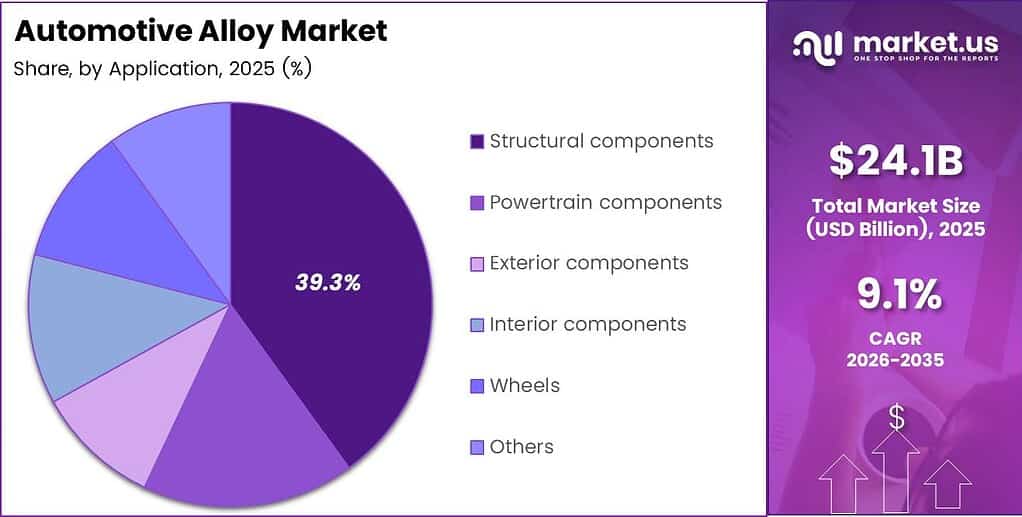
- Structural Components dominate the By Application segment with a 39.30% share in 2025.
- Passenger Cars dominate the By Vehicle Type segment with a 54.30% share in 2025.
- Casting dominates the By Manufacturing Process segment with a 34.00% share in 2025.
- OEM dominates the By Sales Channel segment with an 88.00% share in 2025.
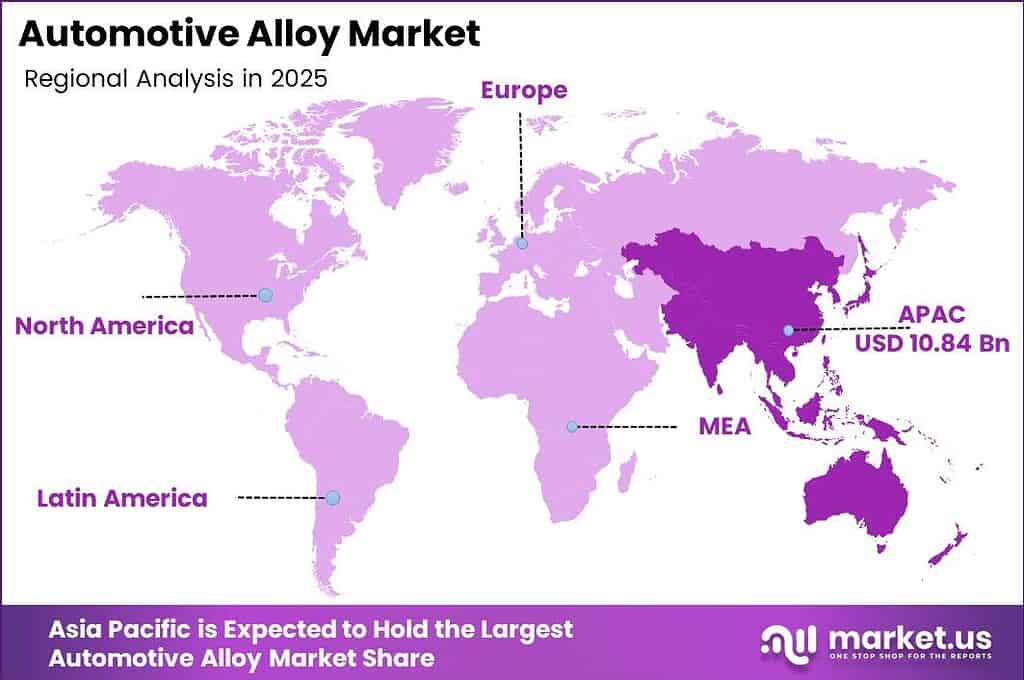
- Asia Pacific leads all regions with a 45.00% share, valued at USD 10.84 Billion in 2025.
- Europe is the fastest-growing region during the forecast period.
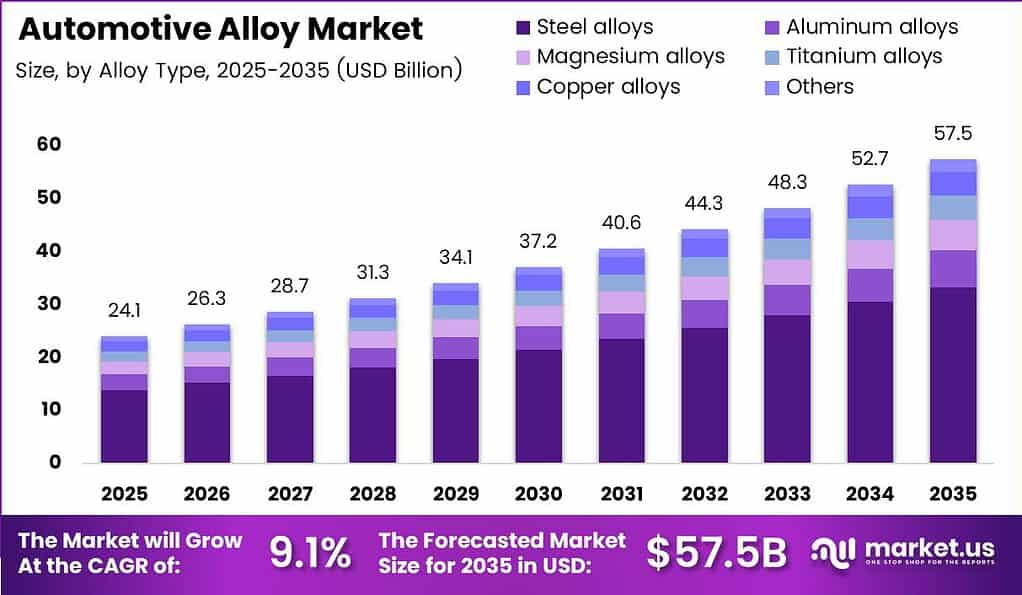
According to our research, global car production grew 4.2% to 78.7 million units in 2025. This volume increase directly expands total alloy demand across every material category. Suppliers with capacity to scale alongside OEM build schedules capture the largest share of this production-led revenue uplift.
Global electric-car sales exceeded 20 million units in 2025, rising 20% and representing 25% of new-car sales, as reported by the International Energy Agency. Battery weight creates a structural offset imperative for OEMs. This creates durable demand for aluminum and magnesium alloy content per vehicle across all major EV platforms.
The United States imposed additional 25% tariffs on steel and aluminum imports from trading partners on March 12, 2025, as reported by the World Trade Organization. This forced alloy pricing and supply-chain decisions to accelerate. Hydro responded by beginning construction of a €180 million Torija recycling plant with 120,000 tonnes of annual extrusion-ingot capacity in March 2025, signaling that regional supply localization is now a competitive priority. The World Bank forecast its metals-and-minerals price index to decline 10% in 2025 and a further 3% in 2026, which partially offsets tariff cost pressure for buyers who source from domestic mills.
Alloy Type Analysis
Steel Alloys dominate with 58.00% due to high structural performance and low unit cost.
In 2025, Steel Alloys held a dominant market position in the By Alloy Type segment of the Automotive Alloy Market, with a 58.00% share. Data from World Steel Association shows global crude-steel production totaled 1,849.4 million tonnes in 2025. This deep supply base keeps steel alloy conversion costs below competing materials, reinforcing OEM preference for steel-intensive body architectures on high-volume platforms.
Aluminum Alloys represent the fastest-scaling material category within the segment. As per our research, average automotive aluminum content was expected to reach 250 kg per vehicle by 2025, up from approximately 158 kg in 2012. Transportation applications also accounted for 36% of U.S. aluminum consumption in 2024, according to the U.S. Geological Survey. An aluminum car body can weigh 40% less than a lightweight-steel body, making this material essential for OEMs targeting range and efficiency targets simultaneously. In December 2025, Constellium inaugurated new Singen finishing lines following a €30 million investment for battery-grade aluminum foilstock, illustrating that suppliers are actively expanding application-specific capacity.
Magnesium Alloys serve the most weight-critical interior and powertrain components where volume and load requirements allow. According to the U.S. Geological Survey, castings accounted for an estimated 69% of U.S. primary-magnesium consumption in 2025, principally for automotive applications. Magnesium can reduce component mass by 60–75% when replacing steel or cast iron, per U.S. Department of Energy data, giving OEMs a decisive advantage in dashboard cross-car beams, seat frames, and transmission housings where every gram removed improves structural balance.
Titanium Alloys and Copper Alloys collectively address high-performance and electrification-specific needs. Based on U.S. Department of Energy data, titanium can reduce component mass by 40–55% when replacing alloy steel, delivering performance gains that justify premium pricing in motorsport and luxury segments. Copper alloys hold the remaining share through connector, busbar, and wiring applications that expand in proportion to EV electrical architecture complexity.
Application Analysis
Structural Components dominate with 39.30% due to safety regulation and crash-energy management requirements.
In 2025, Structural Components held a dominant market position in the By Application segment of the Automotive Alloy Market, with a 39.30% share. Structural applications consume the highest alloy volumes per vehicle because body-in-white, pillars, and floor assemblies require continuous material coverage. OEMs that lock in multi-year alloy supply agreements for structural programs gain predictable cost structures and reduce platform re-engineering risk across model generations.
Powertrain Components represent the second-largest application category and are undergoing the fastest material transition in the segment. The shift from internal combustion to electric powertrains replaces cast-iron blocks and steel transmission housings with aluminum die-cast motor housings and battery enclosures. Suppliers who have already qualified aluminum and magnesium alloy grades for powertrain use hold qualification lead times as a durable competitive barrier.
Exterior Components and Interior Components together address surface quality, corrosion resistance, and NVH performance requirements. Exterior applications use high-formability aluminum and advanced high-strength steel grades to balance styling freedom with pedestrian safety regulations. Interior applications increasingly specify magnesium die-castings for instrument-panel structures and door modules where mass reduction directly improves vehicle dynamics. Wheels and other remaining applications hold the balance of segment share through forged aluminum and steel wheel programs that scale with production volumes.
Vehicle Type Analysis
Passenger Cars dominate with 54.30% due to global production volume and OEM light weighting mandates.
In 2025, Passenger Cars held a dominant market position in the By Vehicle Type segment of the Automotive Alloy Market, with a 54.30% share. As per our research, U.S. tariff rates on imported motor vehicles and related parts increased by 25 percentage points in 2025, according to the World Trade Organization. This disrupted established sourcing models and pushed OEMs toward domestic alloy supply relationships to insulate production economics from further policy shifts.
Light Commercial Vehicles represent a structurally distinct buying pattern because fleet operators prioritize payload-to-curb-weight ratios over styling flexibility. Aluminum chassis components and high-strength steel cab structures address both objectives, creating sustained demand independent of consumer sentiment cycles. Heavy Commercial Vehicles hold the remaining share, with alloy adoption progressing more gradually given longer product development cycles and stricter axle-load compliance requirements across regional markets.
Manufacturing Process Analysis
Casting dominates with 34.00% due to design flexibility and suitability for complex component geometries.
In 2025, Casting held a dominant market position in the By Manufacturing Process segment of the Automotive Alloy Market, with a 34.00% share. Die-casting enables high production rates for aluminum and magnesium components, reducing per-unit conversion costs for high-volume programs. OEMs that invest in large-format die-casting equipment lower assembly complexity and reduce the number of weld joints, directly improving structural integrity.
Forging delivers superior fatigue strength for suspension and drivetrain components subject to repeated dynamic loading. Rolling produces flat-rolled sheet and coil for stamped body panels, doors, and hoods where surface quality and formability are primary requirements. Extrusion and Stamping serve structural profiles and high-volume body panels, respectively, while other processes including additive manufacturing and powder metallurgy hold the remaining share and are gaining qualified use cases in motorsport and low-volume specialty programs.
Sales Channel Analysis
OEM dominates with 88.00% due to long-term supply agreements and platform nomination cycles.
In 2025, OEM held a dominant market position in the By Sales Channel segment of the Automotive Alloy Market, with an 88.00% share. Figures from UNCTAD show global trade reached a record $33 trillion in 2024, rising 3.7%. This trade volume sustains the cross-border alloy supply flows that feed tier-one supplier networks and OEM manufacturing plants across multiple continents, creating scale advantages for producers with global logistics capabilities.
Aftermarket accounts for the remaining 12% share and serves collision repair, performance modification, and fleet maintenance demand. Aftermarket volumes are less exposed to OEM production cyclicality, providing alloy distributors with a counter-cyclical revenue buffer. Distributors that build technical service capabilities alongside product availability can capture repair-shop loyalty before larger competitors enter this channel.
Key Market Segments
By Alloy Type
- Steel Alloys
- Aluminum Alloys
- Magnesium Alloys
- Titanium Alloys
- Copper Alloys
- Others
By Application
- Structural Components
- Powertrain Components
- Exterior Components
- Interior Components
- Wheels
- Others
By Vehicle Type
- Passenger Cars
- Light Commercial Vehicles
- Heavy Commercial Vehicles
By Manufacturing Process
- Casting
- Forging
- Rolling
- Extrusion
- Stamping
- Others
By Sales Channel
- OEM
- Aftermarket
Regional Analysis
Asia Pacific Dominates the Automotive Alloy Market with a Market Share of 45.00%, Valued at USD 10.84 Billion
Asia Pacific commands the largest share of the automotive alloy market because it houses the world’s highest concentration of vehicle production capacity. Data from ACEA shows Asia accounted for 62.1% of global car production in 2025. World Steel Association figures show Asia produced 1,386.8 million tonnes of crude steel in 2024, providing the raw material foundation that supports deep domestic alloy conversion capacity. In April 2025, Rio Tinto and AMG Metals and Materials agreed to assess an Indian project with up to 1 million tonnes per year of primary-aluminum capacity, signaling confidence in the region’s long-term alloy supply expansion.
Europe is the fastest-growing region in the automotive alloy market. ACEA data shows the European Union accounted for 14.6% of global car production in 2025, with the region’s stringent fleet emissions regulations accelerating aluminum and advanced steel adoption ahead of most global peers. New EU truck registrations increased 9.8% to 171,933 units in the first half of 2026, according to ACEA, expanding commercial-vehicle alloy demand alongside passenger-car programs.
Automotive and light-truck production consumes more than 85% of aluminum castings in Germany and approximately 80% in France, per International Aluminium Institute data, confirming that alloy consumption in Europe is structurally tied to vehicle output rather than discretionary industrial spending. The Queensland and Australian governments committed a combined A$2 billion over 10 years to support Rio Tinto’s Boyne aluminum smelter through at least 2040, demonstrating sovereign-level commitment to securing regional aluminum supply chains.
The Indian subcontinent presents a structurally expanding demand base within the Asia Pacific region. Figures from SIAM show Indian passenger-vehicle sales reached a record 4.3 million units in FY2024–25, rising 2%. Indian commercial-vehicle sales registered 595,000 units in FY2023–24, according to SIAM data. This combined vehicle output volume supports material suppliers targeting local alloy processing investments to serve Indian OEM supply chains.
Key Regions and Countries
North America
- US
- Canada
Europe
- Germany
- France
- The UK
- Spain
- Italy
- Rest of Europe
Asia Pacific
- China
- Japan
- South Korea
- India
- Australia
- Rest of APAC
Latin America
- Brazil
- Mexico
- Rest of Latin America
Middle East and Africa
- GCC
- South Africa
- Rest of MEA
Drivers
Electric vehicle adoption is converting battery-mass compensation from a design preference into an engineering requirement. Global electric-car sales surpassed 20 million in 2025, when electric models represented approximately one-quarter of new-car sales. A 10% reduction in vehicle mass can improve fuel economy by approximately 6–8%, while aluminum and magnesium substitutions can reduce component mass by approximately 30–60% and 30–70%, respectively. This supports an estimated +1.5% incremental CAGR contribution from EV battery-mass offset alone. OEM sourcing is shifting from transactional metal purchasing toward multi-year alloy-development partnerships, giving qualified suppliers earlier platform nominations and greater content per vehicle.
Fleet emissions compliance regulations across Europe, North America, China, Japan, and South Korea create a parallel and sustained source of alloy demand. Advanced high-strength steel delivers a +1.0% estimated CAGR contribution through safety-grade penetration on high-volume passenger platforms. Structural gigacasting adoption adds a further +0.7% across China, North America, and Europe over a medium-term horizon of 2 to 4 years. SUV alloy content growth contributes an additional +0.3% in the short term across North America, the Middle East, China, and India. These stacked regulatory and platform drivers reinforce each other, reducing the likelihood that any single policy reversal would materially slow aggregate alloy demand growth.
| Driver | (~) % Impact on CAGR Forecast | Geographic Relevance | Impact Timeline |
|---|---|---|---|
| EV Battery-Mass Offset | +1.5% | Global; strongest in China, Europe and North America | Short term (≤ 2 years) |
| Fleet Emissions Compliance | +1.0% | Europe, North America, China, Japan and South Korea | Short term (≤ 2 years) |
| Structural Gigacasting Adoption | +0.7% | China, North America and Europe | Medium term (2–4 years) |
| Safety-Grade AHSS Penetration | +0.5% | Global high-volume passenger-vehicle platforms | Short term (≤ 2 years) |
| Commercial-Vehicle Lightweighting | +0.4% | North America, Europe, China and India | Medium term (2–4 years) |
| SUV Alloy Content Growth | +0.3% | North America, Middle East, China and India | Short term (≤ 2 years) |
Restraints
Primary aluminum production requires approximately 186 gigajoules per tonne, compared with 8.3 gigajoules for recycled aluminum, leaving primary supply approximately 22 times more energy-intensive and directly exposed to electricity, alumina, and carbon-cost movements. A sustained 10% alloy-input cost increase with a 2 to 3-quarter contractual pass-through delay can remove approximately 1–3 percentage points from converter margins, producing an estimated -1.2% CAGR adjustment. Cost-sensitive OEM programs consequently delay aluminum-intensive redesigns, preserve conventional steel architectures, and defer supplier tooling commitments.
Section 232 tariff escalation contributes an estimated -0.9% CAGR drag, specifically in the United States and import-dependent supply corridors. Legacy steel platform lock-in adds a further -0.6% friction across global mass-market vehicle production over a medium-term horizon. High tooling conversion costs impose an additional -0.4% headwind on small and mid-sized component suppliers who cannot absorb capital expenditure without multi-year volume commitments. End-market production cyclicality contributes a -0.3% drag in export-oriented automotive hubs where volume swings compress alloy purchasing flexibility.
| Restraint | (~) % Impact on CAGR Forecast | Geographic Relevance | Impact Timeline |
|---|---|---|---|
| Primary-Metal Cost Premium | -1.2% | Global; highest in energy-importing manufacturing economies | Short term (≤ 2 years) |
| Section 232 Tariff Escalation | -0.9% | United States and import-dependent supply corridors | Short term (≤ 2 years) |
| Legacy Steel Platform Lock-In | -0.6% | Global mass-market vehicle production | Medium term (2–4 years) |
| Repair Infrastructure Deficit | -0.5% | India, Southeast Asia, Latin America and Africa | Medium term (2–4 years) |
| High Tooling Conversion Costs | -0.4% | Global small and mid-sized component suppliers | Medium term (2–4 years) |
| End-Market Production Cyclicality | -0.3% | Global; strongest in export-oriented automotive hubs | Short term (≤ 2 years) |
Challenges
Dissimilar-material joining is the most structurally complex challenge in automotive alloy adoption. Mixed aluminum, steel, and magnesium structures require 2 to 4 joining technologies per body program, additional corrosion-isolation steps, and approximately 10–20% more joining-related validation effort. This produces an estimated -0.9% friction drag on maximum attainable CAGR and forces suppliers to absorb recurring research, qualification, and technical-service expenditure without pausing alloy shipments.
Magnesium supply concentration adds -0.7% CAGR friction in Europe, North America, Japan, and South Korea, where producers outside China face constrained feedstock optionality. Corrosion control complexity contributes a further -0.5% drag in global coastal and cold-climate markets where dissimilar-metal contact accelerates galvanic degradation. Formability and springback variance imposes a -0.4% headwind on global stamping and body-structure operations. Metallurgical skills shortage and digital traceability fragmentation add -0.3% and -0.2% friction respectively, with skills deficits concentrated in India, Southeast Asia, Eastern Europe, and North America over a long-term horizon of four or more years.
| Challenge | (~) % CAGR Friction Drag | Geographic Relevance | Mitigation Horizon |
|---|---|---|---|
| Dissimilar-Material Joining Complexity | -0.9% | Global multi-material vehicle platforms | Medium term (2–4 years) |
| Magnesium Supply Concentration | -0.7% | Europe, North America, Japan and South Korea | Medium term (2–4 years) |
| Corrosion Control Complexity | -0.5% | Global coastal and cold-climate markets | Medium term (2–4 years) |
| Formability and Springback Variance | -0.4% | Global stamping and body-structure operations | Short term (≤ 2 years) |
| Metallurgical Skills Shortage | -0.3% | India, Southeast Asia, Eastern Europe and North America | Long term (≥ 4 years) |
| Digital Traceability Fragmentation | -0.2% | Global multi-tier automotive supply chains | Medium term (2–4 years) |
Opportunities
Closed-loop alloy sorting represents the highest-value near-term revenue opportunity in the automotive alloy supply chain. Automotive stamping generates approximately 30–40% trim scrap from incoming aluminum sheet, yet mixed 5xxx– and 6xxx-series material is widely downcycled where plants lack separation infrastructure. Laser-based sorting has demonstrated purity above 95%, and recycling aluminum requires approximately 8.3 gigajoules per tonne versus 186 gigajoules for primary metal. Scaled closed-loop contracts could reduce usable-metal cost by an estimated 4–8% and expand converter margins by approximately 2 to 4 percentage points, adding up to +0.9% to CAGR.
Additive manufacturing alloy grades offer a +0.7% potential CAGR upside in Europe, North America, Japan, and China over a long-term horizon of four or more years, targeting low-volume structural and powertrain components where near-net-shape production eliminates machining waste. Hydrogen mobility alloy systems contribute an additional +0.5% upside across Europe, China, Japan, South Korea, and North America for tank, fuel-cell enclosure, and frame materials. Regional foundry consolidation in India, Southeast Asia, Eastern Europe, and Latin America adds +0.4% by concentrating volumes into fewer, better-capitalized facilities. Alloy IP licensing models and Southeast Asia production localization together provide a further +0.5% combined upside for specialist producers entering Thailand, Indonesia, Vietnam, and Malaysia.
| Opportunity | (~) % Potential CAGR Upside | Geographic Relevance | Execution Window |
|---|---|---|---|
| Closed-Loop Alloy Sorting | +0.9% | Europe, North America, China, Japan and South Korea | Medium term (2–4 years) |
| Additive Manufacturing Alloy Grades | +0.7% | Europe, North America, Japan and China | Long term (≥ 4 years) |
| Hydrogen Mobility Alloy Systems | +0.5% | Europe, China, Japan, South Korea and North America | Long term (≥ 4 years) |
| Regional Foundry Consolidation | +0.4% | India, Southeast Asia, Eastern Europe and Latin America | Medium term (2–4 years) |
| Alloy IP Licensing Models | +0.3% | Global specialist producers and automotive suppliers | Medium term (2–4 years) |
| Southeast Asia Production Localization | +0.2% | Thailand, Indonesia, Vietnam and Malaysia | Medium term (2–4 years) |
Key Company Insights
ArcelorMittal S.A. generated $61.4 billion in sales in 2025, with automotive and mobility representing 17% of sales by market, according to the company’s own factbook. This automotive revenue concentration means that ArcelorMittal’s advanced high-strength steel product pipeline is directly tied to OEM platform decisions. In February 2025, ArcelorMittal confirmed a $1.2 billion Alabama electrical-steel facility with annual capacity of up to 150,000 tonnes, reinforcing its commitment to electrification-linked alloy categories.
Novelis Inc. generated $18.4 billion in net sales and shipped 3,557 kilotonnes of rolled products in fiscal 2026, as reported by the company. Novelis opened its $65 million Ulsan recycling center in April 2025 with annual capacity of 100,000 tonnes of low-carbon aluminum sheet ingot, directly targeting OEM sustainability sourcing requirements. This recycling-led positioning gives Novelis a cost and carbon-certification advantage over primary-metal-dependent competitors as OEM supply chains tighten low-carbon content requirements. Kobe Steel increased U.S. forged-aluminum suspension-parts capacity by 50%, from 280,000 to 420,000 pieces per month, validating the commercial case for dedicated forged-aluminum expansion in the North American market.
Key Players
- ArcelorMittal S.A.
- Novelis Inc. / Hindalco Industries
- Alcoa Corporation
- Nippon Steel Corporation
- Norsk Hydro ASA
- POSCO Holdings Inc.
- Constellium SE
- thyssenkrupp AG
- Kobe Steel, Ltd.
- UACJ Corporation
- China Baowu Steel Group Corporation
- Kaiser Aluminum Corporation
- Rio Tinto Group
- Gränges AB
- AMAG Austria Metall AG
Recent Developments
- June 2026 – POSCO completed a KRW 600 billion electric-arc furnace in Gwangyang with annual capacity of 2.5 million tonnes, the largest of its kind in South Korea.
- June 2026 – Alcoa agreed to acquire South32’s bauxite, alumina, and aluminum assets for approximately $4.1 billion upfront plus contingent consideration of up to $750 million, substantially expanding its upstream resource base.
- April 2026 – POSCO and JSW Steel signed a 50:50 joint-venture agreement for a 6 million-tonne-per-year integrated steel mill in Odisha, India, targeting the country’s growing automotive and infrastructure demand.
- March 2026 – Gränges issued two five-year senior unsecured green bonds totaling SEK 600 million, directing proceeds toward sustainable aluminum rolling operations.
- February 2025 – ArcelorMittal confirmed a $1.2 billion Alabama electrical-steel facility with annual capacity of up to 150,000 tonnes, targeting the North American EV drivetrain supply chain.
- June 2025 – Nippon Steel completed its acquisition of 100% of U.S. Steel at $55 per share, creating an integrated producer with substantial flat-rolled steel capacity serving North American automotive OEMs.
- September 2024 – Constellium opened a €130 million Neuf-Brisach recycling center that added 130,000 tonnes of annual capacity, reinforcing closed-loop aluminum supply for European automotive customers.
- June 2024 – Rio Tinto committed $179 million and Québec committed $106 million to a 10-pot ELYSIS demonstration plant with capacity of up to 2,500 tonnes per year of carbon-free aluminum.
Report Scope
| Report Features | Description |
|---|---|
| Market Value (2026) | USD 26.3 Billion |
| Forecast Revenue (2035) | USD 57.5 Billion |
| CAGR (2026-2035) | 9.1% |
| Base Year for Estimation | 2025 |
| Historic Period | 2020-2024 |
| Forecast Period | 2026-2035 |
| Report Coverage | Revenue Forecast, Market Dynamics, Market Opportunity Analysis, Technology and Innovation Landscape, Competitive Landscape, Recent Developments |
| Segments Covered | By Alloy Type (Steel Alloys, Aluminum Alloys, Magnesium Alloys, Titanium Alloys, Copper Alloys, Others), By Application (Structural Components, Powertrain Components, Exterior Components, Interior Components, Wheels, Others), By Vehicle Type (Passenger Cars, Light Commercial Vehicles, Heavy Commercial Vehicles), By Manufacturing Process (Casting, Forging, Rolling, Extrusion, Stamping, Others), By Sales Channel (OEM, Aftermarket) |
| Regional Analysis | North America (US and Canada), Europe (Germany, France, The UK, Spain, Italy, and Rest of Europe), Asia Pacific (China, Japan, South Korea, India, Australia, and Rest of APAC), Latin America (Brazil, Mexico, and Rest of Latin America), Middle East and Africa (GCC, South Africa, and Rest of MEA) |
| Competitive Landscape | ArcelorMittal S.A., Novelis Inc. / Hindalco Industries, Alcoa Corporation, Nippon Steel Corporation, Norsk Hydro ASA, POSCO Holdings Inc., Constellium SE, thyssenkrupp AG, Kobe Steel Ltd., UACJ Corporation, China Baowu Steel Group Corporation, Kaiser Aluminum Corporation, Rio Tinto Group, Gränges AB, AMAG Austria Metall AG |
| Customization Scope | Customization for segments, region/country-level will be provided. Additional customization can be done based on requirements. |
| Purchase Options | We have three licenses to opt for: Single User License, Multi-User License (Up to 5 Users), Corporate Use License (Unlimited User and Printable PDF) |





































