


Report Overview
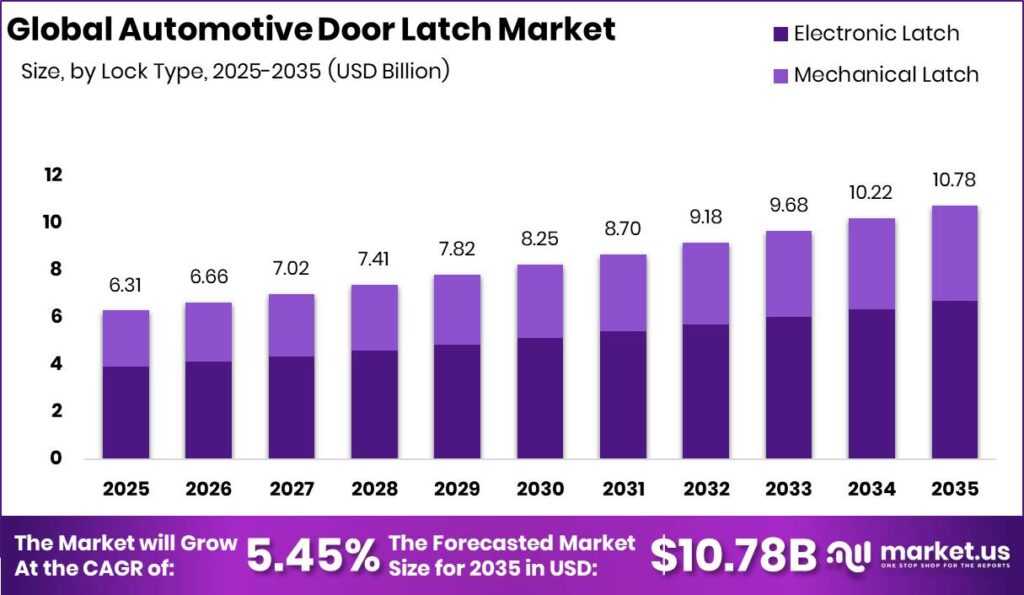
Global Automotive Door Latch Market size is expected to be worth around USD 10.78 Billion by 2035 from USD 6.31 Billion in 2025, growing at a CAGR of 5.45% during the forecast period 2026 to 2035.
The automotive door latch market encompasses all mechanical and electronic closure systems that secure vehicle doors, hoods, tailgates, and rear seat panels. The market spans a broad product portfolio including actuators, switches, handles, cables, and multi-component assemblies. It serves passenger cars, light commercial vehicles, and heavy commercial vehicles across original equipment manufacturer and aftermarket sales channels. Demand reflects the direct relationship between global vehicle production volumes and the number of latch units required per vehicle build.
Key Takeaways
- Market size reached USD 6.31 Billion in 2025 and is forecast to reach USD 10.78 Billion by 2035.
- The market grows at a CAGR of 5.45% from 2026 to 2035.
- Electronic Latch leads the Lock Type segment with a 62.25% share.
- Side Door Latch dominates the Application segment with a 64.85% share.
- Passenger Cars hold the largest Vehicle Type share at 75.20%.
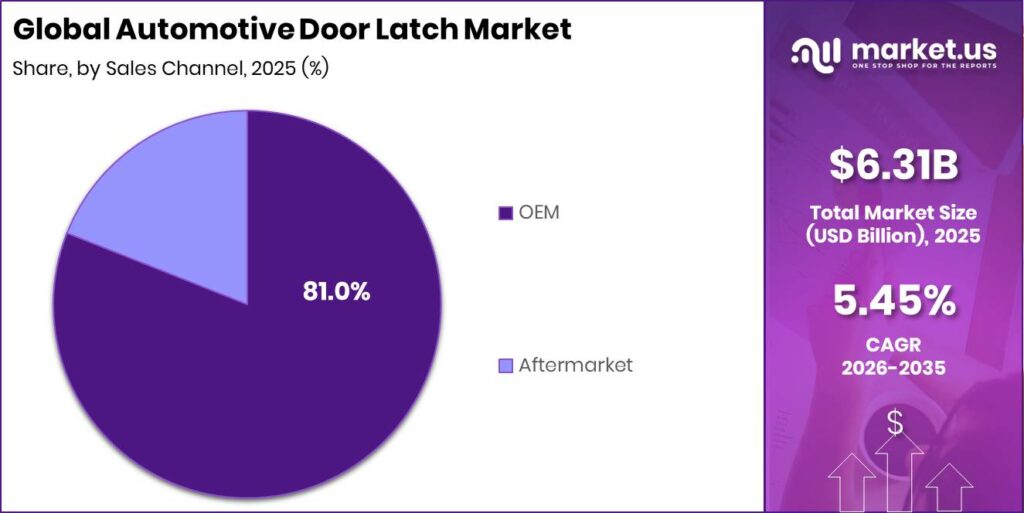
- OEM channel accounts for 81.00% of Sales Channel revenue.
- Keyless Entry System leads the Technology segment with a 54.20% share.
- Actuator is the leading Component with a 32.50% share.
- Steel dominates Material Type at 55%.
- Manual Functionality holds a 68% share.
- OEM Installation Type accounts for 73.20% of the market.
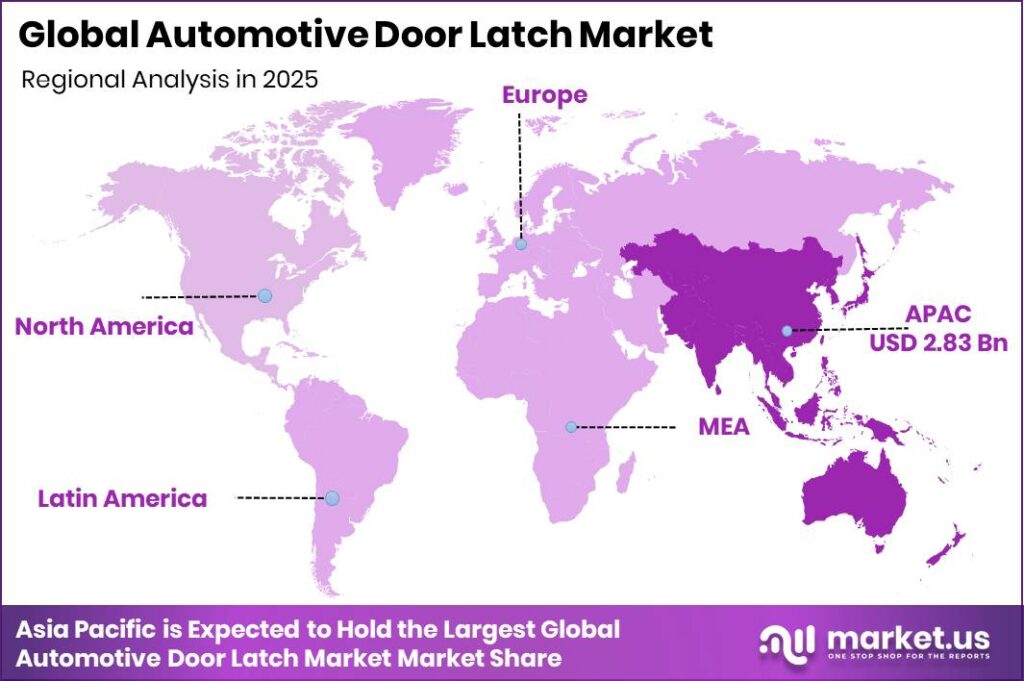
- Asia Pacific dominates regionally with a 45.00% share, valued at USD 2.99 Billion.
Regulatory pressure from safety agencies has reshaped product requirements across the industry. Recall filings from the National Highway Traffic Safety Administration signal that governments are tightening latch performance standards globally. This regulatory scrutiny pushes OEMs to source latches meeting stricter dimensional tolerances and electronic performance thresholds. Suppliers that align product development with evolving safety mandates gain preferred vendor status and protect long-term contract positions against rivals competing on price alone.
In 2025, INEOS implemented 100% door-button assembly replacement across its entire recalled population rather than a selective inspection approach, and introduced improved component guidance, kinematics, and grease application protocols. This full-population replacement strategy signals a broader industry shift toward zero-fault-tolerance latch manufacturing. Suppliers capable of delivering consistent pre-lubrication standards and tighter component fit will win contracts as OEMs enforce stricter incoming quality audits to avoid repeat recalls.
Meanwhile, Magna commercialized its SmartLatch™ technology in 2025, integrating an electronic control unit directly into the latch body for electronically controlled locking and improved styling flexibility. As electronic architectures replace mechanical systems, the component value per door latch unit rises substantially. This creates a revenue mix shift for tier-one suppliers and raises barriers for low-cost manufacturers that lack embedded electronics capability. Ford’s recall of 27,768 Bronco four-door vehicles for child-safety-lock dimensional interference further confirms that precise latch engineering is now a non-negotiable baseline for OEM approval.
Lock Type Analysis
Electronic Latch dominates with 62.25% due to OEM electrification mandates across platforms.
In 2025, Electronic Latch held a dominant market position in the By Lock Type segment of the Automotive Door Latch Market, with a 62.25% share. Ford’s Mustang Mach-E filing identified an electronic-latch lockout condition when the vehicle’s 12-volt battery fell below 8.4 volts after key-off. Ford’s subsequent software remedy extended post-key-off 12-volt support to 12 minutes, allowing the DC/DC converter to power front-door electronic unlocking. This engineering response demonstrates that electronic latch reliability is now a software-dependent function, requiring OEM-level systems integration beyond hardware alone.
Mechanical Latch remains the fastest-growing sub-segment within Lock Type, driven by its continued use in cost-sensitive commercial and entry-level vehicle platforms. The IEA’s 2024 Global EV Outlook notes that battery electric vehicles still represent a minority of total fleet additions in emerging markets, where mechanical latches maintain specification dominance. In markets where vehicle affordability constrains electrification timelines, mechanical latch demand stays structurally supported. Suppliers serving these price-sensitive segments protect volume even as electronic share climbs in premium vehicle lines.
Application Analysis
Side Door Latch dominates with 64.85% due to highest door-count per vehicle architecture.
In 2025, Side Door Latch held a dominant market position in the By Application segment of the Automotive Door Latch Market, with a 64.85% share. A standard four-door passenger vehicle requires a minimum of 4 side door latches, generating more units per vehicle than any other application category. Toyota’s 2026 recall covered 141,286 vehicles fitted with electric rear-door lock-release systems susceptible to water intrusion and short-circuit activation. This volume confirms that side door latch exposure to safety recall risk is proportionally the largest of any application, making reliability investment directly tied to OEM liability costs.
Tailgate Latch is the fastest-growing application sub-segment, reflecting the global expansion of SUV, crossover, and pickup truck production. According to the International Organization of Motor Vehicle Manufacturers, SUV and light truck registrations now represent over 50% of new vehicle sales in North America and key European markets. Each tailgate requires a dedicated latch assembly with load-bearing and weatherproofing specifications distinct from side door applications. This structural shift in vehicle mix gives tailgate latch suppliers a volume growth path independent of overall market expansion rates.
Hood Latch and Back Seat Latch together serve critical secondary safety functions. Hood latches carry dual-release safety requirements enforced under FMVSS standards, meaning each vehicle platform requires certified compliance testing. The NHTSA database recorded multiple hood-related service bulletins across 2024 and 2025 model year vehicles, reinforcing that even low-unit-count applications generate recurring compliance costs. Back Seat Latch demand remains linked to folding-seat platform prevalence in compact SUVs and multi-purpose vehicles, sustaining a structurally stable but lower-volume demand base.
Vehicle Type Analysis
Passenger Cars dominate with 75.20% due to highest global production volume concentration.
In 2025, Passenger Cars held a dominant market position in the By Vehicle Type segment of the Automotive Door Latch Market, with a 75.20% share. According to OICA, global passenger car production exceeded 70 million units annually in recent reporting years, generating demand for upward of 280 million latch units based on a standard four-latch-per-vehicle ratio. This production density creates a structural floor for latch demand that insulates suppliers from short-term demand cycles. OEM tier-one contracts tied to passenger car platforms provide predictable, multi-year volume commitments that smaller aftermarket suppliers cannot replicate.
Light Commercial Vehicles are the fastest-growing vehicle type sub-segment, driven by last-mile delivery fleet expansion and e-commerce logistics growth. The World Bank estimates global e-commerce retail sales exceeded USD 5.8 Trillion in 2023, and fleet operators are replacing vehicles at accelerated cycles. Each light commercial vehicle carries more demanding latch specifications than a standard passenger car, including higher-cycle fatigue requirements and payload-rated door sealing. Suppliers that certify products to commercial fleet standards capture higher per-unit margins and longer replacement intervals than passenger car platform contracts typically offer.
Heavy Commercial Vehicles represent the smallest share within Vehicle Type but carry the highest per-vehicle latch content by weight class and door count. Cab-over and conventional truck configurations require specialized heavy-duty latch assemblies rated for vibration, thermal cycling, and road-shock loads that passenger car components cannot meet. The International Road Transport Union reports the global commercial truck fleet exceeds 400 million vehicles, maintaining steady baseline replacement demand. Suppliers with dedicated heavy commercial vehicle product lines face less price competition and benefit from lower churn in customer relationships.
Sales Channel Analysis
OEM dominates with 81.00% due to direct integration into vehicle assembly supply chains.
In 2025, OEM held a dominant market position in the By Sales Channel segment of the Automotive Door Latch Market, with an 81.00% share. OEM contracts are awarded at the vehicle platform design stage, locking suppliers into multi-year production agreements that typically span 5 to 7 years per platform lifecycle. According to the World Trade Organization, automotive components account for approximately 9% of global merchandise trade, with OEM supply chains forming the dominant procurement structure. This channel dominance means new entrants face platform certification timelines of up to 3 years before generating first revenue from an OEM customer.
The Aftermarket channel is the fastest-growing sales channel and represents an increasingly strategic revenue stream for latch suppliers. The global vehicle fleet age has risen steadily, with the American Automobile Association reporting the average US vehicle age exceeding 12 years as of 2023. Older vehicles generate higher latch replacement frequency as seals degrade and internal components fatigue. Suppliers that establish aftermarket distribution networks alongside OEM operations reduce revenue concentration risk and smooth demand volatility tied to new vehicle production cycles.
Technology Analysis
Keyless Entry System dominates with 54.20% due to standard fitment across connected vehicle platforms.
In 2025, Keyless Entry System held a dominant market position in the By Technology segment of the Automotive Door Latch Market, with a 54.20% share. According to the ITU’s 2023 Global ICT Development Index, connected vehicle penetration has expanded across 47 major economies, with OEMs standardizing digital access systems on mid-tier and above trim levels. Keyless entry integration requires latch assemblies with embedded signal receivers and encrypted authentication modules, raising the component value per unit. Suppliers that offer full-system keyless latch solutions rather than standalone hardware components capture higher contract value per vehicle platform.
Central Locking System retains a stable position as the baseline access technology for volume market segments, particularly in emerging economies where connected vehicle infrastructure is still developing. The OECD reports that vehicle ownership rates in lower-middle-income countries grew at roughly 6% annually between 2018 and 2022, and central locking remains the specified technology for cost-targeted platforms in these regions. Child Safety System demand is directly linked to family vehicle segment growth, with regulatory requirements in the EU and US mandating rear-door child lock provisions on all new passenger vehicles with rear passenger seating.
Component Analysis
Actuator dominates with 32.50% due to its role as the primary electromechanical interface.
In 2025, Actuator held a dominant market position in the By Component segment of the Automotive Door Latch Market, with a 32.50% share. Actuators translate electrical signals into mechanical latch movement, making them the highest-value single component within a latch assembly. According to the IEA, global electric vehicle sales reached 17 million units in 2023, and EV platforms require actuators with tighter voltage tolerance ranges than combustion vehicle equivalents. Suppliers developing actuators rated for low-voltage operating conditions position themselves as preferred partners for the expanding EV segment, where standard actuator specifications are insufficient.
Switch, Handle, and Cable components collectively serve functional integration roles that connect the actuator to the user interface and the vehicle body. The NHTSA recall database confirms that cable-related latch failures account for a recurring category of safety defects, including Volvo Trucks’ 2025 recall of 4,040 vehicles where an inadequately secured cable prevented occupants from opening doors internally. This failure mode pattern supports sustained demand for premium-grade cable assemblies with enhanced routing retention designs. Suppliers that offer cable-and-actuator integrated subassemblies reduce OEM assembly line complexity and improve defect traceability across the latch system.
Material Type Analysis
Steel dominates with 55% due to structural load rating requirements in door latch assemblies.
In 2025, Steel held a dominant market position in the By Material Type segment of the Automotive Door Latch Market, with a 55% share. FMVSS 206 sets minimum door latch strength requirements that steel assemblies reliably meet, while alternative materials require additional testing cycles and design validation before OEM approval. According to the World Steel Association, global automotive steel consumption reached approximately 200 million tonnes in 2022, with structural components including latches and strikers accounting for a defined share of that volume. Steel’s cost-per-unit advantage over aluminum in high-volume stamping operations further reinforces its dominant material position.
Aluminum is gaining adoption in weight-sensitive applications as OEMs pursue fleet average emission targets. The European Aluminium Association reports that automotive aluminum use grew at roughly 3% annually between 2019 and 2023, driven by body structure lightweighting programs. Plastic components serve non-load-bearing functions such as housing covers and aesthetic trim within latch assemblies, reducing unit weight without compromising structural compliance. Suppliers offering multi-material latch solutions that combine steel load elements with aluminum or plastic housings serve OEMs targeting simultaneous weight and cost optimization.
Functionality Analysis
Manual dominates with 68% due to cost-driven specification in global volume vehicle segments.
In 2025, Manual held a dominant market position in the By Functionality segment of the Automotive Door Latch Market, with a 68% share. Manual latch systems require no electrical integration, reducing per-unit cost and eliminating software validation requirements during vehicle homologation. According to OICA, vehicles priced below USD 20,000 represent the majority of new vehicle sales in Asia, Latin America, and Africa combined, and these platforms predominantly specify manual latch configurations. This cost-architecture alignment creates a stable high-volume baseline that sustains manual functionality share even as automatic systems grow on premium platforms.
Automatic functionality is expanding across mid-tier and premium vehicle segments as power door, soft-close, and hands-free access features shift from luxury differentiators to expected standards. The ITU reports that smartphone penetration globally exceeded 70% in 2023, and connected vehicle features including automatic latch control are increasingly tied to mobile device integration. Automatic latch assemblies carry a higher bill-of-materials cost but generate better margin per unit for suppliers with electronic integration capability. This margin differential makes the automatic functionality segment strategically important for tier-one suppliers seeking to grow revenue without growing unit volume proportionally.
Installation Type Analysis
OEM Installation dominates with 73.20% due to factory-fit mandates in all new vehicle builds.
In 2025, OEM Installation held a dominant market position in the By Installation Type segment of the Automotive Door Latch Market, with a 73.20% share. Every new vehicle produced globally requires factory-installed latch systems validated against platform-specific load, cycle, and environmental specifications before line-off approval. According to OICA, global vehicle production across all categories reached approximately 93 million units in 2023, establishing the direct unit floor for OEM installation demand. Suppliers holding homologated OEM installation status are structurally protected from short-cycle competitor substitution, as re-qualification periods typically span 18 to 24 months.
Aftermarket Installation is the fastest-growing installation type as fleet age increases and collision repair volumes generate latch replacement demand outside the OEM supply chain. The Automotive Aftermarket Suppliers Association estimates the North American aftermarket parts market exceeded USD 440 Billion in 2023, with mechanical components including latches forming a core replacement category. Aftermarket installation requires fewer certification barriers than OEM approval, allowing regional suppliers and distributors to compete on price and lead time. This channel dynamic rewards suppliers with broad part-number coverage and rapid fulfillment capabilities over those competing on technical differentiation alone.
Key Market Segments
By Lock Type
- Electronic Latch
- Mechanical Latch
- Others
By Application
- Side Door Latch
- Hood Latch
- Tailgate Latch
- Back Seat Latch
By Vehicle Type
- Passenger Cars
- Light Commercial Vehicles
- Heavy Commercial Vehicles
By Sales Channel
- OEM
- Aftermarket
By Technology
- Central Locking System
- Keyless Entry System
- Child Safety System
- Others
By Component
- Actuator
- Switch
- Handle
- Cable
- Others
By Material Type
- Steel
- Aluminum
- Plastic
- Others
By Functionality
- Manual
- Automatic
- Others
By Installation Type
- OEM
- Aftermarket
- Others
Regional Analysis
Asia Pacific Dominates the Automotive Door Latch Market with a Market Share of 45.00%, Valued at USD 2.99 Billion
Asia Pacific holds the largest regional share in the automotive door latch market at 45.00%, valued at USD 2.99 Billion in 2025. China, Japan, South Korea, and India collectively anchor this dominance through their concentration of global vehicle assembly capacity and tier-one component manufacturing. OICA data confirms that Asia Pacific accounts for over 55% of global vehicle production annually, directly translating into proportional latch unit demand. OEMs sourcing latches within the region benefit from shorter supply chains and lower logistics costs compared to cross-continental procurement structures.
Europe represents the fastest-growing regional market, driven by stringent vehicle safety regulations and the accelerated transition to electric vehicle platforms requiring advanced electronic latch systems. In 2026, Volvo added 2,758 S60L vehicles to an existing latch recall and prescribed replacement of all 4 door latches per vehicle, covering both front and rear side doors. This recall pattern reflects Europe’s regulatory environment, where safety defect remedies are applied comprehensively rather than selectively. Suppliers with European certification capabilities and proximity to German, French, and Swedish OEM assembly plants hold a structural advantage as EV platform latch specifications tighten.
Key Regions and Countries
North America
- US
- Canada
Europe
- Germany
- France
- The UK
- Spain
- Italy
- Rest of Europe
Asia Pacific
- China
- Japan
- South Korea
- India
- Australia
- Rest of APAC
Latin America
- Brazil
- Mexico
- Rest of Latin America
Middle East and Africa
- GCC
- South Africa
- Rest of MEA
Market Dynamics
Market Opportunity Analysis - Aftermarket, emerging regions, and EV-specific latch platforms offer distinct entry points for focused suppliers
The aftermarket installation channel holds an underexploited revenue position relative to its structural scale. OEM Installation currently commands a 73.20% share of the installation type segment, leaving a 26.80% aftermarket share that remains fragmented across regional distributors. As global fleet age rises and recall-driven replacements increase, the aftermarket creates durable volume demand that does not require OEM platform certification. Suppliers entering this channel with broad part-number coverage and regional distribution partnerships face lower barriers than OEM qualification timelines and shorter paths to first revenue generation.
Heavy Commercial Vehicles represent an underserved sub-segment within the vehicle type category. Passenger Cars dominate at 75.20%, concentrating supplier investment and competitive intensity on that segment, while heavy commercial vehicle latch specifications remain served by a narrower supplier base. Specialized heavy-duty latch assemblies require vibration, thermal, and payload ratings that exclude standard passenger car suppliers. New entrants with industrial-grade engineering capability can build defensible positions in this sub-segment with less head-to-head competition than they would face targeting passenger car platform programs.
Latin America and the Middle East and Africa represent regionally underexploited demand pools where vehicle fleet growth is outpacing local latch supply infrastructure. Asia Pacific already captures 45.00% of global market share, and North America and Europe are mature with established supplier bases. By contrast, Brazil, Mexico, and GCC countries are expanding domestic vehicle assembly capacity, creating OEM supply gaps that regional and international mid-tier suppliers can fill. Early supplier entry into these regions during platform development phases secures long-term contracts before global tier-one competitors prioritize local market penetration.
The Automatic Functionality sub-segment offers a margin-expansion opportunity distinct from volume growth. Manual systems hold a 68% share, but automatic latch assemblies carry higher per-unit bills of materials and generate better margin for suppliers with electronic integration capability. As mid-tier vehicle platforms adopt power door and soft-close features previously reserved for premium segments, automatic latch demand will expand into volume market tiers. Suppliers that productize automatic latch solutions at accessible price points for B-segment and C-segment platforms capture growing share before the margin premium compresses at scale.
Technology and Innovation Landscape - Electronic integration, mechatronic platforms, and EV-specific latch architectures redefine competitive positioning
Embedded electronic control unit technology is the most consequential product innovation in the automotive door latch market. Magna’s 2025 commercialization of SmartLatch™ integrates an ECU directly into the latch body, enabling electronically controlled locking without routing external wiring harnesses to a separate control unit. This architecture reduces assembly line complexity for OEMs and lowers the vehicle weight contribution of door access systems. Suppliers that replicate or exceed this level of integration set the new baseline for electronic latch platform specifications on connected and electric vehicle programs.
Mechatronic closure platform development is advancing across multiple tier-one suppliers simultaneously. Kiekert’s 2025 development focus on intelligent, lightweight mechatronic platforms targets automated access functions for electric and connected vehicle architectures, where door systems must integrate with vehicle-level software stacks and over-the-air update protocols. This technology direction requires latch suppliers to build software engineering competence alongside traditional mechanical design. Suppliers that treat latch development as a hardware-only function will be disqualified from EV platform bids where software certification is a mandatory supply condition.
Electronic latch vulnerability management has emerged as a critical engineering discipline following recurring field failures linked to voltage sensitivity and water intrusion. Ford’s identification of an electronic-latch lockout condition below 8.4 volts and Toyota’s 2026 recall of 141,286 vehicles for water-intrusion short-circuit failures define the two primary failure modes requiring design solutions. Suppliers developing sealed electronic latch assemblies with low-voltage operating ranges rated below 8 volts and IP67 or higher ingress protection will differentiate on reliability and reduce OEM warranty liability.
Power release, cinching, and ice-breaking functions represent the next generation of active latch features moving from luxury to mainstream vehicle segments. Brose’s April 2025 presentation at Auto Shanghai 2025 demonstrated integrated latch systems combining power release, cinching, ice-breaking, and mechanical emergency backup in a single assembly. This feature convergence raises the engineering complexity and the average selling price per latch unit. Manufacturers that develop single-assembly solutions covering all active functions reduce the OEM’s supplier count per door, creating strong account consolidation advantages for full-system latch integrators.
Market Drivers
| Driver | (~) % Impact on CAGR Forecast | Geographic Relevance | Impact Timeline |
|---|---|---|---|
| Vehicle production expansion | +1.20% | Global, led by Asia-Pacific | Short term (2 years or less) |
| Electronic latch adoption | +0.95% | China, Europe, North America, Japan | Medium term (2 to 4 years) |
| SUV and crossover proliferation | +0.70% | North America, China, Europe, India | Short term (2 years or less) |
| Safety compliance upgrades | +0.60% | North America, Europe, Japan, South Korea | Short term (2 years or less) |
| EV platform industrialization | +0.50% | China, Europe, North America | Medium term (2 to 4 years) |
| Commercial fleet replacement | +0.35% | India, ASEAN, Latin America, North America | Medium term (2 to 4 years) |
Vehicle production expansion
OICA recorded global vehicle production at 92.7 million units in 2024, rising to 96.4 million units in 2025, a year-on-year increase of 3.9%. Global vehicle sales rose from 95.3 million to 99.8 million units across the same period, a gain of approximately 4.7%. Each passenger vehicle incorporates at least 4 side-door latches, while SUVs, vans, pickup trucks, and premium vehicles require additional tailgate, liftgate, powered-closure, child-safety, and electronic-access components. This production expansion converts latch demand from replacement-oriented purchasing into program-linked serial-production demand, increasing call-off volumes across stamped housings, pawls, actuators, microswitches, and assembled modules.
Asia Pacific accounted for approximately 61% of worldwide motor-vehicle output in 2025, with regional production growing roughly 7.6%, reinforcing the need for localized manufacturing capacity near Chinese, Indian, Japanese, South Korean, and ASEAN assembly hubs. Higher unit volumes allow suppliers to amortize progressive dies, automated inspection systems, and validation costs across larger production runs, improving fixed-cost absorption while reducing per-unit logistics and depreciation burdens. As per our research, this broad-based production recovery contributes an estimated +1.20% to the baseline CAGR of 5.45%, reflecting a moderate global automotive recovery rather than an exceptional demand cycle.
Market Restraints
| Restraint | (~) % Impact on CAGR Forecast | Geographic Relevance | Impact Timeline |
|---|---|---|---|
| Cross-border tariff exposure | -1.05% | United States, Mexico, Canada, Europe, Asia | Short term (2 years or less) |
| OEM cost-down mandates | -0.80% | Global | Short term (2 years or less) |
| Automotive financing pressure | -0.60% | North America, Europe, India, Brazil | Medium term (2 to 4 years) |
| Mechanical latch substitution | -0.50% | India, ASEAN, Africa, Latin America | Short term (2 years or less) |
| Platform cancellation risk | -0.40% | Europe, North America, China | Medium term (2 to 4 years) |
| Vehicle affordability constraints | -0.35% | Global | Short term (2 years or less) |
Cross-border tariff exposure
The U.S. presidential proclamation issued in March 2025 applied an additional Section 232 tariff of 25% on specified imported automobiles from April 3, 2025 and on designated automobile parts no later than May 3, 2025, according to the White House and Federal Register. This measure raises the landed cost of imported latch modules and components for North American programs dependent on multi-country production networks. A separate increase in U.S. duties on imported steel and aluminum to 50% from June 4, 2025 compounded input-cost pressure for latch makers using stamped steel enclosures, hardened components, springs, actuator casings, and aluminum structural parts.
Tariffs create an immediate hard stop rather than a gradual operational challenge, particularly where existing supply contracts cannot absorb the additional duty and customer cost recovery is delayed. OEM and tier-one pricing schedules fixed before serial production leave suppliers exposed to margin compression, higher inventory carrying costs, accelerated local-content investment, and postponed capital expenditure on advanced latch programs. As per our research, this import-cost exposure is likely to reduce the baseline CAGR by approximately 1.05% from the 5.45% baseline, with the most severe impact on suppliers carrying high import intensity or limited regional manufacturing redundancy.
Market Challenges
| Challenge | (~) % CAGR Friction Drag | Geographic Relevance | Mitigation Horizon |
|---|---|---|---|
| Electronic latch cybersecurity validation | -0.85% | Europe, Japan, South Korea, China | Medium term (2 to 4 years) |
| Semiconductor traceability management | -0.65% | Global | Medium term (2 to 4 years) |
| Closure durability validation | -0.55% | Global | Long term (4 years or more) |
| Mechatronics talent scarcity | -0.45% | Europe, North America, India, Mexico | Long term (4 years or more) |
| Regional platform fragmentation | -0.40% | China, North America, Europe, India | Medium term (2 to 4 years) |
| Environmental reliability testing | -0.30% | North America, Europe, Northeast Asia | Long term (4 years or more) |
Electronic latch cybersecurity validation
UNECE UN Regulation No. 155 introduced cybersecurity management system requirements for vehicle type approval, while UN Regulation No. 156 established software update management system requirements. Both regulations applied to new vehicle types from July 2022 and extended to all new vehicles sold in the European Union from July 2024. Electronic latch suppliers must now complement mechanical validation covering load, corrosion, door-slam durability, and crash retention with interface-security testing, secure boot verification, authentication management, diagnostic access protection, and incident-response procedures. Suppliers cannot trade physical retention performance for digital functionality, as NHTSA continues to enforce FMVSS No. 206 in parallel, requiring simultaneous evidence across both safety and cybersecurity domains.
This dual compliance obligation slows program execution, raises engineering headcount requirements, increases test-laboratory utilization, and extends supplier qualification timelines beyond conventional mechanical latch programs. OEM pricing schedules rarely accommodate mid-program cost increases tied to cybersecurity validation scope expansion, leaving suppliers to absorb incremental software assurance investment within fixed contract margins. Without reusable secure hardware-software architectures, standardized validation libraries, and clear responsibility allocation between OEMs and tier-one suppliers, this complexity compounds across each new electronic latch platform. As per our research, this challenge imposes an estimated -0.85% drag on the market’s maximum growth potential from the 5.45% baseline CAGR over the medium term.
Market Opportunities
| Opportunity | (~) % Potential CAGR Upside | Geographic Relevance | Execution Window |
|---|---|---|---|
| Software-defined door platforms | +1.10% | China, Europe, North America, Japan | Medium term (2 to 4 years) |
| Predictive maintenance services | +0.75% | North America, Europe, China, India | Medium term (2 to 4 years) |
| Powered closure retrofits | +0.60% | North America, Europe, China, Gulf states | Short term (2 years or less) |
| Commercial fleet access systems | +0.50% | North America, Europe, India, China | Medium term (2 to 4 years) |
| Local supplier acquisitions | +0.40% | Mexico, India, ASEAN, Eastern Europe | Medium term (2 to 4 years) |
| Autonomous-shuttle access modules | +0.35% | China, Europe, North America, Middle East | Long term (4 years or more) |
Software-defined door platforms
Software-defined door platforms represent the most underexploited revenue opportunity in the automotive door latch market. Most latch revenue today is tied to a one-time hardware transaction, yet the convergence of electronic latches, electric actuators, digital keys, remote access, and centralized vehicle computing can support recurring software, diagnostics, upgrade, and fleet-service revenue streams. UNECE UN Regulation No. 155 and No. 156 have established formal frameworks for cybersecurity management and software update control across the vehicle lifecycle, creating an institutional foundation for suppliers that deliver secure, auditable, and updateable door-control electronics. A platformized offering could combine latch actuation, anti-pinch sensing, soft-close control, child-lock status, emergency-unlock logic, remote diagnostics, and digital-key authorization through a single electronic-control layer.
The strategic value of scalable door-domain software increases in proportion to the global installed base, which reached 96.4 million production units in 2025. Relative to a conventional hardware-only sale, adding modular software and remote diagnostics can increase gross-margin potential by approximately 3 to 7 percentage points after development amortization. Shared code modules and remote calibration may reduce incremental feature-deployment cost per vehicle by roughly 15% to 25%. As per our research, capturing this opportunity through investment in functional safety certification, cybersecurity compliance, and OEM interface control can add an estimated +1.10% CAGR upside above the 5.45% baseline forecast.
Geopolitical Impact Analysis
Trade policy shifts are directly affecting the cost structure of automotive door latch manufacturing. According to the WTO, global automotive tariffs have increased in complexity since 2023, with the United States applying a 25% tariff on imported passenger vehicles and components under Section 232 measures effective 2025. Steel, the dominant material input at 55% of latch composition, is subject to overlapping Section 232 steel tariffs of 25%, raising raw material costs for North American latch assemblers sourcing steel from outside preferential trade zones. Suppliers without domestic steel procurement agreements face compounding cost exposure across both material and finished goods tariff structures.
Supply chain rerouting driven by US-China trade tensions is reshuffling sourcing decisions for electronic latch components. The UNCTAD 2024 World Investment Report notes that nearshoring and friend-shoring accelerated across automotive supply chains in 2023 and 2024, with component sourcing shifting from China-based producers toward Mexico, Vietnam, and Eastern Europe. Electronic latch assemblies that incorporate microcontrollers, sensors, and encrypted access modules source these components from semiconductor supply chains exposed to US export controls covering advanced chips. Suppliers with dual-source strategies across at least 2 geographically distinct semiconductor vendors reduce production continuity risk when export restrictions tighten on specific chip categories.
Key Company Insights
Magna International Inc. holds a broad structural advantage through its multi-technology latch portfolio spanning mechanical, electronic, and mechatronic closure systems. Magna’s 2025 commercialization of SmartLatch™ technology integrates an electronic control unit directly into the latch body, enabling electronically controlled locking and improved OEM styling flexibility. This product architecture raises the switching cost for OEM customers already validated on the SmartLatch™ platform. However, higher system complexity increases Magna’s per-unit warranty exposure if software or ECU components generate field failures at scale.
Kiekert AG has concentrated its 2025 development pipeline on intelligent, lightweight mechatronic closure platforms targeting automated access functions for electric and connected vehicle architectures. Ford’s recall of 2,002 four-door Broncos for insufficient latch clearance resulting in child-lock bypass, alongside 0 reported accidents and 0 injuries, demonstrates that even minor dimensional tolerancing errors carry full recall cost consequences regardless of injury outcome. Kiekert’s focus on precision mechatronic engineering directly addresses this zero-defect expectation. Lumax Auto Technologies’ May 2025 acquisition of the remaining 25% stake in IAC International Automotive India signals that regional interior and door-system integrators are consolidating, intensifying competition for Asian platform programs where Kiekert competes.
Key Players
- Magna International Inc.
- Aisin Corporation
- Mitsui Mining and Smelting Co.
- Mitsui Kinzoku ACT Corp.
- Kiekert AG
- Inteva Products, LLC
- U-Shin Ltd.
- Strattec Security Corporation
- Brose Fahrzeugteile SE
- Huf Group
- Valeo
- WITTE Automotive GmbH
- Dura Automotive Systems
- Stabilus
- Shiroki Corporation
- Minda Corporation Ltd.
- IFB Automotive Private Limited
- Aditya Auto Products
- Johnan Manufacturing
- Mitsuba Corporation
- Anhui Zhongding Sealing Parts
- GECOM Corporation
- EBERHARD
- Minda VAST Access Systems Pvt. Ltd.
- Shivani Locks Pvt. Ltd.
Recent Developments
- April 2025: Brose Fahrzeugteile SE presented advanced vehicle access, smart cockpit, and high-end electronic latch systems at Auto Shanghai 2025, featuring power release, cinching, ice-breaking, and mechanical emergency backup functions.
- 2026: Nissan’s striker recall covered 26,432 vehicles whose improperly welded door strikers could crack and no longer retain doors during driving or a crash. Nissan specified replacement of affected door strikers in less than 0.5 hour per vehicle and applied countermeasure parts to all door strikers rather than only visibly defective units, eliminating the risk of unrecognized partial weld fractures.
- 2025: A Spartan Fire Chassis recall involving cab-door latch logic covered 1,260 vehicles, with the manufacturer estimating that 50% contained the defect. TriMark’s related recall divided 1,080 suspect latch-logic assemblies into 504 left-hand units and 576 right-hand units for targeted replacement.
Report Scope
| Report Features | Description |
|---|---|
| Market Value (2025) | USD 6.31 Billion |
| Forecast Revenue (2035) | USD 10.78 Billion |
| CAGR (2026-2035) | 5.45% |
| Base Year for Estimation | 2025 |
| Historic Period | 2020-2024 |
| Forecast Period | 2026-2035 |
| Report Coverage | Revenue Forecast, Market Dynamics, Market Opportunity Analysis, Technology and Innovation Landscape, Competitive Landscape, Recent Developments |
| Segments Covered | By Lock Type (Electronic Latch, Mechanical Latch, Others), By Application (Side Door Latch, Hood Latch, Tailgate Latch, Back Seat Latch), By Vehicle Type (Passenger Cars, Light Commercial Vehicles, Heavy Commercial Vehicles), By Sales Channel (OEM, Aftermarket), By Technology (Central Locking System, Keyless Entry System, Child Safety System, Others), By Component (Actuator, Switch, Handle, Cable, Others), By Material Type (Steel, Aluminum, Plastic, Others), By Functionality (Manual, Automatic, Others), By Installation Type (OEM, Aftermarket, Others) |
| Regional Analysis | North America (US and Canada), Europe (Germany, France, The UK, Spain, Italy, and Rest of Europe), Asia Pacific (China, Japan, South Korea, India, Australia, and Rest of APAC), Latin America (Brazil, Mexico, and Rest of Latin America), Middle East and Africa (GCC, South Africa, and Rest of MEA) |
| Competitive Landscape | Magna International Inc., Aisin Corporation, Mitsui Mining and Smelting Co., Mitsui Kinzoku ACT Corp., Kiekert AG, Inteva Products LLC, U-Shin Ltd., Strattec Security Corporation, Brose Fahrzeugteile SE, Huf Group, Valeo, WITTE Automotive GmbH, Dura Automotive Systems, Stabilus, Shiroki Corporation, Minda Corporation Ltd., IFB Automotive Private Limited, Aditya Auto Products, Johnan Manufacturing, Mitsuba Corporation, Anhui Zhongding Sealing Parts, GECOM Corporation, EBERHARD, Minda VAST Access Systems Pvt. Ltd., Shivani Locks Pvt. Ltd. |
| Customization Scope | Customization for segments, region / country-level will be provided. Additional customization can be done based on requirements. |
| Purchase Options | We have three licenses to opt for: Single User License | Multi-User License (Up to 5 Users) | Corporate Use License (Unlimited User and Printable PDF) |





































