


Report Overview
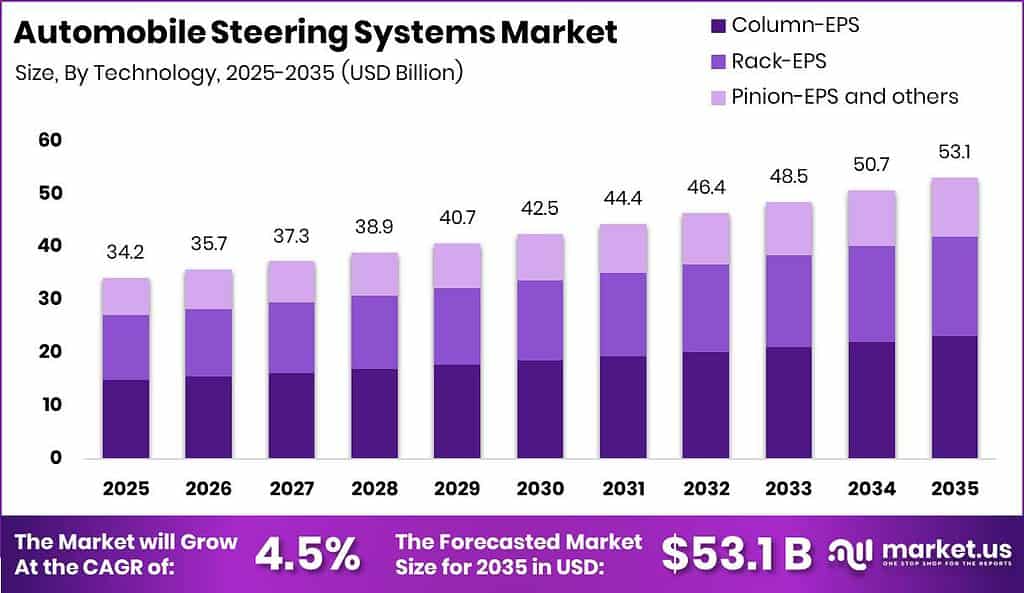
Global Automobile Steering Systems Market size is expected to be worth around USD 53.1 Billion by 2035 from USD 34.2 Billion in 2025, growing at a CAGR of 4.5% during the forecast period 2026 to 2035.
Therefore, the market covers systems that convert driver or automated inputs into controlled wheel angle across passenger and commercial platforms. Product structures span electric, hydraulic, electro hydraulic, and steer by wire architectures, plus columns, motors, pumps, sensors, and controllers. Content per vehicle rises as assistance moves from fluid circuits toward motors, torque sensing, and software calibration sold into OEM assembly programs.
Key Takeaways
- The market reaches USD 34.2 Billion in 2025 and USD 53.1 Billion by 2035 at a 4.5% CAGR.
- Electric Power Steering leads steering type mix with a 70.1% share.
- Steering column and rack lead components with a 36.5% share.
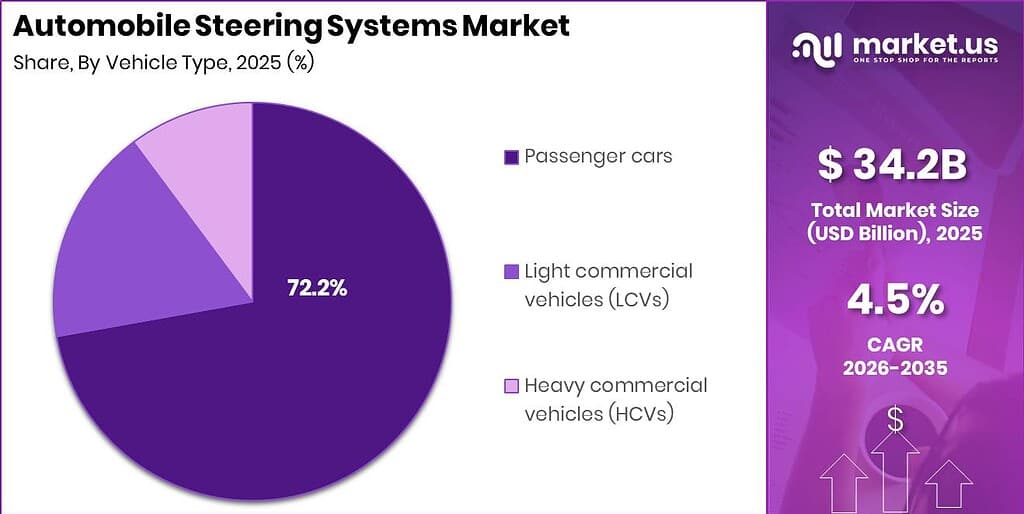
- Passenger cars lead vehicle type mix with a 72.2% share.
- Column-EPS leads technology mix with a 43.6% share.
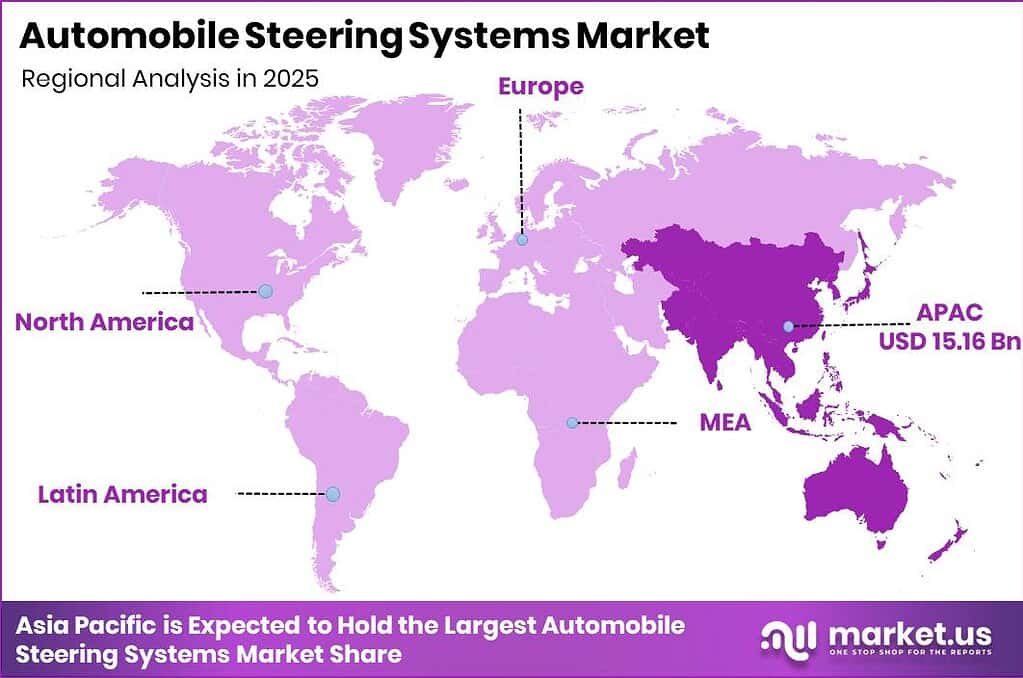
- Asia Pacific leads regional demand on vehicle output scale and local steering capacity buildout.
Government rules on power steering and automatically commanded steering functions raise the bar for electronically controllable architectures on new vehicle programs. UNECE Working Party 29 provisions push suppliers to prove controllability for ADAS-linked steering features before SOP gates clear. This means OEMs favor partners who already hold validated EPS and fail-operational software stacks. Higher compliance effort concentrates awards toward firms with reusable control modules rather than one-off mechanical designs.
As a result, end-use growth in electrified and software-defined vehicles lifts demand for higher-angle and higher-torque steering hardware. ZF EasyTurn doubles maximum front-wheel steering angle from 40 degrees to 80 degrees and cuts a midsize-car turning circle from more than 10 meters to less than 7 meters. In October 2025, Nexteer launched its Direct Drive Hand Wheel Actuator for 12V/48V software-defined vehicles. Suppliers who pair tight turning performance with low-voltage actuators win early design-ins on urban and EV platforms.
Steering Type Analysis
Electric Power Steering (EPS) dominates with 70.1% due to electric platforms without hydraulic pumps.
In 2025, Electric Power Steering (EPS) held a dominant market position in the By Steering Type segment of Automobile Steering Systems Market, with a 70.1% share. Figures from the IEA show electric car sales exceeded 20 million in 2025, equal to about one quarter of global car sales. This volume pulls steering content toward motors, torque sensors, and ECUs instead of engine-driven pumps. Suppliers with multi-platform EPS modules capture repeat awards as EV and hybrid programs scale.
Hydraulic Power Steering still serves selected internal combustion programs that retain belt-driven pump architectures and familiar steering feel targets. OICA data show global vehicle production reached about 96.4 million units in 2025, sustaining residual HPS call-offs where full electrification lags. This reflects slower powertrain transitions in some mass-market fleets. HPS specialists face margin pressure unless they migrate tooling and labor toward electro hydraulic or electric assist lines.
Electro Hydraulic Power Steering bridges pump-based assist and fuller electric control on mixed powertrain portfolios. Buyers use EHPS when packaging or cost blocks a full EPS switch yet electronic modulation is still required for basic driver-assist features. This creates a finite transition pool rather than a long-run volume core. Vendors should treat EHPS as a bridge SKU while shifting engineering spend to higher-volume electric architectures.
Manual and steer by wire systems form the fastest path for software-defined control and redundant actuation. Nexteer rear-wheel steering turns rear wheels by up to 12 degrees and had secured two Chinese OEM contracts with production expected in 2026. In January 2025, ZF Rane Automotive India launched localized rack drive EPS production lines that strengthen regional electric-assist supply. Early movers who lock redundant actuators and homologation evidence gain multi-year platform control.
Component Analysis
Steering column/rack dominates with 36.5% due to universal fit across platforms.
In 2025, Steering column/rack held a dominant market position in the By Component segment of Automobile Steering Systems Market, with a 36.5% share. Every assisted or manual layout still needs a mechanical path to the road wheels, so column and rack assemblies remain the highest-volume bill-of-materials anchor. OICA figures place Asia Pacific vehicle output near 59.2 million units in 2025, more than 61% of world production. Column and rack plants co-located with that build base protect delivery time and win share on cost.
Electric motors convert battery or alternator power into assist torque and now sit at the center of EPS value. IEA data show almost 22 million electric cars produced globally in 2025, a more than 25% rise on the prior year. This production wave multiplies motor content per steering gear across pure EV and hybrid lines. Motor suppliers who qualify noise, efficiency, and rare-earth risk packages become hard to displace mid-cycle.
Hydraulic pumps retain demand wherever HPS or EHPS remains specified on commercial or entry ICE models. Pump volume tracks residual hydraulic architectures rather than new EV clean-sheet designs. This signals a managed decline path, not an abrupt exit, in regions with slower electrification. Incumbent pump makers should harvest cash while reallocating machining capacity toward electric-assist housings.
Sensors are the fastest component line as torque, angle, and motor-position feedback become mandatory for ADAS-ready steering. ECU and related electronics package control logic, diagnostics, and cybersecurity hooks beside the sensor set and hold the remaining share collectively. UNECE links steering functions to broader electronic safety expectations, raising sensor and controller content per vehicle. Firms that sell sensor-plus-ECU kits raise switching costs versus stand-alone mechanical vendors.
Vehicle Type Analysis
Passenger cars dominates with 72.2% due to high global light vehicle volumes.
In 2025, Passenger cars held a dominant market position in the By Vehicle Type segment of Automobile Steering Systems Market, with a 72.2% share. Light passenger builds set the volume floor for EPS motors, columns, and calibration software across global platforms. IEA reporting shows EVs near 55% of car sales in China in 2025, concentrating electric steering demand in the largest single national car market. Passenger-car platform wins still decide most supplier revenue scale.
Light commercial vehicles need durable assist systems for stop-start urban routes and higher duty cycles than private cars. Electric LCV adoption adds demand for efficient low-voltage EPS that survives delivery fleet utilization. IEA-linked market tracking shows electric LCV sales growing over 40% in 2024 in major markets, with China above 450,000 units. LCV programs reward suppliers who prove thermal durability and lower total cost of ownership.
Heavy commercial vehicles are the fastest vehicle class as fleet electrification and tighter maneuvering needs reach trucks and buses. IEA data show electric truck sales more than doubled in 2025 to about 9% of global truck sales, with China near one in four trucks sold electric. Higher axle loads require stronger assist torque and redundant controls. HCV specialists who certify high-output electric steering early lock long fleet replacement cycles.
Technology Analysis
Column-EPS dominates with 43.6% due to packaging ease in compact cars.
In 2025, Column-EPS held a dominant market position in the By Technology segment of Automobile Steering Systems Market, with a 43.6% share. Column-assist packs the motor on the steering column, which suits transverse engine bays and cost-focused passenger platforms. Global vehicle production of about 96.4 million units in 2025 keeps high throughput on column-assist lines. Vendors with modular column-EPS families spread tooling cost across multiple OEM nameplates.
Rack-EPS places assist at the rack for sharper response and is preferred on performance and many midsize to premium cars. Higher on-center precision supports advanced driver-assist steering feel targets that column units may not match. This reflects buyer willingness to pay for steering feel on upper trims. Suppliers need dual column and rack catalogs or they cede premium program share.
Pinion-EPS and other layouts serve niche packaging cases and transitional architectures where column or rack mounts are constrained. These configurations hold the remaining technology share and matter on selected platforms rather than as the default global standard. This creates selective RFQ opportunities for flexible engineering teams. Broad-line suppliers should keep pinion options available without over-investing relative to column and rack cores.
Key Market Segments
By Steering Type
- Electric Power Steering (EPS)
- Hydraulic Power Steering (HPS)
- Electro-Hydraulic Power Steering (EHPS)
- Manual / Steer-by-wire (SbW and others)
By Component
- Steering column/rack
- Electric motor
- Hydraulic pump
- Sensors
- ECU and others
By Vehicle Type
- Passenger cars
- Light commercial vehicles (LCVs)
- Heavy commercial vehicles (HCVs)
By Technology
- Column-EPS
- Rack-EPS
- Pinion-EPS and others
Regional Analysis
Asia Pacific Dominates the Automobile Steering Systems Market through Vehicle Output Scale and Local Steer by Wire Capacity
Asia Pacific anchors demand because regional vehicle output and EV manufacturing density pull steering content into local plants. ZF reported steer-by-wire start of production at Zhangjiagang in the first quarter of 2025 on the NIO ET9 and plans annual capacity of 380,000 steer-by-wire systems with official SOP in the first quarter of 2026. In December 2024, ZF finalized a 3,700 m² Anting Shanghai expansion for ADAS and EV production needs. Local capacity shortens logistics and locks Chinese and wider Asia OEM awards.
Europe is a critical validation and premium deployment theater even where build rates are softer. ZF stated that its Mercedes-Benz application would mark Europe’s first series production of a steer-by-wire vehicle in 2026. That SOP date turns Europe into the reference homologation stage for global follow-on programs. Suppliers who clear European series quality gates gain a transferable safety case for other regions.
India and other fast-localizing markets add a second growth lane for column and rack EPS. In January 2025, ZF Rane Automotive India expanded through a licensing agreement for column drive EPS systems aimed at the Indian domestic market. This reflects OEM pressure to localize electric assist as passenger volumes rise. Regional license and localization deals cut import duty exposure and improve award odds on domestic platforms.
Key Regions and Countries
North America
- US
- Canada
Europe
- Germany
- France
- The UK
- Spain
- Italy
- Rest of Europe
Asia Pacific
- China
- Japan
- South Korea
- India
- Australia
- Rest of APAC
Latin America
- Brazil
- Mexico
- Rest of Latin America
Middle East and Africa
- GCC
- South Africa
- Rest of MEA
Market Dynamics
Market Opportunity Analysis - Faster vehicle classes, sensor-rich builds, and under-localized regions open white space
Heavy commercial vehicles remain underexploited relative to passenger-car EPS scale even though they are the fastest vehicle class. Fleet electrification and tighter urban maneuvering raise assist torque and redundancy needs that car-derived units may not meet. This creates room for HCV-specific high-output electric steering platforms. Early movers who certify truck and bus systems can lock multi-year fleet replacement contracts before generalists adapt.
Sensors are the fastest component line yet still trail column and rack revenue concentration. ADAS-ready torque and angle sensing raises electronics content while many awards still price mechanical hardware as the core. Therefore pure-play sensing and ECU bundles can take share from mechanical-only vendors. Investors should favor suppliers who sell calibrated sensor-controller kits with cybersecurity documentation included.
India and wider localization corridors remain under-penetrated versus China-centric steer by wire capacity. Domestic passenger growth and duty pressure favor local column and rack EPS over fully imported systems. This signals attractive joint-venture and license economics for global majors. New entrants that co-invest tooling with local partners can win share without building full global plants first.
Manual and steer by wire architectures still hold a small installed base versus EPS leadership, leaving software-defined control under-served on mass platforms. Clean-sheet EV programs are the practical entry gate for redundant actuators and hand-wheel feedback devices. As a result, modular steer by wire that reuses software across trims can out-earn one-off premium pilots. Capital should prioritize scalable redundancy kits over bespoke show-car systems.
Technology and Innovation Landscape - Higher torque, rear steering, and wire control redefine product roadmaps
Column-assist torque capability is rising to serve heavier vehicles without a full rack redesign. Nexteer standard column-assist electric power steering provides 40 to 95 Nm of steering-assist torque for heavier vehicles. That band lets OEMs keep column packaging while covering higher front-axle loads. Suppliers outside this torque window risk exclusion from crossover and light-truck EPS shortlists.
High-output column systems extend that envelope further for next-wave vehicle weights. Nexteer launched High-Output CEPS in April 2025 with steering-assist capacity of up to 110 Nm, beyond its standard CEPS range. This signals a clear migration path for platforms that outgrow legacy assist limits. Investors should track which OEMs standardize high-output CEPS as a shared module across nameplates.
Steer by wire changes the driver interface by cutting hand-wheel work and enabling new cabin layouts. ZF’s steer-by-wire system can reduce maximum steering-wheel rotation to 180 to 210 degrees, removing hand-over-hand steering in the described application. Cabin designers can then free space and reshape cockpits for automated modes. First series awards will set software and actuator standards that followers must match.
Rear-axle steering complements front assist for low-speed turn-in and high-speed stability. ZF’s second-generation Active Kinematics Control rear-steering system can deliver a unilateral rear-wheel steering angle of up to ±12 degrees. Combined front and rear control improves urban agility without larger steering wheels. Chassis suppliers who own both front steer by wire and rear AKC can bundle full-vehicle motion control.
Drivers
Electrified vehicle architectures expand the installed base for electric power steering because they need assist without an engine-driven hydraulic pump. Value therefore shifts from mechanical assemblies toward motors, torque sensors, electronic control units, and calibration software. The International Energy Agency reports global electric-car sales exceeded 17 million in 2024, more than 20% of total car sales. The extra 3.5 million electric cars sold versus 2023 exceeded the entire global electric-car market of 2020.
IEA data also record 17.3 million electric cars produced globally in 2024, including 12.4 million in China, concentrating scale sourcing in the largest electrified build base. UNECE Working Party 29 steering provisions cover power steering and automatically commanded steering functions. This raises commercial weight for electronically controllable steering on ADAS-equipped vehicles. The content-per-vehicle shift supports about +1.2% CAGR contribution when suppliers reuse common modules across high volumes.
| Driver | (~) % Impact on CAGR Forecast | Geographic Relevance | Impact Timeline |
|---|---|---|---|
| Electrified-platform EPS adoption | +1.2% | Global, strongest in China, Europe and North America | Medium term (2 to 4 years) |
| ADAS steering-function integration | +0.9% | Europe, North America, China, Japan | Short term (2 years or less) |
| Lightweight efficiency upgrades | +0.6% | Global passenger-vehicle platforms | Short term (2 years or less) |
| Premium steering-feel differentiation | +0.5% | North America, Europe, China, Gulf markets | Medium term (2 to 4 years) |
| Commercial-vehicle electrification | +0.4% | China, Europe, North America | Medium term (2 to 4 years) |
Restraints
Steering demand tracks vehicle build schedules, so production cuts reduce component call-offs while engineering, tooling, and plant overhead stay fixed. ACEA records global car manufacturing of 75.5 million units in 2024, down 0.5% year on year, while EU car production fell 6.2% to 11.4 million units. Such losses weaken capacity absorption at European steering plants. Customers then intensify annual price-down demands on remaining volume.
ACEA further reported only 0.8% growth in EU car registrations during 2024, showing weak regional production was not a brief inventory correction. The IMF flagged elevated policy uncertainty and tariff rates in its 2025 outlook, complicating program planning and supplier capital allocation. This is a sales restraint that can defer new steering-line investment and compress margins before costs resize. The pattern supports about -1.0% drag on baseline CAGR when builds stay soft.
| Restraint | (~) % Impact on CAGR Forecast | Geographic Relevance | Impact Timeline |
|---|---|---|---|
| Vehicle-output volatility | -1.0% | Europe, North America and export-dependent production hubs | Short term (2 years or less) |
| OEM cost-down pressure | -0.8% | Global mass-market platforms | Short term (2 years or less) |
| Tariff-driven input inflation | -0.5% | North America and Europe | Medium term (2 to 4 years) |
| Low-cost manual-steering persistence | -0.4% | South Asia, Africa and selected Latin American markets | Medium term (2 to 4 years) |
| High validation-entry costs | -0.3% | Global, especially new entrants | Medium term (2 to 4 years) |
Challenges
As steering becomes an electronically controlled safety domain, makers must prove sensors, control logic, power paths, and fallback modes keep the vehicle controllable through defined faults. UNECE places automatically commanded steering systems, including lane keeping, lane change, low-speed assistance, corrective steering, and emergency steering, under UN Regulation 79. That scope widens the functional cases developers must validate before launch. Longer safety cases slow advanced feature release even when base EPS sales continue.
UNECE documentation also links steering-equipment rules to UN Regulation 155 cybersecurity-management requirements, adding cyber assessment, evidence retention, and software-change governance to the workload. Automated-driving work further requires monitoring programs that collect and analyse operational information after launch. The estimated -0.8% friction drag reflects more hardware-in-the-loop testing and specialist software cost. Suppliers who sell reusable safety architectures and automated regression tools open a services revenue stream around validation capacity.
| Challenge | (~) % CAGR Friction Drag | Geographic Relevance | Mitigation Horizon |
|---|---|---|---|
| Fail-operational software validation | -0.8% | Global, initially premium and automated vehicles | Long term (4 years or more) |
| Automotive semiconductor qualification | -0.6% | Global electronics supply chain | Medium term (2 to 4 years) |
| Cybersecurity lifecycle compliance | -0.5% | Europe, Japan, Korea and UNECE-adopting markets | Medium term (2 to 4 years) |
| Rare-earth motor exposure | -0.4% | Global, concentrated upstream exposure | Long term (4 years or more) |
| Safety-software talent scarcity | -0.3% | Global engineering centers | Long term (4 years or more) |
Opportunities
Steer-by-wire remains an untapped platform opportunity because high-volume architectures still mostly keep a mechanical steering link. Scalable modular redundancy, homologation evidence, and customer acceptance still need deliberate investment. UNECE steering-rule work includes a proposal on steer-by-wire under amendments to UN Regulation 79, signalling a regulatory path without an immediate mass-market mandate. Early design-ins on clean-sheet EVs can set the module standard for later derivatives.
The International Energy Agency reports available electric-car models rose 15% year on year to nearly 785 in 2024, expanding clean-sheet programs for modular steering pitches. IEA also projects electric-car sales above 20 million in 2025, more than one quarter of global car sales, creating a large future platform pool. A supplier that standardizes redundant actuators, controllers, and software could target about 10% to 20% higher system revenue per equipped vehicle than conventional EPS. Estimated +1.1% upside depends on converting that white space into platform contracts and updatable software.
| Opportunity | (~) % Potential CAGR Upside | Geographic Relevance | Execution Window |
|---|---|---|---|
| Steer-by-wire platform modules | +1.1% | China, Japan, Europe and North America | Long term (4 years or more) |
| Software-enabled steering services | +0.8% | Global premium fleets and mobility services | Long term (4 years or more) |
| Aftermarket diagnostic ecosystems | +0.6% | North America, Europe and urban Asia | Medium term (2 to 4 years) |
| Low-voltage steering localization | +0.5% | India, ASEAN, Africa and Latin America | Medium term (2 to 4 years) |
| Fleet steering-health analytics | +0.4% | Commercial fleets globally | Medium term (2 to 4 years) |
Key Company Insights
JTEKT Corporation anchors its position through deep EPS system integration sold into high-volume global OEM platforms. That integration ties mechanical gears, motors, and control software into one validated package that shortens OEM sourcing cycles. This creates an advantage on programs that punish multi-vendor interface risk. The risk is slower rotation into pure steer by wire if capital stays weighted toward conventional EPS families.
Robert Bosch GmbH strengthens European electric steering supply through automated manufacturing scale and electronics depth. In December 2024, Bosch expanded its European footprint with new automated electric steering production in Hungary. Local automated capacity cuts lead times for EU OEMs under content and logistics pressure. The approach raises barriers for smaller entrants that lack regional plants and mechatronic stacks.
Key Players
- JTEKT Corporation
- Robert Bosch GmbH
- ZF Friedrichshafen AG
- Nexteer Automotive Corporation
- NSK Ltd.
- Mando Corporation
- Showa Corporation
- Hitachi Astemo, Ltd.
- Hyundai Mobis Co., Ltd.
- ThyssenKrupp AG / thyssenkrupp Presta
- Denso Corporation
- China Automotive Systems Inc.
- Mitsubishi Electric Corporation
- Knorr-Bremse AG
- Aisin Seiki Co., Ltd.
- Others
Recent Developments
- February 2026: Bethel Automotive Safety Systems acquired a 50.97% stake in Yubei Steering System (Xinxiang) to bolster electric steering capabilities in China.
- April 2026: Nexteer Automotive commenced volume production of its steer by wire system for a leading Chinese NEV manufacturer.
- January 2026: Hyundai Mobis and Mando Corporation announced investments in shared steer by wire platforms.
- February 2026: JTEKT and NSK introduced high efficiency, compact EPS units for next generation vehicles.
- March 2026: ZF, Bosch, and Nexteer initiated major capital investments to expand global steer by wire and EPS production capacity.
Geopolitical Impact Analysis
According to UNCTAD, shipping carries over 80% of world merchandise trade, while seaborne trade volume growth is forecast at only 0.5% in 2025 after stronger expansion the prior year. Red Sea and related rerouting lengthens voyages and lifts freight volatility for steering motors, ECUs, and machined housings moved between Asia, Europe, and North America. This means landed cost swings can erase thin EPS margins on long ocean legs. Suppliers with dual-region machining and buffer stocks protect OEM delivery scores when routes stretch.
Data from trade policy tracking shows U.S. measures lifting steel and aluminum duties toward 50% ad valorem on many origins, while a 25% tariff line on automobiles and related parts pressure has reshaped sourcing talks. Steering columns, racks, and motor housings embed steel and aluminum content that reprices quickly under Section 232-style actions. Consequently, North American programs push localization of racks, pumps, and cast housings to avoid stacked duties. Regional tool moves and nearshore forging become competitive necessities rather than optional footprint upgrades.
Report Scope
| Report Features | Description |
|---|---|
| Market Value (2025) | USD 34.2 Billion |
| Forecast Revenue (2035) | USD 53.1 Billion |
| CAGR (2026-2035) | 4.5% |
| Base Year for Estimation | 2025 |
| Historic Period | 2020-2024 |
| Forecast Period | 2026-2035 |
| Report Coverage | Revenue Forecast, Market Dynamics, Market Opportunity Analysis, Technology and Innovation Landscape, Competitive Landscape, Recent Developments |
| Segments Covered | By Steering Type (Electric Power Steering (EPS), Hydraulic Power Steering (HPS), Electro-Hydraulic Power Steering (EHPS), Manual / Steer-by-wire (SbW and others)), By Component (Steering column/rack, Electric motor, Hydraulic pump, Sensors, ECU and others), By Vehicle Type (Passenger cars, Light commercial vehicles (LCVs), Heavy commercial vehicles (HCVs)), By Technology (Column-EPS, Rack-EPS, Pinion-EPS and others) |
| Regional Analysis | North America (US and Canada), Europe (Germany, France, The UK, Spain, Italy, and Rest of Europe), Asia Pacific (China, Japan, South Korea, India, Australia, and Rest of APAC), Latin America (Brazil, Mexico, and Rest of Latin America), Middle East and Africa (GCC, South Africa, and Rest of MEA) |
| Competitive Landscape | JTEKT Corporation, Robert Bosch GmbH, ZF Friedrichshafen AG, Nexteer Automotive Corporation, NSK Ltd., Mando Corporation, Showa Corporation, Hitachi Astemo, Ltd., Hyundai Mobis Co., Ltd., ThyssenKrupp AG / thyssenkrupp Presta, Denso Corporation, China Automotive Systems Inc., Mitsubishi Electric Corporation, Knorr-Bremse AG, Aisin Seiki Co., Ltd., Others |
| Customization Scope | Customization for segments, region / country-level will be provided. Additional customization can be done based on requirements. |
| Purchase Options | We have three licenses to opt for: Single User License | Multi-User License (Up to 5 Users) | Corporate Use License (Unlimited User and Printable PDF) |





































