


Quick Navigation
Report Overview
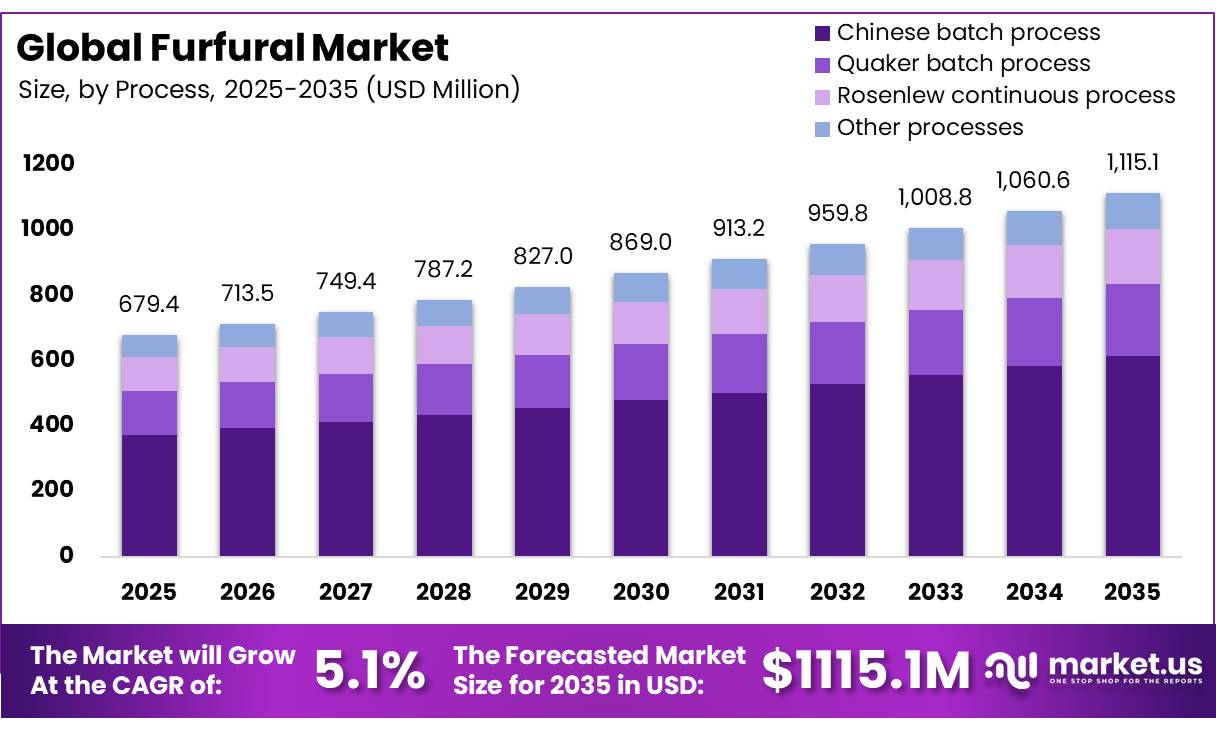
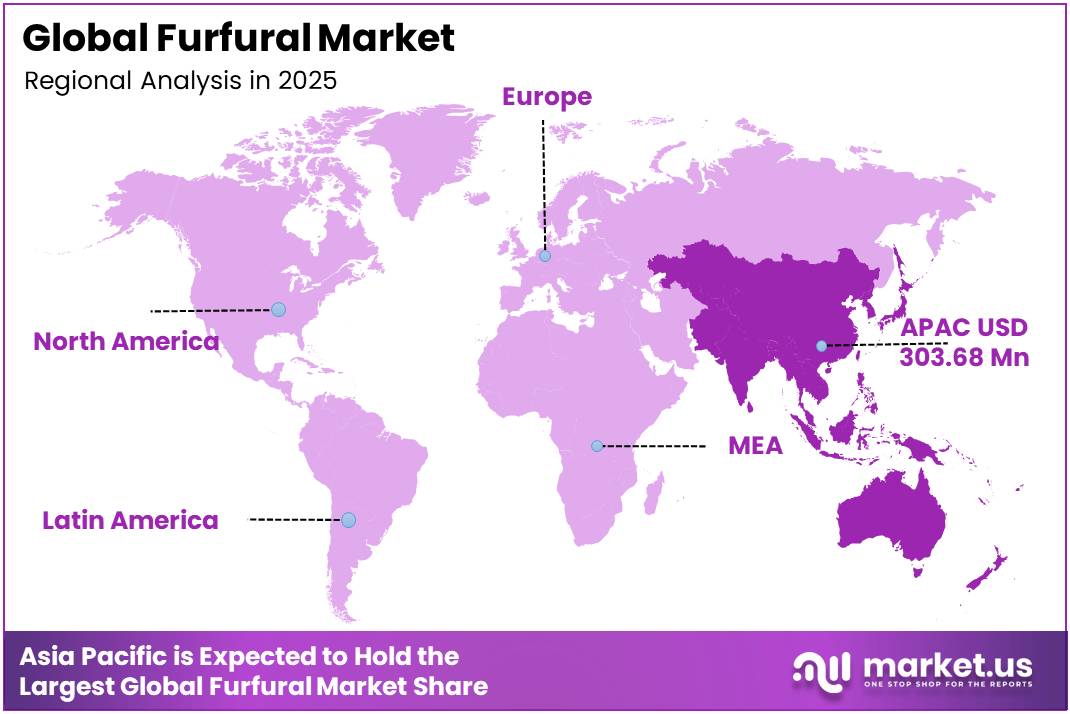
In 2025, the Global Furfural Market was valued at US$679.4 million, and between 2026 and 2035, this market is estimated to register a CAGR of 5.1%, reaching about US$1115.1 million by 2035. Asia Pacific held a dominant market position, capturing more than a 44.7% share, holding USD 303.7 million in revenue.
Furfural is a renewable heterocyclic aldehyde produced by acid-catalysed dehydration of pentose sugars contained in corncobs, oat hulls, sugarcane bagasse, wheat bran, and forestry residues. Its industrial value comes from its role as a selective refining solvent and as a platform intermediate for furfuryl alcohol, furan resins, tetrahydrofurfuryl alcohol, specialty solvents, agrochemical ingredients, and fuel molecules. NREL identifies furfural from C5 sugars as a key platform molecule for producing chemicals and C9–C16 hydrocarbons suitable for jet- and diesel-fuel blending.
- USDA estimated United States corn production at a record 17.0 billion bushels in 2025, 14% above 2024, indicating a large potential stream of corncob and stalk residues without diverting food-grade grain. However, commercial conversion remains resource-intensive. A 2025 Royal Society of Chemistry assessment based on industrial data reported that 12.24 tonnes of corncob yielded 1.12 tonnes of furfural, alongside 1.00 tonne of furfuryl alcohol and 0.11 tonne of methylfuran.
Key Takeaways
- The Global furfural market was valued at USD 679.4 million in 2025.
- The Global market is projected to grow at a CAGR of 5.1% and is estimated to reach USD 1,115.1 million by 2035.
- By process, the Chinese batch process dominated the global furfural market, accounting for 55.1% of the total market share in 2025.
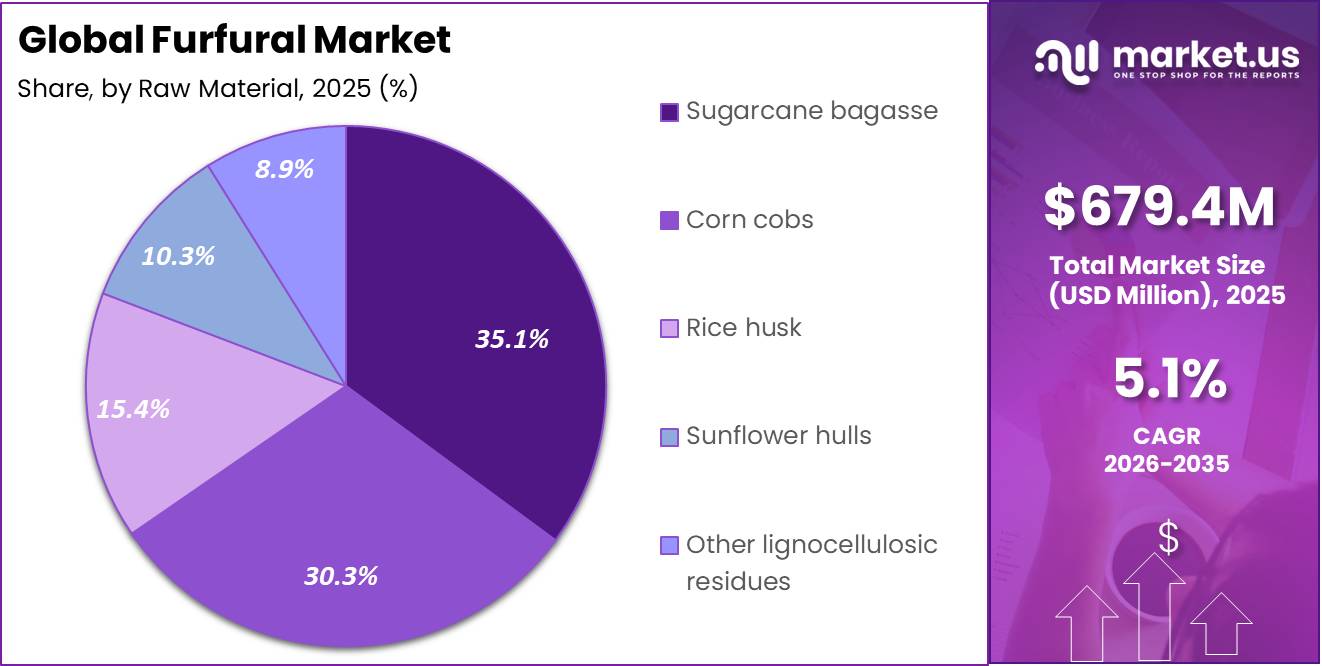
- Based on raw material, sugarcane bagasse led the market, comprising 35.1% of the total market share.
- On the basis of application, furfuryl alcohol dominated the market, constituting 70.1% of the total market share.
- Among the end-use industries, refineries and petrochemicals held the largest share in the furfural market, accounting for 39.7% of the market share.
- In 2025, Asia Pacific dominated the global furfural market, accounting for 44.4%, the largest share of global consumption due to the strong availability of agricultural residues and the presence of major furfural manufacturers in countries such as China and India.
Demand is supported by foundry binders, corrosion-resistant resins, lubricant refining, pharmaceutical intermediates, and pressure to replace fossil-derived solvents. The strongest operating drivers are low-cost residue supply, integrated steam generation, higher catalyst selectivity, and downstream conversion into higher-value derivatives. Producers must nevertheless manage sulfuric-acid consumption, wastewater neutralisation, energy-intensive distillation, variable biomass quality, and occupational exposure controls.
Future opportunities are expected in continuous reactors, reusable solid-acid catalysts, solvent-efficient separation, and integrated biorefineries that monetise cellulose, lignin, heat, and power alongside furfural. Policy support is strengthening this pathway.
The EU’s Circular Bio-based Europe Joint Undertaking opened a €170.7 million 2026 call, including €20 million for biorefinery competitiveness and €14 million for residual-biomass valorisation. These programmes should accelerate demonstration plants, improve yields, lower emissions, and expand furfural’s role in renewable resins, solvents, and advanced fuels.
Furfural Market Segmentation
Process Analysis
Chinese Batch Process leads the Furfural Market with a 55.1% share due to simple operation and biomass-based production
In March 2025, Chinese batch process held a dominant market position, capturing more than a 55.1% share of the furfural market by process. Its leadership was supported by straightforward equipment design, lower initial investment, and suitability for processing corncobs, bagasse, and other agricultural residues. The process remained widely used because producers could operate in batches, adjust feedstock quality, and manage production with established acid-hydrolysis methods.
Quaker batch process showed growth in 2025 as manufacturers looked for improved heat control, better recovery, and more consistent product quality. Its operating structure supported higher process discipline and more efficient handling of biomass feedstocks. The segment also gained attention from producers seeking better yield management, reduced material losses, and smoother downstream purification.
Raw Material Analysis
Sugarcane bagasse leads with 35.1% due to availability and efficient residue use
In March 2025, Sugarcane bagasse held a dominant market position, capturing more than a 35.1% share of the furfural market by raw material. Its leadership was supported by availability from sugar-processing operations and pentosan content. Producers preferred bagasse because it could be sourced as an agricultural residue, helping lower disposal pressure while supporting biomass-based chemical production. Its established collection systems, handling, and suitability for acid hydrolysis further strengthened its use in furfural plants.
Corn cobs emerged as a growing raw material in 2025 because of their high pentosan content and suitability for furfural conversion. Their seasonal availability, concentrated supply near corn-processing areas, and low competing industrial use encouraged adoption. Producers also valued corn cobs for consistent quality, manageable storage, and efficient processing performance.
Application Analysis
Furfuryl Alcohol leads with 70.1% due to strong demand from foundry resins and industrial binders
In 2025, Furfuryl alcohol held a dominant market position, capturing more than a 70.1% share of the furfural market by application. In March 2025, its leadership remained supported by widespread use in furan resins, foundry binders, corrosion-resistant materials, and composite products. Manufacturers preferred furfuryl alcohol because it offered strong thermal stability, chemical resistance, and reliable bonding performance. Its established role in metal casting and industrial resin production also supported consumption across manufacturing regions.
Solvent applications showed growing demand in 2025 as industries increased the use of furfural for refining lubricating oils, extracting unsaturated compounds, and processing specialty chemicals. Its selective solvency, renewable feedstock origin, and suitability for chemical systems encouraged wider adoption. Producers also explored its use in coatings, pharmaceutical processing, and value-added industrial operations.
End-Use Analysis
Refineries and Petrochemicals lead with 39.7% due to strong demand for selective refining solvents
In 2025, Refineries and petrochemicals held a dominant market position, capturing more than a 39.7% share of the furfural market by end use. In March 2025, the segment remained strong because furfural was used as a selective solvent in lubricant refining and petrochemical separation. Its ability to remove unwanted aromatic compounds helped producers improve oil quality and processing efficiency. Established refinery infrastructure, solvent requirements, and compatibility with operations further supported its leading position.
Agriculture and agrochemicals emerged as a growing end-use segment in 2025. Furfural gained attention as an intermediate for pesticides, herbicides, fungicides, and other crop-protection formulations. Its biomass-based origin, chemical versatility, and suitability for specialty synthesis encouraged wider adoption among agrochemical producers seeking efficient and renewable raw materials.
Key Market Segments
By Process
- Chinese batch process
- Quaker batch process
- Rosenlew continuous process
- Other processes
By Raw Material
- Sugarcane bagasse
- Corn cobs
- Rice husk
- Sunflower hulls
- Other lignocellulosic residues
By Application
- Furfuryl alcohol
- Solvent
- Intermediate
- Other specialty chemicals
By End Use
- Refineries and petrochemicals
- Agriculture and agrochemicals
- Food and beverage
- Pharmaceuticals
- Others
Drivers
Electrosynthesis and High-Yield Catalytic Innovation
Technology innovation in electrosynthesis and advanced catalytic conversion is transforming furfural’s value proposition by unlocking new high-margin downstream molecules and reducing the energy and capital intensity of production, which together expand the investable universe for furfural capacity. Project PERFORM, led by TNO and highlighted in World Biomarket Insights in February 2026, demonstrates that biobased furfural can be electrochemically converted to maleic acid a polyester resin precursor as well as to furoic acid, hydrofuroin, and other derivatives with applications in fragrances, food additives, and sustainable aviation fuels, transforming the electrochemical reactor from a cost center into a selectivity-management asset.
Simultaneously, process-engineering studies in 2024–2025 show that catalytic systems using ZnCS-2 at 10 weight percent loading can achieve furfural yields of up to approximately 72 percent from xylose-rich feedstocks at 180 degrees Celsius over 60 minutes, with a conceptual process assessment confirming the pathway is technically scalable. These advances matter to market growth because they break the yield ceiling and product specificity limitations that have historically constrained furfural’s economics in high-cost energy environments; by enabling modular electrochemical units that can be co-located with biorefineries and fueled by renewable electricity, they also open the door to EU and North American deployment models that would otherwise be uneconomical at regional energy and labor costs.
Drivers Impact Analysis
| Driver | (~) % Impact on CAGR | Geographic Relevance | Impact Timeline |
|---|---|---|---|
| Bio-based platform chemical demand | +1.6% | Asia Pacific core, EU, North America | Long term (≥ 4 years) |
| Furfuryl alcohol and furan resin demand | +1.3% | China, APAC foundry hubs, EU, North America | Medium term (2-4 years) |
| Agro-residue valorization via biorefineries | +1.0% | China, Brazil, Southeast Asia, LATAM | Long term (≥ 4 years) |
| Electrosynthesis and high-yield catalytic innovation | +0.9% | EU tech hubs, U.S., Japan | Medium term (2-4 years) |
| SAF and biofuel mandate integration | +0.8% | EU, UK, U.S., APAC corridors | Long term (≥ 4 years) |
| Regulatory push for renewable carbon inputs | +0.7% | EU regulatory core, OECD economies | Medium term (2-4 years) |
Restraints
Toxicity-led compliance burden
Furfural’s hazardous profile is a direct growth restraint because it materially increases handling, storage, transport, and workplace-compliance costs across the entire value chain, raising the minimum efficient scale for profitable production and discouraging smaller entrants. OSHA chemical data list a permissible exposure limit of 5 ppm, equivalent to 20 mg/m3, while published threshold limit guidance also references much tighter control benchmarks, and state hazard bulletins note that furfural can be absorbed through the skin, irritate eyes and respiratory tissues, and in higher exposures affect the lungs, liver, kidneys, and central nervous system.
The new Chinese Hazardous Chemicals Safety Law, effective 1 May 2026, reinforces this burden by requiring full-lifecycle controls, dedicated safety personnel, registration, and licensing, with penalties reaching 200,000 RMB for registration failures and up to 500,000 RMB for unlicensed hazardous-chemical operations.
Restraint Impact Analysis
| Restraint | (~) % Impact on CAGR | Geographic Relevance | Impact Timeline |
|---|---|---|---|
| China supply concentration | -1.5% | Global; EU, North America, Japan importers | Long term (≥ 4 years) |
| Toxicity-led compliance burden | -1.2% | Global plants; China, EU, U.S. core | Long term (≥ 4 years) |
| Price volatility and margin squeeze | -1.0% | Global; EU and U.S. downstream users | Medium term (2-4 years) |
| Hazardous plant CapEx intensity | -0.9% | APAC emerging, LATAM, Africa | Long term (≥ 4 years) |
| Trade and regulatory exposure | -0.8% | China exporters, EU hubs, U.S. buyers | Medium term (2-4 years) |
| Environmental treatment overhead | -0.7% | China clusters, developing-market plants | Long term (≥ 4 years) |
Opportunity
Diversified non-China biorefinery hubs
Geographic diversification of furfural capacity into new biorefinery hubs outside China is a forward-looking opportunity rather than a current driver because as of 2025 mainland China still controls nearly 90 percent of global capacity and over 80 percent of consumption, leaving only a small fraction of production elsewhere and making non-China supply a residual niche.
With tens of millions of tons of sugarcane bagasse and other lignocellulosic residues generated annually in Brazil, Southeast Asia, and parts of Africa, and with many of these residues still burned for low-value energy, the potential to convert even 5–10 percent of available pentosan-rich biomass into furfural at yields approaching 60–70 percent, as reported in recent kinetic and process-assessment studies, would support hundreds of thousands of tons of new capacity across multiple regions.
This white space is not yet captured because the capex and hazardous-process hurdles concentrate today’s investments in China’s established chemical clusters; however, over a 10–15 year horizon, replicating even a third of China’s 2025 capacity in LATAM and ASEAN would materially reduce concentration risk and give local resin, solvent, and fuel industries a domestic renewable-carbon feedstock, which can support regional policy goals and lower logistics costs.
Opportunity Impact Analysis
| Opportunity | (~) % Potential CAGR | Geographic Relevance | Execution Window |
|---|---|---|---|
| Diversified non-China biorefinery hubs | +1.0% | LATAM, ASEAN, Africa, EU | Long term (≥ 4 years) |
| High-value specialty & pharma intermediates | +0.9% | EU, North America, Japan | Medium term (2-4 years) |
| SAF-oriented furfural routes | +0.8% | EU, UK, U.S., APAC aviation | Long term (≥ 4 years) |
| Modular electrosynthesis licensing | +0.7% | EU tech hubs, U.S., Japan, Korea | Medium term (2-4 years) |
| Integrated agro-industrial JV platforms | +0.6% | Brazil, China hinterland, Southeast Asia | Long term (≥ 4 years) |
| Digital trading, pricing, and risk tools | +0.5% | Global buyers; EU, U.S., Japan importers | Short term (≤ 2 years) |
Challenge
Global logistics and energy shocks
Supply-chain analyses in 2026 highlight that retailers and manufacturers alike are operating under rising transportation costs, labor shortages, regulatory complexity, and environmental pressures, with global sourcing and demand volatility adding layers of unpredictability; in this environment, chemical shipments must contend with higher freight rates, longer lead times, and more frequent disruptions.
Sector-wide assessments of chemical price volatility emphasize that geopolitical events and trade policies—such as tensions around the Strait of Hormuz and Middle East disruptions in 2025–2026—have tightened supplies of energy and petrochemical feedstocks, driving up costs for heat and power-intensive chemical processes and affecting logistics through fuel surcharges and capacity constraints.
Strategically, companies must invest in diversified routing, multiple logistics partners, and potentially in nearer-to-market capacity to reduce exposure; however, these network adjustments take years and capital, so in the interim the industry operates under higher average supply-chain costs and variability, trimming perhaps 0.7 percentage points off the maximum growth that would be feasible under stable logistics and energy regimes.
Challenges Impact Analysis
| Challenge | (~) % CAGR Friction | Geographic Relevance | Mitigation Horizon |
|---|---|---|---|
| Seasonal feedstock variability | -0.9% | APAC agro belts, LATAM, Africa | Medium term (2-4 years) |
| Chemical price volatility | -0.8% | EU, U.S., import-dependent buyers | Medium term (2-4 years) |
| Global logistics and energy shocks | -0.7% | APAC corridors, EU hubs, U.S. ports | Long term (≥ 4 years) |
| Process efficiency and yield dispersion | -0.6% | Legacy plants in China, APAC, LATAM | Long term (≥ 4 years) |
| Chemical engineering talent gaps | -0.5% | EU, North America, UK, Japan | Long term (≥ 4 years) |
| Digital and risk-management maturity | -0.4% | Mid-sized producers and buyers worldwide | Medium term (2-4 years) |
Geopolitical Impact Analysis
Global Supply Chain Dependence and Trade Policies Influence the Furfural Market
Geopolitical trends, trade regulations, and international supply chain dynamics all have a significant impact on the global furfural market. Furfural production is heavily concentrated in Asia, particularly in China, so any disruptions caused by export policies, logistics, energy prices, or trade tensions can have a direct impact on global supply availability and pricing trends. China remains a leading producer and exporter of furfural due to its large-scale manufacturing infrastructure, low production costs, and abundant biomass feedstocks.
Rising geopolitical tensions and shifting trade policies are encouraging countries and chemical manufacturers to reduce their reliance on single-country sourcing approaches. Increasing transportation costs, fluctuating fuel prices, and stricter environmental regulations all have an impact on international furfural trade and manufacturers’ operational expenses. These developments are encouraging businesses to focus on regional production expansion and localized supply chains in order to improve market stability and lower procurement risks.
For instance, in October 2023, tightening environmental compliance inspections in several major chemical manufacturing provinces in China temporarily reduced operating rates of biomass-based chemical plants, leading to short-term supply tightness in export markets. Similarly, in March 2024, increased freight and energy costs across Asia-Pacific shipping routes further raised landed costs for furfural imports in Europe and North America, impacting downstream resin and solvent manufacturers.
Regional Analysis
Asia Pacific Dominates the Global Furfural Market
Asia Pacific has emerged as the leading region in the global furfural market, accounting 44.7% for the majority of both production and consumption in 2025. The region’s leadership is primarily driven by its well-established industrial infrastructure, large-scale chemical manufacturing base, and abundant supply of agricultural feedstock for furfural production. Countries like China and India, with their extensive furfural production facilities and cost-effective manufacturing capabilities, play an important role in strengthening the regional market.
Furthermore, government support for sustainable chemical production and ongoing investments in biorefinery projects help to boost the region’s production capacity. Overall, Asia Pacific not only dominates the global market in terms of share, but it also serves as the primary growth engine, accounting for the majority of global output and significantly influencing pricing and supply dynamics in the furfural industry.
Key Regions and Countries Covered
- North America
- The US
- Canada
- Europe
- Germany
- France
- The UK
- Spain
- Italy
- Russia & CIS
- Rest of Europe
- APAC
- China
- Japan
- South Korea
- India
- ASEAN
- Rest of APAC
- Latin America
- Brazil
- Mexico
- Rest of Latin America
- Middle East & Africa
- GCC
- South Africa
- Rest of MEA
Key Players Analysis
The global furfural market has an oligopolistic structure, with production and supply concentrated among a small number of established manufacturers, primarily in Asia Pacific. The market is not highly fragmented, as large-scale production requires significant capital investment, specialized processing technology, and consistent access to biomass feedstock, resulting in high entry barriers for new participants.
A small group of key producers, like ongye Holding Group Corporation Limited, Shandong Xinhua Pharmaceutical Co., Ltd., Tianyu Group, and Henan Tiancheng Furfural Co., Ltd primarily based in China, dominates global output, controlling a significant portion of production capacity and export supply. These established players benefit from economies of scale, integrated supply chains, and long-term customer relationships in end-use industries like refineries, petrochemicals, and chemical manufacturing.
Market Key Players
- Central Romana Corporation
- International Furan Chemicals IFC
- TransFurans Chemicals bvba
- Hongye Holding Group Corporation Limited
- Illovo Sugar Africa Pty Ltd
- Pennakem LLC
- Silvateam SpA
- Lenzing AG
- KRBL Limited
- Hebei Furan International or Hebeichem
- Henan Huilong Chemical Co Ltd
- Zibo Xinye Chemical Co Ltd
- Xingtai Chunlei Furfuryl Alcohol Co Ltd
- Behran Oil Co
- Tanin Group or Tanin dd
- Others
Key Development
- In July 2025, Central Romana Corporation completed its harvest after processing 3.21 million short tons of sugarcane and producing 306,904 short tons of sugar. The operation also generated 21.54 million gallons of molasses, supporting bagasse availability for furfural production.
- In September 2025, TransFurans Chemicals joined the €9.1 million SOLRESS project, supported by €7 million from the Circular Bio-based Europe Joint Undertaking. The company will help scale bio-based solvents, including furfural and 2-methyltetrahydrofuran.
- In October 2025, Pennakem LLC was renamed Minasolve LLC as Minafin Group combined its green chemistry operations. The restructuring strengthened its focus on furan chemistry, renewable solvents, and specialty bio-based chemicals.
- In March 2026, Lenzing AG reported producing about 1.218 million tons of dissolving wood pulp in 2025. Its integrated biorefinery continued producing wood-based furfural, acetic acid, pulp, and renewable energy.
Report Scope
| Report Features | Description |
|---|---|
| Market Value (2025) | USD 679.4 Mn |
| Forecast Revenue (2035) | USD 1,115.1 Mn |
| CAGR (2026-2035) | 5.1% |
| Base Year for Estimation | 2025 |
| Historic Period | 2020-2024 |
| Forecast Period | 2026-2035 |
| Report Coverage | Revenue Forecast, Market Dynamics, Competitive Landscape, Recent Developments |
| Segments Covered | By Process (Chinese Batch Process, Quaker Batch Process, Rosenlew Continuous Process, and Other Processes), By Raw Material (Sugarcane Bagasse, Corn Cobs, Rice Husk, Sunflower Hulls, and Other Lignocellulosic Residues), By Application (Furfuryl Alcohol, Solvent, Intermediate, and Other Specialty Chemicals), By End Use (Refineries and Petrochemicals, Agriculture and Agrochemicals, Food and Beverage, Pharmaceuticals, and Others) |
| Regional Analysis | North America – The US & Canada; Europe – Germany, France, The UK, Spain, Italy, Russia & CIS, Rest of Europe; APAC– China, Japan, South Korea, India, ASEAN & Rest of APAC; Latin America– Brazil, Mexico & Rest of Latin America; Middle East & Africa– GCC, South Africa, & Rest of MEA |
| Competitive Landscape | Central Romana Corporation, International Furan Chemicals IFC, TransFurans Chemicals bvba, Hongye Holding Group Corporation Limited, Illovo Sugar Africa Pty Ltd, Pennakem LLC, Silvateam SpA, Lenzing AG, KRBL Limited, Hebei Furan International (Hebeichem), Henan Huilong Chemical Co Ltd, Zibo Xinye Chemical Co Ltd, Xingtai Chunlei Furfuryl Alcohol Co Ltd, Behran Oil Co, Tanin Group (Tanin dd) |
| Customization Scope | Customization for segments, region/country-level will be provided. Moreover, additional customization can be done based on the requirements. |
| Purchase Options | We have three licenses to opt for: Single User License, Multi-User License (Up to 5 Users), Corporate Use License (Unlimited Users and Printable PDF) |





































