


Report Overview
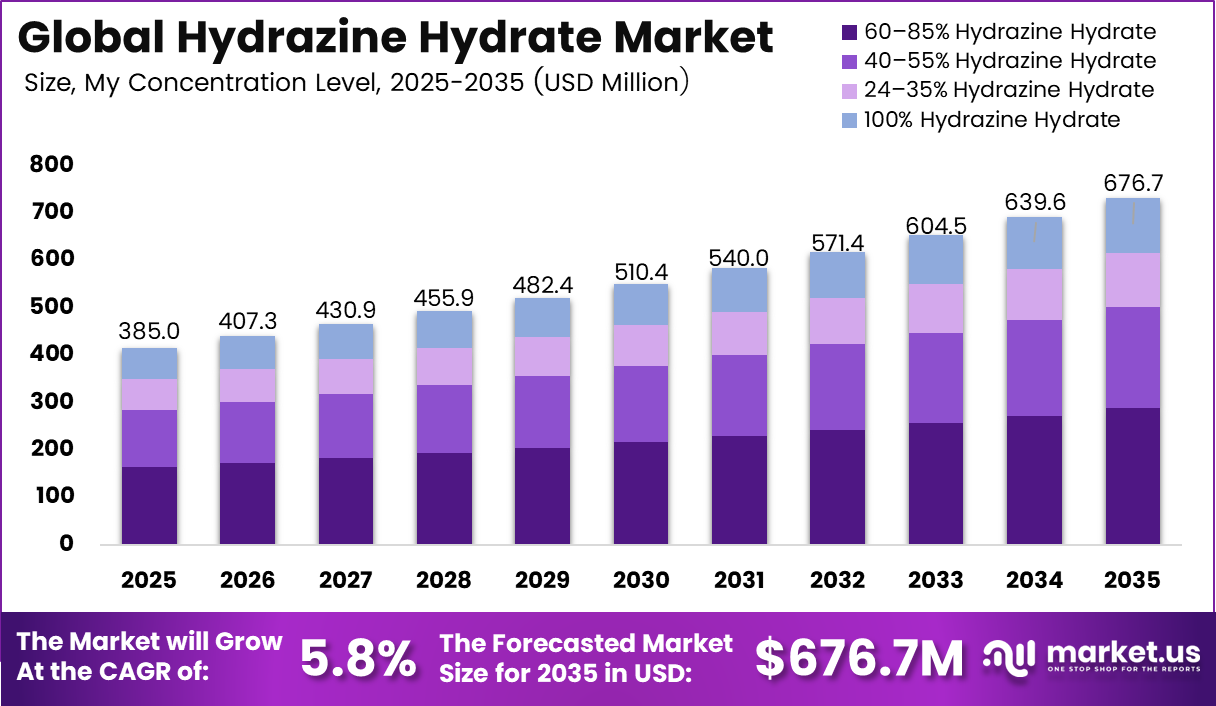
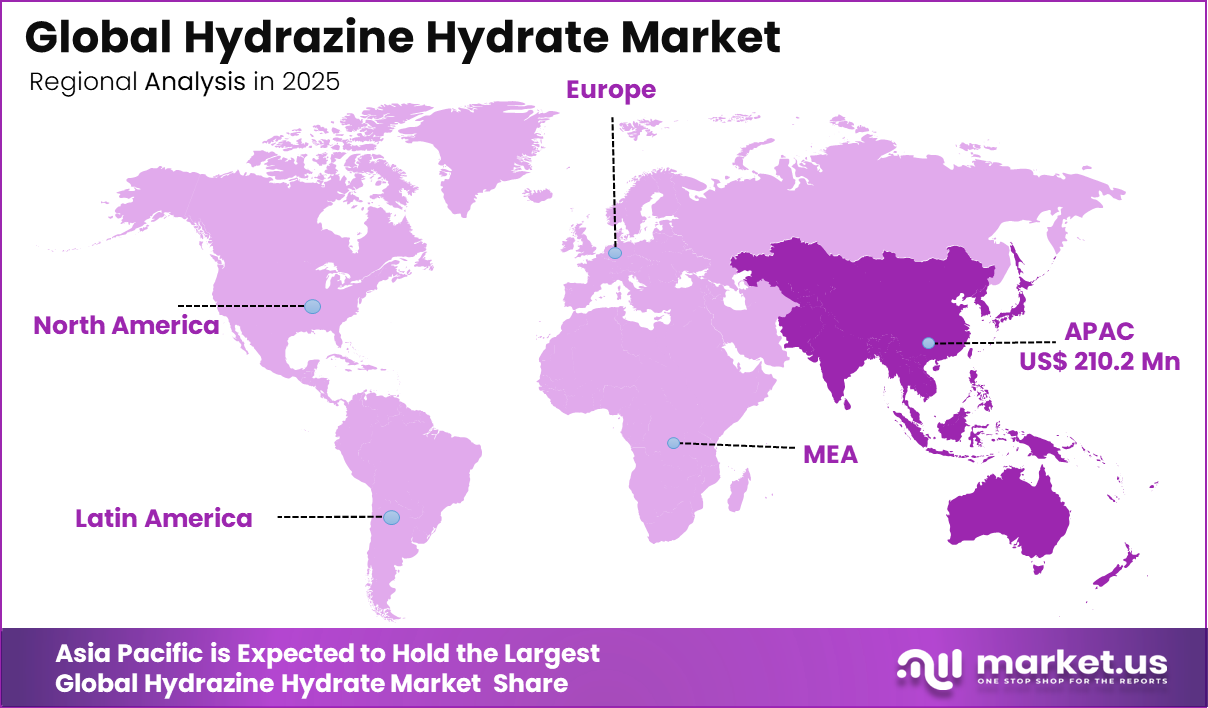
The Global Hydrazine Hydrate Market was valued at USD 385 million in 2025, and between 2026 and 2035, it is estimated to grow at a CAGR of 5.8%, reaching about USD 676.7 million by 2035. Asia Pacific held a dominant Market position, capturing more than 54.6% share and generating USD 210.2 million in revenue.
The hydrazine hydrate market remains an important part of the global chemical value chain because of the material’s use as a strong reducing agent and chemical intermediate. Key applications include boiler-water treatment, agrochemical production, pharmaceutical intermediates, polymers, and blowing agents. Demand is closely linked to the expansion of industrial water-treatment systems, agrochemical manufacturing, and pharmaceutical production.
Yibin Tianyuan’s 2025 operating results illustrate current production and demand conditions in the sector. The company produced 30,700 tonnes of hydrazine hydrate against a stated annual design capacity of 30,000 tonnes, representing a utilization rate of 102.33% and a production increase of 3.72% from 29,600 tonnes in 2024. Sales increased by 6.42%, reaching 31,500 tonnes compared with 29,600 tonnes in the previous year. Year-end inventory rose from approximately 100 tonnes in 2024 to 700 tonnes in 2025, an increase of 638.20%, although the high percentage was largely due to the comparatively low inventory base in 2024.
Asia-Pacific remains the principal production and consumption center, supported by large chemical-manufacturing bases in China and India. In 2025, continued investment in municipal and industrial water-treatment infrastructure strengthened demand for oxygen scavengers and corrosion-control chemicals used in power-generation and boiler systems. Producers are also focusing on stabilized formulations, safer handling systems, controlled-use grades, and lower-emission production processes to meet stricter workplace and environmental requirements.
Key Takeaways
- The Global Hydrazine Hydrate Market was valued at US$ 385.0 million in 2025.
- The global hydrazine hydrate market is projected to grow at a CAGR of 5.8% and is estimated to reach US$ 676.7 million by 2035.
- On the basis of concentration level, the 60–85% hydrazine hydrate dominated the market, constituting 42.5% of the total market share.
- Based on the grade, the pharmaceutical grade dominated the hydrazine hydrate market, with a substantial market share of around 88.9%.
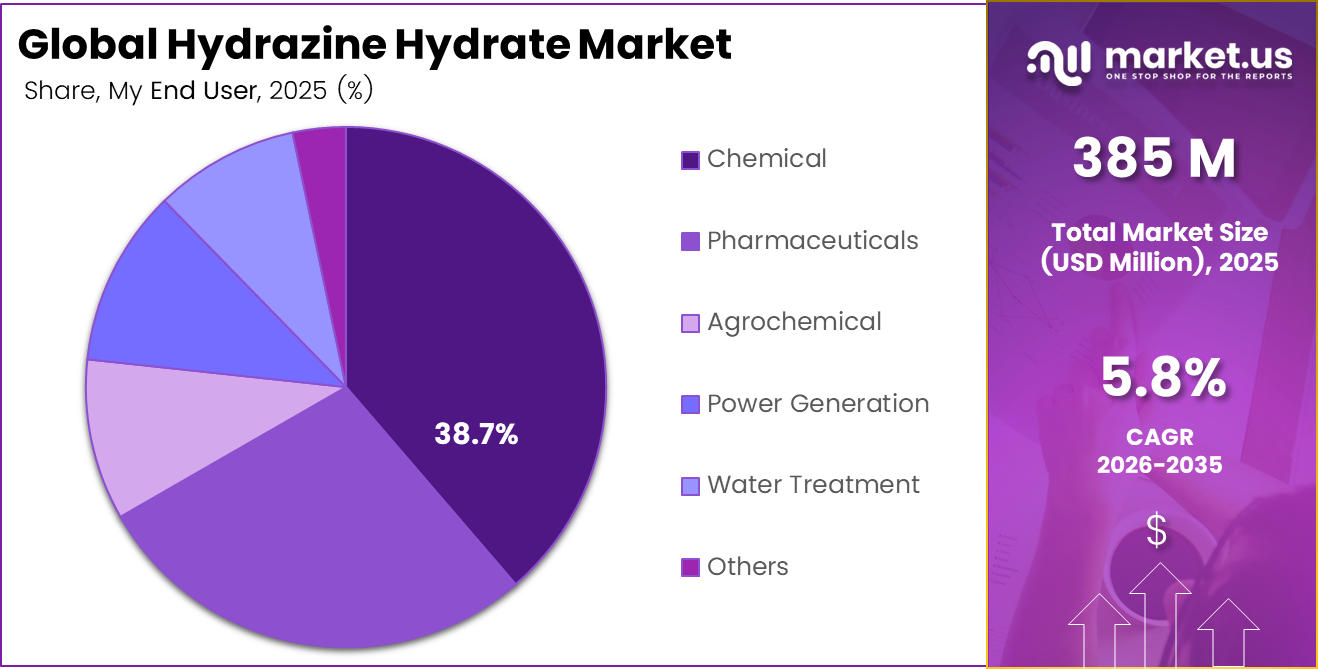
- Among the end-use industries, the chemical industry held a major share in the hydrazine hydrate market, with 38.7% of the market share.
- The Asia Pacific was the most dominant region in the hydrazine hydrate market, accounting for 54.6% of the total global consumption.
Concentration level Analysis
60–85% Hydrazine Hydrate represents the dominant Segment in the Market.
The global hydrazine hydrate market is largely structured around the 60–85% concentration grade, with 42.5%, which functions as the principal commercial standard for bulk supply and industrial conversion. This grade is widely preferred due to its operational balance between reactivity and stability, allowing safer handling during long-distance transport while still meeting performance requirements in downstream chemical synthesis.
It remains a key input in the production of intermediates such as azodicarbonamide, which is used in polymer processing applications including foamed plastics for insulation and protective packaging. At the same time, demand for lower concentration grades (around 24–35%) is rising steadily as end users respond to tightening safety and environmental regulations introduced across major industrial jurisdictions in 2025–2026.
Grade Analysis
Pharmaceutical-grade represents the highest share of the market
Pharmaceutical-grade hydrazine hydrate continues to represent the highest share, 88.9% of market value, largely driven by stringent purity standards enforced across regulated pharmaceutical manufacturing systems. Throughout 2025, healthcare supply chain assessments indicated that expanding global API production capacity has been directly associated with increased procurement of high-purity hydrazine hydrate, particularly within controlled synthesis environments.
Investment flows directed toward oncology-focused manufacturing facilities and next-generation therapeutic pipelines have been documented to require increasingly strict contaminant-free input materials. As regulatory frameworks governing impurity thresholds continue to tighten across major pharmaceutical jurisdictions, higher growth momentum is being recorded for ultra-pure hydrazine hydrate relative to standard industrial grades, reinforcing its expanding role within global drug production ecosystems.
End Use Analysis
Chemical Industry Dominates Consumption While Water Treatment Emerges as Fastest-Growing Application Segment
The chemical industry continues to account for the largest share, 38.7% of hydrazine hydrate consumption, supported by its deeply embedded role in large-scale industrial synthesis networks. Throughout 2025, technical and sectoral discussions across polymer and specialty chemical platforms have consistently highlighted its function as a key intermediate in the production of multiple downstream derivatives.
In these systems, hydrazine hydrate is increasingly being adopted as an oxygen scavenger due to its effectiveness in controlling dissolved oxygen corrosion without leaving solid residues in treated water. Its alignment with tightening zero-liquid-discharge (ZLD) standards and evolving corrosion-control expectations is steadily enhancing its relevance within modern industrial water treatment practices.
Key Market Segments
By Concentration Level
- 100% Hydrazine Hydrate
- 60–85% Hydrazine Hydrate
- 40–55% Hydrazine Hydrate
- 24–35% Hydrazine Hydrate
By Grade
- Pharmaceutical Grade
- Industrial Grade
By End Use
- Chemical
- Pharmaceuticals
- Agrochemical
- Power Generation
- Water Treatment
- Others
Market Dynamics
Drivers
| Driver | (~) % Impact on
CAGR |
Geographic Relevance | Impact Timeline |
|---|---|---|---|
| Rising agrochemical intermediates demand | +2.0% | Asia-Pacific, Latin America, Europe | Short term (≤ 2 years) |
| Growth in polymer foaming applications | +1.4% | Global automotive & construction | Medium term (2–4 years) |
| Expansion of boiler water treatment usage | +0.9% | Power & industrial sectors worldwide | Medium term (2–4 years) |
| Pharmaceutical synthesis applications | +0.7% | North America, Europe, Asia-Pacific | Short term (≤ 2 years) |
| Emerging energy applications in fuel cells | +0.8% | Japan, South Korea, EU research hubs | Long term (≥ 4 years) |
Rising agrochemical intermediates demand
Hydrazine hydrate consumption is increasingly tied to agrochemical intermediates for herbicides and plant growth regulators, with several Asia-Pacific and Latin American producers reporting mid–single-digit tonnage growth in hydrazine-based intermediates over the last 2 years, supported by national pesticide production statistics and export data.
This demand translates into incremental hydrazine hydrate off-take growth of roughly 2–3% annually in key producing countries, which reasonably maps to an additional contribution of about +2.0% to the overall hydrazine hydrate market CAGR versus the 5.8% baseline, given that agrochemicals account for a meaningful share of global hydrazine derivative output.
Commercially, this shifts business models toward longer-term offtake contracts with agrochemical formulators, stabilizing plant utilization at above 80–85% capacity and supporting operating margin retention in the mid-teens despite higher energy and safety-compliance costs, while incentivizing selective debottlenecking investments of a few additional kilotons per year rather than greenfield capacity.
Restraints
| Restraint | (~) % Impact on CAGR | Geographic Relevance | Impact Timeline |
|---|---|---|---|
| Carcinogenicity-driven regulatory tightening | -2.1% | North America, EU, developed Asia | Short term (≤ 2 years) |
| High hazard-compliance & insurance costs | -1.3% | Global manufacturing sites | Medium term (2–4 years) |
| Financing constraints for new hydrazine units | -0.9% | Global, strongest in OECD banking systems | Medium term (2–4 years) |
| Stricter occupational exposure limits | -0.7% | US, EU, Japan | Short term (≤ 2 years) |
| Localized restrictions in rocket propellant uses | -0.5% | Selected spacefaring nations | Long term (≥ 4 years) |
Carcinogenicity-driven regulatory tightening
Hydrazine’s classification as a probable human carcinogen by major agencies, with exposure limits as low as 0.01–0.03 ppm over 2–8-hour periods, has prompted rapid tightening of permitting, emissions, and workplace controls in North America, the EU, and developed Asian markets, directly constraining new hydrazine hydrate capacity additions and in some cases forcing rationalization of smaller, subscale facilities.
To meet these standards, plants are absorbing step changes in compliance costs, including installation of advanced scrubbers, real-time monitoring, and upgraded personal protective equipment, which can add mid–single-digit percentage points to operating costs per unit and reduce effective throughput by 5–10% during retrofit and audit cycles, thereby shaving an estimated 2.1% off the otherwise attainable CAGR relative to the 5.8% baseline.
Strategically, producers are deferring, or downsizing planned CapEx, shifting toward fewer, larger, and more automated units with higher fixed-cost intensity but lower variable compliance overhead, and in the near term accepting margin compression of roughly 100–150 basis points as they reprice contracts and renegotiate long-term supply arrangements under tighter regulatory scrutiny.
Challenges
| Challenge | (~) % CAGR | Geographic Relevance | Mitigation Horizon |
|---|---|---|---|
| Complex hazardous supply-chain logistics | -1.6% | Global, amplified in cross-border trade | Medium term (2–4 years) |
| Specialized safety talent shortages | -1.1% | Global, especially emerging markets | Long term (≥ 4 years) |
| Volatile raw material & energy inputs | -1.0% | Global chemical manufacturing regions | Short term (≤ 2 years) |
| Customer diversification toward alternative chemistries | -0.8% | EU, North America | Medium term (2–4 years) |
| Stringent transport and storage documentation | -0.7% | Global regulatory corridors | Short term (≤ 2 years) |
Complex hazardous supply-chain logistics
The requirement to ship hydrazine hydrate as a high-hazard substance under stringent dangerous goods codes, combined with carcinogenicity-linked handling rules, creates systemic friction in cross-border logistics, including mandatory use of specialized tankers, additional packaging integrity tests, and multi-step customs inspection, which can extend lead times by 5–10 days and raise transport costs per ton by 10–20% compared with standard inorganic chemicals.
These frictions effectively cap the market’s achievable growth by constraining the ability of producers to serve distant demand centers on just-in-time schedules, translating into an estimated CAGR drag of around -1.6% versus the unconstrained potential above the 5.8% baseline, particularly for smaller buyers with limited inventory buffers.
In response, companies are restructuring supply chains toward regional hubs with higher buffer stocks, negotiating multi-year logistics contracts with hazardous-material carriers, and investing in digital track-and-trace and route optimization, which collectively require incremental working capital equal to several weeks of additional inventory and modestly lower asset turns but reduce stockout risk and support long-term customer retention despite the structural logistical complexity.
Opportunities
| Opportunity | (~) % Potential
CAGR |
Geographic Relevance | Execution Window |
|---|---|---|---|
| Hydrazine hydrate-based protonic fuel cells scale-up | +2.2% | Asia-Pacific, EU innovation clusters | Long term (≥ 4 years) |
| Value-added water treatment formulations | +1.3% | Global power & industrial users | Medium term (2–4 years) |
| Agrochemical derivative portfolio broadening | +1.1% | Asia-Pacific, Latin America | Medium term (2–4 years) |
| Contract manufacturing & tolling models | +0.9% | Global, especially fragmented markets | Short term (≤ 2 years) |
| Process intensification & low-emission technologies | +0.8% | EU, Japan, North America | Long term (≥ 4 years) |
Hydrazine hydrate-based protonic fuel cells scale-up
Emerging work on hydrazine hydrate as a high–energy-density, carbon-free fuel for protonic ceramic fuel cells demonstrates technical feasibility but remains largely pre-commercial, with current deployments confined to pilot-scale systems and laboratory stacks rather than volume industrial or mobility applications, which is why this represents white-space upside rather than a present driver.
If scaled, even capturing a modest share of high-density stationary or niche aerospace power segments could lift hydrazine hydrate demand growth by several percentage points annually in these verticals, translating to an incremental market CAGR upside of about +2.2% over the 5.8% baseline, assuming controlled adoption in compatible geographies with robust safety regimes.
Strategically, this upside hinges on unit-economics improvement through process optimization that could reduce hydrazine production costs by an estimated 10–15% per unit and support margin expansion of 150–250 basis points versus current industrial grades, while new licensing, offtake, and joint-venture models with fuel cell OEMs enable producers to diversify revenue streams beyond traditional chemical-derivative markets.
Regional Analysis
The Asia Pacific region continues to account for the largest share, 54.6%, of global hydrazine hydrate demand, supported by its extensive and deeply integrated chemical manufacturing base. Industrial output assessments published through 2025 indicate that major production clusters in China and India host a high concentration of chemical synthesis facilities and downstream processing units, enabling large-scale consumption across polymer, agrochemical, and specialty chemical value chains.
Asia Pacific is also being observed as the fastest-growing regional market, driven by accelerated industrial relocation and capacity expansion trends. During 2025–2026, multiple announcements highlighted the shifting of pharmaceutical API production toward special economic zones across developing economies in the region, alongside sustained investment in energy and water infrastructure.
The rapid development of thermal power generation capacity and municipal utility systems has further increased demand for industrial feedstock chemicals, with growth momentum consistently exceeding that of more mature manufacturing regions such as Europe and North America.
Key Regions and Countries Covered in this Report
- North America
- The US
- Canada
- Europe
- Germany
- France
- The UK
- Spain
- Italy
- Russia & CIS
- Rest of Europe
- APAC
- China
- Japan
- South Korea
- India
- ASEAN
- Rest of APAC
- Latin America
- Brazil
- Mexico
- Rest of Latin America
- Middle East & Africa
- GCC
- South Africa
- Rest of MEA
Key Players Analysis
Hydrazine hydrate manufacturers focus on strengthening process safety differentiation, production scale efficiency, and upstream–downstream integration to maintain competitiveness in a highly regulated and defense-sensitive market. A key priority is continuous process innovation, including optimization of the Raschig and peroxide-based production routes to improve yield efficiency, reduce hazardous by-products, and ensure consistent high-purity grades required for aerospace and military applications.
Companies increasingly invest in large-scale, automated, and safety-compliant production systems, as hydrazine handling is tightly governed under EPA, ECHA, and other chemical safety frameworks due to its high toxicity and carcinogenic classification. Vertical integration with ammonia, hydrogen peroxide, and specialty chemical suppliers helps stabilize feedstock availability and mitigate input price volatility.
Strategic capacity expansion, particularly in Asia-Pacific regions such as China and India, aligns with concentrated demand from defense, satellite propulsion, and industrial synthesis sectors. Additionally, manufacturers emphasize regulatory compliance systems, long-term defense procurement contracts, and secure supply agreements to strengthen customer lock-in and ensure resilience against export controls and geopolitical supply disruptions.
Major Players in the Industry
- Arkema S.A.
- LANXESS AG
- Otsuka Chemical Co., Ltd.
- Yibin Tianyuan Group Co., Ltd.
- Weifang Yaxing Chemical Co., Ltd.
- Chongqing Chemical & Pharmaceutical Holding (Group) Company
- Hunan Zhuzhou Chemical Industry Group Co., Ltd.
- Nippon Carbide Industries Co., Inc.
- Gujarat Alkalies and Chemicals Limited
- HPL Additives Limited
- Matrix Fine Chemicals GmbH
- Thermo Fisher Scientific Inc.
- Vizag Chemicals
- Acuro Organics Limited
Recent Developments
- In 2025, LANXESS continues to operate a hydrazine/hydrazine-hydrate facility at CHEMPARK Leverkusen. The North Rhine-Westphalia regulator’s 2026 environmental-monitoring program lists the LANXESS “Hydrazin-Anlage” in buildings O14 and T36 as an Industrial Emissions Directive installation, with a two-year inspection interval. This provides current regulatory evidence that the plant remains within LANXESS’s operating asset base.
- In 2025, Otsuka Chemical’s latest corporate materials continue to present hydrazine as a central technology platform. Its chemical business uses hydrazine as a starting material for hydrazides, aldehyde absorbents, resin crosslinkers, rubber additives, polymerization initiators, and foaming agents. Otsuka emphasizes integrated production from raw materials and the ability to offer custom synthesis from laboratory to plant scale.
Report Scope
| Report Features | Description |
|---|---|
| Market Value (2025) | USD 385 Mn |
| Forecast Revenue (2035) | USD 676.7 Mn |
| CAGR (2026-2035) | 5.8% |
| Base Year for Estimation | 2025 |
| Historic Period | 2020-2024 |
| Forecast Period | 2026-2035 |
| Report Coverage | Revenue Forecast, Market Dynamics, Competitive Landscape, Recent Developments |
| Segments Covered | Market By Concentration Level (100% Hydrazine Hydrate, 60–85% Hydrazine Hydrate, 40–55% Hydrazine Hydrate, and 24–35% Hydrazine Hydrate), By Grade (Pharmaceutical Grade and Industrial Grade), By End Use Industry (Chemical, Pharmaceuticals, Agrochemical, Power Generation, Water Treatment, and Others) |
| Regional Analysis | North America – The US & Canada; Europe – Germany, France, The UK, Spain, Italy, Russia & CIS, Rest of Europe; APAC- China, Japan, South Korea, India, ASEAN & Rest of APAC; Latin America- Brazil, Mexico & Rest of Latin America; Middle East & Africa- GCC, South Africa, & Rest of MEA |
| Competitive Landscape | Arkema, LANXESS, Otsuka Chemical, Yibin Tianyuan Group, Weifang Yaxing Chemical, Chongqing Chemical & Pharmaceutical, Hunan Zhuzhou Chemical Industry Group, Nippon Carbide Industries, Gujarat Alkalies and Chemicals Limited, HPL Additives, Matrix Fine Chemicals, Thermo Fisher Scientific, Vizag Chemicals, Acuro Organics Limited, Other Key Players |
| Customization Scope | Customization for segments and region/country-level will be provided. Moreover, we can provide further customization to meet your requirements. |
| Purchase Options | We have three licenses to opt for: Single User License, Multi-User License (Up to 5 Users), Corporate Use License (Unlimited Users and Printable PDF) |





































