


Global Vital Signs Monitoring Devices Market By Product Type (Blood Pressure Monitors (Instrument & Accessories, Digital Blood Pressure Monitor, Blood Pressure Instrument Accessories, Aneroid Blood Pressure Monitors and Ambulatory Blood Pressure Monitors), Pulse Oximeters (Wrist-worn Pulse Oximeters, Table-top/Bedside Pulse Oximeters, Pulse Oximeter Accessories, Pediatric Pulse Oximeters, Hand-held Pulse Oximeters and Fingertip Pulse Oximeter), Temperature Monitoring Devices (Temperature Monitoring Device Accessories, Mercury Filled Thermometers, Liquid Crystal Thermometer, Infrared Thermometers and Digital Thermometers) and Others), By End-user (Hospitals, Home Healthcare, Ambulatory Centers and Other), Region and Companies – Industry Segment Outlook, Market Assessment, Competition Scenario, Trends and Forecast 2026-2035
- Published date: Feb 2026
- Report ID: 177533
- Number of Pages: 269
- Format:
-
keyboard_arrow_up
Quick Navigation
Report Overview
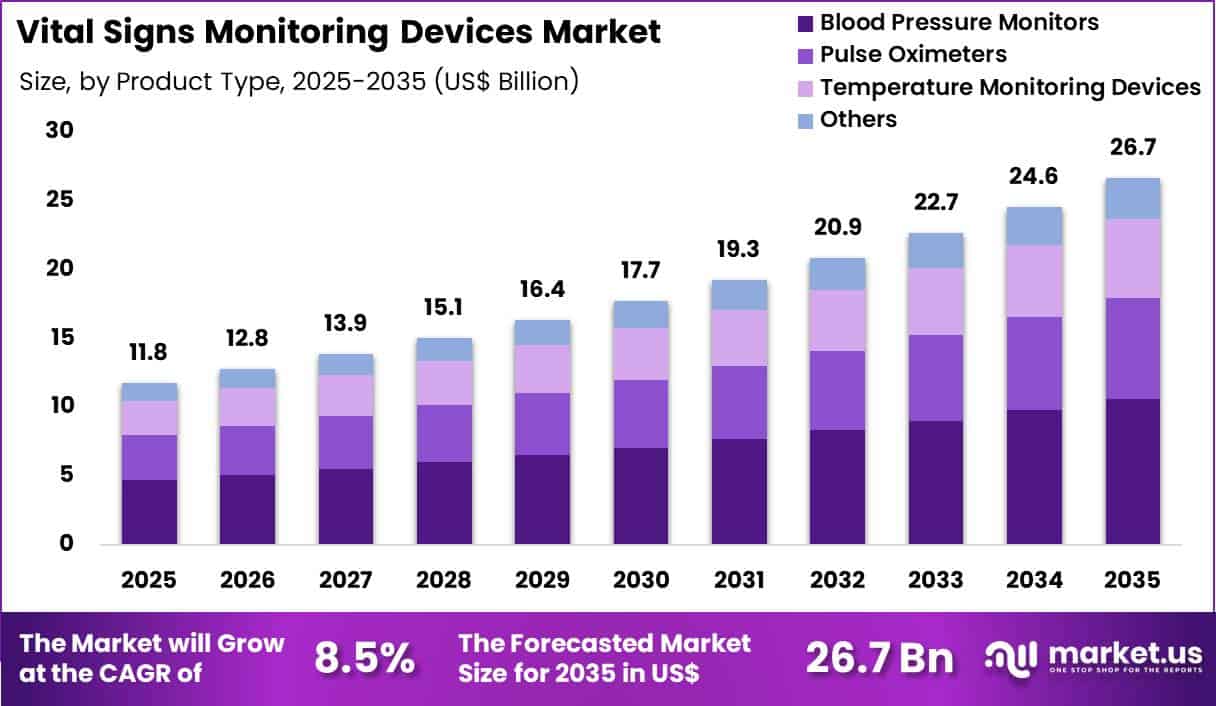
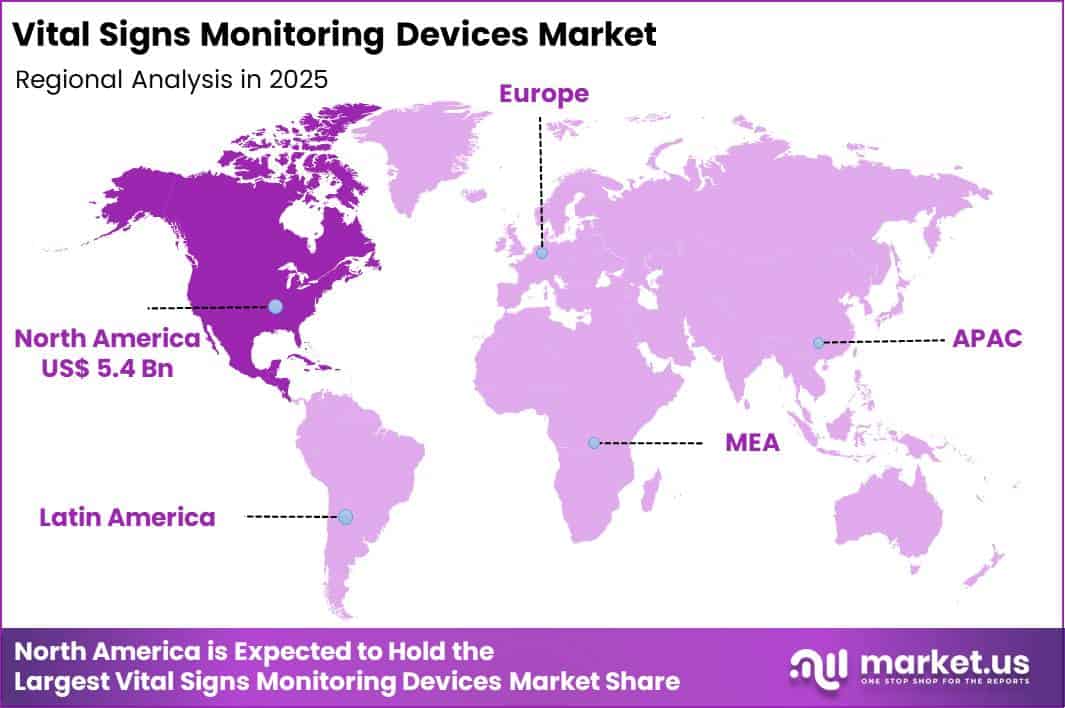
Global Vital Signs Monitoring Devices Market size is expected to be worth around US$ 26.7 Billion by 2035 from US$ 11.8 Billion in 2025, growing at a CAGR of 8.5% during the forecast period 2026 to 2035. In 2025, North America led the market, achieving over 45.5% share with a revenue of US$ 5.4 Billion.
Rising prevalence of chronic diseases and the emphasis on proactive health management drive the vital signs monitoring devices market as healthcare providers and patients demand continuous, accurate tracking of physiological parameters to support timely interventions.
Clinicians increasingly utilize multiparameter monitors in intensive care units to observe heart rate, blood pressure, respiratory rate, oxygen saturation, and temperature in critically ill patients, enabling rapid detection of deterioration in sepsis or post-surgical recovery. These devices support ambulatory monitoring through wearable patches that transmit real-time data for heart failure patients, alerting providers to arrhythmias or fluid overload for early outpatient adjustments.
Home care applications include portable devices for hypertensive patients, where automated blood pressure cuffs log readings to guide medication titration and lifestyle modifications. Pediatric specialists apply compact vital signs monitors in neonatal units to track premature infants’ cardiorespiratory stability during kangaroo care and incubator stays.
Telehealth platforms integrate these tools for remote chronic obstructive pulmonary disease management, allowing physicians to review oxygen saturation trends and adjust supplemental therapy without in-person visits.
Manufacturers pursue opportunities to embed artificial intelligence algorithms that predict adverse events from vital signs patterns, expanding applications in postoperative care where early warning scores trigger rapid response teams. Developers advance wireless, battery-efficient sensors with extended wear time, broadening utility in elderly fall prevention and sleep apnea screening.
These innovations facilitate seamless connectivity with electronic health records, streamlining data flow for multidisciplinary teams managing complex comorbidities. Opportunities emerge in consumer-grade devices with clinical-grade accuracy for wellness tracking, appealing to proactive users monitoring stress-related cardiovascular risks.
Companies invest in ergonomic, skin-friendly designs that improve compliance in long-term chronic care. Recent trends emphasize predictive analytics and integration with virtual care platforms, positioning vital signs monitoring devices as foundational tools in value-based healthcare focused on prevention, early detection, and reduced hospitalizations.
Key Takeaways
- In 2025, the market generated a revenue of US$ 11.8 Billion, with a CAGR of 8.5%, and is expected to reach US$ 26.7 Billion by the year 2035.
- The product type segment is divided into blood pressure monitors, pulse oximeters, temperature monitoring devices and others, with blood pressure monitors taking the lead with a market share of 39.8%.
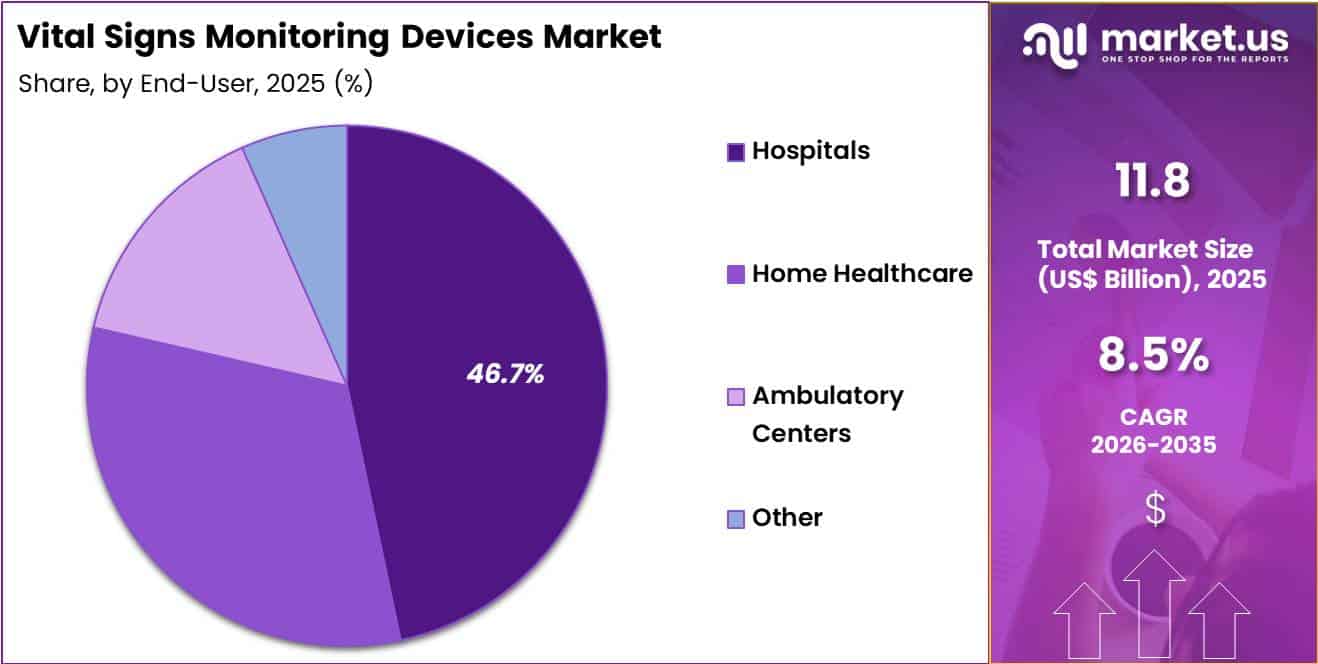
- Considering end-user, the market is divided into hospitals, home healthcare, ambulatory centers and other. Among these, hospitals held a significant share of 46.7%.
- North America led the market by securing a market share of 45.5%.
Product Type Analysis
Blood pressure monitors contributed 39.8% of growth within product type and led the vital signs monitoring devices market due to their essential role in routine clinical assessment and chronic disease management. Clinicians rely on frequent blood pressure measurement to diagnose hypertension, guide medication decisions, and monitor cardiovascular risk.
High prevalence of lifestyle-related disorders increases screening and follow-up visits, which elevates device usage across inpatient and outpatient settings. Blood pressure monitoring remains a standard requirement in almost every clinical encounter, reinforcing sustained demand.
Growth strengthens as digital and automated monitors improve accuracy, ease of use, and data connectivity. Integration with electronic health records supports longitudinal patient tracking. Preventive healthcare programs emphasize early detection of hypertension, which increases monitoring frequency.
Hospitals and clinics expand monitoring points across wards and emergency departments. The segment is expected to remain dominant as cardiovascular risk management continues to rely on regular and reliable blood pressure assessment.
End-User Analysis
Hospitals accounted for 46.7% of growth within end-user and dominated the vital signs monitoring devices market due to high patient turnover and continuous monitoring needs. Emergency rooms, intensive care units, and general wards depend on vital signs tracking to guide clinical decisions and detect deterioration early. Hospitals maintain large inventories of monitoring devices to support round-the-clock care. Standardized clinical protocols reinforce routine measurement across departments.
Growth continues as hospitals expand digital monitoring infrastructure and patient safety initiatives. Rising admissions for chronic and acute conditions increase monitoring intensity. Staff training and accreditation requirements further support consistent device utilization.
Teaching hospitals also contribute through research and innovation adoption. The segment is anticipated to remain the primary growth driver as hospitals continue to anchor acute and continuous patient monitoring practices.
Key Market Segments
By Product Type
- Blood Pressure Monitors
- Instrument & Accessories
- Digital Blood Pressure Monitor
- Blood Pressure Instrument Accessories
- Aneroid Blood Pressure Monitors
- Ambulatory Blood Pressure Monitors
- Pulse Oximeters
- Wrist-worn Pulse Oximeters
- Table-top/Bedside Pulse Oximeters
- Pulse Oximeter Accessories
- Pediatric Pulse Oximeters
- Hand-held Pulse Oximeters
- Fingertip Pulse Oximeter
- Temperature Monitoring Devices
- Temperature Monitoring Device Accessories
- Mercury Filled Thermometers
- Liquid Crystal Thermometer
- Infrared Thermometers
- Digital Thermometers
- Others
By End-user
- Hospitals
- Home Healthcare
- Ambulatory Centers
- Other
Drivers
Increasing prevalence of cardiovascular diseases is driving the market.
The escalating global incidence of cardiovascular diseases has substantially heightened the demand for vital signs monitoring devices to facilitate early detection and continuous management of heart-related conditions. Improved screening programs and demographic shifts contribute to higher diagnosis rates, expanding the application of monitors for parameters like blood pressure and heart rate.
Healthcare providers are increasingly relying on these devices to support multidisciplinary care for patients with chronic cardiovascular issues. Government health agencies emphasize preventive strategies to address this public health challenge through enhanced monitoring. Vital signs monitoring devices enable real-time tracking, which is essential for reducing complications in high-risk populations.
The association between aging populations and elevated cardiovascular risks further amplifies the need for accessible monitoring solutions. National surveillance efforts highlight the burden of these diseases, prompting greater resource allocation for diagnostic tools. Key organizations are investing in technology to improve device accuracy for cardiovascular applications.
According to the World Health Organization, an estimated 19.8 million people died from cardiovascular diseases in 2022, representing approximately 32% of all global deaths. This driver positions vital signs monitoring as a cornerstone in mitigating the impact of cardiovascular morbidity worldwide.
Restraints
High cost of advanced vital signs monitoring devices is restraining the market.
The premium pricing of sophisticated vital signs monitoring systems, including multi-parameter and wireless models, poses a significant barrier to adoption in resource-constrained healthcare environments. Manufacturing intricacies involving sensors and connectivity features contribute to elevated production expenses for these devices.
Smaller facilities often defer upgrades, opting for basic monitors due to budgetary limitations. Regulatory compliance for quality standards adds further financial burdens on suppliers and end-users. In public sectors, procurement favors economical options, delaying implementation of cutting-edge technologies.
Providers must balance clinical benefits against economic viability when selecting these monitors for routine use. This restraint curtails expansion in developing regions with sparse healthcare funding. Collaborative leasing arrangements aim to ease these pressures incrementally. Despite operational advantages, fiscal considerations limit equitable access across diverse settings. Resolving affordability through policy reforms remains key to countering this market impediment.
Opportunities
Growth in pulse oximetry revenues is creating growth opportunities.
The upward momentum in revenues from pulse oximetry products indicates substantial potential for vital signs monitoring devices in respiratory and critical care applications. Bolstered financial performance enables investments in integrated systems that combine oximetry with other vital parameters.
Masimo Corporation’s healthcare revenues from the sale of pulse oximetry products to hospitals associated with group purchasing organizations amounted to $794.0 million in 2024, up from $678.1 million in 2023. This increment reflects robust demand extending to comprehensive monitoring solutions in institutional settings.
Alliances with healthcare networks facilitate the deployment of hybrid devices in high-volume units. The considerable procedural foundation in advanced economies magnifies prospects for device enhancements. Reforms in diagnostic compensation strengthen infrastructure for multi-modal monitoring.
Foremost corporations initiate geographic extensions to harness economic advancements. This opportunity harmonizes with endeavors to heighten benchmarks in patient surveillance. Concentrated evolutions can produce remarkable strides in specialized vital signs applications.
Impact of Macroeconomic / Geopolitical Factors
Macroeconomic conditions shape the vital signs monitoring devices market through hospital budgets, home care spending, and digital health investment priorities. Inflation and higher interest rates raise costs for electronics, logistics, and financing, which slows device replacement cycles in hospitals and clinics.
Geopolitical tensions disrupt supplies of sensors, semiconductors, displays, and batteries, increasing lead times and inventory risk. Current US tariffs on imported components and finished monitors increase landed costs for manufacturers and distributors, which compresses margins and pressures pricing. These factors challenge smaller vendors and delay adoption in price sensitive care settings.
On the positive side, trade pressure encourages domestic assembly, supplier diversification, and stronger quality oversight. Rising focus on remote patient monitoring, chronic disease management, and post acute care sustains demand. With disciplined sourcing, software integration, and service based models, the market remains positioned for stable and confident growth.
Latest Trends
Integration of artificial intelligence in blood pressure monitoring is a recent trend in the market.
In 2024, the incorporation of machine learning algorithms in vital signs devices has advanced predictive capabilities for hypertension management. These innovations enable automated detection of irregular patterns during routine measurements. Manufacturers focused on regulatory clearance to ensure reliability in AI-enhanced monitors. Clinical evaluations emphasized improved specificity in identifying atrial fibrillation through integrated analytics.
OMRON Healthcare announced the U.S. Food and Drug Administration approval in November 2024 for its home blood pressure monitors featuring AI-powered atrial fibrillation detection. This development facilitates early intervention in cardiovascular risks without additional equipment. Industry emphasis on data security supports the adoption of these smart systems in home care.
The trend addresses limitations in traditional monitoring by providing actionable insights to users. Regulatory pathways have evolved to accommodate AI features in consumer devices. Sector partnerships refine models for higher diagnostic accuracy in diverse populations. These advancements position AI as transformative in elevating vital signs monitoring efficacy.
Regional Analysis
North America is leading the Vital Signs Monitoring Devices Market
North America accounted for a 45.5% share of the Vital Signs Monitoring Devices market in 2024, reflecting deep integration of continuous monitoring across hospitals, outpatient clinics, and home care settings. Health systems expanded early warning and remote surveillance programs to detect deterioration sooner and reduce avoidable admissions.
Widespread adoption of connected bedside monitors and wearable sensors improved clinical workflows and supported data driven decision making. Aging populations and higher acuity among hospitalized patients increased demand for reliable multiparameter monitoring.
Reimbursement clarity for remote patient monitoring strengthened provider confidence and accelerated deployment beyond acute care. Supply chain maturity and interoperability with electronic records further supported scale up.
A strong supporting indicator comes from the Centers for Disease Control and Prevention, which reported in 2023 that nearly 48% of US adults have hypertension, underscoring sustained need for routine blood pressure and vital sign tracking.
The Asia Pacific region is expected to experience the highest CAGR during the forecast period
The Vital Signs Monitoring Devices market in Asia Pacific is expected to grow steadily during the forecast period as healthcare systems modernize and expand access to continuous care. Governments prioritize early detection and chronic disease management to ease pressure on tertiary hospitals.
Hospitals and clinics increasingly deploy networked monitors to improve efficiency amid high patient volumes. Home based care models gain traction as smartphone connectivity and digital health platforms spread. Local manufacturing and regional procurement lower costs and broaden adoption across public facilities.
Training initiatives improve clinician familiarity with continuous monitoring protocols. A verifiable signal of underlying demand appears in 2023 data from the World Health Organization, which estimated that about one in three adults in the Western Pacific Region lives with hypertension, highlighting the large patient base that supports long term growth across the region.
Key Regions and Countries
North America
- US
- Canada
Europe
- Germany
- France
- The UK
- Spain
- Italy
- Russia
- Netherland
- Rest of Europe
Asia Pacific
- China
- Japan
- South Korea
- India
- Australia
- New Zealand
- Singapore
- Thailand
- Vietnam
- Rest of APAC
Latin America
- Brazil
- Mexico
- Rest of Latin America
Middle East & Africa
- South Africa
- Saudi Arabia
- UAE
- Rest of MEA
Key Players Analysis
Key competitors in the vital signs monitoring devices market grow by advancing multi-parameter platforms that combine blood pressure, pulse oximetry, temperature, and respiratory metrics into unified solutions that support efficient clinical workflows. They also strengthen value propositions with connected health features, cloud-enabled analytics, and interoperable electronic medical record integrations that facilitate continuity of care across acute, ambulatory, and home settings.
Firms expand commercial reach through partnerships with health systems, telehealth providers, and large group purchasing organizations that drive volume contracts and broader deployment. Geographic expansion into Asia Pacific and Latin America complements established demand in North America and Europe, capturing rising investments in patient monitoring infrastructure and preventive care technologies.
Hill-Rom Holdings Inc., a part of Baxter International, exemplifies a diversified medical technology company with a broad suite of patient monitoring and care-enhancing solutions supported by global sales operations and dedicated clinical training resources.
The company advances its strategic agenda through disciplined R&D investment, targeted acquisitions to broaden capabilities, and a customer-centric approach that aligns product enhancements with evolving provider priorities.
Top Key Players
- Philips Healthcare
- GE HealthCare
- Medtronic
- Masimo
- Nihon Kohden
- Dräger
- Mindray
- Spacelabs Healthcare
- Hillrom
- Schiller
Recent Developments
- In April 2024, GE HealthCare obtained US FDA clearance for its Portrait VSM vital signs monitor. The device is designed to deliver accurate, real-time visibility into patient vital parameters, supporting faster and more informed clinical decision-making.
- In November 2023, DuPont partnered with STMicroelectronics to co-develop a next-generation wearable concept focused on continuous remote biosignal monitoring, highlighting advancements in connected health and sensor-enabled medical devices.
Report Scope
Report Features Description Market Value (2025) US$ 11.8 Billion Forecast Revenue (2035) US$ 26.7 Billion CAGR (2026-2035) 8.5% Base Year for Estimation 2025 Historic Period 2020-2024 Forecast Period 2026-2035 Report Coverage Revenue Forecast, Market Dynamics, COVID-19 Impact, Competitive Landscape, Recent Developments Segments Covered By Product Type (Blood Pressure Monitors (Instrument & Accessories, Digital Blood Pressure Monitor, Blood Pressure Instrument Accessories, Aneroid Blood Pressure Monitors and Ambulatory Blood Pressure Monitors), Pulse Oximeters (Wrist-worn Pulse Oximeters, Table-top/Bedside Pulse Oximeters, Pulse Oximeter Accessories, Pediatric Pulse Oximeters, Hand-held Pulse Oximeters and Fingertip Pulse Oximeter), Temperature Monitoring Devices (Temperature Monitoring Device Accessories, Mercury Filled Thermometers, Liquid Crystal Thermometer, Infrared Thermometers and Digital Thermometers) and Others), By End-user (Hospitals, Home Healthcare, Ambulatory Centers and Other) Regional Analysis North America – US, Canada; Europe – Germany, France, The UK, Spain, Italy, Russia, Netherlands, Rest of Europe; Asia Pacific – China, Japan, South Korea, India, Australia, New Zealand, Singapore, Thailand, Vietnam, Rest of APAC; Latin America – Brazil, Mexico, Rest of Latin America; Middle East & Africa – South Africa, Saudi Arabia, UAE, Rest of MEA Competitive Landscape Philips Healthcare, GE HealthCare, Medtronic, Masimo, Nihon Kohden, Dräger, Mindray, Spacelabs Healthcare, Hillrom, Schiller Customization Scope Customization for segments, region/country-level will be provided. Moreover, additional customization can be done based on the requirements. Purchase Options We have three licenses to opt for: Single User License, Multi-User License (Up to 5 Users), Corporate Use License (Unlimited User and Printable PDF)  Vital Signs Monitoring Devices MarketPublished date: Feb 2026add_shopping_cartBuy Now get_appDownload Sample
 -
-
- Philips Healthcare
- GE HealthCare
- Medtronic
- Masimo
- Nihon Kohden
- Dräger
- Mindray
- Spacelabs Healthcare
- Hillrom
- Schiller
Our Clients

- 177533
- Feb 2026






