


Market Overview
Global Virtual Eating Disorder Treatment Market size is expected to be worth around US$ 2.77 Billion by 2035 from US$ 1.44 Billion in 2025, growing at a CAGR of 6.7% during the forecast period from 2026 to 2035. In 2025, North America led the market, achieving over 42.70% share with a revenue of US$ 0.62 Billion.
The increasing adoption of virtual care is reshaping the treatment landscape for eating disorders by improving access to specialized mental health services, particularly for patients in rural and underserved communities. Government agencies and healthcare organizations continue to support telehealth as an effective method for delivering behavioral health services, helping reduce geographical and workforce barriers.
According to the U.S. National Institute of Mental Health (NIMH), eating disorders are serious mental illnesses associated with high rates of psychiatric comorbidities, emphasizing the importance of timely diagnosis and continuous treatment.
Clinical evidence also highlights the significant burden of eating disorders across different age groups. NIMH reports that binge eating disorder affects approximately 1.2% of U.S. adults annually, while 2.8% experience the condition during their lifetime.
Among adolescents aged 13–18 years, the lifetime prevalence of eating disorders is estimated at 2.7%, with females experiencing a higher prevalence (3.8%) than males (1.5%). Furthermore, over 78% of individuals with binge eating disorder experience impairment related to their condition, reinforcing the need for long-term, multidisciplinary care.
The expansion of telehealth infrastructure has created favorable conditions for virtual eating disorder treatment programs. The U.S. Substance Abuse and Mental Health Services Administration (SAMHSA) reported that the share of mental health treatment facilities offering telemedicine increased from 22.2% in 2015 to 68.7% in 2020, reflecting a rapid transformation in digital behavioral healthcare delivery.
This broader adoption enables virtual platforms to provide psychotherapy, nutritional counseling, psychiatric consultations, family-based therapy, and ongoing patient monitoring through secure digital technologies.
Growing awareness campaigns, increasing acceptance of remote mental healthcare, and continuous improvements in digital health technologies are expected to strengthen virtual treatment adoption.
Integration of video consultations, mobile health applications, remote symptom monitoring, and evidence-based cognitive behavioral therapy platforms is improving treatment continuity while expanding access to specialized clinicians. These developments are expected to support better patient engagement, earlier intervention, and improved long-term recovery outcomes for individuals living with eating disorders.
Key Takeaways
- Market Size : Virtual Eating Disorder Treatment Market size is expected to be worth around US$ 2.77 Billion by 2035 from US$ 1.44 Billion in 2025
- Market Share : The market is growing at a CAGR of 6.7% during the forecast period from 2026 to 2035.
- Disorder Type Analysis : The Binge Eating Disorder (BED) segment dominated the Virtual Eating Disorder Treatment Market in 2025, accounting for 32.80% of the global market share.
- Treatment Approach Analysis : The Outpatient / Virtual Therapy Sessions segment held the largest share of the Virtual Eating Disorder Treatment Market in 2025, accounting for 39.50% of total revenue.
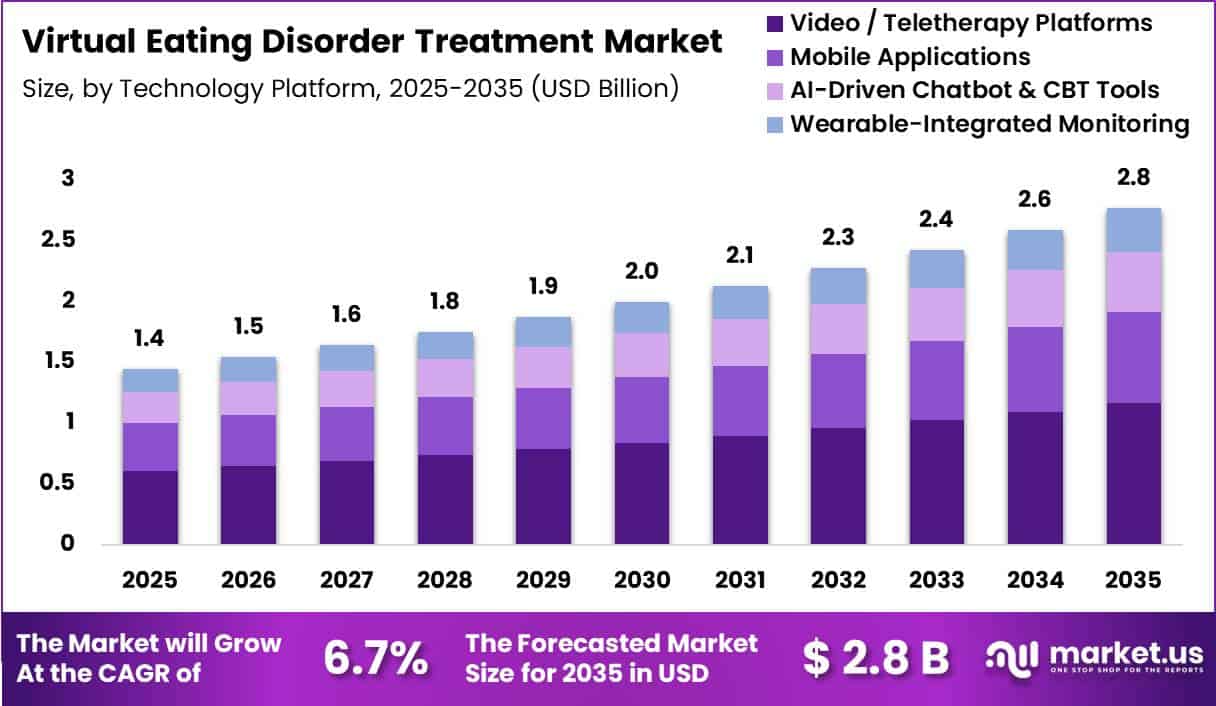
- Technology Platform Analysis : The Video / Teletherapy Platforms segment dominated the Virtual Eating Disorder Treatment Market in 2025, capturing 42.10% of the global market share.
- Distribution Channel Analysis : The Clinics segment accounted for the largest share of the Virtual Eating Disorder Treatment Market in 2025, representing 41.10% of global revenue.
- Regional Analysis : In 2025, North America led the market, achieving over 42.70% share with a revenue of US$ 0.62 Billion.
Disorder Type Analysis
The Binge Eating Disorder (BED) segment dominated the Virtual Eating Disorder Treatment Market in 2025, accounting for 32.80% of the global market share. Its leading position is driven by the high prevalence of BED, increasing diagnosis rates, and growing acceptance of virtual cognitive behavioral therapy (CBT) as an effective treatment option.
Digital therapy platforms offer convenient access to psychologists, dietitians, and psychiatrists, making continuous care more accessible for patients. Research has shown that internet-based CBT significantly reduces binge-eating episodes and improves eating disorder symptoms, further supporting the adoption of virtual treatment for BED.
Anorexia Nervosa represents another significant segment, with demand supported by virtual family-based therapy, nutritional counseling, and regular medical monitoring. Bulimia Nervosa continues to witness steady growth as teletherapy improves access to psychotherapy and relapse prevention programs.
Avoidant/Restrictive Food Intake Disorder (ARFID) is also gaining greater clinical attention, particularly among children and adolescents, encouraging providers to expand specialized virtual care programs. The Others category, including Other Specified Feeding or Eating Disorders (OSFED), contributes to market expansion through personalized digital treatment pathways.
Overall, advances in telemedicine, secure video consultations, symptom tracking, and multidisciplinary virtual care are improving treatment accessibility across all disorder types, supporting sustained market growth and better long-term recovery outcomes.
Treatment Approach Analysis
The Outpatient / Virtual Therapy Sessions segment held the largest share of the Virtual Eating Disorder Treatment Market in 2025, accounting for 39.50% of total revenue. This dominance is attributed to the convenience, affordability, and flexibility of scheduled online therapy sessions, which allow patients to receive continuous psychological and nutritional support without requiring hospitalization.
Virtual outpatient care also improves treatment adherence by reducing travel time and increasing access to eating disorder specialists. Telemedicine-based psychotherapy has demonstrated promising outcomes in reducing eating disorder symptoms while improving patient engagement and continuity of care.
Intensive Outpatient Programs (IOP) are experiencing strong demand among individuals requiring structured therapy several days per week while remaining at home. Virtual Partial Hospitalization Programs (PHP) provide a higher level of supervised care through multidisciplinary treatment teams and are increasingly adopted for moderate-to-severe cases requiring frequent monitoring.
AI-Assisted Self-Help Programs are emerging as an innovative segment, using digital CBT modules, symptom tracking, personalized reminders, and behavioral coaching to complement clinician-led treatment. These platforms improve patient engagement between therapy sessions and support long-term recovery.
Continuous improvements in telehealth infrastructure, evidence-based digital therapies, and integrated care models are expected to further strengthen adoption across all treatment approaches during the forecast period.
Technology Platform Analysis
The Video / Teletherapy Platforms segment dominated the Virtual Eating Disorder Treatment Market in 2025, capturing 42.10% of the global market share. These platforms provide secure video consultations, multidisciplinary care coordination, and regular follow-up sessions, making them the preferred technology for treating eating disorders remotely.
Their widespread adoption is supported by improvements in telehealth infrastructure, patient convenience, and increasing acceptance of virtual mental healthcare. Video-based therapy enables psychologists, psychiatrists, and dietitians to deliver personalized treatment while maintaining strong patient engagement.
Mobile Applications are becoming increasingly popular by allowing users to monitor meals, emotions, symptoms, and treatment progress through smartphones. AI-Driven Chatbot & CBT Tools are expanding rapidly as they provide personalized behavioral guidance, self-help exercises, and continuous support between therapy sessions, improving patient adherence.
Wearable-Integrated Monitoring represents an emerging segment that enables healthcare providers to remotely monitor activity levels, sleep patterns, and other health indicators that support comprehensive patient management.
Integration of artificial intelligence, cloud-based health records, and secure digital communication continues to enhance the efficiency and accessibility of virtual eating disorder treatment. These technological innovations are expected to improve patient outcomes while supporting long-term growth of the virtual treatment market.
Distribution Channel Analysis
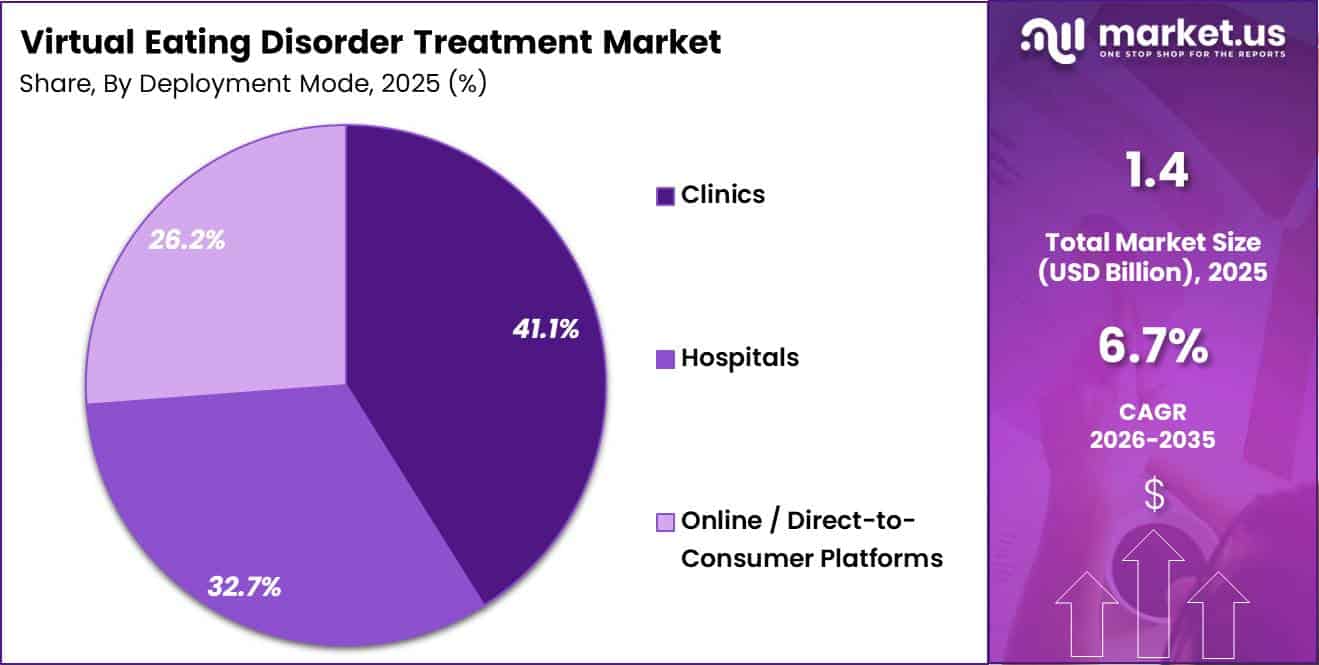
The Clinics segment accounted for the largest share of the Virtual Eating Disorder Treatment Market in 2025, representing 41.10% of global revenue.
Specialized behavioral health and eating disorder clinics increasingly provide virtual consultations, nutritional counseling, family-based therapy, and psychological assessments through secure telehealth platforms. Their established clinical expertise, multidisciplinary treatment teams, and continuity of care have positioned clinics as the leading distribution channel for virtual eating disorder services.
Hospitals continue to play an important role by offering virtual follow-up care for patients discharged from inpatient or intensive treatment programs. Hospital-based telemedicine services support long-term recovery through remote psychiatric consultations, medical monitoring, and coordinated care with outpatient specialists.
Meanwhile, Online / Direct-to-Consumer Platforms are witnessing rapid growth as patients increasingly seek convenient, private, and accessible treatment options without requiring referrals. These platforms provide virtual therapy sessions, digital CBT programs, nutrition coaching, and mobile-based support, making specialized care available to broader populations.
Growing consumer awareness, expanding insurance coverage for telehealth, and continued investments in digital behavioral healthcare platforms are expected to strengthen all distribution channels, while improving access to evidence-based treatment and enhancing patient outcomes across the virtual eating disorder treatment market.
Market Segmentations
By Disorder Type
- Binge Eating Disorder (BED)
- Anorexia Nervosa
- Bulimia Nervosa
- Avoidant / Restrictive Food Intake Disorder (ARFID)
- Others
By Treatment Approach
- Outpatient / Virtual Therapy Sessions
- Intensive Outpatient Programs (IOP)
- Partial Hospitalization Programs (PHP) – Virtual
- AI-Assisted Self-Help Programs
By Technology Platform
- Video / Teletherapy Platforms
- Mobile Applications
- AI-Driven Chatbot & CBT Tools
- Wearable-Integrated Monitoring
By Distribution Channel
- Clinics
- Hospitals
- Online / Direct-to-Consumer Platforms
Drivers
Hybrid Care Models Improving Retention and Expanding Reach in Eating Disorder Treatment
Virtual eating disorder treatment is increasingly being adopted as a hybrid layer rather than a full replacement for in person care, improving retention and continuity of care. A 2025 JMIR systematic review found telemedicine based interventions were generally safe, helpful, and motivating, and associated with better retention, improved patient physician communication, and reduced symptom severity, though evidence remains limited and heterogeneous.
From a commercial standpoint, retention is a key hidden cost driver in behavioral health. High dropout rates increase clinician idle time, delay recovery, and raise costs of re engaging patients. Hybrid models help address this through ongoing virtual check ins, meal support, family therapy, and relapse prevention touchpoints, bridging intensive outpatient, outpatient, and post discharge care.
This shifts revenue from episodic care toward a more annuity like patient lifecycle, with more continuous engagement across recovery stages. It also improves capacity utilization by reducing missed sessions and stabilizing clinician caseloads.
The estimated 1.8 % point CAGR uplift reflects improved retention, higher lifetime value per patient, and better treatment completion rates rather than just new patient acquisition. The effect is strongest in North America and Australia, where telehealth infrastructure and reimbursement already support hybrid behavioral care models.
| Driver | (~) % Impact on CAGR Forecast | Geographic Relevance | Impact Timeline |
|---|---|---|---|
| Reimbursement-backed telebehavioral expansion | +2.4% | North America core, selective EU analogs | Short term (≤ 2 years) |
| Rising diagnosed burden in youth and young adults | +2.1% | North America core, EU, ANZ, urban APAC spill-over | Medium term (2-4 years) |
| Hybrid care models improving retention and reach | +1.8% | North America core, EU, ANZ | Short term (≤ 2 years) |
| Clinical validation of digital adjuncts and self-guided tools | +1.5% | North America, UK, EU digital health hubs | Medium term (2-4 years) |
| Provider capacity optimization and lower delivery friction | +1.3% | North America, UK, Australia, tier-1 APAC cities | Short term (≤ 2 years) |
| Regulatory normalization of digital mental health oversight | +1.1% | U.S. core, EU, other regulated OECD markets | Long term (≥ 4 years) |
Challenges
Cross Border Licensure Maze in Virtual Eating Disorder Care
Fragmented professional licensure rules across states and countries create a structural barrier to scaling virtual eating disorder programs. Providers must navigate medical, psychology, and dietetics boards with different telehealth statutes, supervision requirements, and prescribing constraints, resulting in 9 to 15 months of legal and compliance lead time before full multi jurisdiction operations are possible. This reduces clinician capacity utilization.
A mid sized provider with around 150 clinicians may only operate effectively in 60 to 70 % of target regions, leaving 30 to 40 % of planned encounter volume unrealized due to licensing restrictions rather than clinical demand.
As a result, organizations concentrate on a limited set of permissive jurisdictions, slowing geographic expansion and limiting scale efficiency .From a market perspective, this creates a 3 to 4 % point constraint on revenue growth, translating into an estimated 1.4 % point reduction in maximum achievable CAGR for the virtual eating disorder care segment.
Operators typically allocate 5 to 7 % of operating costs to licensure management and compliance systems. Scaling strategies depend on centralized credentialing platforms managing thousands of licenses with approximately 12 month renewal cycles, supported by hub and spoke staffing models to extend coverage across states.
Over a 2 to 4 year horizon, expansion of compact licensure agreements and standardized telehealth frameworks may gradually ease these constraints, converting licensure complexity into a manageable operating cost rather than a binding growth limit.
| Challenge | (~) % CAGR Friction Drag | Geographic Relevance | Mitigation Horizon |
|---|---|---|---|
| Cross-border licensure maze | -1.4% | North America, EU, APAC hubs | Medium term (2–4 years) |
| Digital access & privacy gap | -1.6% | Rural US, emerging markets | Long term (≥ 4 years) |
| Clinical workforce virtualization lag | -1.8% | North America core, EU | Long term (≥ 4 years) |
| Outcomes evidence & reimbursement inertia | -1.5% | US, EU payers, OECD | Medium term (2–4 years) |
| High-acuity virtual care limits | -1.2% | Global urban–rural split | Long term (≥ 4 years) |
| Data governance & AI safety burden | -1.0% | US, EU regulatory hubs | Medium term (2–4 years) |
Restraints
Limited ED Specialist Capacity and Clinician Adoption
The supply of clinicians with eating disorder ED expertise remains structurally limited, and the shift to virtual care has not resolved this constraint. Only around 30 % of individuals with eating disorders receive specialized treatment, reflecting both workforce scarcity and uneven service distribution.
While telehealth based ED programs can achieve outcomes comparable to in person care, they still rely on the same constrained pool of therapists, dietitians, psychiatrists, and family based therapy specialists, many of whom have limited training in delivering high acuity ED care in digital formats.
Implementation barriers remain significant. Systematic reviews of digital mental health interventions show that roughly 40 % of efforts report insufficient clinician training or organizational resistance, which slows onboarding, limits adoption of digital tools like symptom trackers, and reduces willingness to manage severe cases remotely. As a result, throughput gains from telehealth are constrained.
In practice, a typical ED clinician may manage 20 to 25 concurrent patients in hybrid models, but only 10 to 15 in fully virtual models, due to screen fatigue, documentation burden, and perceived clinical risk. This caps expected scalability, reducing potential capacity expansion from a theoretical 2 to 3 times uplift to roughly 20 to 30 % effective gain.
High touch ED care further amplifies strain, with multiple weekly sessions and medical coordination increasing clinician workload by 30 to 50 % per patient compared with general tele psychology. This contributes to 10 to 15 % annual attrition among ED specialists, driving ongoing recruitment costs and limiting sustainable scale up of virtual ED programs.
| Restraint | (~) % Impact on CAGR Forecast | Geographic Relevance | Impact Timeline |
|---|---|---|---|
| Fragmented telehealth reimbursement & in-person visit rules | -2.0% | North America core, EU | Medium term (2–4 years) |
| Digital divide and socio-economic access gaps | -1.5% | North America, EU, emerging APAC, LATAM | Long term (≥ 4 years) |
| Limited ED-specialist capacity and clinician adoption | -1.2% | North America core, EU, APAC corridors | Medium term (2–4 years) |
| Data privacy, cross-border licensure, and platform compliance burden | -0.9% | North America, EU, cross-border hubs | Long term (≥ 4 years) |
| Patient trust, clinical appropriateness, and acuity constraints | -0.8% | Global | Short–Medium term (≤ 4 years) |
| Underdeveloped integration with public mental-health systems | -0.7% | Emerging APAC, LATAM, parts of EMEA | Long term (≥ 4 years) |
Opportunity
Payer-Integrated Stepped-Care Virtual Eating Disorder Treatment Platforms
Payer integrated stepped care virtual platforms represent a future opportunity because most eating disorder ED telehealth today remains self pay or only loosely reimbursed, with limited formal stratification across digital, outpatient, and intensive treatment levels. Current growth assumptions largely reflect incremental virtual therapy adoption rather than full redesign of the ED care pathway.
A stepped care model would integrate multiple tiers: web based guided self help for binge eating and bulimia already shown in studies to be non-inferior to treatment as usual, therapist led virtual intensive outpatient programs, and escalation to partial hospitalization or inpatient care only when clinical thresholds are met.
This structure could reduce average cost per successfully treated patient by 20 to 30 % while increasing system capacity by 30 to 40 % through greater use of low intensity digital care.
If payers across the US, EU, and advanced APAC markets adopted outcome based reimbursement tied to symptom reduction or reduced acute admissions, the reimbursed ED population could rise from roughly 30 % today to 50 to 55 % by 2035, while controlling overall episode cost through fewer high intensity interventions.
Because current telehealth adoption models do not fully incorporate payer led stepped care design, this shift is not embedded in baseline forecasts. Structurally, integration of ED care into formal benefit design and reimbursement pathways could add about 2.0 % points of CAGR upside, driven by higher coverage, improved retention, and better cost efficiency across the care continuum.
| Opportunity | (~) % Potential CAGR Upside | Geographic Relevance | Execution Window |
|---|---|---|---|
| Employer-funded virtual ED programs | +2.2% | North America, Western Europe | Medium term (2-4 years) |
| Payer-integrated stepped-care platforms | +2.0% | US, EU, advanced APAC | Medium term (2-4 years) |
| Youth & family-centric hybrid models | +1.6% | North America, EU, high-income APAC | Short term (≤ 2 years) |
| Global cross-border specialist networks | +1.4% | North America outbound, GCC, APAC urban | Long term (≥ 4 years) |
| Data-driven relapse prevention subscriptions | +1.8% | Global developed markets | Short term (≤ 2 years) |
| Low-intensity digital therapeutics for subclinical ED | +2.1% | Global, focus on urban and college populations | Medium term (2-4 years) |
Regional Analysis
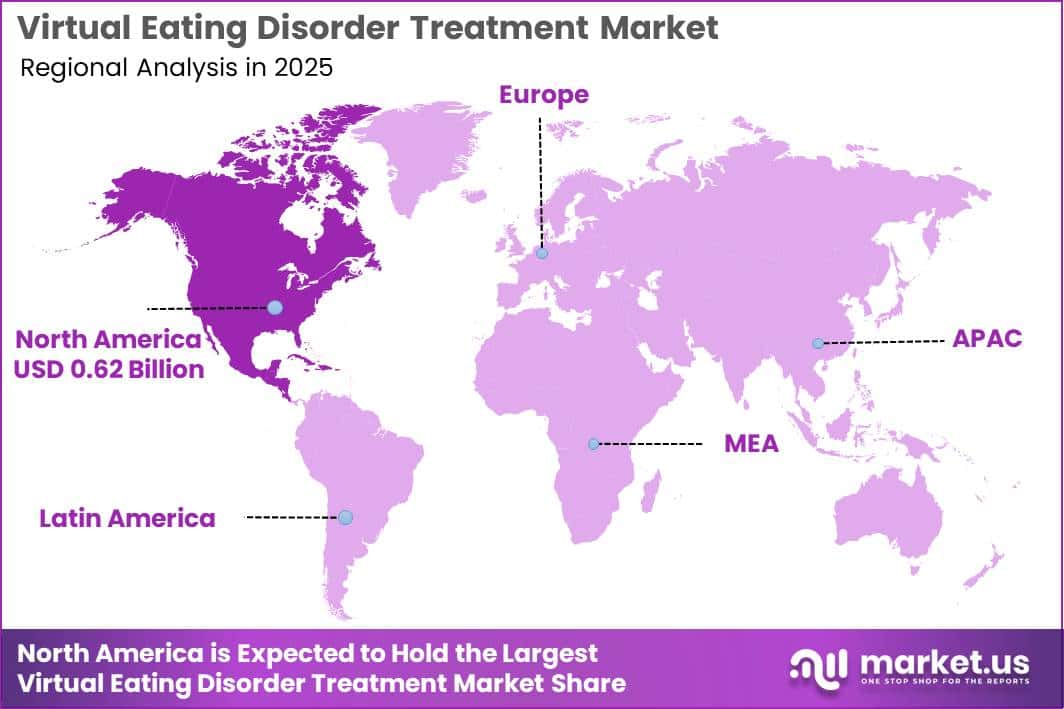
In 2025, North America dominated the Virtual Eating Disorder Treatment Market, accounting for over 42.70% of global revenue and generating approximately US$ 0.62 billion. The region’s leadership is driven by its well-established telehealth infrastructure, favorable reimbursement policies, widespread internet access, and strong presence of specialized behavioral health providers.
The United States remains the primary contributor, supported by increasing awareness of eating disorders, growing adoption of virtual cognitive behavioral therapy (CBT), remote nutritional counseling, and multidisciplinary care models.
Clinical studies also demonstrate that telehealth-based eating disorder treatment can improve continuity of care and patient engagement while expanding access to specialists, particularly in underserved communities.
Europe represents the second-largest regional market, benefiting from expanding digital health initiatives, supportive public healthcare systems, and increasing investments in mental health services across countries such as the United Kingdom, Germany, and France. Favorable reimbursement frameworks and growing acceptance of telemedicine continue to support market expansion.
The Asia-Pacific region is expected to register the fastest growth during the forecast period due to rising mental health awareness, expanding smartphone and internet penetration, improving healthcare infrastructure, and increasing government focus on digital healthcare services. Large patient populations in countries including China, India, Japan, and Australia further create substantial growth opportunities.
Meanwhile, Latin America and the Middle East & Africa are emerging markets, supported by gradual improvements in telehealth infrastructure, growing recognition of eating disorders, and expanding digital mental health initiatives.
Although specialist availability and reimbursement remain comparatively limited, ongoing investments in virtual healthcare and increasing awareness are expected to strengthen adoption across these regions over the coming years.
Key Regions and Countries
North America
- The US
- Canada
Europe
- Germany
- France
- The U.K.
- Italy
- Spain
- Russia & CIS
- Rest of Europe
Asia Pacific
- China
- India
- Japan
- South Korea
- ASEAN
- Australia & New Zealand
- Rest of Asia Pacific
Middle East & Africa
- GCC
- South Africa
- Rest of Middle East & Africa
Latin America
- Brazil
- Mexico
- Rest of Latin America
Key Player Analysis
The Virtual Eating Disorder Treatment Market is characterized by the presence of specialized providers that combine evidence-based clinical care with digital technologies to improve access to treatment.
Leading companies are focusing on expanding virtual therapy services, multidisciplinary care teams, personalized treatment plans, and insurance coverage to meet the growing demand for remote behavioral healthcare. These providers are also investing in digital platforms that support continuous patient engagement, remote monitoring, and family participation throughout the recovery process.
Equip Health has established a strong position through its fully virtual care model, offering therapist, dietitian, medical provider, family mentor, and peer mentor support for patients of all ages across the United States.
Within Health differentiates itself with personalized virtual intensive outpatient and partial hospitalization programs supported by an integrated digital platform. Monte Nido & Affiliates continues to expand its virtual intensive outpatient programs while leveraging its long-standing expertise in eating disorder care.
Center for Discovery strengthens competition by offering virtual treatment alongside its residential and outpatient services, enabling continuity of care. Eating Recovery Center (ERC) remains a major provider through comprehensive virtual treatment programs that integrate psychotherapy, nutrition counseling, and medical management.
Nourish is also expanding access to virtual nutrition counseling, supporting patients who require ongoing dietary guidance as part of eating disorder recovery.
Top Key Players
- Equip Health
- Within Health
- Nourish
- Monte Nido & Affiliates
- Center for Discovery
- Eating Recovery Center (ERC)
- Arise Virtual Health
- Alma Health
- Talkspace
- BetterHelp (Teladoc Health)
- Brightside Health
- Rethink My Therapy
Recent Developments
- In May 2026, Equip Health announced a US$58 million Series B funding round to expand its virtual eating disorder treatment services across all 50 U.S. states, broaden adult care, increase insurance partnerships, and strengthen collaborations with Medicaid and state governments to improve treatment accessibility.
- In August 2025, Talkspace reported second-quarter 2025 revenue of US$54.3 million, an 18% year-over-year increase, driven by 35% growth in payer revenue, reflecting continued expansion of its virtual behavioral healthcare business.
- In April 2025, Teladoc Health acquired UpLift, a virtual mental health provider with relationships covering more than 100 million covered lives, to expand insured access to virtual behavioral healthcare and strengthen its digital mental health network, including services relevant to eating disorder care.
Report Scope
| Report Features | Description |
|---|---|
| Market Value (2025) | US$ 1.44 Billion |
| Forecast Revenue (2035) | US$ 2.77 Billion |
| CAGR (2026-2035) | 6.7% |
| Base Year for Estimation | 2025 |
| Historic Period | 2020-2024 |
| Forecast Period | 2026-2035 |
| Report Coverage | Revenue Forecast, Market Dynamics, Competitive Landscape, Recent Developments |
| Segments Covered | By Disorder Type (Binge Eating Disorder (BED), Anorexia Nervosa, Bulimia Nervosa, Avoidant / Restrictive Food Intake Disorder (ARFID), Others), By Treatment Approach (Outpatient / Virtual Therapy Sessions, Intensive Outpatient Programs (IOP), Partial Hospitalization Programs (PHP) – Virtual, AI-Assisted Self-Help Programs), By Technology Platform (Video / Teletherapy Platforms, Mobile Applications, AI-Driven Chatbot & CBT Tools, Wearable-Integrated Monitoring), By Distribution Channel (Clinics, Hospitals, Online / Direct-to-Consumer Platforms) |
| Regional Analysis | North America – The US, Canada; Europe – Germany, France, U.K., Italy, Spain, Russia & CIS, Rest of Europe; Asia Pacific – China, India, Japan, South Korea, ASEAN, Australia & New Zealand, Rest of Asia Pacific; Middle East & Africa – GCC, South Africa, Rest of Middle East & Africa; Latin America – Brazil, Mexico, Rest of Latin America |
| Competitive Landscape | Equip Health, Within Health, Nourish, Monte Nido & Affiliates, Center for Discovery, Eating Recovery Center (ERC), Arise Virtual Health, Alma Health, Talkspace, BetterHelp (Teladoc Health), Brightside Health, Rethink My Therapy |
| Customization Scope | Customization for segments, region/country-level will be provided. Moreover, additional customization can be done based on the requirements. |
| Purchase Options | We have three licenses to opt for: Single User License, Multi-User License (Up to 5 Users), Corporate Use License (Unlimited User and Printable PDF) |





































