


Market Overview
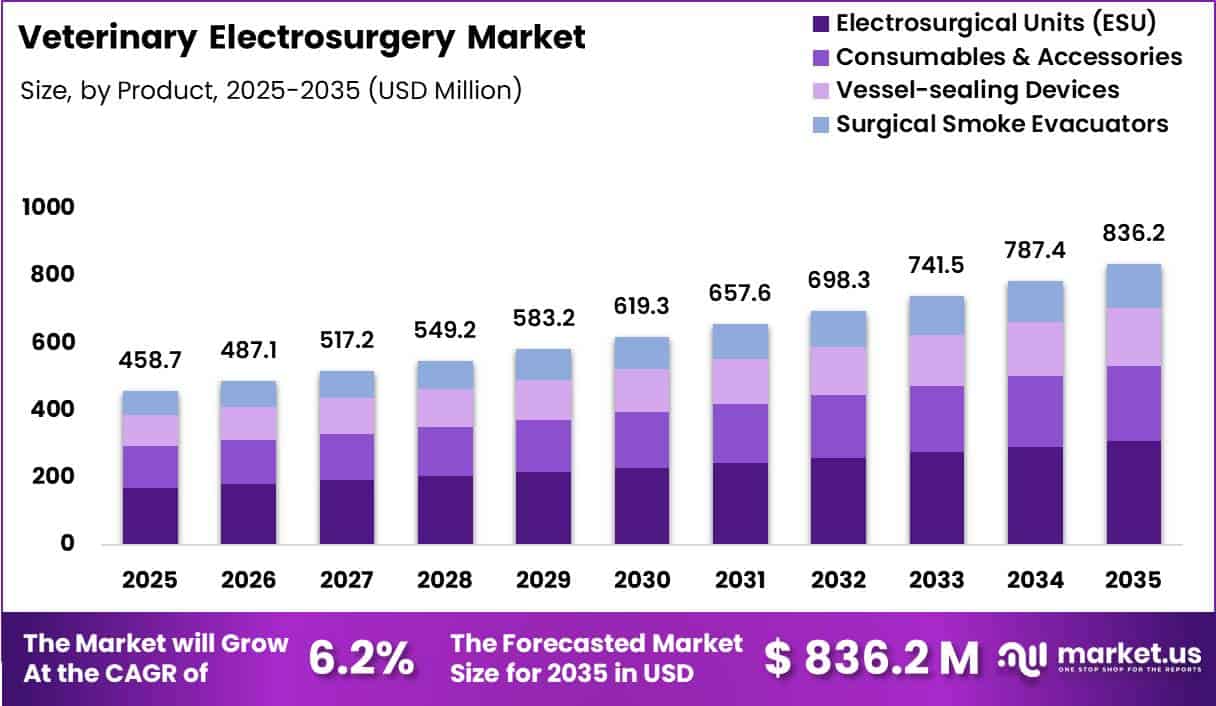
Global Veterinary Electrosurgery Market size is expected to be worth around US$ 836.2 Million by 2035 from US$ 458.7 Million in 2025, growing at a CAGR of 6.2% during the forecast period from 2026 to 2035. In 2025, North America led the market, achieving over 42.0% share with a revenue of US$ 192.7 Million.
The global Veterinary Electrosurgery Market is gaining importance as veterinary hospitals and clinics increasingly adopt advanced surgical technologies that support precise tissue cutting, coagulation, and bleeding control.
Electrosurgical systems use high-frequency electrical energy to perform surgical procedures and are available in monopolar and bipolar configurations, along with generators, electrodes, consumables, accessories, and smoke evacuation systems. These technologies are used across general, dental, orthopedic, ophthalmic, gynecological, and urological procedures for both companion and large animals.
The market is supported by the expanding role of specialized veterinary surgery and the broader availability of advanced animal healthcare services. Veterinary surgery is a recognized specialty area within veterinary medicine, and related disciplines such as dentistry, ophthalmology, orthopedics, and internal medicine continue to expand the scope of surgical care in animals.
Growth is being encouraged by rising demand for surgical interventions, greater emphasis on precision and hemostasis, technological improvements in electrosurgical generators and electrodes, and increasing investment in veterinary clinical infrastructure.
Ongoing advancements in veterinary anesthesia, surgical monitoring, and perioperative care are also expected to support adoption of electrosurgical technologies.
Key Takeaways
- Market Size: Global Veterinary Electrosurgery Market size is expected to be worth around US$ 836.2 Million by 2035 from US$ 458.7 Million in 2025.
- Market Share: The market is growing at a CAGR of 6.2% during the forecast period from 2026 to 2035.
- Product: The product segment of the Veterinary Electrosurgery Market is led by Electrosurgical Units (ESU), which accounted for 37.1% of the market share in 2025.
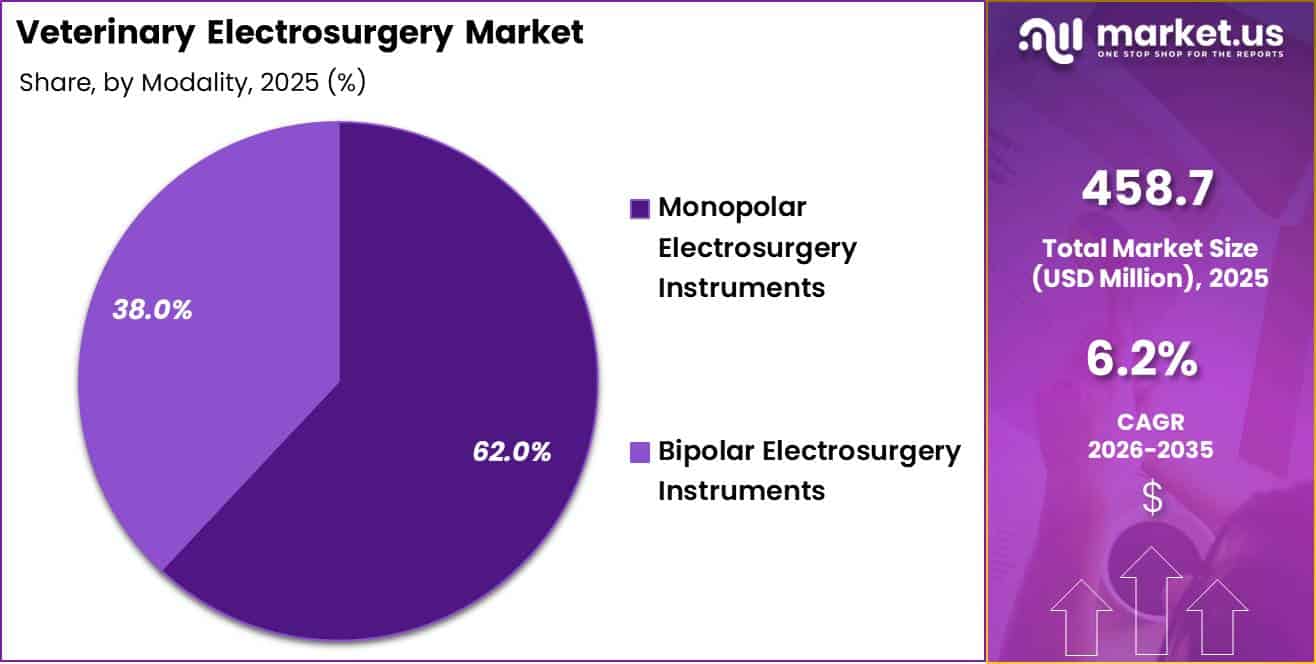
- Modality: The modality segment is dominated by Monopolar Electrosurgery Instruments, which captured 62.0% of the market share in 2025.
- Animal Type: The animal type segment is led by Small Animals, which accounted for 72.0% of the Veterinary Electrosurgery Market in 2025.
- Application: The application segment is dominated by General Surgery, which held a 45.3% market share in 2025.
- End User: The end-user segment is led by Veterinary Hospitals, which accounted for 58.0% of the market share in 2025.
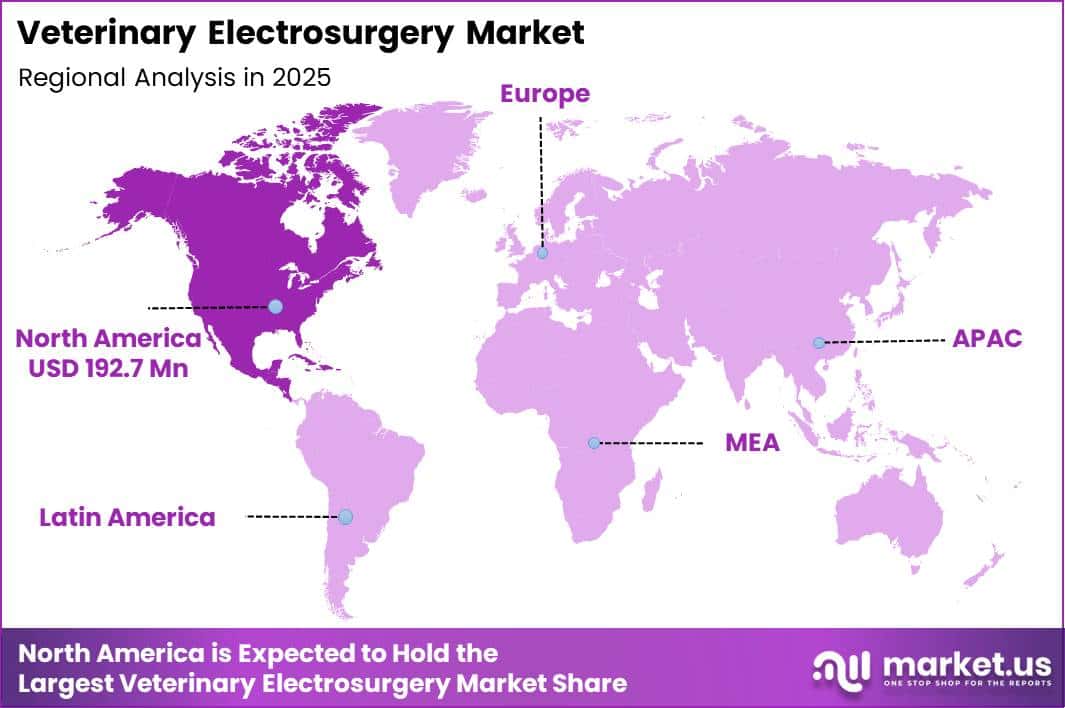
- Regional Analysis: In 2025, North America led the market, achieving over 42.0% share with a revenue of US$ 192.7 Million.
Product Analysis
The product segment of the Veterinary Electrosurgery Market is led by Electrosurgical Units (ESU).
The product segment of the Veterinary Electrosurgery Market is led by Electrosurgical Units (ESU), which accounted for 37.1% of the market share in 2025.
ESUs represent the core equipment used to deliver controlled electrical energy for cutting tissue, coagulation, and hemostasis during veterinary surgical procedures. Their widespread adoption is supported by increasing surgical interventions in companion animals and the growing availability of advanced energy-based surgical systems.
Consumables & Accessories represented 26.8% of the market, benefiting from recurring demand for electrodes, cables, pads, and other disposable or replaceable components required during procedures. Vessel-sealing Devices held a 20.5% share, supported by their ability to seal blood vessels efficiently and reduce intraoperative bleeding, particularly in complex soft-tissue surgeries.
Surgical Smoke Evacuators accounted for the remaining 15.6%, reflecting growing awareness of surgical smoke management and operating-room safety. Overall, product demand is being shaped by the increasing use of minimally invasive and energy-based surgical techniques, improvements in electrosurgical technology, and rising veterinary healthcare expenditure.
Modality Analysis
The modality segment is dominated by Monopolar Electrosurgery Instruments.
The modality segment is dominated by Monopolar Electrosurgery Instruments, which captured 62.0% of the market share in 2025. Monopolar systems remain widely used in veterinary procedures because of their versatility, relatively straightforward operation, and effectiveness in cutting and coagulating tissue across a broad range of surgical applications.
These instruments are particularly suitable for general and soft-tissue surgeries involving small and large animals. Their established use in veterinary operating environments and compatibility with various electrosurgical generators continue to support segment growth.
Bipolar Electrosurgery Instruments accounted for 38.0% of the market in 2025. Bipolar technology provides more localized energy delivery between two electrodes, offering greater precision and controlled coagulation, which can be valuable in procedures involving delicate tissues and blood vessels.
Adoption of bipolar systems is expected to increase as veterinary professionals seek improved surgical precision, reduced collateral tissue damage, and enhanced hemostatic control. Despite the growing acceptance of bipolar technology, monopolar instruments continue to maintain their leading position due to their broader procedural applicability and established presence across veterinary surgical settings.
Animal Type Analysis
The animal type segment is led by Small Animals.
The animal type segment is led by Small Animals, which accounted for 72.0% of the Veterinary Electrosurgery Market in 2025. The strong dominance of this segment is primarily associated with the expanding ownership of companion animals, increasing spending on veterinary healthcare, and greater demand for advanced surgical procedures for dogs, cats, and other small companion animals.
Electrosurgery is increasingly used in small-animal procedures because it can support efficient tissue cutting, coagulation, and bleeding control, contributing to improved surgical outcomes and recovery. The increasing availability of specialized veterinary hospitals and clinics equipped with advanced surgical technologies is also supporting adoption.
Large Animals represent the remaining segment of the market and include horses, cattle, and other livestock species. Electrosurgical techniques are utilized in selected procedures involving large animals, although adoption is comparatively lower due to differences in clinical requirements, surgical environments, animal size, and access to specialized equipment.
Nevertheless, technological advancements and growing awareness of modern veterinary surgical techniques may create opportunities for increased use of electrosurgery in large-animal medicine. Overall, small-animal veterinary care remains the primary demand center for electrosurgical technologies.
Application Analysis
The application segment is dominated by General Surgery.
The application segment is dominated by General Surgery, which held a 45.3% market share in 2025. The leading position of this segment reflects the broad use of electrosurgical technologies across routine and complex soft-tissue procedures, including tissue incision, coagulation, and hemostasis.
Increasing surgical volumes in companion animals and growing adoption of advanced surgical techniques are supporting demand for electrosurgical equipment in general veterinary practice.
Dental Surgery represents another important application, where electrosurgical devices can assist with tissue management and bleeding control during selected oral procedures. Gynecological & Urological Surgery is also benefiting from the use of electrosurgery in procedures requiring precise tissue handling and effective hemostasis.
Orthopedic Surgery contributes to market demand through selected procedures where electrosurgical instruments support soft-tissue management around surgical sites. The Others category includes additional specialized veterinary procedures that require controlled energy-based tissue treatment.
Overall, the application landscape is expanding as veterinarians increasingly incorporate advanced surgical technologies into clinical practice. Continued improvements in instrument precision, safety, and energy control are expected to strengthen the role of electrosurgery across multiple veterinary specialties.
End User Analysis
The end-user segment is led by Veterinary Hospitals in 2025.
The end-user segment is led by Veterinary Hospitals, which accounted for 58.0% of the market share in 2025. Veterinary hospitals hold the largest share because they typically manage higher volumes of surgical cases and have greater access to specialized operating rooms, trained veterinary surgeons, anesthesia services, and advanced electrosurgical equipment.
The growing demand for complex procedures among companion animals is further encouraging hospitals to invest in modern surgical technologies that can improve precision, coagulation, and procedural efficiency.
Veterinary Clinics represent another significant end-user segment, particularly as more clinics expand their surgical capabilities and adopt advanced equipment for routine and specialized procedures. The Others category includes additional veterinary care settings and specialized facilities that utilize electrosurgical technologies based on their clinical requirements.
Increasing pet healthcare expenditure, rising demand for surgical treatment, and improvements in veterinary infrastructure are supporting adoption across these end-user groups.
Overall, veterinary hospitals are expected to maintain their leading position due to their greater procedural capacity and investment capabilities, while veterinary clinics may experience growing adoption as electrosurgical systems become more accessible and easier to integrate into smaller clinical environments.
Key Market Segments
By Product
- Electrosurgical Units (ESU)
- Consumables & Accessories
- Vessel-sealing Devices
- Surgical Smoke Evacuators
By Modality
- Monopolar Electrosurgery Instruments
- Bipolar Electrosurgery Instruments
By Animal Type
- Small Animals
- Large Animals
By Application
- General Surgery
- Dental Surgery
- Gynecological & Urological Surgery
- Orthopedic Surgery
- Others
By End User
- Veterinary Hospitals
- Veterinary Clinics
- Others
Drivers
Companion Animal Procedure Intensity and Case Throughput.
Growth in companion animal populations and rising veterinary spending are increasing surgical and procedural volumes in small animal care. In the U.S., tens of millions of households own dogs and cats, supporting a large and expanding clinical base for veterinary services, particularly in surgery, dentistry, oncology, and soft tissue procedures.
As more pets receive formal veterinary care, a higher share of cases progresses into surgical workflows where electrosurgical tools improve precision, hemostasis, and procedural efficiency. This increases equipment utilization rates in veterinary clinics and specialty hospitals.
Commercially, electrosurgery systems generate value not only through initial device placement but also through recurring consumables such as electrodes, accessories, and maintenance services. As procedure volumes rise, installed systems achieve higher throughput, improving return on investment for clinics and driving replacement and upgrade cycles.
The strongest adoption is seen in North America and Western Europe, where veterinary care is highly structured and procedure intensive.
However, emerging urban markets in Asia Pacific are beginning to adopt more advanced surgical standards as private veterinary hospital networks expand. Overall, increasing procedural intensity in companion animal care is driving higher utilization of electrosurgery systems and strengthening recurring revenue streams across veterinary surgical markets.
| Driver | (~) % Impact on CAGR Forecast | Geographic Relevance | Impact Timeline |
|---|---|---|---|
| Companion animal procedure intensity and case throughput | +1.6% | North America core, EU urban centers, APAC private-clinic corridors | Short term |
| Vessel sealing and bipolar workflow substitution | +1.3% | North America, Western Europe, advanced APAC | Short term |
| Stray animal sterilization and public-health surgery programs | +1.1% | India, South Asia, MENA, Latin America spill-over | Medium term |
| Infection control, sterilization durability, and OR standardization | +0.9% | North America core, EU, institutional APAC | Medium term |
| Regulatory tightening in electrosurgical safety and labeling | +0.7% | U.S. core, EU notified-body markets, export manufacturers in APAC | Medium term |
| Cost pressure favoring faster surgery and fewer consumables | +0.8% | U.S., Canada, UK, Australia, private urban APAC | Short term |
Challenges
Electrosurgery Market Constraints from Fragmented Device Oversight.
Veterinary electrosurgery operates in a partially regulated environment where human medical device standards such as FDA aligned QMS expectations and ISO 13485 principles influence manufacturing practices, but dedicated veterinary devices often face limited pre market scrutiny.
This creates uneven quality assurance across products, leading larger veterinary groups to periodically identify gaps in calibration, maintenance records, and safety documentation. In practice, this fragmentation slows procurement cycles as buyers increasingly demand stronger traceability, quality systems, and post market surveillance even when not strictly required.
As a result, some fleet upgrades are delayed by 12–24 months while vendors align documentation and safety processes with human grade expectations. The overall market impact is a modest drag on growth, as replacement cycles slow and compliance costs rise typically 3–5% of revenue for quality systems and field support.
However, this pressure is gradually pushing the industry toward more standardized ISO aligned manufacturing and service practices, which should reduce fragmentation over time.
| Challenge | (~) % CAGR Friction Drag | Geographic Relevance | Mitigation Horizon |
|---|---|---|---|
| Fragmented device oversight | -1.2% | North America, EU, emerging Asia | Long term (≥ 4 years) |
| Safety & smoke compliance gaps | -1.0% | North America core, EU clinics | Medium term (2-4 years) |
| OR workflow & human-factor risks | -0.9% | Global referral centers | Medium term (2-4 years) |
| Skilled electrosurgery talent deficit | -0.8% | APAC growth hubs, LATAM | Long term (≥ 4 years) |
| Capital-light clinics & aging equipment | -0.7% | Tier-2/3 markets global | Long term (≥ 4 years) |
| Limited data & outcome standardization | -0.6% | Global multi-site chains | Medium term (2-4 years) |
Restraints
High Capital Cost and Margin Pressure in Veterinary Electrosurgery.
High capital cost and margin pressure are a key constraint on veterinary electrosurgery adoption because upfront equipment costs for full function generators and bipolar systems typically range from USD 15,000–40,000, while per procedure revenues for soft tissue surgeries in many clinics remain below USD 300. This creates long payback periods, often extending to 5–7 years in mid volume practices, making investment less attractive for smaller and rural clinics.
The burden is further increased by recurring consumable costs such as electrodes, grounding pads, and smoke evacuation systems, which can add USD 8–20 per procedure. These ongoing expenses compress already modest procedure margins, which may only be 10–15% after accounting for labor, anesthesia, and overhead costs.
Rising interest rates between 2023–2025 have also increased leasing and financing costs, pushing annual capital servicing expenses higher and reducing affordability for smaller practices.
As a result, many clinics defer upgrades or choose lower spec alternatives, slowing replacement cycles. For OEMs, this environment leads to greater price competition, heavier discounting, and margin pressure, ultimately constraining overall market adoption and growth.
| Restraint | (~) % Impact on CAGR Forecast | Geographic Relevance | Impact Timeline |
|---|---|---|---|
| High capital cost and margin pressure | -2.3% | North America core, EU, select APAC | Medium term (2–4 years) |
| Regulatory ambiguity and compliance overhead | -1.4% | US, EU, emerging APAC | Medium term (2–4 years) |
| Safety incidents and liability risk | -1.1% | North America, EU | Short to medium term (≤4 years) |
| Supply chain volatility in components | -1.7% | Global, APAC corridors | Short term (≤2 years) |
| Skills gap and OR workflow constraints | -0.9% | Global urban and secondary markets | Long term (≥4 years) |
| Uneven adoption in emerging veterinary care | -1.2% | LATAM, MEA, Tier-3 APAC | Long term (≥4 years) |
Opportunity
One-Health Zoonosis-Linked Surgical Preparedness Programs.
This opportunity builds on the growing One-Health approach, which links human, animal, and environmental health to reduce zoonotic disease risk. Instead of treating electrosurgery demand as purely driven by elective veterinary procedures, it positions these systems within formal outbreak preparedness and infection-control programs for both companion and production animals.
Under such frameworks, electrosurgery can be promoted for its precise cutting and coagulation benefits, which help reduce tissue contamination and improve aseptic surgical outcomes in high-risk animal populations.
This creates policy-driven demand tied to disease prevention and biosecurity rather than routine clinical care alone. If even a small share of animal surgeries in zoonosis-prone regions adopt standardized electrosurgery protocols, it could increase system utilization, expand consumable usage, and support additional equipment deployments over time.
The biggest impact is expected in Asia and Africa, where One-Health surveillance and veterinary capacity building are expanding.
| Opportunity | (~) % Potential CAGR Upside | Geographic Relevance | Execution Window |
|---|---|---|---|
| Integrated minimally invasive surgery bundles | +2.2% | North America, Western Europe | Short term (≤ 2 years) |
| Electrosurgery penetration into emerging companion animal hubs | +1.9% | APAC emerging, Latin America urban | Medium term (2–4 years) |
| One-Health zoonosis-linked surgical preparedness programs | +1.6% | Global; high in Asia, Africa | Medium term (2–4 years) |
| AI-assisted energy delivery & safety optimization | +2.8% | North America core, EU, high-income APAC | Long term (≥ 4 years) |
| Subscription-based equipment-plus-service models | +1.7% | North America, EU, selected APAC | Short–Medium term (≤ 4 years) |
| Species- and procedure-specific electrosurgery kits | +1.4% | Global companion and production animal markets | Medium term (2–4 years) |
Regional Analysis
North America dominated the Veterinary Electrosurgery Market in 2025.
In 2025, North America dominated the Veterinary Electrosurgery Market, accounting for over 42.0% of the global market share and generating approximately US$ 192.7 million in revenue. The region’s leadership is supported by the strong adoption of advanced veterinary surgical technologies, increasing pet healthcare expenditure, and the presence of well-established veterinary hospitals and specialty clinics.
The United States represents the major contributor to regional growth, driven by rising companion animal ownership and growing demand for minimally invasive surgical procedures. Increasing awareness of advanced electrosurgical techniques, including vessel sealing and tissue cutting, is also encouraging veterinary professionals to adopt sophisticated surgical equipment.
Europe is expected to maintain a significant position, supported by expanding veterinary healthcare infrastructure, increasing animal welfare awareness, and growing demand for technologically advanced surgical procedures.
The Asia-Pacific region is anticipated to witness notable growth during the forecast period, driven by rising pet ownership, improving veterinary facilities, increasing disposable incomes, and expanding access to specialized animal healthcare services.
Meanwhile, Latin America and the Middle East & Africa are emerging markets, with growth supported by improving veterinary infrastructure and increasing investments in animal healthcare. Overall, technological advancements and rising demand for safer, efficient, and minimally invasive veterinary surgeries are expected to strengthen regional market expansion.
Key Regions and Countries
North America
- The US
- Canada
Europe
- Germany
- France
- The U.K.
- Italy
- Spain
- Russia & CIS
- Rest of Europe
Asia Pacific
- China
- India
- Japan
- South Korea
- ASEAN
- Australia & New Zealand
- Rest of Asia Pacific
Middle East & Africa
- GCC
- South Africa
- Rest of Middle East & Africa
Latin America
- Brazil
- Mexico
- Rest of Latin America
Key Player Analysis
The Veterinary Electrosurgery Market is moderately fragmented, with competition driven by technological innovation, product reliability, surgical efficiency, and expanding veterinary healthcare infrastructure. Medtronic plc maintains a strong competitive position through advanced energy-based surgical technologies and continued R&D focused on precision, safety, and improved surgical outcomes.
Covetrus, Inc. emphasizes its broad veterinary healthcare ecosystem, leveraging distribution capabilities, product availability, and partnerships to strengthen market reach and support veterinary practices. B. Braun Melsungen AG competes through innovative surgical technologies, integrated solutions, and investments in R&D aimed at improving procedural efficiency and clinical safety.
Symmetry Surgical Inc. focuses on product innovation across surgical instruments and electrosurgical solutions, supporting workflow integration and specialized veterinary applications. Integra LifeSciences Holdings Corporation strengthens its position through advanced surgical technologies, R&D capabilities, and solutions designed to improve surgical workflows and patient outcomes.
Overall, these leading players compete through product development, strategic partnerships, distribution expansion, workflow integration, and ecosystem-based solutions. Their strategies increasingly focus on combining electrosurgical devices with complementary instruments, accessories, training, and technical support to create comprehensive solutions for veterinary hospitals and clinics.
Continuous innovation and customer-centric product development remain central to maintaining competitiveness in the evolving market.
Top Key Players
- Medtronic plc
- Covetrus, Inc.
- B. Braun Melsungen AG
- Symmetry Surgical Inc.
- Integra LifeSciences Holdings Corporation
- Olympus Corporation
- Avante Animal Health
- Burtons Medical Equipment Ltd
- Summit Hill Laboratories
- Eickemeyer Veterinary Equipment, Inc.
- KLS Martin Group
- Dre Veterinary
- Macan Manufacturing
- Led SpA
- Bovie Medical Corporation
- Others
Recent Developments
- In May 2025, The company conducted its Energy Devices Basic and Expert Training program, covering electrosurgical fundamentals, bipolar vessel sealing, surgical smoke management, HF generators, and hands-on training with new energy-device product launches. This highlights KLS Martin’s continued focus on advancing electrosurgical expertise and supporting the adoption of newer energy technologies in surgical settings.
- In February 2026, Covetrus and Cencora announced a definitive agreement to merge Covetrus and MWI Animal Health, creating a broader animal-health platform covering products, technology, and services. The transaction values MWI Animal Health at an enterprise value of $3.5 billion. For the veterinary electrosurgery market, the development is strategically important because a larger distribution and technology ecosystem could improve access to specialized veterinary equipment and support broader product integration across animal healthcare practices
- In September 2025, Medtronic launched the Valleylab FT10 Electrosurgical Generator and Valleylab FT10 Vessel Sealing Generator in India. The products use controlled surgical energy for tissue cutting and vessel sealing, reinforcing Medtronic’s focus on advanced energy-based surgical technologies. While the launch is focused on human healthcare, the development is relevant to the broader electrosurgery competitive landscape and demonstrates continued innovation in energy platforms.
Report Scope
| Report Features | Description |
|---|---|
| Market Value (2025) | US$ 458.7 Million |
| Forecast Revenue (2035) | US$ 836.2 Million |
| CAGR (2026-2035) | 6.2% |
| Base Year for Estimation | 2025 |
| Historic Period | 2020-2024 |
| Forecast Period | 2026-2035 |
| Report Coverage | Revenue Forecast, Market Dynamics, Competitive Landscape, Recent Developments |
| Segments Covered | By Product (Electrosurgical Units (ESU), Consumables & Accessories, Vessel-sealing Devices, Surgical Smoke Evacuators), By Modality (Monopolar Electrosurgery Instruments, Bipolar Electrosurgery Instruments), By Animal Type (Small Animals, Large Animals), By Application (General Surgery, Dental Surgery, Gynecological & Urological Surgery, Orthopedic Surgery, Others), By End User (Veterinary Hospitals, Veterinary Clinics, Others) |
| Regional Analysis | North America – The US, Canada; Europe – Germany, France, U.K., Italy, Spain, Russia & CIS, Rest of Europe; Asia Pacific – China, India, Japan, South Korea, ASEAN, Australia & New Zealand, Rest of Asia Pacific; Middle East & Africa – GCC, South Africa, Rest of Middle East & Africa; Latin America – Brazil, Mexico, Rest of Latin America |
| Competitive Landscape | Medtronic plc, Covetrus, Inc., B. Braun Melsungen AG, Symmetry Surgical Inc., Integra LifeSciences Holdings Corporation, Olympus Corporation, Avante Animal Health, Burtons Medical Equipment Ltd, Summit Hill Laboratories, Eickemeyer Veterinary Equipment, Inc., KLS Martin Group, Dre Veterinary, Macan Manufacturing, Led SpA, Bovie Medical Corporation, Others |
| Customization Scope | Customization for segments, region/country-level will be provided. Moreover, additional customization can be done based on the requirements. |
| Purchase Options | We have three licenses to opt for: Single User License, Multi-User License (Up to 5 Users), Corporate Use License (Unlimited User and Printable PDF) |





































