


Market Overview
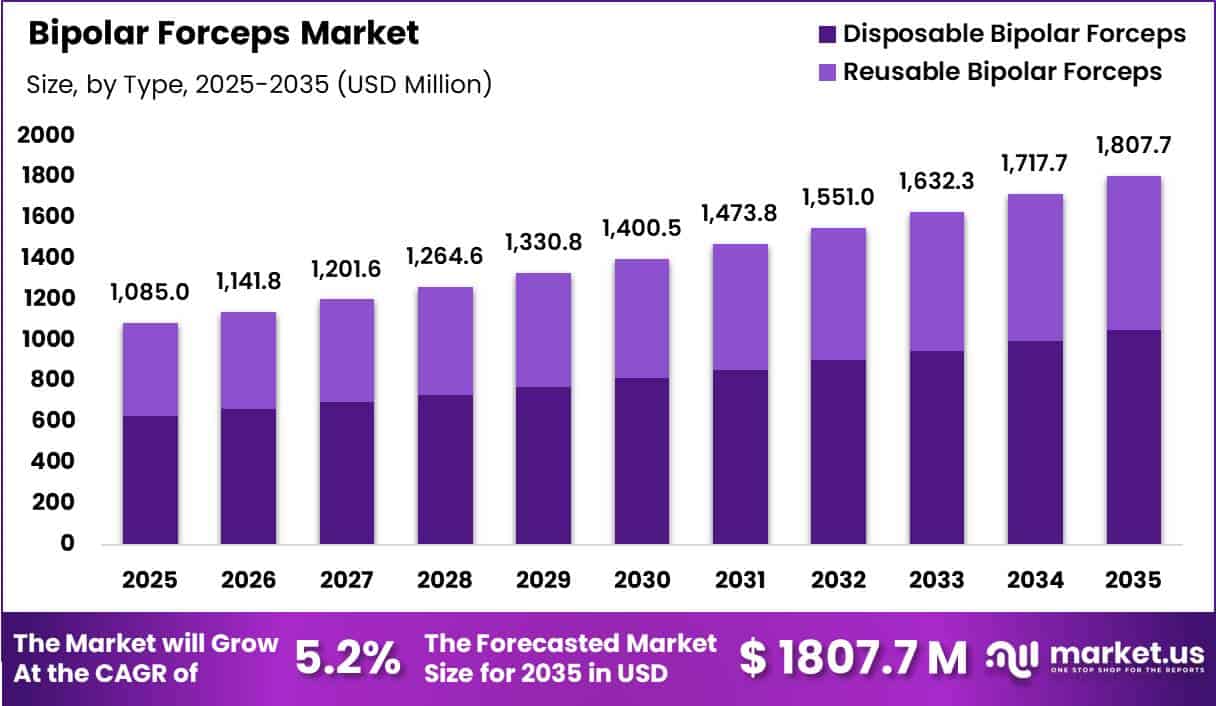
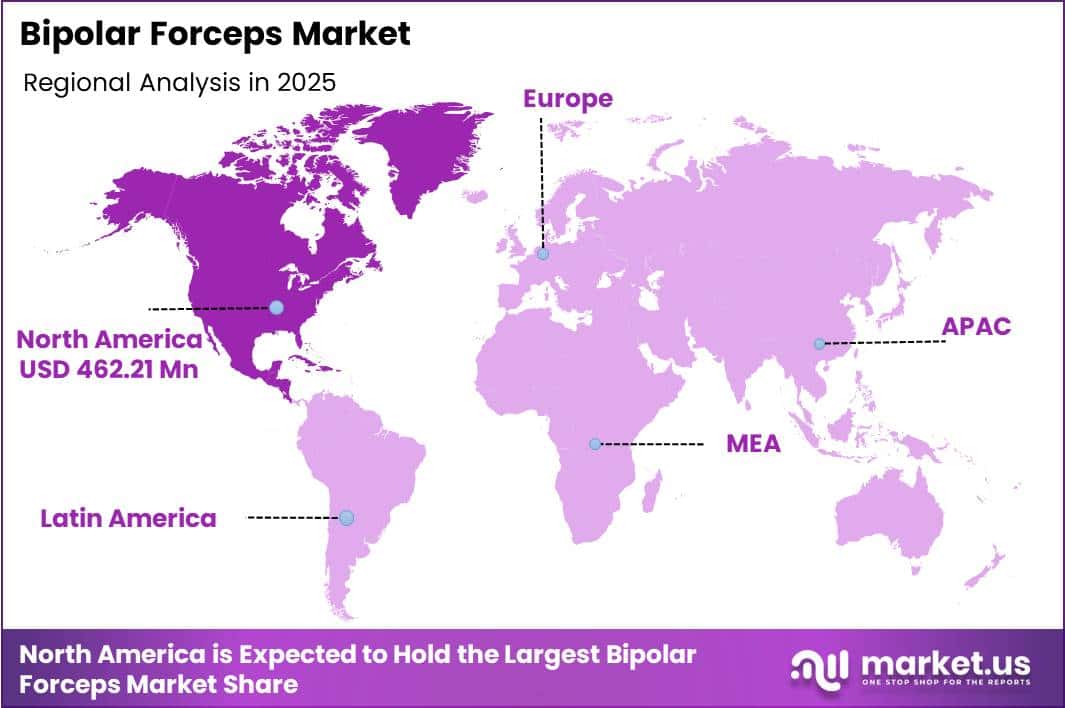
The Global Bipolar Forceps Market size is expected to be worth around US$ 1,807.7 Million by 2035 from US$ 1,085.0 Million in 2025, growing at a CAGR of 5.2% during the forecast period from 2026 to 2035. In 2025, North America led the market, achieving over 42.6% share with a revenue of US$ 462.2 Million.
Bipolar forceps are precision electrosurgical instruments used to grasp, coagulate, and control bleeding during surgical procedures by passing high-frequency electrical current only between the two tips of the forceps. Unlike monopolar electrosurgery, the electrical circuit remains localised, reducing thermal spread to surrounding tissues and making bipolar forceps particularly valuable in neurosurgery, ophthalmology, ENT, plastic surgery, gynaecology, and microsurgical procedures.
The U.S. Food and Drug Administration (FDA) classifies bipolar forceps under Class II electrosurgical cutting and coagulation devices (Product Code GEI), requiring manufacturers to demonstrate safety and substantial equivalence through the 510(k) premarket pathway before commercialisation.
Growing surgical volumes and the increasing adoption of minimally invasive procedures continue to support demand for advanced bipolar forceps. According to the World Health Organisation, approximately 234 million major surgical procedures are performed each year globally, highlighting the significant need for reliable electrosurgical instruments in operating rooms.
In addition, the WHO estimates that more than 1 in 10 patients experience adverse events during healthcare, many of which are associated with surgical care, reinforcing the importance of precision devices that enhance procedural safety.
Technological innovation is further strengthening the market, with manufacturers introducing disposable, irrigating, illuminated, and non-stick bipolar forceps designed to improve surgical precision, reduce tissue adhesion, and support efficient coagulation.
Recent FDA-cleared devices are available in multiple lengths and tip sizes, are commonly supplied sterile with a Sterility Assurance Level (SAL) of 10⁻⁶, and are intended for single-use or reusable applications across a wide range of surgical specialities. Continued regulatory approvals, infection-control requirements, and advancements in electrosurgical systems are expected to sustain long-term growth in the bipolar forceps market.
Key Takeaways
- Market Size: The Global Bipolar Forceps Market size was US$ 1,085.0 Million in 2025. The market is estimated to grow to US$ 1,807.7 million by 2035.
- Market Share: The Compound Annual Growth Rate (CAGR) of the market from 2026 to 2035 will be 5.2%.
- Type: Disposable Bipolar Forceps has the largest market share, accounting for 58.2% of total sales.
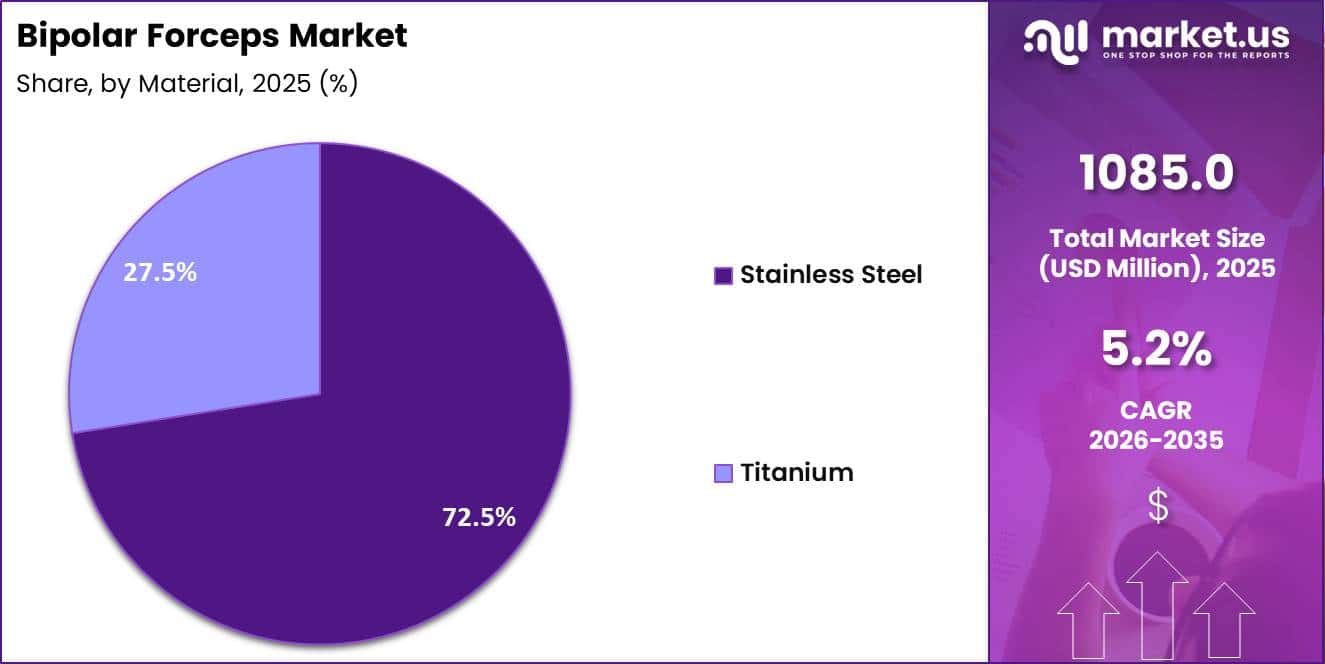
- Material: Stainless Steel dominates the segment, accounting for 72.5% of total revenue.
- Application: Neurosurgery leads the segment, accounting for 35.3% of total revenue.
- End User: Hospitals dominate the segment, accounting for 62.4% of total revenue.
- Regional: North America is the dominant regional market, accounting for 42.6% of global sales.
Type Analysis
The disposable bipolar forceps segment dominated the bipolar forceps market in 2025, accounting for 58.2% of the total market share. The segment’s leadership is driven by the growing emphasis on infection prevention, strict sterilisation protocols, and the widespread adoption of single-use surgical instruments in hospitals and outpatient facilities. Disposable bipolar forceps eliminate the need for reprocessing and reduce the risk of cross-contamination, making them particularly valuable in high-volume surgical environments.
Healthcare providers also benefit from improved workflow efficiency, consistent instrument performance, and compliance with evolving infection control regulations. Increasing numbers of minimally invasive and electrosurgical procedures further support demand for disposable devices, especially in neurosurgery, gynaecology, and general surgery.
The reusable bipolar forceps segment held 41.8% of the market in 2025. These instruments continue to maintain strong demand due to their long operational lifespan, cost-effectiveness over repeated procedures, and widespread use in healthcare facilities with established sterilisation infrastructure. Premium reusable forceps manufactured from durable materials offer precise tissue handling and reliable electrical conductivity, making them suitable for complex surgical interventions.
Continuous improvements in ergonomic design, insulation technology, and corrosion resistance are enhancing product durability and surgeon comfort, ensuring that reusable bipolar forceps remain an important segment despite the growing adoption of disposable alternatives.
Material Analysis
The stainless steel segment dominated the bipolar forceps market in 2025, capturing 72.5% of the total market share. Stainless steel remains the preferred material because it offers an excellent balance of durability, corrosion resistance, electrical conductivity, and mechanical strength required during electrosurgical procedures. The material withstands repeated sterilisation cycles without significant degradation, making it suitable for both reusable and premium surgical instruments.
Manufacturers also favour stainless steel because it supports precision manufacturing while maintaining affordability compared to advanced speciality alloys. Its widespread acceptance across hospitals and surgical centres continues to reinforce its market leadership in neurosurgical, cardiovascular, and general surgical procedures.
The titanium segment accounted for 27.5% of the market in 2025 and is gaining attention in specialised surgical applications. Titanium bipolar forceps provide exceptional strength while being considerably lighter than stainless steel, reducing surgeon hand fatigue during lengthy procedures. The material is highly resistant to corrosion and exhibits excellent biocompatibility, making it particularly valuable in delicate microsurgical and neurosurgical interventions.
Titanium instruments also offer improved handling precision due to their lightweight construction and durability. Although higher manufacturing costs limit widespread adoption, increasing demand for premium surgical instruments and advanced microsurgical procedures is expected to support steady growth of the titanium segment over the coming years.
Application Analysis
The neurosurgery segment dominated the bipolar forceps market in 2025, accounting for 35.3% of the total market share. Bipolar forceps are indispensable in neurosurgical procedures because they enable precise coagulation while minimising thermal damage to surrounding neural tissues. The increasing incidence of neurological disorders, brain tumours, spinal surgeries, and cerebrovascular procedures has significantly strengthened demand for advanced bipolar forceps.
Surgeons rely on these instruments for accurate hemostasis in delicate operating fields where precision directly influences patient outcomes. Technological advancements, including improved insulation, ergonomic designs, and enhanced electrical performance, have further reinforced their widespread use in neurosurgical operating rooms.
The general surgery segment continues to represent a substantial portion of the market owing to the high volume of abdominal, gastrointestinal, and soft tissue procedures performed globally. Gynaecological surgery is experiencing consistent growth due to increasing minimally invasive procedures and rising demand for effective bleeding control.
Cardiovascular surgery also contributes significantly, as bipolar forceps provide precise vessel coagulation while reducing collateral tissue injury during complex operations. The others segment, including orthopaedic, ENT, plastic, and urological procedures, continues expanding as electrosurgical technologies become increasingly integrated into diverse surgical specialities, supporting sustained demand for high-performance bipolar forceps across multiple clinical applications.
End-User Analysis
The hospitals segment dominated the bipolar forceps market in 2025, holding 62.4% of the total market share. Hospitals perform the highest volume of complex surgical procedures requiring advanced electrosurgical instruments, making them the primary consumers of bipolar forceps. Large healthcare institutions benefit from comprehensive surgical infrastructure, specialised operating rooms, and highly trained multidisciplinary surgical teams.
The increasing number of neurological, cardiovascular, gynaecological, and general surgical procedures continues to support demand for both disposable and reusable bipolar forceps in hospital settings. Investments in advanced surgical technologies and infection prevention measures further strengthen hospital procurement of high-quality bipolar electrosurgical instruments.
The ambulatory surgical centres (ASCs) segment is witnessing notable growth due to the increasing shift toward minimally invasive and same-day surgical procedures. These facilities prioritise efficient, cost-effective surgical instruments that support rapid patient turnover and shorter recovery times. Speciality clinics also contribute to market expansion through increasing outpatient surgical services in ophthalmology, ENT, gynaecology, and dermatology.
Meanwhile, academic and research institutions represent an important segment by supporting surgical education, clinical training, and product evaluation activities. Continuous research into advanced electrosurgical techniques, coupled with surgeon training programs, sustains demand for bipolar forceps across teaching hospitals and research-focused medical institutions, complementing overall market growth.
Key Market Segments
By Type
- Disposable Bipolar Forceps
- Reusable Bipolar Forceps
By Material
- Stainless Steel
- Titanium
By Application
- Neurosurgery
- General Surgery
- Gynecological Surgery
- Cardiovascular Surgery
- Others
By End User
- Hospitals
- Ambulatory Surgical Centres
- Specialty Clinics
- Academic and Research Institutions
Drivers
Surgical smoke compliance favouring integrated bipolar platforms
Electrosurgical tools are a recognised source of surgical smoke, and the AMA’s 2025 report noted that 18 U.S. states had passed surgical smoke legislation as of its 2024 review, while recommending smoke evacuation, ventilation, and PPE to reduce staff exposure to fine particulate matter and other hazards.
WHO also continues to frame operating room safety as a measurable patient safety priority, and its Surgical Safety Checklist has been shown to reduce complications and mortality by more than 30 %, which strengthens hospital willingness to formalise energy device protocols rather than treat plume management as optional.
This driver benefits bipolar forceps specifically where smoke evacuation capability is integrated into hand-switched or disposable electrosurgical accessories, because procurement shifts from lowest-cost forceps toward workflow-compliant accessory ecosystems that reduce add-on setup friction.
That transition is most immediate in the U.S. and premium hospital systems and reasonably supports about 1.4 % points of CAGR upside as compliance converts clinical preference into budgeted replacement demand.
| Driver | (~) % Impact on CAGR Forecast | Geographic Relevance | Impact Timeline |
|---|---|---|---|
| Outpatient shift lifting bipolar consumable turns | +1.9% | North America core, EU urban systems, APAC private-hospital corridors | Short term (≤ 2 years) |
| Surgical smoke compliance favouring integrated bipolar platforms | +1.4% | U.S. core, EU, selected APAC tertiary centres | Short term (≤ 2 years) |
| Single-use and anti-stick tip adoption improving OR economics | +1.6% | North America core, Japan, South Korea, GCC, EU premium sites | Medium term (2-4 years) |
| Chronic disease and obesity burden are expanding hemostasis-intensive caseloads | +1.7% | U.S., EU5, Gulf, urban China, India tertiary centres | Medium term (2-4 years) |
| Precision thermal-control demand in microsurgery and laparoscopy | +1.3% | U.S. academic centres, EU, Japan, South Korea | Medium term (2-4 years) |
| Quality-risk and reprocessing scrutiny are accelerating product refresh | +1.1% | U.S. core, EU regulated systems, APAC export-oriented hospitals | Short term (≤ 2 years) |
Challenges
Outpatient price mix compression in bipolar forceps adoption
A central challenge in 2026 is that bipolar forceps demand is increasingly tied to outpatient and ambulatory surgery center migration, yet the reimbursement environment in those channels is becoming tighter and more operationally selective, with CMS finalizing a 2.6 % OPPS payment update for CY 2026 while also adjusting outpatient payment rules, continuing procedure migration, and expanding ASC eligibility criteria in ways that intensify provider focus on consumable cost, turnover time, and case profitability.
When facilities absorb only low single-digit payment updates, but face labour inflation, sterilisation overhead, and compliance add-ons, even a 1.5 to 3.0 % increase in per-case instrument cost or a 2 to 4-minute delay in room turnover can materially compress margin on high-volume gynaecology, ENT, and general surgery workflows, making premium bipolar forceps harder to scale across all surgeons and sites.
The resulting 0.8 % point CAGR drag comes from mix dilution rather than lost clinical relevance, and manufacturers must respond with SKU rationalisation, generator compatibility optimisation, value analysis evidence, and lower total cost of procedure contracting models that match outpatient economics over the next 2 to 4 years.
| Challenge | (~) % CAGR Friction Drag | Geographic Relevance | Mitigation Horizon |
|---|---|---|---|
| Sterile component volatility | -1.1% | North America core, EU hospital networks, APAC export corridors | Medium term (2-4 years) |
| OR workforce capability gap | -0.9% | North America tertiary centres, EU ageing systems, LMIC surgical hubs | Long-term (≥ 4 years) |
| Outpatient price-mix compression | -0.8% | U.S. ASC channels, North America core, selected EU day-surgery markets | Medium term (2-4 years) |
| Compliance workflow burden | -0.7% | U.S. state-regulated providers, EU regulatory hubs, premium APAC hospitals | Short term (≤ 2 years) |
| Shortage reporting exposure | -0.6% | U.S. manufacturing base, cross-border OEM suppliers, hospital procurement groups | Medium term (2-4 years) |
| Procedure complexity migration | -0.8% | U.S. outpatient networks, EU elective surgery centres, APAC urban hospitals | Long-term (≥ 4 years) |
Restraints
Hospital Capital Expenditure Tightening in Surgical Equipment
The second restraint is capital expenditure tightening in hospitals driven by macro health spending dynamics, where total U.S. health expenditure grew approximately 7.2 to 7.5 % in 2023 to 2024 but is increasingly directed toward labour, drugs, and operations rather than equipment capex, with similar mid-single-digit trends across OECD systems.
Hospital capex committees in North America and Europe are prioritising robotics, imaging, and digital infrastructure over incremental electrosurgical instrumentation, resulting in delayed upgrades to bipolar forceps generators and slower adoption of premium non-stick or ergonomic variants.
As a result, surgical equipment capex is growing at approximately 2 to 3 % annually versus 5 to 6% pre-COVID, implying a 25 to 35 % shortfall over 3 to 4 years. From a unit economics perspective, bipolar forceps depend on 7 to 10 year generator refresh cycles plus instrument upselling to sustain 3 to 4 % ASP growth; delays of 2 to 3 years in 20 to 30 % of hospitals can reduce ASP growth below 2 %, leaking approximately 200 basis points of revenue CAGR and contributing an estimated 2.3 % point drag on market growth.
Strategically, firms increasingly stretch existing platforms via incremental software, compatibility, and accessory updates rather than full upgrades, shifting R&D toward compliance and cybersecurity. Sales teams also face higher effort per dollar of revenue as competition for limited capex slots intensifies, with potential EBITDA margin compression of 200 to 300 basis points in downside cases unless offset by cost efficiencies.
| Restraint | (~) % Impact on CAGR Forecast | Geographic Relevance | Impact Timeline |
|---|---|---|---|
| Post-COVID surgical backlog normalisation | -1.8% | North America core, EU, selective APAC | Short term (≤ 2 years) |
| Capital expenditure tightening in hospitals | -2.3% | North America core, EU, Latin America | Medium term (2–4 years) |
| Stricter electrosurgical regulatory compliance | -1.6% | U.S., EU, high-regulation APAC | Medium term (2–4 years) |
| Supply-chain volatility in speciality metals | -1.4% | Global, with APAC and EU manufacturing hubs | Short–Medium term (≤ 3 years) |
| Shift from reusable to disposable economics | -1.2% | North America, EU, high-income APAC | Long term (≥ 4 years) |
| Price compression from purchasing groups | -1.0% | North America core, EU hospital networks | Medium–Long term (2–5 years) |
Opportunity
Procedure-linked subscription models for bipolar forceps
This opportunity shifts bipolar forceps revenue from one-off instruments and capital sales toward bundled, procedure-linked subscription contracts with hospitals and integrated delivery networks. With approximately 300 to 350 million operative procedures annually expected in high-income and upper-middle-income markets by 2030, bipolar electrosurgical use could realistically address 25 to 30 % of this volume.
Instead of ad hoc procurement, vendors would bundle forceps, tips, consumables, and maintenance into per-procedure or per-operating-room-minute pricing, combined with uptime guarantees, safety checks, and staff training aligned with electrosurgical risk reduction. This reframes procurement from unit cost to performance and utilisation.
Such a model could increase realised revenue per active operating room by approximately 15 to 25 %, expand gross margins by 300 to 400 basis points through better demand visibility and lower sales overhead, and ultimately add about 2.0 % points to market CAGR by monetising usage intensity rather than hardware alone.
| Opportunity | (~) % Potential CAGR Upside | Geographic Relevance | Execution Window |
|---|---|---|---|
| Procedure-linked subscription models | +2.0% | North America, EU, high-volume APAC | Short term (≤ 2 years) |
| LMIC surgical access scale-up alignment | +1.5% | Sub-Saharan Africa, South Asia, LatAm | Medium term (2-4 years) |
| Integrated safety & smoke-management bipolar systems | +1.3% | North America core, EU, advanced APAC | Medium term (2-4 years) |
| Data-instrumented smart bipolar forceps | +1.8% | Tertiary hospitals globally, academic centres | Long-term (≥ 4 years) |
| Reusable–single-use hybrid models for cost-constrained systems | +1.2% | LMIC public systems, EU cost-pressured hospitals | Short–medium term (≤ 4 years) |
| Speciality-specific bipolar portfolios for high-growth surgical domains | +1.4% | Global neurosurgery, gynaecology, and ENT hubs | Medium term (2-4 years) |
Regional Analysis
In 2025, North America led the market, achieving over 42.6% share with a revenue of US$ 462.21 million. Market leadership is supported by a highly developed healthcare infrastructure, widespread adoption of advanced electrosurgical technologies, and a high volume of neurosurgical, cardiovascular, and minimally invasive procedures.
Strong investments in hospital modernisation, favourable reimbursement systems, and the presence of leading medical device manufacturers further contribute to regional growth. Continuous product innovation and increasing emphasis on infection prevention have accelerated the adoption of both disposable and reusable bipolar forceps across hospitals and ambulatory surgical centres.
Europe represented the second-largest regional market, driven by well-established public healthcare systems, growing surgical procedure volumes, and stringent regulatory standards for patient safety and medical device quality.
Countries such as Germany, France, Italy, and the United Kingdom continue to invest in advanced operating room technologies, supporting steady demand for precision electrosurgical instruments. Rising adoption of minimally invasive surgery and increasing elderly populations requiring complex surgical interventions also strengthen regional market expansion.
The Asia-Pacific region is expected to register the fastest growth during the forecast period due to expanding healthcare infrastructure, increasing healthcare expenditure, and rising access to advanced surgical services in countries including China, Japan, South Korea, and Australia. Growing awareness of infection control, rapid hospital expansion, and increasing numbers of trained surgeons are boosting demand for bipolar forceps.
Meanwhile, Latin America and the Middle East & Africa are experiencing gradual market growth, supported by improving healthcare facilities, greater investment in surgical capabilities, and expanding availability of modern electrosurgical equipment.
Key Regions and Countries
North America
- The US
- Canada
Europe
- Germany
- France
- The U.K.
- Italy
- Spain
- Russia & CIS
- Rest of Europe
Asia Pacific
- China
- India
- Japan
- South Korea
- ASEAN
- Australia & New Zealand
- Rest of Asia Pacific
Middle East & Africa
- GCC
- South Africa
- Rest of the Middle East & Africa
Latin America
- Brazil
- Mexico
- Rest of Latin America
Key Player Analysis
Competitive advantage in the global bipolar forceps market is achieved through broad product portfolio coverage spanning disposable and reusable bipolar forceps across stainless steel and titanium material formulations, established relationships with hospital neurosurgery and general surgery departments, and continued investment in precision tip geometry and insulation technology improving intraoperative hemostasis performance.
Major strategic priorities for leading manufacturers include expansion of disposable bipolar forceps product lines addressing infection control and cross-contamination prevention requirements in hospital surgical settings, development of titanium lightweight forceps designs reducing surgeon fatigue during extended neurosurgical procedures, and growing investment in ambulatory surgical centre distribution channels supporting the structural shift toward outpatient surgical procedures.
Strong hospital surgical procurement relationships, combined with growing speciality clinic and ambulatory surgical centre presence, represent a critical competitive differentiator for manufacturers serving the dominant neurosurgery application segment globally.
Top Key Players
- Medtronic plc
- B. Braun Melsungen AG
- Johnson & Johnson (Ethicon)
- Stryker Corporation
- CONMED Corporation
- KLS Martin Group
- Integra LifeSciences Corporation
- BD (Becton, Dickinson and Company)
- Olympus Corporation
- Karl Storz SE & Co. KG
- Erbe Elektromedizin GmbH
- Stingray Surgical Products, LLC
- Surgical Holdings, Inc.
- Teleflex Incorporated
- Kirwan Surgical Products, LLC
- Other Key Players
Recent Developments
- In January 2026, Medtronic plc launched an expanded disposable bipolar forceps line featuring enhanced insulation coating technology, targeting hospital neurosurgery and cardiovascular surgery departments seeking improved tissue precision and reduced thermal spread during complex surgical procedures.
- In February 2026, B. Braun Melsungen AG introduced a new titanium lightweight bipolar forceps series for gynaecological and general surgery applications, targeting ambulatory surgical centre and speciality clinic buyers seeking ergonomic instruments with reduced surgeon fatigue during minimally invasive procedures.
- In March 2026, CONMED Corporation expanded its reusable bipolar forceps portfolio with new autoclave-compatible stainless steel designs, targeting hospital central sterile services departments seeking extended instrument lifecycle performance with consistent hemostasis quality across repeated sterilisation cycles.
- In April 2026, Integra LifeSciences Corporation secured a multi-year supply agreement with a leading Asian hospital network covering its neurosurgical bipolar forceps and electrosurgical accessory portfolio, expanding its institutional presence across neurosurgery and cardiovascular surgery procurement channels in the region.
Report Scope
| Report Features | Description |
|---|---|
| Market Value (2025) | US$ 1,085.0 Million |
| Forecast Revenue (2035) | US$ 1,807.7 Million |
| CAGR (2026-2035) | 5.2% |
| Base Year for Estimation | 2025 |
| Historic Period | 2020-2024 |
| Forecast Period | 2026-2035 |
| Report Coverage | Revenue Forecast, Market Dynamics, Competitive Landscape, Recent Developments |
| Segments Covered | By Type (Disposable Bipolar Forceps, Reusable Bipolar Forceps), By Material (Stainless Steel, Titanium), By Application (Neurosurgery, General Surgery, Gynaecological Surgery, Cardiovascular Surgery, Others), By End User (Hospitals, Ambulatory Surgical Centres, Speciality Clinics, Academic and Research Institutions) |
| Regional Analysis | North America – The US, Canada; Europe – Germany, France, U.K., Italy, Spain, Russia & CIS, Rest of Europe; Asia Pacific – China, India, Japan, South Korea, ASEAN, Australia & New Zealand, Rest of Asia Pacific; Middle East & Africa – GCC, South Africa, Rest of Middle East & Africa; Latin America – Brazil, Mexico, Rest of Latin America |
| Competitive Landscape | Medtronic plc, B. Braun Melsungen AG, Johnson & Johnson (Ethicon), Stryker Corporation, CONMED Corporation, KLS Martin Group, Integra LifeSciences Corporation, BD (Becton, Dickinson and Company), Olympus Corporation, Karl Storz SE & Co. KG, Erbe Elektromedizin GmbH, Stingray Surgical Products, LLC, Surgical Holdings, Inc., Teleflex Incorporated, Kirwan Surgical Products, LLC, Other Key Players |
| Customization Scope | Customization for segments, region/country-level will be provided. Moreover, additional customization can be done based on the requirements. |
| Purchase Options | We have three licenses to opt for: Single User License, Multi-User License (Up to 5 Users), Corporate Use License (Unlimited User and Printable PDF) |





































