


Report Overview
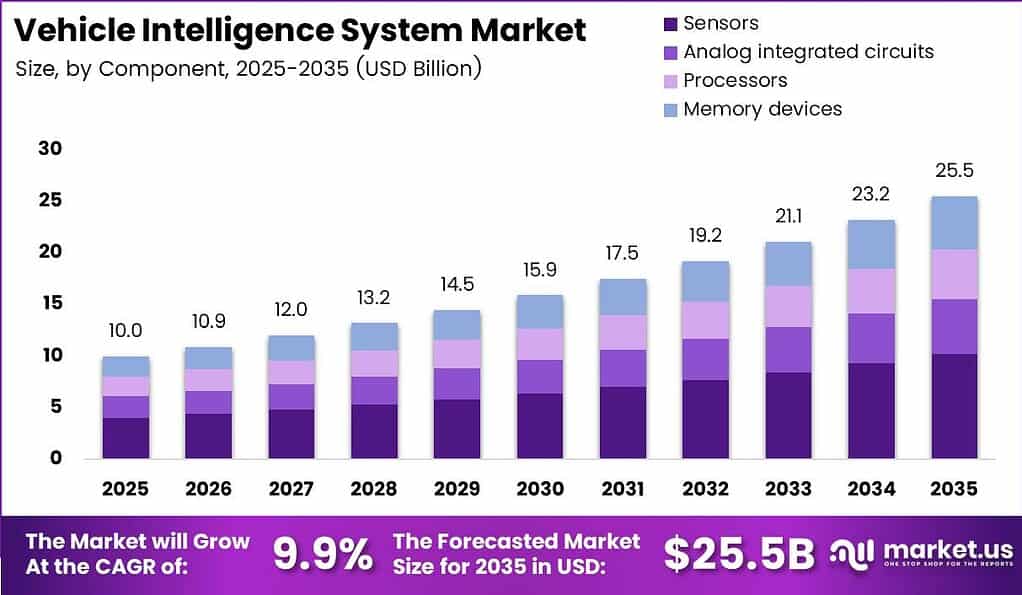
Global Vehicle Intelligence System Market size is expected to be worth around USD 25.5 Billion by 2035 from USD 10.0 Billion in 2025, growing at a CAGR of 9.9% during the forecast period 2026 to 2035.
The vehicle intelligence system market encompasses hardware and software components that enable vehicles to sense, process, and respond to road environments. This includes sensors, processors, memory devices, and analog integrated circuits that collectively support functions such as road scene understanding, ADAS, driver monitoring, and connected fleet management. The market spans passenger and commercial vehicles across OEM-integrated and aftermarket channels.
Key Takeaways
- The Global Vehicle Intelligence System Market is valued at USD 10.0 Billion in 2025 and is forecast to reach USD 25.5 Billion by 2035, expanding at a CAGR of 9.9% during 2026 to 2035.
- By Component, Sensors leads with a 30.30% share, reflecting mandatory safety detection hardware requirements across new vehicle programs.
- By Road Scene Understanding, Road/Lane Tracking Systems holds the largest share at 38.00%, anchored by lane-departure and highway-assist mandates in Europe and North America.
- By ADAS and Monitoring, Adaptive Cruise Control dominates at 24.00%, representing the most widely deployed active safety feature across passenger and commercial fleets.
- By Vehicle Type, Passenger Vehicles account for 72.00% of market revenue, driven by the broadest regulatory compliance burden and the highest global production volumes.
- By Propulsion Type, Internal-Combustion-Engine Vehicles hold a 65.00% share, sustained by installed base scale and ongoing new-model production through the near term.
- By Sales Channel, OEM commands 85.00% of revenue, as factory-integrated and type-approved systems remain the only path to full safety-mandate compliance.
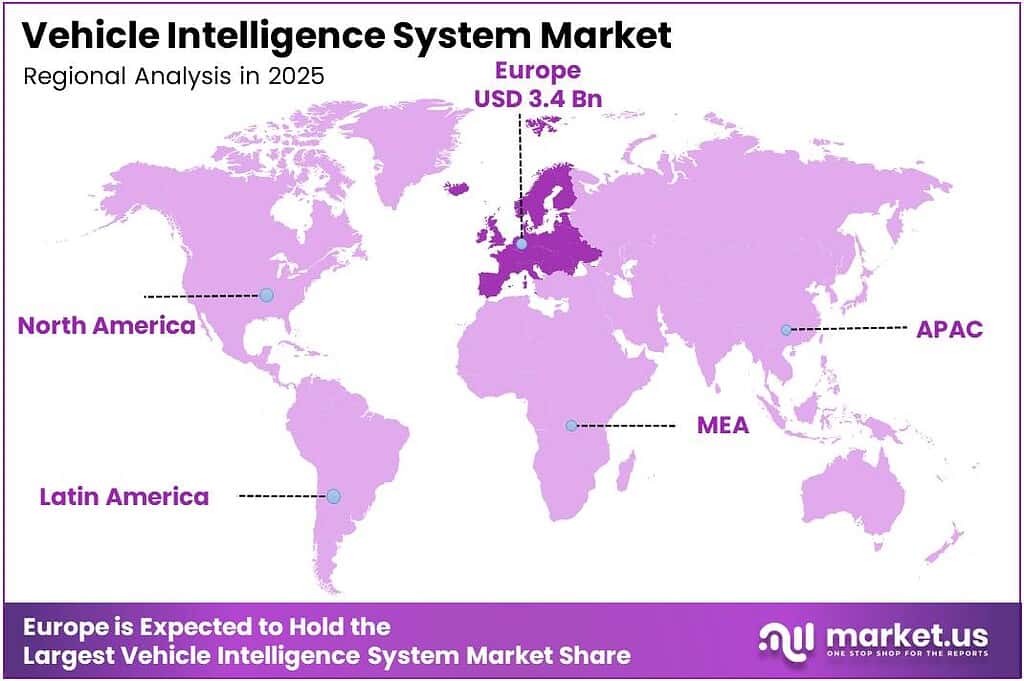
- Europe is the dominant region with a 34.00% market share, valued at USD 3.4 Billion in 2025, led by the EU General Safety Regulation mandating ADAS as standard content across all new motor vehicles.
As per our research, road crashes cost most countries approximately 3% to 5% of GDP. This fiscal burden compels governments to mandate safety technology rather than treat it as optional equipment. Vendors supplying ADAS and monitoring systems benefit from policy-driven baseline demand that is decoupled from consumer discretionary spending cycles.
According to OICA data, global vehicle production increased from 92.7 million units in 2024 to 96.4 million in 2025, up 3.9%. This output expansion directly enlarges the addressable base for factory-installed intelligence systems. OEM-channel suppliers who hold volume agreements with high-output manufacturers lock in embedded unit economics before aftermarket competitors can access the same vehicles.
OICA figures show global vehicle sales increased from 95.3 million units in 2024 to 99.8 million in 2025, up 4.7%. Sales growth outpacing production growth signals that inventory drawdown is accelerating throughput. This creates a pull-through effect for fitted intelligence systems and raises the incentive for OEMs to differentiate on sensor and software content. As part of this investment wave, Valeo announced plans to invest more than €200 million in India and target approximately €700 million in Indian sales by 2028, signaling that tier-one suppliers are repositioning capital toward high-growth emerging production hubs.
Component Analysis
Sensors dominate with 30.30% due to mandatory safety detection hardware requirements.
In 2025, Sensors held a dominant market position in the By Component segment of the Vehicle Intelligence System Market, with a 30.30% share. Sensors form the physical perception layer that every higher-level ADAS and monitoring function depends on. FMVSS No. 127 mandates automatic emergency braking on nearly all new U.S. passenger cars and light trucks by September 2029, directly requiring compliant sensor arrays. Vendors who build modular, multi-function sensor platforms capture recurring upgrade revenue as performance thresholds tighten.
Analog integrated circuits occupy a structurally critical role as the signal-conditioning bridge between raw sensor outputs and digital processing pipelines. Without precise analog front-ends, sensor data quality degrades and system-level safety certification becomes harder to achieve. Suppliers who integrate analog and digital functions on a single die reduce board space and bill-of-materials cost, creating a measurable advantage in platform bids.
Processors carry the computational workload for real-time scene interpretation, object classification, and decision execution across all ADAS functions. As vehicle intelligence architectures shift toward centralized domain controllers, processor content per vehicle rises. This concentration benefits suppliers with ISO 26262-certified compute platforms that OEMs can validate once and deploy across multiple model lines.
Memory devices complete the component set by storing maps, model weights, sensor calibration data, and event records required for both real-time operation and post-incident analysis. Analog integrated circuits, processors, and memory devices together hold the remaining share not captured by sensors, each underpinning distinct layers of the intelligence stack.
Road Scene Understanding Analysis
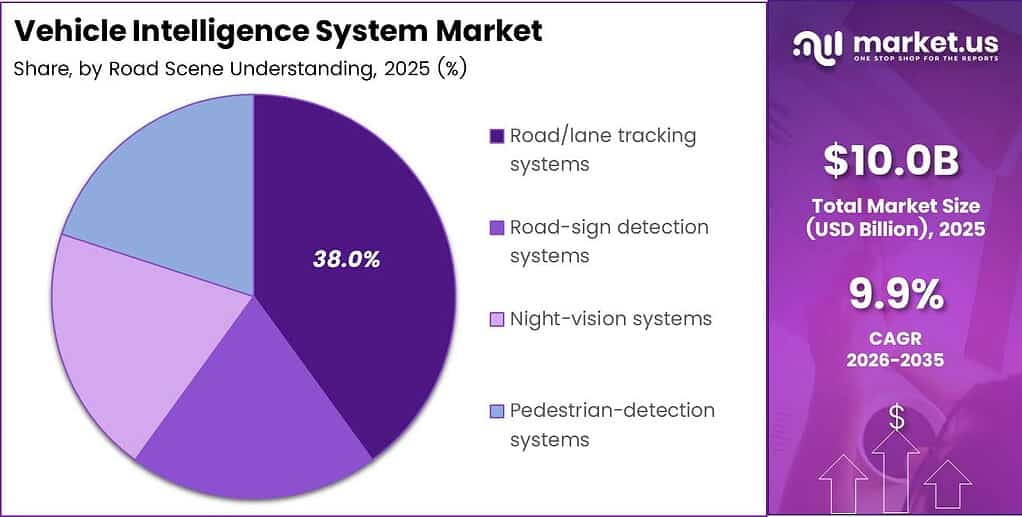
Road/lane tracking systems dominate with 38.00% due to lane-departure and highway-assist regulation.
In 2025, Road/lane tracking systems held a dominant market position in the By Road Scene Understanding segment of the Vehicle Intelligence System Market, with a 38.00% share. Lane-tracking functions anchor the mandatory ADAS package under the EU General Safety Regulation and are a prerequisite for higher automation levels. Systems that deliver accurate lane-center positioning across varied road markings, lighting, and weather conditions command premium OEM placement and recurring software validation contracts.
Road-sign detection systems deliver a compliance-aligned function that regulators increasingly treat as baseline rather than optional. FMVSS No. 127 is projected to save at least 360 lives and prevent at least 24,000 injuries annually in the United States, underscoring the policy pressure pushing sign-recognition content into standard vehicle builds. Suppliers who achieve high detection accuracy across multilingual and worn signage gain an edge in global platform rollouts.
Night-vision systems address a persistent safety gap because low-light conditions account for a disproportionate share of severe crashes relative to exposure hours. As per our research, approximately 1.19 million road-traffic deaths occurred globally in 2021, down 5% from 2010. Progress at this pace is insufficient for regulatory targets, raising the policy case for mandating active night-vision content in premium and near-premium segments.
Pedestrian-detection systems close the scenario coverage that lane and sign functions leave open, targeting the most legally and reputationally sensitive collision type. Road-sign detection, night-vision, and pedestrian-detection systems together hold the remaining share after road/lane tracking, each defending a distinct portion of the mandatory and near-mandatory safety scope.
ADAS and Monitoring Analysis
Adaptive cruise control dominates with 24.00% due to highway-speed automation adoption.
In 2025, Adaptive cruise control held a dominant market position in the By ADAS and Monitoring segment of the Vehicle Intelligence System Market, with a 24.00% share. Adaptive cruise control represents the entry point for combined longitudinal automation and forward-collision awareness, making it the most widely deployed active safety feature in both passenger and commercial vehicles. OEMs who offer it as standard rather than optional on mid-tier trims accelerate sensor volume and open upsell pathways toward traffic-jam assist and highway pilot functions.
Blind-spot detection systems address a lateral awareness gap that mirrors, cameras, and driver attention alone cannot reliably close at highway speeds. The U.S. National Highway Traffic Safety Administration estimated 39,345 traffic fatalities in 2024, down 3.8% from 2023 at 1.20 fatalities per 100 million vehicle-miles travelled. Lateral-threat detection systems that contribute to this declining fatality trend build a measurable safety record, which insurers and fleet operators use to justify system procurement.
Park-assist systems capture a distinct urban-use-case demand that is separate from highway automation, addressing the low-speed maneuvering scenarios responsible for a high share of minor collision claims. Aptiv’s Gen 6 ADAS platform was selected for 14 Indian truck and bus models covering more than 30 variants, demonstrating that park and low-speed assist functions are gaining commercial vehicle traction in large emerging markets. This selection signals a shift from passenger-only deployment toward fleet-scale commercial procurement.
Traffic-jam assist, driver-drowsiness monitoring, and warning and alertness sensing systems hold the remaining share within the ADAS and monitoring segment. Each targets a distinct behavioral or operational risk profile, with drowsiness monitoring gaining regulatory momentum as regulators extend attention-detection requirements beyond European markets.
Vehicle Type Analysis
Passenger vehicles dominate with 72.00% due to consumer safety regulation and volume scale.
In 2025, Passenger vehicles held a dominant market position in the By Vehicle Type segment of the Vehicle Intelligence System Market, with a 72.00% share. Passenger vehicles carry the broadest regulatory compliance burden for ADAS content and represent the largest single production volume globally. OEM suppliers who standardize their intelligence platform across high-volume passenger model families achieve the unit economics and certification reuse that allow them to undercut late-moving competitors on price.
Commercial vehicles hold the remaining share and are increasingly subject to fleet-operator mandates for telematics, driver monitoring, and collision avoidance that are separate from consumer-facing passenger regulations. Fleet procurement cycles create predictable, contract-based revenue that differs structurally from retail-driven passenger volumes. Suppliers who build vehicle-type-specific platforms for trucks and buses access a stickier customer base with longer replacement intervals and higher average intelligence content per unit.
Propulsion Type Analysis
Internal-combustion-engine vehicles dominate with 65.00% due to installed base scale and replacement lag.
In 2025, Internal-combustion-engine vehicles held a dominant market position in the By Propulsion Type segment of the Vehicle Intelligence System Market, with a 65.00% share. The ICE installed base and ongoing new-model production sustain demand for intelligence systems that do not require electrified architecture, keeping this segment the largest revenue contributor through the near term. Suppliers who design platform-agnostic hardware architectures serve both ICE and electrified variants without doubling their validation workload.
Hybrid electric vehicles occupy a transition position where intelligence system content rises because hybrid powertrains require tighter integration between propulsion management, regenerative braking logic, and ADAS trigger events. This integration complexity raises average selling price per vehicle relative to pure ICE platforms. Vendors who validate their systems on hybrid architectures gain a qualification head start for the higher-integration demands of full battery-electric platforms.
Battery electric vehicles represent the fastest-shifting propulsion segment within the market. According to IEA data, global electric-car sales exceeded 20 million in 2025, up 20%, and accounted for 25% of new-car sales globally. IEA data also shows global electric-car sales exceeded 17 million in 2024, rising more than 25% and representing more than 20% of new-car sales, confirming a sustained acceleration that pulls intelligence content demand higher as BEV platforms carry denser sensor and compute loads than ICE equivalents.
Sales Channel Analysis
OEM dominates with 85.00% due to factory-integration mandates and certification requirements.
In 2025, OEM held a dominant market position in the By Sales Channel segment of the Vehicle Intelligence System Market, with a 85.00% share. OEM integration remains dominant because safety mandates require type-approved, factory-validated systems that aftermarket fitment cannot replicate at equivalent certification depth. Suppliers who hold long-cycle OEM platform nominations secure multi-year revenue visibility that aftermarket players cannot match, while also controlling the software update and data-logging revenue stream tied to installed systems.
Aftermarket channels hold the remaining 15% share and serve the large existing fleet that will age out of factory-integrated compliance windows over the forecast period. Modular retrofit kits that can be professionally installed and remotely provisioned represent the primary growth lever in this segment. Suppliers who develop plug-and-play hardware with OTA update capability convert aftermarket hardware sales into recurring subscription revenue, improving margin profile and customer retention.
Key Market Segments
By Component
- Sensors
- Analog integrated circuits
- Processors
- Memory devices
By Road Scene Understanding
- Road/lane tracking systems
- Road-sign detection systems
- Night-vision systems
- Pedestrian-detection systems
By ADAS and Monitoring
- Adaptive cruise control
- Blind-spot detection
- Park-assist systems
- Traffic-jam assist systems
- Driver-drowsiness monitoring
- Warning and alertness sensing systems
By Vehicle Type
- Passenger vehicles
- Commercial vehicles
By Propulsion Type
- Internal-combustion-engine vehicles
- Hybrid electric vehicles
- Battery electric vehicles
By Sales Channel
- OEM
- Aftermarket
Regional Analysis
Europe Dominates the Vehicle Intelligence System Market with a Market Share of 34.00%, Valued at USD 3.4 Billion
Europe holds the largest regional share at 34.00%, valued at USD 3.4 Billion in 2025, driven by the EU General Safety Regulation mandating ADAS as standard content across all new motor vehicles. EU new-car registrations increased by 1.8% in 2025, and battery-electric registrations reached 1,880,370 units with a 17.4% market share, up from 13.6% in 2024. In the first half of 2026, EU new-car registrations rose 5.7% and BEV registrations reached 1,220,890 units at a 20.7% share, up from 15.6% one year earlier. This sustained electrification trajectory lifts intelligence system content per vehicle as BEV platforms carry denser sensor and compute loads. HARMAN agreed to acquire ZF’s ADAS business for €1.5 billion in December 2025, with approximately 3,750 employees expected to transfer, reshaping the European competitive landscape for ADAS supply.
Asia-Pacific is the fastest-growing region, supported by the world’s largest vehicle production base. According to OICA data, Asia-Pacific produced approximately 59.2 million vehicles in 2025, accounting for more than 61% of global production. China alone produced 34.531 million vehicles and sold 34.4 million vehicles in 2025, setting both production and sales records. IEA figures show EV sales outside China, Europe, and the United States reached 2 million units in 2025, up from 1.3 million in 2024, pointing to intelligence system demand expanding beyond the three established markets into Southeast Asia and beyond.
North America advances on the back of federal regulatory action and fleet-driven procurement. The U.S. AEB standard remains on track for full compliance by September 2029, sustaining a mandated upgrade cycle across the passenger and light-truck fleet. Latin America, the Middle East, and Africa hold smaller shares today but represent long-cycle expansion markets as regulation harmonizes and fleet modernization programs gain funding.
Key Regions and Countries
North America
- US
- Canada
Europe
- Germany
- France
- The UK
- Spain
- Italy
- Rest of Europe
Asia Pacific
- China
- Japan
- South Korea
- India
- Australia
- Rest of APAC
Latin America
- Brazil
- Mexico
- Rest of Latin America
Middle East and Africa
- GCC
- South Africa
- Rest of MEA
Market Dynamics
Market Opportunity Analysis - Aging fleets, underserved commercial segments, and emerging markets create entry points for targeted intelligence players
The aftermarket channel holds 15% of the sales channel segment today but serves the largest addressable vehicle population. European fleets average over 12 years of age, placing the majority of in-service vehicles beyond new-production intelligence mandates. This creates a retrofit window where modular, subscription-priced systems can enter without competing directly against OEM-integrated platforms, giving new entrants a structurally protected beachhead.
Commercial vehicles hold the minority vehicle-type share at 28%, yet carry higher average intelligence content requirements per unit due to fleet telematics mandates and driver-monitoring rules that passenger-car buyers do not face. Consequently, suppliers who build commercial-specific platforms access customers with longer replacement cycles, procurement-driven buying decisions, and higher willingness to pay for validated uptime and compliance features.
The propulsion mix shift toward battery electric vehicles opens a product differentiation gap. BEV platforms require tighter sensor-to-powertrain integration than ICE equivalents, and suppliers who validate their intelligence systems on electrified architectures first establish reusable safety cases that slow-moving competitors must rebuild from scratch. This creates a window for component specialists to become preferred BEV platform partners before OEMs consolidate their supplier lists.
Asia-Pacific accounts for more than 61% of global vehicle production but currently absorbs a disproportionately smaller share of intelligence system revenue relative to its output volume. This gap reflects lower average ADAS content per vehicle across non-China markets in the region. Suppliers who localize certification, distribution, and pricing for South and Southeast Asian OEMs access a volume base that is structurally underpenetrated relative to regulatory trajectories already visible in Japan, South Korea, and India.
Technology and Innovation Landscape - Radar scale, edge-AI integration, and physical AI acquisitions define the next competitive frontier
Continental’s production of its 200 millionth automotive radar sensor in 2025 demonstrates that radar has crossed from differentiated feature to volume commodity. Suppliers who achieve this scale reduce per-unit cost through manufacturing learning curves that smaller entrants cannot replicate. This shifts competitive pressure from sensor existence to sensor fusion quality, where software and algorithm capability determines system-level margin.
Euro NCAP’s 2026 methodology contains four safety stages, each scored out of 100 points, raising the performance bar for scene understanding and ADAS accuracy across the European market. This structured scoring framework converts abstract safety claims into measurable procurement criteria for OEMs. Suppliers who align their validation programs to Euro NCAP stage requirements gain a certification shortcut that reduces time-to-bid on new platform programs.
DENSO invested ¥619.4 billion in research and development in fiscal 2025, equivalent to 8.6% of revenue. At this intensity, DENSO sustains a broad pipeline of sensor, compute, and software patents that protect margin on current platforms and accelerate time-to-market on next-generation systems. Competitors who underfund R&D relative to this benchmark risk falling behind on certification cycles that OEMs run on fixed multi-year schedules.
Mobileye’s EyeQ installed base exceeded 250 million vehicles by July 2026. This scale creates a data flywheel where fleet-scale real-world driving events continuously refine perception models that lab-only competitors cannot match. The NHTSA estimated 36,640 U.S. traffic fatalities in 2025, down 6.7% from 2024, with 1.10 fatalities per 100 million vehicle-miles travelled. Large installed bases that demonstrably contribute to declining fatality rates build the regulatory and insurance-sector relationships that new entrants must spend years to establish.
Drivers
The European Union extended its General Safety Regulation to all new motor vehicles on 7 July 2024, making functions such as intelligent speed assistance, lane keeping, automated braking, and event recording standard rather than premium options. These measures are projected to save more than 25,000 lives and prevent at least 140,000 serious injuries by 2038. This mandate converts discretionary feature licensing into mandatory embedded hardware, recurring validation, and software-update revenue, reducing customer-acquisition risk for compliant suppliers.
In the United States, the light-vehicle AEB standard finalized in 2024 remained on its implementation path following a rule amendment effective 20 March 2025, with full compliance required by September 2029. Required performance includes collision avoidance at up to 62 miles per hour and automatic braking at up to 90 miles per hour for imminent lead-vehicle collisions. These mandates support a modeled +2.1 percentage-point contribution to the 9.9% baseline CAGR, making regulatory alignment the single largest identifiable growth lever in this market.
| Driver | (~) % Impact on CAGR Forecast | Geographic Relevance | Impact Timeline |
|---|---|---|---|
| Mandatory ADAS Standardization | +2.1% | Europe, North America, Japan, South Korea | Short term (≤ 2 years) |
| EV-Native Compute Intensity | +1.4% | Global, led by China and Europe | Medium term (2–4 years) |
| Fleet Operating-Cost Analytics | +1.0% | North America, Europe, Asia-Pacific | Medium term (2–4 years) |
| Edge-AI Cost Improvements | +0.7% | Global automotive production hubs | Medium term (2–4 years) |
| Cellular Vehicle-to-Everything Standardization | +0.5% | North America, China, Europe | Medium term (2–4 years) |
Restraints
The United States connected-vehicle rule, effective 17 March 2025, prohibits covered connectivity and automated-driving software with specified Chinese or Russian links beginning with Model Year 2027, followed by hardware restrictions from Model Year 2030 or 1 January 2029 for components without a model year. Regulated importers and manufacturers must also file annual conformity declarations. This hard-stop exposure affects telematics control units, cellular, satellite, Bluetooth, and Wi-Fi modules, forcing affected programs to replace suppliers before vehicles can be sold in the United States.
A modeled re-sourcing cycle of 9 to 18 months, including redesign, security review, and type revalidation, can raise affected intelligence-module costs by approximately 4 to 8%. This compresses program gross margins by 150 to 300 basis points and defers platform capital expenditure, producing an isolated -1.3 percentage-point deduction from the 9.9% baseline CAGR. Suppliers with clean, documented supply chains gain a structural pricing advantage over those still untangling multi-tier component origins.
| Restraint | (~) % Impact on CAGR Forecast | Geographic Relevance | Impact Timeline |
|---|---|---|---|
| Foreign-Adversary Component Prohibitions | -1.3% | United States and cross-border suppliers | Short term (≤ 2 years) |
| Fragmented Data-Localization Rules | -0.9% | Europe, China, India, Middle East | Medium term (2–4 years) |
| High Fleet Financing Costs | -0.7% | Global commercial-vehicle markets | Short term (≤ 2 years) |
| Electronic-Module Trade Barriers | -0.6% | North America, Europe, China | Medium term (2–4 years) |
| Closed Vehicle Data Access | -0.4% | Global aftermarket channels | Medium term (2–4 years) |
Challenges
Vehicle-intelligence platforms remain exposed to opaque mature-node semiconductor supply chains. A U.S. government assessment found that only 17% of surveyed end users could confirm their products contained no chips manufactured by China-based foundries, while 38% reported at least some such content. Vendors must trace wafer origin, redesign boards, qualify substitute devices, and preserve functional-safety evidence across multiple component tiers to resolve this exposure.
Modeled automotive requalification can consume 12 to 24 months, while defensive inventories of 16 to 26 weeks can lift working-capital requirements by approximately 8 to 15%. Sustained mitigation requires dual-source architectures, standardized provenance declarations, reusable safety cases, and regional buffer capacity. The unresolved workload imposes an estimated -1.0 percentage-point friction drag against the market’s 9.9% baseline growth ceiling, creating a meaningful cost-of-compliance burden that smaller suppliers cannot easily absorb.
| Challenge | (~) % CAGR Friction Drag | Geographic Relevance | Mitigation Horizon |
|---|---|---|---|
| Semiconductor Provenance Complexity | -1.0% | Global automotive supply chains | Medium term (2–4 years) |
| Safety-Validation Workload | -0.8% | Europe, North America, Asia-Pacific | Long term (≥ 4 years) |
| Sensor Robustness Variability | -0.6% | Cold, tropical and dusty regions | Medium term (2–4 years) |
| Automotive-AI Talent Scarcity | -0.5% | Global engineering centers | Long term (≥ 4 years) |
| Software Configuration Drift | -0.4% | Global connected-vehicle fleets | Medium term (2–4 years) |
Opportunities
The brownfield fleet retrofit opportunity targets existing vehicles outside factory-integrated intelligence cycles. European passenger cars averaged 12.7 years of age and trucks approximately 14 years, placing the majority of serviceable vehicles beyond the reach of new-production mandates. Modular camera, telematics, and edge-inference kits sold through fleets, leasing channels, and authorized workshops can convert one-time hardware transactions into subscriptions priced at a modeled US$8 to US$20 per vehicle per month.
At annual conversion rates of only 2 to 4% across eligible fleets, standardized installation and remote provisioning could reduce deployment cost per vehicle by 20 to 30%. This moves blended gross margin from approximately 25 to 35% for hardware-only sales toward 45 to 60%, and adds up to +1.4 percentage points to the 9.9% baseline CAGR. Early movers who build certified installation networks and cloud-based fleet dashboards lock in subscription revenue before the retrofit channel professionalizes under potential regulation.
| Opportunity | (~) % Potential CAGR Upside | Geographic Relevance | Execution Window |
|---|---|---|---|
| Brownfield Fleet Retrofit Subscriptions | +1.4% | Europe, North America, India, Southeast Asia | Medium term (2–4 years) |
| Usage-Based Insurance Data Products | +0.8% | North America, Europe, developed Asia | Medium term (2–4 years) |
| Commercial-EV Energy Intelligence | +0.7% | China, Europe, North America | Medium term (2–4 years) |
| Two-Wheeler Safety Intelligence | +0.6% | India, Southeast Asia, Latin America | Long term (≥ 4 years) |
| Residual-Value Certification Analytics | +0.4% | Europe, North America, China | Medium term (2–4 years) |
Key Company Insights
Robert Bosch GmbH generated €90.5 billion in sales in 2024, positioning it as the largest diversified supplier active in this market. However, Bosch announced approximately 13,000 additional job reductions through 2030 to address an annual Mobility cost gap of around €2.5 billion. This signals a strategic margin-repair cycle that could slow Bosch’s ADAS product investment cadence and create share openings for leaner, focused competitors.
Continental AG generated €39.7 billion in consolidated sales in 2024, including €19.4 billion from Automotive. Continental produced its 200 millionth automotive radar sensor in 2025 and reported approximately €1.5 billion of first-quarter 2025 radar orders with production starts planned for 2026 and 2027. This order volume confirms Continental’s radar segment as a durable revenue base, while its scale in sensor manufacturing gives it a unit-cost advantage that smaller radar suppliers cannot easily replicate. NXP entered an agreement to acquire TTTech Auto for US$625 million in January 2025, signaling that semiconductor players are moving aggressively into automotive compute stack ownership.
Key Players
- Robert Bosch GmbH
- Continental AG
- DENSO Corporation
- ZF Friedrichshafen AG
- Valeo S.A.
- Aptiv PLC
- Mobileye Global Inc.
- Magna International Inc.
- Autoliv, Inc.
- NVIDIA Corporation
- Infineon Technologies AG
- NXP Semiconductors N.V.
- Harman International
- BorgWarner Inc.
- Stoneridge, Inc.
Recent Developments
- June 17, 2025 – NXP Semiconductors completed its acquisition of TTTech Auto for US$766 million in cash, expanding its automotive compute and safety software portfolio.
- October 24, 2025 – NXP Semiconductors completed its acquisition of Aviva Links for US$243 million in cash, adding automotive connectivity technology to its platform.
- October 27, 2025 – NXP Semiconductors completed its acquisition of Kinara for US$307 million in cash, bringing edge-AI inference capabilities into its automotive product line.
- January 6, 2026 – Mobileye agreed to acquire Mentee Robotics for US$900 million, comprising approximately US$612 million in cash and up to approximately 26.2 million Mobileye shares, targeting physical AI leadership.
- September 9, 2026 – Beep closed a Mobileye-led Series B financing that brought its total capital raised to approximately US$130 million, accelerating commercial deployment of autonomous mobility networks.
Report Scope
| Report Features | Description |
|---|---|
| Market Value (2025) | USD 10.0 Billion |
| Forecast Revenue (2035) | USD 25.5 Billion |
| CAGR (2026-2035) | 9.9% |
| Base Year for Estimation | 2025 |
| Historic Period | 2020-2024 |
| Forecast Period | 2026-2035 |
| Report Coverage | Revenue Forecast, Market Dynamics, Market Opportunity Analysis, Technology and Innovation Landscape, Competitive Landscape, Recent Developments |
| Segments Covered | By Component (Sensors, Analog integrated circuits, Processors, Memory devices), By Road Scene Understanding (Road/lane tracking systems, Road-sign detection systems, Night-vision systems, Pedestrian-detection systems), By ADAS and Monitoring (Adaptive cruise control, Blind-spot detection, Park-assist systems, Traffic-jam assist systems, Driver-drowsiness monitoring, Warning and alertness sensing systems), By Vehicle Type (Passenger vehicles, Commercial vehicles), By Propulsion Type (Internal-combustion-engine vehicles, Hybrid electric vehicles, Battery electric vehicles), By Sales Channel (OEM, Aftermarket) |
| Regional Analysis | North America (US and Canada), Europe (Germany, France, The UK, Spain, Italy, and Rest of Europe), Asia Pacific (China, Japan, South Korea, India, Australia, and Rest of APAC), Latin America (Brazil, Mexico, and Rest of Latin America), Middle East and Africa (GCC, South Africa, and Rest of MEA) |
| Competitive Landscape | Robert Bosch GmbH, Continental AG, DENSO Corporation, ZF Friedrichshafen AG, Valeo S.A., Aptiv PLC, Mobileye Global Inc., Magna International Inc., Autoliv Inc., NVIDIA Corporation, Infineon Technologies AG, NXP Semiconductors N.V., Harman International, BorgWarner Inc., Stoneridge Inc. |
| Customization Scope | Customization for segments, region/country-level will be provided. Additional customization can be done based on requirements. |
| Purchase Options | We have three licenses to opt for: Single User License, Multi-User License (Up to 5 Users), Corporate Use License (Unlimited User and Printable PDF) |





































