


Report Overview
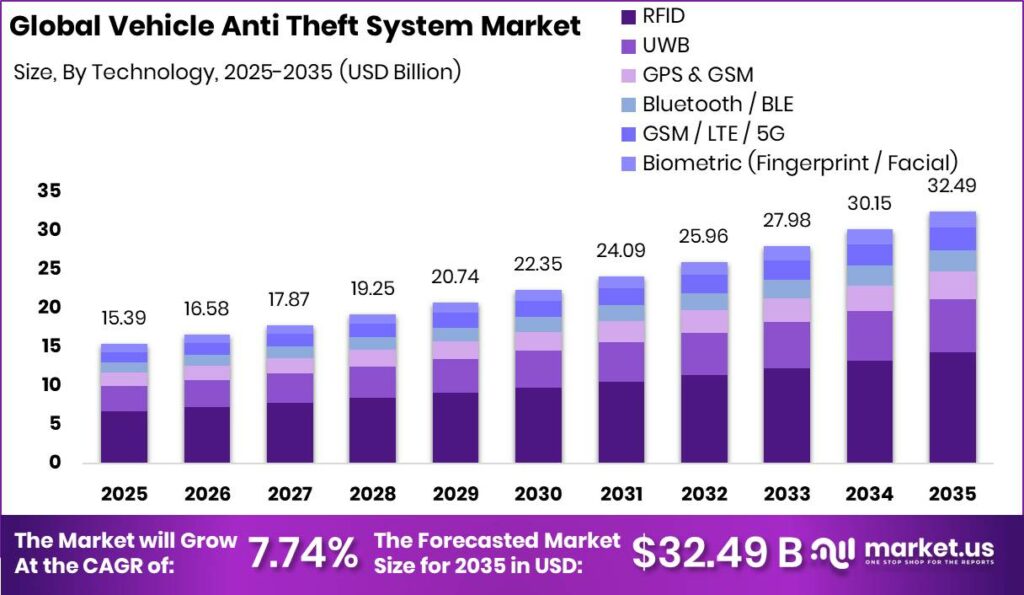
Global Vehicle Anti Theft System Market size is expected to be worth around USD 32.49 Billion by 2035 from USD 15.39 Billion in 2025, growing at a CAGR of 7.74% during the forecast period 2026 to 2035. This expansion reflects rising fitment of electronic immobilizers, keyless security, and tracking modules across new vehicle platforms. Suppliers who secure long term OEM contracts capture durable revenue as unit volumes scale.
Therefore, the market covers hardware and software that deter theft, block unauthorized starts, and support recovery after loss. Product types include immobilizers, remote keyless entry, alarms, steering locks, biometrics, GPS and GSM trackers, and ultra wideband digital keys. Technology stacks span RFID, UWB, GPS and GSM, Bluetooth, cellular links, and biometric capture. Vehicle types range from passenger cars to commercial fleets, two wheelers, and off road equipment, sold through OEM and aftermarket channels.
Key Takeaways
- The market is valued at USD 15.39 Billion in 2025 and is projected to reach USD 32.49 Billion by 2035.
- Growth runs at a CAGR of 7.74% over the forecast period 2026 to 2035.
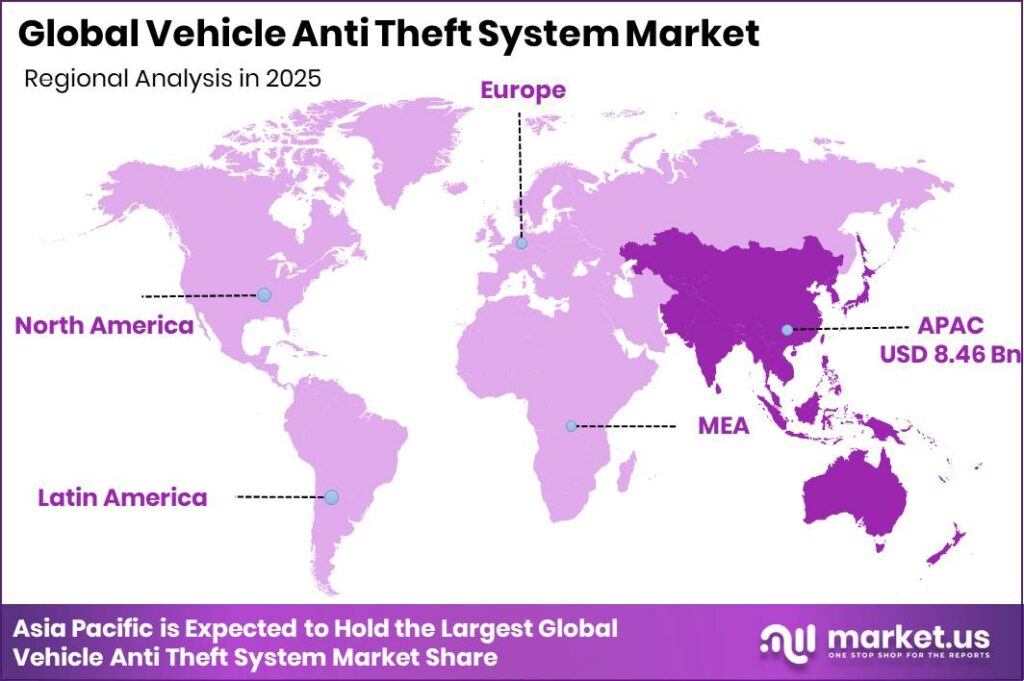
- Asia Pacific leads with a 55.00% share, valued at USD 17.87 Billion.
- Immobilizers lead By Product Type with a 36.85% share.
- RFID leads By Technology with a 44.00% share.
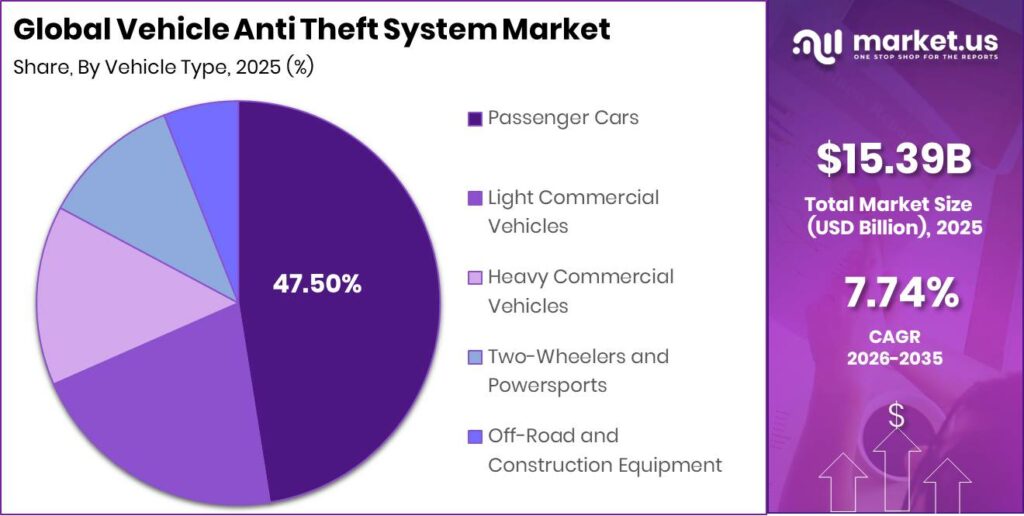
- Passenger Cars lead By Vehicle Type with a 47.50% share.
- OEM leads By Sales Channel with a 65.00% share.
As per our research, more than 659,880 vehicle thefts were reported in the United States in 2025, equal to roughly one vehicle stolen every 48 seconds. This volume keeps insurers and fleets pressing for factory grade protection on every new build. Consequently, end use growth in passenger and commercial fleets translates directly into higher attach rates for immobilizers and tracking kits. Vendors that bundle recovery services with hardware lock in multi year service margins.
Based on lockdownyourcar.org data, Colorado reported 16,291 vehicle thefts in 2025, down 34% year on year and 56% below its 2021 level. Falling local incidents still leave a large installed base that needs upgrades when older cars lack modern locks. This means retrofit programs and aftermarket kits remain a parallel demand stream beside new vehicle fitment.
In December 2025, Hyundai and Kia agreed to retrofit more than 4 million vehicles in the U.S. with additional anti theft measures, including ignition protection. Large OEM retrofit campaigns pull supply chain volume into aftermarket and dealer channels at once. As a result, suppliers with scalable ignition and immobilizer modules win share when regulators and owners demand faster remediation.
Product Type Analysis
Immobilizers dominates with 36.85% due to proven engine start denial performance.
In 2025, Immobilizers held a dominant market position in the By Product Type segment of Vehicle Anti Theft System Market, with a 36.85% share. A 2025 peer reviewed analysis found that theft of vehicles equipped with electronic engine immobilizers fell 80% relative to a matched control group. This effectiveness keeps OEMs specifying immobilizers as baseline content on mass market platforms. Suppliers who certify modules to global type approval rules lock multi year platform awards.
Remote Keyless Entry systems give drivers convenience while opening a relay attack surface that forces continuous RF hardening. Global motor vehicle production reached about 96.4 million units in 2025 according to OICA figures. High build rates mean every keyless architecture decision multiplies component volume for Tier 1s. Firms that migrate fobs to challenge response designs protect brand liability and retain OEM wallet share.
Alarm Systems and Steering Wheel or Column Lock products still serve cost sensitive fleets and older parks where full electronic stacks are not fitted. ACEA reported global car production grew 4.2% to 78.7 million units in 2025. Rising car output expands the pool of vehicles that can take layered alarms and mechanical locks as secondary barriers. Vendors who package low cost audible deterrents with steering locks win tenders in price led regions.
Biometric Capture Devices and GPS or GSM Tracking System units address identity proof and post theft recovery, while Ultra Wideband Digital Key is the fastest growing product line. In January 2025, Keyvault secured USD 1 million to launch its K1 smartphone based car key technology. Early capital for digital keys signals buyer willingness to replace physical fobs. Immobilizer peers, alarms, and locks still hold remaining share collectively beside these growth niches.
Technology Analysis
RFID dominates with 44.00% due to low cost transponder immobilizer fitment.
In 2025, RFID held a dominant market position in the By Technology segment of Vehicle Anti Theft System Market, with a 44.00% share. A systematic review cited in 2025 peer reviewed work found that 15 of 16 studies concluded electronic immobilization successfully reduced vehicle theft. Consistent evidence keeps RFID transponders as the default secure element in volume programs. Chip suppliers with automotive grade RFID lines defend high attach rates against newer radios.
Ultra Wideband is the fastest growing technology because time of flight ranging defeats classic relay attacks on passive entry. Industry digital key tracking shows only about 6% of cars shipped with UWB enabled keys in 2024, with expectations near 40% by 2030. Low current penetration leaves a long runway for module makers. Investors funding UWB silicon and antenna packs position for OEM digital key mandates.
Global Positioning System and GSM stacks power recovery and geofence alerts after a theft event. Teltonika class deployments and fleet telematics programs rely on continuous location uplinks when the primary battery is cut. Cellular backup paths keep recovery odds high for insurers. Providers who certify multi constellation GNSS with dual SIM routing win fleet security bids.
Bluetooth and BLE support phone as key pairing, while GSM, LTE, and 5G carry over the air key updates, and biometric fingerprint or facial capture adds user binding. Berg Insights linked reporting indicated roughly 82.7% of vehicles manufactured in 2024 would carry embedded telematics. High telematics fitment creates a natural host for BLE, cellular, and biometric security features. Integrators who unify these radios on one secure ECU reduce OEM wiring cost.
Vehicle Type Analysis
Passenger Cars dominates with 47.50% due to high global light vehicle output.
In 2025, Passenger Cars held a dominant market position in the By Vehicle Type segment of Vehicle Anti Theft System Market, with a 47.50% share. OICA data show world vehicle production near 96.4 million units in 2025, with passenger cars forming the bulk of that mix. Dense car production concentrates immobilizer and keyless content on the highest volume platforms. Tier 1s aligned to global car platforms secure the largest absolute unit counts.
Light Commercial Vehicles need cargo protection and driver authentication because stop start urban routes raise theft exposure. China alone produced about 24.3 million vehicles in 2025 among top national totals reported from OICA based tallies. Large Asian build centers pull LCV security content into regional supply chains. Suppliers with ruggedized trackers for vans capture fleet aftermarket pull through.
Heavy Commercial Vehicles prioritize trailer and tractor recovery over cabin convenience features. Long haul operators face high asset values per unit, so GPS recovery and remote immobilization justify higher bill of materials. Insurers often require documented tracking before covering cross border loads. Vendors offering certified heavy duty ECUs gain preferred supplier status with fleet lessors.
Two Wheelers and Powersports is the fastest growing vehicle class, while Off Road and Construction Equipment needs harsh environment trackers. SIAM reported India two wheeler sales of about 20.50 million units in calendar 2025. Massive two wheeler volumes in Asia open white space for compact immobilizers and GPS tags. Players who price modules for motorcycle OEMs unlock the remaining share held with off road equipment.
Sales Channel Analysis
OEM dominates with 65.00% due to factory line security fitment standards.
In 2025, OEM held a dominant market position in the By Sales Channel segment of Vehicle Anti Theft System Market, with a 65.00% share. Embedded telematics research indicated about 82.7% of vehicles built in 2024 would ship with factory telematics hardware. Factory connectivity gives OEMs a native path to immobilizers, digital keys, and remote disable features. Channel partners who win BOM slots at program kickoff lock decade long revenue.
Aftermarket is the fastest growing channel as owners upgrade older cars and complete large retrofit campaigns. Global vehicle sales near 99.8 million units in 2025 enlarge the parc that later needs add on alarms and trackers. Growing parc size multiplies installer and e commerce demand for plug in kits. Brands with certified dealer networks convert theft headlines into immediate kit sales.
OEM programs favor validated cybersecurity stacks and type approval documentation before start of production. Aftermarket buyers favor quick install time and smartphone apps that show live location. Dual channel strategies let suppliers serve both factory launches and legacy fleets. Firms that keep SKUs distinct by channel avoid channel conflict while covering full demand.
Fleet buyers increasingly specify security suites in lease contracts, pulling both OEM options and aftermarket overlays. Shared mobility operators need rapid deprovisioning of digital keys when vehicles change users. This creates subscription upside beyond one time hardware sales. Providers who meter access by driver identity raise lifetime value per vehicle.
Key Market Segments
By Product Type
- Immobilizers
- Remote Keyless Entry
- Alarm Systems
- Steering-Wheel / Column Lock
- Biometric Capture Devices
- GPS / GSM Tracking System
- Ultra-Wideband Digital Key
By Technology
- RFID
- Ultra-Wideband (UWB)
- Global Positioning System (GPS) & Global System for Mobile Communications (GSM)
- Bluetooth / BLE
- GSM / LTE / 5G
- Biometric (Fingerprint / Facial)
By Vehicle Type
- Passenger Cars
- Light Commercial Vehicles
- Heavy Commercial Vehicles
- Two-Wheelers and Powersports
- Off-Road and Construction Equipment
By Sales Channel
- OEM
- Aftermarket
Regional Analysis
Asia Pacific Dominates the Vehicle Anti Theft System Market with a Market Share of 55.00%, Valued at USD 17.87 Billion
Asia Pacific leads on the back of high vehicle production in China, India, Japan, and Korea and dense two wheeler fleets that need compact security modules. Factory fit content scales with regional build rates and export platforms. This creates the largest absolute addressable base for immobilizers and RFID keys. Suppliers with local manufacturing near Asian OEM clusters protect lead times and cost.
North America remains a high value arena as theft patterns and insurer rules push stronger electronic protection. U.S. reported vehicle thefts fell 23% from 2024 to 2025 according to National Highway Traffic Safety Administration vehicle theft prevention resources. Even with fewer incidents, residual risk and retrofit programs sustain spending on tracking and ignition protection. Vendors who align kits to insurer discount criteria win dealer shelf space.
Europe combines type approval pressure with still material theft volumes that keep security content mandatory. In England and Wales, vehicle related theft declined 14% to 596,000 incidents in the year ending December 2025, as reported by the Office for National Statistics. Large incident counts still justify continuous investment in UWB and software immobilizers. Latin America and Middle East and Africa add growth through rising parc and urban fleet security needs.
Key Regions and Countries
North America
- US
- Canada
Europe
- Germany
- France
- The UK
- Spain
- Italy
- Rest of Europe
Asia Pacific
- China
- Japan
- South Korea
- India
- Australia
- Rest of APAC
Latin America
- Brazil
- Mexico
- Rest of Latin America
Middle East and Africa
- GCC
- South Africa
- Rest of MEA
Market Dynamics
Market Opportunity Analysis - Two wheelers, aftermarket retrofits, and biometric access open underpenetrated profit pools.
Two Wheelers and Powersports remains the fastest growing vehicle type while still trailing passenger cars on security content depth. High unit volumes in India and ASEAN leave many platforms with basic or no electronic immobilization. New entrants that design compact, low power GPS and RFID kits for motorcycles can win OEM slots before global Tier 1s fully localize. Early pricing discipline builds share before standards harden.
Aftermarket grows faster than OEM even though OEM holds 65.00% channel share today. Large retrofit waves and aging parks create demand that factory programs cannot serve alone. Installer networks and e commerce brands that certify insurer approved kits capture owners shut out of dealer options. This channel rewards speed of fulfillment over multi year platform politics.
Biometric Capture Devices still sit mainly on premium trims inside the product mix led by immobilizers at 36.85%. Mainstream platforms have not yet embedded fingerprint or facial access as default content. Suppliers who offer feature on demand biometric licensing convert hardware scarcity into recurring identity revenue. Investors gain exposure to margin expansion without waiting for full fleet turnover.
Ultra Wideband Digital Key is the fastest growing product line while RFID still holds 44.00% technology share. The gap between legacy transponders and UWB phone keys defines a multi year replacement cycle. Chip and module vendors focused only on UWB can partner with OEMs exiting pure RF fobs. Regional focus on Europe and North America matches the strongest relay theft pressure.
Technology and Innovation Landscape - UWB ranging, predictive AI, and long life trackers redefine defense layers.
Ultra wideband time of flight ranging replaces static RF fobs that thieves can relay in under a minute. OEMs adopt sleeping fob and UWB architectures to cut keyless theft liability. Module makers who meet automotive temperature and antenna constraints win the next passive entry generation. Investors should track UWB attach rates as the lead indicator of ASP expansion.
AI based predictive anti theft systems use vehicle sensors and telematics to flag risk before a theft completes. OCTO style models shift spend from pure recovery hardware toward prevention software subscriptions. Fleets gain lower loss ratios when alerts trigger remote immobilization early. Software vendors with labeled theft event data build defensible model moats.
Post quantum cryptography ready vehicle PKI hardens authentication as connected keys proliferate. AUTOCRYPT class launches prepare OEMs for longer lived certificate infrastructures on software defined vehicles. Early PKI integration lowers retrofit cost when quantum resistant mandates arrive. Security vendors embedded at SOP avoid later gateway redesigns.
As per our research on published deployment specs, high capacity internal backup batteries can sustain autonomous tracking for up to 8 days after primary vehicle power is cut. Long backup life raises recovery probability when thieves disable the main battery. Tracker suppliers who certify multi day autonomy win insurer preferred lists. This hardware trait pairs with cellular dual path designs for harsh theft scenarios.
Drivers
Signal relay and keyless entry theft is the strongest near term force raising installed base demand. Stichting VbV documented keyless entry exploitation on 59% of passenger cars stolen in the Netherlands in 2025. UK crime survey patterns attribute close to two thirds of car thefts to relay style attacks. Attacks completed in under 60 seconds push OEMs toward UWB ranging and software immobilizers.
This shift raises per vehicle security bill of materials by an estimated 18% to 25% and moves revenue toward subscription tracking and over the air key management. Even as U.S. thefts stood near 659,900 vehicles in 2025, higher value UWB and biometric kits protect supplier margins. European sleeping fob designs in type approval filings mark the inflection that supports this driver contribution.
| Driver | (~) % Impact on CAGR Forecast | Geographic Relevance | Impact Timeline |
|---|---|---|---|
| Surging Relay & Keyless Vehicle Theft | +2.4% | Europe, North America | Short term (2 years or less) |
| Factory-Fit Telematics Integration | +1.9% | North America, Europe, APAC | Medium term (2 to 4 years) |
| UNECE R116 Type-Approval Enforcement | +1.3% | Europe, Japan, South Korea | Short term (2 years or less) |
| Insurer Premium-Linked Security Mandates | +1.1% | UK, North America | Medium term (2 to 4 years) |
| Rising Vehicle Production Volumes | +0.9% | India, China, Southeast Asia | Medium term (2 to 4 years) |
| Passive Keyless Entry Standardization | +0.7% | Global | Long term (4 years or more) |
Restraints
Scarcity of automotive grade microcontrollers and secure element chips is the sharpest near term barrier to system output. Market.us semiconductor analysis flagged mature node tightness lasting 3 to 5 years from the 2020 shortage onset. India NITI Aayog value chain work has linked the same pinch to OEM line stoppages. Anti theft ECUs and UWB modules share constrained 40nm to 90nm wafer supply with other vehicle electronics.
Allocation driven lead times of 26 to 52 weeks cap security module shipments even when order books are full. Spot premiums compress supplier gross margins by an estimated 3 to 6 points when costs cannot pass through. Delayed CapEx on next generation secure element lines slows capacity recovery. Buyers face longer program ramps until wafer allocation normalizes.
| Restraint | (~) % Impact on CAGR Forecast | Geographic Relevance | Impact Timeline |
|---|---|---|---|
| Automotive Semiconductor Supply Scarcity | -1.8% | Global | Short term (2 years or less) |
| Elevated Interest Rates Curbing New-Car Sales | -1.4% | North America, Europe | Short term (2 years or less) |
| Price Sensitivity in Entry-Level Segments | -1.1% | India, Southeast Asia, Africa | Medium term (2 to 4 years) |
| Fragmented Aftermarket Standards | -0.8% | Emerging Markets | Medium term (2 to 4 years) |
| Consumer Data-Privacy Restrictions | -0.6% | EU, California | Medium term (2 to 4 years) |
Challenges
Escalating cyber attack sophistication is the deepest structural friction on growth ceilings. As RF entry hardens, attackers shift to CAN bus injection, OBD II key programming, and software defined vehicle exploits. PlaxidityX linked research ties keyless related losses to billions in industry cost, while UNECE WP.29 R155 obliges full lifecycle cyber management. Field testing shows thieves can defeat unhardened systems in under 60 seconds.
OBD port and software immobilizer countermeasures need continuous over the air patch cycles that add an estimated 2% to 4% to annual per platform maintenance cost. That burden erodes subscription margins designed to fund ongoing defense. OEMs must fund security operations centers, penetration testing, and PSIRT teams aligned to R155 audits. Hardware line items become permanent operating expense and slow realizable maximum growth.
| Challenge | (~) % CAGR Friction Drag | Geographic Relevance | Mitigation Horizon |
|---|---|---|---|
| Escalating Cyber-Attack Sophistication | -1.5% | Global | Long term (4 years or more) |
| Embedded Security Talent Deficit | -1.0% | North America, Europe, India | Medium term (2 to 4 years) |
| OEM Software Integration Complexity | -0.9% | Global | Medium term (2 to 4 years) |
| OBD-Port Exploit Countermeasures | -0.7% | Europe, North America | Medium term (2 to 4 years) |
| Cross-Border Certification Divergence | -0.5% | Global | Long term (4 years or more) |
Opportunities
Biometric vehicle access remains largely confined to premium trims and is not yet mainstream across volume platforms. HID Global trend tracking ties readiness to edge processed, presentation attack resistant capture that only recently became automotive viable. Multi modal biometrics sold as factory options or over the air features can shift revenue from one time hardware to recurring authentication licensing. Identity markets growing at double digit rates support estimated gross margin expansion of 8 to 12 points versus conventional fob hardware.
Early movers who bundle biometric identity with OTA key provisioning can convert a meaningful share of the connected installed base into subscription revenue. Convergence with expanding telematics stacks lowers effective cost per authenticated access. This path also defends against relay and cyber threats that passive fobs cannot stop. Investors funding automotive grade biometric modules gain first mover pricing power in North America, Europe, and China.
| Opportunity | (~) % Potential CAGR Upside | Geographic Relevance | Execution Window |
|---|---|---|---|
| Biometric Vehicle Access Monetization | +2.1% | North America, Europe, China | Medium term (2 to 4 years) |
| Two-Wheeler Anti-Theft White Space | +1.6% | India, ASEAN, Africa | Medium term (2 to 4 years) |
| V2X-Enabled Recovery Subscriptions | +1.4% | North America, APAC | Long term (4 years or more) |
| Fleet & Shared-Mobility Security Suites | +1.1% | Global Urban Centers | Medium term (2 to 4 years) |
| Aftermarket M&A Roll-Up Consolidation | +0.8% | Emerging Markets | Long term (4 years or more) |
Key Company Insights
Continental AG positions as a full stack chassis and security electronics supplier with deep OEM program access. Scale across body electronics lets the firm bundle immobilizers with broader domain controllers. This reduces integration cost for carmakers choosing single Tier 1 awards. Concentration on factory channels raises exposure if semiconductor allocation slows module shipments.
Robert Bosch GmbH leverages powertrain and electronics breadth to embed engine immobilization inside core vehicle architectures. Cross domain software skills support over the air key and theft countermeasure updates. In September 2025, Sasken Technologies partnered with VicOne on OEM cyber stacks, underscoring how software partners shape the competitive field around Bosch class Tier 1s. New York State DMV investigators recovered 140 stolen vehicles and 8 parts worth nearly USD 200,000 in the first half of 2026, keeping enforcement demand visible for Bosch grade recovery and immobilizer tech.
Key Players
- Continental AG
- Robert Bosch GmbH
- Valeo SE
- Denso Corporation
- Tokai Rika Co., Ltd.
- Aptiv PLC
- HELLA GmbH & Co. KGaA
- Johnson Controls International plc
- Lear Corporation
- Mitsubishi Electric Corporation
- ZF Friedrichshafen AG
- Huf Hülsbeck & Fürst GmbH & Co. KG
- Stoneridge, Inc.
- Viper Security Systems
- Meta System S.p.A.
- Clifford (Directed Inc.)
- Minda Corporation Limited
- Marquardt Group
- Compustar
- ALPHA Corporation
- Author LLC
- OnStar Corporation
- Pandora Car Alarm Systems Ltd.
Recent Developments
- February 2025: Vodafone Automotive partnered with PlaxidityX to integrate the vDome anti theft cybersecurity solution into Vodafone Automotive vehicle tracking and security products, targeting unauthorized key access and cyber based takeover attempts.
- December 2025: OCTO Telematics launched an AI based predictive anti theft system that uses machine learning, vehicle sensors, and telematics data to identify theft risks before a vehicle is stolen.
- December 2025: AUTOCRYPT introduced AutoCrypt PKI Vehicles, a post quantum cryptography enabled security solution for automotive OEMs that strengthens authentication and encrypted communication for connected anti theft architectures.
- May 2026: KPIT Technologies announced a strategic investment agreement to acquire a stake in Cymotive Technologies, expanding intrusion detection, threat monitoring, and lifecycle cybersecurity for software defined vehicles.
Geopolitical Impact Analysis
According to WTO trade monitoring, higher tariffs taking effect through 2025 dampen merchandise trade into 2026 and raise cost uncertainty for cross border auto parts. Section 232 style measures have included 25% duties on certain automobiles and auto parts in major markets. Anti theft ECUs, RF modules, and secure elements often move through the same parts corridors as broader vehicle electronics. This means landed cost spikes can delay OEM security content upgrades on export platforms.
Therefore, logistics stress compounds component risk for tracking hardware. UNCTAD Review of Maritime Transport 2025 projects seaborne trade growth slowing to about 0.5% in 2025 after 2.2% growth in 2024. Rerouting and fragile schedule reliability extend lead times for GPS trackers and semiconductor rich immobilizer boards. Suppliers with dual region warehousing protect fitment schedules when ocean transit becomes unpredictable.
Report Scope
| Report Features | Description |
|---|---|
| Market Value (2025) | USD 15.39 Billion |
| Forecast Revenue (2035) | USD 32.49 Billion |
| CAGR (2026-2035) | 7.74% |
| Base Year for Estimation | 2025 |
| Historic Period | 2020-2024 |
| Forecast Period | 2026-2035 |
| Report Coverage | Revenue Forecast, Market Dynamics, Market Opportunity Analysis, Technology and Innovation Landscape, Competitive Landscape, Recent Developments |
| Segments Covered | By Product Type (Immobilizers, Remote Keyless Entry, Alarm Systems, Steering-Wheel / Column Lock, Biometric Capture Devices, GPS / GSM Tracking System, Ultra-Wideband Digital Key), By Technology (RFID, Ultra-Wideband (UWB), Global Positioning System (GPS) & Global System for Mobile Communications (GSM), Bluetooth / BLE, GSM / LTE / 5G, Biometric (Fingerprint / Facial)), By Vehicle Type (Passenger Cars, Light Commercial Vehicles, Heavy Commercial Vehicles, Two-Wheelers and Powersports, Off-Road and Construction Equipment), By Sales Channel (OEM, Aftermarket) |
| Regional Analysis | North America (US and Canada), Europe (Germany, France, The UK, Spain, Italy, and Rest of Europe), Asia Pacific (China, Japan, South Korea, India, Australia, and Rest of APAC), Latin America (Brazil, Mexico, and Rest of Latin America), Middle East and Africa (GCC, South Africa, and Rest of MEA) |
| Competitive Landscape | Continental AG, Robert Bosch GmbH, Valeo SE, Denso Corporation, Tokai Rika Co., Ltd., Aptiv PLC, HELLA GmbH & Co. KGaA, Johnson Controls International plc, Lear Corporation, Mitsubishi Electric Corporation, ZF Friedrichshafen AG, Huf Hülsbeck & Fürst GmbH & Co. KG, Stoneridge, Inc., Viper Security Systems, Meta System S.p.A., Clifford (Directed Inc.), Minda Corporation Limited, Marquardt Group, Compustar, ALPHA Corporation, Author LLC, OnStar Corporation, Pandora Car Alarm Systems Ltd. |
| Customization Scope | Customization for segments, region / country-level will be provided. Additional customization can be done based on requirements. |
| Purchase Options | We have three licenses to opt for: Single User License | Multi-User License (Up to 5 Users) | Corporate Use License (Unlimited User and Printable PDF) |





































