


Report Overview
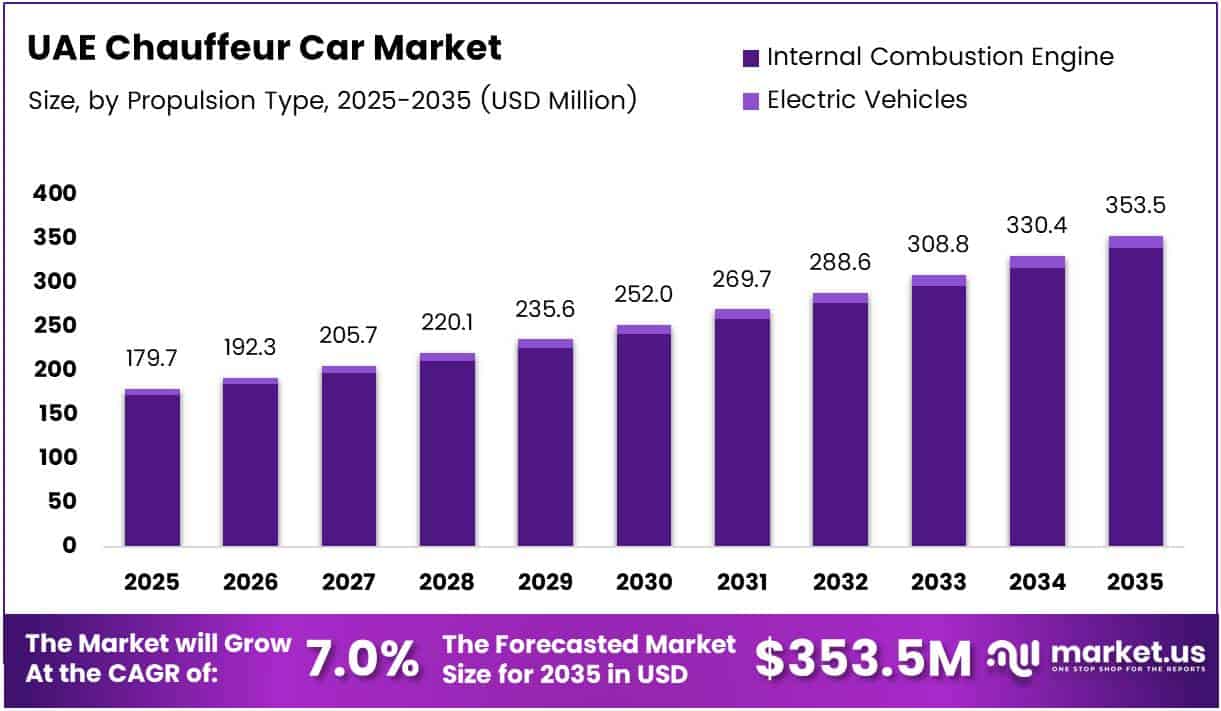
In 2025, the UAE Chauffeur Car Market was valued at US$179.7 million, and between 2025 and 2035, this market is estimated to register a CAGR of 7.0%, reaching about US$353.5 million by 2035.
The UAE chauffeur car market is shaped by its role in supporting high-profile events, international tourism flows, and executive mobility across Dubai, Abu Dhabi, and Sharjah. The country hosts globally significant occasions, including conferences, exhibitions, sporting events such as races at Yas Marina Circuit, and cultural festivals, which consistently attract international visitors, celebrities, and business leaders.
- Tourism contributes approximately 14% of the UAE’s GDP, generating around USD 70 billion in 2025. More than 20 cultural sites and libraries operate across the emirate, supported by 115 programs spanning heritage and arts.
These inflows, combined with traffic congestion and limited parking near major venues, create strong reliance on professional door-to-door transport solutions that ensure punctuality and convenience. A key structural driver is the scale of aviation activity.
- In 2025, Dubai International Airport (DXB) recorded 95.2 million passengers, marking its busiest year ever and the highest annual international passenger traffic globally.
- Abu Dhabi Airports handled over 33 million passengers, with Zayed International Airport alone serving 8.59 million passengers in 2025 Q4, reflecting 13.8% year-on-year growth.
- Sharjah Airport contributed 19.48 million passengers in 2025, up from 17.1 million in 2024, alongside 116,657 flight movements.
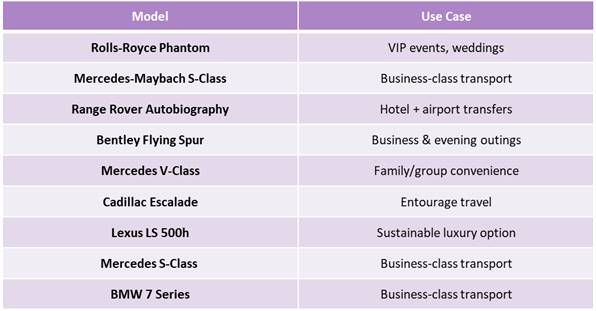
These volumes directly reinforce demand for pre-booked chauffeur transfers, especially airport-to-city mobility. Fleet offerings span luxury sedans, SUVs, and ultra-luxury vehicles, designed for corporate executives, families, and VIP travelers, with emphasis on comfort, safety, and premium interiors.
Service provision is regulated under authorities such as the Roads and Transport Authority (RTA) in Dubai and the Integrated Transport Centre (ITC) in Abu Dhabi, ensuring licensed operators meet strict professional standards.
- Abu Dhabi, covering 85% of the UAE’s land area, anchors formal and diplomatic mobility needs, while Dubai drives high-volume corporate and tourism-linked demand supported by its free zones, Jebel Ali port, and luxury hospitality ecosystem.
Key Takeaways
- The UAE chauffeur car market was valued at US$179.7 million in 2025.
- The UAE chauffeur car market is projected to grow at a CAGR of 7.0% and is estimated to reach US$353.5 million by 2035.
- On the basis of service type, event transportation dominated the market, constituting 31.5% of the total market share.
- Based on the vehicle type, sedans led the chauffeur car market, comprising 44.0% of the total market.
- Among the propulsion types, internal combustion engine chauffeur cars held a major share of the market, accounting for around 96.0% of the revenue.
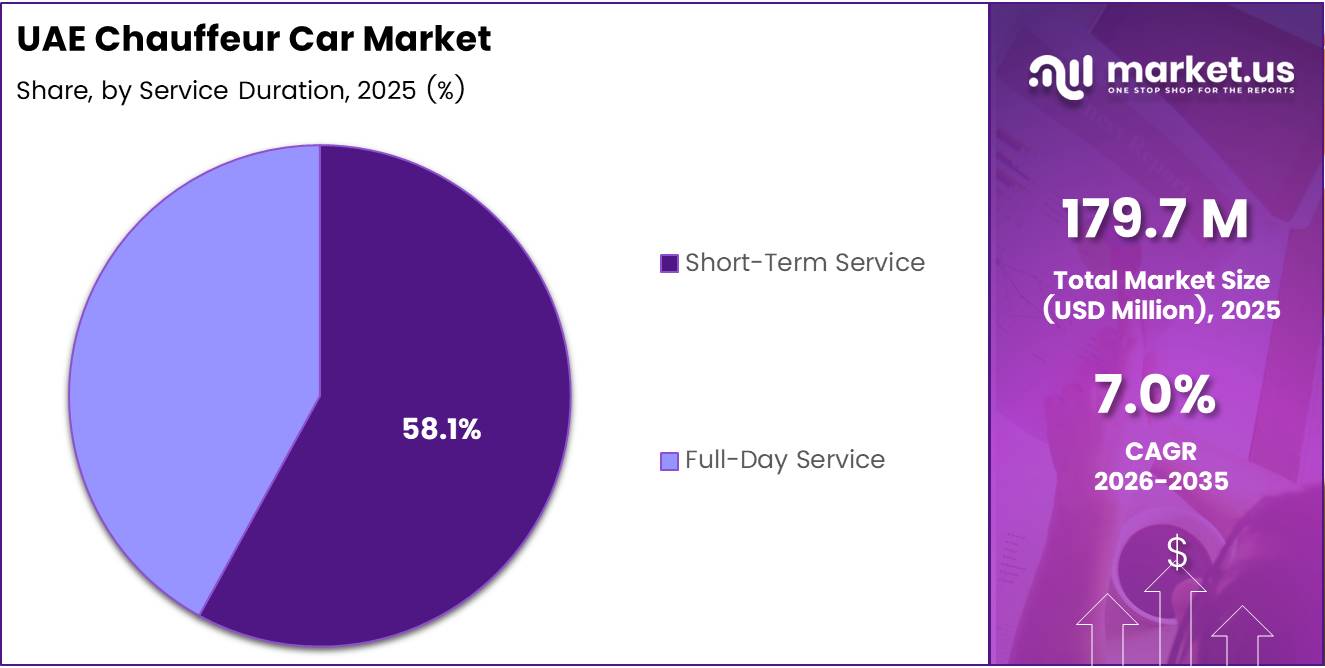
- Based on the service duration, short-term services withheld larger share in the market, with 58.1%.
Service Type Analysis
Event Transportation Services Are a Prominent Segment in the Market.
Event Transportation accounts for 31.5% of the UAE chauffeur car market, making it the most dominant service category. This segment is strongly influenced by the country’s position as a global events hub, hosting high-profile occasions such as international exhibitions, cultural festivals, luxury product launches, sporting events, and business conferences across Dubai, Abu Dhabi, and Sharjah.
The concentration of large-scale venues and recurring calendar events generates consistent demand for coordinated, pre-booked mobility solutions that can manage high passenger volumes with precision. Limited parking availability, traffic congestion around event zones, and the need for time-sensitive arrivals further reinforce reliance on chauffeur-driven services. Operators in this segment emphasize punctuality, fleet scalability, and premium customer experience, often deploying a mix of luxury sedans, SUVs, and group vehicles to accommodate diverse attendee profiles ranging from VIPs to corporate delegations.
Vehicle Type Analysis
Sedans Dominated the Chauffeur Car Market.
Sedan vehicles represent the dominant 44.0% share in the UAE chauffeur car market, reflecting their strong alignment with executive mobility and premium point-to-point travel requirements. Their popularity is driven by high utilization in airport transfers, corporate travel, and business meetings, where comfort, efficiency, and a professional image are key expectations. Sedans are particularly favored by business travelers and corporate clients due to their smooth ride quality, discreet design, and suitability for navigating dense urban environments such as Dubai Marina, Downtown Dubai, and Abu Dhabi’s central business districts.
Operators further prefer sedans because of their operational efficiency, lower maintenance costs compared to larger vehicle categories, and higher trip frequency potential. This combination of passenger preference and fleet economics positions sedans as the backbone of structured chauffeur operations across both commercial and tourism-linked mobility demand in the UAE.
Propulsion Type Analysis
Internal Combustion Engine Chauffeur Cars Held Major Share of the Market.
Internal combustion engine vehicles dominate the UAE chauffeur car market with a commanding 96.0% share, reflecting the strong reliance on traditional fuel-based mobility across both commercial and premium transport operations. This dominance is supported by well-established fueling infrastructure, long driving ranges suited for inter-emirate and airport transfers, and the operational flexibility required for high-utilization chauffeur services.
ICE vehicles remain the preferred choice for corporate travel, event transportation, and tourism-linked mobility, where uninterrupted availability and rapid turnaround times are critical. Fleet operators benefit from mature maintenance ecosystems, easier vehicle acquisition cycles, and broad model availability across sedan, SUV, and luxury segments. Despite growing interest in sustainability, ICE vehicles continue to anchor service delivery due to their reliability in handling high-demand routes across Dubai, Abu Dhabi, and Sharjah, particularly during peak tourism and event seasons.
- By the end of 2025, the number of EVs in Dubai reached 47,944, up from 37,486 in 2024, a 27.9% increase.
Service Duration Analysis
Chauffeur Cars Are Mostly Utilized for Short-Term Services.
Short-term service accounts for 58.1% of the UAE chauffeur car market, making it the leading service duration category. This dominance is primarily driven by high-frequency mobility requirements such as airport transfers, point-to-point business travel, hotel pickups, and short-distance intra-city movements across Dubai, Abu Dhabi, and Sharjah. The UAE’s strong aviation connectivity and continuous inflow of international tourists and corporate travelers reinforce demand for quick turnaround trips that prioritize punctuality and convenience over extended vehicle retention.
Short-term bookings are well-aligned with the fast-paced urban environment, where clients often require flexible, on-demand transportation for meetings, events, and scheduled engagements. For operators, this segment enables higher trip volumes per vehicle per day, improving fleet utilization efficiency. The combination of time-sensitive demand patterns and structured urban mobility needs positions short-term services as the core operational backbone of chauffeur service providers in the UAE.
Key Market Segments
By Service Type
- Airport Transfer
- City Tours & Leisure Travel
- Business & Corporate Travel
- Event Transportation
- Others
By Vehicle Type
- Sedan
- SUV
- Others
By Propulsion Type
- Internal Combustion Engine
- Electric Vehicles
By Service Duration
- Short-Term Service
- Full-Day Service
Drivers
Rapid Expansion of the UAE Events and Entertainment Ecosystem Drives the Demand for Chauffeur Cars
The rapid expansion of the UAE’s events and entertainment ecosystem acts as a key demand driver for the chauffeur car market, underpinned by the country’s position as a global destination for large-scale business, cultural, and sporting gatherings. Cities such as Dubai and Abu Dhabi host a dense calendar of international exhibitions, conferences, festivals, and sporting events that attract corporate executives, government delegations, celebrities, and high-net-worth individuals, increasing reliance on premium, pre-arranged mobility solutions.
- In 2025, Abu Dhabi recorded 26.6 million visitors, supported by 252 culture and leisure events drawing more than 4.2 million attendees, a 20% increase compared to 2024.
- Key events included the MOTN Festival with 252,988 visitors, Coldplay concerts at Zayed Sports City with 193,470 attendees, the Abu Dhabi T10 tournament with around 100,000 attendees, and Liwa Village exceeding 159,000 visitors.
- Cultural festivals collectively attracted over 608,000 attendees. Major events included IDEX/NAVDEX with 206,000 attendees, Make it in the Emirates with 122,000, Abu Dhabi Sustainability Week with 50,000, and the Bridge Summit with 39,000, while the Advantage Abu Dhabi program supported 175 events with 464,000 delegates, up 28%.
- The MICE segment expanded significantly, with events rising 37% to 6,600 and delegate participation reaching 2.2 million, up 40%.
- Dubai World Trade Centre recorded 2.97 million attendees in 2025, up 12%, across 401 events, a 6% increase. DWTC hosted 134 MICE events with 2.19 million participants, including 951,000 international attendees, 43%.
- More than 63,000 companies participated, with 78% international representation. Flagship events attracted nearly 630,000 attendees, while DXB LIVE delivered 442 major events.
These volumes reinforce sustained demand for chauffeur services across airport transfers, hourly bookings, and event-specific transport solutions.
Restraints
Reliance on Imported Vehicle Fleet and Exposure to Supply Chain Disruptions Limiting Chauffeur Cars Adoption
The UAE chauffeur car market is constrained by a high dependence on imported vehicles, as the absence of a domestic automotive manufacturing base, particularly in the premium and luxury segments, necessitates sourcing fleets from Europe, North America, and East Asia. This reliance exposes operators to external vulnerabilities, including global supply chain disruptions, currency fluctuations, and logistics inefficiencies, which collectively affect fleet procurement timelines and operational continuity.
- The emergence of War Risk Surcharges (WRS) has increased import costs, with roll-on/roll-off (RoRo) shipments incurring approximately USD 6 per cubic meter, while containerized shipments attract flat surcharges of around USD 1,500 per standard container and up to USD 3,500 for specialized containers.
Recent geopolitical tensions in the Middle East have further intensified these challenges by introducing maritime risks along critical trade corridors. The Strait of Hormuz, a key gateway for vehicle imports into the UAE, significantly influences supply chain stability, particularly for logistics hubs such as Jebel Ali Port.
- The incremental costs for container shipments now range between USD 1,500 and USD 4,000 per container, excluding base freight charges.
Shipping companies are rerouting vessels to avoid high-risk zones such as the Red Sea and the Strait of Hormuz, leading to extended transit times and higher logistics costs. These disruptions delay fleet expansion, slow replacement cycles, and reduce spare parts availability, resulting in longer vehicle downtime and lower operational efficiency. Consequently, capital expenditure rises, margins compress, and service scalability is constrained, particularly during peak demand periods, with potential cost pass-through impacting price competitiveness.
Opportunity
Growing Preference for Premium Mobility Solutions in the Tourism Sector Expanding Market Reach
The continued expansion of premium tourism in the UAE presents a strong avenue for value creation within the chauffeur car market, driven by a visitor base that increasingly prioritizes comfort, personalization, and reliability in ground transportation. High-spending international travelers, including leisure tourists, business visitors, and high-net-worth individuals across Dubai, Abu Dhabi, and Sharjah, are progressively shifting toward chauffeur-driven mobility for airport transfers, city tours, and full-day travel experiences.
- Dubai recorded 19.59 million overnight visitors between January and December 2025, reflecting a 5% increase over 2024.
This behavioral shift is reinforced by the UAE’s positioning as a global luxury destination and contributes to sustained uptake of premium transport services. Major institutions such as the Natural History Museum Abu Dhabi and the Zayed National Museum further strengthen cultural tourism depth.
- Abu Dhabi’s cultural ecosystem continues to expand, with the Louvre Abu Dhabi attracting 1.4 million visitors and Qasr Al Hosn receiving over 843,000 visitors, up 22% year-on-year.
This momentum is aligned with the UAE Tourism Strategy 2031, targeting AED 450 billion tourism GDP contribution, AED 100 billion in new investments, and 40 million annual hotel guests, supported by 25 initiatives across identity building, product diversification, workforce development, and investment attraction. As tourism infrastructure and experiential offerings expand, demand for high-quality chauffeur services is expected to intensify across integrated hospitality and travel ecosystems.
Emerging Trends
Strategic Partnerships with Key Players in the Hospitality Ecosystem
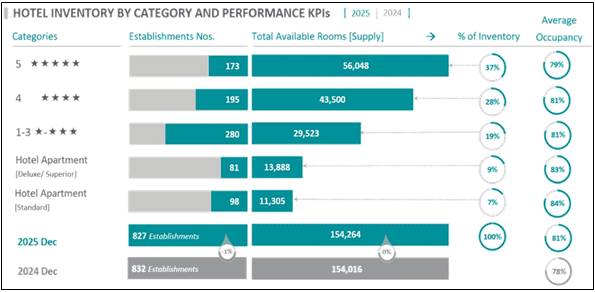
The UAE chauffeur car market is increasingly shaped by deep integration with the luxury hospitality ecosystem, reflecting the country’s position as a global hub for high-end tourism and premium guest experiences. Hotels across the UAE operate across multiple segments, including beachfront resorts, downtown business hotels, boutique properties, desert retreats, eco-resorts within protected reserves, and heritage hotels offering culturally immersive stays. Iconic establishments such as Burj Al Arab and Atlantis: The Palm further reinforce the nation’s luxury positioning, driving expectations for seamless, end-to-end mobility solutions.
Hospitality operators are progressively incorporating chauffeur services into their core guest offerings through dedicated fleets or long-term partnerships with licensed transport providers in Dubai, Abu Dhabi, and other emirates. This integration enables consistent service delivery while allowing hotels to outsource fleet management and operational complexities. The approach enhances guest convenience, particularly for high-net-worth travelers and business visitors seeking premium, reliable transfers.
- In 2025, Abu Dhabi recorded hotel revenues of AED 9.1 billion, reflecting a 19.5% year-on-year increase, alongside 5.9 million hotel guests and 338,000 visitors across holiday homes and glamping accommodations.
The strength of this linkage is supported by strong sector performance. Dubai’s hospitality sector further registered sustained growth during the same period. As luxury tourism expands, chauffeur providers aligned with hospitality partners are positioned to benefit from a stable, high-value customer base and enhanced brand visibility within an increasingly experience-driven mobility landscape.
Dubai Accommodation Supply and Demand: Jan-Dec 2025
Geopolitical Impact Analysis
Regional Security Volatility and Its Implications for Premium Mobility and Fleet Operations in the UAE
The UAE chauffeur car market is significantly influenced by geopolitical tensions across the Middle East, which shape both operational stability and demand patterns. Regional disputes, including maritime and territorial conflicts, have increased risks along key logistics corridors used for importing luxury vehicles and critical spare parts required for premium chauffeur fleets. Given the sector’s reliance on international suppliers for high-end vehicles, disruptions in global shipping routes can lead to delays, higher freight costs, and reduced fleet availability, directly affecting service continuity and expansion plans.
The Strait of Hormuz remains a critical vulnerability, where any escalation can trigger rerouted shipments, war-risk surcharges, and extended delivery timelines. These factors increase operational expenditure and constrain timely fleet replacement and maintenance cycles, often forcing operators to adjust pricing structures or limit vehicle deployment during peak demand periods. Security concerns further extend to travel demand.
- In April 2026, the UAE intercepted 17 ballistic missiles and 35 drones amid a temporary US-Iran ceasefire brokered by Pakistan. Over a six-week conflict period, the UAE Air Defence Forces intercepted 537 ballistic missiles, 26 cruise missiles, and 2,256 drones, with 224 reported injuries, including an April 8 strike at the Habshan gas facility injuring two Emiratis and one Indian. Such events heighten perceived regional risk among international travelers.
This volatility influences tourism and corporate mobility, as high-net-worth visitors and business travelers exhibit sensitivity to safety conditions. It further affects large-scale events and exhibitions, leading to fluctuating attendance and irregular chauffeur bookings, thereby impacting fleet utilization, revenue stability, and long-term planning for service providers.
Key Company Insights
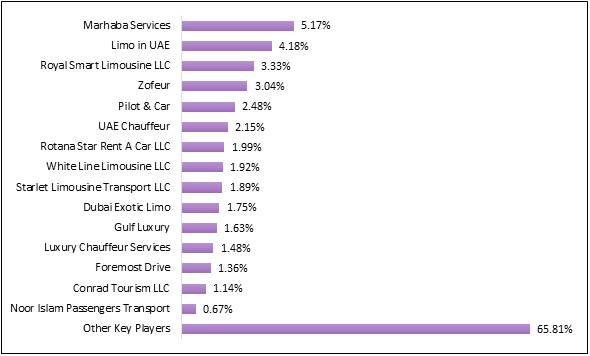
Players in the UAE chauffeur car market focus on strengthening service differentiation through premium customer experience, fleet quality, and operational reliability to secure competitive positioning. Significant emphasis is placed on maintaining a diversified fleet mix, including luxury sedans, SUVs, and high-end vehicles, to cater to corporate clients, tourists, and VIP segments. Operators invest in driver training programs that emphasize professionalism, multilingual capability, and local route expertise to enhance service consistency.
Digital transformation is another key focus, with advanced booking platforms, real-time tracking, and automated dispatch systems improving convenience and efficiency. Strategic partnerships with hotels, airlines, and event organizers help secure recurring demand streams, particularly for airport transfers and event transportation. Additionally, companies optimize fleet utilization through hourly and full-day service models while integrating sustainability initiatives such as gradual EV adoption to align with evolving regulatory and customer expectations.
Key Players
- Marhaba Services
- Limo in the UAE
- Royal Smart Limousine LLC
- Zofeur
- Pilot & Car
- UAE Chauffeur
- Rotana Star Rent A Car LLC
- White Line Limousine LLC
- Starlet Limousine Transport LLC
- Dubai Exotic Limo
- Gulf Luxury
- Luxury Chauffeur Services
- Foremost Drive
- Conrad Tourism LLC
- Noor Islam Passengers Transport
- Other Key Players
Report Scope
| Report Features | Description |
|---|---|
| Market Value (2025) | US$179.7 Mn |
| Forecast Revenue (2035) | US$353.5 Mn |
| CAGR (2025-2035) | 7.0% |
| Base Year for Estimation | 2025 |
| Historic Period | 2021-2024 |
| Forecast Period | 2025-2035 |
| Report Coverage | Revenue Forecast, Market Dynamics, Competitive Landscape, Recent Developments |
| Segments Covered | By Service Type (Airport Transfer, City Tours & Leisure Travel, Business & Corporate Travel, Event Transportation, and Others), By Vehicle Type (Sedan, SUV, and Others), By Propulsion Type (Internal Combustion Engine and Electric Vehicles), By Service Duration (Short-Term Service and Full-Day Service) |
| Competitive Landscape | Marhaba Services, Limo in UAE, Royal Smart Limousine LLC, Zofeur, Pilot & Car, UAE Chauffeur, Rotana Star Rent A Car LLC, White Line Limousine LLC, Starlet Limousine Transport LLC, Dubai Exotic Limo, Gulf Luxury, Luxury Chauffeur Services, Foremost Drive, Conrad Tourism LLC, Noor Islam Passengers Transport, and Other Players. |
| Customization Scope | Customization for segments, region/country-level will be provided. Moreover, additional customization can be done based on the requirements. |
| Purchase Options | We have three licenses to opt for: Single User License, Multi-User License (Up to 5 Users), Corporate Use License (Unlimited Users and Printable PDF) |





































