


Report Overview
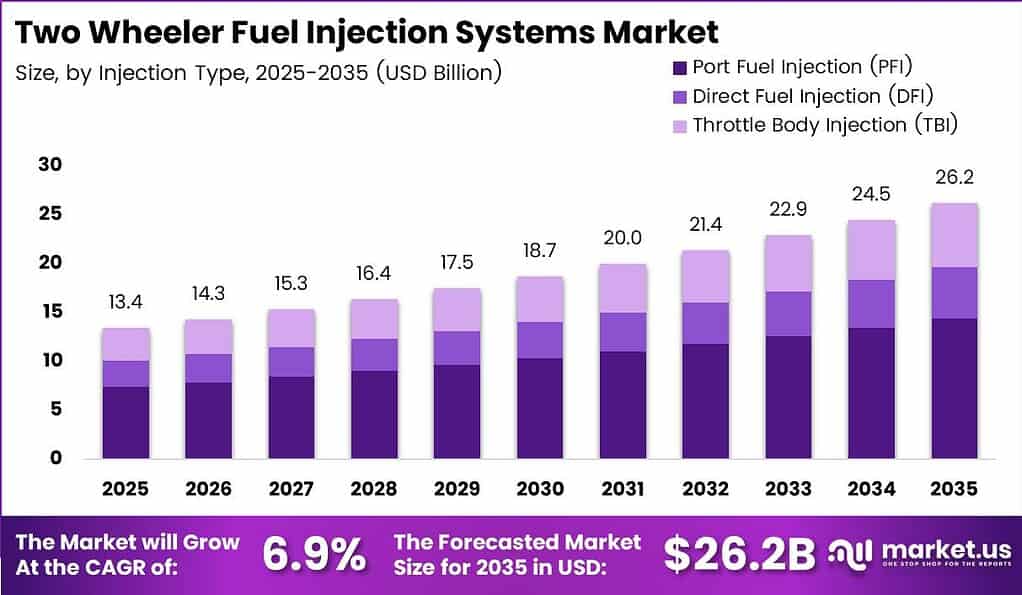
Global Two Wheeler Fuel Injection Systems Market size is expected to be worth around USD 26.2 Billion by 2035 from USD 14.3 Billion in 2026, growing at a CAGR of 6.9% during the forecast period 2026 to 2035.
The two-wheeler fuel injection systems market encompasses electronic fuel metering components fitted to internal combustion engine motorcycles, scooters, and mopeds. The market includes port fuel injection units, direct fuel injection assemblies, and throttle body injection systems, alongside the electronic control units, fuel pumps, sensors, and diagnostic modules integrated with each platform. This reflects the replacement of carburetion technology mandated by global emissions compliance frameworks.
Key Takeaways
- The global Two Wheeler Fuel Injection Systems Market is valued at USD 14.3 Billion in 2026 and is forecast to reach USD 26.2 Billion by 2035, at a CAGR of 6.9%.
- Port Fuel Injection (PFI) dominates the By Injection Type segment with a 55.00% share.
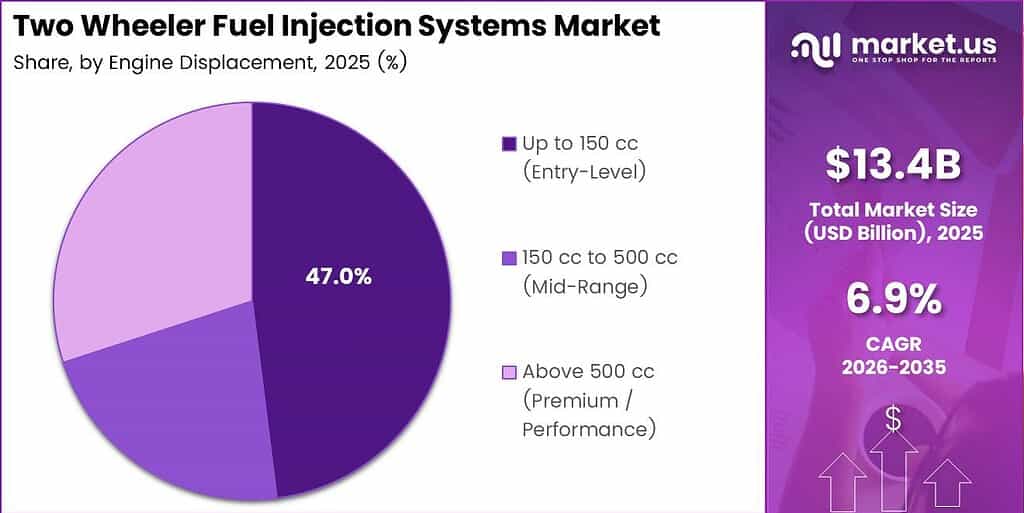
- Entry-Level (Up to 150 cc) dominates the By Engine Displacement segment with a 47.00% share.
- Motorcycles dominate the By Vehicle Type segment with a 64.00% share.
- OEM dominates the By Sales Channel segment with a 65.20% share.
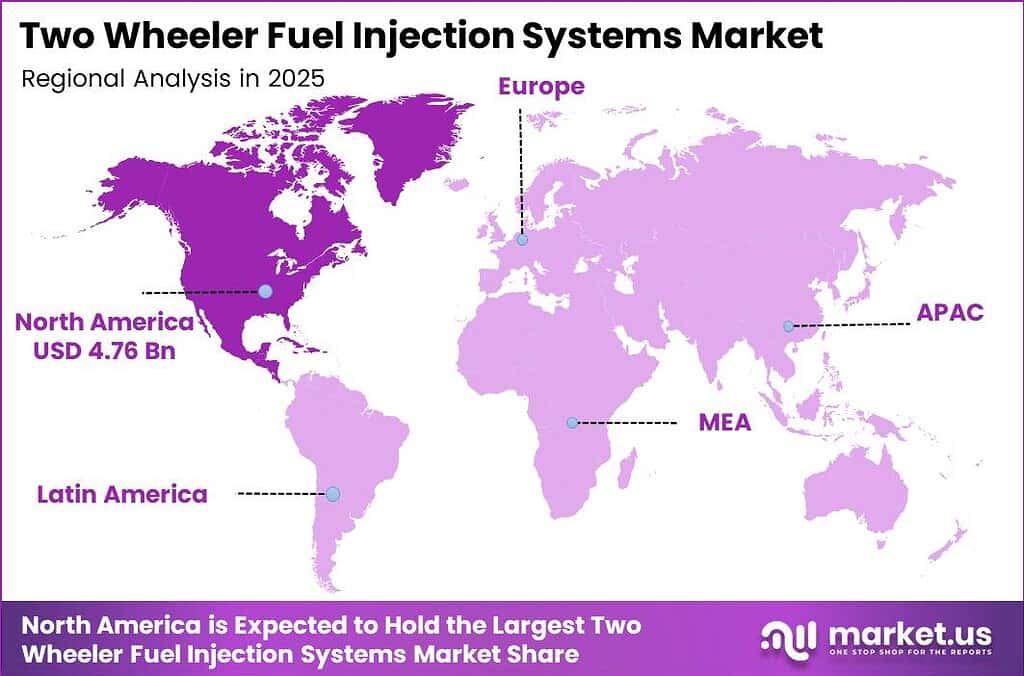
- North America holds the dominant regional position with a 35.50% share, valued at USD 4.76 Billion.
- Europe is the fastest-growing regional market during the forecast period.
Regulatory tightening is converting fuel injection from a performance feature to a compliance necessity. India’s OBD II-B mandate took effect from 1 April 2025, adding catalyst monitoring and misfire detection requirements that raise electronic content per vehicle. Each compliant model carries an estimated price increase of approximately ₹800 to ₹3,000, creating structural demand for bundled injection and diagnostic systems.
According to Honda, the company expected FY2025 global motorcycle sales of 20.2 million units, representing approximately 40% of global motorcycle sales. In March 2025, Honda announced an approximately ₹15 billion investment in a 670,000-unit annual production line for 125 cc and 160 cc two-wheelers. This volume concentration in a single OEM signals that supplier contract wins linked to Honda platforms carry outsized revenue implications.
As per our research, global electric two- and three-wheeler sales rose by almost 15% to approximately 11 million units in 2025, representing around 15% of total two- and three-wheeler sales. This substitution risk is partially offset by the still-dominant combustion base. The World Bank projected average commodity prices to increase by 16% in 2026, which will lift input costs for injector and ECU components and compress supplier margins unless offset by volume scale.
Injection Type Analysis
Port Fuel Injection (PFI) dominates with 55.00% due to low-cost compliance fit for mass-market bikes.
In 2025, Port Fuel Injection (PFI) held a dominant market position in the By Injection Type segment of the Two Wheeler Fuel Injection Systems Market, with a 55.00% share. According to Bosch, gasoline port fuel injection operates at approximately 6 bar, making it mechanically simpler and cheaper to calibrate than high-pressure alternatives. This cost profile makes PFI the default choice for OEMs supplying price-sensitive emerging markets where volume is highest.
Direct Fuel Injection (DFI) commands a premium position in the performance motorcycle segment. As reported by Bosch, high-pressure direct injection systems operate at up to 350 bar, delivering improved combustion efficiency and lower particulate emissions. DENSO documented a gasoline direct-injection system operating at 20 MPa, confirming that DFI has reached production-ready specification for two-wheeler platforms. This creates a clear upgrade path for OEMs targeting Euro 5+ markets.
Throttle Body Injection (TBI) retains relevance in the entry-level segment where simplicity and serviceability outweigh precision gains. Data from SAE shows a motorcycle fuel-injection design that eliminated three separate sensors, including throttle-position, cam-timing, and barometric sensors. This sensor consolidation reduces bill-of-materials cost and improves field reliability in markets with limited diagnostic infrastructure, making TBI a durable option for rural and frontier deployments.
Engine Displacement Analysis
Up to 150 cc (Entry-Level) dominates with 47.00% due to mass-market volume in South and Southeast Asia.
In 2025, the Up to 150 cc (Entry-Level) segment held a dominant market position in the By Engine Displacement segment of the Two Wheeler Fuel Injection Systems Market, with a 47.00% share. Honda’s planned Tapukara production line will manufacture 670,000 units of 125 cc and 160 cc scooters and light motorcycles annually. This single facility illustrates how entry-level displacement concentrates production volume and creates predictable, high-run injection system supply contracts.
The 150 cc to 500 cc (Mid-Range) segment captures commuter and semi-premium buyers who prioritize fuel economy over outright performance. In May 2025, Honda announced an approximately ₹9.2 billion production line with annual capacity of 650,000 125 cc motorcycles, raising the Gujarat plant’s capacity to 2.61 million units. Separately, Suzuki announced an approximately ₹11.74 billion motorcycle plant with annual capacity of 750,000 units. These investments confirm that mid-volume displacement platforms are receiving major capital commitments from leading OEMs.
The Above 500 cc (Premium / Performance) segment carries the highest injection system content value per unit. Honda’s CB1000GT features a 1,000 cm³ liquid-cooled, four-cylinder engine with model-specific fuel-injection settings, illustrating the engineering complexity that premium platforms demand. Although unit volumes are lower than entry-level tiers, average selling price per injection system in this segment is materially higher, supporting margin for Tier 1 suppliers who can meet homologation requirements across multiple global markets.
Vehicle Type Analysis
Motorcycles dominate with 64.00% due to higher engine complexity and emissions compliance cost per unit.
In 2025, Motorcycles held a dominant market position in the By Vehicle Type segment of the Two Wheeler Fuel Injection Systems Market, with a 64.00% share. The United States recorded 6,228 motorcyclist fatalities in 2024, representing 16% of all traffic fatalities. This safety exposure is pushing regulators toward connected diagnostics and advanced engine management, which in turn raises the electronic content specification on new motorcycle platforms.
Scooters and Mopeds represent the fastest-converting sub-segment as urban emissions zones tighten in China and European cities. India’s domestic scooter and moped population feeds directly into OBD II-B compliance demand, and OEMs are integrating injection systems even on sub-100 cc platforms to meet regulatory thresholds. Suppliers that can deliver cost-engineered injection kits below current platform price points will accelerate this conversion at scale.
Sales Channel Analysis
OEM dominates with 65.20% due to factory-integrated compliance requirements at point of manufacture.
In 2025, the Original Equipment Manufacturer (OEM) channel held a dominant market position in the By Sales Channel segment of the Two Wheeler Fuel Injection Systems Market, with a 65.20% share. Regulatory mandates requiring factory-fitted fuel injection across major markets in India, Europe, and East Asia make the OEM channel structurally locked in. Suppliers that hold preferred Tier 1 status with leading OEMs benefit from predictable, high-volume demand tied directly to annual model production cycles.
The Aftermarket channel serves the installed base of earlier-generation motorcycles being retrofitted to meet updated emissions standards. Commercial retrofit architectures already cover approximately 35 to 300 cc single-cylinder engines, and a standardized channel-installed platform could reduce installed cost by 15 to 20% relative to one-off conversions. This cost reduction widens the addressable retrofit market in South Asia and Sub-Saharan Africa, where the carbureted fleet remains large.
Key Market Segments
By Injection Type
- Port Fuel Injection (PFI)
- Direct Fuel Injection (DFI)
- Throttle Body Injection (TBI)
By Engine Displacement
- Up to 150 cc (Entry-Level)
- 150 cc to 500 cc (Mid-Range)
- Above 500 cc (Premium / Performance)
By Vehicle Type
- Motorcycles
- Scooters & Mopeds
By Sales Channel
- Original Equipment Manufacturer (OEM)
- Aftermarket
Regional Analysis
North America Dominates the Two Wheeler Fuel Injection Systems Market with a Market Share of 35.50%, Valued at USD 4.76 Billion
North America holds a 35.50% share of the Two Wheeler Fuel Injection Systems Market, valued at USD 4.76 Billion in 2025. The region’s dominance reflects a mature premium and performance motorcycle base where fuel injection has been standard fitment for over a decade. High per-unit injection system content value and persistent consumer demand for connected engine management sustain North America’s revenue leadership through the forecast period.
Europe is the fastest-growing region, propelled by Euro 5+ emissions rules that require enhanced OBD functions and mileage-accumulation testing of approximately 17,500 to 35,000 km for newly homologated models. Continental’s October 2025 ContiTech expansion of more than $85 million in Iowa added capacity directly relevant to cross-regional supply chains serving European OEM programs. This regulatory intensity makes Europe a high-value battleground for suppliers capable of full-stack emissions compliance integration.
Asia Pacific carries the largest unit volume base for two-wheeler fuel injection globally. Vietnam alone had more than 74 million registered motorcycles and mopeds in 2023, accounting for over 90% of its motorized vehicle fleet. As per our research, India recorded 19.6 million domestic two-wheeler sales in FY2024–25, an increase of 9.1% year over year. These volume figures confirm that Asia Pacific is the primary engine of global injection system demand at the unit level.
Key Regions and Countries
North America
- US
- Canada
Europe
- Germany
- France
- The UK
- Spain
- Italy
- Rest of Europe
Asia Pacific
- China
- Japan
- South Korea
- India
- Australia
- Rest of APAC
Latin America
- Brazil
- Mexico
- Rest of Latin America
Middle East and Africa
- GCC
- South Africa
- Rest of MEA
Market Dynamics
Market Opportunity Analysis - Underexploited segments and high-volume regions offer clear entry points for injection system suppliers
The Aftermarket sales channel holds a structurally underexploited position despite covering the largest installed base of carbureted two-wheelers globally. OEM channel dominance at 65.20% reflects factory-fitment compliance demand, but the remaining 34.80% of the market is concentrated in retrofit and replacement activity. Suppliers that develop standardized retrofit kits for sub-300 cc engines can access recurring revenue streams without competing directly for OEM platform awards.
The Above 500 cc (Premium / Performance) displacement segment generates the highest injection system content value per unit, yet it represents the smallest share of the three displacement tiers. By contrast, this segment is the primary driver of DFI adoption and integrated OBD compliance stacks. New entrants that target premium-tier calibration services, rather than volume hardware supply, can establish margin-rich positions without requiring mass-production tooling investment.
Sub-Saharan Africa’s local-assembly conversion pathway represents an opportunity with a projected +0.40% CAGR upside. The region’s carbureted fleet is large and growing, and emissions regulation timelines are earlier than most suppliers are currently planning for. First-mover suppliers that establish local application-engineering and calibration partnerships ahead of regulatory deadlines will lock in supply agreements before global Tier 1 players scale their regional presence.
Scooters and Mopeds remain a conversion opportunity in markets where urban emissions zones are tightening fastest. China and European cities are restricting ICE registrations in metropolitan areas, accelerating the compliance timeline for sub-100 cc platforms. Injection system suppliers that cost-engineer solutions for this sub-segment below current platform price floors will access volume that larger players have not prioritized.
Technology and Innovation Landscape - ECU integration, high-pressure injection, and sensor consolidation are redefining system value per vehicle
High-pressure direct fuel injection has reached production-ready specification for two-wheeler platforms, with systems documented operating at up to 350 bar for port-based architectures and 20 MPa for gasoline direct injection. This pressure range delivers measurable combustion efficiency gains and lower particulate emissions. OEMs investing in Euro 5+ compliance now treat DFI not as a premium option but as a regulatory engineering requirement for newly homologated performance models.
Sensor consolidation within injection system design is reducing bill-of-materials cost while improving field reliability. An SAE-documented design eliminated 3 separate sensors from a motorcycle fuel-injection platform, removing throttle-position, cam-timing, and barometric functions through integrated ECU logic. This approach is directly relevant to emerging-market deployments where diagnostic infrastructure is limited and component failure rates are higher due to fuel quality variation.
ECU automation is advancing rapidly at the manufacturing level. DENSO’s planned ¥69 billion ECU facility with approximately 56,000 m² of floor area targets 24-hour unmanned operation, signaling that ECU production is transitioning to lights-out manufacturing. This shift reduces per-unit labor cost and compresses delivery lead times, creating a cost and speed advantage for suppliers that can execute at this automation level.
OBD II-B integration has elevated the ECU from a fuel-metering controller to a full emissions-diagnostic platform. India’s 1 April 2025 mandate requires catalyst monitoring, misfire detection, and diagnostic logic embedded within the injection system stack. Bosch’s R&D spend of €7.9 billion in 2025 funds the multi-market calibration engineering this compliance complexity demands, confirming that R&D scale is now a direct competitive differentiator in injection system supply.
Drivers
India’s OBD II-B deadline and Europe’s Euro 5+ transition have redefined the fuel injection system from a standalone metering device to an integrated emissions-control stack. The Indian regulatory schedule introduced catalyst monitoring, misfire detection, and related diagnostic functions from 1 April 2025. Europe applied enhanced OBD and durability requirements to newly homologated motorcycles in 2024 and existing model registrations in 2025. Each compliant model carries a price increase of approximately ₹800 to ₹3,000, expanding electronic content per vehicle and favoring bundled system suppliers.
| Driver | (~) % Impact on CAGR Forecast | Geographic Relevance | Impact Timeline |
|---|---|---|---|
| Tightening Emissions and OBD Mandates | +1.25% | India, EU, East Asia | Short term (≤ 2 years) |
| ICE Two-Wheeler Volume Recovery | +0.65% | South and Southeast Asia | Short term (≤ 2 years) |
| Fuel-Efficiency Optimization Demand | +0.45% | Global, emerging markets | Medium term (2–4 years) |
| Premium Motorcycle Mix Expansion | +0.35% | Europe, North America, Asia | Medium term (2–4 years) |
| Electronic Powertrain Platform Standardization | +0.25% | Global manufacturing hubs | Long term (≥ 4 years) |
Restraints
Battery-electric substitution creates a direct content-loss mechanism because every electric two-wheeler replacing a combustion model eliminates the injector, fuel pump, throttle-body hardware, and associated fuel-control electronics. India recorded approximately 1.14 million electric two-wheeler registrations in FY2025, representing about 21% annual growth, with category penetration reaching approximately 7.6% by August 2025. The modeled -0.85% drag can lower utilization at injector and pump plants and strand ICE-specific tooling as combustion-platform awards shrink.
| Restraint | (~) % Impact on CAGR Forecast | Geographic Relevance | Impact Timeline |
|---|---|---|---|
| Battery-Electric Two-Wheeler Substitution | -0.85% | China, India, Southeast Asia, EU | Short term (≤ 2 years) |
| Entry-Level Motorcycle Affordability Ceiling | -0.50% | South Asia, Africa, Latin America | Short term (≤ 2 years) |
| Urban ICE Registration Curbs | -0.35% | China, EU metropolitan markets | Medium term (2–4 years) |
| Elevated Consumer Borrowing Costs | -0.30% | Emerging and frontier markets | Short term (≤ 2 years) |
| Homologation-Driven Model Discontinuations | -0.20% | EU, India, export markets | Short term (≤ 2 years) |
Challenges
Fuel injection systems remain structurally exposed to automotive-grade microcontrollers, pressure sensors, and power semiconductors whose qualification requirements prevent rapid substitution. Average automotive semiconductor lead time stood at approximately 14.3 weeks in the first quarter of 2024, but embedded processors and discrete components remained above 20 weeks. Discrete lead times increased by about 21% and sensor lead times by 4% during the same quarter. This uneven availability forces suppliers to qualify pin-compatible components, redesign ECUs for multiple chipsets, and fund duplicate calibration validation, sustaining an estimated -0.70% friction drag on attainable CAGR.
| Challenge | (~) % CAGR Friction Drag | Geographic Relevance | Mitigation Horizon |
|---|---|---|---|
| Automotive Chip Volatility | -0.70% | Global supply chains | Medium term (2–4 years) |
| Thermal and Vibration Validation | -0.50% | Global, tropical markets | Medium term (2–4 years) |
| Diagnostic Technician Skills Gap | -0.40% | South Asia, Africa, Southeast Asia | Long term (≥ 4 years) |
| Contaminated Fuel Injector Fouling | -0.30% | Emerging and rural markets | Medium term (2–4 years) |
| Fragmented Homologation Requirements | -0.25% | Global export programs | Long term (≥ 4 years) |
Opportunities
Legacy-fleet conversion represents an untapped revenue channel independent of new ICE motorcycle sales. Commercial retrofit architectures already cover approximately 35 to 300 cc single-cylinder engines. A standardized channel-installed platform could reduce installed cost by 15 to 20% relative to one-off conversions and expand supplier gross margin by approximately 4 to 6 percentage points through shared ECUs, pumps, sensors, and calibration maps. Converting only 0.5 to 1.0% of the serviceable legacy fleet annually could add an estimated +0.70% CAGR upside while generating recurring maintenance and replacement-part revenue.
| Opportunity | (~) % Potential CAGR Upside | Geographic Relevance | Execution Window |
|---|---|---|---|
| Legacy Fleet EFI Retrofits | +0.70% | South Asia, Southeast Asia, Africa | Medium term (2–4 years) |
| Flex-Fuel Closed-Loop Platforms | +0.50% | India, Brazil, Southeast Asia | Medium term (2–4 years) |
| African Local-Assembly Conversion | +0.40% | Sub-Saharan Africa | Long term (≥ 4 years) |
| Hybrid Two-Wheeler Range Extenders | +0.30% | Asia and urban export markets | Long term (≥ 4 years) |
| Remanufactured Injector Programs | +0.25% | Global aftermarket | Medium term (2–4 years) |
Key Company Insights
Robert Bosch GmbH generated €91.0 billion in sales across approximately 500 entities worldwide in 2025 and invested €7.9 billion in research and development. This R&D scale funds simultaneous calibration across PFI, DFI, and OBD-integrated platforms. In May 2025, Bosch launched a corporate venture-capital fund worth approximately €250 million to accelerate emerging powertrain technology. Bosch’s investment capacity makes it structurally difficult for smaller injection system suppliers to match its multi-platform coverage and regulatory engineering depth.
DENSO Corporation generated ¥7,540.0 billion in consolidated revenue in FY2026, an increase of 5.3%. DENSO’s September 2024 announcement of a ¥69 billion ECU plant with approximately 56,000 m² of floor area and planned 24-hour unmanned operation signals a step-change in production automation. In December 2025, Hitachi agreed to transfer a 21% Astemo stake to Honda for approximately ¥152.3 billion, raising Honda’s ownership to 61%. This consolidation tightens Honda-platform supply alignment, which may redirect some injection system content awards toward Astemo at DENSO’s expense on Honda programs.
Key Players
- Robert Bosch GmbH
- DENSO Corporation
- Astemo, Ltd.
- Marelli Holdings Co., Ltd.
- Mikuni Corporation
- Dell’Orto S.p.A.
- Walbro LLC
- UCAL Limited
- Continental AG
- BorgWarner Inc. / Delphi Technologies
- Ducati Energia S.p.A.
- SEDEMAC Mechatronics Pvt. Ltd.
- Shindengen Electric Manufacturing Co., Ltd.
- Edelbrock LLC
- Kinsler Fuel Injection
Recent Developments
- May 22, 2026 – Continental inaugurated a Rayong plant expansion involving more than €300 million, adding annual capacity for 3 million passenger-car and light-truck tires and launching local radial-motorcycle-tire production.
- April 27, 2026 – Bosch announced an investment of approximately €200 million in Bosch Business Innovations over five years to fund next-generation automotive technology platforms.
- July 4, 2026 – Continental agreed to sell ContiTech for €4.0 billion, with performance-based payments of up to €250 million, sharpening its focus on core automotive technology segments.
- September 25, 2025 – Astemo agreed to pay TDK ¥4.3 billion for its automotive power-supply development business, strengthening Astemo’s electrification and ECU capabilities.
- July 31, 2025 – Marelli received final court approval to access $1.1 billion in debtor-in-possession financing, providing liquidity to sustain operations during its restructuring process.
- September 9, 2024 – DENSO announced a ¥69 billion ECU plant with approximately 56,000 m² of plant area and planned 24-hour unmanned operation, significantly expanding automated ECU production capacity.
- January 26, 2024 – Continental announced an approximately $90 million, 85,000 m² hydraulic-hose plant in Mexico that would double regional capacity and create more than 200 jobs.
Report Scope
| Report Features | Description |
|---|---|
| Market Value (2026) | USD 14.3 Billion |
| Forecast Revenue (2035) | USD 26.2 Billion |
| CAGR (2026-2035) | 6.9% |
| Base Year for Estimation | 2025 |
| Historic Period | 2020-2024 |
| Forecast Period | 2026-2035 |
| Report Coverage | Revenue Forecast, Market Dynamics, Market Opportunity Analysis, Technology and Innovation Landscape, Competitive Landscape, Recent Developments |
| Segments Covered | By Injection Type (Port Fuel Injection (PFI), Direct Fuel Injection (DFI), Throttle Body Injection (TBI)), By Engine Displacement (Up to 150 cc (Entry-Level), 150 cc to 500 cc (Mid-Range), Above 500 cc (Premium / Performance)), By Vehicle Type (Motorcycles, Scooters & Mopeds), By Sales Channel (Original Equipment Manufacturer (OEM), Aftermarket) |
| Regional Analysis | North America (US and Canada), Europe (Germany, France, The UK, Spain, Italy, and Rest of Europe), Asia Pacific (China, Japan, South Korea, India, Australia, and Rest of APAC), Latin America (Brazil, Mexico, and Rest of Latin America), Middle East and Africa (GCC, South Africa, and Rest of MEA) |
| Competitive Landscape | Robert Bosch GmbH, DENSO Corporation, Astemo, Ltd., Marelli Holdings Co., Ltd., Mikuni Corporation, Dell’Orto S.p.A., Walbro LLC, UCAL Limited, Continental AG, BorgWarner Inc. / Delphi Technologies, Ducati Energia S.p.A., SEDEMAC Mechatronics Pvt. Ltd., Shindengen Electric Manufacturing Co., Ltd., Edelbrock LLC, Kinsler Fuel Injection |
| Customization Scope | Customization for segments, region/country-level will be provided. Additional customization can be done based on requirements. |
| Purchase Options | We have three licenses to opt for: Single User License, Multi-User License (Up to 5 Users), Corporate Use License (Unlimited User and Printable PDF) |





































