Report Overview
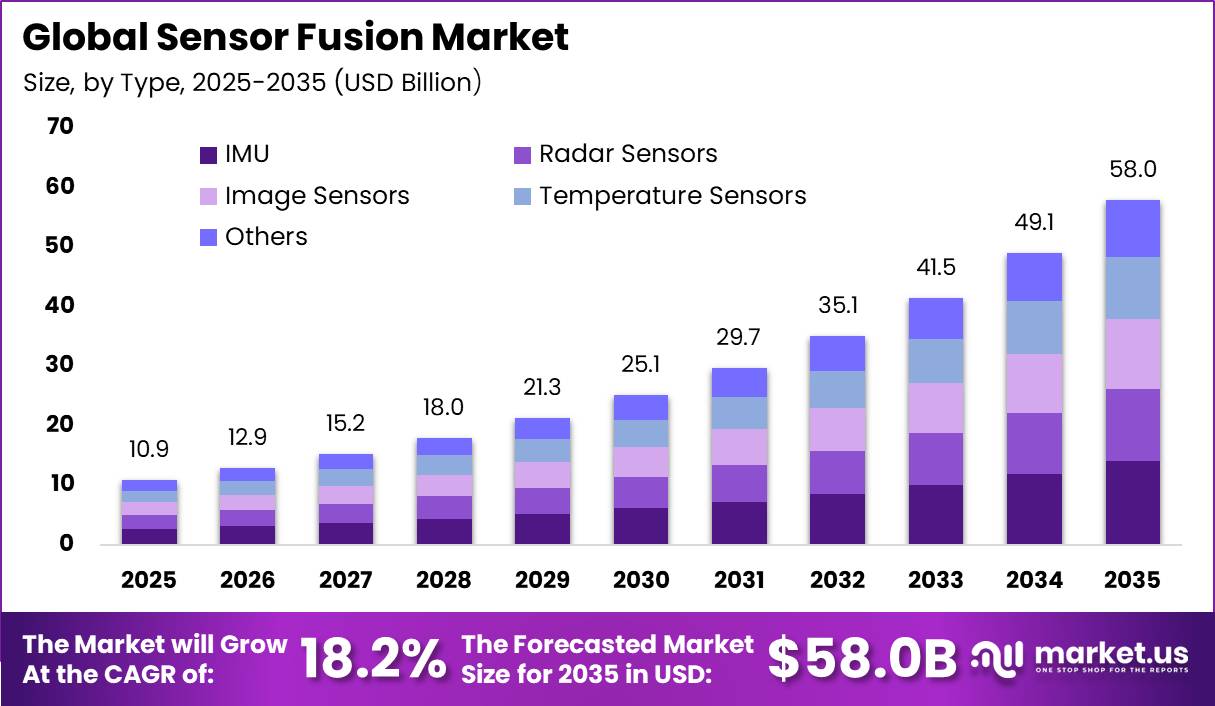
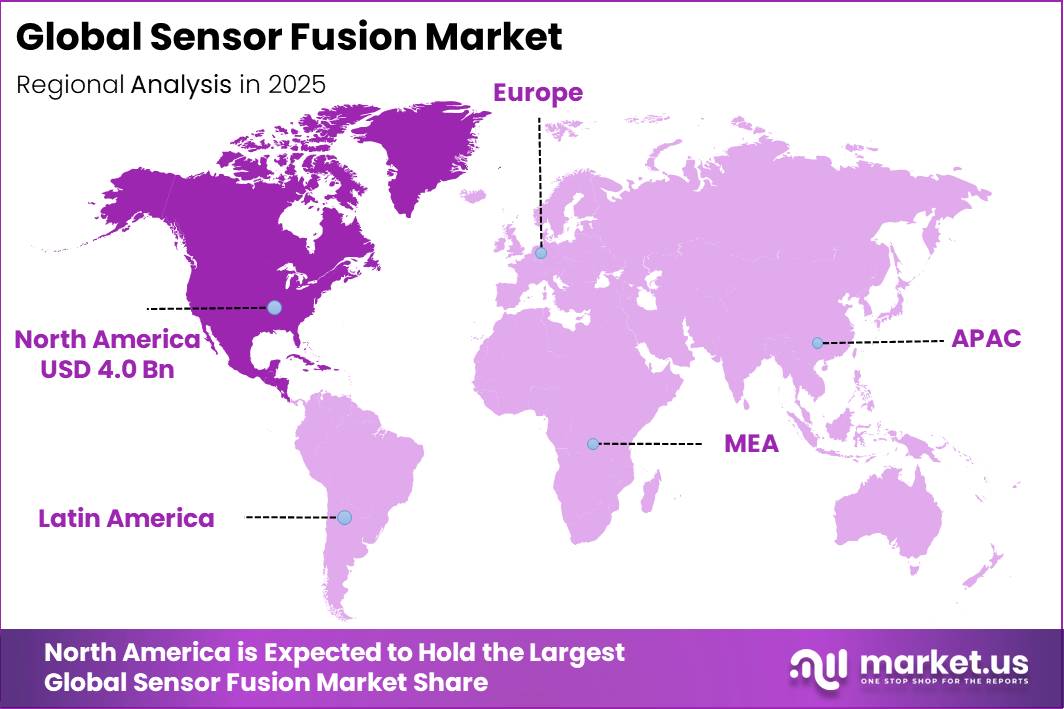
In 2025, the Global Sensor Fusion Market was valued at USD 10.9 billion. The market is projected to grow at a CAGR of 18.2% during 2026–2035, reaching approximately USD 58.0 billion by 2035. North America dominated the global market in 2025, accounting for more than 36.5% of the total market share and generating approximately USD 4.0 billion in revenue.
Growth is supported by rising use of systems that combine information from cameras, radar, lidar, inertial sensors, ultrasonic sensors, and other sensing technologies to improve real-time decisions. The automotive sector remains a major demand source. Global motor-vehicle production increased from 92.7 million units in 2024 to 96.4 million units in 2025, while vehicle sales reached 99.8 million units.
Modern vehicles increasingly depend on sensor fusion for automatic emergency braking, adaptive cruise control, parking assistance, driver monitoring, and automated-driving functions. Electric and connected vehicles are also creating additional opportunities as they require better management of battery, vehicle motion, safety, and surrounding-road information.
In China, new-energy vehicle production reached 16.626 million units in 2025, rising 29%, further expanding the installed base for advanced sensing technologies. Industrial automation is another important growth area. Manufacturers installed 542,000 industrial robots in 2024, while the global operational stock reached 4.664 million units, increasing 9% year over year. The Americas installed 50,100 industrial robots in 2024. Supported by automotive, electronics, aerospace, medical-device, logistics, and defense applications.
Key Takeaway
- The Sensor Fusion Market was valued at USD 10.9 billion in 2025 and is projected to reach USD 58.0 billion by 2035, growing at a CAGR of 18.2%.
- The IMU segment held a leading 24.3% share by type, supported by its role in navigation, drones, vehicles, and industrial equipment.
- The MEMS segment held a leading 62.4% share by technology, driven by compact, low-power, cost-effective sensor manufacturing.
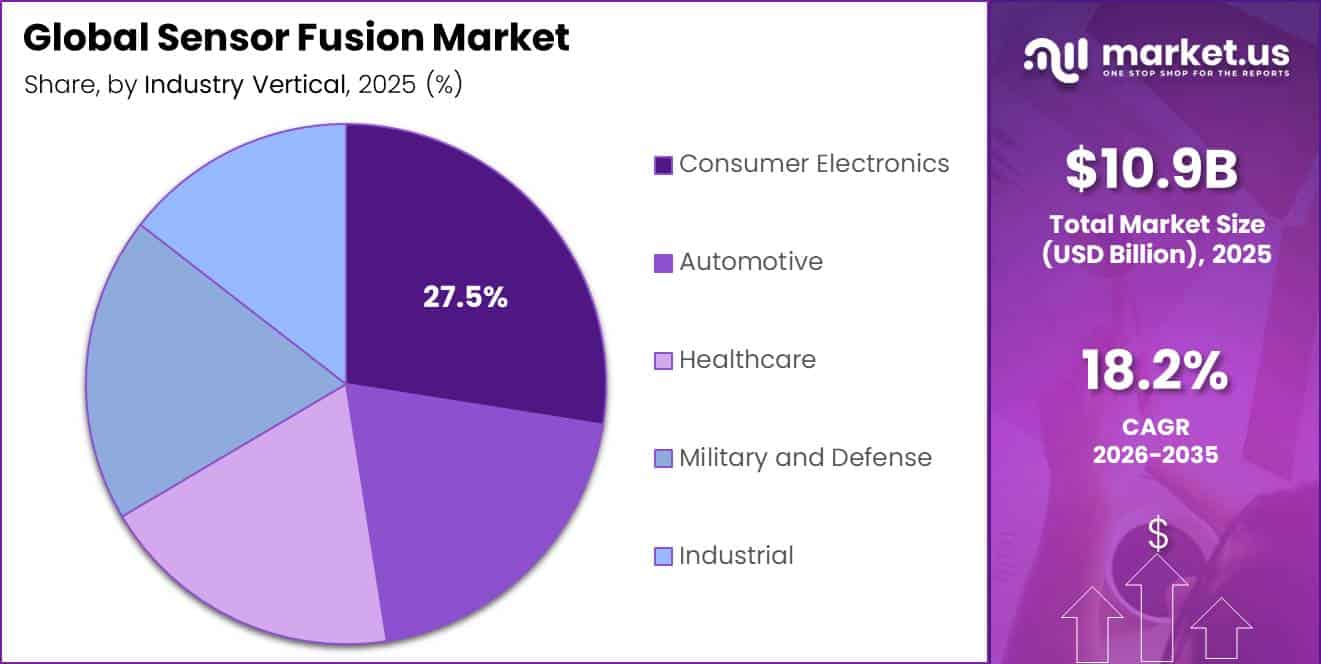
- The consumer electronics segment held a leading 27.5% share by industry vertical, supported by high smartphone and wearable device shipments.
- North America led the market in 2025 with a 36.5% share, generating approximately USD 4.0 billion in revenue.
Market Statistics and Data Insights
- Global vehicle sales increased from 95.3 million units to 99.8 million units, up 4.7%. This creates a large hardware base for radar, cameras, IMUs, MEMS sensors, and centralized sensor-processing systems.
- NHTSA’s FMVSS No. 127 requires automatic emergency braking on nearly all U.S. passenger cars and light trucks by September 2029. Systems must avoid contact with a lead vehicle at speeds up to 62 mph, automatically brake at up to 90 mph when a vehicle collision is imminent, and detect pedestrians at up to 45 mph. The requirements apply to vehicles weighing 10,000 pounds or less. These functions directly rely on sensing and perception systems.
- Distracted-driving crashes killed 3,208 people and injured 315,167 people in the U.S. during 2024. NHTSA also notes that taking the eyes off the road for 5 seconds at 55 mph is equivalent to travelling about the length of a football field without looking.
- AAA’s 2025 U.S. consumer survey found that 78% of drivers considered improvements in vehicle safety systems a top technology priority, compared with only 13% who prioritized development of self-driving vehicles.
- The same AAA survey found that 64% of U.S. drivers would definitely or probably want automatic emergency braking on their next vehicle, 62% wanted reverse automatic emergency braking, and 59% wanted lane-keeping assistance.
- Eurostat reported that 70.9% of people aged 16–74 in the EU used an internet-connected or IoT device in 2024. Smart wearables such as smartwatches and fitness trackers were used by 29.9%, while 10.5% used a car with built-in wireless connectivity.
- Eurostat also reported that 57.9% of people used internet-connected TVs, 19.5% used connected game consoles, 19.3% used connected home-audio systems and 16.0% used smart speakers or virtual assistants in 2024.
- Bosch reported in its 2025 Annual Report that more than 50% of all new smartphones are equipped with Bosch MEMS sensors. Bosch also spent €7.9 billion on R&D during the year, compared with €7.8 billion in the previous year.
- GSMA reported that around 4.3 billion people, equal to 54% of the global population, owned a smartphone in its published global adoption data.
- Global semiconductor sales reached a record USD 791.7 billion in 2025, increasing 25.6% from USD 630.5 billion. Fourth-quarter sales reached USD 236.6 billion, up 37.1% year over year. Logic-device sales reached USD 301.9 billion, increasing 39.9%.
- Bosch Sensortec’s BHI385 smart sensor integrates embedded AI with 6DoF and 9DoF sensor fusion. Typical current consumption is below 500 μA at 50 Hz during sensor-fusion operation and below 50 μA for simpler accelerometer-based algorithms. The package measures only 2.5 × 3.0 × 0.95 mm³.
By Type
The IMU segment holds a leading 24.3% share of the sensor fusion market, supported by its critical role in providing continuous motion and orientation data when cameras, radar, GPS, or lidar signals are weak, delayed, or unavailable. An inertial measurement unit combines accelerometers and gyroscopes to measure acceleration, rotation, tilt, and movement, making it important for drones, vehicles, robots, navigation systems, and industrial equipment.
The U.S. Federal Aviation Administration estimated the U.S. small-drone fleet at around 1.8 million units in 2024 and projected it to reach nearly 1.9 million units by 2029. IMUs help drones maintain stable flight, detect movement, hold position, and land safely by combining motion data with navigation and camera inputs.
Automotive safety applications also support demand. The U.S. National Highway Traffic Safety Administration reported 3,208 deaths in distraction-affected crashes in 2024, accounting for 8.2% of all traffic fatalities. This strengthens demand for driver-assistance and stability systems that rely on IMUs for yaw detection, navigation continuity, rollover monitoring, and vehicle-motion control.
By Technology
The MEMS segment holds a leading 62.4% share of the sensor fusion market, mainly because micro-electromechanical systems allow sensors to be compact, low-power, cost-effective, and suitable for mass production. MEMS accelerometers, gyroscopes, microphones, pressure sensors, and magnetometers are widely used in smartphones, wearables, earbuds, drones, vehicles, and smart-home devices.
Their silicon-based manufacturing process allows multiple sensing functions to be integrated into small chips, making them easier to combine with processors and other electronic components. GSMA reported around 4.7 billion smartphone users globally in 2024, with the number expected to reach 5.5 billion by 2030.
MEMS technology also provides continuous physical data without significantly increasing device size, power use, or overall system cost. GSMA estimated that mobile technologies and services contributed around USD 6.5 trillion to the global economy, equal to 5.8% of global GDP in 2024, highlighting the large digital-device base supporting continued MEMS demand.
By Industry Vertical
The Consumer Electronics segment holds a leading 27.5% share of the sensor fusion market, supported by high device shipments and the use of several sensors in each product. IDC forecasts worldwide smartphone shipments at 1.2 billion units in 2025, highlighting the large installed base for sensor fusion technologies.
Modern smartphones combine accelerometers, gyroscopes, magnetometers, proximity sensors, ambient-light sensors, cameras, microphones, and biometric sensors. Sensor fusion processes these inputs together to improve motion tracking, orientation, navigation, image stabilization, gaming, facial recognition, fall detection, and fitness functions.
Wearable devices are also creating strong demand for compact and power-efficient sensing systems. IDC reported that global wrist-worn device shipments reached 45.6 million units in the first quarter of 2025, increasing 10.5% year over year. Smartwatches and fitness bands use combined motion, heart-rate, location, and altitude data to monitor steps, exercise, sleep, and other health-related activities.
Key Market Segments
By Type
- IMU
- Radar Sensors
- Image Sensors
- Temperature Sensors
- Others
By Technology
- MEMS
- Non MEMS
By Industry Vertical
- Consumer Electronics
- Automotive
- Healthcare
- Military and Defense
- Industrial
Geopolitical Impact Analysis
Geopolitical disruption is increasing both the cost and delivery time of sensor fusion hardware, which depends heavily on globally traded MEMS devices, microcontrollers, processors, printed circuit boards, cameras, radar modules, passive components, and semiconductor wafers. Red Sea tensions have pushed many Asia-Europe shipments away from the Suez Canal and toward the Cape of Good Hope.
UNCTAD estimates that this route change adds about 12 sailing days to the Shanghai-Rotterdam journey, increasing transit time by roughly 30% and reducing effective global container shipping capacity by around 9%. For manufacturers operating with lean inventories, these delays can increase working-capital requirements.
UNCTAD also reported that the disruption contributed 148 percentage points to a cumulative 120% rise in the China Containerized Freight Index between October 2023 and June 2024, raising freight costs for imported sensors and electronic assemblies. The WTO’s 2025 tariff profiles cover applied tariffs and non-tariff measures across more than 170 economies, showing the scale of compliance challenges in international electronics trade.
Energy costs are another important factor because semiconductor fabrication, packaging, clean-room operations, and air freight require significant energy. The World Bank projected its energy-price index to decline by 12% in 2025 and another 10% in 2026, although geopolitical tensions could quickly reverse this trend.
Regional Analysis
North America led the global sensor fusion market in 2025, accounting for 36.5% of total revenue, or around USD 4.0 billion. The region benefits from strong capabilities in automotive engineering, consumer electronics, aerospace and defense, healthcare technology, industrial automation, and AI development.
The United States remains a major hub for advanced sensor systems, including inertial measurement units, radar, cameras, MEMS sensors, lidar, and edge-processing platforms. U.S. real GDP grew by 2.2% in 2025, supported by investment in equipment, research and development, and intellectual-property products.
This investment base supports growing sensor fusion demand across autonomous systems, robotics, connected vehicles, medical devices, and smart factories. Connected-transport deployment also strengthens regional demand. U.S. Department of Transportation data identified 4,366 operational roadside units and 1,465 operational onboard units, with another 6,449 roadside units and 1,045 onboard units planned.
Asia Pacific is expected to be the fastest-growing regional market, supported by large-scale production of smartphones, consumer electronics, electric vehicles, industrial equipment, and drones. Its strong manufacturing base supports cost-efficient integration of MEMS sensors, processors, cameras, and connectivity modules.
Key Regions and Countries
North America
- US
- Canada
Europe
- Germany
- France
- The UK
- Spain
- Italy
- Rest of Europe
Asia Pacific
- China
- Japan
- South Korea
- India
- Australia
- Rest of APAC
Latin America
- Brazil
- Mexico
- Rest of Latin America
Middle East & Africa
- GCC
- South Africa
- Rest of MEA
Market Dynamics
Drivers
| Driver | (~) % CAGR | Geographic Relevance | Impact Timeline |
|---|---|---|---|
| Mandatory vehicle safety sensing | +3.0% | North America and Europe | Medium term (2 to 4 years) |
| Edge AI device integration | +2.2% | Global | Short term (2 years or less) |
| Industrial mobile automation | +1.6% | Asia Pacific and Europe | Medium term (2 to 4 years) |
| Aerospace navigation upgrades | +1.1% | North America and Europe | Long term (4 years or more) |
| Precision healthcare devices | +0.9% | Global | Medium term (2 to 4 years) |
Mandatory vehicle safety sensing
Mandatory advanced driver-assistance systems are a major growth driver for the sensor fusion market. NHTSA’s FMVSS No. 127 requires automatic emergency braking and pedestrian detection on nearly all U.S. light vehicles by September 1, 2029.
The rule covers collision avoidance at up to 62 mph, automatic braking at up to 90 mph, and pedestrian detection at up to 45 mph for vehicles weighing 10,000 pounds or less. In Europe, Regulation 2019/2144 has required intelligent speed assistance on all new vehicles since July 7, 2024.
These regulations are shifting sensor fusion from an optional premium feature to standard vehicle content, increasing demand for camera-radar-IMU processing, safety software, and advanced domain controllers. This regulatory push could contribute an estimated +3.0% to the market’s 18.2% CAGR.
Restraints
| Restraint | (~) % CAGR | Geographic Relevance | Impact Timeline |
|---|---|---|---|
| Automotive production cyclicality | -2.4% | Global | Short term (2 years or less) |
| Consumer device price pressure | -1.7% | Asia Pacific | Short term (2 years or less) |
| Automotive design-win delays | -1.3% | North America and Europe | Medium term (2 to 4 years) |
| High safety qualification costs | -1.0% | Global | Medium term (2 to 4 years) |
| Capital spending deferrals | -0.8% | Europe | Short term (2 years or less) |
Automotive production cyclicality
Automotive production cyclicality is a key near-term restraint for the sensor fusion market because vehicle manufacturers can delay model launches, reduce sensor content, and postpone controller orders during weak demand.
Infineon reported FY 2025 revenue of €14.6 billion, down 2%, while STMicroelectronics recorded USD 11.8 billion, a decline of 11.1%. NXP also reported FY 2025 revenue of USD 12.2 billion, down 3% year over year.
Lower vehicle production can delay purchases of sensors, processors, and related electronic components even when safety regulations continue to support long-term demand. Continued automotive weakness may also delay capacity expansion and investment, creating an estimated 2.4% drag on the market’s near-term CAGR potential.
Challenges
| Challenge | (~) % CAGR | Geographic Relevance | Mitigation Horizon |
|---|---|---|---|
| Multi-sensor validation complexity | -2.1% | Global | Long term (4 years or more) |
| Semiconductor supply concentration | -1.6% | Asia Pacific and Europe | Medium term (2 to 4 years) |
| Embedded software talent gap | -1.2% | Global | Long term (4 years or more) |
| Sensor data calibration | -1.0% | Global | Medium term (2 to 4 years) |
| Cybersecurity assurance burden | -0.8% | North America and Europe | Medium term (2 to 4 years) |
Multi-sensor validation complexity
Multi-sensor validation remains a major long-term challenge for the sensor fusion market because systems must work safely across changing light, weather, road conditions, vehicle motion, and component tolerances.
NHTSA’s FMVSS No. 127 requires pedestrian detection in both daylight and darkness, with testing across speeds from above 6.2 mph to below 90.1 mph. Euro NCAP also requires advanced driver-assistance testing over at least 2,000 km across a minimum of 3 European countries.
These requirements increase spending on simulation, hardware-in-the-loop testing, fleet data, functional safety, and over-the-air validation. Unless suppliers improve software standardization, reusable safety cases, and verification tools, validation complexity could create an estimated 2.1% drag on the market’s maximum growth potential.
Opportunities
| Opportunity | (~) % CAGR | Geographic Relevance | Execution Window |
|---|---|---|---|
| Software-defined vehicle platforms | +2.8% | Global | Medium term (2 to 4 years) |
| Sensor fusion software licensing | +2.0% | North America and Europe | Medium term (2 to 4 years) |
| Autonomous warehouse fleets | +1.5% | Asia Pacific and North America | Short term (2 years or less) |
| Medical monitoring wearables | +1.2% | Global | Medium term (2 to 4 years) |
| Drone inspection systems | +1.0% | North America and Asia Pacific | Long term (4 years or more) |
Software-defined vehicle platforms
Software-defined vehicles represent an emerging opportunity for the sensor fusion market as automakers move toward centralized computing and software-based vehicle functions. Infineon completed its USD 2.5 billion acquisition of Marvell’s Automotive Ethernet business in 2025, adding an operation expected to generate USD 225–250 million in annual revenue with about a 60% gross margin.
NXP also completed its USD 766 million acquisition of TTTech Auto, strengthening its safety middleware and vehicle software capabilities. Connected-vehicle infrastructure provides another growth base. U.S. Department of Transportation projects included 4,366 operational roadside units and 1,465 operational onboard units.
As automakers use fused sensor data for configurable features, fleet analytics, and paid safety services, software-based revenue could improve overall platform economics. Successful deployment of scalable vehicle software platforms could potentially add around 2.8% to market CAGR.
Key Players Analysis
The sensor fusion market is led by Tier-1 semiconductor and automotive technology suppliers with strong sensor portfolios, processing capabilities, and established relationships with vehicle and industrial OEMs. Bosch remains a major automotive-system supplier, with its Mobility division generating €55.8 billion in 2025.
The company invested €7.9 billion in R&D, equal to 8.7% of group sales, while 75% of its R&D spending was directed toward Mobility activities such as electrification, driver assistance, and automated driving. NXP reported USD 12.2 billion in revenue and USD 2.3 billion in R&D spending in 2025, representing 19.2% of revenue.
Analog Devices generated USD 11.02 billion and invested USD 1.7 billion, or 16.0% of revenue, in R&D. Infineon reported €14.6 billion in FY2025 revenue and spent €2.2 billion, or 15.2%, on R&D, while its Marvell automotive Ethernet acquisition contributed to negative free cash flow of €1.05 billion. STMicroelectronics recorded USD 11.8 billion in 2025 revenue and allocated around 17.3% of revenue to R&D.
Renesas reported non-GAAP revenue of ¥1,318.5 billion in 2025. Bosch, NXP, ADI, Infineon, and ST are estimated to represent a combined 45–55% of sensor-fusion component and platform value. Competition also includes InvenSense, Asahi Kasei Microdevices, Baselabs, and Maxim Integrated, which became part of ADI following its 2021 acquisition.
Top Key Players in the Market
- Analog Devices Inc.
- NXP Semiconductor
- Renesas Electronics Corporation
- Bosch Sensortec GmbH
- InvenSense Inc
- Infineon Technologies
- STMicroelectronics
- Asahi Kasei Microdevices
- Baselabs
- Maxim Integrated
Recent Developments
- In 2026, STMicroelectronics completed the acquisition of NXP Semiconductors’ MEMS sensor business on February 2. The transaction was originally valued at up to USD 950 million, including USD 900 million upfront and up to USD 50 million linked to technical milestones. ST later reported an acquisition-related cash outflow of USD 895 million, while the acquired MEMS business contributed about USD 40 million to its first-quarter revenue.
- In 2025, Infineon Technologies agreed on April 7 to acquire Marvell Technology’s Automotive Ethernet business for USD 2.5 billion in cash. The acquired operation was expected to generate USD 225–250 million in annual revenue with a gross margin of around 60%. Its Ethernet portfolio supports data rates from 100 Mbps to 10 Gbps, allowing high-speed transfer of camera, radar, lidar, and other sensor data across software-defined vehicle architectures.
Report Scope
| Report Features | Description |
|---|---|
| Market Value (2025) | USD 10.9 Billion |
| Forecast Revenue (2035) | USD 58.0 Billion |
| CAGR (2026-2035) | 18.2% |
| Base Year for Estimation | 2025 |
| Historic Period | 2020-2024 |
| Forecast Period | 2026-2035 |
| Report Coverage | Revenue Forecast, Market Dynamics, Competitive Landscape, Recent Developments |
| Segments Covered | By Type (IMU, Radar Sensors, Image Sensors, Temperature Sensors, Others), By Technology (MEMS, Non-MEMS), By Industry Vertical (Consumer Electronics, Automotive, Healthcare, Military and Defense, Industrial) |
| Regional Analysis | North America – US, Canada; Europe – Germany, France, The UK, Spain, Italy, Rest of Europe; Asia Pacific – China, Japan, South Korea, India, Australia, Singapore, Rest of APAC; Latin America – Brazil, Mexico, Rest of Latin America; Middle East & Africa – GCC, South Africa, Rest of MEA |
| Competitive Landscape | Analog Devices Inc., NXP Semiconductor, Renesas Electronics Corporation, Bosch Sensortec GmbH, InvenSense Inc., Infineon Technologies, STMicroelectronics, Asahi Kasei Microdevices, Baselabs, Maxim Integrated |
| Customization Scope | Customization for segments and region/country-level will be provided. Additional customization can be done based on requirements. |
| Purchase Options | We have three licenses to opt for: Single User License, Multi-User License (Up to 5 Users), Corporate Use License (Unlimited Users and Printable PDF) |