Report Overview
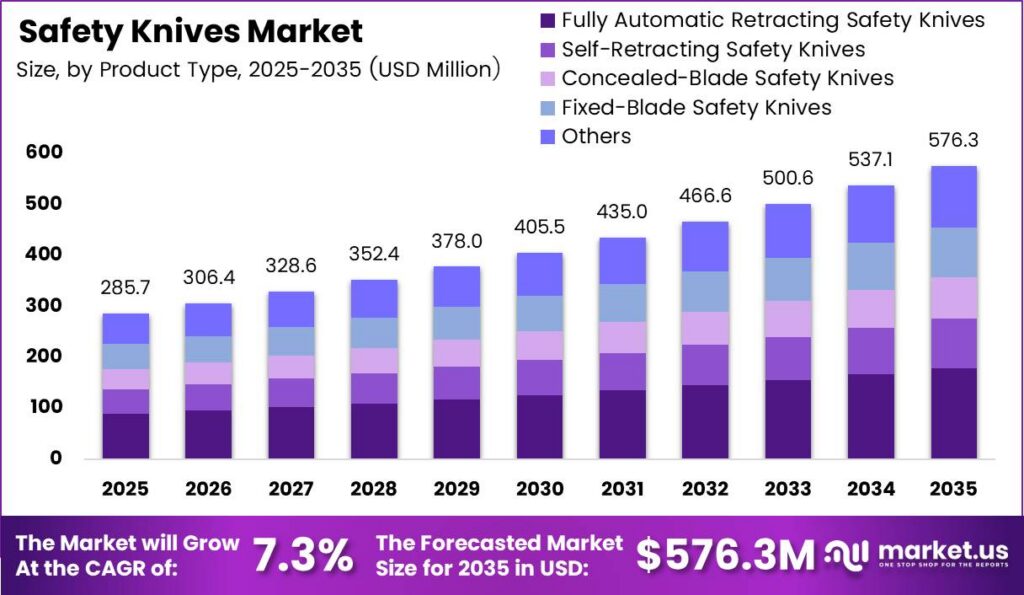
Global Safety Knives Market size is expected to be worth around USD 576.3 Million by 2035 from USD 285.7 Million in 2025, growing at a CAGR of 7.3% during the forecast period 2026 to 2035. Safety knives are cutting tools that shield, retract, or limit blade exposure when workers cut packaging, film, strapping, and textiles. Their design reduces the hand lacerations that open utility blades cause on busy work floors.
The market spans retractable, concealed-blade, and fixed-blade tools sold into warehousing, retail fulfillment, manufacturing, construction, and food plants. According to OSHA, 385,488 US establishments reported 1,538,299 injuries and illnesses in 2023. Those cases caused 18,506,116 days away from work. This means every cutting station carries a measurable lost-time risk. Consequently, safety managers treat knife choice as a cost decision, not a minor tool purchase.
Key Takeaways
- The Global Safety Knives Market was valued at USD 285.7 Million in 2025.
- The market is forecast to reach USD 576.3 Million by 2035.
- The market is growing at a CAGR of 7.3% from 2026 to 2035.
- Fully Automatic Retracting Safety Knives led the Product Type segment with a 31.0% share in 2025.
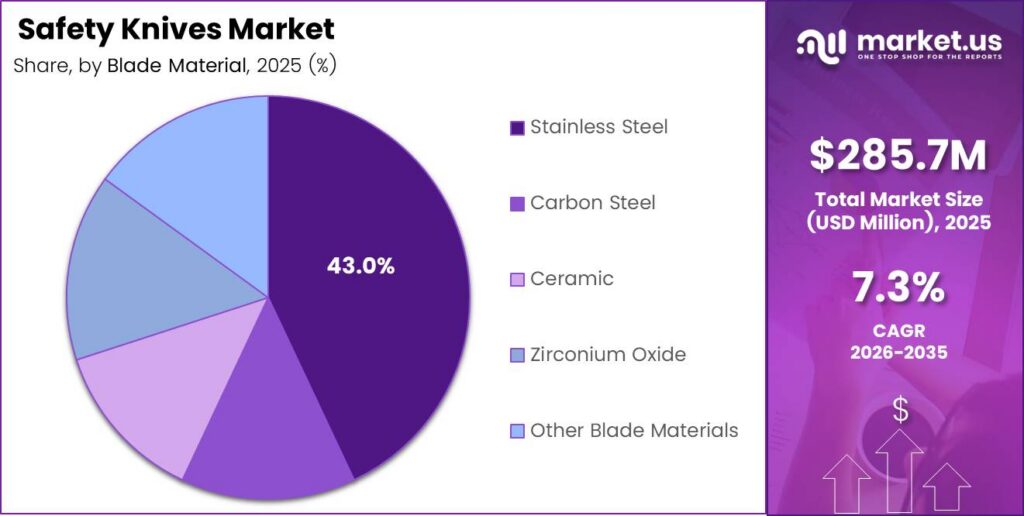
- Stainless Steel led the Blade Material segment with a 43.0% share in 2025.
- Plastic led the Handle Material segment with a 38.0% share in 2025.
- Warehousing and Logistics led the End-Use Industry segment with a 32.0% share in 2025.
- Online Retail / E-Commerce held a 29.0% share of the Distribution Channel segment in 2025.
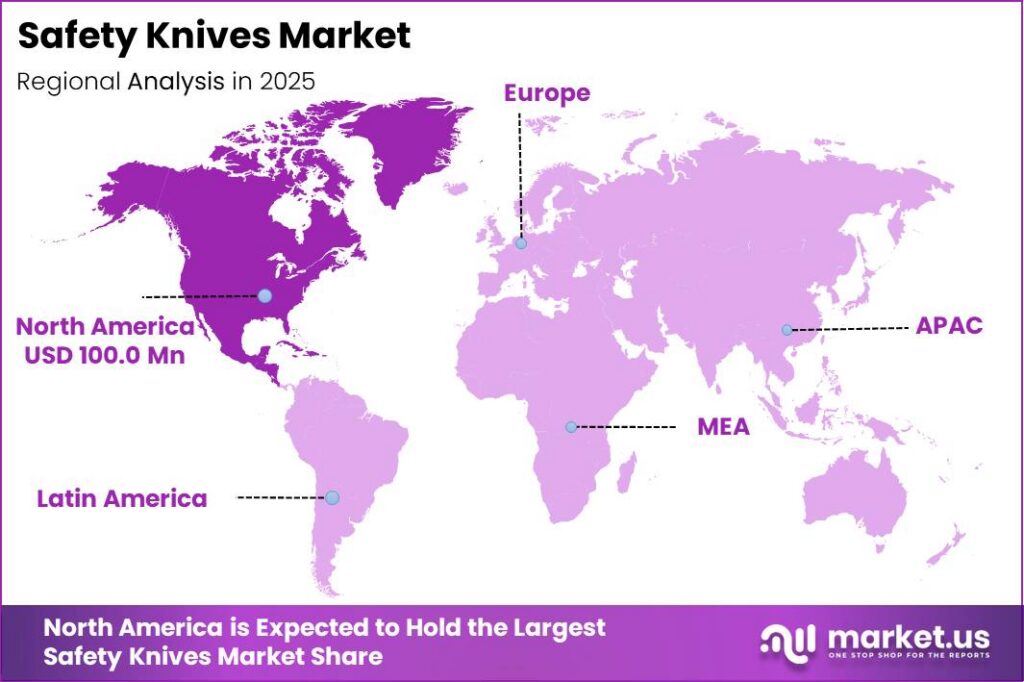
- North America dominated with a 35.0% share in 2025, valued at USD 100.0 Million.
- The forecast period runs from 2026 to 2035.
European rules push employers to remove hazards at the tool level. As reported by Eurostat, losing control of machines, tools, or handling equipment caused 21.7% of EU non-fatal work accidents in 2023. This reflects a hazard that blade design can address directly. Therefore, auto-retracting and concealed-blade knives fit neatly into employer risk assessments. Vendors that document injury reduction gain an edge in audited tenders across EU industrial sites.
Large tool groups are reshaping portfolios around core hand tools. In December 2025, Stanley Black & Decker agreed to sell its Consolidated Aerospace Manufacturing business to Howmet Aerospace for USD 1.8 Billion in cash. The deal frees capital for its Tools & Outdoor unit, which houses its utility and safety knife lines. As a result, buyers can expect sharper investment in cutting tools, from branding to pricing and channel support.
North America held a 35.0% share of the market in 2025, valued at USD 100.0 Million. The region combines strict OSHA recordkeeping with one of the densest warehouse and parcel networks in the world. Those two factors make cut injuries visible in cost reports and frequent on the floor. Consequently, large shippers write safety knife specifications into site standards. This gives suppliers recurring blade orders and multi-site contracts across the US and Canada.
Vehicle output adds a second, steady base of buyers. Data from OICA shows global vehicle production reached 96.4 Million units in 2025, up 3.9%. Each assembly plant opens parts cartons, trims foam, and cuts protective film at nearly every station. This creates constant blade wear and replacement cycles. Therefore, automakers and their parts suppliers form a dependable channel for bulk safety knife and blade contracts.
Product Type Analysis
Fully Automatic Retracting Safety Knives dominates with 31.0% share in 2025 due to hands-free blade return after every cut.
In 2025, Fully Automatic Retracting Safety Knives held a 31.0% share in the Product Type segment of the Safety Knives Market. Eurostat found that 65.4% of EU non-fatal work accidents in 2023 happened at the worker’s usual workstation. Repetitive cutting at fixed stations is exactly where an exposed blade causes harm. The spring pulls the blade back the instant it leaves the material, so buyers gain protection without retraining workers.
Self-Retracting Safety Knives suit buyers who want more control during long, steady cuts. Based on Eurostat data, 32.0% of EU non-fatal work accidents in 2023 occurred on industrial sites. These knives keep the blade out only while the user holds the slider, then retract once the thumb lets go. This means plants get controlled depth on thick cardboard and plastic with a reliable fail-safe for heavy receiving work.
Concealed-Blade Safety Knives target the highest-volume, lowest-skill cutting tasks. According to the US Bureau of Labor Statistics, warehousing employed 433,060 hand laborers and material movers in 2025. These workers slice tape, shrink wrap, and strapping where no exposed edge is needed. The recessed blade cannot touch skin, so high-turnover sites skip training costs. As a result, logistics buyers order concealed cutters in bulk as low-cost, single-model fleets.
Blade Material Analysis
Stainless Steel dominates with 43.0% share in 2025 due to corrosion resistance in wet environments.
In 2025, Stainless Steel held a 43.0% share in the Blade Material segment of the Safety Knives Market. Figures from the World Steel Association show global crude steel output reached 1,849.4 Million tonnes in 2025, down 2.0%. Chromium in stainless grades resists rust from moisture, food residue, and cleaning chemicals. This means blades hold an edge longer in cold stores and food plants. Softer steel output also gives blade makers more room to negotiate supply prices.
Carbon Steel blades serve users who value sharpness and low unit cost over corrosion resistance. The World Steel Association indicates that US crude steel output reached 82.0 Million tonnes in 2025, up 3.1%. Higher carbon content lets blades harden to a finer, sharper edge at lower material cost. Consequently, North American blade makers gain steadier local supply for high-volume snap-off and replacement blades.
Ceramic blades serve food, pharmaceutical, and electronics users who need edges that never rust and do not conduct electricity. Zirconium oxide ceramic is harder than steel, so the edge stays sharp far longer between changes. Ceramic also needs no oil coating, which removes a contamination risk on food and drug lines. This creates a premium niche where buyers pay more per blade but cut total replacement and audit costs.
Handle Material Analysis
Plastic dominates with 38.0% share in 2025 due to light weight and low molding cost.
In 2025, Plastic held a 38.0% share in the Handle Material segment of the Safety Knives Market. As reported by Plastics Europe, global plastics production reached 430.9 Million tonnes in 2024, up 4.1%. Injection molding turns low-cost polymer into light handles with built-in blade channels and guards in a single shot. Therefore, plastic keeps unit prices low for fleet buyers who issue knives to hundreds of workers.
Metal handles serve heavy-duty users in construction and manufacturing who need tools that survive drops and rough handling. Data from the World Steel Association shows China produced 960.8 Million tonnes of crude steel in 2025, down 4.4%. Lower Chinese output can tighten export supply of the steel used in metal handle bodies and blade carriers. As a result, metal-handle makers should lock in longer supply contracts to protect margins.
Rubberized and ergonomic grip handles target users who cut through long shifts and face hand fatigue. Plastics Europe found that circular plastics production in Europe stayed near 8 Million tonnes in 2024, just 15% of EU output. Soft-grip overmolds use thermoplastic elastomers that recycled feedstock can increasingly supply. This signals room for brands that pair comfort grips with recycled content to win sustainability-scored EU tenders.
End-Use Industry Analysis
Warehousing and Logistics dominates with 32.0% share in 2025 due to high daily carton cutting volumes.
In 2025, Warehousing and Logistics held a 32.0% share in the End-Use Industry segment of the Safety Knives Market. According to the US Bureau of Labor Statistics, warehousing and storage employed 1,831.8 Thousand workers in September 2026. Nearly every one of these workers opens cartons, cuts stretch film, or trims strapping during each shift. This means fleet orders scale with headcount, so logistics operators remain the largest repeat buyers of handles and blades.
Retail and E-Commerce Fulfillment buyers handle fast, mixed-size parcel streams with heavy returns volumes. Based on US Census Bureau data, US retail e-commerce sales reached USD 340.2 Billion in the second quarter of 2026. That figure equals 17.1% of total US retail sales. Each online order adds at least one box to open at receiving or returns. Consequently, fulfillment centers buy safety cutters that protect both product contents and workers.
Manufacturing plants use safety knives for unpacking parts, trimming materials, and opening raw goods. The US Census Bureau indicates that private manufacturing construction spending fell 19.8% year over year to USD 168.2 Billion in August 2026. Fewer new plants slow fleet orders tied to site openings. However, existing factories still replace blades on fixed cycles. This shifts seller focus toward blade replacement contracts inside the current installed base.
Distribution Channel Analysis
Online Retail / E-Commerce dominates with 29.0% share in 2025 due to easy reorders and wide choice.
In 2025, Online Retail / E-Commerce held a 29.0% share in the Distribution Channel segment of the Safety Knives Market. Figures from the US Census Bureau show US e-commerce sales grew 12.2% year over year in the second quarter of 2026. Buyers who already order supplies online can reorder blades and compare safety features in minutes. Therefore, brands with strong marketplace listings and subscription options win more repeat volume.
Hardware and Home-Improvement Stores serve contractors, trades, and homeowners who buy knives on the spot. As reported by the US Census Bureau, US residential construction spending reached USD 882.3 Billion at an annual rate in August 2026. Remodeling and new homes create steady cutting work on drywall, carpet, and roofing. As a result, store shelves favor branded retractable knives sold in bundles with spare blades.
Distributors and Wholesalers connect manufacturers with thousands of small and mid-sized industrial accounts. These partners hold stock, bundle knives with gloves and other PPE, and offer credit terms. This matters because small buyers rarely order in volumes that justify direct sales from brands. Consequently, suppliers that train distributor sales teams on injury cost savings gain wider reach without building their own field force.
Key Market Segments
By Product Type
- Fully Automatic Retracting Safety Knives
- Self-Retracting Safety Knives
- Concealed-Blade Safety Knives
- Fixed-Blade Safety Knives
- Others
By Blade Material
- Stainless Steel
- Carbon Steel
- Ceramic
- Zirconium Oxide
- Other Blade Materials
By Handle Material
- Plastic
- Metal
- Rubberized / Ergonomic Grip
- Composite Materials
- Other Handle Materials
By End-Use Industry
- Warehousing and Logistics
- Retail and E-Commerce Fulfillment
- Manufacturing
- Construction
- Food and Beverage
- Healthcare and Pharmaceuticals
- Automotive
- Textile and Apparel
- Other End-Use Industries
By Distribution Channel
- Direct Sales
- Distributors and Wholesalers
- Industrial Supply Stores
- Hardware and Home-Improvement Stores
- Online Retail / E-Commerce
- Other Distribution Channels
Regional Analysis
North America Dominates the Safety Knives Market with a Market Share of 35.0% in 2025, Valued at USD 100.0 Million
North America held a 35.0% share in 2025, backed by strict injury reporting and dense distribution networks. According to the US Census Bureau, US construction spending reached USD 2,203.1 Billion at an annual rate in August 2026, down 1.7% year over year. Construction crews cut drywall, insulation, and roofing every day. Therefore, even a slight dip in spending leaves a large, stable base for safety knife replacement sales.
Europe follows as a mature market shaped by EU safety directives and strict employer liability. Eurostat indicates that the EU recorded 2.83 Million non-fatal work accidents in 2023, down 5% from 2022. Employers who are cutting accident counts tend to keep investing in proven controls. This signals steady upgrade spending on certified safety knives in Germany, France, Italy, and other industrial hubs.
Asia Pacific, Latin America, and the Middle East and Africa form the next growth tiers. Data from OICA shows China produced 34.53 Million vehicles in 2025, up 10.4%. According to the WTO, South American merchandise imports should grow 4.6% in 2026. Based on World Steel Association data, Africa produced 23.2 Million tonnes of crude steel in 2025, up 3.8%. This means rising factory and trade activity will widen the formal buyer base in these regions.
Key Regions and Countries
North America
- US
- Canada
Europe
- Germany
- France
- The UK
- Spain
- Italy
- Rest of Europe
Asia Pacific
- China
- Japan
- South Korea
- India
- Australia
- Rest of APAC
Latin America
- Brazil
- Mexico
- Rest of Latin America
Middle East and Africa
- GCC
- South Africa
- Rest of MEA
Market Dynamics
Safety knife sales track how much freight, parcels, and stock move through supply chains. As reported by the US Bureau of Labor Statistics, transportation, storage, and distribution managers held 228,100 jobs in 2025. That role is set to grow 6% by 2035. These managers set site safety rules and approve tool budgets. Consequently, sellers who reach logistics managers with injury-cost data can shape specifications across whole distribution networks.
Drivers
Hand injuries keep safety knives on every safety manager’s agenda. Hands, wrists, and fingers account for an estimated 23% of US workplace injuries. Employers filed 9,034 severe injury reports with federal OSHA in 2024. An OSHA rule in January 2025 also amended 29 CFR 1926.95(c) to require properly fitting PPE in construction. This signals tighter inspection focus on hand protection, which pulls guarded cutters into formal safety programs.
The economics favor conversion. A serious laceration costs an estimated USD 10,000 in direct medical expense, and total hand-injury costs can reach about USD 39,500 per case. Guarded or auto-retracting cutters cost USD 5 to 25 per unit. Preventing one injury can fund a whole site’s conversion. As a result, buyers shift to safety-specified contracts that can raise customer lifetime value by an estimated 25 to 35%.
| Driver | (~) % Impact on CAGR Forecast | Geographic Relevance | Impact Timeline |
|---|---|---|---|
| Laceration-Driven Workplace Safety Enforcement | +1.9% | North America, Europe | Short term (≤ 2 years) |
| E-commerce Fulfillment & Warehouse Box-Opening Volumes | +1.6% | Global, APAC core | Short term (≤ 2 years) |
| Auto-Retracting Blade Standardization | +1.1% | North America, Europe, Japan | Medium term (2–4 years) |
| Ceramic Blade Penetration in Food & Pharma | +0.9% | North America, Western Europe | Medium term (2–4 years) |
| Workers’ Compensation Cost Escalation | +0.7% | U.S., Canada, Australia | Short term (≤ 2 years) |
| Manufacturing Reshoring in Packaging-Intensive Sectors | +0.5% | U.S., Mexico, India | Long term (≥ 4 years) |
Restraints
A wide price gap slows conversion in emerging markets. Unbranded utility knives retail for about ₹50 to ₹100 in India, while entry auto-retractable models start near ₹115. Branded industrial safety cutters reach ₹950 to ₹1,805 per piece, a premium of 2x to 15x. Informal work makes up an estimated 60 to 80% of non-agricultural jobs across South Asia, Southeast Asia, and Africa. Without enforcement, buyers choose on unit price.
This restraint hits supplier economics directly. Safety knife brands face an estimated 8 to 12 percentage points of channel margin compression when they cut prices to compete. Many delay regional assembly and distributor stocking until regulation or multinational customers create enough pull. Consequently, emerging-market conversion stays slow and depends on enforcement or global accounts that carry Western safety standards into local plants.
| Restraint | (~) % Impact on CAGR Forecast | Geographic Relevance | Impact Timeline |
|---|---|---|---|
| Low-Cost Conventional Utility Knife Substitution | -1.2% | APAC, Latin America, Africa | Short term (≤ 2 years) |
| Elevated Interest Rates Curtailing Warehouse Build-Outs | -0.7% | North America, Europe | Short term (≤ 2 years) |
| Blade Carry & Possession Restrictions | -0.4% | UK, EU, Australia | Medium term (2–4 years) |
| SME Safety Budget Freezes | -0.4% | Global | Short term (≤ 2 years) |
| Import Tariffs on Steel Blades & Tool Components | -0.3% | U.S., India | Short term (≤ 2 years) |
Challenges
Worker behavior limits how far safety knives spread inside a site. Guarded and auto-retracting cutters add trigger resistance and limit cut depth. That friction can slow each cut by an estimated 5 to 15% in high-throughput picking. Workers then return to personal open-blade knives, and audits often find non-compliant tools at 20 to 30% of stations. Gloves show the same pattern, with an often-cited 70% of hand injuries involving no gloves or the wrong ones.
This friction caps repeat orders and weakens the case for whole-site conversion. Manufacturers must invest in ergonomic designs with actuation forces under 10 N and ambidextrous handles. Task-specific product lines and field trials measured in cuts per hour will also matter. Consequently, R&D spending may rise from an estimated 2 to 3% of revenue to 4 to 5%, favoring larger brands that can fund it.
| Challenge | (~) % CAGR Friction Drag | Geographic Relevance | Mitigation Horizon |
|---|---|---|---|
| Worker Productivity Resistance to Guarded Designs | -0.8% | Global | Medium term (2–4 years) |
| Counterfeit Branded Cutters Online | -0.5% | APAC, Middle East, Online Marketplaces | Medium term (2–4 years) |
| Zirconia & Specialty Steel Volatility | -0.4% | China-linked Supply Chains, Global | Short term (≤ 2 years) |
| Fragmented Safety Certification Standards | -0.3% | EU, North America, APAC | Long term (≥ 4 years) |
| Packaging Automation Reducing Manual Cutting | -0.3% | North America, Western Europe | Long term (≥ 4 years) |
Opportunities
Managed blade programs remain a largely untapped revenue model. Fewer than an estimated 10% of enterprise accounts buy through metered replenishment contracts today. A subscription could bundle handles, scheduled blade swaps, vending dispensers, sharps disposal, and injury reporting for USD 1.50 to 3.00 per worker per month. This model could lift blade attach rates by an estimated 30 to 50% in multi-site logistics fleets.
The margin case is stronger still. Gross margins could rise from about 35 to 40% on transactional sales to 50 to 55% on recurring contracts. Contracts would also lock in revenue for 3 to 5 years. Ceramic blades, which manufacturers claim last up to 11 times longer than steel, could cut replacement logistics cost by an estimated 15 to 20%. This creates first-mover upside above the 7.3% baseline.
| Opportunity | (~) % Potential CAGR Upside | Geographic Relevance | Execution Window |
|---|---|---|---|
| Blade-as-a-Service Subscription Programs | +1.4% | North America, Europe | Medium term (2–4 years) |
| Formal-Sector Conversion in India & Southeast Asia | +1.1% | India, ASEAN | Long term (≥ 4 years) |
| Smart Tool-Tracking & Usage Analytics | +0.6% | North America, Japan, Germany | Long term (≥ 4 years) |
| Metal-Detectable Cutters for Food Safety Audits | +0.5% | Global Food Processing Hubs | Medium term (2–4 years) |
| Regional Distributor Roll-Up Acquisitions | +0.4% | Europe, Latin America | Medium term (2–4 years) |
Key Company Insights
MARTOR KG
MARTOR KG is a German safety knife specialist based in Solingen, with a portfolio built entirely around safe cutting. Its SECUMAX, SECUNORM, and SECUPRO lines cover concealed, fully automatic, and self-retracting designs for logistics, retail, and industry. The company sells through subsidiaries and partners across Europe, North America, and Asia. This focus lets MARTOR win specification-led contracts where buyers rank injury reduction above unit price.
As reported by stern magazine, MARTOR ranked in July 2026 among the 500 most innovative mid-sized companies in Germany. The recognition reflects steady investment in new safety knife designs and recycled-plastic handles. This signals that its innovation pipeline remains a core competitive tool. Consequently, buyers in regulated industries gain confidence in long-term product support, which strengthens MARTOR in multi-year framework contracts with large logistics and retail groups.
Stanley Black & Decker, Inc.
Stanley Black & Decker is a global tools leader whose STANLEY brand sells utility and retractable knives through retail, industrial, and online channels. According to its 2025 Form 10-K, the company earned USD 15.13 Billion in 2025 revenue. Its Tools & Outdoor segment contributed USD 13.16 Billion, or 87% of the total. This scale gives the company shelf space and pricing power that smaller safety knife specialists cannot match.
Figures from Stanley Black & Decker show that its Global Cost Reduction Program reached about USD 2.1 Billion in pre-tax run-rate savings by February 2026. The program cut supply chain and overhead costs across tool categories. This creates room to fund product refreshes and absorb tariff pressure on imported blades and components. As a result, the company can hold competitive shelf prices on cutting tools while protecting its margins.
Key Players
- MARTOR KG
- Stanley Black & Decker, Inc.
- OLFA Corporation
- Slice, Inc.
- Milwaukee Electric Tool Corporation
- Apex Tool Group, LLC
- IRWIN Industrial Tools
- Pacific Handy Cutter, Inc. (PHC)
- The Safety Knife Company
- Hyde Tools, Inc.
- Techni Trade
- Klever Innovations LLC
- Mure & Peyrot
- NT Incorporated / NT Cutter
- KDS Corporation
Recent Developments
2026
- July 2026: Stanley Black & Decker investment: the company reduced debt by USD 1.7 Billion and repurchased 3.2 Million shares for USD 250 Million in the second quarter, according to its quarterly results release.
- July 2026: MARTOR innovation: the SECUMAX 370 safety knife won 3 major product awards, as reported by MARTOR.
- May 2026: Milwaukee Tool capacity expansion: the company proposed a 141,000 square foot office and lab building in Menomonee Falls for 50 employees, as reported by The Daily Reporter.
- April 2026: Stanley Black & Decker agreement: the company completed the sale of Consolidated Aerospace Manufacturing to Howmet Aerospace, directing about USD 1.57 Billion in net proceeds to debt reduction, according to a company press release.
- April 2026: Stanley Black & Decker investment: the board approved a new USD 500 Million share repurchase program, as reported by Simply Wall St.
- February 2026: Milwaukee Tool capacity expansion: the company unveiled Project Red Wood, with 3 new buildings totaling 499,500 square feet in Menomonee Falls, as reported by BizTimes.
2025
- September 2025: Milwaukee Tool investment: the company committed USD 42 Million to its Menomonee Falls facility, creating 300 jobs with USD 4.5 Million in state tax credits, as reported by FOX6 News.
- June 2025: OLFA Corporation product launch: the company renewed its NXL 500 and EXL 500 large cutters with easier grips and improved handling, as reported by IPROS.
Geopolitical Impact Analysis
Shipping volatility now shapes blade and handle supply costs. According to UNCTAD, global seaborne trade grew 2.2% in 2024 but should slow to 0.5% in 2025. UNCTAD expects growth to average only 2% a year from 2026 to 2030. As reported by UNCTAD, containerized trade should grow 1.4% in 2025. Stainless steel blade stock, zirconia powder, and molded handles move mostly in containers from Asian plants to Western hubs. Slow container trade lengthens lead times and lifts freight cost per unit. Consequently, distributors should hold more blade safety stock, and manufacturers should qualify second sources near end markets.
Trade policy and conflict add a second layer of risk. Data from the WTO shows world merchandise trade volume should grow 3.9% in 2026, up from an earlier 1.9% forecast. The WTO found that AI-enabling goods made up 47% of trade growth in the first half of 2026. This means much of the rebound sits in electronics, not steel blades or plastic tool parts. Middle East conflict also raises freight and insurance costs on Asia to Europe routes. As a result, safety knife makers face uneven shipping capacity and should price contracts with freight adjustment clauses.
Report Scope
| Report Features | Description |
|---|---|
| Market Value (2025) | USD 285.7 Million |
| Forecast Revenue (2035) | USD 576.3 Million |
| CAGR (2026-2035) | 7.3% |
| Base Year for Estimation | 2025 |
| Historic Period | 2021-2025 |
| Forecast Period | 2026-2035 |
| Report Coverage | Revenue Forecast, Market Dynamics, Market Opportunity Analysis, Technology and Innovation Landscape, Competitive Landscape, Recent Developments |
| Segments Covered | By Product Type (Fully Automatic Retracting Safety Knives, Self-Retracting Safety Knives, Concealed-Blade Safety Knives, Fixed-Blade Safety Knives, Others), By Blade Material (Stainless Steel, Carbon Steel, Ceramic, Zirconium Oxide, Other Blade Materials), By Handle Material (Plastic, Metal, Rubberized / Ergonomic Grip, Composite Materials, Other Handle Materials), By End-Use Industry (Warehousing and Logistics, Retail and E-Commerce Fulfillment, Manufacturing, Construction, Food and Beverage, Healthcare and Pharmaceuticals, Automotive, Textile and Apparel, Other End-Use Industries), By Distribution Channel (Direct Sales, Distributors and Wholesalers, Industrial Supply Stores, Hardware and Home-Improvement Stores, Online Retail / E-Commerce, Other Distribution Channels) |
| Regional Analysis | North America (US and Canada), Europe (Germany, France, The UK, Spain, Italy, and Rest of Europe), Asia Pacific (China, Japan, South Korea, India, Australia, and Rest of APAC), Latin America (Brazil, Mexico, and Rest of Latin America), Middle East and Africa (GCC, South Africa, and Rest of MEA) |
| Competitive Landscape | MARTOR KG, Stanley Black & Decker, Inc., OLFA Corporation, Slice, Inc., Milwaukee Electric Tool Corporation, Apex Tool Group, LLC, IRWIN Industrial Tools, Pacific Handy Cutter, Inc. (PHC), The Safety Knife Company, Hyde Tools, Inc., Techni Trade, Klever Innovations LLC, Mure & Peyrot, NT Incorporated / NT Cutter, KDS Corporation |
| Customization Scope | Customization for segments, region / country-level will be provided. Additional customization can be done based on requirements. |
| Purchase Options | We have three licenses to opt for: Single User License | Multi-User License (Up to 5 Users) | Corporate Use License (Unlimited User and Printable PDF) |