


Report Overview
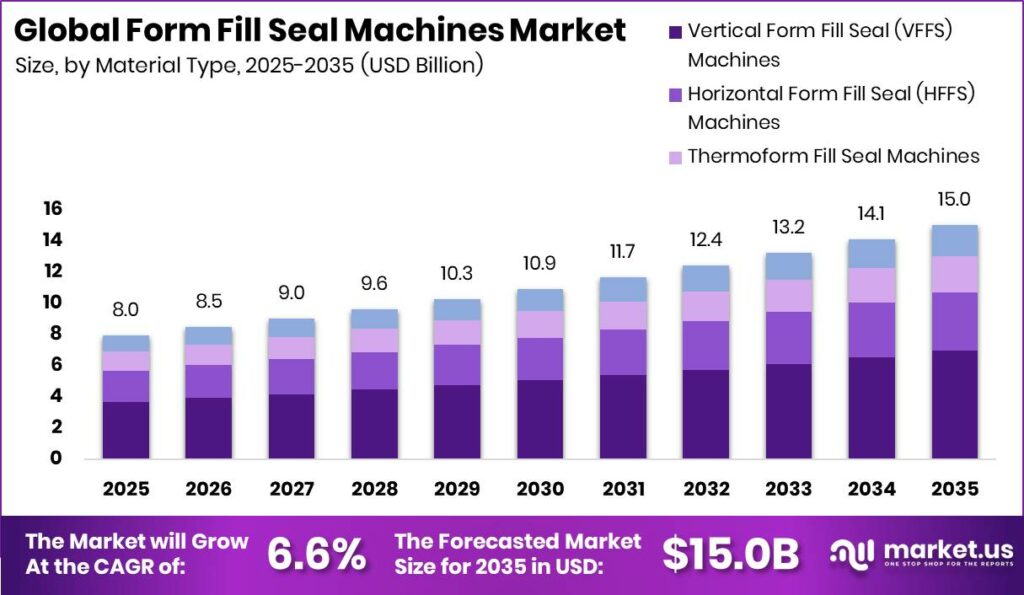
Global Form Fill Seal Machines Market size is expected to be worth around USD 15.00 Billion by 2035 from USD 8.00 Billion in 2025, growing at a CAGR of 6.6% during the forecast period 2026 to 2035. This growth reflects heavy factory automation spending across food, pharmaceutical, and chemical packaging lines. Manufacturers replacing manual stations with automated systems now anchor most new equipment orders worldwide.
Form fill seal machines form, fill, and seal packages in one continuous motion from a flat film reel. The market splits across vertical, horizontal, thermoform, and aseptic machine types serving Pouch Packaging Market formats such as pouches, sachets, and blister packs. This means buyers can match a single platform to solid, liquid, powder, or granule products across many industries.
Key Takeaways
- Global market reaches USD 15.00 Billion by 2035, up from USD 8.00 Billion in 2025 at a CAGR of 6.6%.
- Vertical Form Fill Seal (VFFS) Machines lead the machine type segment with a 46.20% share.
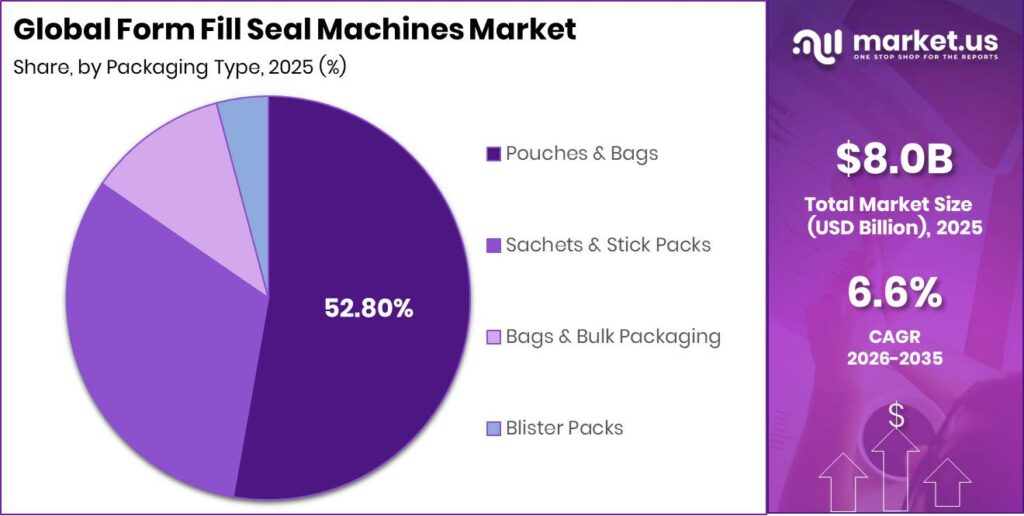
- Pouches & Bags dominate the packaging type segment with a 52.80% share.
- Fully Automatic Machines control the automation level segment with a 61.50% share.
- Food & Beverage leads end use with a 38.90% share.
- Direct Sales to OEMs and industrial buyers hold a 67.40% share of distribution.
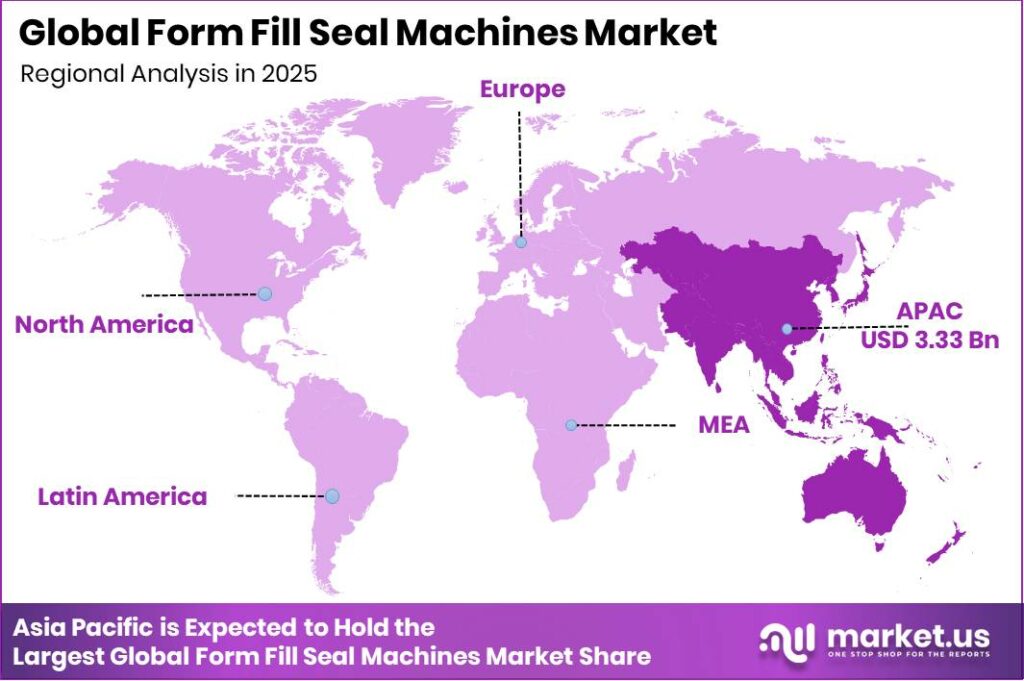
- Asia-Pacific leads all regions with a 41.80% share, valued at USD 3.33 Billion.
Government programs now shape demand across major consumption markets. India’s Production Linked Incentive scheme pushed food processors toward automated lines, lifting local packaging equipment orders. This means machine builders that align product roadmaps with subsidy timelines can capture procurement waves before competitors respond. Policy support therefore converts directly into new machine order volume for early suppliers.
Regulation in pharmaceuticals and packaging waste further steers buyer behavior. Stricter blister and pouch mandates force drug makers to install compliant sealing systems, expanding the addressable base. As a result, vendors offering serialization-ready and recyclable-film-capable machines gain a clear tender advantage. This creates a durable edge for suppliers who certify equipment ahead of enforcement deadlines.
As per our research, VFFS automation cuts packaging labor by over 60% in high-volume operations. This reduction lets processors scale output without adding headcount during expansion. Companies that delay automation therefore risk losing margin to faster, lower-cost rivals. Rising food and beverage output continues to pull machine demand upward across both mature and emerging plants.
Machine Type Analysis
Vertical Form Fill Seal (VFFS) Machines dominate with 46.20% due to compact footprint and fast throughput.
In 2025, Vertical Form Fill Seal (VFFS) Machines held a dominant market position in the By Machine Type segment of Form Fill Seal Machines Market, with a 46.20% share. UN Comtrade records classify most packaging machinery trade under HS code 842240, where global exports exceeded USD 7 Billion in recent reporting years. This means suppliers of vertical systems address the single largest and most tradable equipment category, supporting stable export-led revenue.
Horizontal Form Fill Seal (HFFS) Machines serve flat products, trays, and stand-up pouches that vertical systems handle less efficiently. ITC Trade Map data show packaging machinery imports rose across Asian manufacturing hubs in recent years. This signals steady replacement demand from processors upgrading multi-format lines. Vendors offering horizontal platforms therefore capture premium orders in ready-meal and personal care packaging.
Thermoform Fill Seal Machines form rigid or semi-rigid cavities from film before filling and sealing. World Bank industry indicators link rising processed-food output to higher demand for protective rigid packaging. This creates room for thermoform suppliers in chilled and medical packaging niches. Aseptic Form Fill Seal Machines complete the segment, serving sterile liquid dairy and pharmaceutical filling where hygiene standards command premium pricing.
Packaging Type Analysis
Pouches & Bags dominate with 52.80% due to lightweight format and material savings.
In 2025, Pouches & Bags held a dominant market position in the By Packaging Type segment of Form Fill Seal Machines Market, with a 52.80% share. FAO data link rising packaged-food consumption to expanding flexible packaging output in developing regions. This means machine builders geared toward pouch formats align with the fastest-adopting food packaging category, supporting long-run order stability.
Sachets & Stick Packs serve single-serve foods, condiments, and pharmaceuticals where portion control matters. UNIDO manufacturing statistics show single-serve packaging output climbing in emerging economies. This reflects buyer demand for low-cost, travel-friendly formats. Suppliers offering multi-lane sachet machines therefore win volume orders from high-throughput FMCG plants.
Bags & Bulk Packaging handles larger industrial quantities for chemicals, feed, and agricultural inputs. World Bank trade indicators tie agricultural output growth to demand for bulk fill and seal systems. This creates steady replacement demand in fertilizer and grain packaging. Blister Packs round out the segment, serving pharmaceutical unit-dose lines where regulatory mandates lock in sustained equipment demand.
Automation Level Analysis
Fully Automatic Machines dominate with 61.50% due to high output and low labor dependency.
In 2025, Fully Automatic Machines held a dominant market position in the By Automation Level segment of Form Fill Seal Machines Market, with a 61.50% share. World Bank labor-cost indicators show manufacturing wages rising steadily across major economies. This means processors adopt fully automatic lines to protect margins, cementing this segment as the primary revenue driver for OEMs.
Semi-Automatic Machines bridge manual and full automation for mid-scale producers with moderate volumes. IMF economic data show mid-tier manufacturers in developing markets expanding output steadily. This reflects a practical entry point for buyers not yet ready for full automation. Vendors offering upgradable semi-automatic units therefore capture first-time automation buyers who later trade up.
Manual Machines still serve micro-producers, pilot lines, and low-volume specialty runs. National statistical offices report large informal manufacturing bases across South Asia and Africa. This signals a long conversion runway for suppliers targeting entry-level buyers. As a result, machine builders offering low-cost manual units retain a foothold in price-sensitive segments.
End Use Industry Analysis
Food & Beverage dominates with 38.90% due to high-volume continuous packaging demand.
In 2025, Food & Beverage held a dominant market position in the By End Use Industry segment of Form Fill Seal Machines Market, with a 38.90% share. FAO food production indices show global processed-food output rising year after year. This means food processors remain the largest and most consistent buyers of fill and seal equipment, anchoring baseline demand for the whole market.
Pharmaceuticals require sterile, serialization-ready packaging under strict regulatory oversight. WTO trade statistics show pharmaceutical product trade expanding across major markets. This reflects rising demand for compliant blister and pouch machines. Suppliers certifying equipment to drug-safety standards therefore command premium pricing in this high-margin segment.
Chemicals & Fertilizers, Personal Care & Cosmetics, Industrial Goods, and Agriculture Products together hold the remaining share collectively. World Bank sector data link industrial and agricultural output growth to steady packaging equipment demand. This creates diversified order pipelines across non-food verticals. Machine builders serving multiple end uses therefore reduce dependence on any single cyclical industry.
Material Compatibility Analysis
Plastic Films dominate with 44.70% due to versatile sealing and low material cost.
In 2025, Plastic Films held a dominant market position in the By Material Compatibility segment of Form Fill Seal Machines Market, with a 44.70% share. UN Comtrade records show global plastics-in-primary-forms trade exceeding tens of billions of dollars annually. This means machines optimized for plastic film runnability serve the most widely traded packaging substrate, supporting broad buyer compatibility.
Paper-Based Packaging responds to recyclability mandates pushing brands toward fiber substrates. World Bank environmental policy trackers show rising regulation on single-use plastics across regions. This reflects a shift that rewards machines able to seal heat-sealable paper laminates. Vendors qualifying paper-ready sealing systems therefore capture sustainability-driven upgrade orders.
Aluminum Foils and Multi-Layer Laminates complete the segment, serving barrier-critical food and pharmaceutical products. UNIDO output data show high-barrier packaging demand rising with pharmaceutical manufacturing. This signals durable demand for machines handling foil and laminate structures. Suppliers offering flexible material handling therefore serve premium, high-margin packaging niches.
Filling Type Analysis
Solid Products Filling dominates with 41.30% due to broad food and confectionery use.
In 2025, Solid Products Filling held a dominant market position in the By Filling Type segment of Form Fill Seal Machines Market, with a 41.30% share. FAO consumption data show solid packaged foods forming the bulk of global processed-food volume. This means suppliers of solid-fill systems address the widest product base, supporting steady equipment demand across snack and confectionery lines.
Liquid Filling serves beverages, sauces, dairy, and liquid pharmaceuticals under strict hygiene needs. World Bank consumption indicators show packaged beverage volumes rising in emerging economies. This reflects strong demand for sealed liquid pouch and sachet systems. Vendors offering leak-proof liquid filling therefore win orders in fast-growing beverage categories.
Powder Filling and Granule Filling complete the segment, serving spices, dairy powders, fertilizers, and detergents. UNIDO industrial data show powder and granule product output expanding across chemical sectors. This creates dosing-accuracy demand that rewards precise auger and weigher systems. Machine builders offering exact fill control therefore protect margins in waste-sensitive applications.
Speed Capacity Analysis
Medium-Speed Machines dominate with 48.60% due to balanced output and cost efficiency.
In 2025, Medium-Speed Machines held a dominant market position in the By Speed Capacity segment of Form Fill Seal Machines Market, with a 48.60% share. IMF industrial output data show mid-scale processors forming the largest manufacturing tier globally. This means medium-speed systems match the volume needs of most buyers, supporting the broadest addressable equipment base.
High-Speed Machines serve large processors needing maximum output per line. World Bank manufacturing indicators show high-volume food plants expanding capacity steadily. This reflects demand for systems that lower cost per pack at scale. Vendors offering high-speed platforms therefore capture premium orders from large multinational producers.
Low-Speed Machines serve small batches, specialty products, and pilot lines. National statistical offices report large small-enterprise manufacturing populations across developing regions. This signals a steady entry-level market for affordable, lower-throughput systems. As a result, suppliers targeting small producers retain a durable presence in price-sensitive segments.
Distribution Channel Analysis
Direct Sales dominate with 67.40% due to complex machine specification and installation needs.
In 2025, Direct Sales to OEMs and industrial buyers held a dominant market position in the By Distribution Channel segment of Form Fill Seal Machines Market, with a 67.40% share. WTO trade statistics show capital machinery moving largely through direct manufacturer-to-buyer channels. This means OEMs controlling direct relationships capture the bulk of high-value orders and long-term service revenue.
Distributors & System Integrators serve buyers needing local support, integration, and financing. ITC Trade Map data show intermediary machinery trade active across regional markets. This reflects demand for partners who bundle installation and after-sales service. Vendors building strong integrator networks therefore extend reach into markets they cannot serve directly.
Online Industrial Platforms handle smaller, standardized machine sales for entry-level buyers. World Bank digital-economy indicators show industrial e-commerce expanding across regions. This signals a low-cost channel for reaching first-time and small-scale purchasers. As a result, suppliers listing standard units online capture price-sensitive buyers efficiently.
Key Market Segments
By Machine Type
- Vertical Form Fill Seal (VFFS) Machines
- Horizontal Form Fill Seal (HFFS) Machines
- Thermoform Fill Seal Machines
- Aseptic Form Fill Seal Machines
By Packaging Type
- Pouches & Bags
- Sachets & Stick Packs
- Bags & Bulk Packaging
- Blister Packs
By Automation Level
- Fully Automatic Machines
- Semi-Automatic Machines
- Manual Machines
By End Use Industry
- Food & Beverage
- Pharmaceuticals
- Chemicals & Fertilizers
- Personal Care & Cosmetics
- Industrial Goods
- Agriculture Products
By Material Compatibility
- Plastic Films
- Paper-Based Packaging
- Aluminum Foils
- Multi-Layer Laminates
By Filling Type
- Solid Products Filling
- Liquid Filling
- Powder Filling
- Granule Filling
By Speed Capacity
- Medium-Speed Machines
- High-Speed Machines
- Low-Speed Machines
By Distribution Channel
- Direct Sales (OEMs & Industrial Buyers)
- Distributors & System Integrators
- Online Industrial Platforms
Regional Analysis
Asia Pacific Dominates the Form Fill Seal Machines Market with a Market Share of 41.80%, Valued at USD 3.33 Billion
Asia Pacific leads the market with a 41.80% share, valued at USD 3.33 Billion in 2025. Large food processing bases in China and India drive this dominance through heavy automation investment. This means suppliers prioritizing regional service and financing capture the largest pool of new machine orders. Rising packaged-food output across the region continues to pull equipment demand upward.
North America ranks as a fast-growing region backed by strong food and pharmaceutical automation spending. In August 2025, Matrix Packaging Machinery introduced new VFFS systems at PACK EXPO 2025 with higher throughput for food packaging. This signals active vendor investment aimed at North American processors. As a result, buyers gain access to more flexible, higher-output platforms that accelerate line upgrades.
Europe, Latin America, and the Middle East and Africa hold the remaining share collectively. European buyers upgrade equipment to meet recyclable-film and packaging-waste rules. This creates steady retrofit and replacement demand across mature plants. By contrast, Latin America and MEA offer conversion potential as manual lines shift toward automated fill and seal systems.
Key Regions and Countries
North America
- US
- Canada
Europe
- Germany
- France
- The UK
- Spain
- Italy
- Rest of Europe
Asia Pacific
- China
- Japan
- South Korea
- India
- Australia
- Rest of APAC
Latin America
- Brazil
- Mexico
- Rest of Latin America
Middle East and Africa
- GCC
- South Africa
- Rest of MEA
Market Dynamics
Market Opportunity Analysis - Underserved automation tiers and emerging regions offer entry points for new players
Semi-Automatic Machines mark an underexploited tier between manual and full automation. This segment sits below Fully Automatic systems that hold 61.50% of the automation market, leaving mid-scale processors underserved. This means vendors offering upgradable semi-automatic units can capture first-time automation buyers. New entrants building clear upgrade paths therefore convert cautious buyers into future full-automation customers.
Online Industrial Platforms remain a thin slice of the distribution mix behind Direct Sales at 67.40%. This channel reaches small buyers that field-sales teams cannot serve profitably. This creates a low-cost route for suppliers selling standardized entry-level machines. Instead of chasing large tenders, agile players can scale volume through digital catalogs and remote support.
Latin America and the Middle East and Africa sit outside Asia Pacific’s leading 41.80% regional share. These regions still run many manual packaging lines awaiting conversion. This signals a long runway for suppliers offering affordable, service-backed systems. Early movers building local support networks therefore lock in share before larger OEMs commit.
Paper-Based Packaging trails Plastic Films, which hold 44.70% of the material segment. Recyclability rules push brands toward fiber substrates that older machines struggle to seal. This creates a niche for vendors qualifying paper-ready sealing systems early. New players specializing in sustainable material handling therefore claim a defensible position ahead of mass adoption.
Technology and Innovation Landscape - Automation, dosing precision, and energy efficiency redefine competitive edges
Servo-driven control now anchors modern FFS machine design. As per our research, servo motors cut energy use up to 20% versus pneumatic systems while sharpening seal timing. High-efficiency IE4 and IE5 motors add 20 to 40% energy savings on packaging lines. This means buyers lower cost per pack, giving vendors with efficient drives a clear procurement advantage.
Precision dosing systems drive quality gains across food lines. As per our research, auger fillers reach ±1 to 2% accuracy for powders, while multihead weighers hit ±0.5 to 1.0 grams for snacks. One documented line ran 150 packs per minute at a 0.5% error rate with one operator. This creates strong labor and waste savings that reward buyers choosing precision-first machines.
Quick-changeover design reshapes multi-SKU productivity. As per our research, toolless BVC series systems cut changeover time 40 to 60%, and one snack maker lifted OEE from 65% to 89%. Uptime exceeded 98% with MTBF above 720 hours. This means faster format switching directly raises throughput, giving flexible-line vendors an edge in FMCG tenders.
AI predictive maintenance emerges as the next monetization layer. As per our research, pilot programs on FFS lines cut unplanned downtime 50% and maintenance costs 20%. VFFS ROI payback now ranges from 6 to 18 months depending on volume. This signals a recurring software revenue stream for OEMs digitizing their installed machine base.
Drivers
Food and beverage automation investment pushes high-speed FFS machine procurement forward. Labor costs in North American and European food plants rose 8 to 18% yearly between 2022 and 2025, forcing processors to automate. VFFS machines running 60 to 200 bags per minute have become the default specification for new plant projects above USD 15 million. This means machine builders tie order volume directly to elevated food plant CapEx cycles.
US food and beverage plant construction spending topped USD 14 Billion in 2024, the highest in over a decade. This shift moved buyers from single-machine purchases to fleet agreements covering 5 to 15 machines per site. As a result, OEMs lifted framework contract values 18 to 25% and raised aftermarket service margins to 55 to 68%. This creates predictable recurring revenue and higher switching costs for suppliers.
| Driver | (~) % Impact on CAGR Forecast | Geographic Relevance | Impact Timeline |
|---|---|---|---|
| Food & Beverage Industry Automation Investment Driving High-Speed FFS Machine Procurement | +2.1% | Global, led by North America, Western Europe, China, India, Southeast Asia | Short term (≤ 2 years) |
| Pharmaceutical Blister & Pouch Packaging Regulatory Mandates Accelerating FFS Adoption | +1.5% | United States, European Union, India, Japan, South Korea | Short term (≤ 2 years) |
| E-Commerce & FMCG SKU Proliferation Demanding Flexible Multi-Format FFS Capability | +1.1% | United States, China, India, Europe, Southeast Asia | Short term (≤ 2 years) |
| Sustainability-Driven Transition to Mono-Material & Recyclable Film Substrates Requiring Machine Upgrades | +0.8% | European Union, United Kingdom, North America, Australia, Japan | Medium term (2–4 years) |
| Rising Labor Cost & Workforce Availability Pressures Compelling Packaging Automation in Emerging Markets | +0.5% | India, Southeast Asia, Latin America, Eastern Europe, Middle East | Medium term (2–4 years) |
Restraints
High capital cost limits FFS adoption among SMEs and emerging-market buyers. A mid-range VFFS system retails at EUR 180,000 to 450,000 in Europe and USD 120,000 to 280,000 for Asian equivalents, while full lines reach EUR 600,000 to 1.2 million. This threshold excludes most SMEs in India, Vietnam, and Colombia, who budget only USD 20,000 to 80,000 per facility. This means OEMs face a hard cap on addressable unit volume in fast-growing regions.
Financing costs deepen the barrier for smaller buyers. SME machinery loans in Tier-2 Indian and Southeast Asian cities carry 12 to 18% annual rates, turning a USD 150,000 machine into a USD 220,000 to 260,000 repayment. This eliminates the labor-savings case for plants running under 2 shifts daily. As a result, 78 to 85% of establishments stay on manual lines, leaving conversion locked without new financing models.
| Restraint | (~) % Impact on CAGR Forecast | Geographic Relevance | Impact Timeline |
|---|---|---|---|
| High Capital Acquisition Cost of Advanced FFS Systems Limiting SME & Emerging-Market Uptake | -1.8% | India (SME food processors), Southeast Asia, Sub-Saharan Africa, Latin America, Eastern Europe | Short term (≤ 2 years) |
| U.S.–China Trade Tariffs Disrupting Machine Component Supply Chains & Raising Equipment Costs | -1.1% | United States manufacturers & buyers; China-origin FFS machine exporters | Short term (≤ 2 years) |
| Stringent CE / FDA Machinery Safety & Hygienic Design Compliance Extending Time-to-Market | -0.6% | European Union, United States, Canada, Japan, Australia | Medium term (2–4 years) |
| Extended Lead Times for Critical Servo Drive & Control System Components | -0.4% | Global; acute for mid-tier manufacturers dependent on European & Japanese servo suppliers | Short term (≤ 2 years) |
| Currency Volatility Compressing Export Revenue for European & Japanese OEMs | -0.2% | Germany, Italy, Japan — primary FFS machine exporting nations | Short term (≤ 2 years) |
Challenges
Recyclable and mono-material films create runnability problems on existing FFS lines. Mono-material PE films hold a narrow seal temperature window of about ±3 to 5°C versus ±8 to 12°C for conventional laminates. On lines running 100 to 180 bags per minute, small temperature drift raises seal failure rates to 3 to 8% against 0.5 to 1.5% on older films. This means downtime costs food makers USD 800 to 2,500 per hour per line.
These material shifts force costly machine redesign for OEMs. Qualifying a new sealing platform costs an estimated EUR 500,000 to 2 million per machine design. Each distinct film formulation adds 6 to 12 months of validation before compatibility guarantees are possible. This creates a strong aftermarket revenue stream for suppliers selling upgraded controllers and sealing jaws to buyers meeting recyclability rules.
| Challenge | (~) % CAGR Friction Drag | Geographic Relevance | Mitigation Horizon |
|---|---|---|---|
| Recyclable & Mono-Material Film Runnability Issues | -0.9% | European Union, United Kingdom, North America, Australia | Medium term (2–4 years) |
| Servo & PLC Component Supply Concentration Risk | -0.6% | Global; critical for mid-tier OEMs dependent on 1–2 Tier-1 automation suppliers | Medium term (2–4 years) |
| Skilled Maintenance Technician Shortage | -0.5% | United States, Germany, India, Southeast Asia | Long term (≥ 4 years) |
| OEM Aftermarket Fragmentation & Spare Parts Piracy | -0.4% | India, China, Southeast Asia, Middle East, Africa | Long term (≥ 4 years) |
| Rapid Format Changeover Complexity for Multi-SKU Lines | -0.3% | Global, most acute for FMCG & personal care multi-format packaging operations | Medium term (2–4 years) |
Opportunities
Equipment-as-a-Service opens the SME market that upfront pricing blocks. OEMs can retain machine ownership and charge USD 1,500 to 4,500 monthly for a mid-range VFFS system covering maintenance and diagnostics. An SME paying USD 2,500 monthly avoids a USD 180,000 outlay while cutting packaging cost per unit 15 to 30% above 500,000 packs monthly. This means vendors unlock buyers previously priced out of automation.
The subscription model reshapes lifetime revenue for machine builders. A single 6-year contract returns roughly USD 180,000 in subscription plus USD 40,000 to 80,000 in parts and service. This lifts total lifecycle revenue per machine 22 to 44% and shifts margin toward the 55 to 70% service tier. This signals a clear first-mover window through 2026 to 2030 for OEMs willing to finance assets on their books.
| Opportunity | (~) % Potential CAGR Upside | Geographic Relevance | Execution Window |
|---|---|---|---|
| Equipment-as-a-Service (EaaS) & Machine Subscription Model for SME Market Penetration | +1.5% | India, Southeast Asia, Latin America, Eastern Europe, Sub-Saharan Africa | Medium term (2–4 years) |
| AI-Driven Predictive Maintenance & Digital Twin Platform Monetization on Installed FFS Base | +1.1% | United States, Germany, Japan, South Korea, China | Medium term (2–4 years) |
| Pharmaceutical Unit-Dose & Serialization-Compliant FFS Segment Expansion | +0.8% | United States, EU, India, Japan, Brazil | Medium term (2–4 years) |
| Retrofit & Upgrade Market for Existing FFS Installed Base to Mono-Material Film Compatibility | +0.5% | European Union, United Kingdom, Australia, North America | Short term (≤ 2 years) |
| Autonomous & Lights-Out FFS Line Development for Hyperautomated Fulfillment Centers | +0.3% | United States, Germany, Japan, China | Long term (≥ 4 years) |
Key Company Insights
Syntegon Technology GmbH holds a structural advantage through its deep pharmaceutical and food packaging engineering base. Its focus on regulated blister and pouch systems positions it for serialization-driven demand across the US, EU, and Japan. This creates a durable edge in high-margin drug packaging tenders. However, its premium pricing limits reach into price-sensitive SME segments where lower-cost Asian machines increasingly compete.
IMA Group builds strength through a broad processing and packaging portfolio spanning food and pharmaceutical lines. Its automated systems let a single operator manage 15 to 120 packages per minute, cutting labor dependency sharply. This creates a clear efficiency pitch for high-volume buyers upgrading manual lines. However, heavy exposure to European currency swings can compress export margins during volatile exchange-rate periods.
Key Players
- Syntegon Technology GmbH
- IMA Group
- ProMach Inc.
- Coesia S.p.A.
- Bosch Packaging Technology
- Tetra Pak International S.A.
- ULMA Packaging
- Multivac Group
- Robert Bosch GmbH
- Krones AG
- Barry-Wehmiller Companies, Inc.
- Paxiom Group
- Nichrome India Ltd.
- Matrix Packaging Machinery
- Fuji Machinery Co., Ltd.
Recent Developments
- December 2025: ProMach acquired DFT Technology GmbH, expanding its processing and packaging portfolio with advanced thermal food processing technologies that complement its form fill seal machine business.
- April 2025: BW Flexible Systems launched the upgraded Hayssen R300 horizontal form fill seal machine equipped with the OpView HMI, providing improved operator interface, diagnostics, and production control.
Geopolitical Impact Analysis
According to the WTO, tariff tensions between major economies continue to reshape FFS machine component flows. Recent US tariff measures raised duties on many imported industrial goods, with some machinery categories facing rates above 25%. This means US buyers sourcing servo drives and controls from Asian suppliers absorb higher landed costs. As a result, OEMs reroute component sourcing toward domestic and allied suppliers to protect delivery timelines and pricing.
Figures from the World Shipping Council show that Red Sea rerouting extended many Asia-to-Europe transit times by 10 to 14 days, raising freight costs sharply. IEA data show energy price swings lifting film and resin input costs, key raw materials for FFS packaging substrates. This creates margin pressure for European OEMs importing steel and electronic parts. Consequently, buyers face longer machine lead times and higher quotes on new equipment orders.
Report Scope
| Report Features | Description |
|---|---|
| Market Value (2025) | USD 8.00 Billion |
| Forecast Revenue (2035) | USD 15.00 Billion |
| CAGR (2026-2035) | 6.6% |
| Base Year for Estimation | 2025 |
| Historic Period | 2020-2024 |
| Forecast Period | 2026-2035 |
| Report Coverage | Revenue Forecast, Market Dynamics, Market Opportunity Analysis, Technology and Innovation Landscape, Competitive Landscape, Recent Developments |
| Segments Covered | By Machine Type (Vertical Form Fill Seal (VFFS) Machines, Horizontal Form Fill Seal (HFFS) Machines, Thermoform Fill Seal Machines, Aseptic Form Fill Seal Machines), By Packaging Type (Pouches & Bags, Sachets & Stick Packs, Bags & Bulk Packaging, Blister Packs), By Automation Level (Fully Automatic Machines, Semi-Automatic Machines, Manual Machines), By End Use Industry (Food & Beverage, Pharmaceuticals, Chemicals & Fertilizers, Personal Care & Cosmetics, Industrial Goods, Agriculture Products), By Material Compatibility (Plastic Films, Paper-Based Packaging, Aluminum Foils, Multi-Layer Laminates), By Filling Type (Solid Products Filling, Liquid Filling, Powder Filling, Granule Filling), By Speed Capacity (Medium-Speed Machines, High-Speed Machines, Low-Speed Machines), By Distribution Channel (Direct Sales (OEMs & Industrial Buyers), Distributors & System Integrators, Online Industrial Platforms) |
| Regional Analysis | North America (US and Canada), Europe (Germany, France, The UK, Spain, Italy, and Rest of Europe), Asia Pacific (China, Japan, South Korea, India, Australia, and Rest of APAC), Latin America (Brazil, Mexico, and Rest of Latin America), Middle East and Africa (GCC, South Africa, and Rest of MEA) |
| Competitive Landscape | Syntegon Technology GmbH, IMA Group, ProMach Inc., Coesia S.p.A., Bosch Packaging Technology, Tetra Pak International S.A., ULMA Packaging, Multivac Group, Robert Bosch GmbH, Krones AG, Barry-Wehmiller Companies, Inc., Paxiom Group, Nichrome India Ltd., Matrix Packaging Machinery, Fuji Machinery Co., Ltd. |
| Customization Scope | Customization for segments, region / country-level will be provided. Additional customization can be done based on requirements. |
| Purchase Options | We have three licenses to opt for: Single User License | Multi-User License (Up to 5 Users) | Corporate Use License (Unlimited User and Printable PDF) |





































