


Report Overview
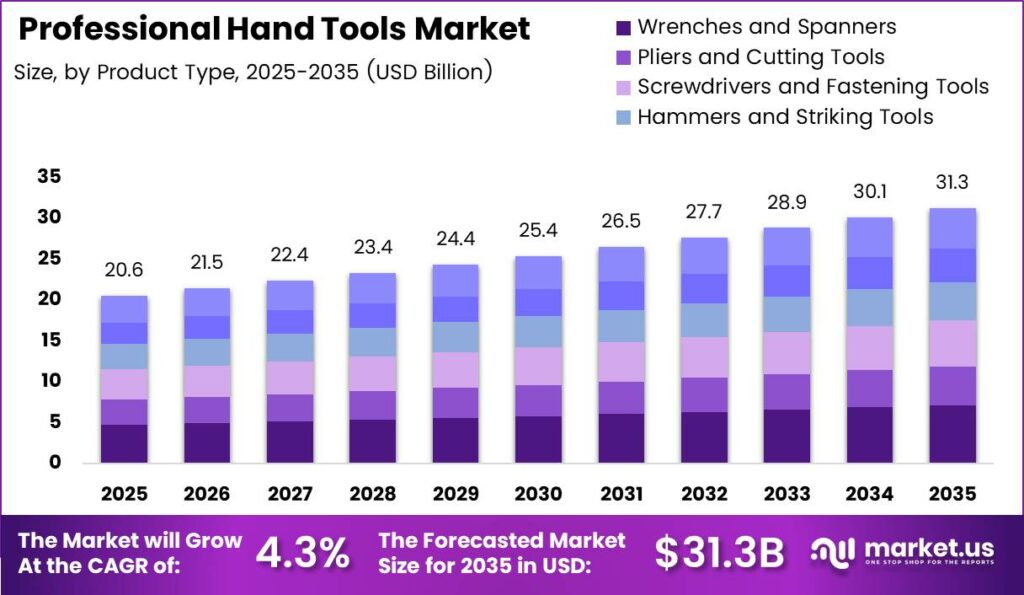
Global Professional Hand Tools Market size is expected to be worth around USD 31.3 Billion by 2035 from USD 20.6 Billion in 2025, growing at a CAGR of 4.3% during the forecast period 2026 to 2035. This trajectory reflects sustained demand across industrial, construction, and field-service trades worldwide.
The professional hand tools market encompasses manually operated, non-powered instruments used in skilled trades and industrial environments. Product categories span wrenches, pliers, screwdrivers, hammers, sockets, and precision measuring tools. End-use industries include automotive, construction, manufacturing, electrical, plumbing, and woodworking. This breadth of application creates a structurally diverse revenue base for suppliers and distributors.
Key Takeaways
- The global Professional Hand Tools Market was valued at USD 20.6 Billion in 2025 and is forecast to reach USD 31.3 Billion by 2035.
- The market is growing at a CAGR of 4.3% during the forecast period 2026 to 2035.
- Wrenches and Spanners dominate the Product Type segment with a 20.3% share.
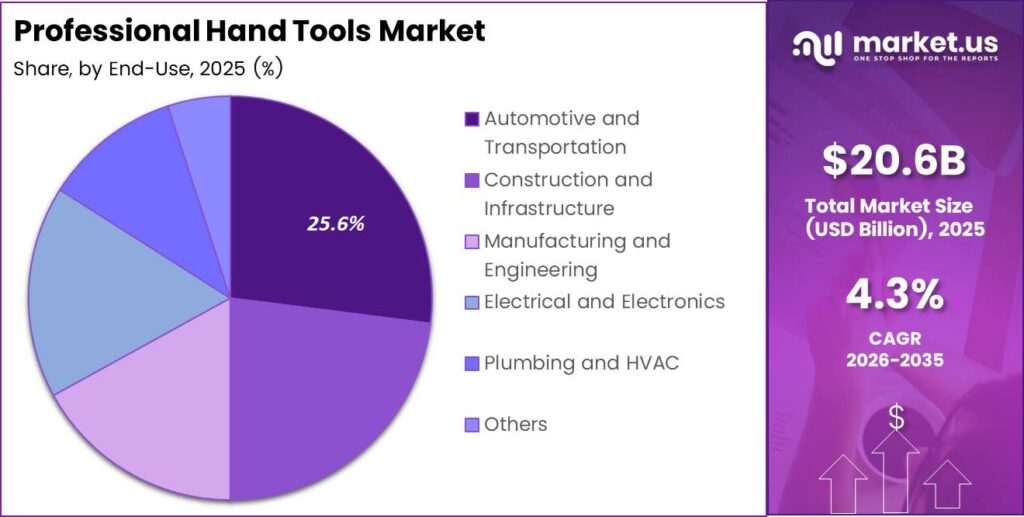
- Automotive and Transportation leads the End-Use Industry segment with a 25.4% share.
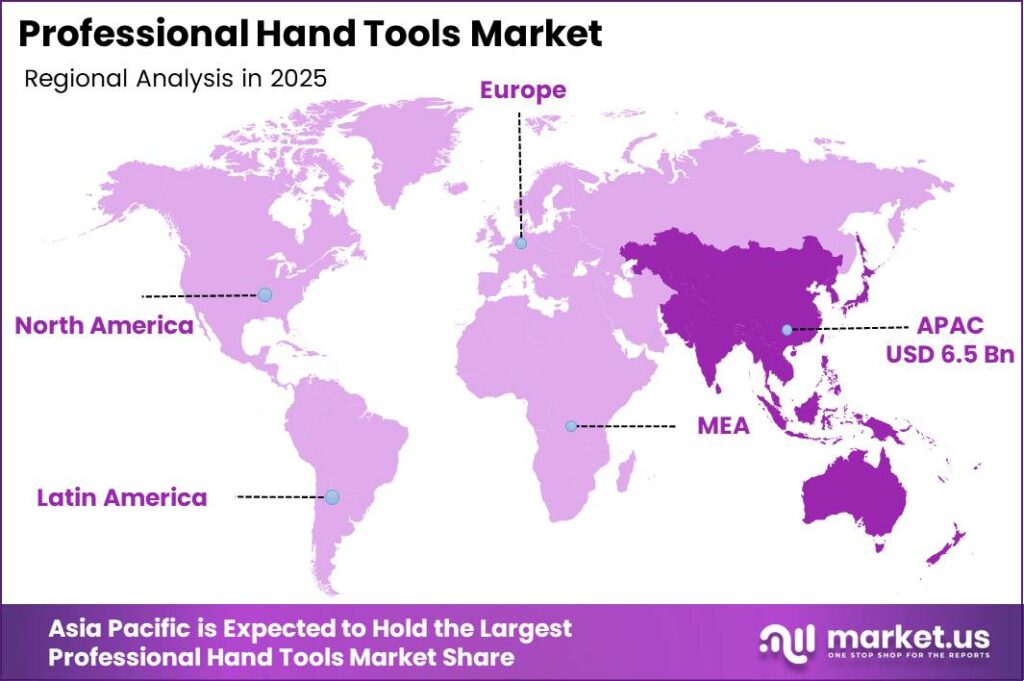
- Asia Pacific is the dominant region, holding a 32.2% market share valued at USD 6.5 Billion.
Regulatory frameworks are tightening requirements for certified tooling in energized work environments. As per our research, NFPA 70E mandates insulated hand tools across PPE Categories 1 through 4, covering arc-flash exposure levels from 4 cal/cm² to 40 cal/cm². This compliance requirement expands the addressable market for premium insulated tool lines in electrical, utility, and industrial maintenance applications.
Based on Market.us data, ASTM F1505 and IEC 60900 require insulated tools rated for 1,000 V operation to withstand a 10,000 V proof test, establishing a 10:1 safety factor. Vendors that certify to these standards access a differentiated premium tier with lower price sensitivity. In December 2025, Stanley Black & Decker agreed to sell its Consolidated Aerospace Manufacturing business to Howmet Aerospace for approximately $1.8 Billion, signaling a deliberate portfolio refocus toward core tools.
Product Type Analysis
Wrenches and Spanners dominate with 20.3% due to broad torque-critical industrial and automotive use.
In 2025, Wrenches and Spanners held a dominant market position in the By Product Type segment of the Professional Hand Tools Market, with a 20.3% share. Torque-critical assembly tasks in automotive, manufacturing, and maintenance operations drive consistent replacement demand. In 2026, Milwaukee Tool expanded its professional wrench portfolio through new launches across ratchets, sockets, and wrenches, reinforcing competitive activity in this category.
Pliers and Cutting Tools represent the second-largest category by functional breadth across electrical, plumbing, and general mechanical trades. The Plumbing and Mechanical 2025 contractor survey found that the majority of plumbing and mechanical service technicians still rely primarily on traditional hand tools despite increasing adoption of cordless and digital technologies. This behavior confirms that pliers and cutting tools maintain deep penetration in established contractor workflows.
Screwdrivers and Fastening Tools serve the highest-volume segment of field assembly and installation work. Market.us data indicates that ASTM F1505-16 (2026) requires insulated screwdrivers designed for energized work to carry five permanent compliance markings and withstand a 10,000 V proof test. This standard elevates the minimum specification bar, which pushes buyers toward certified premium products over commodity alternatives.
Hammers and Striking Tools, Measuring and Layout Tools, Sockets and Ratchets, and Cutting and Sawing Tools collectively hold the remaining share. A 2025 On The Tools survey found that 86% of UK tradespeople worry about tool theft, with 58% worrying daily. This security concern directly affects procurement behavior and creates demand for tracked, asset-managed tool kits across all these sub-segments.
End-Use Industry Analysis
Automotive and Transportation dominates with 25.4% due to complex vehicle-servicing and assembly torque requirements.
In 2025, Automotive and Transportation held a dominant market position in the By End-Use Industry segment of the Professional Hand Tools Market, with a 25.4% share. Precision torque control requirements in both OEM assembly and aftermarket service environments drive consistent demand for calibrated wrenches, sockets, and fastening tools. This segment rewards vendors offering certified accuracy over generic alternatives.
Construction and Infrastructure represents the second-largest end-use segment based on sustained project volumes across residential, commercial, and public works categories. A 2025 RFID tool-tracking case study reported that Holt CAT achieved payback on its initial USD 76,000 RFID tool-management investment in less than 8 months through improved tool visibility and inventory control. This result demonstrates that construction buyers are willing to invest in tool management systems when the operational payback is measurable.
Manufacturing and Engineering drives demand for precision measuring tools, socket sets, and fastening equipment across assembly lines and maintenance operations. The adoption of IoT-enabled inventory tracking in manufacturing facilities is shifting procurement away from unit purchasing toward managed tool programs. Vendors that offer calibration traceability alongside product supply gain a structural advantage in this segment.
Electrical and Electronics, Plumbing and HVAC, Woodworking and Carpentry, and other end-use industries account for the remaining market share. Each sector carries distinct tool specification requirements tied to trade safety standards and material compatibility rules. Suppliers serving multiple verticals with certified, segment-specific SKUs reduce channel dependency and improve margin resilience.
Key Market Segments
By Product Type
- Wrenches and Spanners
- Pliers and Cutting Tools
- Screwdrivers and Fastening Tools
- Hammers and Striking Tools
- Measuring and Layout Tools
- Sockets and Ratchets
- Cutting and Sawing Tools
- Others
By End-Use Industry
- Automotive and Transportation
- Construction and Infrastructure
- Manufacturing and Engineering
- Electrical and Electronics
- Plumbing and HVAC
- Woodworking and Carpentry
- Others
Regional Analysis
Asia Pacific Dominates the Professional Hand Tools Market with a Market Share of 32.2%, Valued at USD 6.5 Billion
Asia Pacific holds the largest regional share at 32.2%, valued at USD 6.5 Billion in 2025. The region’s dominance reflects its scale in manufacturing, automotive production, and infrastructure construction. China, Japan, South Korea, and India collectively generate the region’s tool consumption base. Supply-side concentration in China also positions APAC as the world’s primary production and export hub for professional hand tools.
North America represents a structurally mature market driven by high trade-labor density, strong safety compliance requirements, and a large automotive aftermarket. In August 2025, Milwaukee Tool introduced more than 100 new tools through its Pipeline 2025 launch program, targeting electrical installation and productivity solutions for professional trades. This level of product investment reflects a market where vendor innovation, not price alone, drives purchasing decisions among professional buyers.
Europe benefits from strict workplace safety regulations under EU directives and active enforcement of insulated tool standards. Wage inflation in precision metalworking of 4 to 7% per annum since 2022 has raised manufacturing costs for European hand tool producers. This pressure accelerates consolidation toward premium certified products where higher margins justify the cost structure, narrowing the competitive field for price-sensitive entrants.
Latin America presents an expanding demand base tied to manufacturing investment in Mexico and infrastructure projects across Brazil. Channel fragmentation across informal trade networks remains a structural barrier for premium brand penetration. Vendors that invest in distributor development and segment-specific certified tool kits will gain early mover advantage as formalization of the trades workforce continues.
Middle East and Africa is driven by large-scale infrastructure and energy project pipelines across the GCC. Demand concentrates in construction, oil and gas maintenance, and utilities. Premium tool vendors that meet international certifications and offer distributor support programs are better positioned than commodity suppliers in this project-driven buying environment.
Key Regions and Countries
North America
- US
- Canada
Europe
- Germany
- France
- The UK
- Spain
- Italy
- Rest of Europe
Asia Pacific
- China
- Japan
- South Korea
- India
- Australia
- Rest of APAC
Latin America
- Brazil
- Mexico
- Rest of Latin America
Middle East and Africa
- GCC
- South Africa
- Rest of MEA
Drivers
Sustained on-site labor intensity in construction, infrastructure maintenance, utilities, and installation trades provides the strongest near-term demand support for professional hand tools. U.S. construction spending reached a seasonally adjusted annual rate of USD 2.17 Trillion in April 2026, with highway spending at USD 149.6 Billion and public construction at USD 532.7 Billion. This operating backdrop accelerates replacement cycles for pliers, wrenches, striking tools, and fastening accessories, especially in contractor fleets where downtime costs outweigh unit purchase price.
EU total market production in December 2025 recorded a 1.2% monthly gain in construction, confirming that field-work activity remains a durable volume engine even when broader industrial output is uneven. This driver can reasonably add approximately 1.6 percentage points to baseline CAGR growth through 2028. Vendors that prioritize high-availability SKUs, jobsite durability, and distributor fill rates over pure price competition are best positioned to capture this volume.
| Driver | (~) % Impact on CAGR Forecast | Geographic Relevance | Impact Timeline |
|---|---|---|---|
| Infrastructure and field-service work intensity lifting replacement cycles | +1.6% | North America core, EU public works, APAC urban corridors, Middle East project hubs | Short term (≤ 2 years) |
| Manufacturing localization and export-capacity buildout expanding industrial tool consumption | +1.3% | India, Southeast Asia, Mexico, U.S. industrial belt, Central Europe | Medium term (2-4 years) |
| Pro-channel resilience and omnichannel procurement improving sell-through | +1.0% | North America core, Western Europe, developed APAC | Short term (≤ 2 years) |
| Safety compliance tightening increasing premium ergonomics and certified-tool demand | +0.8% | U.S. construction and industrial sites, EU workplaces, regulated APAC factories | Short term (≤ 2 years) |
| Battery-serviceability and repair rules reinforcing modular hand-tool ecosystems | +0.7% | EU core, UK spill-over, premium global brands with Europe exposure | Medium term (2-4 years) |
| Auto aftermarket and light-vehicle service complexity raising mechanic-grade toolkit spend | +0.9% | North America, EU, Japan, South Korea, urban APAC workshops | Medium term (2-4 years) |
Restraints
A chronic scarcity of skilled machinists, tool and die makers, and CNC operators represents a structural cost constraint for professional hand tool manufacturers. Skilled metalworking labor can account for 20 to 30% of total manufacturing cost in precision-grade tools. In North America and Western Europe, wage inflation in precision metalworking has run at 4 to 7% per annum since 2022, while vacancy rates in some industrial clusters remain above 8 to 10%.
Plants are forced to operate at 5 to 15% below rated capacity or absorb overtime and temporary labor costs that raise unit labor cost per tool by 6 to 10%. Training a fully productive tool room technician requires 18 to 36 months, creating a structural lag in capacity ramp-up. These labor frictions are modeled to trim approximately 1.4 percentage points from otherwise achievable CAGR, as manufacturers under-deliver on lead time, customization, and new product introduction speed.
| Restraint | (~) % Impact on CAGR Forecast | Geographic Relevance | Impact Timeline |
|---|---|---|---|
| Volatile alloy & steel input costs | -1.9% | North America core, EU, APAC export hubs | Short to medium term |
| Tight skilled metalworking labor pools | -1.4% | North America, Western Europe, Japan, GCC | Medium to long term |
| Channel destocking & trade down in construction | -1.6% | North America, EU, LATAM, selective APAC | Short term |
| China overcapacity, price wars & tariffs | -1.2% | North America, EU, ASEAN, India | Medium term |
| Regulatory tightening on workplace safety & materials | -0.9% | EU, UK, North America, advanced APAC | Medium to long term |
| Slow digital & ergonomic product migration by incumbents | -1.0% | Global tier-1 urban and industrial corridors | Long term |
Challenges
The professional hand tools market faces a persistent labor-pipeline challenge, as the number of sufficiently trained tradespeople is not expanding at the same rate as replacement and project demand. OECD reporting noted labor shortages as a production-limiting factor for 21.2% of employers in late 2022, compared to 6.4% in 2019. U.S.-linked construction data points to a gap of approximately 500,000 skilled workers, and JLL projects 2.1 Million unfilled U.S. skilled-trades roles by 2030 if current conditions persist.
For hand-tool suppliers, this translates into lower premium-mix conversion and longer replacement cycles as understaffed crews defer noncritical purchases. Market.us models this as a 1.3 percentage-point drag on achievable growth, driven by 10 to 15% lower upgrade intensity in labor-constrained contractor fleets. Vendors that invest in trade-school partnerships, contractor education modules, and service-led channel programs will convert accounts faster than those that compete on product alone.
| Challenge | (~) % CAGR Friction Drag | Geographic Relevance | Mitigation Horizon |
|---|---|---|---|
| Skilled trades pipeline erosion | -1.3% | North America core, Western Europe, GCC project markets | Long term (≥ 4 years) |
| Metal input cost turbulence | -1.0% | China, India, ASEAN manufacturing bases, EU importers | Medium term (2-4 years) |
| Multi-tier channel fragmentation | -0.8% | South Asia, Southeast Asia, LATAM, Africa trade corridors | Medium term (2-4 years) |
| Counterfeit quality dilution | -0.8% | India, Southeast Asia, Africa, informal LATAM markets | Long term (≥ 4 years) |
| Compliance upgrade burden | -0.7% | India, EU regulatory hubs, North America industrial buyers | Short term (≤ 2 years) |
| Low digital inventory visibility | -0.6% | Global SME distributor networks | Medium term (2-4 years) |
Opportunities
The migration from one-time professional hand tool sales toward managed supply contracts represents a material upside opportunity. U.S. construction spending reached a seasonally adjusted annual rate of USD 2.17 Trillion in April 2026, including USD 729.8 Billion in nonresidential activity and USD 185.7 Billion in manufacturing construction. This installed base of industrial and contractor buyers increasingly values uptime, procurement efficiency, and inventory certainty over unit price alone.
Suppliers that convert even a low-single-digit share of large contractor or plant-maintenance accounts into service-led contracts could see annual revenue per account rise by 10 to 15% through recurring replenishment, kit standardization, and reduced stockout penalties. Connected professional tool systems carry a potential CAGR upside of +1.7%, and formalizing emerging-market trades in India, Southeast Asia, MENA, and Latin America offers a further +2.0% upside. Early movers that build service infrastructure now will define the category terms before competitors scale.
| Opportunity | (~) % Potential CAGR Upside | Geographic Relevance | Execution Window |
|---|---|---|---|
| Service-led enterprise contracts | +1.3% | North America core, EU, Japan | Short term |
| Connected pro tool systems | +1.7% | North America, EU, Japan, Korea | Medium term |
| Formalizing emerging-market trades | +2.0% | India, Southeast Asia, MENA, LATAM | Medium term |
| Tool storage and workflow adjacencies | +1.1% | North America, EU, APAC urban | Short term |
| Direct digital pro channels | +1.5% | North America, EU, Australia | Short term |
| Refurbishment and lifecycle monetization | +0.9% | EU core, North America, Japan | Long term |
Key Company Insights
Snap-on Incorporated holds a strong position in calibrated industrial torque tools. Its TECHANGLE electronic torque wrenches are specified at ±2% clockwise and ±3% counterclockwise accuracy across 20 to 100% of full-scale capacity. In October 2025, Snap-on Industrial launched its Control Tech+ Electronic Torque Wrenches, targeting digital torque management and traceability in demanding industrial environments. This product positions Snap-on to capture the growing certified-accuracy segment.
Stanley Black and Decker operates the broadest portfolio among professional hand tool manufacturers, spanning contractor, industrial, and outdoor segments. Its adjustable industrial torque wrenches carry ±3% clockwise accuracy certification. The December 2025 sale of its Consolidated Aerospace Manufacturing business to Howmet Aerospace for USD 1.8 Billion sharpens focus on core tools. This divestiture signals a strategic commitment to the professional hand tools category and concentrates capital toward higher-margin core segments.
Key Players
- Stanley Black & Decker
- Snap-on Incorporated
- Bosch Tools
- Makita Corporation
- Hilti Group
- Apex Tool Group
- Klein Tools
- Channellock Inc.
- Wiha Tools
- Wera Tools
- Facom (part of Stanley)
- Irwin Tools
- Proto Industrial Tools
- Gedore Tools
- Knipex
- Hazet
- Other Key Players
Recent Developments
- July 2025 – KNIPEX launched its Summer 2025 product lineup targeting photovoltaic and electrical installation professionals, introducing the KNIPEX ErgoStrip PV, MultiCrimp PV, EvoStrip, ComStrip, additional Cobra ES sizes, and the DPT50 pipe cutter for thicker-walled plastic pipes.
- October 2025 – Stanley Black and Decker showcased new professional-grade DEWALT outdoor solutions and technologies at Equip Expo 2025, expanding its portfolio for professional contractors and landscape professionals.
- August 2025 – Milwaukee Tool introduced more than 100 new tools through its Pipeline 2025 launch program, including advanced electrical installation and productivity-focused solutions for professional trades.
Report Scope
| Report Features | Description |
|---|---|
| Market Value (2025) | USD 20.6 Billion |
| Forecast Revenue (2035) | USD 31.3 Billion |
| CAGR (2026-2035) | 4.3% |
| Base Year for Estimation | 2025 |
| Historic Period | 2020-2024 |
| Forecast Period | 2026-2035 |
| Report Coverage | Revenue Forecast, Market Dynamics, Market Opportunity Analysis, Technology and Innovation Landscape, Competitive Landscape, Recent Developments |
| Segments Covered | By Product Type (Wrenches and Spanners, Pliers and Cutting Tools, Screwdrivers and Fastening Tools, Hammers and Striking Tools, Measuring and Layout Tools, Sockets and Ratchets, Cutting and Sawing Tools, Others); By End-Use Industry (Automotive and Transportation, Construction and Infrastructure, Manufacturing and Engineering, Electrical and Electronics, Plumbing and HVAC, Woodworking and Carpentry, Others) |
| Regional Analysis | North America (US and Canada), Europe (Germany, France, The UK, Spain, Italy, and Rest of Europe), Asia Pacific (China, Japan, South Korea, India, Australia, and Rest of APAC), Latin America (Brazil, Mexico, and Rest of Latin America), Middle East and Africa (GCC, South Africa, and Rest of MEA) |
| Competitive Landscape | Stanley Black and Decker, Snap-on Incorporated, Bosch Tools, Makita Corporation, Hilti Group, Apex Tool Group, Klein Tools, Channellock Inc., Wiha Tools, Wera Tools, Facom (part of Stanley), Irwin Tools, Proto Industrial Tools, Gedore Tools, Knipex, Hazet, Other Key Players |
| Customization Scope | Customization for segments, region/country-level will be provided. Additional customization can be done based on requirements. |
| Purchase Options | We have three licenses to opt for: Single User License, Multi-User License (Up to 5 Users), Corporate Use License (Unlimited User and Printable PDF) |





































