


Report Overview
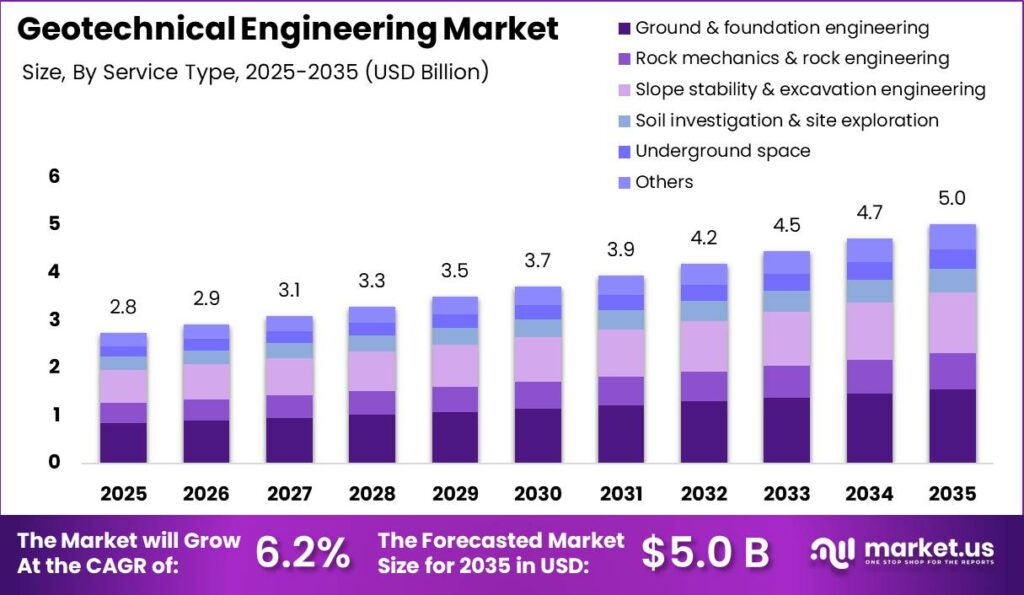
Global Geotechnical Engineering Market size is expected to be worth around USD 5.00 Billion by 2035 from USD 2.80 Billion in 2025, growing at a CAGR of 6.2% during the forecast period 2026 to 2035. This market supports the design and safety of built structures. Owners rely on it to reduce foundation risk before capital is committed.
Geotechnical engineering studies soil, rock, and groundwater to guide foundation and structural design. The market splits across service type, application, and end user categories. Firms deliver site investigation, laboratory testing, and advisory work. Therefore, demand tracks directly with the volume and scale of active construction and energy projects worldwide.
Key Takeaways
- Global market size reached USD 2.80 Billion in 2025 and heads toward USD 5.00 Billion by 2035.
- The market grows at a CAGR of 6.2% across the 2026 to 2035 forecast period.
- Ground and foundation engineering leads By Service Type with a 31.2% share.
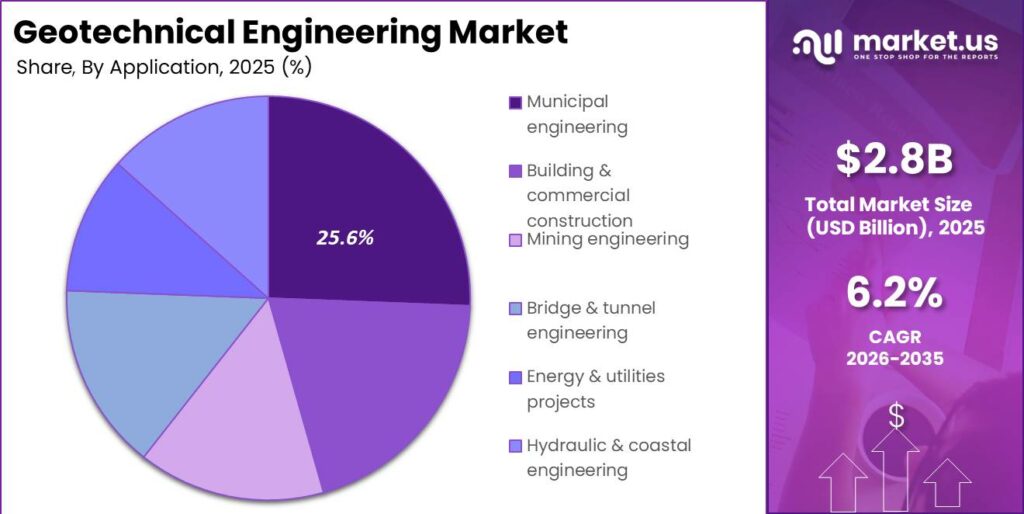
- Municipal engineering leads By Application with a 25.6% share.
- Government agencies and public works departments lead By End-User with a 23.6% share.
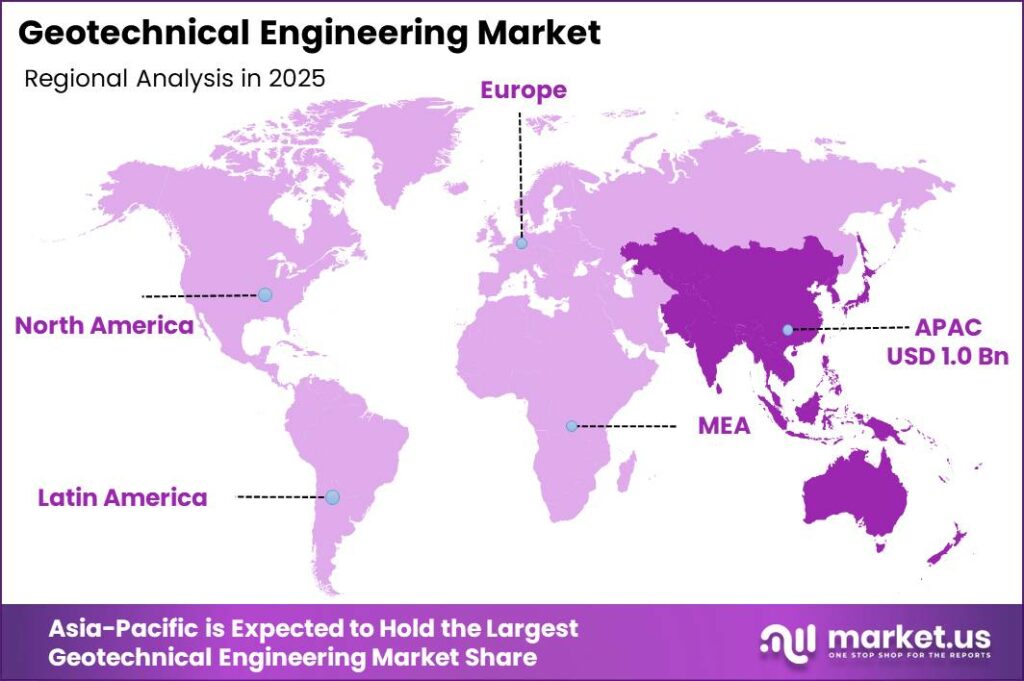
- Asia-Pacific dominates with a 35.6% share, valued at USD 1.00 Billion.
Construction Machinery demand feeds directly into geotechnical scoping, since heavy civil work triggers upfront investigation. Government spending anchors this market. Public bodies fund transport, water, and flood defense projects that require mandatory subsurface study. This means firms with public-sector credentials capture steady, budget-backed work that private cycles cannot easily disrupt.
As per our research, aging asset inventories push recurring geotechnical demand across mature economies. This creates a shift from one-off surveys toward retained advisory roles. In March 2026, Keller Group reported record 2025 results, with revenue rising to £3.1 Billion and underlying operating profit reaching £218.2 Million. This signals that scale players convert infrastructure demand into durable earnings.
As per our research, Keller Group operated in 2025 with around 10,000 employees across 5 continents and roughly 5,500 projects completed each year. This footprint spreads risk across many markets at once. As a result, large contractors absorb regional downturns better than single-country specialists competing for local tenders.
Service Type Analysis
Ground and foundation engineering dominates with 31.2% due to mandatory load-bearing design work.
In 2025, Ground and foundation engineering held a dominant market position in the By Service Type segment of Geotechnical Engineering Market, with a 31.2% share. Every structure needs verified bearing capacity before construction proceeds. The U.S. National Tunnel Inventory lists more than 500 public-road tunnels requiring ongoing geotechnical evaluation. This means foundation specialists secure repeat work tied to both new builds and asset maintenance.
Soil investigation and site exploration covers borehole drilling, cone penetration testing, and geophysical surveys before construction. Fugro’s new Jakarta laboratory increased Asia-Pacific testing capacity by 20% while cutting turnaround times by 30% through a 550 square metre facility with over 30 testing stations. This means faster reporting lets firms clear more projects and lift throughput without adding field crews.
Rock mechanics and rock engineering serves tunnels, dams, and deep excavations where rock behavior controls safety. Slope stability and excavation engineering protects sites against collapse during earthworks. Underground space engineering supports metro and utility corridors in dense cities. These specialized services, plus other niche categories, hold the remaining share collectively and command premium rates due to technical difficulty.
Application Analysis
Municipal engineering dominates with 25.6% due to constant public infrastructure investment cycles.
In 2025, Municipal engineering held a dominant market position in the By Application segment of Geotechnical Engineering Market, with a 25.6% share. Cities continuously renew roads, water systems, and drainage networks. The U.S. National Tunnel Inventory records more than 500 public-road tunnels needing routine inspection and geotechnical review. This means municipal budgets create a stable, recurring pipeline that shields firms from private-sector swings.
Building and commercial construction drives foundation and settlement analysis for offices, housing, and retail sites. Mining engineering demands slope and tailings assessment where ground failure carries severe cost. Bridge and tunnel engineering requires deep subsurface study before major spans proceed. This creates high-value engagements for firms holding heavy civil credentials and specialized testing equipment.
Energy and utilities projects need geotechnical work for substations, pipelines, and generation sites. Hydraulic and coastal engineering supports ports, dams, and flood defenses where water interacts with soil. These applications hold the remaining share collectively. This means firms serving energy and coastal owners tap fast-growing demand linked to power expansion and climate defense spending.
End-User Analysis
Government agencies dominate with 23.6% due to sustained public works funding mandates.
In 2025, Government agencies and public works departments held a dominant market position in the By End-User segment of Geotechnical Engineering Market, with a 23.6% share. Public bodies commission the largest transport and water programs. Statutory funding envelopes lock in multi-year work. This means firms with government framework contracts gain revenue visibility that private clients rarely provide across full project lifecycles.
Infrastructure developers and EPC contractors bundle geotechnical scopes into large design-build packages. Energy and utility companies commission subsurface study for grid and generation assets. Industrial and manufacturing firms need foundation work for plants and warehouses. This creates demand for firms that integrate investigation, design, and monitoring into single accountable engagements.
Mining and natural resources companies rely on slope and stability analysis to protect extraction sites and workers. Real estate and commercial developers require settlement studies before high-rise and mixed-use builds. These end users hold the remaining share collectively. This means diversified firms balance cyclical private demand against steady public and resource-sector contracts.
Key Market Segments
By Service Type
- Ground & foundation engineering
- Rock mechanics & rock engineering
- Slope stability & excavation engineering
- Soil investigation & site exploration
- Underground space
- Others
By Application
- Municipal engineering
- Building & commercial construction
- Mining engineering
- Bridge & tunnel engineering
- Energy & utilities projects
- Hydraulic & coastal engineering
By End-User
- Industrial & manufacturing firms
- Government agencies & public works departments
- Energy & utility companies
- Infrastructure developers & EPC contractors
- Mining & natural resources companies
- Real estate & commercial developers
Regional Analysis
Asia-Pacific Dominates the Geotechnical Engineering Market with a Market Share of 35.6%, Valued at USD 1.00 Billion
Asia-Pacific leads the market with a 35.6% share worth USD 1.00 Billion in 2025. Rapid urban growth across China and India fuels metro, road, and housing construction. Dense city development forces heavy subsurface study before building. This means firms serving Asia-Pacific owners tap the deepest project pipeline of any region worldwide.
North America grows quickly on the back of infrastructure renewal and offshore wind buildout. In September 2025, Fugro and Ørsted completed the first onshore deployment of Fugro’s patented Heat Flow Module CPT probe in Australia for offshore wind planning. This creates advisory demand for firms that master marine foundation and seabed investigation techniques.
Europe sustains steady demand through coastal defense and energy transition projects. The Middle East funds large urban and transport programs backed by public capital. Latin America and Africa add mining and resource-linked work. This means diversified firms balance mature-market renewal against emerging-market expansion for resilient revenue.
Key Regions and Countries
North America
- US
- Canada
Europe
- Germany
- France
- The UK
- Spain
- Italy
- Rest of Europe
Asia Pacific
- China
- Japan
- South Korea
- India
- Australia
- Rest of APAC
Latin America
- Brazil
- Mexico
- Rest of Latin America
Middle East and Africa
- GCC
- South Africa
- Rest of MEA
Market Dynamics
Market Opportunity Analysis - Underserved service tiers and lagging regions open room for focused new entrants
Soil investigation and site exploration remains underexploited despite feeding every downstream service. Many owners still treat it as a low-value commodity task. This means firms that pair fast turnaround with digital reporting can reposition it as a premium, decision-critical service. New entrants that lead here capture early client relationships before larger foundation specialists lock in the account.
Government agencies and public works departments hold a 23.6% share, yet fragmented local tenders leave room for regional specialists. This creates entry points for firms that build public-sector credentials in a single geography first. Therefore, focused challengers can win framework contracts that national giants overlook, then scale steadily across adjacent municipal markets.
Energy and utilities applications lag municipal work in service maturity despite rising demand from grid and offshore projects. This signals white space for firms mastering marine and seabed investigation. As a result, early movers in energy-linked geotechnics build scarce expertise that commands premium rates before competitors qualify their own crews.
North America grows faster than its current base suggests, driven by renewal and offshore wind. This means the region rewards firms that enter with specialized substructure advisory now. By contrast, waiting cedes ground to incumbents already deploying advanced CPT and monitoring tools across the eastern seaboard.
Technology and Innovation Landscape - Digital data platforms and advanced testing rigs reshape competitive edges
Advanced cone penetration testing redefines field productivity for offshore and deep-site work. Fugro’s Electric Deep Drive CPT system performs investigations to depths of 105 metres using a 110-metre continuous coil, eliminating repeated rod handling. This means firms adopting continuous-coil rigs clear deep surveys faster and win time-sensitive energy contracts competitors cannot service.
Open geotechnical data platforms convert previously stranded project data into reusable digital assets. In 2025, BRGM launched development of an open platform to digitize and standardize borehole, laboratory, and in-situ test data for future civil projects. This creates a durable data advantage. Firms that build structured archives now reduce repeat investigation costs and speed future bids.
Standardized digital datasets change how firms reuse historical subsurface knowledge. The BRGM-led initiative identified that geotechnical projects generate data from core drilling, destructive boreholes, laboratory testing, and in-situ tests. This means firms that unify these streams into one queryable system cut redundant fieldwork. As a result, they price competitively while protecting margin on repeat-site regions.
Drivers
Public infrastructure stimulus remains the single largest active contributor to market growth. Multi-year statutory funding envelopes drive this expansion. The US Infrastructure Investment and Jobs Act committed roughly USD 1.2 Trillion across surface transport and water systems per US Department of Transportation tracking. India’s FY 2025-26 Union Budget set capital outlay near Rs 10.2 lakh crore per the Ministry of Finance. This converts major contracts into mandatory site investigation scopes.
These funding programs turn one-off borehole campaigns into retained, multi-phase advisory relationships. The World Bank heavy civil infrastructure baseline shows sustained expansion near 6.8% in global built-environment output. This reprices the business model toward recurring engineering-of-record engagements. As a result, firms gain higher billing rates and stronger backlog visibility even as OECD fixed-investment growth moderated through 2026.
| Driver | (~) % Impact on CAGR Forecast | Geographic Relevance | Impact Timeline |
|---|---|---|---|
| Public Infrastructure Stimulus Programs | +2.1% | North America, EU, India | Medium term (2 to 4 years) |
| Renewable Energy Foundation Buildout | +1.6% | EU, North America, East Asia | Medium term (2 to 4 years) |
| Accelerating Urbanization Density | +1.3% | Asia Pacific, Middle East | Long term (4 years or more) |
| Seismic Resilience Code Tightening | +0.9% | Japan, US West Coast, Chile | Short term (2 years or less) |
| Data Center Site Investigation Demand | +0.8% | North America, Nordics, India | Short term (2 years or less) |
Restraints
The high cost of capital forms the most severe immediate barrier to activity. Restrictive monetary policy sits at the root. US Federal Reserve open market data held policy benchmark rates near 4.25% to 4.5%, with comparable European Central Bank levels sustained through 2025. Developers deferred or cancelled a reported 25% to 30% of manufacturing and commercial starts. This freezes the front-end site investigation spend geotechnical firms depend on.
This financing squeeze forces acute margin compression across the sector. Fixed drilling-rig and laboratory overheads cannot scale down as fast as revenue contracts. Rig utilization falls below breakeven levels. Therefore, firms delay their own equipment CapEx on new sonic and CPT tools until World Bank lending rate indices confirm a durable easing cycle.
| Restraint | (~) % Impact on CAGR Forecast | Geographic Relevance | Impact Timeline |
|---|---|---|---|
| Elevated Interest Rate Financing Costs | -1.7% | North America, EU | Short term (2 years or less) |
| Private Non-Residential CapEx Freeze | -1.1% | Europe, North America | Short term (2 years or less) |
| Public Budget Reallocation Cuts | -0.7% | India, select emerging markets | Medium term (2 to 4 years) |
| Permitting and Environmental Approval Delays | -0.6% | EU, North America | Medium term (2 to 4 years) |
| Fragmented Small Firm Price Competition | -0.5% | Asia Pacific, Global | Long term (4 years or more) |
Challenges
The shortage of experienced practitioners marks the deepest structural vulnerability. An aging workforce and thin university enrollment pipelines drive this gap, per ASCE workforce commentary. Mid-to-senior engineers with stamping authority retire faster than graduates qualify. Project teams cannot staff concurrent site investigations. This adds effective lead-time drag of several weeks per engagement, even as US Bureau of Labor Statistics projections show demand outpacing supply through the decade.
A licensed engineer of record must sign geotechnical deliverables. This bottleneck caps the number of billable projects a firm can clear regardless of backlog. Therefore, firms must invest in structured mentorship, automated interpretation software, and higher graduate pay. These steps raise per-project labor cost and compress the margin gains that infrastructure demand would otherwise deliver.
| Challenge | (~) % CAGR Friction Drag | Geographic Relevance | Mitigation Horizon |
|---|---|---|---|
| Senior Geotechnical Talent Deficit | -1.4% | North America, EU, Australia | Long term (4 years or more) |
| Subsurface Data Uncertainty Risk | -0.9% | Global | Medium term (2 to 4 years) |
| Climate Driven Ground Variability | -0.7% | Coastal, permafrost regions | Long term (4 years or more) |
| Fragmented Legacy Data Systems | -0.6% | Global | Medium term (2 to 4 years) |
| Specialized Equipment Supply Lead Times | -0.5% | Global | Short term (2 years or less) |
Opportunities
Digital twin monitoring subscriptions represent genuine white space beyond current drivers. Today’s revenue stays project-bound and closes at construction completion. A persistent subsurface digital twin converts the same asset into a recurring monitoring service almost no firm monetizes at scale. IoT platform adoption of digital twin capability rose toward roughly 85% per sensor-industry surveys. Subsurface uncertainty drives as much as 56.5% of construction cost overruns per peer-reviewed studies.
A monitoring subscription that pre-empts failure carries software-like gross margins. These sit well above the roughly 15% to 20% typical of transactional drilling, potentially lifting blended per-asset margin by 10 to 15 points. ISSMGE guidance and UNFCCC frameworks steer owners toward continuous risk assessment. This opens an annuity revenue layer for firms that invest before larger conglomerates standardize the offering.
| Opportunity | (~) % Potential CAGR Upside | Geographic Relevance | Execution Window |
|---|---|---|---|
| Digital Twin Monitoring Subscriptions | +2.0% | North America, EU, East Asia | Medium term (2 to 4 years) |
| Offshore Wind Substructure Advisory | +1.5% | North Sea, US East Coast, Taiwan | Medium term (2 to 4 years) |
| Fragmented Regional M&A Roll Ups | +1.1% | North America, Europe | Short term (2 years or less) |
| Climate Adaptation Retrofit Advisory | +0.9% | Coastal Asia, Europe | Long term (4 years or more) |
| Geothermal Ground Source Assessment | +0.7% | EU, North America | Long term (4 years or more) |
Key Company Insights
AECOM positions itself as a full-service infrastructure advisor spanning transport, water, and energy. This breadth lets the firm attach geotechnical scopes to large multidiscipline programs. Bundled delivery locks in clients across long project lifecycles. However, heavy exposure to public budgets creates risk when government funding cycles slow or reallocate mid-program.
Bentley Systems, Inc. anchors its position in geotechnical software rather than field services. Its digital platforms support ground modeling and infrastructure asset management. This creates a recurring license revenue base insulated from drilling-rig utilization swings. As a result, Bentley captures value as owners shift toward digital twin monitoring and data-driven design workflows across mature markets.
Key Players
- AECOM
- Bentley Systems, Inc.
- Black & Veatch
- CENGRS
- Fugro NV
- Gardline Limited
- HDR, Inc.
- Jacobs Solutions Inc.
- Kiewit Corporation
- Shanghai Municipal Engineering Design Institute (Group) Co., Ltd.
- Stantec, Inc.
Recent Developments
- February 2025: Fugro acquired EOMAP GmbH & Co. KG to integrate satellite Earth Observation technology into its marine and water-related geotechnical solutions, strengthening environmental mapping, coastal monitoring, and Geo-data services.
- January 2025: SOCOTEC acquired Ninyo & Moore, a U.S.-based geotechnical engineering and materials testing company, adding 16 offices and 600 employees to strengthen its infrastructure testing capabilities in the United States.
- March 2025: Certerra acquired Tierra Inc., a geotechnical and materials engineering firm, expanding its technology-enabled testing, inspection, and certification platform for infrastructure projects.
- June 2025: UES acquired Geohazards Engineering and Geology to strengthen its forensic engineering, geotechnical, geological, and geophysical service portfolio.
Geopolitical Impact Analysis
US metal tariffs directly raise the cost of geotechnical equipment and foundation steel. As reported by BCG, US tariffs on steel and aluminum doubled to 50% for all countries except the UK, effective June 4, 2025. This lifts input costs for piling, casing, and rig fabrication. Therefore, firms importing specialized drilling steel face higher CapEx and pass part of that burden into project bids.
Red Sea rerouting reshapes the delivery timelines for imported testing rigs and components. According to UNCTAD, vessel diversion from the Red Sea pushed dry bulk trade in ton-miles up by an estimated 1.2%. Data from Xeneta shows Far East to Mediterranean long-term rates fell 25% by early 2026 as capacity normalized. This means firms that timed equipment orders to easing freight cycles protected project schedules and margin.
Report Scope
| Report Features | Description |
|---|---|
| Market Value (2025) | USD 2.80 Billion |
| Forecast Revenue (2035) | USD 5.00 Billion |
| CAGR (2026-2035) | 6.2% |
| Base Year for Estimation | 2025 |
| Historic Period | 2020-2024 |
| Forecast Period | 2026-2035 |
| Report Coverage | Revenue Forecast, Market Dynamics, Market Opportunity Analysis, Technology and Innovation Landscape, Competitive Landscape, Recent Developments |
| Segments Covered | By Service Type (Ground & foundation engineering, Rock mechanics & rock engineering, Slope stability & excavation engineering, Soil investigation & site exploration, Underground space, Others), By Application (Municipal engineering, Building & commercial construction, Mining engineering, Bridge & tunnel engineering, Energy & utilities projects, Hydraulic & coastal engineering), By End-User (Industrial & manufacturing firms, Government agencies & public works departments, Energy & utility companies, Infrastructure developers & EPC contractors, Mining & natural resources companies, Real estate & commercial developers) |
| Regional Analysis | North America (US and Canada), Europe (Germany, France, The UK, Spain, Italy, and Rest of Europe), Asia Pacific (China, Japan, South Korea, India, Australia, and Rest of APAC), Latin America (Brazil, Mexico, and Rest of Latin America), Middle East and Africa (GCC, South Africa, and Rest of MEA) |
| Competitive Landscape | AECOM, Bentley Systems Inc., Black & Veatch, CENGRS, Fugro NV, Gardline Limited, HDR Inc., Jacobs Solutions Inc., Kiewit Corporation, Shanghai Municipal Engineering Design Institute (Group) Co. Ltd., Stantec Inc. |
| Customization Scope | Customization for segments, region / country-level will be provided. Additional customization can be done based on requirements. |
| Purchase Options | We have three licenses to opt for: Single User License | Multi-User License (Up to 5 Users) | Corporate Use License (Unlimited User and Printable PDF) |





































