Report Overview
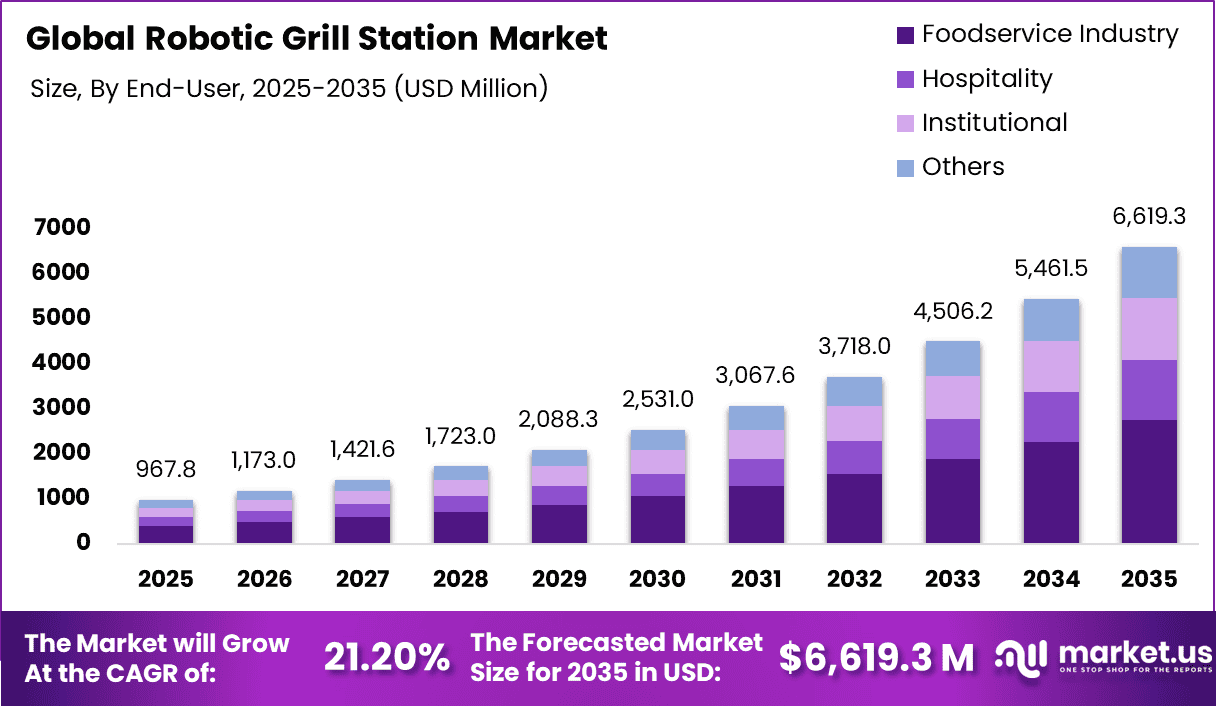
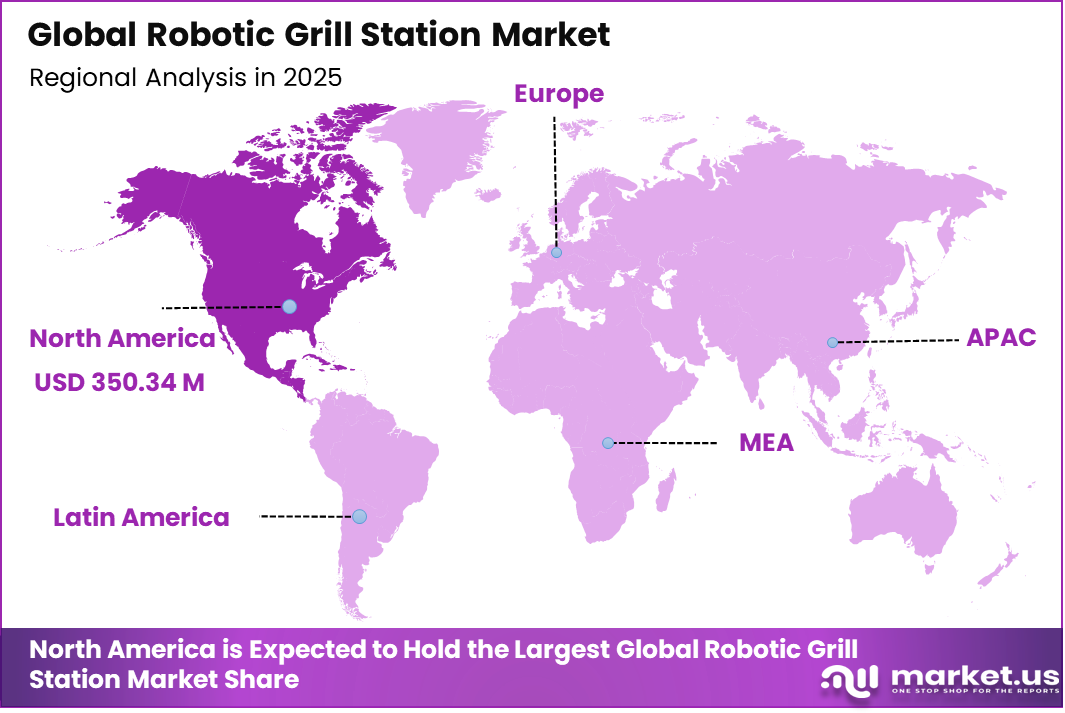
The Global Robotic Grill Station Market generated USD 967.8 million in 2025 and is predicted to register growth from USD 1,173 million in 2026 to about USD 6,619.3 million by 2035, recording a CAGR of 21.20% throughout the forecast span. In 2025, North America held a dominant market position, capturing more than a 36.2% share, holding USD 350.34 Million revenue.
Top Market Takeaways
- Product Type Fully automated grill stations account for 58.2% of the Robotic Grill Station market, as operators prefer systems that can handle grilling with minimal human intervention for speed and consistency.
- Application Commercial kitchens represent 38.2% of the market, because hotels, restaurants, and quick-service outlets use robotic grills to manage high-volume cooking and maintain uniform quality.
- End-User The foodservice industry makes up 41.7% of demand, reflecting strong adoption by restaurant chains, QSR brands, and cloud kitchens looking to reduce labor dependence and improve throughput.
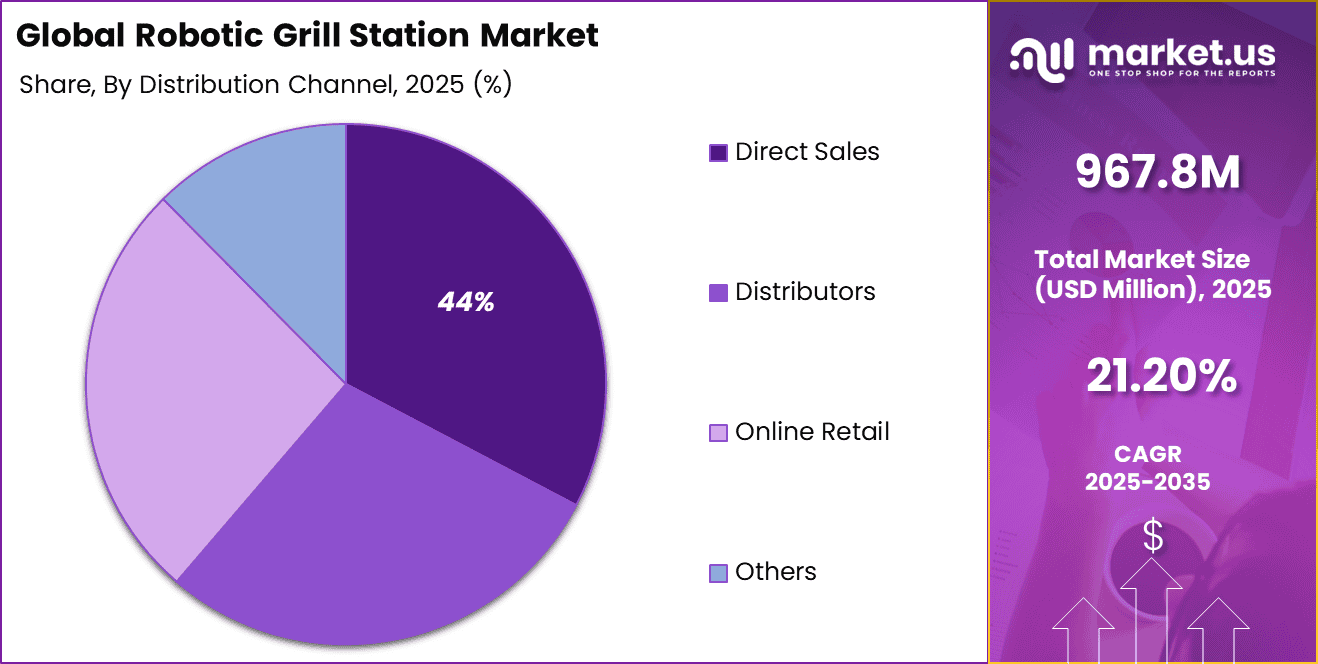
- Distribution Channel Direct sales account for 43.5%, since many buyers work directly with manufacturers or integrators to customize grill layouts, capacities, and integration with existing kitchen workflows.
- Region North America represents 36.2% of the global market, driven by early adoption of kitchen automation and strong demand from restaurant and hospitality players.
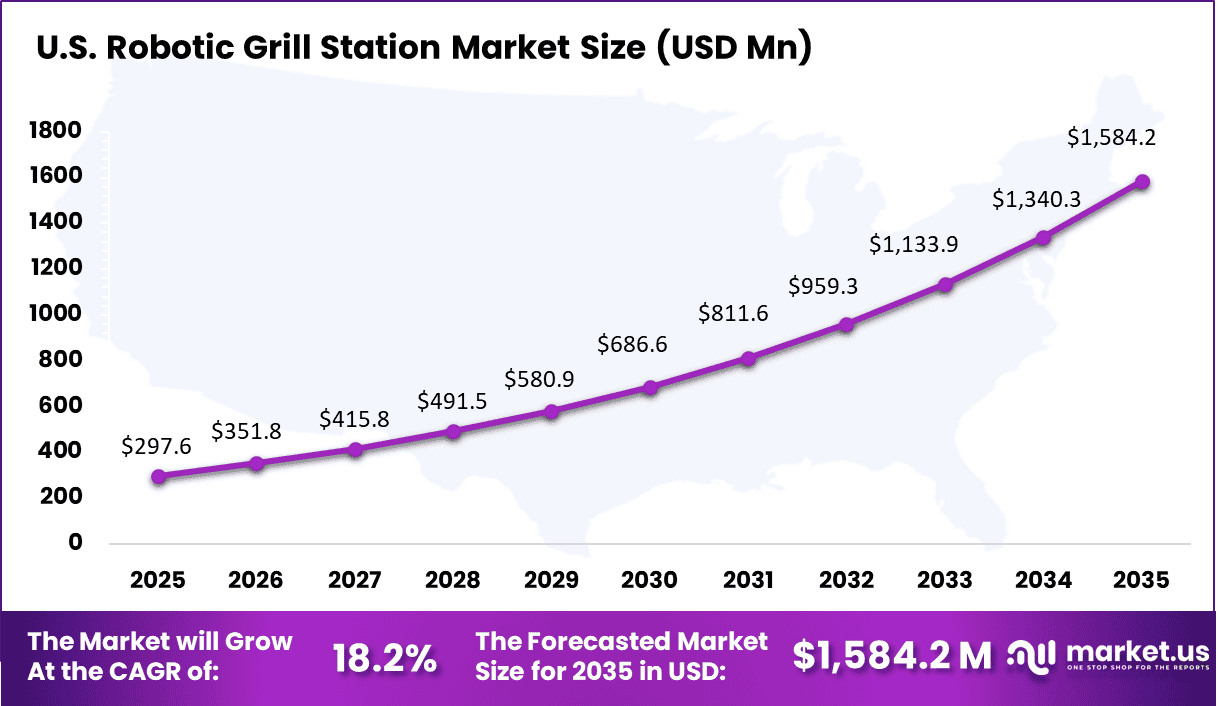
- Country The US market is valued at USD 297.6 million and is expected to grow at a CAGR of 18.2%, supported by rising labor costs, staff shortages, and interest in highly automated grilling solutions.
Robotic grill stations are automated cooking systems designed to prepare grilled food items with limited human intervention. These stations can manage tasks such as patty placement, flipping, timing, temperature control, and order sequencing through a combination of sensors, robotics, and software.
They are being introduced in quick service restaurants, institutional kitchens, food courts, and high traffic dining locations where speed and consistency are essential. As foodservice operations modernize, robotic grill stations are becoming a practical solution for standardized cooking and more efficient kitchen workflows.
One of the main driving factors is the growing pressure on restaurants to improve labor efficiency and maintain consistent food quality. Grill operations often involve repetitive tasks, heat intensive environments, and dependence on trained staff, which makes automation attractive. In addition, customer expectations for faster service and reliable order accuracy are encouraging operators to adopt technology that reduces delays and human error.
The expansion of digital ordering, self service kiosks, and delivery channels is also supporting demand, as automated grill systems can integrate directly with incoming orders. Rising focus on workplace safety is further strengthening adoption by reducing staff exposure to hot surfaces and grease.
Demand for robotic grill stations is increasing as foodservice operators seek scalable and space efficient cooking solutions. There is a strong preference for systems that offer precise temperature control, repeatable cooking results, easy cleaning, and dependable uptime. Buyers are also looking for stations that can integrate with kitchen management software, point of sale systems, and inventory tools.
The demand is particularly strong in burger chains, cafeterias, stadiums, airports, convenience food outlets, and ghost kitchens where speed and throughput are critical. As restaurant automation gains wider acceptance, the need for reliable and intelligent robotic grill solutions is expected to grow steadily.
Drivers Impact Analysis
| Key Driver | Impact on CAGR Forecast (~%) | Geographic Relevance | Impact Timeline | Additional Insight |
|---|---|---|---|---|
| Rising labor shortages in commercial kitchens | +4.6% | North America, Europe, Asia Pacific | Short to medium term | Automation helps solve staffing gaps |
| Growing demand for fast and consistent food preparation | +4.1% | Global | Medium term | Robotics improve speed and consistency |
| Increasing adoption of smart kitchen automation | +3.7% | North America, Asia Pacific, Europe | Medium to long term | Smart kitchens support robotic grills |
| Rising focus on workplace safety and heat exposure reduction | +3.2% | Global | Medium term | Robots reduce human exposure to grills |
| Expansion of quick-service restaurants and chain outlets | +2.8% | Global | Medium to long term | Chains seek scalable cooking systems |
Restraints Impact Analysis
| Key Restraint | Impact on CAGR Forecast (~%) | Geographic Relevance | Impact Timeline | Additional Insight |
|---|---|---|---|---|
| High equipment purchase and installation costs | -3.3% | Emerging markets | Short to medium term | Costs slow adoption among smaller kitchens |
| Maintenance complexity and downtime risks | -2.8% | Global | Medium term | Breakdowns disrupt food operations |
| Limited flexibility for varied menu items | -2.4% | Global | Medium term | Complex menus remain challenging |
| Resistance from traditional kitchen operators | -2.0% | Developing regions | Medium to long term | Manual cooking habits slow change |
| Food safety and regulatory compliance barriers | -1.7% | Global | Long term | Compliance can delay deployment |
By Product Type Analysis
The fully automated grill stations segment accounted for 58.2% of the market share, reflecting its strong role in transforming high-volume cooking operations through minimal human intervention. This dominance is supported by the growing demand for systems that can handle grilling, timing, temperature control, flipping, and output consistency with precision. Foodservice operators are increasingly adopting fully automated units to improve speed and reduce manual workload.
Another factor driving this segment is the need for consistent food quality and safer kitchen operations. Fully automated grill stations help reduce cooking errors, lower direct exposure to heat, and maintain standardized output across shifts. These advantages continue to strengthen adoption in modern commercial food preparation environments.
By Application Analysis
The commercial kitchens segment held 38.2% share, driven by the increasing need for efficient cooking systems in restaurants, hotels, cafeterias, and quick-service outlets. Commercial kitchens require dependable equipment that can manage peak-hour demand while maintaining service speed and food consistency. Robotic grill stations help streamline repetitive cooking tasks and improve workflow efficiency.
In addition, rising labor challenges and higher customer expectations for fast service have encouraged kitchen operators to modernize cooking processes. Automated grilling solutions support faster turnaround times and better capacity utilization, reinforcing demand in this application segment.
By End-User Analysis
The foodservice industry segment captured 41.7% of the market, reflecting broad adoption across restaurants, catering services, institutional kitchens, and hospitality venues. Businesses in this sector are increasingly investing in automation to improve productivity, reduce operational pressure, and maintain consistent cooking standards. Robotic grill stations support scalable and efficient food preparation.
Furthermore, the growing focus on hygiene, cost control, and service quality has increased interest in automated kitchen equipment. Foodservice operators view robotic grilling systems as a practical solution for enhancing kitchen performance and meeting changing consumer expectations.
By Distribution Channel Analysis
The direct sales segment accounted for 44% of the market share, driven by the specialized and capital-intensive nature of robotic grill station purchases. Buyers often prefer dealing directly with manufacturers to evaluate technical specifications, installation planning, and customization options based on kitchen layout and production needs. This approach supports more informed purchasing decisions.
Moreover, direct sales channels provide stronger after-sales service, staff training, and maintenance support for complex equipment. Operators value long-term supplier relationships to ensure reliability and system performance, which has reinforced the importance of direct sales in the market.
Key Challenges
- High equipment cost makes adoption difficult for small food businesses.
- Complex installation and kitchen layout changes require planning.
- Regular maintenance increases downtime and service costs.
- Heat, smoke, and grease can affect system performance.
- Food safety compliance requires strict cleaning and monitoring.
- Limited flexibility for custom cooking preferences and menu changes.
- Technical failures can disrupt service during peak hours.
- Dependence on stable power and network connectivity.
- Need for trained staff to supervise and manage operations.
- Customer hesitation toward robot-based food preparation.
Emerging Trends
The robotic grill station market is evolving toward automated cooking systems that improve speed, consistency, and kitchen safety in high volume foodservice environments. One of the key emerging trends is the use of AI assisted cooking controls that monitor temperature, timing, and doneness in real time, helping deliver uniform food quality across every order.
Another important trend is the integration of robotic grill stations with digital ordering and kitchen display systems, allowing cooking tasks to begin automatically as orders enter the workflow. There is also growing demand for modular equipment designs that can fit into compact kitchens, ghost kitchens, and nontraditional foodservice locations. In addition, self cleaning surfaces, grease management systems, and remote diagnostics are becoming more common, reducing maintenance effort and downtime. The shift toward data driven kitchen operations is also encouraging the use of performance dashboards that track throughput, energy use, and cooking efficiency.
Growth Factors
The growth of this market is driven by the rising need for labor efficiency and operational consistency in restaurants and commercial kitchens. Foodservice operators are facing pressure to serve customers faster while maintaining product quality, which is encouraging investment in automated grilling solutions. The expansion of delivery based dining and quick service formats is also supporting demand for systems that can manage steady order volumes during peak periods.
Another major factor is the shortage of kitchen labor and high employee turnover, making automation an attractive long term option. Businesses are also focusing on improving workplace safety by reducing direct exposure to heat, smoke, and repetitive cooking tasks. Furthermore, the increasing adoption of smart kitchen technologies is creating strong opportunities for robotic grill stations as operators modernize food preparation environments.
Key Market Segments
By Product Type
- Fully Automated Grill Stations
- Semi-Automated Grill Stations
By Application
- Commercial Kitchens
- Quick Service Restaurants
- Hotels
- Catering Services
- Others
By End-User
- Foodservice Industry
- Hospitality
- Institutional
- Others
By Distribution Channel
- Direct Sales
- Distributors
- Online Retail
- Others
Regional Analysis
North America accounted for 36.2% of the Robotic Grill Station market, supported by rapid adoption of kitchen automation and strong demand for operational efficiency in foodservice businesses. The region has a large network of quick-service restaurants, commercial kitchens, and institutional food operators that are increasingly investing in robotic cooking systems to improve speed, consistency, and hygiene.
Robotic grill stations are gaining popularity for automating repetitive cooking tasks, reducing dependence on manual labor, and maintaining standardized food quality. In addition, rising interest in contactless food preparation and smart kitchen solutions is strengthening market demand across the region.
The U.S. market reached USD 297.6 Million and is projected to grow at a CAGR of 18.2%, driven by labor shortages, rising wage pressure, and increasing focus on productivity in restaurant operations. Foodservice operators are adopting robotic grill stations to improve throughput, lower preparation errors, and optimize kitchen workflows during peak demand periods.
Growth in delivery-focused dining models and technology-enabled restaurant formats is also supporting adoption. In addition, continued investment in automation, artificial intelligence, and connected kitchen equipment is expected to support strong growth of the market in the US over the coming years.
Key Regions and Countries
- North America
- US
- Canada
- Europe
- Germany
- France
- The UK
- Spain
- Italy
- Russia
- Netherlands
- Rest of Europe
- Asia Pacific
- China
- Japan
- South Korea
- India
- Australia
- Singapore
- Thailand
- Vietnam
- Rest of APAC
- Latin America
- Brazil
- Mexico
- Rest of Latin America
- Middle East & Africa
- South Africa
- Saudi Arabia
- UAE
- Rest of MEA
Competitive Analysis
The competitive landscape of the Robotic Grill Station Market is driven by a mix of food automation innovators and global industrial robotics companies. Companies such as Middleby Corporation, Miso Robotics, ABB Ltd., KUKA AG, Fanuc Corporation, Yaskawa Electric Corporation, Kawasaki Robotics, and Universal Robots focus on automated cooking systems that improve speed, consistency, and labor efficiency in commercial kitchens.
These players provide robotic arms, smart cooking controls, and integrated kitchen automation platforms. Their strong engineering capabilities and growing adoption in quick-service restaurants help them maintain a leading position in the market.
At the same time, companies such as Apex Motion Control, Panasonic Corporation, RoboChef, Chowbotics (DoorDash), CaliBurger (Flippy by Miso Robotics), Makr Shakr, Robotics Inventions, Moley Robotics, Autec Inc., Festo AG & Co. KG, Keenon Robotics, and Dexai Robotics compete by offering specialized foodservice robots and modular automation solutions.
These players focus on compact designs, safety features, easy deployment, and support for high-volume kitchen operations. Competition in this market is driven by cooking accuracy, operational reliability, labor cost reduction, and the ability to deliver efficient automated food preparation systems.
Top Key Players in the Market
- Middleby Corporation
- Miso Robotics
- Apex Motion Control
- ABB Ltd.
- KUKA AG
- Kawasaki Robotics
- Fanuc Corporation
- Yaskawa Electric Corporation
- Panasonic Corporation
- Universal Robots
- RoboChef
- Chowbotics (DoorDash)
- CaliBurger (Flippy by Miso Robotics)
- Makr Shakr
- Robotics Inventions
- Moley Robotics
- Autec Inc.
- Festo AG & Co. KG
- Keenon Robotics
- Dexai Robotics
- Others
Future Outlook
The future outlook for the Robotic Grill Station Market looks strong as foodservice operators continue to focus on kitchen automation, labor efficiency, and consistent cooking quality. The market is expected to grow with rising demand for faster meal preparation and reduced dependence on manual kitchen staff. Restaurants are anticipated to adopt robotic grill stations to improve speed, maintain food consistency, and manage high order volumes during busy hours. In the coming years, advancements in AI, sensors, and connected kitchen systems are expected to improve accuracy, safety, and performance, supporting wider adoption across commercial kitchens and quick-service restaurants.
Recent Developments
- January 2025, Miso Robotics – Miso launches its next‑generation Flippy Fry Station, a smaller and faster AI‑powered robot that cooks fries, nuggets, tacos, and other fried items; it installs overnight, handles over 100 baskets per hour, and is rolling out to more White Castle, Jack in the Box, and other big brands.
- May 2025, Middleby Corporation – Middleby wins multiple 2025 Kitchen Innovations Awards, including for its LongWave Infrared Oven that sears meats in a single pass and supports high‑throughput grilling, and it showcases automated cooking and IoT solutions at the National Restaurant Show.
Report Scope
| Report Features | Description |
|---|---|
| Market Value (2025) | USD 967.8 Million |
| Forecast Revenue (2035) | USD 6,619.3 Million |
| CAGR(2025-2035) | 21.20% |
| Base Year for Estimation | 2024 |
| Historic Period | 2020-2024 |
| Forecast Period | 2025-2035 |
| Report Coverage | Revenue forecast, AI impact on Market trends, Share Insights, Company ranking, competitive landscape, Recent Developments, Market Dynamics and Emerging Trends |
| Segments Covered | By Product Type (Fully Automated Grill Stations, Semi-Automated Grill Stations), By Application (Commercial Kitchens, Quick Service Restaurants, Hotels, Catering Services, Others), By End-User (Foodservice Industry, Hospitality, Institutional, Others), By Distribution Channel (Direct Sales, Distributors, Online Retail, Others) |
| Regional Analysis | North America – US, Canada; Europe – Germany, France, The UK, Spain, Italy, Russia, Netherlands, Rest of Europe; Asia Pacific – China, Japan, South Korea, India, New Zealand, Singapore, Thailand, Vietnam, Rest of Latin America; Latin America – Brazil, Mexico, Rest of Latin America; Middle East & Africa – South Africa, Saudi Arabia, UAE, Rest of MEA |
| Competitive Landscape | Middleby Corporation, Miso Robotics, Apex Motion Control, ABB Ltd., KUKA AG, Kawasaki Robotics, Fanuc Corporation, Yaskawa Electric Corporation, Panasonic Corporation, Universal Robots, RoboChef, Chowbotics (DoorDash), CaliBurger (Flippy by Miso Robotics), Makr Shakr, Robotics Inventions, Moley Robotics, Autec Inc., Festo AG & Co. KG, Keenon Robotics, Dexai Robotics, Others |
| Customization Scope | Customization for segments, region/country-level will be provided. Moreover, additional customization can be done based on the requirements. |
| Purchase Options | We have three license to opt for: Single User License, Multi-User License (Up to 5 Users), Corporate Use License (Unlimited User and Printable PDF) |