Report Overview
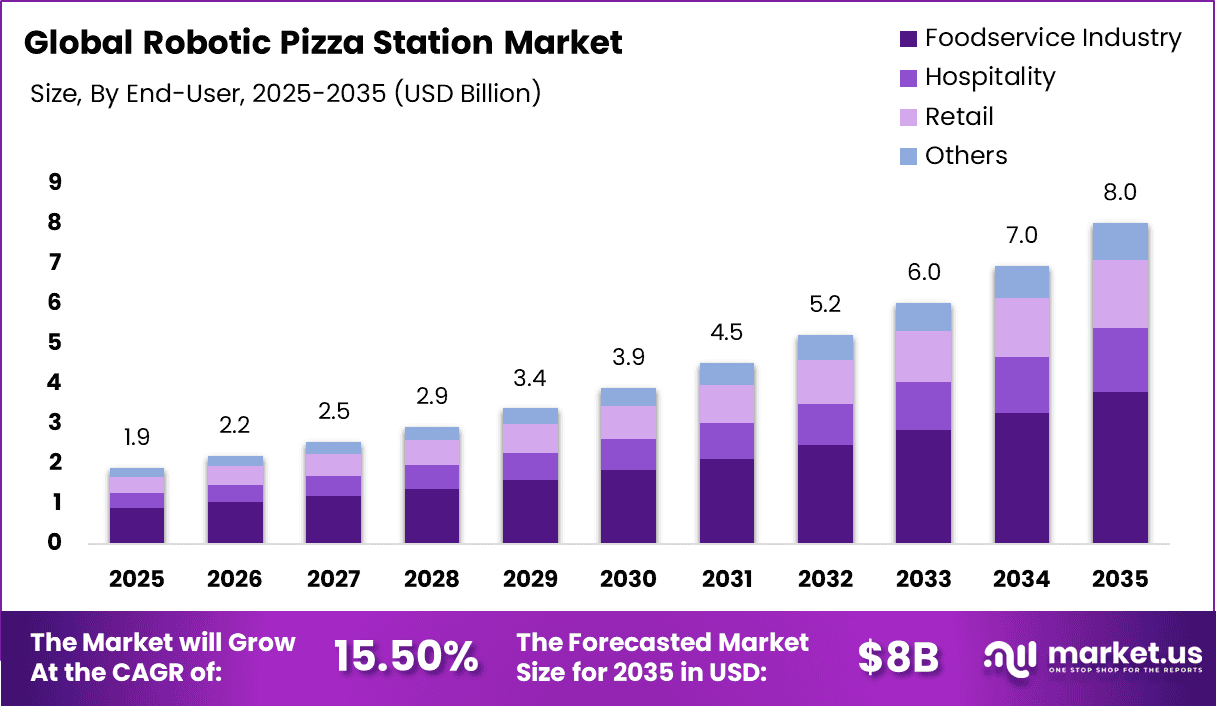
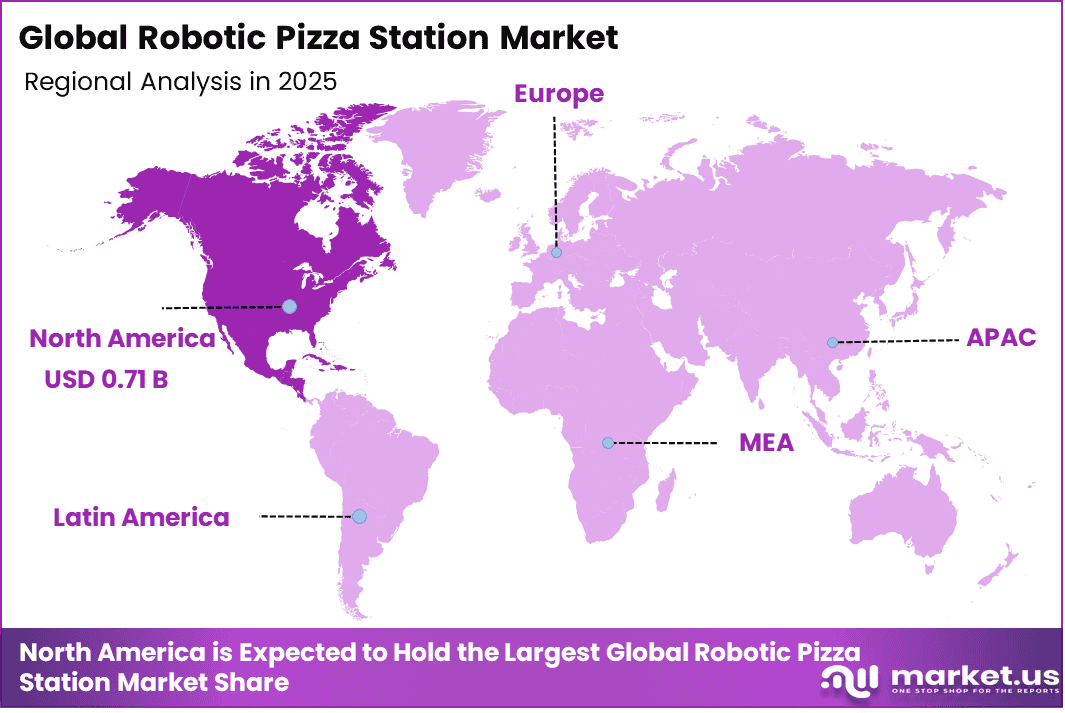
The Global Robotic Pizza Station Market generated USD 1.9 billion in 2025 and is predicted to register growth from USD 2.2 billion in 2026 to about USD 8 billion by 2035, recording a CAGR of 15.50% throughout the forecast span. In 2025, North America held a dominant market position, capturing more than a 37.4% share, holding USD 0.71 Billion revenue.
Top Market Takeaways
- Component Hardware accounts for 55.9% of the Robotic Pizza Station market, as most investment goes into robotic arms, ovens, conveyors, and dispensing units that automate pizza preparation and cooking.
- Application Commercial restaurants represent 38.6% of the market, because chains and independent restaurants use robotic pizza stations to speed up service, maintain consistency, and reduce labor dependence.
- End-User The foodservice industry makes up 47.2% of demand, reflecting strong adoption by quick-service restaurants, pizza chains, and cloud kitchens looking to handle peak volumes efficiently.
- Automation Level Fully automated systems hold 58.3% of the market, as operators prefer end-to-end automation that can handle dough, toppings, baking, and slicing with minimal human intervention.
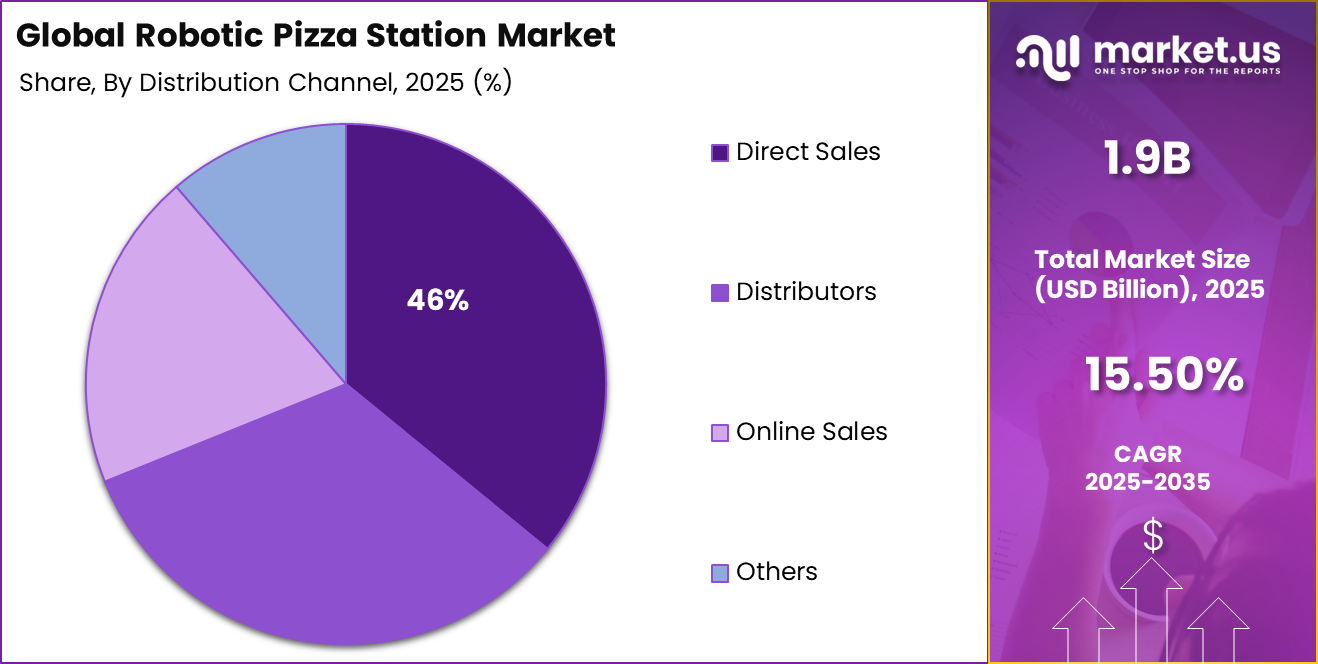
- Distribution Channel Direct sales account for 46.4%, since many buyers work directly with manufacturers or integrators to customize layouts, capacity, and integration with existing kitchen systems.
- Region North America represents 37.4% of the global market, driven by early adoption of food automation and strong demand from QSR and fast-casual brands.
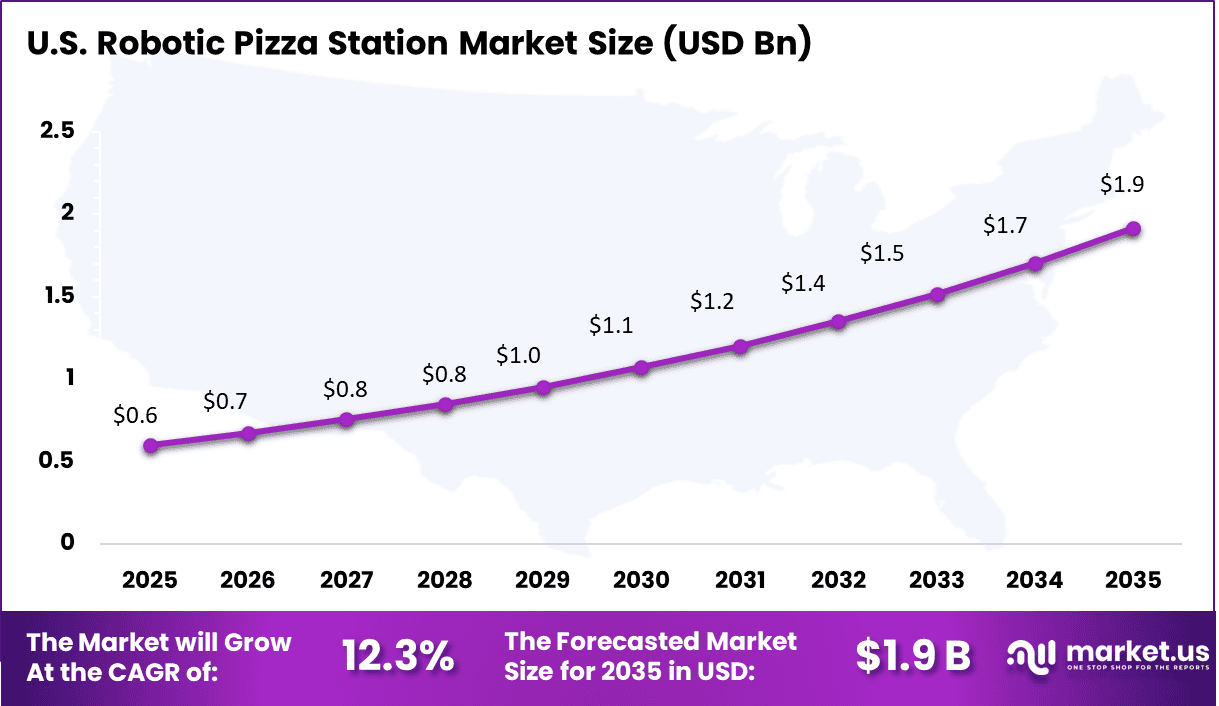
- Country The US market is valued at USD 0.60 billion and is expected to grow at a CAGR of 12.3%, supported by labor shortages, rising wage costs, and interest in high-throughput, automated pizza preparation solutions.
Robotic pizza stations are automated food preparation systems designed to assemble, cook, and sometimes serve pizzas with minimal human involvement. These stations can manage tasks such as dough handling, sauce dispensing, topping placement, baking control, and order tracking through integrated software and mechanical systems.
They are being adopted in quick service restaurants, self service kiosks, entertainment venues, and high traffic retail locations where speed and consistency are important. As foodservice operators look for smarter kitchen models, robotic pizza stations are becoming a practical option for standardized production.
One of the main driving factors is the growing need for labor efficiency in foodservice operations. Restaurants are facing challenges related to staffing availability, training time, and wage pressure, which is encouraging investment in automation.
In addition, customers expect faster service and consistent food quality, and robotic systems help deliver repeatable results with shorter preparation time. The expansion of digital ordering and delivery platforms is also supporting adoption, as automated stations can connect directly with incoming orders and streamline workflow. Rising interest in contactless service models is further strengthening market momentum.
Demand for robotic pizza stations is increasing as operators seek scalable and space efficient kitchen solutions. There is a strong preference for systems that can produce pizzas quickly, maintain ingredient consistency, and operate with simple maintenance requirements. Buyers are also looking for stations that integrate with payment systems, mobile ordering apps, and store management software.
The demand is particularly strong in airports, malls, universities, convenience retail, ghost kitchens, and busy urban food locations where rapid service is critical. As food automation becomes more accepted, the need for reliable and intelligent robotic pizza solutions is expected to grow steadily.
Drivers Impact Analysis
| Key Driver | Impact on CAGR Forecast (~%) | Geographic Relevance | Impact Timeline | Additional Insight |
|---|---|---|---|---|
| Rising labor shortages in foodservice operations | +4.1% | North America, Europe, Asia Pacific | Short to medium term | Automation helps offset staffing gaps |
| Growing demand for quick-service and contactless dining | +3.7% | Global | Medium term | Fast service supports robotic adoption |
| Increasing focus on order consistency and food quality | +3.3% | Developed markets | Medium to long term | Robotics improve repeatable preparation |
| Expansion of smart kitchens and restaurant automation | +3.0% | North America, Asia Pacific, Europe | Medium term | Smart kitchens increase equipment demand |
| Rising delivery and takeout meal volumes | +2.6% | Global | Medium to long term | High order volumes need efficient production |
Restraints Impact Analysis
| Key Restraint | Impact on CAGR Forecast (~%) | Geographic Relevance | Impact Timeline | Additional Insight |
|---|---|---|---|---|
| High upfront equipment acquisition costs | -2.8% | Emerging markets | Short to medium term | Capital cost slows adoption |
| Complex maintenance and spare parts needs | -2.4% | Global | Medium term | Maintenance raises ownership costs |
| Limited skilled operators and technicians | -2.0% | Global | Medium to long term | Skill shortages affect deployment |
| Slow adoption among small contractors | -1.7% | Developing regions | Medium term | Smaller firms prefer manual methods |
| Harsh site conditions affecting equipment uptime | -1.5% | Global | Long term | Tough environments increase downtime |
By Component Analysis
The hardware segment accounted for 55.9% of the market share, reflecting its central role in enabling automated dough handling, sauce dispensing, topping placement, baking, and output management. This dominance is supported by the growing demand for robotic arms, sensors, ovens, conveyors, and control units that ensure consistent pizza preparation. Hardware remains the foundation of robotic pizza stations as physical automation depends on reliable mechanical systems.
Another factor driving this segment is the need for durability and continuous operation in busy foodservice environments. Operators are investing in robust hardware systems that can maintain speed, hygiene, and product consistency during peak service hours. These benefits continue to strengthen adoption across automated kitchen setups.
By Application Analysis
The commercial restaurants segment held 38.6% share, driven by the increasing need to improve kitchen efficiency and reduce service time in dine-in and quick-service outlets. Restaurants are adopting robotic pizza stations to handle repetitive preparation tasks while maintaining consistent quality standards. This helps staff focus on customer service and order management.
In addition, rising labor challenges and growing demand for faster delivery have encouraged commercial restaurants to modernize food preparation processes. Automated pizza systems support higher output and more predictable operations, reinforcing demand in this application segment.
By End-User Analysis
The food service industry segment captured 47.2% of the market, reflecting broad adoption across restaurants, cloud kitchens, catering units, and institutional dining operations. Businesses in this sector are increasingly using automation to improve productivity, reduce errors, and maintain food consistency. Robotic pizza stations help streamline kitchen workflows and support scalable operations.
Furthermore, changing consumer expectations for quick service and consistent quality have increased investment in automated kitchen technologies. Foodservice operators view robotic systems as a practical way to improve efficiency while managing operational costs.
By Automation Level Analysis
The fully automated segment accounted for 58.3% of the market share, driven by strong demand for end-to-end solutions that minimize manual intervention. Fully automated systems can manage multiple preparation stages with limited human input, improving speed, hygiene, and operational consistency. This makes them attractive for high-volume foodservice environments.
Moreover, businesses are prioritizing labor efficiency and standardized output, especially where staffing pressures remain high. Fully automated stations help reduce dependency on manual processes while maintaining predictable production levels, supporting continued growth of this segment.
By Distribution Channel Analysis
The direct sales segment held 46% share, driven by the technical and customized nature of robotic pizza station purchases. Buyers often prefer working directly with manufacturers to evaluate specifications, installation needs, training requirements, and integration with kitchen layouts. This purchasing model supports better decision-making for capital equipment investments.
In addition, direct sales channels provide stronger after-sales support, maintenance services, and performance upgrades. Foodservice operators value close supplier relationships for systems that require ongoing technical reliability, reinforcing the importance of direct sales in the market.
Investor Type Impact Analysis
| Investor Type | Growth Sensitivity | Risk Exposure | Geographic Focus | Investment Outlook |
|---|---|---|---|---|
| Venture capital firms | Moderate | High | US, Europe | Investing in construction robotics startups |
| Private equity firms | Moderate to high | Moderate | North America and Europe | Scaling heavy equipment manufacturers |
| Corporate investors | High | Moderate | Global | Strategic investments in smart construction |
| Institutional investors | Moderate | Low to moderate | Developed markets | Prefer stable industrial machinery firms |
| Government and public funding bodies | High | Low | Global | Supporting infrastructure modernization |
Technology Enablement Analysis
| Technology | Impact on CAGR Forecast (~%) | Geographic Relevance | Impact Timeline | Additional Insight |
|---|---|---|---|---|
| AI-based order flow and kitchen optimization | +4.3% | US, Europe, Asia Pacific | Medium to long term | Improves speed and throughput |
| Vision-guided robotic topping systems | +3.8% | Global | Medium term | Enhances ingredient accuracy |
| IoT-enabled remote monitoring platforms | +3.2% | Global | Medium term | Supports predictive maintenance |
| Autonomous baking and cooking control systems | +2.9% | Developed markets | Medium to long term | Improves cooking consistency |
| Cloud-connected POS and robotics integration | +2.5% | Global | Short to medium term | Connects ordering with production |
Key Challenges
- High setup cost makes adoption difficult for small food businesses.
- Complex installation and kitchen integration require planning.
- Maintenance needs can increase downtime and repair costs.
- Limited flexibility for custom orders and menu changes.
- Food safety compliance requires regular cleaning and monitoring.
- Dependence on stable power and internet connectivity.
- Technical failures can disrupt service during busy hours.
- Customer hesitation toward fully automated food preparation.
- Need for trained staff to supervise and manage the system.
- Space constraints in small restaurant locations.
Emerging Trends
The robotic pizza station market is evolving toward highly automated food preparation systems that combine speed, consistency, and digital ordering convenience. One of the key emerging trends is the integration of end to end automation, where dough handling, sauce dispensing, topping placement, baking coordination, and order tracking are managed through a connected system. This improves output consistency and reduces preparation errors.
Another important trend is the growing use of AI driven demand forecasting that helps stations prepare ingredients and manage workflow during peak hours. There is also increasing adoption of compact modular designs that fit into restaurants, airports, campuses, and nontraditional retail locations with limited space. In addition, touchless ordering interfaces and app based integration are becoming more common, improving customer convenience and reducing wait times. Real time monitoring of ingredient levels, hygiene status, and equipment performance is also gaining traction, supporting smoother operations.
Growth Factors
The growth of this market is driven by the rising demand for quick service dining and the need for labor efficient kitchen operations. Foodservice operators are seeking solutions that can maintain product consistency while reducing dependency on repetitive manual tasks, which is encouraging investment in robotic pizza systems. The expansion of delivery focused dining models and digital ordering channels is also supporting demand for automated preparation stations that can handle steady order volumes.
Another major factor is the challenge of labor shortages and rising wage pressure in hospitality operations, making automation more attractive. Businesses are also focusing on faster service, lower food waste, and better order accuracy, which strengthens adoption of robotic stations. Furthermore, consumer interest in novelty dining experiences and technology enabled food service is creating additional opportunities for this market across commercial and institutional settings.
Key Market Segments
By Component
- Hardware
- Software
- Services
By Application
- Commercial Restaurants
- Cloud Kitchens
- QSRs
- Catering Services
- Others
By End-User
- Foodservice Industry
- Hospitality
- Retail
- Others
By Automation Level
- Fully Automated
- Semi-Automated
By Distribution Channel
- Direct Sales
- Distributors
- Online Sales
- Others
Regional Analysis
North America accounted for 37.4% of the Robotic Pizza Station market, supported by strong demand for foodservice automation and growing adoption of smart kitchen technologies. The region has a mature quick-service restaurant ecosystem where operators are increasingly investing in robotic systems to improve order speed, maintain product consistency, and reduce labor pressure.
Robotic pizza stations are gaining traction for automating tasks such as dough preparation, topping placement, baking coordination, and order handling. In addition, rising consumer preference for fast and contactless service is strengthening market demand across the region.
The U.S. market reached USD 0.60 Billion and is projected to grow at a CAGR of 12.3%, driven by increasing labor cost pressures and the need for efficient restaurant operations. Foodservice businesses are adopting robotic pizza stations to improve throughput, reduce preparation errors, and deliver consistent quality across locations.
Growth in delivery-focused restaurant models, late-night food demand, and technology-led dining experiences is also supporting adoption. In addition, continued investment in restaurant automation and digital ordering systems is expected to support steady growth of the market in the US over the coming years.
Key Regions and Countries
- North America
- US
- Canada
- Europe
- Germany
- France
- The UK
- Spain
- Italy
- Russia
- Netherlands
- Rest of Europe
- Asia Pacific
- China
- Japan
- South Korea
- India
- Australia
- Singapore
- Thailand
- Vietnam
- Rest of APAC
- Latin America
- Brazil
- Mexico
- Rest of Latin America
- Middle East & Africa
- South Africa
- Saudi Arabia
- UAE
- Rest of MEA
Competitive Analysis
The competitive landscape of the Robotic Pizza Station Market is shaped by a mix of food automation startups and established commercial kitchen equipment companies. Companies such as Middleby Corporation, Picnic Works, Piestro, PAZZI Robotics, Hyper Robotics, and Zume Pizza focus on automated pizza preparation systems that improve speed, consistency, and labor efficiency.
These players develop solutions covering dough handling, sauce dispensing, topping placement, baking, and order management. Their focus on reducing operating costs and improving output quality helps them maintain a strong position in the market.
At the same time, companies such as Moley Robotics, XRobotics, Le Bread Xpress, APEX Pizza Robotics, L2F Inc., BeeHex, Karakuri Ltd., Cali Group (CaliPizza Kitchen), Robot Coupe, Ekim (PAZZI), Makr Shakr, Sally the Robot (Chowbotics), and RoboChef compete by offering robotic kitchen systems, modular automation tools, and smart foodservice technologies.
These players focus on flexible designs, easy integration, and compact systems for restaurants, ghost kitchens, and high-traffic food outlets. Competition in this market is driven by automation reliability, food quality consistency, space efficiency, and the ability to support faster service in modern food operations.
Top Key Players in the Market
- Zume Pizza
- Picnic Works
- Piestro
- Middleby Corporation
- PAZZI Robotics
- Moley Robotics
- XRobotics
- Le Bread Xpress
- APEX Pizza Robotics
- Hyper Robotics
- L2F Inc.
- BeeHex
- Karakuri Ltd.
- Cali Group (CaliPizza Kitchen)
- Robot Coupe
- Ekim (PAZZI)
- Makr Shakr
- Sally the Robot (Chowbotics)
- RoboChef
- Others
Future Outlook
The future outlook for the Robotic Pizza Station Market looks promising as restaurants continue to focus on automation, faster service, and consistent food quality. The market is expected to grow with rising demand for efficient kitchen operations and reduced dependence on manual labor. Foodservice businesses are anticipated to adopt robotic pizza stations to improve speed, lower operating costs, and handle peak order volumes more effectively. In the coming years, advancements in AI, smart sensors, and connected kitchen systems are expected to make these solutions more reliable and flexible, supporting wider adoption across quick-service and delivery-focused outlets.
Recent Developments
March, 2025 – Picnic Works’ Picnic Pizza Station is installed at Moto Pizza in Seattle to automate sauce, cheese, and topping distribution, letting the restaurant keep up with viral social‑media demand while reducing waste and labour pressure.
May, 2025 – PizzaHQ in New Jersey converts a traditional pizzeria into a largely robotic one using Picnic’s system, with expansion plans supported by a leasing model rather than upfront capex.
Report Scope
| Report Features | Description |
|---|---|
| Market Value (2025) | USD 1.9 Billion |
| Forecast Revenue (2035) | USD 8 Billion |
| CAGR(2025-2035) | 15.50% |
| Base Year for Estimation | 2024 |
| Historic Period | 2020-2024 |
| Forecast Period | 2025-2035 |
| Report Coverage | Revenue forecast, AI impact on Market trends, Share Insights, Company ranking, competitive landscape, Recent Developments, Market Dynamics and Emerging Trends |
| Segments Covered | By Component (Hardware, Software, Services), By Application (Commercial Restaurants, Cloud Kitchens, QSRs, Catering Services, Others), By End-User (Foodservice Industry, Hospitality, Retail, Others), By Automation Level (Fully Automated, Semi-Automated), By Distribution Channel (Direct Sales, Distributors, Online Sales, Others) |
| Regional Analysis | North America – US, Canada; Europe – Germany, France, The UK, Spain, Italy, Russia, Netherlands, Rest of Europe; Asia Pacific – China, Japan, South Korea, India, New Zealand, Singapore, Thailand, Vietnam, Rest of Latin America; Latin America – Brazil, Mexico, Rest of Latin America; Middle East & Africa – South Africa, Saudi Arabia, UAE, Rest of MEA |
| Competitive Landscape | Zume Pizza, Picnic Works, Piestro, Middleby Corporation, PAZZI Robotics, Moley Robotics, XRobotics, Le Bread Xpress, APEX Pizza Robotics, Hyper Robotics, L2F Inc., BeeHex, Karakuri Ltd., Cali Group (CaliPizza Kitchen), Robot Coupe, Ekim (PAZZI), Makr Shakr, Sally the Robot (Chowbotics), RoboChef, Others |
| Customization Scope | Customization for segments, region/country-level will be provided. Moreover, additional customization can be done based on the requirements. |
| Purchase Options | We have three license to opt for: Single User License, Multi-User License (Up to 5 Users), Corporate Use License (Unlimited User and Printable PDF) |