DJ Software Market By Type (Controllers, Mixers, Media Players, Turntables & Accessories), By Application (Personal, Commercial), By Connectivity (Wired, Wireless), By Integration (Standalone, Modular), By Regional Analysis, Global Trends and Opportunity, Future Outlook By 2025-2035
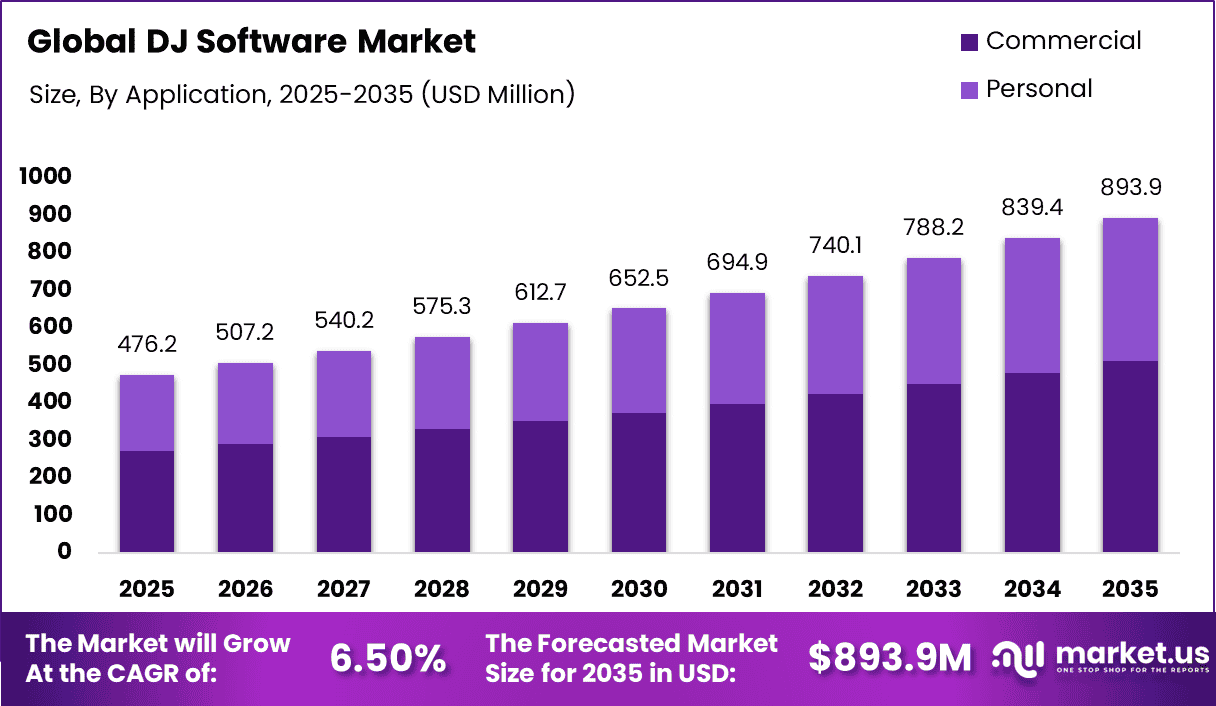
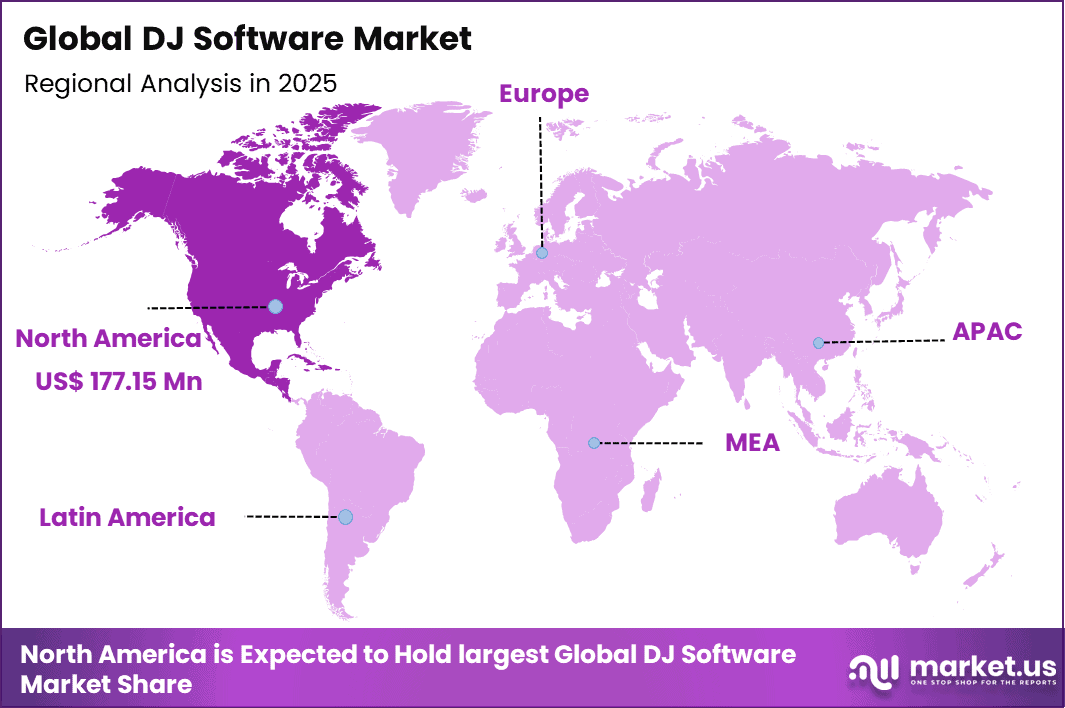
The Global DJ Software Market generated USD 476.2 million in 2025 and is predicted to register growth from USD 507.2 million in 2026 to about USD 893.9 million by 2035, recording a CAGR of 6.50% throughout the forecast span. In 2025, North America held a dominant market position, capturing more than a 37.2% share, holding USD 177.15 Million revenue.
DJ software has become a core digital tool for mixing, organizing, and performing music across clubs, events, livestreams, and personal use. It allows users to blend tracks, control tempo, apply effects, create playlists, and manage music libraries through computers, tablets, and connected controllers.
The shift from physical media to digital music has transformed how DJs perform, making software an essential part of both professional and entry level setups. As music performance becomes more technology driven, DJ software continues to expand in capability and accessibility.
One of the main driving factors is the growing popularity of live entertainment, private events, and digital music performances. DJs need flexible tools that can manage large music collections and deliver smooth transitions during performances.
In addition, the rise of affordable controllers and home studio equipment is encouraging more users to enter the market, increasing software adoption. Streaming integration is also supporting growth, as performers want access to wider music catalogs without relying only on local files. Continuous improvements in audio effects, beat matching, stem separation, and real time performance tools are further increasing the value of DJ software.
Demand for DJ software is rising as both professionals and hobby users seek reliable and easy to use performance solutions. There is a strong preference for software that offers stable operation, low latency response, and compatibility with a wide range of hardware devices. Users are also looking for features such as cloud library sync, recording tools, and advanced mixing controls.
The demand is particularly strong among mobile DJs, club performers, event organizers, and content creators who use music in digital broadcasts. As music culture and creator platforms continue to grow, the need for versatile and high performance DJ software is expected to increase steadily.
Top Market Takeaways
Media players command 62.5% by type, delivering track library management, waveform visualization, and hardware controller synchronization for seamless mixing workflows.
Commercial applications capture 57.3%, powering clubs, festivals, and broadcasting with reliable performance, multi-deck support, and broadcast-quality audio routing.
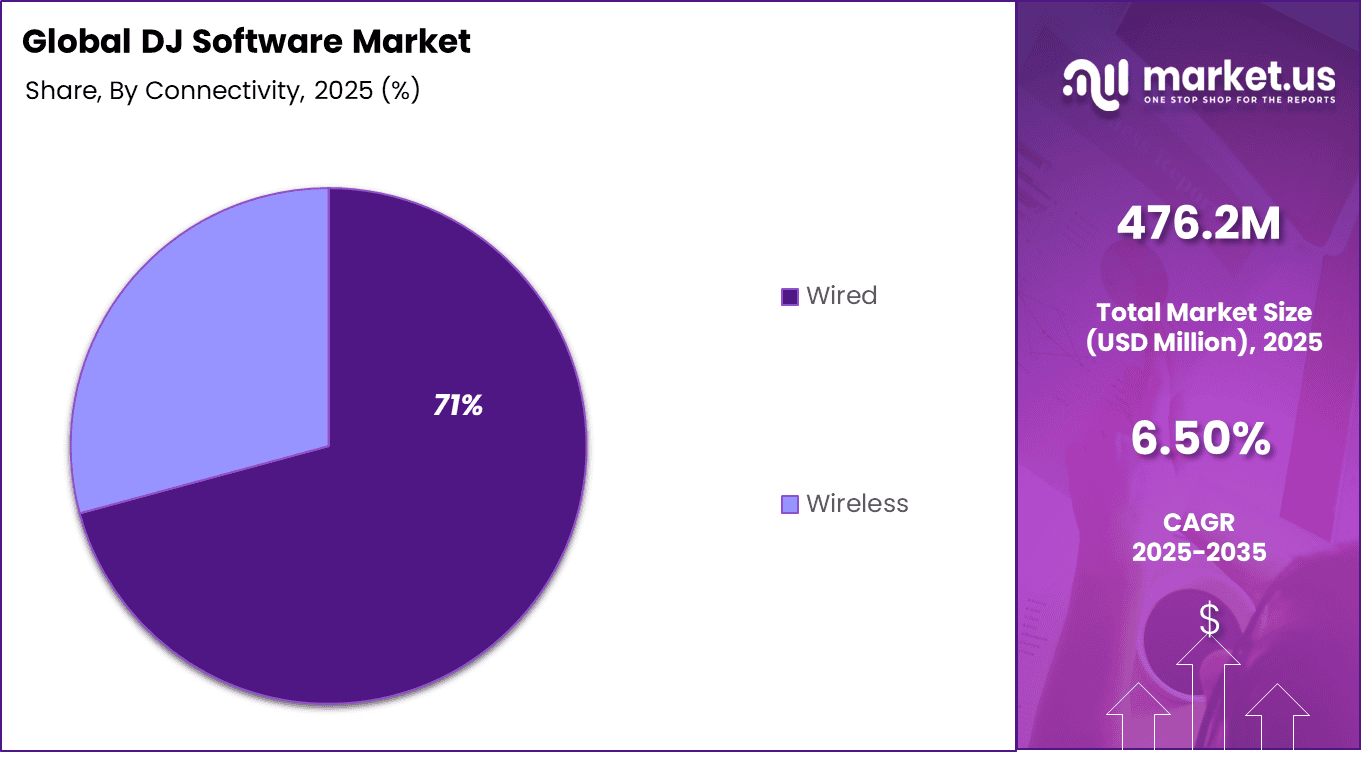
Wired connectivity holds 70.8%, ensuring low-latency MIDI/USB integration and stable operation during extended sets without wireless interference.
Modular integration dominates at 72.4%, enabling plugin ecosystems, effects racks, and hardware expansion for customized performance rigs.
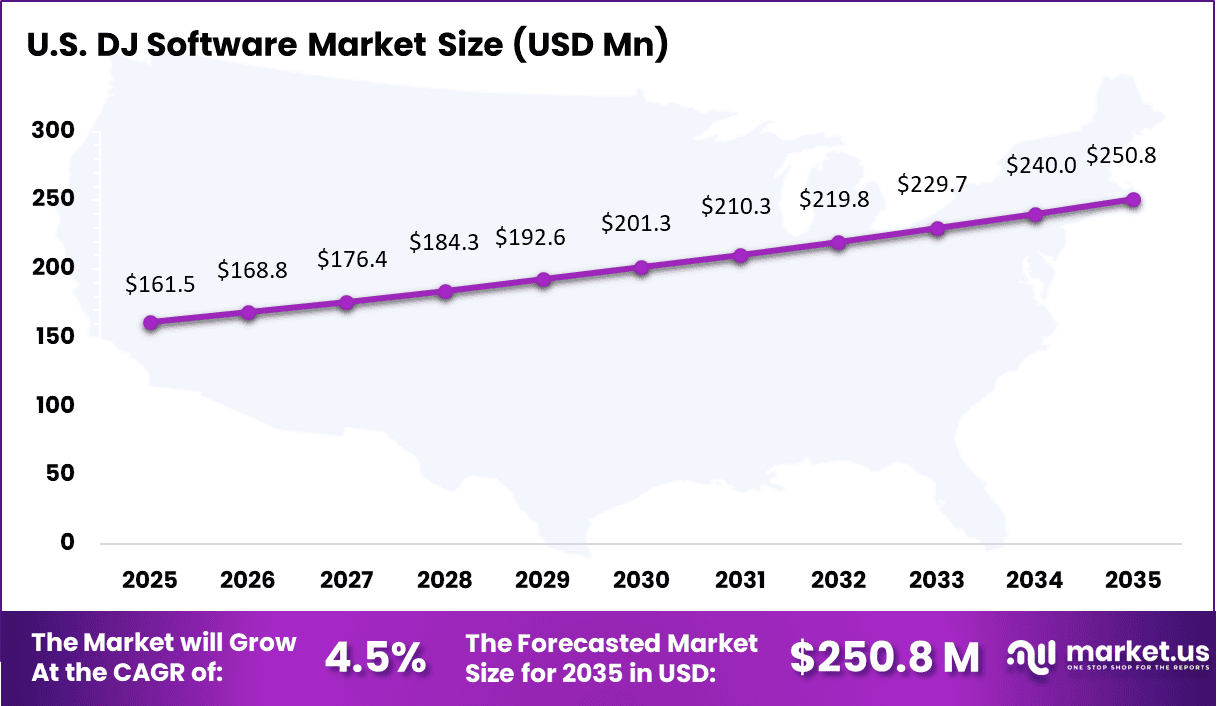
North America drives 37.2% global value, with U.S. market at USD 161.5 million and 4.5% CAGR, fueled by EDM festival circuits and venue technology upgrades.
Drivers Impact Analysis
Key Driver
Impact on CAGR Forecast (~%)
Geographic Relevance
Impact Timeline
Additional Insight
Growing popularity of live events and music festivals
+2.4%
North America, Europe, Asia Pacific
Short to medium term
Events increase DJ software demand
Rising number of independent DJs and music creators
+2.1%
Global
Medium term
Creator economy expands user base
Increasing adoption of digital mixing over traditional setups
+1.9%
Global
Medium to long term
Digital tools replace physical media
Growth of online music streaming integration
+1.7%
Developed markets
Medium term
Streaming access improves track libraries
Expansion of home studios and hobbyist music production
+1.5%
Global
Medium to long term
Home creators adopt affordable tools
Restraints Impact Analysis
Key Restraint
Impact on CAGR Forecast (~%)
Geographic Relevance
Impact Timeline
Additional Insight
High cost of premium software and subscriptions
-2.1%
Emerging markets
Short to medium term
Pricing limits wider adoption
Piracy and use of unauthorized software copies
-1.8%
Global
Medium term
Revenue leakage affects vendors
Hardware compatibility issues with controllers
-1.6%
Global
Medium term
Setup issues slow adoption
Learning curve for advanced mixing features
-1.4%
Global
Medium term
Complexity affects beginners
Dependence on system performance and latency
-1.2%
Global
Long term
Low-end devices reduce experience
By Type Analysis
The media players segment accounted for 62.5% of the market share, reflecting its strong role in core DJ performance and track management. This dominance is supported by the growing need for reliable software that allows users to organize music libraries, mix tracks smoothly, and control playback with precision. Media player solutions are widely preferred by DJs because they simplify live performance workflows and improve set management.
Another factor driving this segment is the increasing demand for user-friendly interfaces and compatibility with multiple audio formats. Modern media player software also offers waveform displays, cue point controls, and playlist management, which enhance performance efficiency. These features continue to strengthen the segment’s position in both professional and independent DJ environments.
By Application Analysis
The commercial segment held 57.3% share, driven by the widespread use of DJ software in clubs, events, hospitality venues, and entertainment spaces. Commercial users require dependable systems that can handle long performance hours, seamless transitions, and high audience expectations. DJ software helps improve sound control and supports professional event execution.
In addition, the growth of live entertainment venues and branded events has increased demand for advanced performance tools. Businesses prefer professional DJ software that supports scheduling, consistency, and audio quality. This has reinforced strong adoption across commercial applications.
By Connectivity Analysis
The wired segment captured 71% of the market, reflecting continued preference for stable and low-latency connections during live performances. Wired setups are widely used because they reduce the risk of signal interruption and ensure consistent communication between controllers, mixers, and audio systems. Reliability remains a major priority in performance environments.
Furthermore, professional users often choose wired connectivity for better sound response and dependable hardware integration. In crowded venues where wireless interference may occur, wired systems provide stronger operational confidence. This has helped maintain the leading share of the wired segment.
By Integration Analysis
The modular segment accounted for 72.4% of the market share, driven by the demand for customizable setups that match different performance styles and venue requirements. Modular solutions allow DJs to combine separate controllers, mixers, and software tools based on their specific needs. This flexibility supports both creative control and easier system upgrades.
Moreover, modular integration appeals to professional users who want scalable configurations rather than fixed systems. It enables selective hardware replacement and smoother adaptation to changing technology trends. These benefits have significantly strengthened the demand for modular DJ software ecosystems.
Investor Type Impact Analysis
Investor Type
Growth Sensitivity
Risk Exposure
Geographic Focus
Investment Outlook
Venture capital firms
Moderate
High
US, Europe
Investing in music tech startups
Private equity firms
Moderate
Moderate
North America and Europe
Scaling audio software providers
Corporate investors
High
Moderate
Global
Strategic investments in creator tools
Institutional investors
Moderate
Low to moderate
Developed markets
Prefer stable media software firms
Government and public funding bodies
Low
Low
Europe, Asia Pacific
Supporting creative industries
Technology Enablement Analysis
Technology
Impact on CAGR Forecast (~%)
Geographic Relevance
Impact Timeline
Additional Insight
AI-powered track matching and mixing tools
+2.6%
US, Europe
Medium to long term
Simplifies live mixing
Cloud-based music libraries and sync features
+2.3%
Global
Short to medium term
Enables cross-device access
Integration with streaming music platforms
+2.1%
Global
Medium term
Expands song availability
Low-latency audio processing engines
+1.9%
Developed markets
Medium to long term
Improves live performance quality
Mobile and tablet DJ applications
+1.7%
Global
Medium term
Broadens entry-level adoption
Key Challenges
High cost of professional software and compatible equipment.
Steep learning curve for beginners using advanced features.
Compatibility issues with different controllers and audio devices.
Software crashes can disrupt live performances.
Frequent updates may create bugs or workflow issues.
Audio latency problems can affect mixing quality.
Piracy and illegal software use impact revenue.
Limited support for some music file formats.
Dependence on strong laptop or hardware performance.
Intense competition from free and low-cost alternatives.
Emerging Trends
The DJ software market is evolving toward more intelligent, mobile, and performance focused solutions that support both professional artists and new creators. One of the key emerging trends is the integration of AI assisted mixing tools that can automatically match tempo, suggest transitions, and organize music libraries based on mood or style. This is helping users create smoother performances while reducing manual setup time.
Another important trend is the rise of cloud connected platforms that allow DJs to access playlists, samples, and settings from multiple devices without depending only on local storage. There is also growing demand for live streaming integration, enabling performers to broadcast sets directly to online audiences. In addition, compatibility with controllers, mobile devices, and touch interfaces is improving, giving users greater flexibility in how they perform. Real time stem separation is also gaining traction, allowing DJs to isolate vocals, drums, or melodies instantly during live mixing.
Growth Factors
The growth of this market is driven by the expanding global music entertainment industry and the rising popularity of live events, festivals, and private performances. As audiences seek more engaging experiences, performers are investing in advanced software that improves creativity and sound control. The growth of social media and creator platforms is also encouraging new users to enter DJing, as digital performances and content sharing have become more accessible.
Another major factor is the lower barrier to entry created by software based setups, which reduce the need for large hardware investments. Event venues, clubs, and independent artists are also seeking portable and flexible performance tools, further supporting demand. Additionally, continuous improvements in audio processing, user interface design, and device compatibility are making DJ software more appealing to both beginners and experienced professionals, supporting sustained market expansion.
Key Market Segments
By Type
Controllers
Mixers
Media Players
Turntables & Accessories
By Application
Personal
Commercial
By Connectivity
Wired
Wireless
By Integration
Standalone
Modular
Regional Analysis
North America accounted for 37.2% of the DJ Software market, supported by a strong entertainment culture and high adoption of digital music production tools. The region has a large base of professional DJs, event organizers, clubs, and independent creators who rely on software for mixing, live performance, playlist control, and sound customization.
Growing demand for live events, music festivals, and private entertainment services is encouraging wider use of advanced DJ platforms. In addition, increasing popularity of home studios and creator-led music production is strengthening demand for accessible and feature-rich DJ software across the region.
The U.S. market reached USD 161.5 Million and is projected to grow at a CAGR of 4.5%, driven by steady demand from nightlife venues, mobile DJs, and digital music creators. Users are increasingly adopting software that offers seamless hardware integration, streaming compatibility, and intuitive performance controls.
The rise of online tutorials and affordable controller devices has also expanded participation among beginners and semi-professional users. In addition, continued growth in event entertainment and digital music culture is expected to support stable expansion of the DJ software market in the US over the coming years.
Key Regions and Countries
North America
US
Canada
Europe
Germany
France
The UK
Spain
Italy
Russia
Netherlands
Rest of Europe
Asia Pacific
China
Japan
South Korea
India
Australia
Singapore
Thailand
Vietnam
Rest of APAC
Latin America
Brazil
Mexico
Rest of Latin America
Middle East & Africa
South Africa
Saudi Arabia
UAE
Rest of MEA
Competitive Analysis
The competitive landscape of the DJ Software Market is driven by a mix of established DJ technology brands and music production software providers. Companies such as Serato, Pioneer DJ, Atomix VirtualDJ, Native Instruments, Rekordbox, and Traktor hold strong positions by offering advanced mixing tools, hardware integration, and performance features for professional DJs.
These players focus on low-latency performance, music library management, live effects, and seamless compatibility with controllers and mixers. Their strong brand recognition and presence in clubs, events, and professional setups help them maintain market leadership.
At the same time, companies such as Algoriddim, Mixvibes, PCDJ, Ableton, Stanton, and Mixxx compete by offering user-friendly and flexible solutions for beginner, mobile, and independent DJs. These players focus on mobile compatibility, creative remix tools, and affordable software options across different skill levels. Competition in this market is driven by ease of use, hardware compatibility, streaming integration, and continuous innovation in live performance features.
The future outlook for the DJ Software Market looks positive as demand for digital music mixing continues to grow across live events, clubs, streaming, and home studios. The market is expected to expand with more users choosing software-based tools for mixing, remixing, and performance control. Beginners are anticipated to enter the market through easy-to-use mobile and desktop applications, while professionals continue to seek advanced creative features. In the coming years, integration with AI, cloud libraries, live streaming tools, and hardware controllers is expected to improve performance and user experience, supporting steady market growth.
Recent Developments
March, 2026 – Serato DJ Pro 4.0.6 adds official Pioneer DJM-250MK2, DJM-750MK2, DJM-450 mixer support plus Rane FOUR/MP2015m controller mapping. Seamless DVS workflow with 24-bit/96kHz vinyl while Suite license unlocks 2-stem separation+video instantly. Club standard with 10M+ downloads serves Coachella residents.
April, 2026 – Pioneer (AlphaTheta) rekordbox 7.2.14 launches SMART CUE auto-cueing tracks, Spotify playlist editing, and Duplicated File Manager cleaning 100K+ libraries. USB stability fixes post-7.2.12 bug while DJM-V5 mixer support enables standalone mixing. Hardware ecosystem leader powering 80% top-100 DJs.
Report Scope
Report Features
Description
Market Value (2025)
USD 476.2 Million
Forecast Revenue (2035)
USD 893.9 Million
CAGR(2025-2035)
6.50%
Base Year for Estimation
2024
Historic Period
2020-2024
Forecast Period
2025-2035
Report Coverage
Revenue forecast, AI impact on Market trends, Share Insights, Company ranking, competitive landscape, Recent Developments, Market Dynamics and Emerging Trends
Segments Covered
By Type (Controllers, Mixers, Media Players, Turntables & Accessories), By Application (Personal, Commercial), By Connectivity (Wired, Wireless), By Integration (Standalone, Modular)
Regional Analysis
North America – US, Canada; Europe – Germany, France, The UK, Spain, Italy, Russia, Netherlands, Rest of Europe; Asia Pacific – China, Japan, South Korea, India, New Zealand, Singapore, Thailand, Vietnam, Rest of Latin America; Latin America – Brazil, Mexico, Rest of Latin America; Middle East & Africa – South Africa, Saudi Arabia, UAE, Rest of MEA