


Global Polyvinyl Alcohol Market Size, Share Analysis Report By Type (Fully Hydrolyzed, Partially Hydrolyzed, PVOH Hydrogels, Others), By Form (Powder, Granules, Flakes, Films (Water-Soluble), Fibers), By End-Use (Food Packaging, Paper Manufacturing, Construction, Electronics, Textile, Others) , By Region and Companies - Industry Segment Outlook, Market Assessment, Competition Scenario, Trends, and Forecast 2025-2034
- Published date: Oct 2025
- Report ID: 161180
- Number of Pages: 344
- Format:
-
keyboard_arrow_up
Quick Navigation
Report Overview
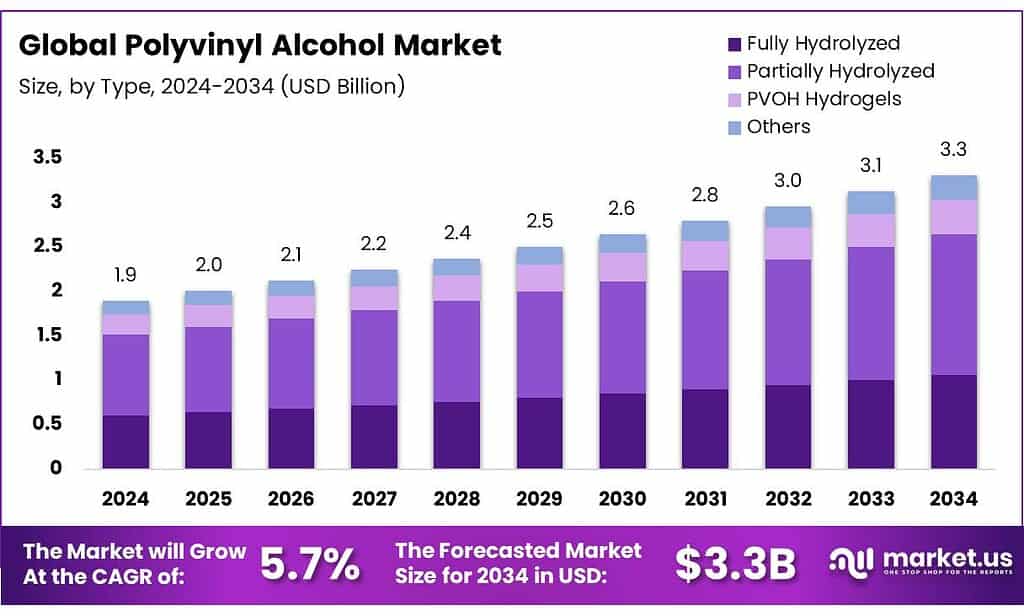
The Global Polyvinyl Alcohol Market size is expected to be worth around USD 3.3 Billion by 2034, from USD 1.9 Billion in 2024, growing at a CAGR of 5.7% during the forecast period from 2025 to 2034. In 2024 Asia Pacific held a dominant market position, capturing more than a 46.8% share, holding USD 0.8 Billion in revenue.
Polyvinyl Alcohol (PVA) is a synthetic, water-soluble polymer synthesized through the hydrolysis of polyvinyl acetate. It exhibits excellent film-forming, emulsifying, and adhesive properties, making it indispensable across various industries. PVA’s biodegradability and non-toxicity have further bolstered its adoption in applications demanding eco-friendly materials.
The current industrial scenario is characterized by geographically concentrated production capacity, rising downstream demand in Asia-Pacific, and regulatory pressures shaping product formulation and end-use adoption. Reported global production capacity has been cited as exceeding ~800,000 tonnes annually for major producers and continues to be expanded by integrated petrochemical and specialty players to match textile, detergent-pod, and packaging demand.
Energy and decarbonization considerations are salient because the chemical sector is a major industrial energy consumer: the industrial sector consumed 37% (≈166 EJ) of global energy in 2022, and the chemicals subsector is among the largest industrial energy users — a factor that is driving capital investment toward energy efficiency and feedstock-flexible processes.
The environmental fate of PVA has been the subject of technical and regulatory review. Regulatory correspondence and petitions to authorities have noted that laboratory biodegradability tests may overstate real-world degradation in conventional wastewater treatment plants; for example, a petition and supporting analyses submitted to the U.S. EPA highlight concerns about variability between lab conditions and environmental systems.
Key Takeaways
- Polyvinyl Alcohol Market size is expected to be worth around USD 3.3 Billion by 2034, from USD 1.9 Billion in 2024, growing at a CAGR of 5.7%.
- Partially Hydrolyzed held a dominant market position, capturing more than a 47.9% share.
- Powder held a dominant market position, capturing more than a 34.5% share of the global polyvinyl alcohol (PVA) market.
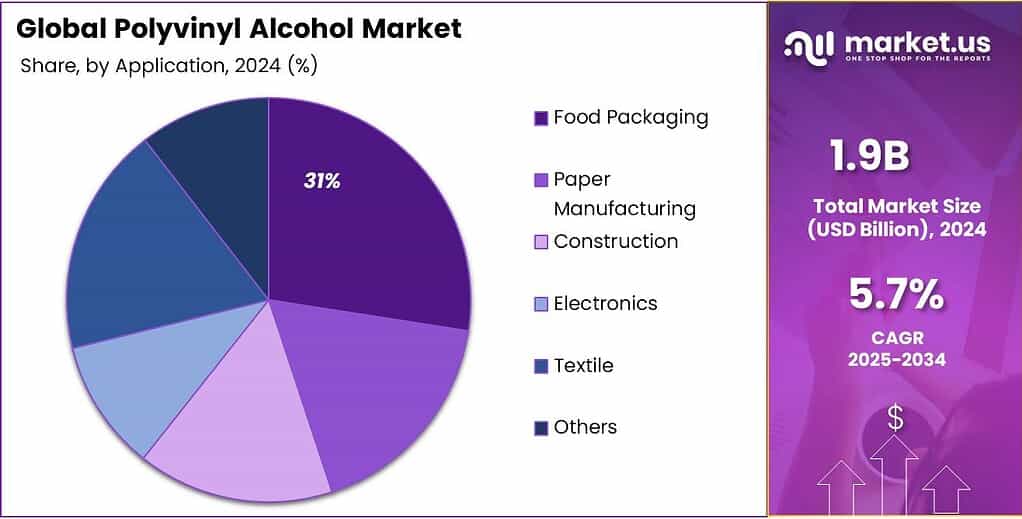
- Food Packaging held a dominant market position, capturing more than a 31.4% share of the global polyvinyl alcohol (PVA) market.
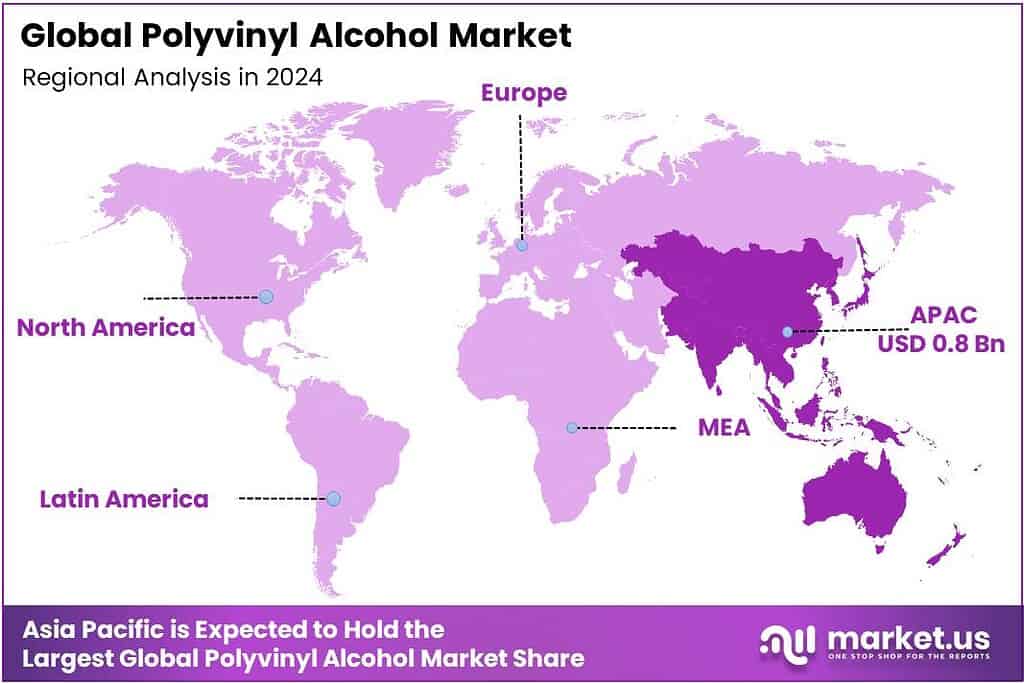
- Asia Pacific held a dominant position in the global polyvinyl alcohol (PVA) market, capturing more than 46.8% of the total share, equivalent to a market value of approximately USD 0.8 billion.
By Type Analysis
Partially Hydrolyzed Leads the Market with 47.9% Share Owing to Its Versatility and Strong Film-Forming Properties
In 2024, Partially Hydrolyzed held a dominant market position, capturing more than a 47.9% share of the global polyvinyl alcohol (PVA) market. This segment maintained its leadership due to its balanced solubility, superior adhesive characteristics, and film-forming capabilities, making it suitable for a wide range of end-use industries. The partially hydrolyzed PVA grade is widely used in packaging films, adhesives, textiles, and paper coatings, where moderate water resistance and excellent flexibility are required. Its ability to dissolve easily in cold or warm water has made it the preferred choice for water-soluble packaging applications, such as detergent pods and agricultural films.
In 2025, the demand for partially hydrolyzed PVA is projected to increase steadily, supported by the growing need for biodegradable and water-soluble polymers across consumer and industrial applications. Expanding production capacities in Asia and Europe, coupled with rising investment in eco-friendly film manufacturing, are expected to further strengthen the market share of this segment. The segment’s performance will continue to be supported by its versatility, cost efficiency, and compliance with sustainability standards, positioning partially hydrolyzed PVA as a key material in the transition toward environmentally responsible packaging solutions.
By Form Analysis
Powder Form Dominates with 34.5% Share Due to Its High Stability and Easy Handling
In 2024, Powder held a dominant market position, capturing more than a 34.5% share of the global polyvinyl alcohol (PVA) market. The powder form is widely preferred across industries because of its longer shelf life, ease of transportation, and high purity. It offers better stability during storage and processing, which makes it the ideal choice for applications in adhesives, construction binders, textile sizing, and paper coatings. Its excellent solubility and consistent performance have strengthened its use in packaging films and water-soluble products, where uniform dispersion and controlled viscosity are essential.
By 2025, the demand for PVA in powder form is expected to grow further, supported by its compatibility with automated production systems and its cost-effectiveness compared to liquid variants. The rising adoption of water-soluble packaging materials and eco-friendly adhesives is also anticipated to sustain its market dominance. With industries focusing on lightweight, easily transportable raw materials, the powder form of PVA will continue to be the preferred option, driving steady growth across manufacturing and consumer applications.
By End-Use Analysis
Food Packaging Leads with 31.4% Share Driven by Rising Demand for Sustainable and Water-Soluble Materials
In 2024, Food Packaging held a dominant market position, capturing more than a 31.4% share of the global polyvinyl alcohol (PVA) market. The segment’s leadership is attributed to the increasing adoption of eco-friendly and biodegradable packaging materials across the food industry. PVA’s strong barrier properties against oxygen, oil, and grease, along with its non-toxic and water-soluble nature, make it ideal for food-grade packaging films and coatings. The polymer is widely used in producing single-use packaging, edible films, and wrapping materials that help extend product shelf life while reducing plastic waste.
By 2025, the demand for PVA-based food packaging is expected to grow steadily, supported by government initiatives promoting sustainable packaging and stricter regulations on conventional plastics. Growing consumer preference for environmentally safe packaging solutions and the rapid expansion of the ready-to-eat food sector are further fueling this trend. As major food manufacturers continue to shift toward biodegradable materials, the food packaging segment is set to remain the largest end-use category, reinforcing PVA’s role as a key material in the future of sustainable packaging.
Key Market Segments
By Type
- Fully Hydrolyzed
- Partially Hydrolyzed
- PVOH Hydrogels
- Others
By Form
- Powder
- Granules
- Flakes
- Films (Water-Soluble)
- Fibers
By End-Use
- Food Packaging
- Paper Manufacturing
- Construction
- Electronics
- Textile
- Others
Emerging Trends
A Game-Changer in Sustainable Food Packaging
Polyvinyl Alcohol (PVA) is rapidly emerging as a sustainable alternative in food packaging, driven by its biodegradable and water-soluble properties. This shift is not just a trend but a response to growing environmental concerns and the need for safer, eco-friendly packaging solutions.
Governments worldwide are recognizing the importance of sustainable packaging materials. In India, for instance, the government has been promoting research and development in biodegradable materials, including PVA-based solutions. Initiatives by institutions like the Indian Institute of Technology Roorkee have led to the development of plant-based biodegradable plastics that degrade within about a week under certain conditions, offering a potential route to reduce persistent plastic waste from disposable packaging
The adoption of PVA in food packaging represents a significant step towards more sustainable and environmentally friendly packaging solutions. As consumer awareness grows and regulatory pressures increase, the demand for biodegradable materials like PVA is expected to continue its upward trajectory, contributing to a reduction in plastic waste and a move towards a more sustainable future.
Drivers
Government Initiatives Promoting Polyvinyl Alcohol (PVA) in Food Packaging
Polyvinyl Alcohol (PVA) is gaining recognition in the food packaging industry due to its biodegradable and water-soluble properties. These characteristics make PVA an attractive alternative to traditional plastic materials, aligning with global efforts to reduce plastic waste and promote sustainability.
Governments worldwide are implementing policies to encourage the use of sustainable materials in packaging. In the United States, the Environmental Protection Agency (EPA) has been urged to conduct comprehensive health and environmental safety testing on PVA, particularly concerning its use in detergent pods. This initiative aims to ensure that PVA products meet safety standards before widespread adoption
Similarly, in India, the government has been promoting the use of eco-friendly materials in various sectors, including packaging. Research institutions, such as the Indian Institute of Technology Roorkee, are at the forefront of developing sustainable packaging solutions. For instance, they have developed biodegradable plant-based polymers that degrade within a week under certain conditions, offering a potential route to reduce persistent plastic waste from disposable packaging
Despite the promising outlook, the adoption of PVA in food packaging faces challenges. One significant concern is the variability in PVA’s biodegradability, which can be influenced by factors such as molecular weight and environmental conditions. Additionally, while PVA is generally recognized as safe (GRAS) for food contact applications, comprehensive studies are needed to fully understand its long-term environmental and health impacts
Restraints
High Production Costs Hindering Widespread Adoption of Polyvinyl Alcohol (PVA) in Food Packaging
Polyvinyl Alcohol (PVA) is emerging as a promising alternative to conventional plastics in food packaging due to its biodegradable and water-soluble properties. However, its widespread adoption faces significant challenges, primarily stemming from high production costs and limited scalability.
The production of PVA involves complex chemical processes, including the polymerization of vinyl acetate followed by hydrolysis. These steps require specialized equipment and controlled conditions, contributing to higher manufacturing costs compared to traditional plastics. For instance, in 2025, the price of PVA in North America was reported at approximately $2.90 per kilogram, which is notably higher than that of polyethylene or polypropylene.
Recognizing the environmental benefits of PVA, some governments are beginning to provide support to overcome these economic barriers. In the United States, the Environmental Protection Agency (EPA) has initiated programs to research and promote the use of biodegradable materials, including PVA, in various applications. Such initiatives aim to reduce plastic waste and encourage the development of sustainable materials.
Similarly, in India, the government has been promoting the use of eco-friendly materials in various sectors, including packaging. Research institutions, such as the Indian Institute of Technology Roorkee, are at the forefront of developing sustainable packaging solutions. For instance, they have developed biodegradable plant-based polymers that degrade within a week under certain conditions, offering a potential route to reduce persistent plastic waste from disposable packaging
Opportunity
Government Initiatives Fueling the Growth of Polyvinyl Alcohol (PVA) in Food Packaging
Polyvinyl Alcohol (PVA) is emerging as a promising alternative to traditional plastics in food packaging due to its biodegradable and water-soluble properties. However, its widespread adoption faces significant challenges, primarily stemming from high production costs and limited scalability.
This cost disparity poses a significant barrier for manufacturers, especially small and medium-sized enterprises, in adopting PVA-based packaging solutions. The higher material costs can translate into increased product prices, potentially deterring consumers and businesses from transitioning to PVA alternatives.
Beyond cost, the scalability of PVA production is another concern. The infrastructure required for large-scale PVA production is not as widespread as that for traditional plastics. Establishing new production facilities or upgrading existing ones to handle PVA synthesis involves substantial capital investment. For example, companies like Kuraray and Sekisui Chemicals have made significant investments in PVA production, but such initiatives are often limited to large-scale operations.
Recognizing the environmental benefits of PVA, some governments are beginning to provide support to overcome these economic barriers. In the United States, the Environmental Protection Agency (EPA) has initiated programs to research and promote the use of biodegradable materials, including PVA, in various applications.
Regional Insights
Asia Pacific Dominates with 46.8% Market Share Valued at USD 0.8 Billion Owing to Expanding Industrial and Packaging Demand
In 2024, Asia Pacific held a dominant position in the global polyvinyl alcohol (PVA) market, capturing more than 46.8% of the total share, equivalent to a market value of approximately USD 0.8 billion. The region’s strong presence is primarily attributed to high production capacities, growing consumption across industrial sectors, and favorable government policies supporting sustainable materials. China, Japan, South Korea, and India are the key contributors, with China accounting for nearly 55% of global PVA production capacity, reflecting its position as both the largest manufacturer and consumer of PVA worldwide. The growth in packaging, textile, and construction industries across the region continues to drive substantial demand for partially and fully hydrolyzed PVA grades.
Key Regions and Countries Insights
- North America
- US
- Canada
- Europe
- Germany
- France
- The UK
- Spain
- Italy
- Rest of Europe
- Asia Pacific
- China
- Japan
- South Korea
- India
- Australia
- Rest of APAC
- Latin America
- Brazil
- Mexico
- Rest of Latin America
- Middle East & Africa
- GCC
- South Africa
- Rest of MEA
Key Players Analysis
Sekisui is major supplier of PVA (selvol line & other PVA/PVB resins) and also produces CPVC compounds, adhesives, coatings and high-performance plastics. In 2024, its Specialty Chemicals subsidiary announced plans to increase PVOH capacity by up to 25% to meet global technical application demand. It has production and sales footprint in U.S., Europe, Mexico, Asia, supplying PVA resins globally.
Founded in 1927 and now part of Mitsubishi Chemical, this Japanese company produces the GOHSENOL™ line of high-grade PVA resins. Its products are used in food packaging, adhesives, optical films, and special industrial applications. The firm emphasizes purity, film forming strength, and reliable moisture/gas barrier properties under ISO 9001 standards. It also supplies specialty polymers and polymers for electronic display films.
Kuraray has built strong capabilities in PVA resin and water-soluble film. Its product brand POVAL™ supports packaging, adhesives, textiles, coatings applications. In 2020 the company invested ~¥5.0 billion to establish a PVA water-soluble film plant in Poland (Zimna Wodka) to strengthen its European supply chain. Its global resin capacity is substantial (plants in Japan, Europe, Singapore) and expansion efforts continue.
Top Key Players Outlook
- Nippon Synthetic Chemical Industry Co.
- Sekisui Chemical Co. Ltd.
- Kuraray Co. Ltd.
- Astrra Chemicals
- Chang Chun Group
- Shin-Etsu Chemical Co., Ltd
- Nippon Chemical Industrial CO., LTD.
- Polysciences
- SEKISUI CHEMICAL CO., LTD.
- Shandong Tiancheng Chemical Co., Ltd.
Recent Industry Developments
In 2024 Sekisui Chemical Co., Ltd., invested USD 45 million in research and development facilities aimed at advancing bio-based PVA production technologies, reflecting its commitment to reducing carbon emissions and promoting environmental sustainability.
In 2025, Astrra Chemicals aims to enhance its production capacity by an additional 5,000 tonnes per year, aligning with the growing demand for sustainable and biodegradable materials in the packaging and textile sectors.
Report Scope
Report Features Description Market Value (2024) USD 1.9 Bn Forecast Revenue (2034) USD 3.3 Bn CAGR (2025-2034) 5.7% Base Year for Estimation 2024 Historic Period 2020-2023 Forecast Period 2025-2034 Report Coverage Revenue Forecast, Market Dynamics, Competitive Landscape, Recent Developments Segments Covered By Type (Fully Hydrolyzed, Partially Hydrolyzed, PVOH Hydrogels, Others), By Form (Powder, Granules, Flakes, Films (Water-Soluble), Fibers), By End-Use (Food Packaging, Paper Manufacturing, Construction, Electronics, Textile, Others) Regional Analysis North America – US, Canada; Europe – Germany, France, The UK, Spain, Italy, Rest of Europe; Asia Pacific – China, Japan, South Korea, India, Australia, Singapore, Rest of APAC; Latin America – Brazil, Mexico, Rest of Latin America; Middle East & Africa – GCC, South Africa, Rest of MEA Competitive Landscape Nippon Synthetic Chemical Industry Co., Sekisui Chemical Co. Ltd., Kuraray Co. Ltd., Astrra Chemicals, Chang Chun Group, Shin-Etsu Chemical Co., Ltd, Nippon Chemical Industrial CO., LTD., Polysciences, SEKISUI CHEMICAL CO., LTD., Shandong Tiancheng Chemical Co., Ltd. Customization Scope Customization for segments, region/country-level will be provided. Moreover, additional customization can be done based on the requirements. Purchase Options We have three licenses to opt for: Single User License, Multi-User License (Up to 5 Users), Corporate Use License (Unlimited User and Printable PDF) 
-
-
- Nippon Synthetic Chemical Industry Co.
- Sekisui Chemical Co. Ltd.
- Kuraray Co. Ltd.
- Astrra Chemicals
- Chang Chun Group
- Shin-Etsu Chemical Co., Ltd
- Nippon Chemical Industrial CO., LTD.
- Polysciences
- SEKISUI CHEMICAL CO., LTD.
- Shandong Tiancheng Chemical Co., Ltd.
Our Clients

- 161180
- Oct 2025






