Report Overview
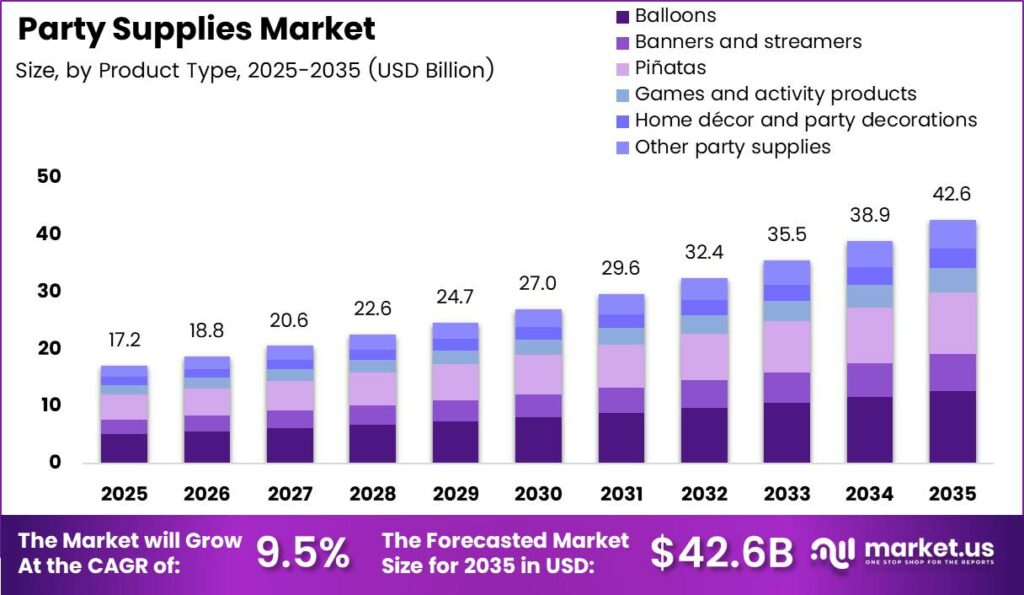
Global Party Supplies Market size is expected to be worth around USD 42.6 Billion by 2035 from USD 17.2 Billion in 2025, growing at a CAGR of 9.5% during the forecast period 2026 to 2035. This trajectory reflects broad-based consumer commitment to in-person celebration, not a niche premium trend.
The party supplies market covers disposable and reusable celebration products sold across retail, specialty, and online channels for personal and commercial use. It spans decorative items, tableware, inflatables, games, and themed merchandise across occasion-based and seasonal demand cycles. This means buyers, brand owners, and distributors all operate within a structurally recurring demand environment.
Party Supplies Market Key Takeaways
- The global party supplies market is valued at USD 17.2 Billion in 2025 and is forecast to reach USD 42.6 Billion by 2035 at a CAGR of 9.5%.
- Balloons dominate the By Product Type segment with a 30.00% share in 2025.
- Birthday parties dominate the By Occasion segment with a 32.00% share in 2025.
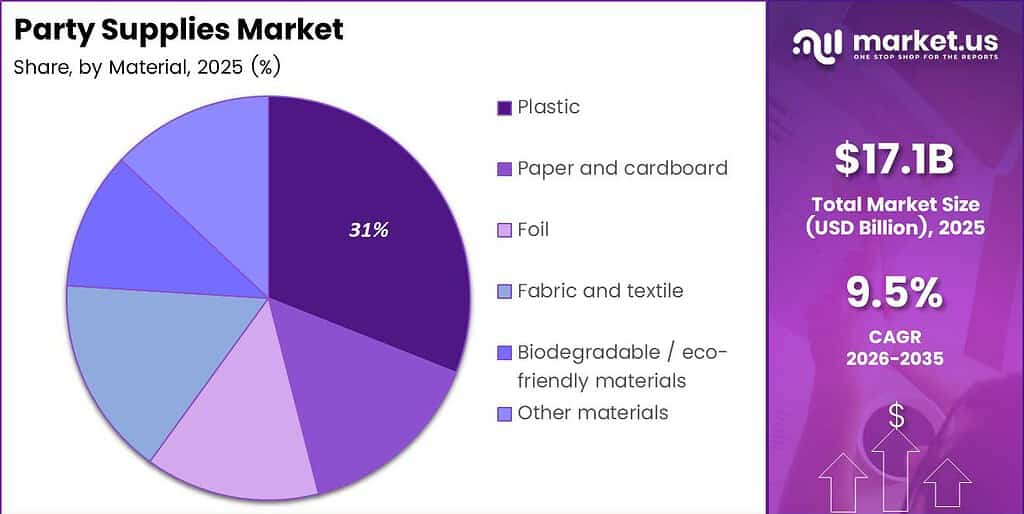
- Plastic dominates the By Material segment with a 31.00% share in 2025.
- Individual consumers dominate the By End User segment with a 78.00% share in 2025.
- Supermarkets and hypermarkets dominate the By Distribution Channel segment with a 29.00% share in 2025.
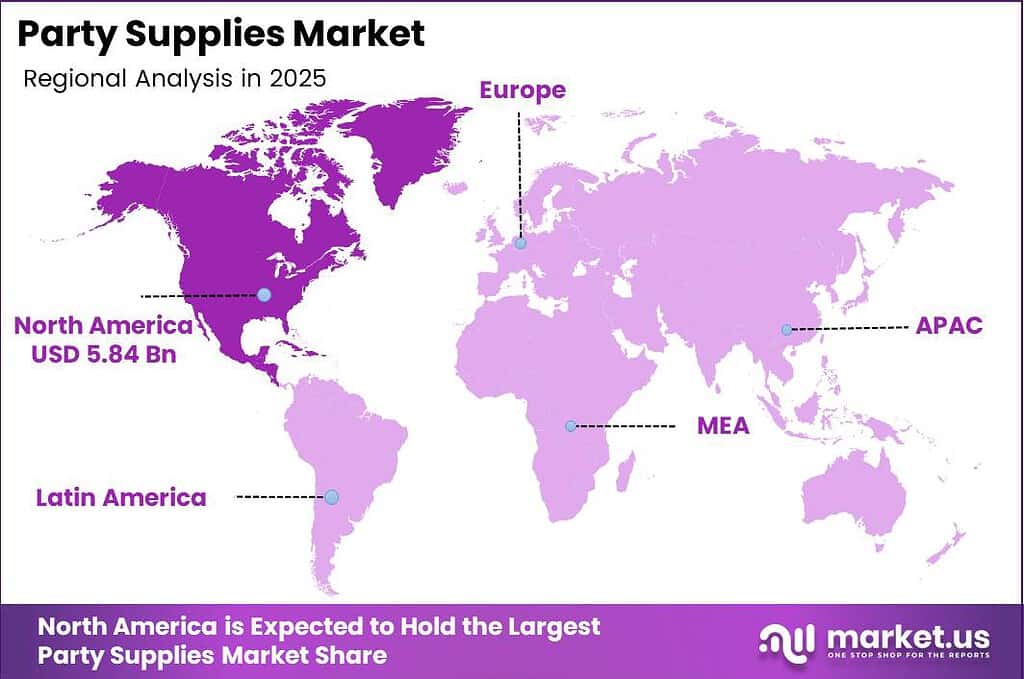
- North America leads all regions with a 34.00% market share, valued at USD 5.84 Billion in 2025.
England’s prohibition on single-use plastic cutlery and balloon sticks, effective October 1, 2023, signals a broader regulatory shift reshaping product development priorities across the industry. Suppliers operating in multiple markets must now map product eligibility by jurisdiction rather than applying blanket SKU strategies. Compliance investment is no longer optional for export-oriented manufacturers.
In November 2025, Folat, Riethmüller, and Anagram confirmed a partnership to jointly exhibit at Spielwarenmesse 2026, presenting coordinated party ranges including licensed products. This consolidation signals that mid-tier European suppliers are responding to scale pressure by pooling commercial reach. Buyers evaluating European supply networks should factor in this shifting competitive structure.
Product Type Analysis
Balloons dominates with 30.00% due to universal use across all celebration types.
In 2025, Balloons held a dominant market position in the By Product Type segment of the Party Supplies Market, with a 30.00% share. Balloons serve as the foundational decoration unit across birthdays, weddings, graduations, and corporate events. Their low unit cost, high visual impact, and compatibility with licensed themes make them the default entry point for party purchases at every price tier.
Banners and streamers serve as the core backdrop product in coordinated party setups, anchoring themed displays across venue types. Their flat, packable format supports both retail shelf efficiency and e-commerce fulfillment at low shipping cost. In April 2025, Michaels announced plans to expand its party supplies selection by 200% beginning in August, adding more than 500 products including paper party supplies and décor categories where banners and streamers sit centrally.
Home décor and party decorations capture spend from consumers building full-room setups rather than single accent pieces. In May 2026, Unique Party launched a Harry Potter-themed party supplies range comprising coordinated tableware, decorations, and foil balloons representing the Hogwarts houses. Licensed decoration ranges of this type convert single-item buyers into full-basket purchasers, directly expanding per-event revenue for both suppliers and retailers.
Games and activity products, piñatas, and other party supplies collectively hold the remaining share in this segment. These categories serve distinct occasion needs, with games targeting younger demographics and piñatas concentrated in Latin American and Hispanic-influenced markets. Their lower universal penetration limits standalone growth but supports basket attachment when bundled with core decorative items.
Occasion Analysis
Birthday parties dominates with 32.00% due to annual recurrence across all age groups.
In 2025, Birthday parties held a dominant market position in the By Occasion segment of the Party Supplies Market, with a 32.00% share. Birthdays generate predictable, repeating demand that no other occasion matches in frequency or household penetration. Every age cohort participates, which insulates this sub-segment from demographic shifts that affect occasion-specific categories like baby showers or graduation parties.
Weddings and anniversaries drive high per-event spend compared to any other occasion category. Couples purchasing coordinated decoration sets, customized tableware, and premium balloon arrangements consistently push average order values above those seen in birthday or seasonal purchases. This makes weddings a priority segment for suppliers capable of offering full-theme coordination at premium price points.
Baby showers and gender-reveal parties represent a structurally growing sub-segment driven by the social expansion of gender-reveal as a distinct celebration format. Seasonal and holiday parties generate concentrated demand spikes around major calendar events, creating predictable inventory planning windows for retailers and distributors. Graduation parties and other occasions collectively account for the remaining share in this segment.
Material Analysis
Plastic dominates with 31.00% due to cost, durability, and manufacturing scale advantages.
In 2025, Plastic held a dominant market position in the By Material segment of the Party Supplies Market, with a 31.00% share. Plastic’s cost and manufacturing scalability have made it the default material for mass-market party products across all categories. However, active regulatory pressure in multiple jurisdictions is forcing suppliers to accelerate substitute material development, creating both compliance cost and first-mover opportunity for early reformulators.
Paper and cardboard represent the primary regulatory-safe substitute for plastic tableware and decorative items across jurisdictions with active bans. Their recyclability supports compliance narratives in both retail marketing and institutional procurement. Suppliers that have already converted production lines to paper-based formats carry a structural advantage as plastic restrictions expand to additional product categories and geographies.
Foil materials dominate in the balloon sub-category due to their longer inflation retention and compatibility with licensed character printing. Fabric and textile materials serve reusable decoration segments including banners, bunting, and themed accessories. Biodegradable and eco-friendly materials hold the remaining share and represent the fastest-reformulating category as sustainability regulations tighten across Europe and North America.
End User Analysis
Individual consumers / residential users dominates with 78.00% due to household celebration frequency.
In 2025, Individual consumers / residential users held a dominant market position in the By End User segment of the Party Supplies Market, with a 78.00% share. Households purchase party supplies for birthdays, holidays, and life-stage events at a frequency no commercial category can match. This concentration means that retail channel strategy, consumer marketing spend, and product accessibility all carry disproportionate weight in determining overall market performance.
Commercial users, including event planners, hospitality venues, corporate clients, and educational institutions, account for the remaining 22% of market share. Commercial buyers place larger, more predictable orders and respond to managed procurement programs, making them a structurally attractive growth channel for suppliers seeking to reduce revenue volatility tied to seasonal household demand cycles.
Distribution Channel Analysis
Supermarkets and hypermarkets dominates with 29.00% due to footfall, convenience, and impulse placement.
In 2025, Supermarkets and hypermarkets held a dominant market position in the By Distribution Channel segment of the Party Supplies Market, with a 29.00% share. High-footfall grocery environments capture impulse purchases from shoppers not actively seeking party supplies. Shelf placement near seasonal promotional displays amplifies this effect, making grocery channel listings a baseline requirement for mass-market party supplies brands.
Specialty stores deliver higher per-visit basket values because their shoppers arrive with specific decoration intent and greater willingness to browse full-theme assortments. E-commerce platforms extend reach to consumers in markets underserved by physical retail, supporting coordinated basket assembly across decoration categories in ways that physical shelf space cannot replicate. Convenience stores and other distribution channels collectively hold the remaining share.
Party Supplies Market Segments
By Product Type
- Balloons
- Banners and streamers
- Piñatas
- Games and activity products
- Home décor and party decorations
- Other party supplies
By Occasion
- Birthday parties
- Weddings and anniversaries
- Baby showers and gender-reveal parties
- Graduation parties
- Seasonal and holiday parties
- Other occasions
By Material
- Plastic
- Paper and cardboard
- Foil
- Fabric and textile
- Biodegradable / eco-friendly materials
- Other materials
By End User
- Individual consumers / residential users
- Commercial users
By Distribution Channel
- Supermarkets and hypermarkets
- Convenience stores
- Specialty stores
- E-commerce / online stores
- Other distribution channels
Party Supplies Market Regional Analysis
North America Dominates the Party Supplies Market with a Market Share of 34.00%, Valued at USD 5.84 Billion
North America leads the global party supplies market with a 34.00% share valued at USD 5.84 Billion in 2025. The region’s established retail infrastructure, high per-capita celebration spend, and mature e-commerce penetration create a structurally deep demand base. Suppliers with North American distribution coverage benefit from both recurring household purchasing and a well-developed specialty retail ecosystem.
In April 2026, Staples and Party City announced a partnership bringing Party City balloons, decorations, and party supplies to more than 700 Staples stores and Staples.com. This distribution expansion signals that North American suppliers are actively broadening physical retail reach beyond traditional party specialty formats. Entrants targeting this region must plan for intensifying shelf competition at both mass and office-retail formats.
Asia Pacific represents the fastest-growing regional opportunity, supported by a large and urbanizing consumer base with rising disposable income allocated toward life-stage celebrations. Europe follows as a mature market undergoing active regulatory transition around single-use plastics, creating both compliance pressure and reformulation opportunity. Latin America and the Middle East and Africa regions serve culturally distinct celebration cycles with underpenetrated formal retail supply chains.
Key Regions and Countries
North America
- US
- Canada
Europe
- Germany
- France
- The UK
- Spain
- Italy
- Rest of Europe
Asia Pacific
- China
- Japan
- South Korea
- India
- Australia
- Rest of APAC
Latin America
- Brazil
- Mexico
- Rest of Latin America
Middle East and Africa
- GCC
- South Africa
- Rest of MEA
Market Dynamics
Market Opportunity Analysis - Underserved commercial buyers and underpenetrated regions offer entry points for focused suppliers
Commercial users represent only 22% of current party supplies spend despite placing larger and more predictable orders than residential buyers. Managed procurement programs targeting hospitality, corporate, and educational institutions remain underbuilt across most supplier portfolios. Entrants that develop B2B fulfillment infrastructure and volume pricing structures can capture this segment before larger players formalize their institutional sales channels.
The e-commerce channel holds structural untapped potential in Asia Pacific, where urbanization and rising disposable income are expanding celebration spend but physical specialty retail coverage remains thin. By contrast, online basket-building tools and theme-coordinated digital storefronts are already proven in North America and Europe. Suppliers that adapt these models to Asia Pacific demand patterns gain a first-mover distribution advantage at lower setup cost than building physical retail presence.
Latin America and Middle East and Africa represent underpenetrated formal retail markets with culturally distinct celebration cycles. Festival and occasion-specific product ranges adapted to local decoration customs have no dominant supplier in either region. New entrants with localized product development and regional distribution partnerships face less incumbent resistance here than in mature North American or European markets.
Biodegradable and eco-friendly materials hold the smallest current material share yet face the strongest regulatory tailwind across Europe and North America. Suppliers that certify and scale compliant eco-friendly product lines before plastic bans expand to additional categories control a compliance-led pricing premium unavailable to late movers. This segment rewards early capital allocation now, before regulatory certainty eliminates scarcity-based pricing power.
Technology and Innovation Landscape - Inflation equipment precision, material reformulation, and licensed design systems define the next competitive edge
According to Bargain Balloons technical guidance updated May 23, 2025, the PremiumConwin Twin-Air Sizer II supports inflation timing in 0.1-second increments with a maximum timer setting of 99 seconds. This precision allows decorators to control balloon sizing with consistency across large event installations. Equipment that reduces inflation variability directly lowers labor time per unit and enables higher throughput at commercial decoration operations.
Based on Market.us data, the PremiumConwin FoilPro includes 3 specialized nozzles covering foil balloons, Bubble and Orbz balloons at high pressure, and latex balloons measuring 5 inches and larger. Multi-nozzle compatibility reduces the number of machines required per operation, lowering capital expenditure for professional decorators. This consolidation of equipment capability into a single unit signals a broader shift toward professional-grade tools in party supply distribution.
In a manufacturing disclosure published May 13, 2025, Gemar reported that its balloon-production process used over 90% renewable materials. This figure describes manufacturing inputs and positions Gemar ahead of anticipated material-composition disclosure requirements in European and North American markets. Suppliers that embed renewable input ratios into production now build regulatory compliance as a durable competitive asset rather than a reactive cost.
In February 2026, Gemar launched its Marshmallow Palette for balloon decoration, comprising 5 new colorways including Linen, Butter, Powder Pink, Powder Blue, and Tiffany. Palette-based product launches align supplier color systems with professional decorator planning workflows and interior design trend cycles. This approach converts a commodity product into a design tool, supporting premium pricing and repeat specification by event professionals.
Drivers
Online retail expands consumer access to matched tableware, decorations, and accessories beyond local store assortments. Data from U.S. Census Bureau shows e-commerce reached 16.1% of retail sales in 2024 and 16.4% in 2025, with online sales growing 5.4% against total retail growth of 3.5%. This gap confirms that online channels are capturing share from physical retail, not merely tracking it.
This shift supports a move from isolated item purchases toward coordinated celebration basket buying. Suppliers that merchandise complete themes online benefit from higher average order values and reduced per-unit fulfillment cost when orders consolidate. Recurring household celebrations reinforce this pattern by generating predictable repurchase cycles that favor suppliers with broad, always-available digital assortments.
| Driver | (~) % Impact on CAGR Forecast | Geographic Relevance | Impact Timeline |
|---|---|---|---|
| Online assortment access and coordinated-basket purchasing | +0.55 percentage points | Global; strongest in digitally mature retail markets | Short term (≤ 2 years) |
| Recurring household celebration purchases | +0.35 percentage points | Global | Short term (≤ 2 years) |
| Licensed entertainment-themed merchandise demand | +0.30 percentage points | North America, Europe, Asia-Pacific | Short term (≤ 2 years) |
| Social-media-led decorative basket expansion | +0.25 percentage points | Global; urban consumer markets | Short term (≤ 2 years) |
| Established festival merchandising cycles | +0.15 percentage points | Asia-Pacific, Latin America, North America | Short term (≤ 2 years) |
Restraints
England prohibited the supply of single-use plastic cutlery and balloon sticks from October 1, 2023. Government reporting identified annual consumption of approximately 2.7 billion predominantly plastic single-use cutlery items and 721 million single-use plates, with only 10% recycled. These volumes confirm the policy rationale but also define the scale of product lines now requiring compliant substitution across affected supply chains.
For suppliers with meaningful exposure to regulated product categories, immediate SKU withdrawal, obsolete inventory write-downs, and tooling expenditure divert capital from expansion. A modeled scenario suggests that for a supplier with 10% of sales exposed and 75% of those purchases retained through compliant substitutes, unrecovered sales equal 2.5% of original revenue. Companies that accelerate compliant reformulation protect margin while those that delay face compounding cost exposure.
| Restraint | (~) % Impact on CAGR Forecast | Geographic Relevance | Impact Timeline |
|---|---|---|---|
| Prohibitions on specified disposable plastic products | -0.30 percentage points | England and other jurisdictions with product-specific bans | Short term (≤ 2 years) |
| Household discretionary-budget exclusion | -0.20 percentage points | Price-sensitive consumer markets | Short term (≤ 2 years) |
| Credit-denied independent retailer replenishment | -0.15 percentage points | Credit-constrained small-business markets | Short term (≤ 2 years) |
| Venue prohibitions on selected decorations | -0.10 percentage points | Regulated venues and environmentally sensitive locations | Short term (≤ 2 years) |
| Declining birth cohorts in mature markets | -0.05 percentage points | Low-fertility European and East Asian markets | Long term (≥ 4 years) |
Challenges
Low-value, bulky party products carry structural freight exposure because transport costs absorb a meaningful share of landed cost and event-date commitments limit tolerance for delivery delays. UNCTAD reported that maritime rerouting increased container-ship demand by 12%, while the Shanghai Containerized Freight Index more than doubled between late 2023 and mid-2024. Panama Canal routes saw sailing-distance increases of 31%, directly raising costs on Asia-origin party supply chains serving North America and Europe.
As per our research, an illustrative landed-cost model shows freight representing 8% of original cost and increasing by 50% raises total landed cost by 4% before expedited delivery or financing costs. The estimated 0.25-percentage-point friction drag reflects slower assortment expansion and constrained reinvestment capacity. Sustained mitigation requires diversified sourcing and reserved freight capacity weighed against higher fixed costs.
| Challenge | (~) % CAGR Friction Drag | Geographic Relevance | Mitigation Horizon |
|---|---|---|---|
| Ocean Freight Route Volatility | -0.25 percentage points | Asia-origin supply chains; Europe and North America | Medium term (2–4 years) |
| Seasonal Inventory Forecasting Errors | -0.18 percentage points | Global | Medium term (2–4 years) |
| Supplier Quality Consistency Gaps | -0.12 percentage points | Fragmented manufacturing and sourcing networks | Medium term (2–4 years) |
| Balloon Inflation Input Volatility | -0.10 percentage points | Helium-dependent balloon distribution markets | Medium term (2–4 years) |
| Decor Installation Labor Bottlenecks | -0.05 percentage points | Urban event-decoration service markets | Medium term (2–4 years) |
Opportunities
On-demand personalized celebration products offer a distinct white space beyond standard stocked assortment sales. As per our research, a personalized product priced 15% above its standard equivalent, with direct unit cost increasing 8% from a starting gross margin of 40%, produces a gross margin of approximately 43.7%. This represents an improvement of approximately 3.7 percentage points before incremental software, support, and acquisition costs.
This opportunity requires deliberate investment in design approval, small-batch production, and fulfillment infrastructure before incremental growth materializes. The conditional CAGR upside is estimated at +0.35 percentage points, with all opportunity rows together contributing at most 1.00 percentage point under an additive scenario. Suppliers that build this capability earliest capture margin expansion while competitors remain locked in commoditized standard-assortment competition.
| Opportunity | (~) % Potential CAGR Upside | Geographic Relevance | Execution Window |
|---|---|---|---|
| On-demand personalized celebration products | +0.35 percentage points | North America, Europe, urban Asia-Pacific | Medium term (2–4 years) |
| Managed institutional celebration procurement | +0.25 percentage points | Corporate, education and hospitality clusters globally | Medium term (2–4 years) |
| Locally adapted underserved celebration ranges | +0.20 percentage points | Underpenetrated regional and diaspora communities | Medium term (2–4 years) |
| Independent retailer private-label partnerships | +0.12 percentage points | Fragmented specialty retail markets | Medium term (2–4 years) |
| Sensory-accessible celebration product ranges | +0.08 percentage points | Inclusive household and institutional purchasing markets | Long term (≥ 4 years) |
Party Supplies Company Insights
Party City Holdco Inc. operates one of North America’s widest party supplies retail networks, giving it direct consumer access that wholesale-only competitors cannot replicate. In April 2026, its partnership with Staples extended distribution to more than 700 stores, broadening physical reach into office retail. However, its recent bankruptcy proceedings expose the brand to integration risk as new asset owners rebuild operations.
Amscan International / Amscan Holdings, Inc. functions as the manufacturing and wholesale backbone for licensed and coordinated party ranges across multiple retail channels. In April 2025, Folat B.V. and Riethmüller Europe GmbH, formerly Amscan Europe, announced a strategic joint venture combining their party-product businesses, with the partnership commencing April 14, 2025. This structural realignment reshapes Amscan’s European distribution reach and creates competitive pressure on independent regional suppliers.
Key Players
- Party City Holdco Inc.
- Unique Industries, Inc.
- American Greetings Corporation / AGC, LLC
- Hallmark Licensing, LLC / Hallmark Cards, Inc.
- Oriental Trading Company, Inc. / OTC Direct, Inc.
- Pioneer Worldwide / Pioneer Balloon Company
- Amscan International / Amscan Holdings, Inc.
- Huhtamäki Oyj / Chinet
- The Beistle Company
- Shindigz
- Meri Meri Inc.
- PartyDeco Sp. z o.o.
- Ginger Ray Ltd.
- Creative Converting, LLC
- Artisano Designs
Recent Developments
- February 2025 – New Amscan PC LLC, an affiliate of Ad Populum, emerged as the winning bidder for Party City’s intellectual property and related Amscan wholesale operating assets with a $20 million bid, including $16 million in cash and additional consideration, subject to bankruptcy-court approval.
- August 2025 – Kishi’s Co., Ltd. launched its expanded “Pukkuri Letter” balloon range for general sale on August 26 through its new STICK BALLOON STUDIO online store, comprising 2,811 products across 10 colours featuring Japanese characters, letters, numbers, and symbols.
- December 2025 – Primark US recalled approximately 3,170 water-balloon pumps because excessive pressure could cause them to rupture, representing a recall-action count rather than a sales-volume figure.
- October 2026 – Dollar Tree recalled approximately 360,500 electric balloon pumps due to overheating and burn hazard risk. The pumps sold for approximately US $17 per unit between August 2025 and July 2026. Dollar Tree had received 3 overheating reports, including 1 involving flames inside a pump and 1 involving a pump exploding, with 0 injuries reported.
- September 2026 – Boland introduced more than 360 additional party items through its New Items Catalogue, expanding its assortment across festival accessories, carnival costumes, wigs, glasses, and masks.
- September 2026 – Party City and Staples announced plans to extend their shop-in-shop partnership to another 120 Staples locations by early December 2026, increasing the planned footprint to more than 820 stores offering balloons, decorations, tableware, and costumes.
Report Scope
| Report Features | Description |
|---|---|
| Market Value (2025) | USD 17.2 Billion |
| Forecast Revenue (2035) | USD 42.6 Billion |
| CAGR (2026-2035) | 9.5% |
| Base Year for Estimation | 2025 |
| Historic Period | 2020-2024 |
| Forecast Period | 2026-2035 |
| Report Coverage | Revenue Forecast, Market Dynamics, Market Opportunity Analysis, Technology and Innovation Landscape, Competitive Landscape, Recent Developments |
| Segments Covered | By Product Type (Balloons, Banners and streamers, Piñatas, Games and activity products, Home décor and party decorations, Other party supplies), By Occasion (Birthday parties, Weddings and anniversaries, Baby showers and gender-reveal parties, Graduation parties, Seasonal and holiday parties, Other occasions), By Material (Plastic, Paper and cardboard, Foil, Fabric and textile, Biodegradable / eco-friendly materials, Other materials), By End User (Individual consumers / residential users, Commercial users), By Distribution Channel (Supermarkets and hypermarkets, Convenience stores, Specialty stores, E-commerce / online stores, Other distribution channels) |
| Regional Analysis | North America (US and Canada), Europe (Germany, France, The UK, Spain, Italy, and Rest of Europe), Asia Pacific (China, Japan, South Korea, India, Australia, and Rest of APAC), Latin America (Brazil, Mexico, and Rest of Latin America), Middle East and Africa (GCC, South Africa, and Rest of MEA) |
| Competitive Landscape | Party City Holdco Inc., Unique Industries, Inc., American Greetings Corporation / AGC, LLC, Hallmark Licensing, LLC / Hallmark Cards, Inc., Oriental Trading Company, Inc. / OTC Direct, Inc., Pioneer Worldwide / Pioneer Balloon Company, Amscan International / Amscan Holdings, Inc., Huhtamäki Oyj / Chinet, The Beistle Company, Shindigz, Meri Meri Inc., PartyDeco Sp. z o.o., Ginger Ray Ltd., Creative Converting, LLC, Artisano Designs |
| Customization Scope | Customization for segments, region/country-level will be provided. Additional customization can be done based on requirements. |
| Purchase Options | We have three licenses to opt for: Single User License, Multi-User License (Up to 5 Users), Corporate Use License (Unlimited User and Printable PDF) |