


Report Overview
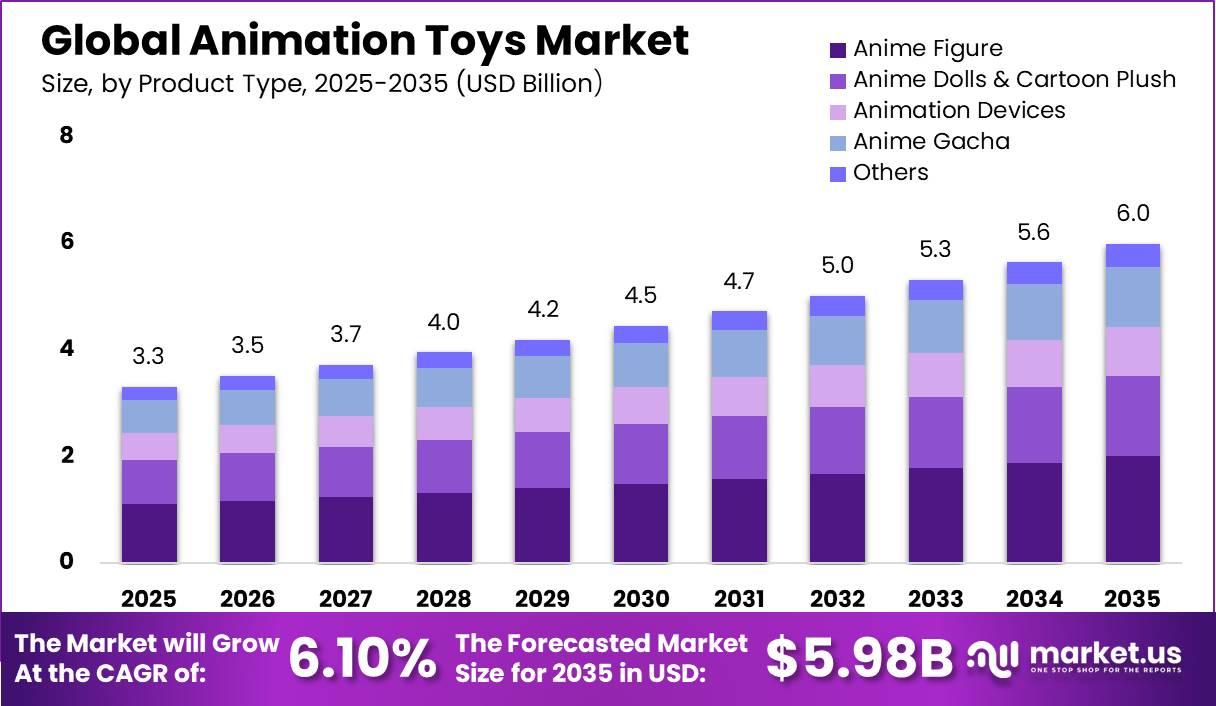
Global Animation Toys Market size is expected to be worth around USD 5.98 Billion by 2035 from USD 3.31 Billion in 2025, growing at a CAGR of 6.1% during the forecast period 2026 to 2035. This trajectory positions animation toys as one of the most consistently expanding sub-sectors within the broader global toy industry.
The animation toys market covers physical and interactive products inspired by animated characters, franchises, and storytelling formats across film, television, and digital media. This market spans anime figures, cartoon plush toys, animation devices, gacha toys, and character-based playsets. Products serve both children and adult collectors. Distribution flows through specialty retail, mass-market channels, and online platforms.
Key Takeaways
- Global Animation Toys Market is valued at USD 3.31 Billion in 2025 and is forecast to reach USD 5.98 Billion by 2035.
- The market grows at a CAGR of 6.1% during the forecast period 2026 to 2035.
- By Product Type, Anime Figures dominate with a 33.50% share in 2025.
- By Category, Recreational Toys hold the leading position with a 72.00% share.
- By Age Group, School-Age Children (6–12 Years) represent the dominant end-user segment with a 34.90% share.
- By Price Range, the Mid-Range (USD 15–50) tier leads with a 46.00% share.
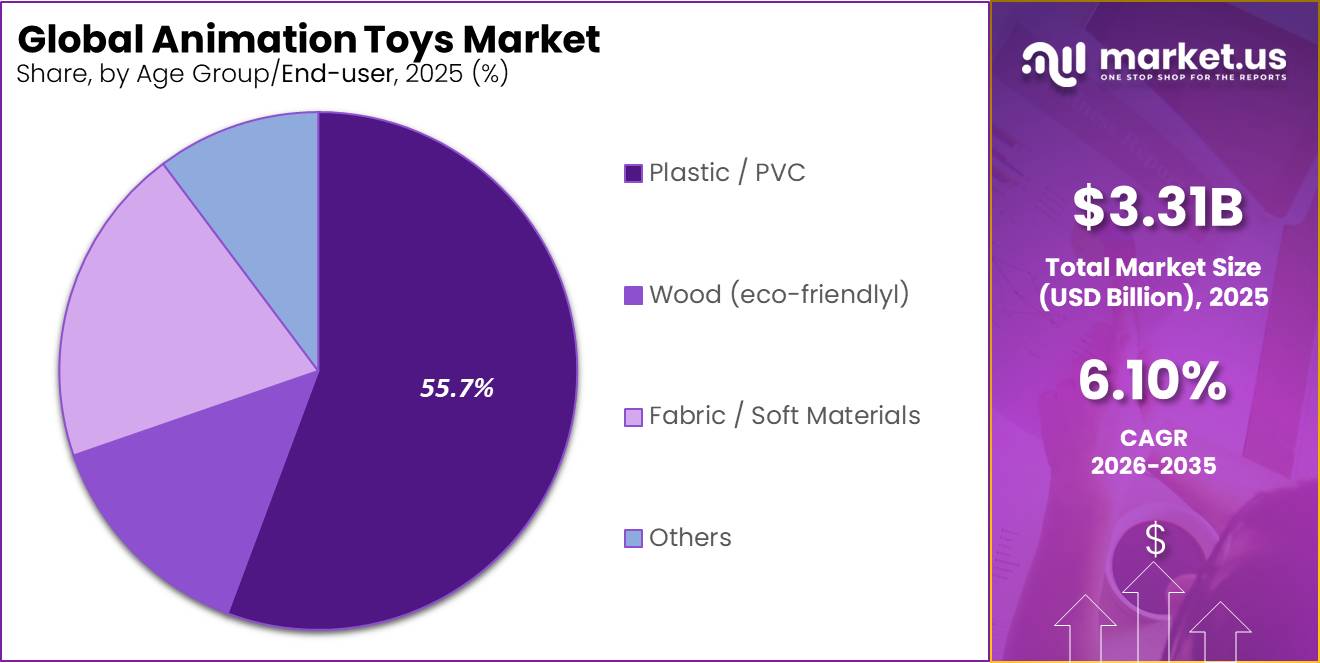
- By Material, Plastic / PVC is the dominant material with a 55.70% share.
- By Distribution Channel, Offline channels lead with a 54.00% share.
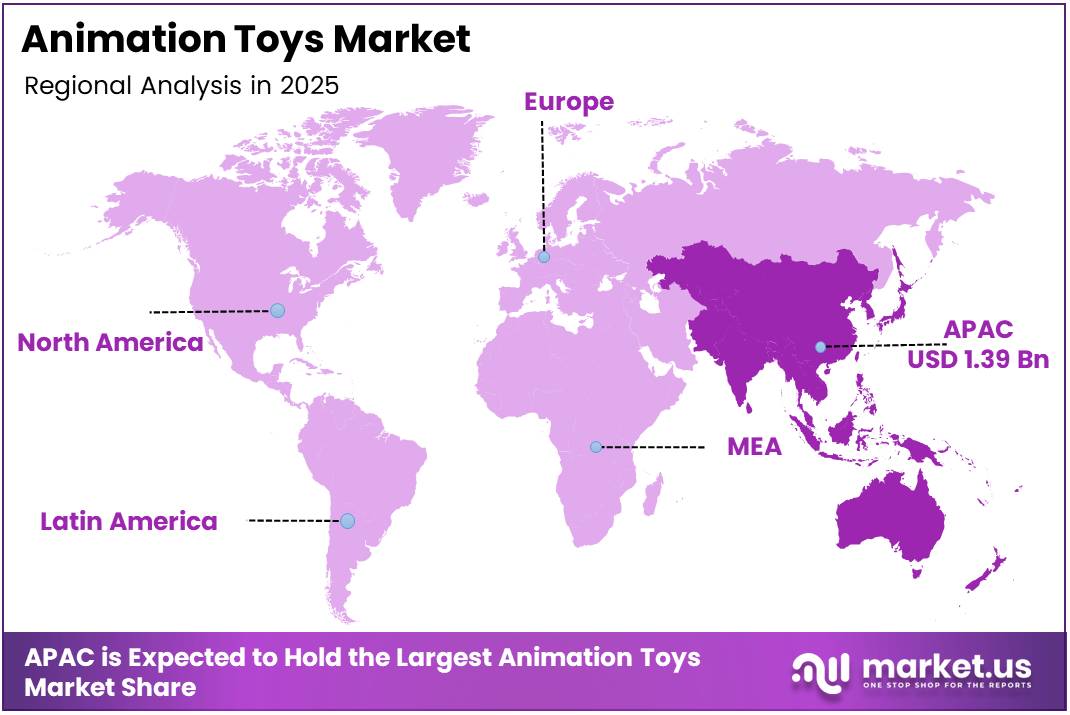
- Asia Pacific is the dominant region with a 42.50% market share, valued at USD 1.39 Billion in 2025.
According to the Toy Association, licensed toys represented 37% of U.S. toy sales and 35% of global toy sales in H1 2025. Licensed toy sales also grew 18% in the U.S. and 17% globally year over year. This scale of licensed activity directly benefits animation toy producers, since character-driven products constitute the core of licensed toy programs worldwide.
The Toy Association also reported that global licensed toy sales grew 15% and accounted for 37% of the global toy market in 2025, while nearly 40% of European consumers purchased toys for themselves or another adult. This adult-buyer expansion widens the addressable market for animation toys beyond traditional child-focused retail. As a result, premium collectibles and franchise-tied products now carry stronger commercial viability across age groups.
In February 2026, Hasbro was reported to be expanding licensing agreements for Harry Potter toy rights, with new product lines planned for release starting 2027 across action figures and interactive collectibles. This reflects a broader market trend of heritage IP being reactivated for both new and returning audiences. Consequently, animation toy producers with strong IP pipelines hold a structural advantage in capturing multi-cycle consumer demand.
Product Type Analysis
Anime Figures dominates with 33.50% due to strong collector demand across global markets.
In 2025, Anime Figures held a dominant market position in the By Product Type segment of the Animation Toys Market, with a 33.50% share. These products attract both children and adult collectors seeking detailed, character-accurate representations of franchise heroes. High perceived value and display appeal support premium pricing. This positions anime figures as the most commercially resilient sub-segment within the product type landscape.
Anime Dolls and Cartoon Plush occupy the second tier in product type performance. These products serve younger consumers and gifting occasions across mass-market channels. Their accessibility in price and format makes them strong candidates for impulse purchases and seasonal demand peaks. Retailers benefit from faster inventory turnover with this format compared to premium collectible figures.
Animation Devices, including flip books, zoetropes, and stop-motion kits, serve educational and creative play needs among school-age children. These products align with STEM and creative arts curriculum themes, giving them institutional sales potential alongside standard retail. Their unit economics differ from character-based toys, with higher perceived educational value supporting price premiums in specialty formats.
Anime Gacha products, alongside other formats in this segment, collectively hold the remaining share. Gacha mechanics drive repeat purchase behavior through randomized collectible reveal formats. This model generates strong revenue-per-consumer ratios despite lower individual unit prices. Together, these smaller sub-segments extend the reach of the animation toys category into impulse and blind-box retail environments.
Category Analysis
Recreational Toys dominates with 72.00% due to broad appeal across child play categories.
In 2025, Recreational Toys held a dominant market position in the By Category segment of the Animation Toys Market, with a 72.00% share. This category spans collectibles, playsets, roleplay formats, and character action figures. These product types serve casual play and fan engagement simultaneously. The breadth of formats under this umbrella makes recreational toys the structural backbone of animation toy revenues.
Collectibles and display figures represent a high-growth sub-segment within recreational toys. According to the Toy Association, global collectible toy sales increased by 35% in H1 2025 and grew 32% globally for the full year, reaching nearly 19% of total toy-industry dollar sales. This pace signals that collectibles are no longer a niche channel. Brands that prioritize collector-grade production quality stand to capture disproportionate share in this fast-scaling sub-market.
Playsets and roleplay products serve children seeking immersive character interaction rather than passive display. These formats require broader character ecosystems to sustain repeat purchasing, making franchise depth a competitive advantage. Brands with multi-character IP libraries can extend playset lines across seasons, generating recurring revenue streams that single-character products cannot replicate.
Learning and Educational Toys hold the remaining category share, covering STEM animation kits, creative arts and animation studio kits, and coding-plus-animation toys. This sub-segment benefits from parental willingness to spend on products with developmental justification. However, its 28% share ceiling within the overall category reflects the reality that entertainment value outweighs educational positioning for most animation toy buyers.
Age Group Analysis
School-Age Children (6–12 Years) dominates with 34.90% due to active franchise media consumption patterns.
In 2025, School-Age Children aged 6 to 12 years held a dominant market position in the By Age Group segment of the Animation Toys Market, with a 34.90% share. This cohort actively follows animated series and gaming franchises, creating sustained demand for character-related products. Their purchasing decisions are heavily influenced by peer trends and media exposure. As per our research, consumers aged 12 and older drove 32% growth in collectible toy demand in 2025, signaling that this group’s engagement extends well beyond the core 6 to 12 age bracket.
Adults and Kidults aged 18 years and above represent the most commercially transformative buyer group in this market. According to The Guardian, adult consumers represented one-third of total toy spending in the United Kingdom during 2025, reflecting strong demand for collectible and animation-related toys among older buyers. This cohort purchases for display, identity expression, and nostalgia. Brands that design for adult aesthetics and shelf presence unlock a high-value revenue channel distinct from traditional child-targeted toy lines.
Teenagers aged 13 to 18 years bridge casual play and collector behavior. This group responds strongly to limited-edition drops, social media product reveals, and fandom-driven purchasing events. Their buying decisions amplify social commerce sales and drive short-cycle inventory movements. Brands that engage teenage audiences through digital content and influencer partnerships gain a behavioral advantage in driving initial sell-through velocity.
Price Range Analysis
Mid-Range (USD 15–50) dominates with 46.00% due to broad consumer affordability and franchise alignment.
In 2025, Mid-Range toys priced between USD 15 and USD 50 held a dominant market position in the By Price Range segment of the Animation Toys Market, with a 46.00% share. This tier captures the widest buyer base because it sits above impulse-price thresholds while remaining accessible for regular purchases. Most mainstream licensed character toys from established franchises are priced within this band. Retailers prioritizing this tier face the highest competition but benefit from the most consistent sell-through rates.
Premium toys priced between USD 50 and USD 150 serve dedicated collectors and gift buyers. This tier benefits from the continued growth of the adult collector segment. Products at this price point typically offer higher articulation detail, better materials, and official licensing. Brands that invest in premium-tier product development build barriers against mass-market competition while accessing a buyer group with higher per-transaction spending.
Ultra-Premium and Collector-grade toys priced above USD 150 and Mass Economy products priced below USD 15 collectively hold the remaining share. The ultra-premium segment is structurally small but high-margin. The economy segment serves price-sensitive buyers and impulse retail environments. Together, these two endpoints of the price spectrum serve distinct consumer motivations that do not compete directly with the dominant mid-range tier.
Material Analysis
Plastic / PVC dominates with 55.70% due to cost efficiency and detailed character reproduction.
In 2025, Plastic and PVC materials held a dominant market position in the By Material segment of the Animation Toys Market, with a 55.70% share. These materials allow precise molding of character features at commercially viable cost points. Their durability suits both child play and display use cases. This structural advantage makes plastic and PVC the default choice for mainstream anime figures, action figures, and gacha products across all price tiers.
Wood-based eco-friendly materials serve the educational and environmentally conscious buyer segment. These products attract premium pricing in specialty and natural toy channels. Fabric and soft materials serve the plush and sensory toy formats favored by younger children and gift purchasers. Together, wood, fabric, and other non-plastic materials occupy the remaining share, serving distinct buyer motivations that plastic-dominant products do not fully address.
Distribution Channel Analysis
Offline dominates with 54.00% due to physical trial and specialty retail strength.
In 2025, Offline channels held a dominant market position in the By Distribution Channel segment of the Animation Toys Market, with a 54.00% share. Specialty toy stores, supermarkets, department stores, hobby and collectible shops, and theme park retail all contribute to this channel’s scale. Physical retail allows buyers to assess product quality directly, which matters especially for premium and collector-grade animation toys. This tactile advantage sustains offline dominance despite the growth of digital purchasing formats.
Online distribution holds the remaining 46% share and is structurally gaining ground. According to our research, licensed toys generated USD 46.4 Billion in sales in 2025 and online retail accounted for 32% of global licensed merchandise sales, while social commerce contributed 16% of online licensed sales. This reflects a strong shift toward digital-first distribution of character and animation-based products. Brands that invest in D2C websites, marketplace presence, and social commerce capabilities position themselves ahead of this ongoing channel migration.
Key Market Segments
By Product Type
- Anime Figures
- Anime Dolls & Cartoon Plush
- Animation Devices (Flip Books, Zoetropes, Stop Motion)
- Anime Gacha (Gachapon)
- Others
By Category / Purpose
- Recreational Toys
- Collectibles & Display Figures
- Playsets & Roleplay
- Character Action Figures
- Learning / Educational Toys
- STEM Animation Kits
- Creative Arts & Animation Studio Kits
- Coding + Animation Toys
By Age Group / End User
- Toddlers (0–3 Years)
- Preschoolers (3–5 Years)
- School-Age Children (6–12 Years)
- Teenagers (13–18 Years)
- Adults / Kidults (18 Years & Above)
By Price Range
- Mass / Economy (Below USD 15)
- Mid-Range (USD 15–50)
- Premium (USD 50–150)
- Ultra-Premium / Collector (Above USD 150)
By Material
- Plastic / PVC
- Wood (eco-friendly, educational)
- Fabric / Soft Materials
- Others
By Distribution Channel
- Offline
- Specialty Toy Stores
- Supermarkets & Hypermarkets
- Department Stores
- Hobby & Collectible Shops
- Theme Park & Entertainment Venue Retail
- Online
- E-commerce Marketplaces
- Brand-Owned D2C Websites
- Social Commerce
- Subscription Toy Boxes
Regional Analysis
Asia Pacific Dominates the Animation Toys Market with a Market Share of 42.50%, Valued at USD 1.39 Billion
Asia Pacific holds the largest share of the global animation toys market at 42.50%, valued at USD 1.39 Billion in 2025. This dominance reflects the region’s role as both a production hub and a primary consumer market for anime and animation-based intellectual property. Japan and South Korea generate globally distributed character franchises. China contributes manufacturing scale and a fast-growing domestic collector base, reinforcing the region’s dual structural advantage.
North America represents the second-largest regional market, supported by high per-capita toy spending and deep franchise licensing infrastructure. The region’s retail network spans mass-market chains, specialty hobby stores, and a mature e-commerce ecosystem. Licensed character toys dominate consumer spending in this region. According to the Toy Association, Pokémon alone generated USD 2.5 Billion in U.S. toy sales in 2025, increasing 87% year over year, confirming the outsized revenue impact of single franchise success in this market.
Europe holds a structurally important position in the animation toys market, driven by high collector engagement and adult buyer participation. Data from Le Monde shows toy sales to people aged over 12 increased by 22% in France in 2025, making this demographic a key growth driver in the regional toy market. Western European consumers show strong willingness to spend on licensed and premium animation products. This makes Europe a priority target for collector-grade and heritage IP product lines.
Key Regions and Countries
North America
- US
- Canada
Europe
- Germany
- France
- The UK
- Spain
- Italy
- Rest of Europe
Asia Pacific
- China
- Japan
- South Korea
- India
- Australia
- Rest of APAC
Latin America
- Brazil
- Mexico
- Rest of Latin America
Middle East and Africa
- GCC
- South Africa
- Rest of MEA
Drivers
Nostalgia-driven IP re-launches are generating measurable demand in the animation toy market as heritage brands attract audiences beyond their original fan base. Consumer trend tracking recorded a 140% increase in searches for 2000s-era kids’ toys in 2026. A growing portion of this engagement comes from younger consumers unfamiliar with the original properties. This audience expansion allows IP owners to reactivate existing content libraries rather than depending entirely on new entertainment releases.
Classic character and toy lines gain renewed commercial traction through updated designs, modern storytelling, and cross-category collaborations. Reintroduced brands benefit from built-in consumer awareness, which lowers marketing costs compared to entirely new IP launches. This trend extends demand cycles and increases the long-term value of established character libraries. IP owners who move early on nostalgia relaunch strategies capture incremental toy demand while extending the commercial life of proven properties.
| Driver | (~) % Impact on CAGR Forecast | Geographic Relevance | Impact Timeline |
|---|---|---|---|
| Household spending resilience lift | +2.0% | North America core, Western Europe, Australia | Short term (≤ 2 years) |
| Pop-culture velocity licensing | +2.4% | North America, EU, advanced APAC, South Korea | Short term (≤ 2 years) |
| Kidult gifting expansion | +2.2% | North America core, Japan, South Korea, Western Europe | Medium term (2-4 years) |
| Nostalgia IP re-launch cycles | +1.9% | North America, EU, Japan, global heritage-brand markets | Medium term (2-4 years) |
| Screen-free cozy play demand | +1.6% | North America, EU, Australia, advanced APAC | Long term (≥ 4 years) |
| Creator-maker toy demand | +1.7% | North America core, EU, India urban, APAC metros | Medium term (2-4 years) |
Restraints
Safety compliance cost inflation constrains the animation toy market through mandatory product-testing and certification obligations. Toys sold in the U.S. must comply with ASTM F963-23, meet federal phthalates restrictions, and be supported by a Children’s Product Certificate. Compliance records must be maintained for 5 years, extending administrative obligations well beyond initial product launch. Regulatory agencies conduct import-entry examinations and ongoing market surveillance to verify continued compliance.
Each new character variant, accessory pack, or electronic feature may require separate testing rather than relying on prior product approvals. This increases certification costs and extends commercialization timelines for licensed toy programs. The burden is highest for low-volume character extensions where compliance costs spread across fewer units. Consequently, some niche licensed products become economically unviable despite genuine consumer demand for them.
| Restraint | (~) % Impact on CAGR Forecast | Geographic Relevance | Impact Timeline |
|---|---|---|---|
| Tariff-led import cost burden | -2.2% | North America core, China-linked supply routes, import-heavy EU spillover | Short term (≤ 2 years) |
| Safety compliance cost inflation | -1.6% | North America, EU, UK, advanced APAC | Medium term (2-4 years) |
| Retail shelf-space concentration | -1.4% | North America core, Western Europe, modern retail APAC | Medium term (2-4 years) |
| Hit-franchise revenue concentration | -1.5% | Global licensed-toy markets | Short term (≤ 2 years) |
| Holiday-season demand compression | -1.3% | North America, EU, Japan, Australia | Long term (≥ 4 years) |
| Mass-market price ceilings | -1.2% | North America, Latin America, price-sensitive EU segments | Medium term (2-4 years) |
Challenges
Hit-driven inventory planning remains a persistent operational challenge in the animation toy market because production decisions must be made before content commercial performance is confirmed. Breakout franchises quickly create stock shortages and lost full-price sales, while weaker properties generate excess inventory and discounting pressure. U.S. toy sales increased 6% in 2025, supported by 3% unit growth and 4% growth in average selling prices. Higher-value licensed products amplify the financial consequences of forecasting errors.
Traditional long-cycle planning models are becoming less effective as entertainment release windows shorten and fan-driven demand spikes in unpredictable patterns. Small miscalculations in demand now create larger working-capital and inventory risks than in prior periods. Manufacturers are shifting toward smaller initial production runs and faster replenishment strategies to manage this exposure. This creates a structural advantage for producers with flexible, near-shore manufacturing relationships over those reliant on fixed long-lead production models.
| Challenge | (~) % CAGR Friction Drag | Geographic Relevance | Mitigation Horizon |
|---|---|---|---|
| License cycle volatility | -1.5% | North America core, EU retail hubs, Japan | Medium term (2-4 years) |
| Hit-driven inventory planning | -1.4% | Global franchise-led markets | Short term (≤ 2 years) |
| Channel margin compression | -1.2% | North America, Western Europe, advanced APAC | Medium term (2-4 years) |
| Adult-fan demand forecasting | -1.1% | North America, Japan, South Korea, EU | Medium term (2-4 years) |
| Short SKU life cycles | -1.3% | Global mass retail and e-commerce markets | Long term (≥ 4 years) |
| Discretionary wallet competition | -1.0% | North America core, EU, Australia | Short term (≤ 2 years) |
Opportunities
Franchise fast-drop toy launches represent a concrete revenue opportunity as entertainment-driven consumer demand peaks sharply around release windows. One major animated film generated USD 1.703 Billion in global box-office revenue, including USD 390 Million domestically and USD 1.313 Billion internationally. This audience scale demonstrates the commercial energy available to toy producers who synchronize product availability with peak fan engagement periods.
Faster development cycles allow character toys, accessories, and role-play products to reach consumers within weeks of major entertainment events. This requires agile licensing approvals, flexible manufacturing processes, and tighter retail coordination than traditional toy launch models. Companies that close the gap between content release and product availability capture higher sell-through rates at full price. This means early-mover alignment with entertainment studios is a direct competitive advantage, not simply a logistics preference.
| Opportunity | (~) % Potential CAGR Upside | Geographic Relevance | Execution Window |
|---|---|---|---|
| Adult collector animation lines | +2.6% | North America core, Japan, South Korea, Western Europe | Short term (≤ 2 years) |
| Franchise fast-drop toy launches | +2.3% | North America, China, EU major retail markets | Short term (≤ 2 years) |
| Screen-to-play digital bundles | +1.9% | North America, advanced APAC, EU digital-native households | Medium term (2-4 years) |
| Preschool learning-character formats | +1.8% | North America, India urban, Southeast Asia, EU | Medium term (2-4 years) |
| Secondary character monetization | +1.7% | Global franchise-led markets | Long term (≥ 4 years) |
| Subscription fandom boxes | +1.5% | North America, UK, Japan, Australia | Medium term (2-4 years) |
Key Company Insights
Mattel, Inc. holds deep structural advantages in the animation toys market through its multi-franchise IP portfolio spanning Barbie, Hot Wheels, and Thomas and Friends. In September 2025, Mattel partnered with Cottage Door Press to expand licensed content for the Luna StoryTime projector, integrating these characters into interactive storytelling formats. This positions Mattel to monetize its IP across physical toy categories and adjacent media product segments simultaneously.
Hasbro, Inc. drives competitive positioning through rapid licensed product deployment across entertainment cycles. In March 2025, Hasbro unveiled new product launches at Toy Fair including PLAY-DOH Barbie, Furby Minis, Beyblade X upgrades, and Transformers Cyberworld under multiple licensed entertainment collaborations. The Toy Association data shows Pokémon generated USD 2.5 Billion in U.S. toy sales in 2025, rising 87% year over year, confirming the outsized revenue concentration risk and reward that single-franchise success creates for major licensees like Hasbro.
Key Players
- Mattel, Inc.
- Hasbro, Inc.
- Bandai Namco Holdings Inc. (Bandai Spirits)
- The LEGO Group
- Good Smile Company, Inc.
- Funko, Inc.
- Spin Master Corp.
- Kotobukiya Co., Ltd.
- JAKKS Pacific, Inc.
- Max Factory (Good Smile subsidiary)
- Playmates Toys Limited
- McFarlane Toys
- MGA Entertainment
- Aniplex Inc. (Sony Music Group)
- Dream International Limited
Recent Developments
- November 2025 – Mirana Toys raised ₹57.5 crore Series A funding to expand manufacturing capacity, injection molding infrastructure, and global distribution for smart and educational toys.
- September 2025 – Mattel partnered with Cottage Door Press to expand licensed content for the Luna StoryTime projector, featuring Barbie, Hot Wheels, and Thomas and Friends characters.
- September 2025 – Hasbro and Disney expanded their PLAY-DOH collaboration with new Disney Jr.-inspired playsets designed to integrate character storytelling with sensory toy systems.
Report Scope
| Report Features | Description |
|---|---|
| Market Value (2025) | USD 3.31 Billion |
| Forecast Revenue (2035) | USD 5.98 Billion |
| CAGR (2026-2035) | 6.1% |
| Base Year for Estimation | 2025 |
| Historic Period | 2020-2024 |
| Forecast Period | 2026-2035 |
| Report Coverage | Revenue Forecast, Market Dynamics, Market Opportunity Analysis, Technology and Innovation Landscape, Competitive Landscape, Recent Developments |
| Segments Covered | By Product Type (Anime Figures, Anime Dolls and Cartoon Plush, Animation Devices, Anime Gacha, Others); By Category (Recreational Toys: Collectibles and Display Figures, Playsets and Roleplay, Character Action Figures; Learning and Educational Toys: STEM Animation Kits, Creative Arts and Animation Studio Kits, Coding and Animation Toys); By Age Group (Toddlers 0–3 Years, Preschoolers 3–5 Years, School-Age Children 6–12 Years, Teenagers 13–18 Years, Adults and Kidults 18 Years and Above); By Price Range (Mass Economy Below USD 15, Mid-Range USD 15–50, Premium USD 50–150, Ultra-Premium Collector Above USD 150); By Material (Plastic and PVC, Wood, Fabric and Soft Materials, Others); By Distribution Channel (Offline: Specialty Toy Stores, Supermarkets and Hypermarkets, Department Stores, Hobby and Collectible Shops, Theme Park and Entertainment Venue Retail; Online: E-commerce Marketplaces, Brand-Owned D2C Websites, Social Commerce, Subscription Toy Boxes) |
| Regional Analysis | North America (US and Canada), Europe (Germany, France, The UK, Spain, Italy, and Rest of Europe), Asia Pacific (China, Japan, South Korea, India, Australia, and Rest of APAC), Latin America (Brazil, Mexico, and Rest of Latin America), Middle East and Africa (GCC, South Africa, and Rest of MEA) |
| Competitive Landscape | Mattel, Inc., Hasbro, Inc., Bandai Namco Holdings Inc. (Bandai Spirits), The LEGO Group, Good Smile Company, Inc., Funko, Inc., Spin Master Corp., Kotobukiya Co., Ltd., JAKKS Pacific, Inc., Max Factory (Good Smile subsidiary), Playmates Toys Limited, McFarlane Toys, MGA Entertainment, Aniplex Inc. (Sony Music Group), Dream International Limited |
| Customization Scope | Customization for segments, region/country-level will be provided. Additional customization can be done based on requirements. |
| Purchase Options | We have three licenses to opt for: Single User License, Multi-User License (Up to 5 Users), Corporate Use License (Unlimited User and Printable PDF) |





































