Report Overview
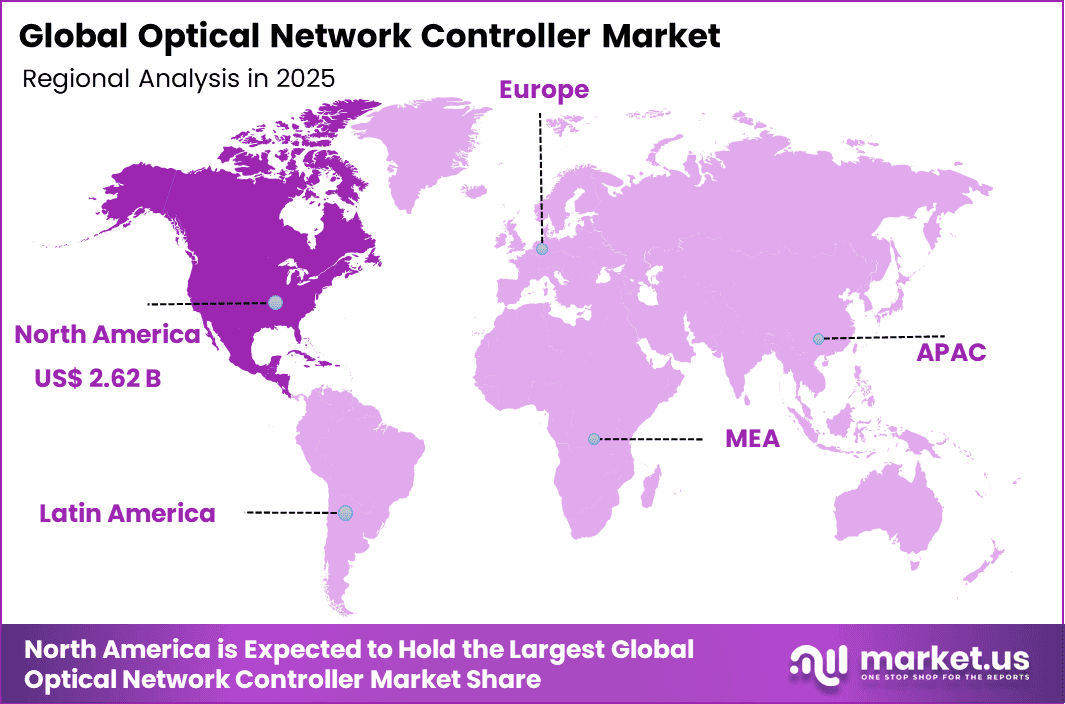
The Global Optical Network Controller Market generated USD 7.0 billion in 2025 and is predicted to register growth from USD 7.9 billion in 2026 to about USD 23.4 billion by 2035, recording a CAGR of 12.8% throughout the forecast span. In 2025, North America held a dominant market position, capturing more than a 37.4% share, with USD 2.62 billion in revenue.
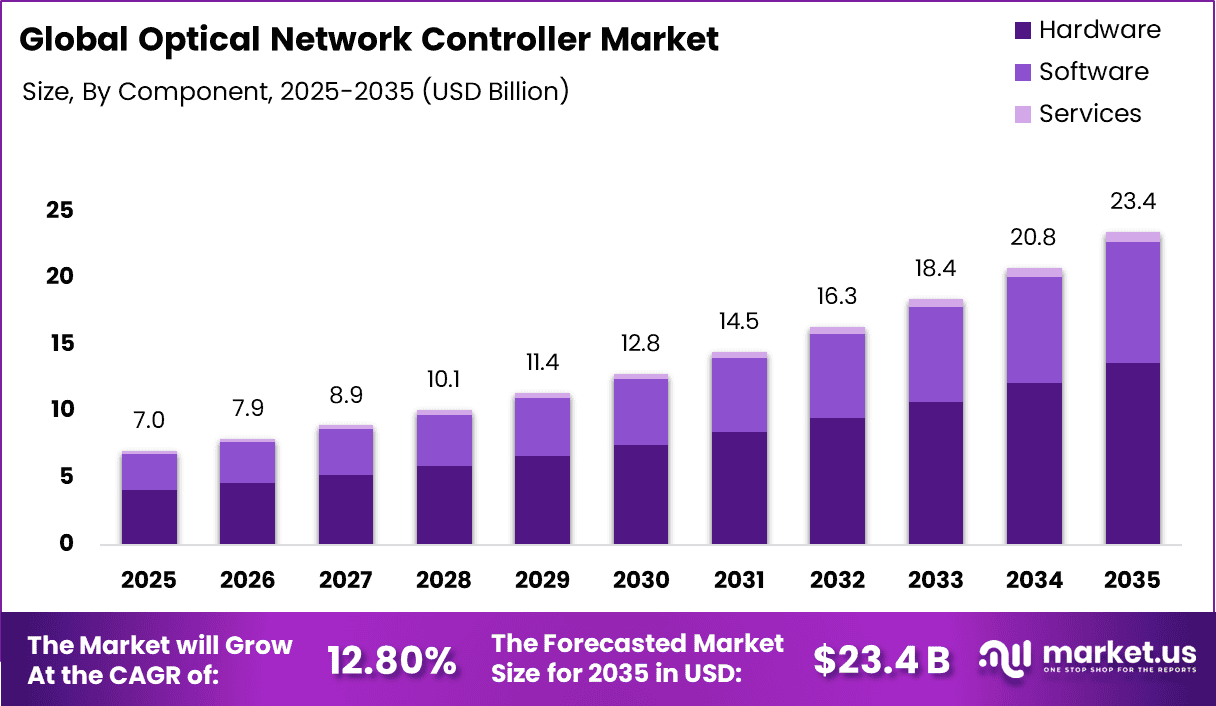
Optical Network Controller market refers to software-based platforms that manage, automate, and coordinate optical transport networks from a centralized control layer. These controllers help network operators handle service provisioning, path management, network monitoring, and resource allocation across fiber infrastructure.
One of the main factors driving this market is the growing need for automation in optical network management. Operators want to reduce manual configuration work, improve service activation speed, and use network resources more efficiently. Another important factor is the wider shift toward software-driven network operations, where centralized controllers help simplify traffic management and support more flexible handling of changing bandwidth requirements.
Top Market Takeaways
- Hardware commands 58.3% market share, delivering embedded controllers, transponders, and muxponders optimized for coherent optics and dynamic wavelength provisioning.
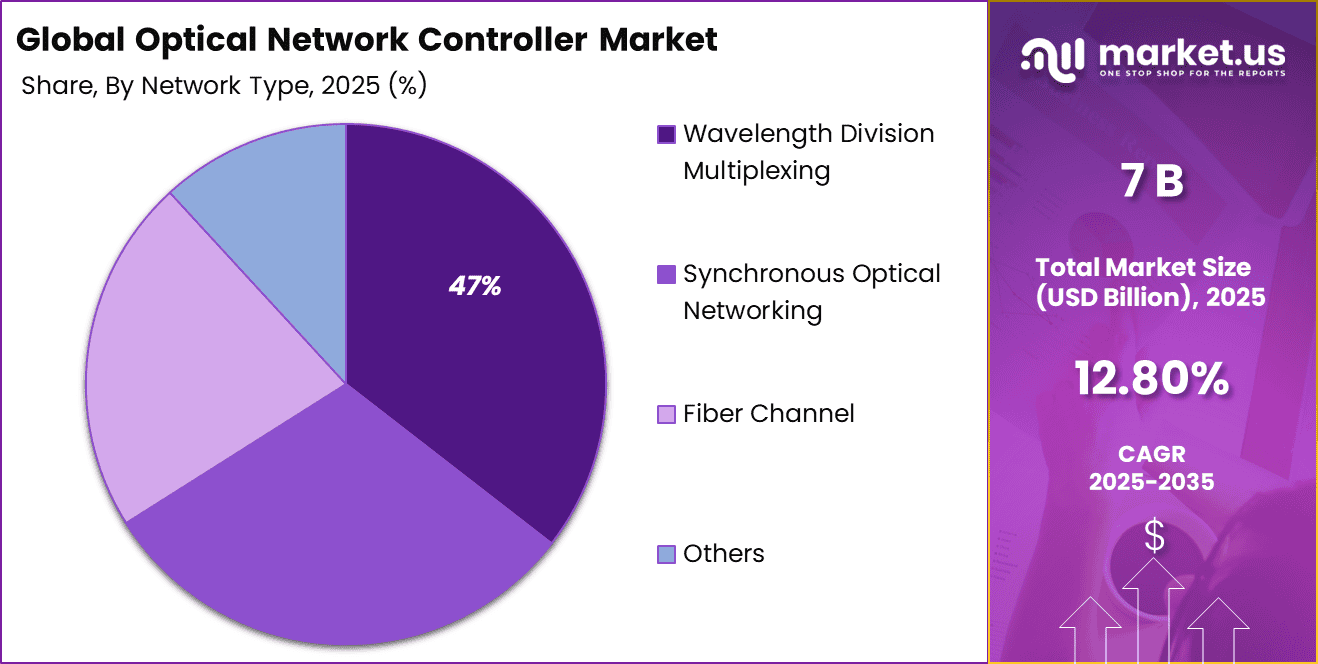
- Wavelength Division Multiplexing captures 46.5%, enabling high-capacity fiber utilization with ROADM integration and multi-terabit spectrum efficiency.
- Data center interconnect applications claim 40.8%, powering metro DCI fabrics, leaf-spine extensions, and low-latency 400G/800G optical bypass.
- Telecom & ISP sector holds 41.6%, leveraging controllers for DWDM network automation, alien wavelength support, and disaggregated open line systems.
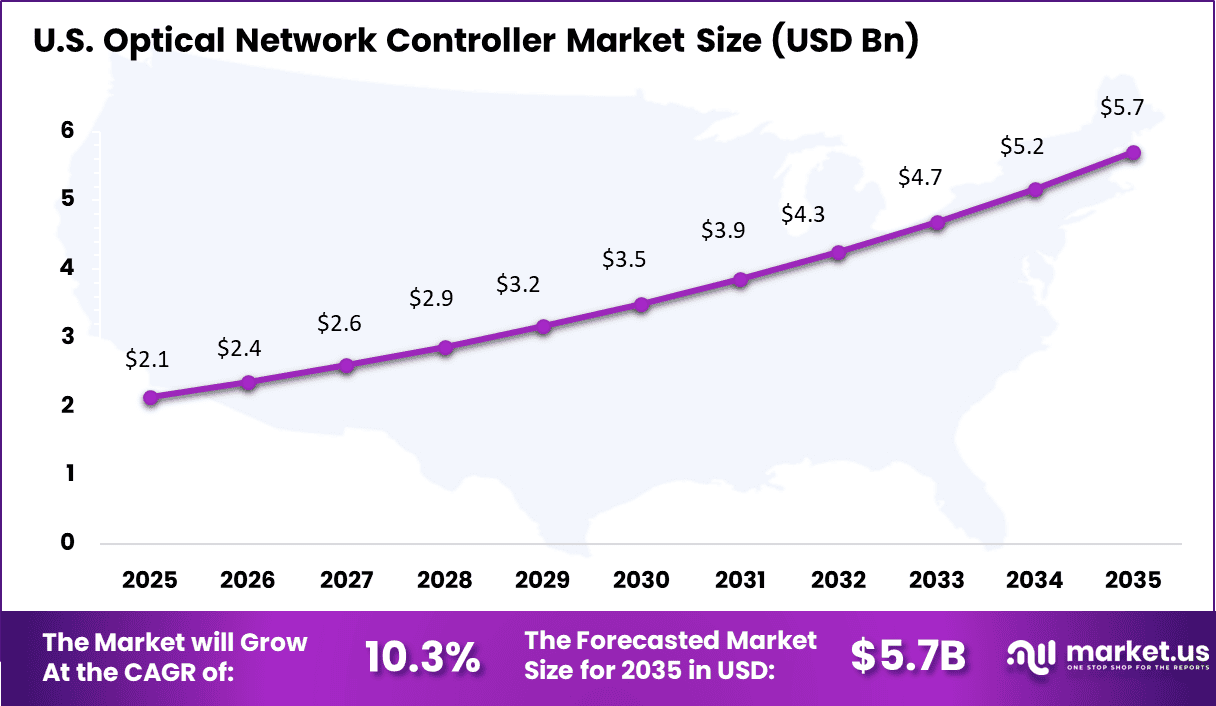
- North America drives 37.4% global value, with the U.S. market at USD 2.14 billion and 10.3% CAGR, fueled by cloud provider fiber buildouts.
By Component Analysis
Hardware accounted for 58.3% of the Optical Network Controller Market. This segment leads because controllers, switches, and optical transport equipment form the backbone of network control and signal management. These components enable efficient routing, monitoring, and optimization of optical traffic across high-capacity networks.
The segment is also supported by increasing demand for high-speed data transmission and reliable network infrastructure. Organizations invest in advanced hardware to manage growing data loads and ensure stable performance across optical communication systems.
By Network Type Analysis
Wavelength division multiplexing represented 47% of the market. This segment dominates because WDM technology allows multiple data signals to be transmitted simultaneously over a single optical fiber. It significantly improves bandwidth utilization and supports high-capacity communication networks.
The segment is driven by the need to handle increasing data traffic from cloud services, streaming, and enterprise applications. WDM enables efficient use of existing fiber infrastructure, which makes it a preferred choice for network expansion and optimization.
By Application Analysis
Data center interconnect accounted for 40.8% of the market. This segment leads because data centers require fast and reliable connectivity to transfer large volumes of data between locations. Optical network controllers help manage traffic flow and ensure efficient communication across interconnected facilities.
The segment is supported by the growth of cloud computing and large-scale data processing. As organizations expand data center capacity, the need for high-performance interconnect solutions continues to rise, driving demand for optical network controllers.
By End User Industry Analysis
Telecom and ISP represented 41.6% of the market. This segment dominates because telecom operators and internet service providers manage extensive optical networks that require advanced control systems. These organizations depend on optical controllers to optimize network performance and maintain service quality.
The segment is driven by increasing demand for high-speed internet and digital services. Telecom and ISP providers invest in optical network technologies to improve connectivity, expand coverage, and support growing data consumption across users and businesses.
Key Market Segments
By Component
- Hardware
- Software
- Services
By Network Type
- Wavelength Division Multiplexing
- Synchronous Optical Networking
- Fiber Channel
- Others
By Application
- Data Center Interconnect
- Metropolitan Area Networks (MAN)
- Long-Haul Networks
- Access Networks
- Others
By End-User Industry
- Telecom & ISP
- Enterprise Data Centers
- Government & Defense
- IT & Cloud
- Service Providers
- Others
Regional Analysis
North America accounted for 37.4% of the Optical Network Controller Market, reflecting strong deployment of advanced network management systems across telecom and data center infrastructure. Service providers across the region increasingly adopt optical network controllers to manage complex fiber networks, optimize bandwidth usage, and support high-speed data transmission.
The growing demand for reliable connectivity, expansion of cloud services, and rising data traffic continue to drive the adoption of intelligent optical control systems across North America.
The U.S. generated about USD 2.14 billion within the regional market and is projected to expand at a CAGR of 10.3%. Telecom operators and data center providers across the country continue to invest in solutions that improve network automation, visibility, and performance.
Optical network controllers enable efficient routing, faster fault detection, and better utilization of network resources. As digital infrastructure expands and demand for high-capacity networks increases, adoption of optical network control technologies continues to grow steadily across the US market.
Key Regions and Countries
- North America
- US
- Canada
- Europe
- Germany
- France
- The UK
- Spain
- Italy
- Russia
- Netherlands
- Rest of Europe
- Asia Pacific
- China
- Japan
- South Korea
- India
- Australia
- Singapore
- Thailand
- Vietnam
- Rest of APAC
- Latin America
- Brazil
- Mexico
- Rest of Latin America
- Middle East & Africa
- South Africa
- Saudi Arabia
- UAE
- Rest of MEA
Drivers Impact Analysis
| Key Driver | Impact on CAGR Forecast (~%) | Geographic Relevance | Impact Timeline | Strategic Effect |
|---|---|---|---|---|
| Rising demand for high bandwidth and data traffic management | +2.9% | North America, Europe, Asia Pacific | Short to Mid Term (2025–2031) | Enhances network capacity optimization |
| Increasing deployment of 5G and fiber optic networks | +2.6% | Asia Pacific, North America, Europe | Mid Term (2026–2032) | Supports advanced optical networking |
| Growing adoption of software-defined networking in telecom | +2.4% | Global | Mid Term (2026–2032) | Improves network programmability |
| Expansion of data centers and cloud infrastructure | +2.2% | Global | Mid to Long Term (2026–2035) | Drives need for efficient optical control |
| Telecom operators focus on automation and network efficiency | +2.0% | Global | Mid to Long Term (2026–2035) | Reduces operational complexity |
Restraints Impact Analysis
| Key Restraint | Impact on CAGR Forecast (~%) | Geographic Relevance | Impact Timeline | Strategic Effect |
|---|---|---|---|---|
| High cost of optical network infrastructure upgrades | -2.3% | Global | Mid Term (2026–2032) | Limits adoption among smaller operators |
| Complexity in integrating legacy optical systems | -2.1% | North America, Europe | Mid Term (2026–2032) | Delays modernization |
| Lack of skilled workforce in optical networking technologies | -1.9% | Global | Mid Term (2026–2032) | Slows implementation |
| Interoperability issues across multi-vendor networks | -1.7% | Global | Mid Term (2026–2032) | Creates deployment challenges |
| Regulatory and compliance challenges in telecom sector | -1.5% | Europe, North America | Mid to Long Term (2026–2035) | Adds operational complexity |
Investor Type Impact Analysis
| Investor Type | Growth Sensitivity | Risk Exposure | Geographic Focus | Investment Outlook |
|---|---|---|---|---|
| Venture Capital Firms | Medium to High | Medium | US, Europe | Growth in network automation solutions |
| Private Equity Firms | High | Medium | North America, Europe | Expansion in telecom infrastructure |
| Strategic Technology Investors | High | Medium | US, China, Japan | Strengthens optical networking ecosystem |
| Corporate Venture Arms | Medium to High | Medium | Global | Supports telecom and cloud integration |
| Government and Infrastructure Funds | Medium | Low | Asia Pacific, Europe | Supports digital connectivity initiatives |
Technology Enablement Analysis
| Technology Enabler | Impact on CAGR Forecast (~%) | Geographic Relevance | Impact Timeline | Implementation Significance |
|---|---|---|---|---|
| Software-defined optical networking platforms | +3.0% | Global | Short to Mid Term (2025–2031) | Enables network programmability |
| Integration with 5G and high-speed fiber networks | +2.7% | North America, Asia Pacific, Europe | Mid Term (2026–2032) | Improves network performance |
| AI-driven network optimization and automation | +2.5% | Global | Mid to Long Term (2026–2035) | Enhances operational efficiency |
| Cloud-based network control and orchestration | +2.3% | Global | Mid Term (2026–2032) | Supports scalable infrastructure |
| Real-time network monitoring and analytics tools | +2.1% | Global | Mid to Long Term (2026–2035) | Improves decision making |
Key Challenges
- Integration with existing optical transport systems is a major challenge because many networks still use older hardware, software, and vendor-specific protocols.
- Managing real-time network visibility is difficult because optical controllers must monitor performance, faults, and traffic changes across complex network environments.
- Interoperability remains a key issue because controllers often need to work across equipment from different vendors with different standards and interfaces.
- High deployment cost can slow adoption because optical network controllers may require software upgrades, system redesign, and skilled technical support.
- Cybersecurity is also a growing concern because centralized network control systems can become targets for unauthorized access, service disruption, or data misuse.
Emerging Trends
A key trend in the Optical Network Controller market is the growing shift toward software-driven network management that enables centralized control of optical infrastructure. Network controllers are increasingly used to automate configuration, monitor performance, and adjust bandwidth allocation in real time.
This allows operators to manage complex optical networks more efficiently while responding quickly to changing traffic demands. The trend reflects a move toward intelligent network orchestration where manual intervention is reduced, and operations become more adaptive.
Growth Factors
The rising demand for high-speed data transmission is supporting the growth of optical network controller solutions. As data traffic continues to increase across enterprise, cloud, and communication networks, operators require better tools to manage optical resources effectively. Controllers help improve network efficiency by optimizing traffic flow and reducing operational complexity.
At the same time, the expansion of data-intensive applications encourages the adoption of advanced network management solutions that ensure stable and reliable connectivity across large-scale optical systems.
Competitive Analysis
The competitive landscape of the Optical Network Controller market includes major optical networking and telecom infrastructure companies that provide control, automation, and traffic management solutions. Ciena Corporation, Huawei Technologies, Cisco Systems, Inc., and Juniper Networks hold strong positions because they offer optical network control platforms that help operators improve bandwidth use, network visibility, and service efficiency across complex fiber networks.
Other companies such as Xilinx, Inc., Lumentum Holdings, Tellabs, Inc., Broadcom Inc., and NeoPhotonics Corporation add competition by supporting the market with optical components, semiconductors, and enabling technologies that strengthen controller performance and network intelligence.
The market is shaped by automation capability, interoperability, software control, and the ability to support fast and reliable data transmission. Overall, competition remains strong as network operators invest in smarter and more flexible optical infrastructure.
Top Key Players in the Market
- Ciena Corporation
- Huawei Technologies
- Cisco Systems, Inc.
- Nokia Corporation
- Infinera Corporation
- ADVA Optical Networking
- Coriant GmbH
- Fujitsu Limited
- ZTE Corporation
- NEC Corporation
- Juniper Networks
- Xilinx, Inc.
- Lumentum Holdings
- Tellabs, Inc.
- Broadcom Inc.
- NeoPhotonics Corporation
- Others
Future Outlook
The future outlook for the Optical Network Controller Market looks strong as telecom operators, cloud providers, and data center networks increasingly need better automation, faster service activation, and easier control of multi-vendor optical infrastructure.
Current industry guidance shows that optical network control platforms are moving toward AI-powered automation, open APIs, and centralized visibility across network layers to improve planning, operations, and decision-making. As bandwidth demand keeps rising with cloud services, AI workloads, and high-capacity transport networks, demand for optical network controllers is expected to grow steadily in the coming years.
Recent Developments
- In March 2026, Huawei iMaster NCE-FAN Intelligent Engine launched at MWC Barcelona, orchestrating AI-powered private lines and 2T single-wavelength boards across China Telecom with 1ms metro latency. FANSpirit agent reduced broadband complaints 60% via predictive fault rectification.
- In February 2026, Cisco Crosswork Optical Network Optimizer 5.0 integrated Routed Optical Networking across NCS1006 platforms deployed in 200+ CSPs, achieving 40% spectrum efficiency gains. ACI Anywhere unified IP-optical fabric across 10K+ data centers.
Report Scope
| Report Features | Description |
|---|---|
| Market Value (2025) | USD 7.0 Billion |
| Forecast Revenue (2035) | USD 23.4 Billion |
| CAGR(2025-2035) | 12.8% |
| Base Year for Estimation | 2024 |
| Historic Period | 2020-2024 |
| Forecast Period | 2025-2035 |
| Report Coverage | Revenue forecast, AI impact on Market trends, Share Insights, Company ranking, competitive landscape, Recent Developments, Market Dynamics and Emerging Trends |
| Segments Covered | By Component (Hardware, Software, Services), By Network Type (Wavelength Division Multiplexing, Synchronous Optical Networking, Fiber Channel, Others), By Application (Data Center Interconnect, Metropolitan Area Networks (MAN), Others), By End-User Industry (Telecom & ISP, Enterprise Data Centers, Others) |
| Regional Analysis | North America – US, Canada; Europe – Germany, France, The UK, Spain, Italy, Russia, Netherlands, Rest of Europe; Asia Pacific – China, Japan, South Korea, India, New Zealand, Singapore, Thailand, Vietnam, Rest of Latin America; Latin America – Brazil, Mexico, Rest of Latin America; Middle East & Africa – South Africa, Saudi Arabia, UAE, Rest of MEA |
| Competitive Landscape | Ciena Corporation, Huawei Technologies, Cisco Systems, Inc., Nokia Corporation, Infinera Corporation, ADVA Optical Networking, Coriant GmbH, Fujitsu Limited, ZTE Corporation, NEC Corporation, Juniper Networks, Xilinx, Inc., Lumentum Holdings, Tellabs, Inc., Broadcom Inc., NeoPhotonics Corporation, Others |
| Customization Scope | Customization for segments, region/country-level will be provided. Moreover, additional customization can be done based on the requirements. |
| Purchase Options | We have three licenses to opt for: Single User License, Multi-User License (Up to 5 Users), Corporate Use License (Unlimited Users and Printable PDF) |