


Report Overview
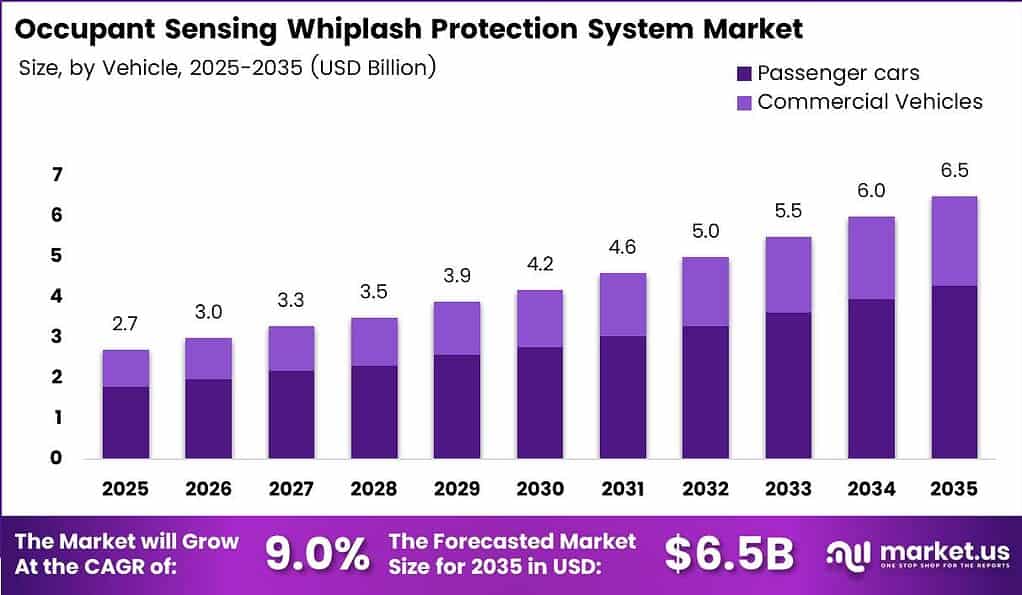
Global Occupant Sensing Whiplash Protection System Market size is expected to be worth around USD 6.5 Billion by 2035 from USD 2.7 Billion in 2025, growing at a CAGR of 9.0% during the forecast period 2026 to 2035.
The occupant sensing whiplash protection system market integrates pressure mats, interior radar, cameras, actuators, and restraint control software into cabin safety architectures. These systems detect seat occupancy, belt-use status, out-of-position occupants, and child presence. Their output triggers adaptive head restraint or restraint control responses calibrated to occupant mass, stature, and posture.
Key Takeaways
- The Global Occupant Sensing Whiplash Protection System Market is valued at USD 2.7 Billion in 2025 and is forecast to reach USD 6.5 Billion by 2035, growing at a CAGR of 9.0% during the forecast period 2026 to 2035.
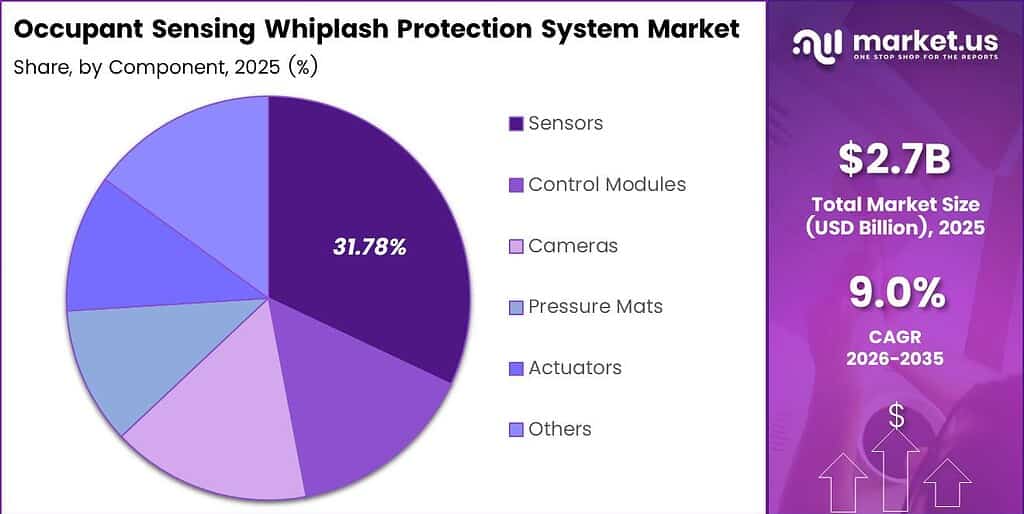
- By Component, Sensors dominate with a 31.78% share in 2025 and are also the fastest-growing component sub-segment, driven by direct occupant detection requirements under the 2026 Euro NCAP framework.
- By Vehicle, Passenger Cars hold the largest share at 62.56% in 2025 and are the fastest-growing vehicle type, supported by the highest new-vehicle production volumes and stringent occupant classification mandates.
- By End User, Automotive Manufacturers account for the dominant share at 42.11% in 2025, reflecting OEM-level program integration at the production stage across global vehicle platforms.
- Mobility Service Providers represent the fastest-growing end-user category, driven by variable occupancy demands in shared and autonomous mobility platforms requiring software-managed sensing stacks.
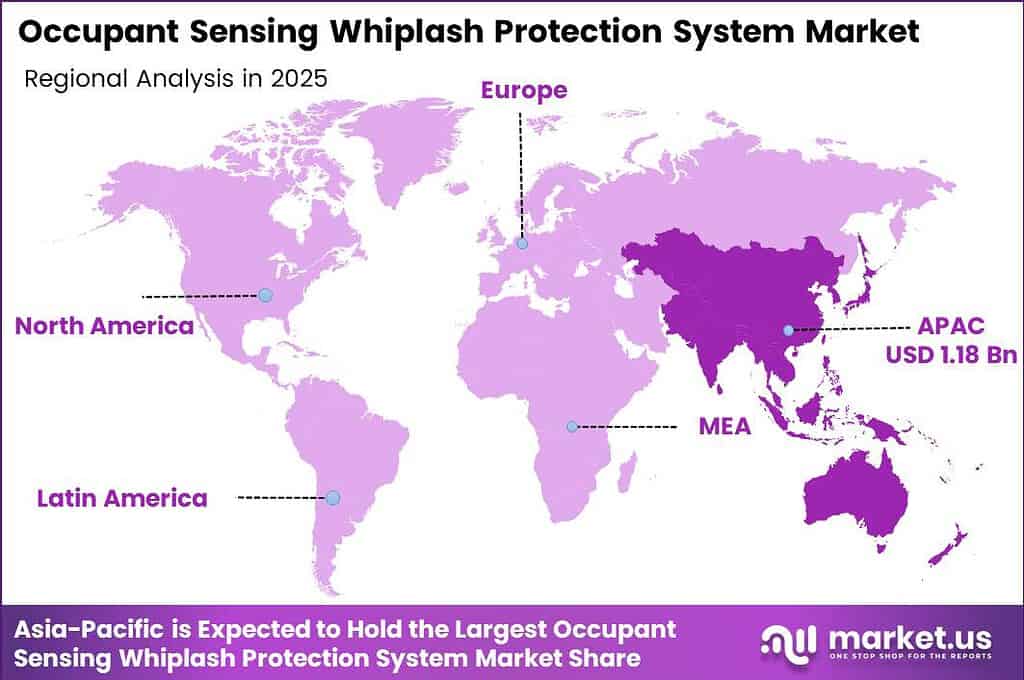
- Asia-Pacific dominates all regions with a 43.78% market share in 2025, valued at USD 1.18 Billion, supported by a regional vehicle production volume of approximately 59.2 million units, representing more than 61% of global output.
- Asia-Pacific is also the fastest-growing region, led by India’s passenger-vehicle sales growth of 7.9% in fiscal year 2025 to 2026 and China’s automobile market reaching approximately 23.7 million units in 2025.
Government regulators and safety assessment bodies are tightening occupant monitoring expectations at the program level. The 2026 Euro NCAP framework elevates scoring requirements for belt-misuse recognition, front-passenger posture awareness, and child-presence detection. This converts sensing from a premium add-on into a compliance necessity across vehicle programs targeting competitive safety ratings.
According to OICA, global vehicle production reached approximately 96.4 million units in 2025, up 3.9% from 2024. This production base provides the addressable platform volume that sensing system suppliers compete to penetrate. Bosch announced plans to invest more than €2.5 billion in artificial intelligence through 2027, including mobility applications, signaling that software-defined safety will intensify supplier competition.
As reported by IEA, electric-car sales exceeded 20 million units globally in 2025, growing 20% year over year. This electrification wave creates a structural opportunity because EV platforms require differentiated passive-safety credentials to compete on premium features. World Bank data projected global economic growth at 2.3% in 2025, meaning procurement decisions will remain cost-disciplined, placing pricing pressure on mid-tier sensing suppliers.
Component Analysis
Sensors dominate with 31.78% due to direct occupant detection and NCAP compliance pull.
In 2025, Sensors held a dominant market position in the By Component segment of the Occupant Sensing Whiplash Protection System Market, with a 31.78% share. Sensors serve as the primary input layer for all downstream restraint decisions, including occupant mass estimation, belt-state confirmation, and out-of-position detection. Their compliance relevance under the 2026 Euro NCAP framework makes them non-negotiable content on programs targeting competitive safety ratings, supporting sustained attach-rate expansion.
Control modules process sensor inputs and translate occupant data into restraint actuation commands. Their integration complexity rises with each additional sensing modality added to a vehicle platform. As per our research, higher sensor fusion demands are expanding control module content value per vehicle, making this sub-segment a key margin lever for Tier 1 suppliers managing software-defined architecture transitions.
Cameras add visual classification capability beyond weight or pressure data alone, enabling posture, stature, and child-seat detection at the cabin level. As per our research, camera adoption is constrained in privacy-sensitive fleet segments across Europe and North America. This creates a bifurcation where camera-based sensing grows faster in consumer vehicles while pressure and radar solutions retain priority in commercial and fleet applications.
Pressure mats, actuators, and other components collectively address specialized fitment requirements across seat rows and vehicle classes. As per our research, pressure mats remain cost-effective for front-row occupancy confirmation, while actuators are essential for active head restraint deployment. These sub-segments hold the remaining market share and serve as margin-support components within full cabin-safety stack configurations.
Vehicle Analysis
Passenger Cars dominate with 62.56% due to high production volume and NCAP-driven fitment mandates.
In 2025, Passenger Cars held a dominant market position in the By Vehicle segment of the Occupant Sensing Whiplash Protection System Market, with a 62.56% share. ACEA data shows approximately 256 million passenger cars operated on EU roads in 2024, up 1.4% year over year. This installed base and annual new-vehicle volume create the largest addressable platform for occupant sensing content expansion. Passenger cars also face the most stringent occupant classification requirements under evolving safety protocols.
Vans represent a structurally distinct sub-segment because their multi-row seating and frequent occupancy variation demand more complex sensing configurations than single-row passenger cars. ACEA data shows approximately 31.1 million vans on EU roads in 2024, up 1.9% year over year. Fleet operators managing van pools face increasing pressure to demonstrate occupant safety compliance, creating pull for sensing upgrades beyond baseline regulatory minimums.
Trucks present a more constrained fitment environment given cab architecture differences and lower per-unit sensing content budgets compared to passenger vehicles. ACEA data shows approximately 6.2 million trucks on EU roads in 2024. Commercial operators prioritize driver-seat protection and belt-use confirmation, concentrating sensing investment in single-occupant or dual-occupant cab configurations rather than multi-row systems. Denso announced a new plant with approximately ¥69 billion of investment targeting electrification and ADAS control units, which will also support commercial vehicle sensing content.
End User Analysis
Automotive Manufacturers dominate with 42.11% due to OEM-level program integration at production.
In 2025, Automotive Manufacturers held a dominant market position in the By End User segment of the Occupant Sensing Whiplash Protection System Market, with a 42.11% share. OEMs embed sensing systems at the program design stage, enabling full integration with restraint control architectures and safety validation pipelines. This structural position gives automotive manufacturers first access to new sensing technologies and creates long-duration supplier relationships built around platform lifecycles rather than individual model years.
Fleet operators represent a commercially distinct buyer segment with high vehicle counts but more standardized duty cycles than consumer vehicles. As per our research, fleet operators prioritize sensing functions tied to belt compliance and driver monitoring over full multi-occupant classification stacks. Autoliv’s 2025 product deliveries included approximately 143 million complete seatbelt systems, reflecting the scale at which restraint components move through fleet-dependent supply chains and the revenue density this creates for passive-safety suppliers.
Mobility service providers represent the fastest-growing end-user category because shared-mobility platforms face unpredictable occupant diversity across every trip. As per our research, ride-hail and autonomous shuttle operators require sensing systems capable of handling variable occupant size, posture, and belt behavior without driver intervention. This requirement creates demand for higher-accuracy, software-managed sensing stacks that command premium pricing compared to fixed-fleet or consumer-vehicle configurations.
Key Market Segments
By Component
- Sensors
- Control Modules
- Cameras
- Pressure Mats
- Actuators
- Others
By Vehicle
- Passenger Cars
- Commercial Vehicles
- Vans
- Trucks
By End User
- Automotive Manufacturers
- Fleet Operators
- Mobility Service Providers
Regional Analysis
Asia-Pacific Dominates the Occupant Sensing Whiplash Protection System Market with a Market Share of 43.78%, Valued at USD 1.18 Billion
Asia-Pacific commands the largest regional share because it hosts the world’s highest vehicle production concentrations. OICA data shows Asia-Pacific produced approximately 59.2 million vehicles in 2025, representing more than 61% of global output. This production dominance means the region’s OEM programs determine the baseline fitment rate for occupant sensing content globally. China’s automobile market reached approximately 23.7 million units in 2025, growing 3.8% year over year, making it the single largest national platform for sensing content expansion.
India is the fastest-growing sub-market within the region and warrants separate attention for sensing suppliers targeting volume growth. SIAM data shows India recorded 4.643 million passenger-vehicle sales in fiscal year 2025 to 2026, representing 7.9% growth. Commercial vehicle sales reached 1.080 million units in the same period. Valeo announced new camera-production lines in India scheduled to begin production by mid-2026, confirming that Tier 1 suppliers are committing capital to in-country manufacturing ahead of demand acceleration.
North America remains the second largest region by revenue concentration, driven by high sensing content per vehicle in premium and mid-size segments. Continental announced approximately $90 million for a new facility in Aguascalientes, Mexico, expected to create more than 200 initial jobs, extending Tier 1 production capacity into lower-cost North American manufacturing zones. Continental also began development of a new radar-sensor plant in New Braunfels, Texas, with approximately €100 million of investment, confirming North American regional supply chain expansion as a strategic priority for leading suppliers.
Key Regions and Countries
North America
- US
- Canada
Europe
- Germany
- France
- The UK
- Spain
- Italy
- Rest of Europe
Asia Pacific
- China
- Japan
- South Korea
- India
- Australia
- Rest of APAC
Latin America
- Brazil
- Mexico
- Rest of Latin America
Middle East and Africa
- GCC
- South Africa
- Rest of MEA
Market Dynamics
Market Opportunity Analysis - Rear-seat sensing, mobility fleets, and emerging Asia markets offer uncontested entry points
Rear-seat occupant sensing represents the most underpenetrated content opportunity relative to current production fitment rates. As established in the segments analysis, multi-row detection and rear-seat whiplash personalization remain only partially commercialized. Suppliers that build modular rear-cabin architectures usable across passenger car and van platforms will access a broader fitment base without developing bespoke per-vehicle solutions for each program.
Mobility service providers are the fastest-growing end-user category but currently receive less product development attention than automotive manufacturers, who hold the 42.11% dominant share. This gap creates a timing advantage for sensing suppliers willing to develop software-managed stacks calibrated for variable occupancy and anonymous-user scenarios. First-movers in this sub-segment can lock in long-duration platform supply agreements before the category scales.
India represents the most immediate volume opportunity within the Asia-Pacific dominant region. Passenger-vehicle sales reached 4.643 million units in fiscal year 2025 to 2026, and commercial vehicle sales added 1.080 million more units. However, entry-vehicle cost pressure constrains full sensing stack fitment. Suppliers that develop cost-optimized sensing configurations for India’s price-sensitive segments will access volume before premium-market-only players enter at scale.
Commercial vehicles, holding the smaller share within the vehicle segment, remain an underexploited platform for whiplash protection sensing. Fleet operators managing van and truck pools face rising belt-compliance requirements but receive fewer purpose-built sensing solutions than passenger-car OEM programs. Suppliers that address commercial cab architecture constraints directly will differentiate from competitors focused exclusively on consumer-vehicle platforms.
Technology and Innovation Landscape - Radar miniaturization, AI-embedded restraint control, and in-country manufacturing define the next competitive layer
Interior radar is emerging as the most consequential sensing technology in this market because it detects occupant presence, posture, and movement without camera privacy concerns. Continental’s production of its 200 millionth radar sensor in May 2025 confirmed that radar manufacturing has crossed into high-volume commodity territory. Suppliers that integrate interior radar with restraint control software will move from component vendors to safety-stack integrators with higher per-vehicle margin potential.
Artificial intelligence investment is reshaping how restraint control modules process multi-modal sensor inputs. Bosch announced plans to invest more than €2.5 billion in artificial intelligence through the end of 2027, covering mobility applications directly relevant to occupant sensing. AI-embedded control modules can adapt restraint response in real time based on occupant classification outputs, reducing false-alert rates and improving whiplash mitigation precision across the full occupant diversity range.
In-country manufacturing capacity is becoming a technology positioning tool as much as a logistics decision. Valeo announced new camera-production lines in India scheduled to begin production by mid-2026, enabling local calibration and certification work alongside regional OEM programs. Suppliers with in-country production can respond faster to local regulatory specification changes, shorten qualification cycles, and offer lower total landed cost compared to import-dependent competitors.
The Bosch STADT:up urban autonomous driving initiative operated with a total budget of €62.2 million over three and a half years, demonstrating that even well-capitalized suppliers apply disciplined budget structures to long-duration autonomy programs. Autonomous cabin configurations require sensing systems capable of managing occupant safety without driver oversight, making occupant sensing a foundational technology layer rather than a secondary restraint input. Suppliers that validate their sensing stacks inside autonomous pilot programs today will hold certification evidence that accelerates program wins when autonomous vehicle production scales.
Drivers
Safety-rating protocols are converting occupant sensing into a vehicle-program requirement because manufacturers need verified detection of seat occupancy, belt-use status, out-of-position occupants, and child presence to protect high safety ratings. The 2026 Euro NCAP occupant-monitoring framework elevates scoring expectations for belt-misuse recognition, front-passenger posture awareness, and child-presence functions, changing the commercial model from isolated seat-weight sensors to higher-content cabin safety stacks. This supports an estimated +2.1% incremental contribution to the stated 9.0% baseline CAGR.
| Driver | (~) % Impact on CAGR Forecast | Geographic Relevance | Impact Timeline |
|---|---|---|---|
| Safety-Rating Occupant Monitoring Pull | +2.1% | Europe-led, extending to China, Japan, South Korea and premium global platforms | Short term (≤ 2 years) |
| Adaptive Restraint Integration | +1.6% | North America, Europe, China and Japan | Medium term (2–4 years) |
| Premium Vehicle Content Growth | +1.2% | China, North America, Europe, Gulf markets and urban India | Short term (≤ 2 years) |
| Software-Defined Cabin Architectures | +1.0% | China, Europe, North America and South Korea | Medium term (2–4 years) |
| Electrified Platform Safety Differentiation | +0.8% | China, Europe and North America | Medium term (2–4 years) |
| Rear-Seat Protection Focus | +0.6% | Europe, Japan, South Korea and North America | Medium term (2–4 years) |
Restraints
In price-sensitive vehicle segments, the restraint is not technical availability but the rigid bill-of-material ceiling imposed by low-margin programs. A full occupant sensing whiplash protection configuration requires multiple load elements, seat-position inputs, belt-state data, a restraint-control interface, software integration, and crash-validation work. Even a modest per-vehicle cost increase is commercially unacceptable where manufacturers defend unit gross margins measured in low single digits, producing an estimated -1.8% deduction from the 9.0% baseline CAGR.
| Restraint | (~) % Impact on CAGR Forecast | Geographic Relevance | Impact Timeline |
|---|---|---|---|
| Cost Pressure in Entry Vehicles | -1.8% | India, ASEAN, Latin America, Africa and lower-priced China segments | Short term (≤ 2 years) |
| Long Automotive Qualification Cycles | -1.4% | Global, strongest in Europe, North America and Japan | Medium term (2–4 years) |
| Uneven Safety Mandate Coverage | -1.1% | Emerging markets and export-dependent assembly hubs | Medium term (2–4 years) |
| Privacy-Driven Camera Avoidance | -0.9% | Europe, North America, Japan and privacy-sensitive fleet segments | Short term (≤ 2 years) |
| OEM Platform Launch Deferrals | -0.7% | Global, particularly capital-constrained vehicle programs | Short term (≤ 2 years) |
| Limited Retrofit Economics | -0.5% | Global aftermarket and aging vehicle fleets | Long term (≥ 4 years) |
Challenges
Whiplash mitigation depends on reliably identifying occupant mass, stature, posture, seat position, belt routing, and pre-crash movement across a far wider population than the legacy crash-test population. NHTSA’s 2024 test-device development plan identified ongoing BioRID-II evaluation targeted for agency decision support by 2025, while 2026 reporting described further work on female rear-impact assessment and advanced restraint optimization. Suppliers must fund multi-year biomechanical datasets and reusable safety-case architectures, creating an estimated -1.6% friction drag on maximum growth potential.
| Challenge | (~) % CAGR Friction Drag | Geographic Relevance | Mitigation Horizon |
|---|---|---|---|
| Occupant Diversity Validation | -1.6% | Global, with stringent relevance in Europe, North America and Japan | Long term (≥ 4 years) |
| Sensor Fusion Robustness | -1.3% | Global premium and automated-driving vehicle programs | Medium term (2–4 years) |
| Seat Architecture Complexity | -1.0% | Global, concentrated in multi-row SUVs, vans and luxury vehicles | Medium term (2–4 years) |
| Semiconductor Supply Concentration | -0.9% | Global, especially East Asian manufacturing supply chains | Medium term (2–4 years) |
| Functional Safety Verification | -0.8% | Europe, North America, China, Japan and South Korea | Long term (≥ 4 years) |
| False-Alert Tuning Burden | -0.6% | Global consumer vehicle markets | Short term (≤ 2 years) |
Opportunities
Rear-cabin direct sensing remains underpenetrated because many production implementations concentrate sensing investment on front-seat occupancy and passenger-airbag suppression. The 2026 assessment framework favors direct sensing over indirect solutions for child-presence, occupant classification, and misuse detection. Platforms combining cabin radar or camera inputs with rear-seat pressure sensing can improve per-vehicle sensing-content economics by an estimated 15% to 25%, while higher-value software and validation content can raise system-level gross-margin potential by roughly 3 to 6 percentage points.
| Opportunity | (~) % Potential CAGR Upside | Geographic Relevance | Execution Window |
|---|---|---|---|
| Rear-Cabin Direct Sensing Platforms | +1.9% | Europe, China, North America, Japan and South Korea | Medium term (2–4 years) |
| Fleet Safety Analytics Services | +1.5% | North America, Europe, China, India and Gulf markets | Medium term (2–4 years) |
| Adaptive Restraint Software Licensing | +1.3% | Global software-defined vehicle platforms | Medium term (2–4 years) |
| Autonomous Cabin Configurations | +1.1% | China, North America, Europe, Japan and South Korea | Long term (≥ 4 years) |
| Commercial Passenger Vehicle Adoption | +0.9% | Europe, North America, China, India and urban ASEAN | Long term (≥ 4 years) |
| Seat-System Supplier Consolidation | +0.7% | Global | Medium term (2–4 years) |
Key Company Insights
Continental AG generated €19.7 billion in 2025 sales and secured North American radar-sensor orders valued at approximately €1.5 billion in May 2025. This order pipeline confirms Continental’s ability to win high-volume ADAS sensor programs at scale. However, its broad automotive electronics portfolio means occupant sensing competes internally for engineering and capital allocation against larger radar and camera platform investments.
Bosch GmbH reported €91.0 billion in 2025 sales revenue, giving it unmatched financial scale to absorb long automotive qualification cycles that constrain smaller suppliers. WHO data indicates approximately 1.19 million global road-traffic deaths annually, creating persistent regulatory pressure that benefits suppliers with proven crash-validation infrastructure. Aptiv reported 2025 U.S. GAAP revenue of $20.4 billion, up 3% year over year, confirming that intelligent vehicle system suppliers are sustaining revenue growth despite macro cost headwinds. Autoliv’s safety products saved approximately 37,000 lives and reduced approximately 600,000 injuries in 2024, while ZF reported 2025 sales of €38.810 billion, demonstrating the revenue scale available to full-system passive-safety integrators. Aptiv’s continued investment confirms that software-defined vehicle system suppliers are competing directly with traditional restraint-focused players for sensing content share. DEV 11: Aptiv reported 2025 revenue of $20.4 billion, up 3% year over year.
Key Players
- Continental AG
- Denso Corporation
- Robert Bosch GmbH
- Autoliv Inc.
- Takata Corporation
- ZF Friedrichshafen AG
- Valeo SA
- Aisin Seiki Co., Ltd.
- Mitsubishi Electric Corporation
- Aptiv PLC
- Other Key Players
Recent Developments
- May 2025 – Continental AG produced its 200 millionth radar sensor, demonstrating large-scale ADAS sensor manufacturing capability across its global supply network.
- May 2025 – Continental AG secured North American radar-sensor orders with a combined value of approximately €1.5 billion, confirming strong OEM demand for next-generation sensing platforms.
- August 2025 – Bosch GmbH completed its largest acquisition, the Johnson Controls-Hitachi Air Conditioning joint venture, for approximately €8 billion, expanding its manufacturing scale and cross-platform electronics capabilities.
- January 2026 – Denso Corporation announced a $69 million investment in a 280,000-square-foot advanced logistics center in Tennessee, strengthening North American supply chain responsiveness for ADAS and electrification components.
- June 2025 – Valeo SA was selected by a European premium automaker to supply its Smart Safety 360 ADAS system, with production scheduled to begin in 2026.
- July 2024 – ZF Friedrichshafen AG received a €425 million European Investment Bank loan supporting €1.3 billion of braking and steering R&D investment.
- October 2025 – Autoliv Inc. signed an agreement with CATARC to advance automotive safety standards and innovation, building on a product portfolio that saved approximately 37,000 lives in 2024.
- May 2026 – Autoliv Inc. announced the gradual discontinuation of manufacturing operations in Türkiye, with closure anticipated in the first half of 2028, as part of global capacity realignment.
Report Scope
| Report Features | Description |
|---|---|
| Market Value (2025) | USD 2.7 Billion |
| Forecast Revenue (2035) | USD 6.5 Billion |
| CAGR (2026-2035) | 9.0% |
| Base Year for Estimation | 2025 |
| Historic Period | 2020-2024 |
| Forecast Period | 2026-2035 |
| Report Coverage | Revenue Forecast, Market Dynamics, Market Opportunity Analysis, Technology and Innovation Landscape, Competitive Landscape, Recent Developments |
| Segments Covered | By Component (Sensors, Control Modules, Cameras, Pressure Mats, Actuators, Others), By Vehicle (Passenger Cars, Commercial Vehicles), By End User (Automotive Manufacturers, Fleet Operators, Mobility Service Providers) |
| Regional Analysis | North America (US and Canada), Europe (Germany, France, The UK, Spain, Italy, and Rest of Europe), Asia Pacific (China, Japan, South Korea, India, Australia, and Rest of APAC), Latin America (Brazil, Mexico, and Rest of Latin America), Middle East and Africa (GCC, South Africa, and Rest of MEA) |
| Competitive Landscape | Continental AG, Denso Corporation, Robert Bosch GmbH, Autoliv Inc., Takata Corporation, ZF Friedrichshafen AG, Valeo SA, Aisin Seiki Co., Ltd., Mitsubishi Electric Corporation, Aptiv PLC, Other Key Players |
| Customization Scope | Customization for segments, region/country-level will be provided. Additional customization can be done based on requirements. |
| Purchase Options | We have three licenses to opt for: Single User License, Multi-User License (Up to 5 Users), Corporate Use License (Unlimited User and Printable PDF) |





































