


Global Nootkatone Market Size, Share, And Industry Analysis Report By Form (Liquid, Crystal), By Purity Grade (50-60, 60-70, 70-80, 80-90, Greater than 90), By Source (Natural, Synthetic), By Application (Flavors and Fragrances, Personal Care and Cosmetics, Household Products, Insect Repellent), By Region and Companies - Industry Segment Outlook, Market Assessment, Competition Scenario, Trends, and Forecast 2025-2034
- Published date: February 2026
- Report ID: 178218
- Number of Pages: 360
- Format:
-
keyboard_arrow_up
Quick Navigation
Report Overview
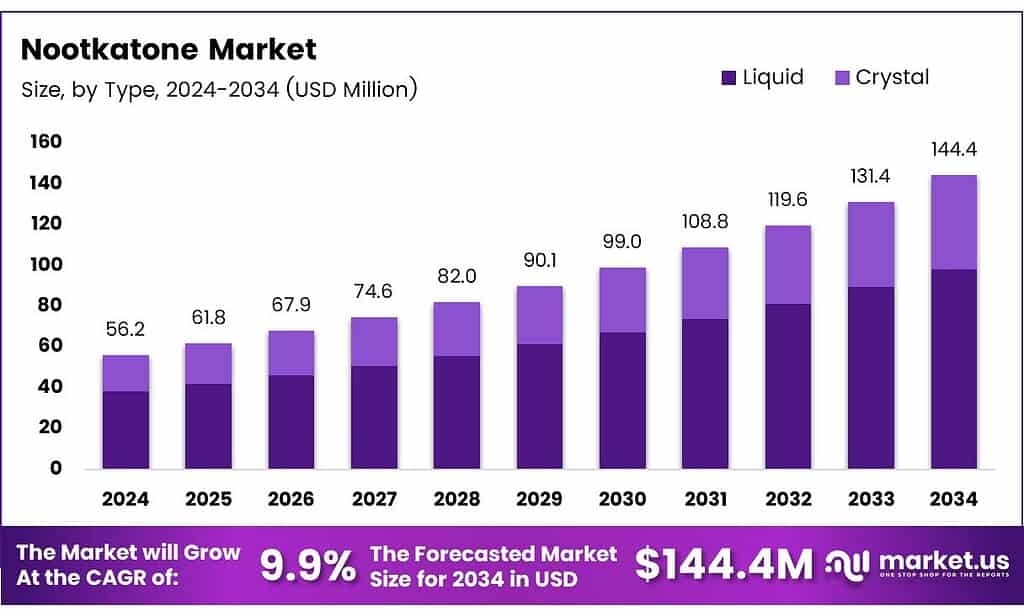
The Global Nootkatone Market size is expected to be worth around USD 144.4 million by 2034 from USD 56.2 million in 2024, growing at a CAGR of 9.9% during the forecast period 2025 to 2034.
Nootkatone is a natural sesquiterpene ketone compound found primarily in grapefruit peel and Alaska yellow cedar. It delivers a distinctive citrus aroma widely valued across the flavor and fragrance industries. Additionally, its bioactive properties make it useful in personal care, pest control, and pharmaceutical applications.
The compound exists in both natural and synthetic forms. Natural nootkatone derives from citrus extraction and fermentation technologies. Synthetic routes offer consistent purity and scalability. Consequently, manufacturers increasingly explore biosynthetic production methods to reduce dependence on limited citrus crop yields.
- Givaudan reported group sales of CHF 7,472 million, reflecting a 5.1% like-for-like increase driven by broad-based demand across fragrance and taste applications. This growth highlights strong commercial momentum for citrus aroma molecules, including nootkatone-containing formulations, across global markets.
Market demand accelerates across multiple application sectors. Flavor and fragrance formulators use nootkatone to create premium citrus profiles. Personal care brands incorporate it for its aroma and bioactive benefits. Moreover, insect repellent manufacturers adopt it as an EPA-registered, bio-based active ingredient for consumer protection products.
Investment in fermentation-based production drives market expansion significantly. Precision fermentation platforms allow commercial-scale nootkatone output from sustainable feedstocks. In 2025, Lallemand began actively producing and commercializing Natural Nootkatone using precision fermentation technology acquired from Evolva, delivering a high-purity, year-round supply independent of citrus harvests.
Key Takeaways
- The Global Nootkatone Market is valued at USD 56.2 million in 2024 and is projected to reach USD 144.4 million by 2034, at a CAGR of 9.9% during the forecast period 2025 to 2034.
- By Form, the Liquid segment dominates with a 69.5% market share in 2025.
- By Purity Grade, the 50-60 purity segment holds the largest share at 43.6% in 2025.
- By Source, the Natural segment leads with a 73.4% share in 2025.
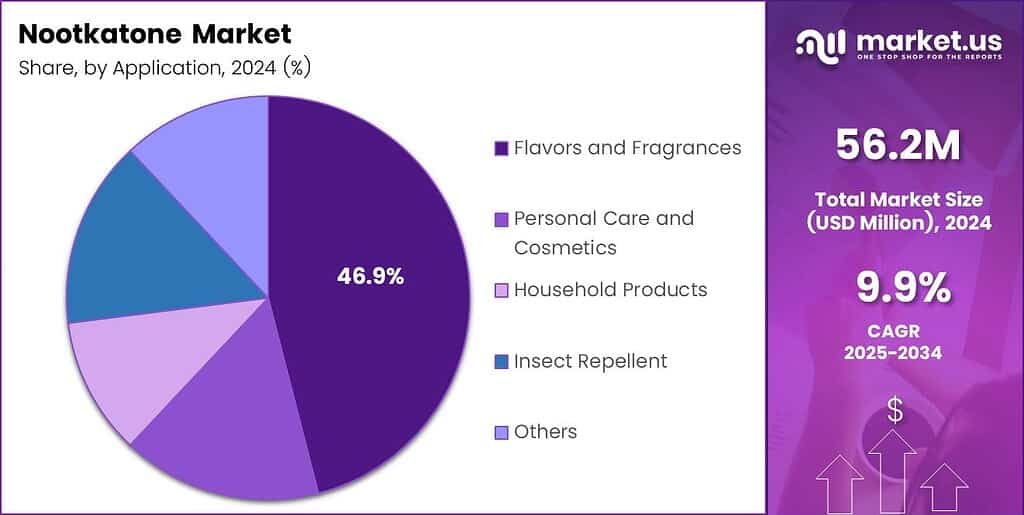
- By Application, Flavors and Fragrances dominate with a 46.9% market share in 2025.
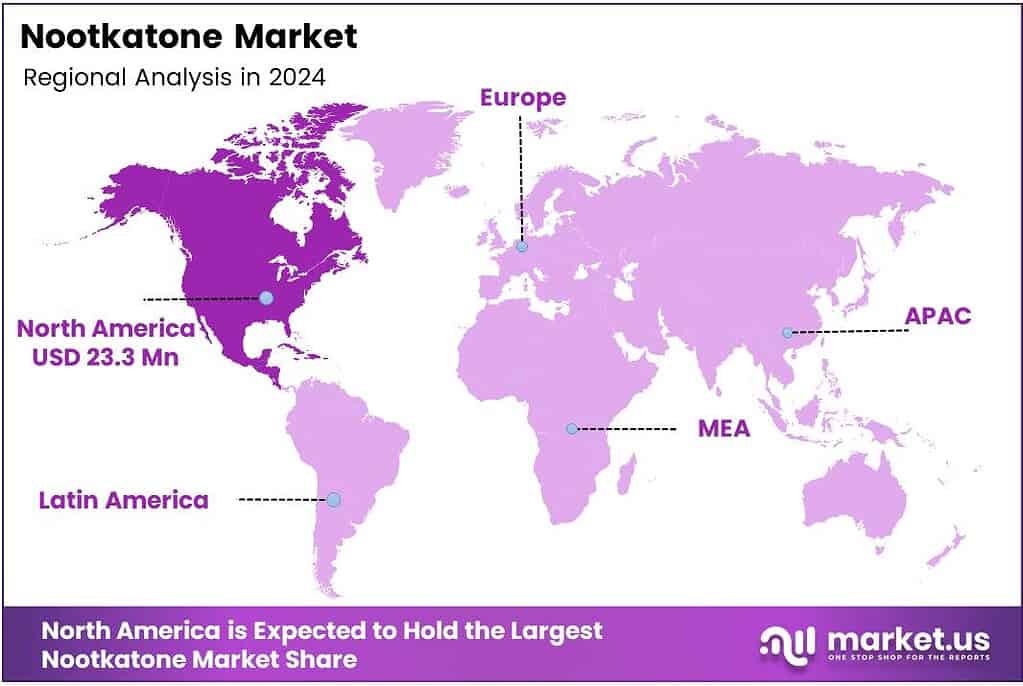
- North America holds the dominant regional position with a 41.5% share, valued at USD 23.3 million.
By Form Analysis
Liquid dominates with 69.5% due to its superior solubility, ease of blending, and broad compatibility across fragrance and flavor formulation systems.
In 2025, Liquid nootkatone held a dominant market position in the By Form segment of the Nootkatone Market, with a 69.5% share. Liquid forms offer superior ease of handling and blending across industrial formulation workflows. Moreover, they integrate seamlessly into perfumes, food flavors, and personal care formulations, making them the preferred choice for most commercial applications.
Crystal nootkatone serves niche applications requiring high-concentration, solid-state ingredient formats. Manufacturers use crystal forms in specific pharmaceutical and specialty fragrance applications where precise dosing matters. However, crystal forms require additional processing steps during formulation, limiting their adoption compared to liquid alternatives in mainstream production environments.
By Purity Grade Analysis
The 50-60 purity grade dominates with 43.6% due to its cost-effectiveness and suitability for standard flavor, fragrance, and consumer product applications.
In 2025, the 50-60 purity grade held a dominant market position in the By Purity Grade segment of the Nootkatone Market, with a 43.6% share. This grade balances performance and production cost effectively. Consequently, it remains the most commercially viable option for large-volume flavor and fragrance manufacturers seeking reliable ingredient consistency at accessible price points.
The 60-70 purity grade serves applications requiring moderately elevated concentration levels. Personal care brands and premium fragrance formulators use this grade for enhanced sensory performance. Additionally, its pricing positions it competitively between entry-level and high-purity tiers, attracting buyers seeking quality upgrades without significant cost increases in formulation budgets.
The 70-80 purity grade targets more demanding formulation requirements in specialty fragrance and bioactive ingredient applications. Formulators deploying nootkatone for functional benefits such as insect repellency prefer this range. Therefore, demand from EPA-registered repellent product manufacturers contributes meaningfully to this segment’s commercial growth during the forecast period.
The 80-90 purity grade addresses advanced pharmaceutical and high-end cosmetic applications. Research-driven formulations requiring tightly controlled ingredient profiles use this specification. Moreover, growing interest in nootkatone’s antimicrobial properties drives incremental demand from laboratory and clinical product development pipelines targeting health-oriented consumers.
The Greater than 90 purity grade serves the most precise analytical, pharmaceutical, and high-value specialty fragrance applications. Manufacturers producing reference standards and high-potency bioactive ingredients rely on ultra-pure nootkatone. However, this grade commands a premium price and remains a smaller segment by volume within the overall purity grade market structure.
By Source Analysis
Natural nootkatone dominates with 73.4%, driven by strong consumer preference for plant-derived, clean-label ingredients across fragrance, flavor, and personal care markets.
In 2025, Natural nootkatone held a dominant market position in the By Source segment of the Nootkatone Market, with a 73.4% share. Consumer demand for traceable, nature-identical aroma ingredients drives this dominance. Additionally, regulatory frameworks across North America and Europe increasingly favor bio-based over petrochemical-derived fragrance and flavor ingredients in commercial formulations.
Synthetic nootkatone offers manufacturers consistent purity, year-round availability, and reduced reliance on variable citrus crop yields. Chemical synthesis routes provide scalable output for cost-sensitive applications. However, synthetic variants face growing scrutiny from clean-label-focused brands and ingredient transparency advocates, which moderates their adoption in premium consumer product formulations seeking nature-derived positioning.
By Application Analysis
Flavors and Fragrances dominate with 46.9% due to nootkatone’s distinctive grapefruit aroma profile, which is highly valued in premium perfumery and food flavor creation.
In 2025, Flavors and Fragrances held a dominant market position in the By Application segment of the Nootkatone Market, with a 46.9% share. The compound’s unique citrus character drives widespread adoption among global flavor houses. Moreover, demand for natural grapefruit notes in premium beverages and fine fragrances sustains consistent commercial volume across both categories.
Personal Care and Cosmetics represents a fast-growing application segment for nootkatone. Skincare and haircare brands incorporate it for its pleasant aroma and reported bioactive benefits. Additionally, the clean-beauty movement accelerates adoption as formulators replace synthetic fragrance ingredients with naturally sourced citrus aroma compounds in premium product lines targeting health-conscious consumers.
Household Products manufacturers use nootkatone to deliver fresh citrus scent profiles in surface cleaners, air fresheners, and laundry formulations. Consumer preference for natural-smelling home care products supports this segment’s expansion. Consequently, ingredient suppliers increasingly offer nootkatone formulations optimized for household product pH ranges and chemical compatibility requirements in commercial cleaning systems.
Insect Repellent applications gained significant commercial traction following EPA registration of nootkatone as a bio-based active ingredient. Brands now develop nootkatone-containing repellents targeting mosquitoes and ticks. Therefore, demand from public health-oriented consumer product companies and government procurement programs contributes to this segment’s above-average growth rate through the forecast period.
The Others category encompasses pharmaceutical research applications and agricultural formulations using nootkatone’s bioactive properties. Academic and industrial researchers investigate its antimicrobial and anti-inflammatory activity. Moreover, nootkatone’s potential in eco-friendly crop protection systems creates an emerging demand stream beyond traditional flavor, fragrance, and personal care applications in the global market.
Key Market Segments
By Form
- Liquid
- Crystal
By Purity Grade
- 50-60
- 60-70
- 70-80
- 80-90
- Greater than 90
By Source
- Natural
- Synthetic
By Application
- Flavors and Fragrances
- Personal Care and Cosmetics
- Household Products
- Insect Repellent
- Others
Emerging Trends
Synthetic Biology and Clean-Label Innovation Reshape the Nootkatone Market
Clean-label beverage and food brands increasingly highlight nootkatone’s distinctive grapefruit character as a premium differentiator. Consumers recognize natural citrus notes as markers of ingredient quality and transparency. Consequently, food and beverage manufacturers reformulate existing products using bio-based nootkatone to meet ingredient-sourcing expectations from health-conscious buyers across retail channels.
- Synthetic biology platforms accelerate nootkatone production at a commercial scale with consistent purity. Fermentation-derived nootkatone now delivers year-round availability without citrus harvest dependence. The company reported sales of €3,776 million, reflecting the continued supply of aroma ingredients aligned with citrus and nootkatone-type profiles amid evolving demand patterns globally.
Direct-to-consumer e-commerce platforms expand global accessibility for nootkatone-containing ingredients and finished products. Smaller specialty fragrance and personal care brands now source nootkatone through digital procurement channels efficiently. Additionally, the industry increasingly focuses on traceable, carbon-neutral sourcing protocols, positioning certified nootkatone as a competitive advantage for premium product positioning strategies worldwide.
Drivers
Natural Citrus Aroma Demand and EPA-Approved Bio-Based Repellency Drive Nootkatone Market Growth
Proven mosquito and tick repellency positions nootkatone as a non-toxic active ingredient in personal protection products. EPA registration validates its safety and efficacy for consumer-ready repellent formulations. Therefore, public health agencies, outdoor product brands, and household goods manufacturers actively incorporate nootkatone into bio-based pest control solutions targeting safety-conscious consumer segments across North America and Europe.
- Consumer preference for natural citrus-derived aromas in premium fragrance and flavor formulations drives nootkatone adoption at scale. Brands reformulate product lines to replace synthetic grapefruit notes with bio-based alternatives. China produced 5.4 million tons of fresh grapefruit in MY2025/26, expanding citrus feedstock availability that underpins natural extraction routes for nootkatone globally.
Expanding pharmaceutical interest in nootkatone’s antimicrobial and anti-inflammatory bioactivity creates additional demand beyond traditional aroma applications. Research institutions and specialty ingredient suppliers investigate its functional health benefits. Moreover, regulatory approvals for bio-based ingredients across North America and Europe further accelerate integration into EPA-compliant pest control and health-oriented personal care product formulations globally.
Restraints
High Production Costs and Raw Material Supply Constraints Limit Nootkatone Market Expansion
Elevated production expenses linked to limited natural citrus oil extraction yields create significant cost barriers for nootkatone manufacturers. Grapefruit peel contains relatively small concentrations of nootkatone, requiring large raw material volumes per unit output. Consequently, natural extraction remains expensive, restricting commercial scalability and limiting price competitiveness against synthetic fragrance alternatives in cost-sensitive market segments.
- Persistent raw material supply constraints from grapefruit and related citrus crop dependencies expose the market to agricultural risk. Climate variability, disease outbreaks, and shifting farming economics affect citrus harvest volumes and quality. According to the USDA, U.S. fresh grapefruit production stood at only 113,000 tons in MY2025/26, illustrating the limited domestic citrus supply base available for nootkatone extraction pathways.
Supply chain unpredictability makes long-term ingredient procurement planning difficult for buyers. Flavor houses and personal care manufacturers that depend on natural nootkatone face potential cost volatility during periods of citrus crop shortfalls. However, advances in fermentation-based production offer a partial mitigation pathway, gradually reducing market exposure to citrus agricultural supply disruptions over the forecast period through 2034.
Growth Factors
Fermentation Breakthroughs and Asia-Pacific Urbanization Accelerate Nootkatone Market Expansion
Rapid urbanization and rising middle-class populations fuel nootkatone penetration across Asia-Pacific personal care markets. Urban consumers in China, India, and Southeast Asia drive demand for premium fragrance and clean-label cosmetic products. Consequently, ingredient suppliers and multinational personal care brands accelerate the distribution of nootkatone-infused formulations targeting this fast-growing, increasingly affluent consumer base throughout the region.
- Breakthroughs in yeast-based fermentation technology enable low-cost, high-volume commercial output of nootkatone. Fermentation platforms decouple production from seasonal citrus harvests, ensuring supply consistency year-round. South Africa exported 255,000 tons of fresh grapefruit in MY2025/26, positioning it as a major citrus supplier that also supports the extraction-based segment of nootkatone supply chains.
The emergence of nootkatone-infused organic skincare and haircare lines targeting clean-label consumers creates new product categories and revenue streams. Brands integrate nootkatone into certified natural formulations to capture premium market positioning. Moreover, integration into sustainable agricultural formulations for eco-friendly crop protection opens additional commercial channels, broadening nootkatone’s revenue base beyond fragrance and personal care markets.
Regional Analysis
North America Dominates the Nootkatone Market with a Market Share of 41.5%, Valued at USD 23.3 Million
North America leads the global nootkatone market, capturing a 41.5% share valued at USD 23.3 million. The region benefits from EPA registration of nootkatone as a bio-based insect repellent active ingredient, which unlocked commercial demand from personal protection product manufacturers. Moreover, strong consumer preference for natural flavor and fragrance ingredients sustains demand across food, beverage, and premium personal care sectors.
Europe represents a significant and innovation-driven market for nootkatone applications across multiple industries. Stringent regulatory frameworks actively favor bio-based and sustainably sourced fragrance ingredients. Consequently, European flavor houses and cosmetic brands prioritize natural nootkatone procurement as part of clean-formulation strategies.
Asia Pacific emerges as the fastest-growing regional market for nootkatone and related citrus aroma ingredients. Rising urbanization, expanding middle-class populations, and surging demand for premium personal care products accelerate ingredient adoption. China, India, Japan, and South Korea serve as key demand centers.
The Middle East and Africa market for nootkatone grows on the back of expanding personal care consumption and rising demand for premium fragrance ingredients. Gulf Cooperation Council markets drive luxury fragrance spending, while African citrus production capacity supports upstream ingredient supply chains. South Africa’s significant grapefruit export volumes further position the continent as a relevant player in nootkatone feedstock availability and trade flows.
Key Regions and Countries
North America
- US
- Canada
Europe
- Germany
- France
- The UK
- Spain
- Italy
- Rest of Europe
Asia Pacific
- China
- Japan
- South Korea
- India
- Australia
- Rest of APAC
Latin America
- Brazil
- Mexico
- Rest of Latin America
Middle East & Africa
- GCC
- South Africa
- Rest of MEA
Key Players Analysis
Evolva Holding SA pioneered the commercial development of fermentation-based natural nootkatone, establishing a biosynthetic production pathway from yeast fermentation platforms. The company built proprietary technology for producing nootkatone and valencene at a commercial scale. In 2025, Evolva transferred its nootkatone business, including biotech production technology and the NootkaShield insect repellency program, to Danstar Ferment AG, marking a pivotal ownership transition in the market.
Isobionics BV operates as a specialist biotechnology company focused on natural aroma ingredient production through fermentation technology. The company produces natural nootkatone and valencene using bio-based manufacturing processes that deliver consistent purity and supply reliability. Additionally, Isobionics’ fermentation expertise positions it as a key supplier for flavor and fragrance houses seeking sustainably produced, natural-origin citrus aroma materials with certified traceability and clean-label credentials.
IFF (International Flavors and Fragrances) holds a broad aroma ingredient and fragrance portfolio spanning natural and synthetic origin materials. The company leverages its global application development capabilities to formulate nootkatone into premium fragrance and flavor systems across multiple consumer product categories. IFF’s research infrastructure supports innovation in bio-based ingredient delivery, positioning it to serve growing demand for clean-label citrus aroma solutions globally.
Givaudan operates as one of the world’s largest flavor and fragrance ingredient companies with significant commercial presence in citrus aroma chemistry. Its Fragrance & Beauty segment reported sales of CHF 3,830 million, up 7.9% like-for-like, with Fine Fragrance growth driven by citrus notes and nootkatone-type ingredients. Givaudan’s global scale provides substantial commercial reach for nootkatone-containing formulations.
Top Key Players in the Market
- Evolva Holding SA
- Isobionics BV
- IFF
- Givaudan
- ChemicalBull
- Wuhan Hesheng Technology Co., LTD.
- Lallemand Inc.
- Vizag Chemical
Recent Developments
- In 2025, Evolva AG, which developed and commercialized precision fermentation-based natural nootkatone and valencene, was acquired by Danstar Ferment AG. This transferred the biotech production technology, R&D capabilities, and related aroma ingredients business (including nootkatone for flavors/fragrances and NootkaShield for insect repellency applications).
- In 2025, Lallemand actively produces and commercializes Natural Nootkatone (and valencene variants) using precision fermentation technology acquired from Evolva. It is described as a new generation ingredient made sustainably from sugar via fermentation, delivering a high-purity, consistent, year-round supply independent of citrus harvests.
Report Scope
Report Features Description Market Value (2024) USD 56.2 Million Forecast Revenue (2034) USD 144.4 Million CAGR (2025-2034) 9.9% Base Year for Estimation 2024 Historic Period 2020-2023 Forecast Period 2025-2034 Report Coverage Revenue Forecast, Market Dynamics, Competitive Landscape, Recent Developments Segments Covered By Form (Liquid, Crystal), By Purity Grade (50-60, 60-70, 70-80, 80-90, Greater than 90), By Source (Natural, Synthetic), By Application (Flavors and Fragrances, Personal Care and Cosmetics, Household Products, Insect Repellent, Others) Regional Analysis North America (US and Canada), Europe (Germany, France, The UK, Spain, Italy, and Rest of Europe), Asia Pacific (China, Japan, South Korea, India, Australia, and Rest of APAC), Latin America (Brazil, Mexico, and Rest of Latin America), Middle East & Africa (GCC, South Africa, and Rest of MEA) Competitive Landscape Evolva Holding SA, Isobionics BV, IFF, Givaudan, ChemicalBull, Wuhan Hesheng Technology Co., LTD., Lallemand Inc., Vizag Chemical Customization Scope Customization for segments, region/country-level will be provided. Moreover, additional customization can be done based on the requirements. Purchase Options We have three licenses to opt for: Single User License, Multi-User License (Up to 5 Users), Corporate Use License (Unlimited Users and Printable PDF) 
-
-
- Evolva Holding SA
- Isobionics BV
- IFF
- Givaudan
- ChemicalBull
- Wuhan Hesheng Technology Co., LTD.
- Lallemand Inc.
- Vizag Chemical
Our Clients

- 178218
- February 2026






