


Report Overview
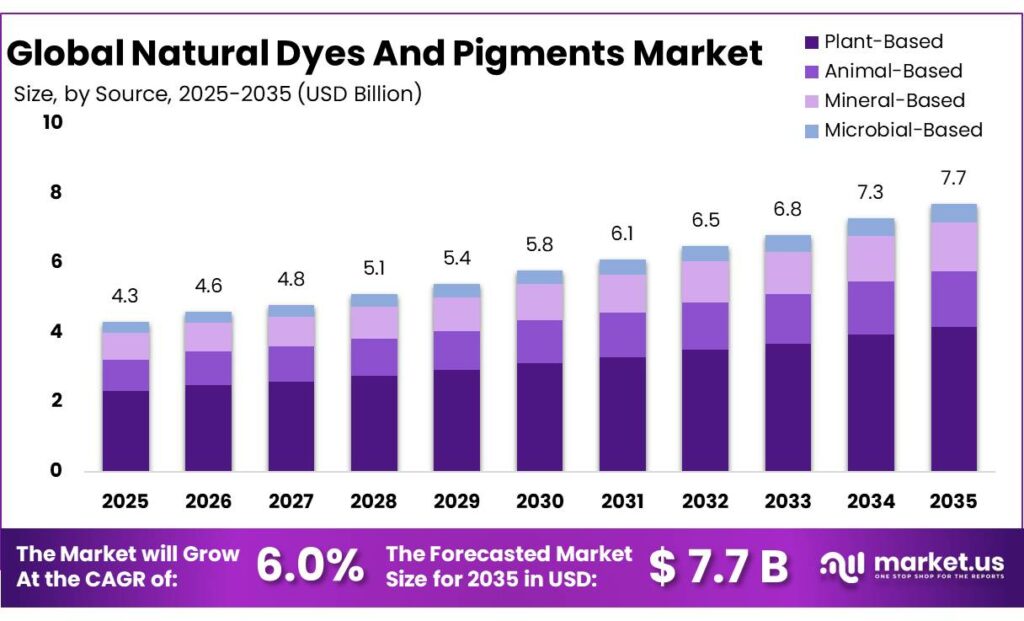
The Global Natural Dyes And Pigments Market size is expected to be worth around USD 7.7 Billion by 2035, from USD 4.3 Billion in 2025, growing at a CAGR of 6.0% during the forecast period from 2026 to 2035. In 2025, Asia-Pacific held a dominant market position, capturing more than a 42.6% share, holding USD 1.8 Billion revenue.
Natural dyes and pigments are moving from niche positioning toward strategic relevance across food, textiles, packaging, cosmetics, and specialty materials, as buyers increasingly prioritize renewable inputs, traceability, and lower-toxicity chemistries. The category’s value proposition rests on plant-, mineral-, microbial-, and bio-based color systems that can support cleaner-label foods and more sustainable industrial coloration.
In the food chain, the shift is being reinforced by regulation and by scale economics: U.S. consumers spent $2.58 trillion on food in 2024, while domestically produced food spending reached $2.17 trillion, underscoring the size of the end-markets now reassessing additive and ingredient profiles. At the same time, USDA notes that U.S. organic food sales reached $65.4 billion in 2024, with produce representing 33% of organic food sales, indicating strong demand for naturally positioned ingredients and formulations.
The current industrial scenario is being shaped by regulatory tightening and by reformulation pressure in mainstream food manufacturing. In the United States, HHS and FDA announced in April 2025 a transition agenda that includes revoking authorization for 2 synthetic food colorings and working with industry to eliminate 6 remaining petroleum-based synthetic dyes from the food supply by the end of 2026.
That policy direction materially improves the commercial outlook for natural pigments, especially in beverage, confectionery, dairy, bakery, and snack applications. FDA reinforced the shift again in May 2025 by approving 3 food colors from natural sources, expanding the palette available to manufacturers. In Europe, food additives continue to be governed under Regulation (EC) No 1333/2008, with authorization tied to safety assessment, technological need, and non-misleading use, which supports a more disciplined and premiumized market structure for compliant natural color systems.
Demand drivers are becoming more quantifiable. On the food side, the USDA reports that U.S. retail sales of organic fresh fruits and vegetables were about $21.5 billion in 2021, and produce accounted for 33% of U.S. organic food sales in 2024; USDA also notes that inflation-adjusted organic retail sales posted a compounded annual growth rate of more than 7% from 2012 to 2023. Such data matters because natural colors and pigments are often adopted alongside organic, clean-label, and minimally processed product strategies.
Government backing is also material: USDA’s Organic Transition Initiative is a $300 million multi-agency effort, while organic certification requires land to be managed without prohibited inputs for 36 months, reinforcing long-term demand for naturally aligned agricultural value chains.
Archroma states that it operates in over 90 countries, with over 4,000 employees, presence in 42 countries, and more than 30 production sites. In a 2025 development, the company said its High IQ® Lasting Color program, powered by selected AVITERA® SE and NOVACRON® dyes, can help mills reduce processing water and energy use by up to 50%, underlining how performance claims are now tied directly to resource savings.
Key Takeaways
- Natural Dyes And Pigments Market size is expected to be worth around USD 7.7 Billion by 2035, from USD 4.3 Billion in 2025, growing at a CAGR of 6.0%.
- Plant-Based held a dominant market position, capturing more than a 54.8% share.
- Natural Pigments held a dominant market position, capturing more than a 65.2% share.
- Red held a dominant market position, capturing more than a 26.9% share.
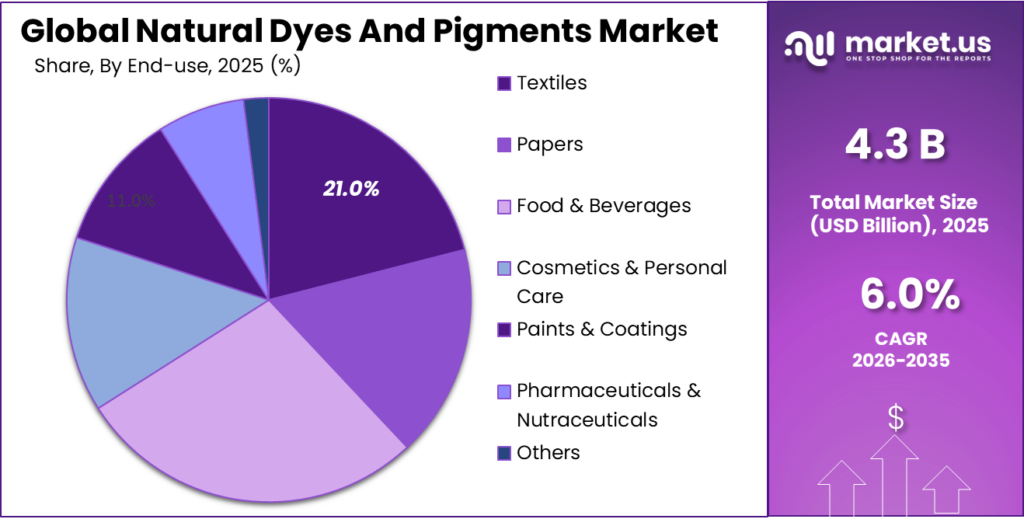
- Food & Beverages held a dominant market position, capturing more than a 28.4% share.
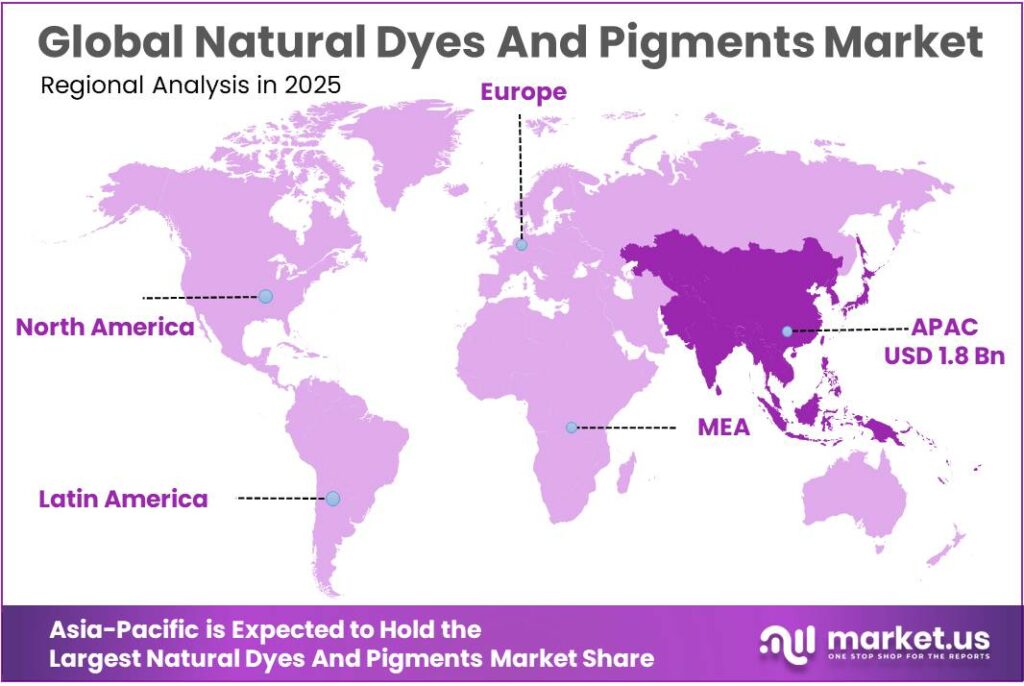
- Asia-Pacific represents the dominant regional segment in the global natural dyes and pigments market, accounting for approximately 42.6% share USD 1.8 billion.
By Source Analysis
Plant-Based dominates with 54.8% driven by rising demand for eco-friendly color solutions
In 2025, Plant-Based held a dominant market position, capturing more than a 54.8% share. This strong lead is mainly linked to growing consumer awareness around sustainability and the shift away from synthetic chemicals. Plant-derived dyes, sourced from materials like leaves, roots, bark, and flowers, have gained popularity across textiles, food coloring, and cosmetics due to their biodegradable nature and lower environmental impact. Many small and large manufacturers have also started investing in plant-based extraction processes to meet changing regulations and consumer preferences.
By Product Analysis
Natural Pigments dominates with 65.2% as industries lean toward safer and non-toxic coloring options
In 2025, Natural Pigments held a dominant market position, capturing more than a 65.2% share. This leading position is largely driven by increasing use in food, cosmetics, and pharmaceuticals where safety and natural origin matter the most. These pigments, derived from minerals and organic sources, are widely preferred because they offer stable coloring while meeting strict health and environmental standards. Many manufacturers have shifted toward natural pigments to replace synthetic additives, especially in products labeled as clean or organic.
By Color Analysis
Red dominates with 26.9% as it remains the most widely used natural color across industries
In 2025, Red held a dominant market position, capturing more than a 26.9% share. This strong presence is mainly due to its wide application in food products, textiles, and cosmetics where bright and appealing shades are in high demand. Natural red dyes, often derived from sources like fruits, roots, and insects, are preferred for their rich tone and better acceptance among consumers looking for natural ingredients. The food industry, in particular, continues to rely heavily on red pigments for products like beverages, confectionery, and processed foods.
By End Use Analysis
Food & Beverages dominates with 28.4% as clean-label trends reshape ingredient choices
In 2025, Food & Beverages held a dominant market position, capturing more than a 28.4% share. This lead comes from the growing demand for natural ingredients in everyday food products, where consumers are paying closer attention to labels and avoiding artificial additives. Natural dyes and pigments are widely used in beverages, bakery items, dairy products, and confectionery to enhance visual appeal while maintaining a clean and safe ingredient profile. Manufacturers are increasingly turning to plant-based and mineral-derived colors to meet both regulatory standards and consumer expectations.
Key Market Segments
By Source
- Plant-Based
- Leaves
- Roots
- Woods and Barks
- Flowers
- Fruits/Seeds
- Animal-Based
- Insects
- Mollusks
- Other Animals
- Mineral-Based
- Ochres
- Clays
- Other Minerals
- Microbial-Based
- Fungi
- Bacteria
- Yeasts
- Algae
By Product
- Natural Dyes
- Natural Pigments
By Color
- Red
- Blue
- Yellow
- Orange
- Green
- Others
By End Use
- Textiles
- Papers
- Food & Beverages
- Cosmetics & Personal Care
- Paints & Coatings
- Pharmaceuticals & Nutraceuticals
- Others
Emerging Trends
Shift toward plant-based and clean-label color innovation shaping market direction
One of the most visible latest trends in the Natural Dyes and Pigments market is the strong move toward plant-based and clean-label color solutions. Consumers are now reading product labels more carefully and avoiding artificial ingredients, which is pushing food companies to rethink their formulations.
Food brands are not just replacing synthetic dyes—they are actively promoting natural ingredients as part of their brand identity. Retail chains and regulators are also playing a role, as many are encouraging or even requiring “no artificial colors” labeling in packaged foods. This has made natural pigments a standard choice rather than a premium option. In 2025 and continuing into 2026, plant-based sources like fruits, vegetables, and algae are leading innovation, as they offer both color and perceived health benefits.
Rising demand for functional and visually appealing natural colors
Another key trend is the growing interest in natural colors that do more than just add appearance—they also provide functional benefits. Modern consumers are not only looking for natural ingredients but also expecting added value, such as antioxidants or nutritional support. For example, pigments like carotenoids naturally provide red, yellow, and orange shades while also acting as antioxidants that help protect food quality and support health
At the same time, color trends themselves are evolving. In 2025–2026, food products are increasingly using warm and comforting shades like yellows, earthy greens, and deep purples to create a sense of wellness and natural appeal. This reflects a shift where color is not just about brightness but also about emotional connection and product storytelling. Governments and food safety bodies are also supporting this transition by approving new natural additives and encouraging safer alternatives in food production
Drivers
Rising health concerns and clean-label demand pushing natural dyes adoption
One of the strongest driving factors for the Natural Dyes and Pigments market is the growing shift toward safer, clean-label food ingredients. Consumers today are far more aware of what goes into their food, and this is clearly influencing how companies formulate products. According to the World Health Organization, there are several thousand food additives used globally, and each must meet safety standards before approval.
This large number has raised concerns among consumers, especially around synthetic additives. Studies and food safety discussions have linked certain artificial colorants to allergic reactions and behavioral effects, which has increased pressure on manufacturers to switch to natural alternatives.
Government regulations and global standards encouraging natural alternatives
Another key factor driving this market is the growing role of government regulations and international food standards. Organizations like the Food and Agriculture Organization and WHO jointly manage global guidelines through systems like Codex Alimentarius, which influences how food additives are used worldwide. These frameworks ensure that only safe additives are permitted, whether natural or synthetic, and they push industries toward safer options over time
In recent years, stricter rules and re-evaluations of food colors have become more common. For example, regulatory bodies continue to reassess older additives and update safety limits, which has led to increased interest in natural pigments that are perceived as lower risk. The food industry is responding quickly—natural colorants derived from sources like carotenoids and anthocyanins are now widely used because they not only provide color but also offer added health-related benefits
Restraints
High production complexity and inconsistency in natural sources limiting large-scale use
One of the key restraining factors for the Natural Dyes and Pigments market is the difficulty in maintaining consistency and standardization. Unlike synthetic colors, natural dyes are extracted from plants, minerals, or biological sources, and their composition can vary widely depending on climate, soil conditions, and extraction methods. Regulatory reviews have pointed out that natural color extracts often lack clear chemical characterization and uniform specifications, which makes it harder to ensure consistent quality across batches.
This becomes a major issue for industries like food and beverages, where even slight variations in color can affect product appeal and brand consistency. Manufacturers are required to meet strict standards before approval, and inconsistencies increase both testing time and production cost. By 2025 and 2026, many companies are still investing heavily in improving extraction technologies and stabilizing formulations, but the gap between natural and synthetic consistency remains noticeable. This challenge slows down adoption, especially for large-scale industrial production where uniformity is critical.
Strict regulations and high approval burden increasing cost and time
Another major restraint comes from the strict regulatory framework around food additives and colorants. In the European Union alone, more than 300 substances are authorized as food additives, each requiring detailed safety evaluation and continuous monitoring. Even natural dyes must go through the same rigorous approval process, including toxicity data, exposure limits, and labeling requirements.
Regulatory bodies such as the European Commission have also mandated re-evaluation of additives approved before 2009, meaning companies must regularly provide updated scientific data or risk losing approval. This ongoing requirement increases compliance costs and creates uncertainty for manufacturers using natural pigments. For smaller producers, especially, the cost of meeting these standards can be a barrier to entry. Moving into 2026, while regulations ensure safety, they also slow innovation and market expansion, as companies must balance between meeting strict guidelines and maintaining cost efficiency.
Opportunity
Expanding clean-label food industry creating strong growth space
One major growth opportunity for the Natural Dyes and Pigments market is the fast expansion of the clean-label food sector. Consumers are actively looking for products with simple and natural ingredients, and this shift is clearly opening new doors for natural colorants.
Within this space, natural colors already hold a visible position, contributing around 18% share in clean-label formulations, especially in beverages, dairy, and confectionery products. Governments and food safety authorities are also encouraging transparency in labeling, which indirectly supports the use of plant-based pigments. As a result, many global food brands are reformulating their products to remove synthetic dyes and adopt natural alternatives.
Technological advancements improving scalability and new applications
Another important opportunity comes from ongoing technological improvements in how natural dyes are produced and used. Earlier, natural pigments faced issues like low stability and limited shelf life, but new methods such as fermentation and encapsulation are helping solve these challenges. Industry data shows that the natural food colors market itself reached around USD 2.0 billion in 2025 and is expected to cross USD 2.2 billion in 2026, showing steady adoption across industries
Research supported by food and agriculture organizations highlights that new extraction and processing techniques are making it easier to produce consistent and high-quality natural pigments from plant and microbial sources. These innovations are especially important for large-scale industries like beverages and packaged foods, where consistency and stability are critical.
Regional Insights
Asia-Pacific Natural Dyes and Pigments Market
Asia-Pacific represents the dominant regional segment in the global natural dyes and pigments market, accounting for approximately 42.6% share USD 1.8 billion, driven by its strong textile heritage, large-scale manufacturing base, and increasing transition toward sustainable materials.
The region benefits from a well-established dyes and pigments ecosystem, with the broader dyes and pigments market exceeding USD 25.8 billion in 2024 and projected to reach USD 46.9 billion by 2035. Additionally, Asia-Pacific holds the largest share in the global dyes and pigments industry, contributing over 60% of total revenue in 2025, supported by high production concentration in China and India.
Key Regions and Countries Insights
- North America
- US
- Canada
- Europe
- Germany
- France
- The UK
- Spain
- Italy
- Rest of Europe
- Asia Pacific
- China
- Japan
- South Korea
- India
- Australia
- Rest of APAC
- Latin America
- Brazil
- Mexico
- Rest of Latin America
- Middle East & Africa
- GCC
- South Africa
- Rest of MEA
Key Players Analysis
AMA Herbal has built a solid position in the natural dyes market with operations starting in 1996, focusing on plant-based dye extraction and herbal products. The company is ISO 9001:2015 certified and exports to multiple global markets, showing strong international reach. Its product portfolio includes 10+ branded natural dye ranges such as Bio Indigo and Rubia, supporting textile applications. The firm also contributes to rural employment, where 1 kg of indigo production generates about 2 days of wages for farmers, highlighting its sustainable supply chain approach.
GNT Group is widely known for its plant-based color solutions used in food and beverages, especially under its EXBERRY brand. The company operates in 100+ countries and uses fruits, vegetables, and plants as raw materials for color production. It follows a vertically integrated model, controlling sourcing, processing, and final product delivery. GNT’s focus on clean-label ingredients aligns strongly with food industry demand, where natural colors are replacing synthetics.
Archroma is a large specialty chemicals company with a strong footprint in dyes and pigments, operating in 90+ countries with multiple production sites worldwide. The company focuses heavily on sustainability, offering advanced eco-friendly dyeing solutions for textiles, packaging, and coatings. It invests significantly in R&D to reduce water and energy usage in dyeing processes.
Top Key Players Outlook
- AMA Herbal
- Archroma
- GNT Group
- Stony Creek Colors
- Döhler GmbH
- Sensient Technologies
- ADM
- Givaudan
- Kalsec Inc.
- Roha Dyechem
Recent Industry Developments
AMA Herbal’s Bio Indigo® and other plant-based dyes are GOTS-certified and widely used in sustainable textile production. A notable impact point is its rural engagement model, where producing 1 kg of Bio Indigo generates about 2 days of farmer wages, linking business growth with social benefits.
Archroma reported estimated revenues of around USD 1.3–1.7 billion in recent years, highlighting its strong presence across textiles, packaging, and coatings.
Report Scope
| Report Features | Description |
|---|---|
| Market Value (2025) | USD 4.3 Bn |
| Forecast Revenue (2035) | USD 7.7 Bn |
| CAGR (2026-2035) | 6.0% |
| Base Year for Estimation | 2025 |
| Historic Period | 2020-2024 |
| Forecast Period | 2026-2035 |
| Report Coverage | Revenue Forecast, Market Dynamics, Competitive Landscape, Recent Developments |
| Segments Covered | By Source (Plant-Based, Animal-Based, Mineral-Based, Microbial-Based), By Product (Natural Dyes, Natural Pigments), By Color (Red, Blue, Yellow, Orange, Green, Others), By End Use (Textiles, Papers, Food And Beverages, Cosmetics And Personal Care, Paints And Coatings, Pharmaceuticals And Nutraceuticals, Others) |
| Regional Analysis | North America – US, Canada; Europe – Germany, France, The UK, Spain, Italy, Rest of Europe; Asia Pacific – China, Japan, South Korea, India, Australia, Singapore, Rest of APAC; Latin America – Brazil, Mexico, Rest of Latin America; Middle East & Africa – GCC, South Africa, Rest of MEA |
| Competitive Landscape | AMA Herbal, Archroma, GNT Group, Stony Creek Colors, Döhler GmbH, Sensient Technologies, ADM, Givaudan, Kalsec Inc., Roha Dyechem |
| Customization Scope | Customization for segments, region/country-level will be provided. Moreover, additional customization can be done based on the requirements. |
| Purchase Options | We have three licenses to opt for: Single User License, Multi-User License (Up to 5 Users), Corporate Use License (Unlimited User and Printable PDF) |





































